
Didit vs ID R&D: IDLive Face liveness or a hosted KYC API
Didit vs ID R&D: compare documented checks, published pricing, review evidence and migration steps. Didit core KYC costs $0.33.
For ID R&D buyers, choose Didit when you want liveness inside a hosted KYC workflow with document checks, face matching and review evidence. Start with $0.33 core KYC and add screening or monitoring as your policy requires.
- Published core KYC price: $0.33 for ID, passive liveness, face match and device/IP.
- Spain’s financial sandbox report: documented NFC and active-liveness fraud tests, with SEPBLAC participation.
- 3,000+ companies use Didit; document coverage spans 220+ countries and territories and 14,000+ document types. Public customer evidence.
Evidence you can inspect before switching
Liveness certification: Didit passive liveness is iBeta Level 1 and Level 2 certified for presentation attack detection (ISO/IEC 30107-3).
A published customer outcome: in Didit’s AhoraCrypto customer story, the crypto on/off-ramp reports more than 20% savings per user against its previous provider and over 50% less time on manual user reviews. The previous provider is unnamed; these are that customer’s reported results.
Budget the checks you will actually run
The core KYC bundle is $0.33: ID verification $0.15 + passive liveness $0.10 + face match $0.05 + device and IP analysis $0.03. The passive-liveness column prices this module at $0.10 per check in a workflow; the core KYC column prices the complete $0.33 bundle.
| Monthly units | Didit core KYC at $0.33 | Didit: Passive liveness in a workflow | Vendor published terms; different scope |
|---|---|---|---|
| 1,000 | $330 | $100 |
|
| 10,000 | $3,300 | $1,000 | |
| 50,000 | $16,500 | $5,000 |
Illustrative USD list-rate budgets. Core KYC assumes successful checks. Taxes, credits, prepaid discounts and other modules are excluded. Database checks and national digital IDs are outside the $0.33 core KYC bundle. Vendor prices retain their stated currency, billing unit and plan scope.
Integration scope: country database checks use the documented workflow or standalone API integration and require each service’s input fields. Global identity enrichment is standalone API only, outside the workflow builder. Database service scope.
Compare the scope your team needs
Mitek acquired ID R&D in 2021. It now markets IDLive Face alongside MiVIP, as shown on its current product page (checked 25 October 2026). The choice here is hosted KYC with Didit versus integrating the IDLive Face liveness component; it is not a comparison with the whole Mitek catalogue. (public source, checked 25 October 2026).
| Requirement | Didit | ID R&D / Mitek IDLive Face public scope |
|---|---|---|
| Document and biometric checks | Core KYC $0.33; NFC $0.15; passive liveness $0.10 in a workflow or $0.05 through the standalone API; active liveness $0.15. ID verification; liveness. | Passive facial liveness and deepfake detection; IDLive Face is a component rather than the full KYC bundle. (public source, checked 25 October 2026). |
| Evidence and review | Check results, extracted fields, images and warnings in the API response; webhooks, compliance PDF reports and case management support review. Investigator is $0.20 per reviewed item. Investigator. | IDLive Face evaluates a selfie for liveness. Inspect its own response schema when integrating; IDLive Doc and voice outputs are separate products. (public source, checked 25 October 2026). |
| Build and migrate | No-code workflows, Copilot, hosted MCP with OAuth 2.1, SDKs for web/iOS/Android/React Native/Flutter, and historical-verification imports. Workflows; Copilot; MCP; import API. | IDLive Face Server is deployed by the customer using Docker or Kubernetes. (public source, checked 25 October 2026). |
| Additional checks in the same Didit account |
| The IDLive Face server documentation (checked 25 October 2026) defines a facial-liveness API. It does not document government database queries, national-eID connections, device/IP risk, AML, transaction monitoring, KYB or crypto screening as part of that component. These are additional requirements of a hosted onboarding workflow. (public source, checked 25 October 2026). |
National digital IDs are an alternative verification route; a signed scheme result is not a selfie or face-match result. Database and eID checks have separate prices from the $0.33 core KYC bundle. Device/IP analysis here is part of a verification session.
Test the attacks your flow needs to resist
A presentation attack puts a spoof in front of a camera; an injection attack feeds substituted media into the capture path. Didit’s liveness documentation describes anti-spoofing checks. Validate both attack paths in your own capture flow and inspect the returned warnings before setting review rules.
A liveness result your reviewer can act on
Didit’s liveness report returns the method, a 0–100 score, the reference selfie, video for active methods, coded warnings and cross-session face matches. The same report appears in the session decision API and status-update webhook. Your analyst can inspect those signals in the console instead of treating the liveness result as an isolated pass or fail.
Watch: Liveness, Face Match & Face Search (Didit Academy)
- Capture and check. Document verification, liveness and face match create evidence on the same session.
- Check for a returning face. Automatic face search is enabled by default on the liveness step and checks eligible faces from the application’s history and lists. It can be switched off per workflow.
- Apply the risk action. A definitive face-blocklist match declines the verification; a possible blocklist match goes to review. Duplicate-face warnings follow the workflow’s configured action.
These are documented product behaviors, not promised fraud-detection rates. See automatic face search and liveness warning actions. The screenshots below show the liveness score, matched faces and list entries that make those decisions reviewable.
Watch: Duplicate Account Detection (Didit Academy)
Public evidence behind the recommendation
The February 2026 report on Spain’s financial sandbox records the project that tested Didit’s solution. Fifty users enrolled in the solution, and the described fraud tests used cryptographic NFC reading with facial biometrics and active liveness. The report describes printed or substituted-photo ID attacks being blocked by the NFC-based flow. Section 4.2 records SEPBLAC’s participation and positive assessment of the reinforced remote-identification measures.
The report’s findings apply to the described sandbox and laboratory exercises.
Didit’s security certification documentation separately lists SOC 2 Type 1 and Type 2 and ISO/IEC 27001.
Didit serves 3,000+ companies. Document coverage spans 220+ countries and territories and 14,000+ document types. Review public customer stories and the document-verification scope.
Inspect the product evidence
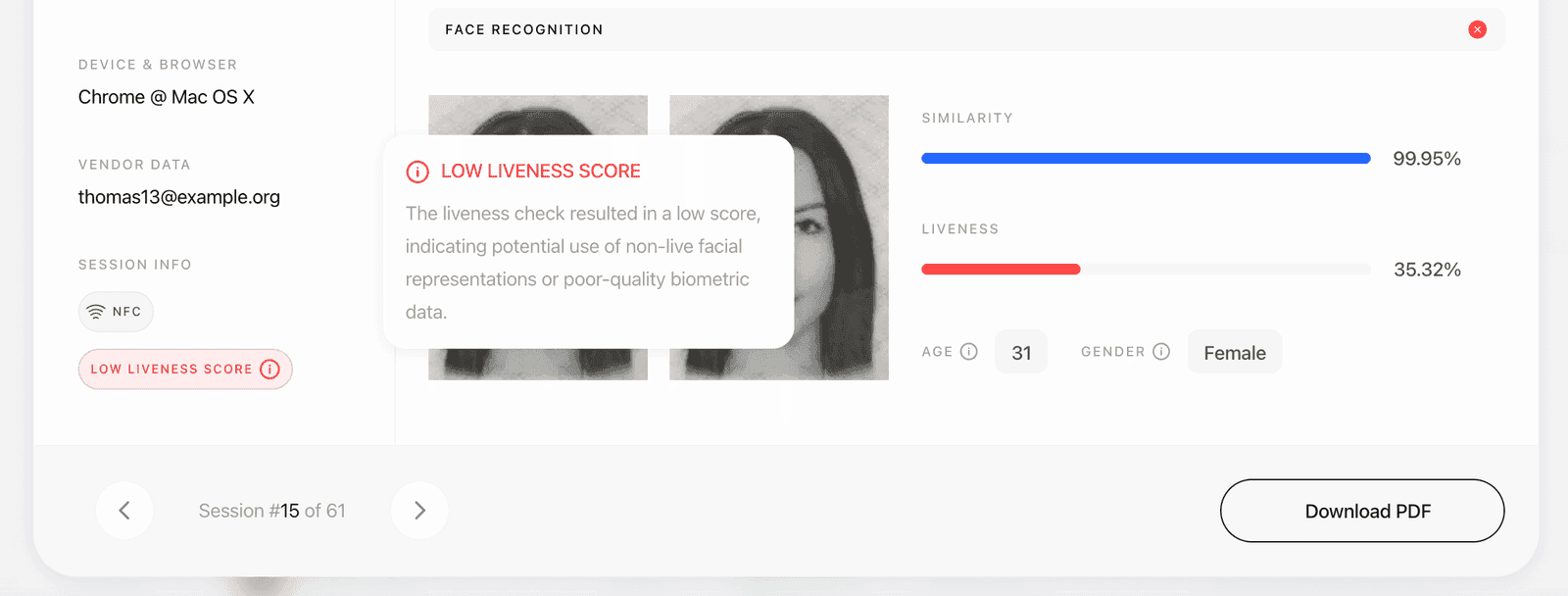
A Didit session flagged for review: a low liveness score warning, with the face match similarity, the liveness score, the estimated age and the device next to it.
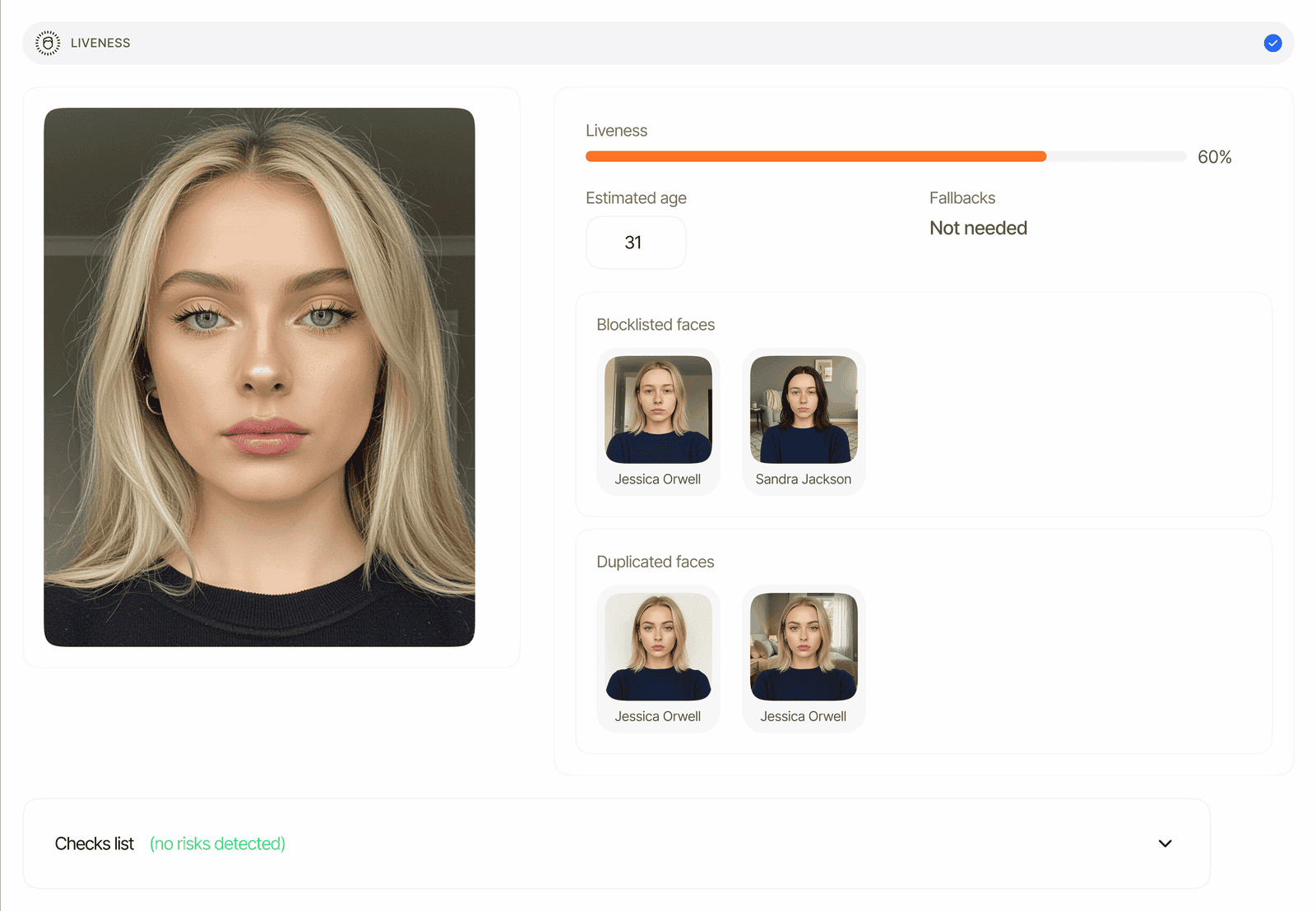
One liveness result in the Didit console: the selfie, the score, the estimated age, blocklisted faces and earlier sessions with the same face.
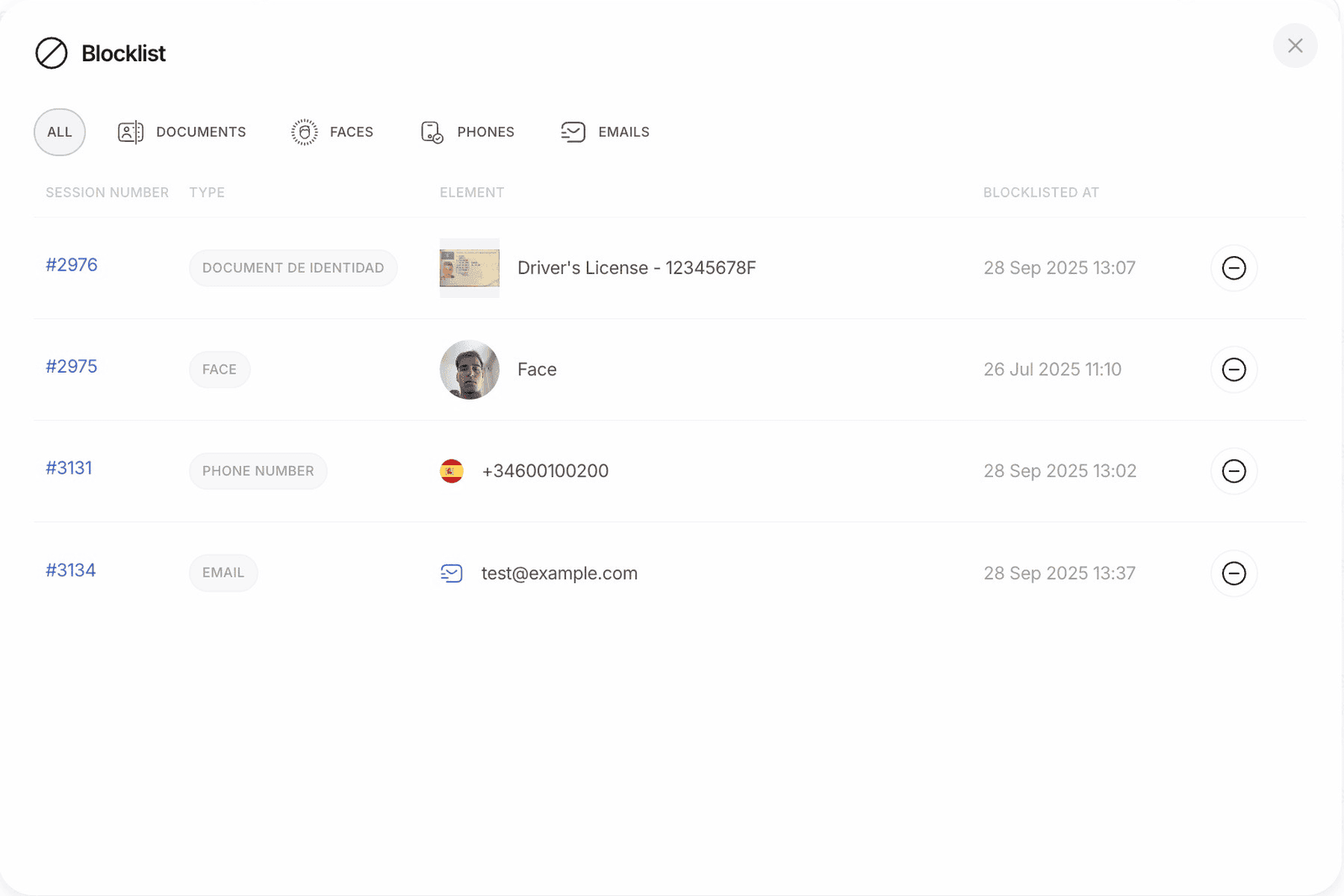
The Didit blocklist: a document, a face, a phone number and an email, each linked to the session it came from.
Put onboarding and monitoring in the same budget
For a fintech or marketplace onboarding 10,000 people in a month and checking 100,000 transactions, the selected Didit usage is straightforward to calculate.
| Selected module | Calculation | Didit usage cost |
|---|---|---|
| Core KYC | 10,000 × $0.33 | $3,300 |
| Initial AML screening | 10,000 × $0.20 | $2,000 |
| Transaction monitoring | 100,000 × $0.02 | $2,000 |
| Usage subtotal | 10,000 users and 100,000 transactions | $7,300 |
Illustrative USD list-rate budget for successful checks and the stated transaction count. Taxes, plan fees, credits, discounts, ongoing AML, database/eID services, KYB, wallet checks, Investigator and other modules are excluded. Each added module has its own price; a vendor comparison requires a quote for this same scope. Didit module prices.
Switch with an evidence-based rollout
Keep the existing journey available while you validate the replacement. Use this proposed acceptance checklist to agree the rollout with your engineering and compliance teams.
| Existing concept | Didit mapping | Acceptance check |
|---|---|---|
| Verification flow | Rebuild the selected steps and branches in a Didit workflow | Run the same supported document and country mix through both journeys. |
| Approval, decline and review states | Map source values with status_mapping in the import API | Reconcile every mapped status; investigate unknown or failed rows before expanding. |
| Historical verification records | POST /v3/session/imports/ with workflow_id and dry_run | Validate the dry run, then inspect terminal job status and created, updated, skipped and failed counts. |
| Rules, cases and webhook handlers | Configure these separately in Didit | Check event handling and review ownership. The historical-verification import does not migrate these configurations. |
Start with a small, predefined share of eligible traffic. Agree completion, manual-review and cost-per-approved-user thresholds before the pilot, comparing the same checks and population. Increase traffic only when those thresholds and the import reconciliation pass; route traffic back to the existing journey if they fail. See the import API, webhooks and workflow documentation.
Start with one flow; keep the evidence as you grow
Didit connects onboarding to screening, monitoring and case review on one account and record. Investigator reads verifications, alerts and cases and writes a cited report with a recommendation for $0.20 per reviewed item. Copilot helps build workflows, and the hosted MCP server lets your own agents connect through OAuth 2.1.
Investigator requires Growth or higher and organization enablement; it does not run in sandbox. Sanctions matches go to a person, and it never files a regulatory report. Its per-item charge is separate from plan fees.
Open the Didit console without a sales call and test your chosen workflow. The pricing announcement published on 2 October 2026 sets the Free plan at $10 of credit every month from 1 November 2026.
Related articles
- Didit vs TECH5: a hosted KYC API vs biometrics for ID programmes
- Didit vs Trust Stamp: published prices vs a quote-led KYC suite
- Didit vs FaceTec: Hosted Liveness, Full Evidence, Published Prices
- Didit vs Nametag: customer KYC API vs workforce identity checks
- Didit vs Keyless: verifying new users vs biometric login
- Didit vs Aware: hosted KYC API vs a biometrics platform