
Didit vs Nametag: customer KYC API vs workforce identity checks
Compare Didit and Nametag for customer onboarding. Review published per-check pricing, omnichannel KYC coverage, AML screening, and verified government data versus mobile-only workforce identity verification.
The Verdict
For teams onboarding customers in regulated industries, Didit provides a complete, modular KYC and compliance platform with transparent per-check pricing ($0.33 for full KYC) across desktop, web, and mobile. In contrast, Nametag describes workforce security and IT helpdesk verification on mobile phones (Nametag, accessed 25 October 2026), with no public per-check pricing published (getnametag.com/pricing returned 'Page not found', checked 25 October 2026).
- Published, transparent pricing: Didit publishes list prices for the checks priced below ($0.15 ID verification, $0.10 passive liveness, $0.05 face match, $0.03 device and IP analysis for a $0.33 core KYC bundle), while Nametag publishes no per-check pricing on its website (checked 25 October 2026).
- True omnichannel customer conversion: Didit verifies users across desktop web, mobile web, hosted links, and native SDKs, whereas Nametag requires an iOS or Android device and blocks desktop webcams and mobile browsers entirely (Nametag human identity verification, reviewed 25 October 2026).
- End-to-end compliance on a unified record: Didit brings together AML watchlist screening ($0.20), ongoing monitoring ($0.07 per user per year), government database validation across 45 countries plus a Global group, six live national eID schemes, and KYB from $2.00 on a single customer identity record.
When an online platform, financial institution, or consumer marketplace verifies an applicant, compliance officers and product engineers need a seamless onboarding journey that operates reliably across all devices. A user might start onboarding on a desktop browser, switch to a smartphone, or complete the entire process within an embedded mobile app. Compliance teams must simultaneously verify identity documents, confirm genuine physical presence, detect suspicious device signals, and check international AML watchlists—all without creating friction that drives abandonment.
Didit provides an integrated identity verification and compliance platform designed specifically for customer onboarding. In contrast, Nametag describes itself as purpose-built for workforce security and account protection, focusing on secure onboarding, helpdesk verification, and self-service account recovery (Nametag homepage, reviewed 25 October 2026). This guide examines how the two platforms differ in verification methods, device support, compliance breadth, and pricing architecture.
Worked Onboarding Workflow: Customer Conversion vs Employee Re-authentication
The operational divide between customer KYC and workforce security becomes apparent when tracing an end-user onboarding journey:
- Step 1Channel Entry & Device SelectionWith Didit, a customer opening an account clicks a link on desktop web, mobile web, or in a native mobile application. They can complete document capture directly via their existing webcam or phone camera without being forced to download an external application or switch devices. With Nametag, the flow exclusively runs on native iOS or Android; mobile web browsers and desktop webcams are blocked (Nametag human identity verification, reviewed 25 October 2026).
- Step 2Document Capture & Biometric LivenessDidit inspects the government document across 14,000+ supported document types and runs passive liveness ($0.10) and 1:1 face match ($0.05). If configured, Didit can perform an NFC chip extraction ($0.15) or validate the national identifier directly against official government databases in 45 countries plus a Global group. Nametag inspects government photo IDs (Nametag FAQ, reviewed 25 October 2026) or India's Aadhaar e-ID (Nametag digital ID, reviewed 25 October 2026), checks device attestation, and performs a 3D Spatial Selfie (Nametag human identity verification, reviewed 25 October 2026).
- Step 3Fraud Signals & Risk ScoringDuring the verification session, Didit evaluates device fingerprinting, IP reputation, proxy/VPN/Tor usage, and geolocation consistency ($0.03 unit, included in the $0.33 bundle). Didit also runs free 1:N face search against your enrolled users to detect duplicate accounts and repeat fraudsters. Nametag links returning users by comparing biometric selfies against a chain of prior verified selfies (Nametag human identity verification, reviewed 25 October 2026).
- Step 4Regulatory Screening & Case ResolutionFor regulated onboarding, Didit screens the applicant against 1,300+ sanctions, PEP, and adverse media lists ($0.20) and enrolls them in ongoing monitoring ($0.07 per user per year). Flagged exceptions route directly to Didit's case management or Investigator agent ($0.20 per reviewed item). Nametag documents workforce integrations (Nametag homepage, reviewed 25 October 2026).
Didit vs Nametag: Core Capabilities Comparison
The following table compares the documented capabilities of both platforms based on public product documentation and published pricing.
| Buyer Task / Capability | Didit Platform Scope | Nametag Documented Scope |
|---|---|---|
| Primary Target ICP | Customer onboarding, KYC, KYB, fraud prevention, and ongoing AML compliance. | Workforce security, candidate verification, IT helpdesk verification, and self-service account recovery (Nametag homepage, reviewed 25 October 2026). |
| Device & Channel Coverage | Omnichannel: desktop web, mobile web, hosted redirects, iframes, and native SDKs (iOS, Android, React Native, Flutter). Docs | Mobile only: exclusively works on Android and iOS; mobile web browsers and desktop webcams are blocked (Nametag human identity verification, reviewed 25 October 2026). |
| Document KYC & Coverage | 14,000+ document types across 220+ countries and territories ($0.15 in a workflow). Full KYC bundle is $0.33. Docs | Verifies identity documents on supported mobile devices (Nametag FAQ, reviewed 25 October 2026). |
| Face Matching & Duplicate Search | 1:1 face match ($0.05) and core 1:N face search against your enrolled users and blocklists (free). Docs | 1:1 face match between ID and selfie; reverification against directory-linked user account (Nametag FAQ, reviewed 25 October 2026). |
| Authoritative identity sources | Direct database connections in 45 countries plus a Global group, running as an extra corroborating step on top of document, liveness and face match. Docs | Supports integration with India's Aadhaar e-ID (Nametag digital ID, reviewed 25 October 2026). |
| Fraud & Device Signals | Device fingerprinting, IP risk, VPN/proxy/Tor detection ($0.03 in KYC bundle), email verification ($0.03), and phone verification ($0.04 + carrier). Docs | Cryptographic attestation (device trust); optional location check (Nametag human identity verification, reviewed 25 October 2026). |
| AI Agents & Automation | Investigator agent ($0.20 per reviewed item), Copilot workflow generation, hosted MCP server with OAuth 2.1. Docs | Hosted MCP server for workforce AI agents; MCP is off by default and must be enabled by Nametag, then per environment by an administrator (Nametag MCP docs, reviewed 25 October 2026). |
| Pricing Transparency | Published list prices for the checks below; pay as you go per successful check; self-serve console sign-up. Pricing | No public per-check price published; getnametag.com/pricing returned 'Page not found' (checked 25 October 2026); describes model as unlimited per user without amounts (Nametag compare). |
Didit checks for the rest of the customer lifecycle
The comparison above covers documented overlapping functions. For customer onboarding and continuing monitoring, these additional Didit modules run in the same account. Their inclusion here makes no claim about Nametag's undocumented scope.
| Didit module | Published scope and price |
|---|---|
| AML screening and monitoring | Screening at $0.20 per check; ongoing AML at $0.07 per user per year. Documentation |
| Transaction monitoring | Real-time rule evaluation at $0.02 per transaction. Documentation |
| Crypto wallet screening and Travel Rule | Wallet screening at $0.15 per check; Travel Rule messaging is a separate module. Documentation |
| Business verification | From $2.00 per business, with free registry search and separately configured linked owner KYC. Documentation |
| Case review | Review check evidence on the customer record; Investigator assistance costs $0.20 per reviewed item. Documentation |
| Historical verification import | Import prior verifications with dry-run validation and status mapping; configure workflows, rules and cases separately. Documentation |
Didit documentation and published prices checked 27 October 2026.
Worked Budget Example: Didit vs Nametag
Financial predictability is essential when budgeting identity verification. Didit charges per completed verification check with transparent list prices published in its console. Nametag does not publish a per-check price on the pages reviewed, operating an unpriced per-user quote model.
| Monthly Volume (Completed Checks) | Didit Core KYC Bundle ($0.33) | Nametag Published Pricing (Quote-based) |
|---|---|---|
| 1,000 verifications | $330 | Quote-based |
| 10,000 verifications | $3,300 | Quote-based |
| 50,000 verifications | $16,500 | Quote-based |
Budgets reflect list prices in USD for completed checks. Didit Core KYC bundle comprises Document ID ($0.15) + Passive Liveness ($0.10) + Face Match ($0.05) + Device & IP Analysis ($0.03). Taxes, optional modules (such as AML screening at $0.20, ongoing monitoring at $0.07 per user per year, or government database validation), prepaid discounts, credits, and enterprise volume discounts are excluded. Nametag describes a model of unlimited verifications per user without publishing amounts; getnametag.com/pricing returned 'Page not found' (checked 25 October 2026) (Nametag comparison page, checked 25 October 2026).
Budgeting a Regulated Compliance Stack
For financial institutions and crypto firms requiring full AML compliance alongside identity verification, Didit's modular catalog allows teams to price additional regulatory components precisely:
- Core KYC Bundle: $0.33 per completed check (ID + passive liveness + face match + device & IP analysis). At 10,000 monthly checks, the base identity verification cost is $3,300.
- Sanctions & PEP Screening: $0.20 per user check against 1,300+ international watchlists. Screening 10,000 onboarding applicants adds $2,000.
- Ongoing AML Monitoring: $0.07 per user per year, ensuring continuous screening against updated sanctions lists.
- Transaction Monitoring (KYT): $0.02 per transaction across 150+ preset rules and custom logic. Monitoring 100,000 monthly transactions costs $2,000.
- Crypto Wallet Screening: $0.15 per check, screening blockchain addresses for sanctions and illicit sources.
Additional Didit Capabilities for Regulated Onboarding
While Nametag concentrates on workforce identity protection and IT service desk workflows, customer-facing organizations often require additional specialized compliance modules that Didit provides within the same platform and on the same customer record:
- Government Database Validation: Direct authoritative lookups across 45 countries plus a Global group, verifying national ID numbers against official government databases as an independent validation step. Read documentation.
- Six Live European eID Schemes: Direct verification with MitID (Denmark), BankID Sweden, iDIN (Netherlands), Finnish Trust Network (Finland), Smart-ID (Estonia, Latvia, Lithuania, Belgium), and Mobile-ID (Estonia, Lithuania). Read documentation.
- NFC Chip Verification: Cryptographic verification of biometric chips in e-passports and national identity cards ($0.15). Read documentation.
- Crypto Wallet Screening & Travel Rule: Wallet screening on blockchain addresses ($0.15 per check) and IVMS 101 counterparty messaging for Travel Rule compliance. Read documentation.
- Business Verification (KYB): Automated business registry extraction from $2.00, identifying Ultimate Beneficial Owners (UBOs) and linking each owner to a personal KYC verification flow on the same account. Read documentation.
Public Proof & Certifications
Review the scope of each published source: SOC 2 Type 1 and Type 2 attestations and ISO/IEC 27001 certification concern security controls; the Spanish sandbox report concerns a tested remote-identification flow.
- Liveness certification: Didit passive liveness is iBeta Level 1 and Level 2 certified for presentation attack detection (ISO/IEC 30107-3).
- Spain's published sandbox report documents tests of Didit's NFC and active-liveness flow. Its supervisory conclusions state that SEPBLAC positively assessed the added safeguards for remote identification.
- Security Standards: SOC 2 Type 1 and Type 2 attestations, and ISO/IEC 27001 certification, documenting its information-security controls.
- Global Coverage: Verified across 14,000+ identity documents in more than 220 countries and territories, trusted by 3,000+ companies.
- Demonstrated Customer Impact: In Didit's published AhoraCrypto customer story, AhoraCrypto reported more than 20% savings per user compared with its previous identity verification provider, and a reduction of more than 50% in time spent on manual user reviews; these are AhoraCrypto's reported experience, not a general benchmark (AhoraCrypto case study).
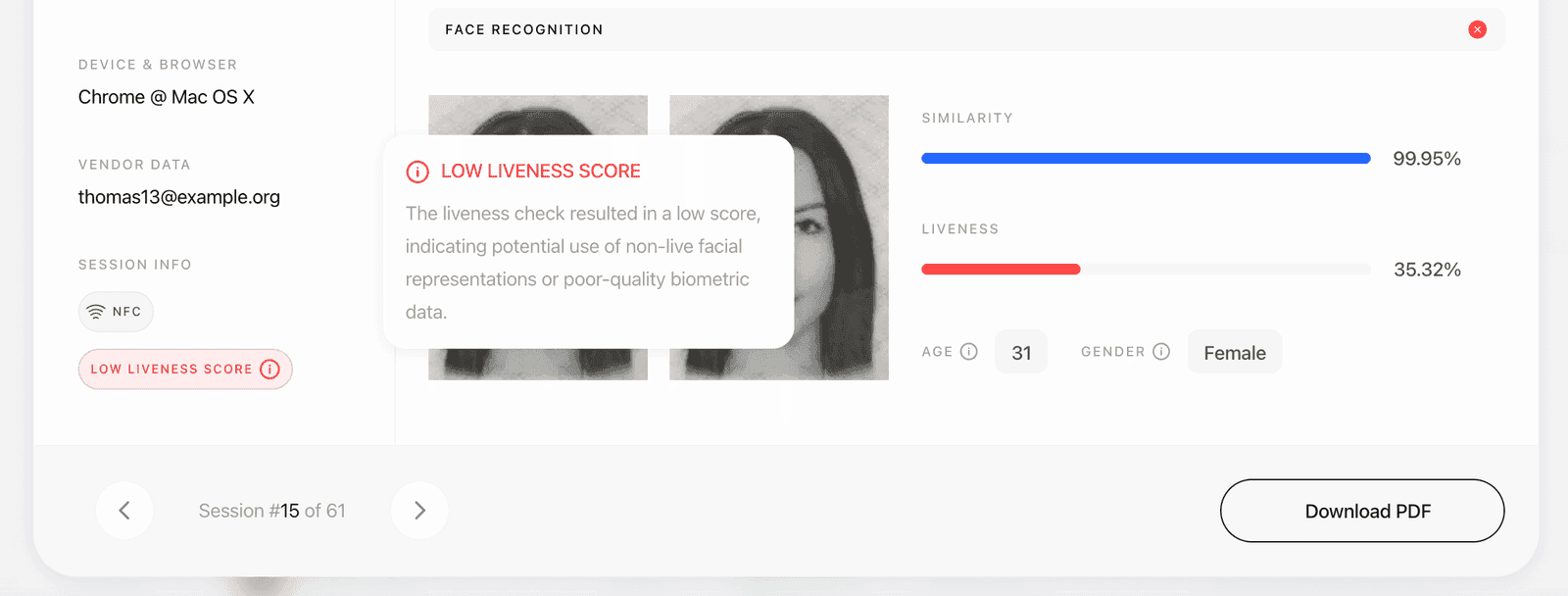
A Didit verification session flagged for review: displays face match similarity, liveness score, estimated age, device risk indicators, and extracted document data on one record.
Addressing Buyer Considerations: Hardware Enclaves vs Omnichannel KYC
Nametag uses device cryptographic attestation and requires an iOS or Android device (Nametag human identity verification, reviewed 25 October 2026), whereas Didit provides browser-plus-SDK capture across desktop web, mobile web, and native mobile apps.
However, applying that constraint to customer onboarding introduces substantial friction. Didit provides native SDKs for mobile applications while simultaneously offering secure desktop web and mobile browser experiences. To add device and network risk signals without blocking web users, Didit captures device and IP signals such as device fingerprint, IP risk, VPN/proxy/Tor detection, and geolocation consistency, allowing businesses to adjust friction dynamically rather than turning away desktop users.
Watch: Pick the Right SDK (Didit Academy)
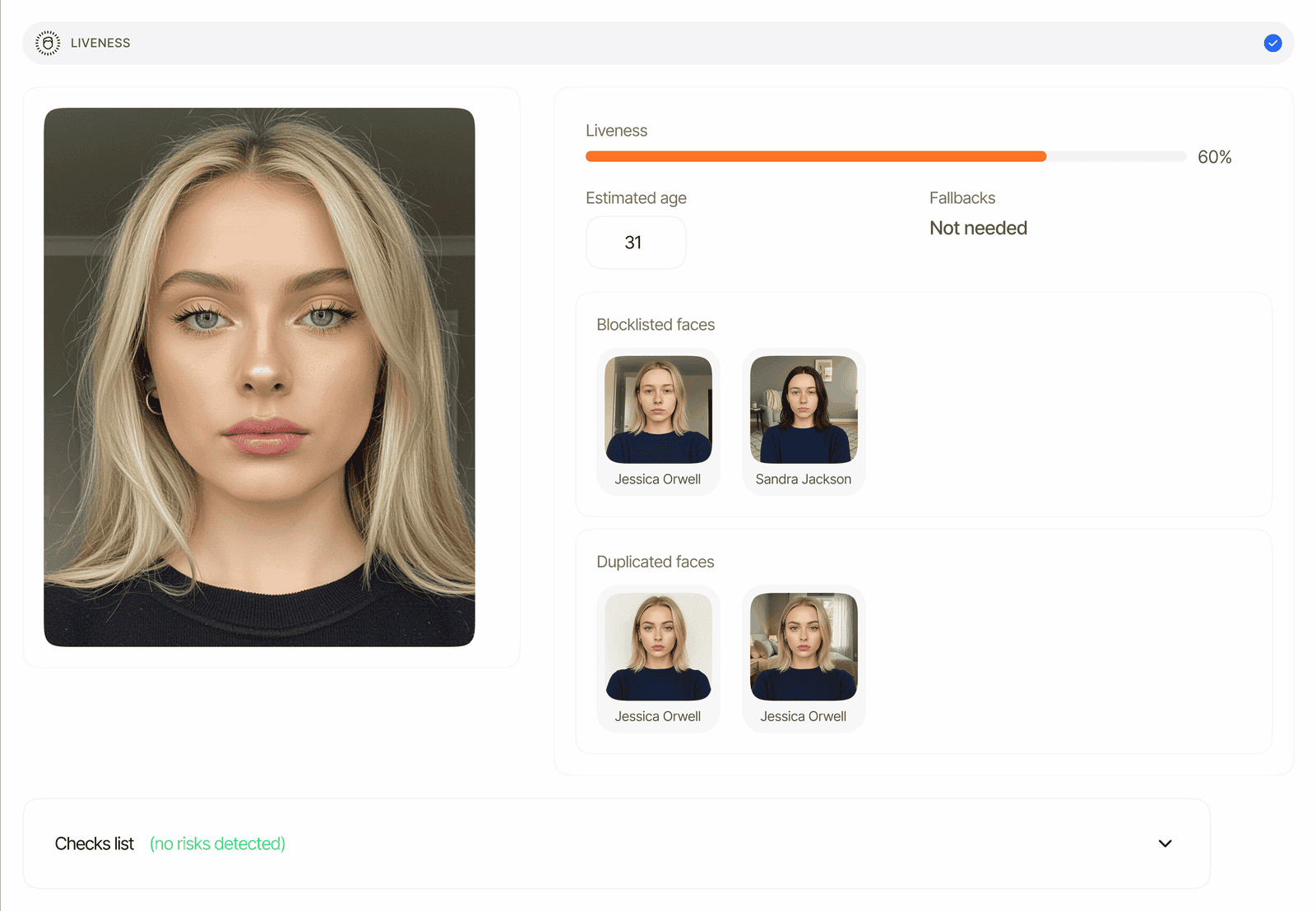
1:N face search in the Didit Business Console: immediately identifies duplicate enrollments and blocklisted individuals across previous sessions.
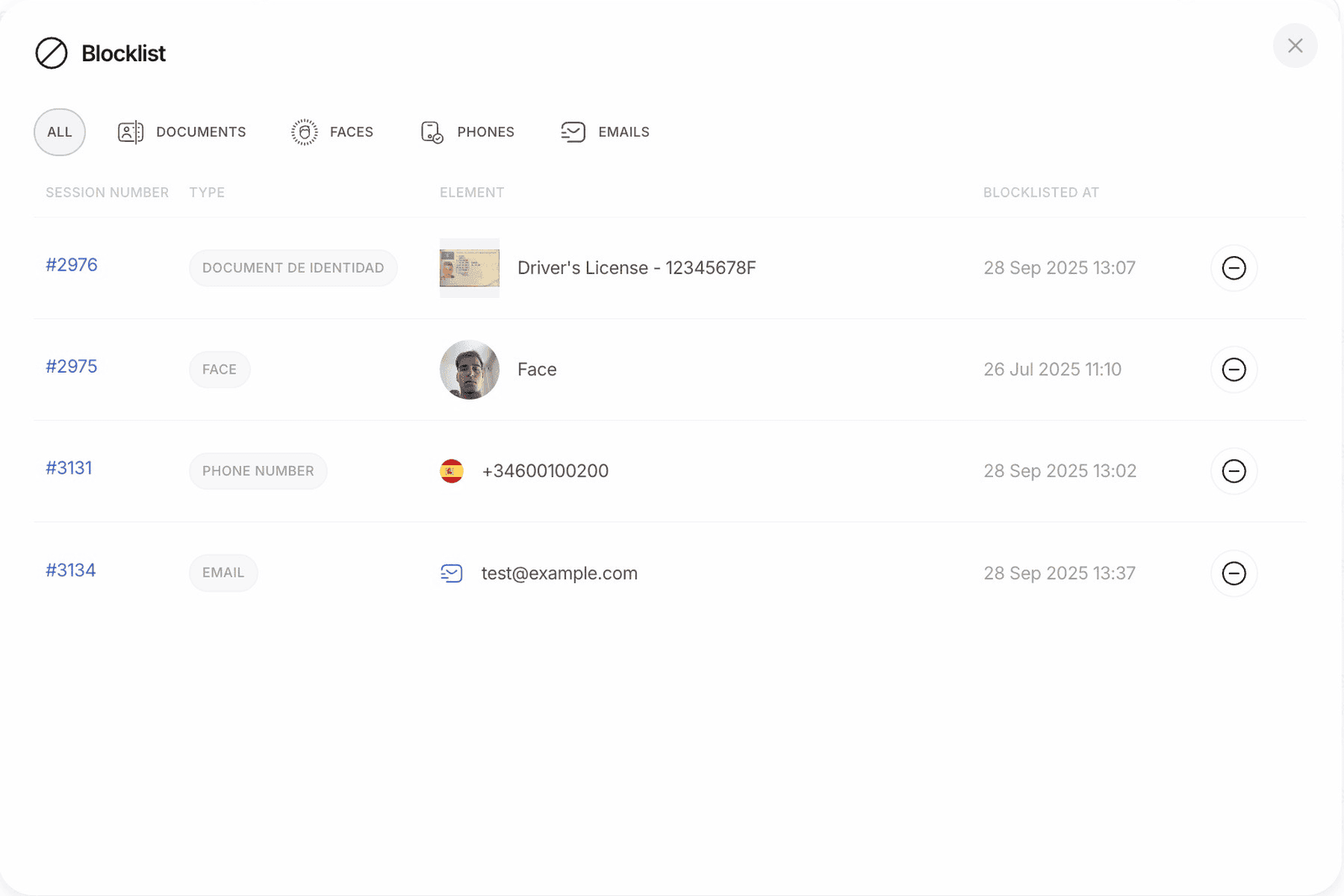
Cross-session risk management: blocklist rules automatically flag matching identity documents, faces, phone numbers, and email addresses.
Migrating from Nametag to Didit
Switching verification providers or integrating Didit alongside an existing solution can be completed in structured phases:
- Step 1Parallel EvaluationCreate an account in the Didit Business Console and route a percentage of onboarding traffic to Didit to evaluate user completion rates, pass rates, and latency.
- Step 2Concept MappingMap Nametag user claims and account recovery rules to Didit workflows, decision rules, risk thresholds, and webhook endpoints. Review team assignments and case management permissions inside the console.
- Step 3Historical Data ImportUse Didit's import API (
POST /v3/session/imports/) to import historical identity verification records usingworkflow_idandstatus_mapping. Run an initial test usingdry_run: true, monitor terminal job completion, and reconcile created, updated, skipped, and failed counts before expanding traffic. Note that the import endpoint imports historical verification data; verification workflows and rules are configured in the console. - Step 4Reconciliation & Traffic ExpansionOnce historical records are reconciled and webhook listeners are validated, expand traffic routing to Didit across all web and mobile onboarding channels.
Frequently Asked Questions
What is the primary difference between Didit and Nametag?
Didit is an omnichannel identity verification and compliance platform built for customer onboarding (KYC, KYB, AML, transaction monitoring) with transparent per-check pricing. Nametag is designed primarily for workforce security, candidate verification, and IT helpdesk self-service account recovery on mobile devices (Nametag, reviewed 25 October 2026).
How much does Nametag cost compared to Didit?
Didit publishes its pricing openly: a full KYC bundle costs $0.33 (document ID $0.15, passive liveness $0.10, face match $0.05, device/IP analysis $0.03). Nametag describes unlimited verifications per user without publishing amounts (Nametag comparison page, accessed 25 October 2026).
Can customers complete verification on desktop computers?
Yes, Didit works on desktop web browsers, mobile web browsers, and native mobile apps via SDKs. Nametag states that it exclusively works on Android and iOS devices, blocking webcams and mobile browsers (Nametag human identity verification, reviewed 25 October 2026).
What verification solutions does Nametag document compared to Didit?
Nametag's homepage lists workforce verification and account-recovery solutions (Nametag homepage, reviewed 25 October 2026). Didit provides customer KYC ($0.33 bundle), AML screening ($0.20), ongoing monitoring ($0.07 per user per year), business verification (from $2.00), and transaction monitoring ($0.02 per transaction) within the same API.
Can I import existing customer verification records to Didit?
Yes. Didit provides a dedicated historical verification import API (POST /v3/session/imports/) that allows teams to migrate verification records using a predefined workflow and status mapping, with dry-run validation, terminal job-state checks, and created/updated/skipped/failed counters.
The Full Didit Platform
Didit unifies customer identity verification, fraud prevention, and ongoing compliance into a single integrated platform with clear, published per-check pricing:
- Unified User Record: One consolidated profile spanning document capture, passive and active liveness, government database corroboration, AML screening, and transaction monitoring.
- Automated AI Investigator: The Investigator agent ($0.20 per reviewed item) reviews flagged sessions, evaluates risk signals against your compliance policies, and drafts comprehensive case summaries with recommendations.
- Console Copilot & Hosted MCP: Build workflows, questionnaires and database validation with Copilot in the Business Console, or connect internal AI agents to Didit's hosted Model Context Protocol (MCP) server secured with OAuth 2.1.
- Immediate Self-Serve Access: Test workflows and APIs in a fully featured sandbox environment directly from the Didit Business Console without waiting for a sales call. The publicly announced Free plan includes $10 of credit every month from 1 November 2026 (pricing announcement).
Start verifying customers with transparent per-check pricing
Explore workflows, run live checks in the sandbox, or inspect verification evidence directly in the console.
Sources
- Nametag homepage, Nametag, reviewed 25 October 2026.
- About Nametag, Nametag, reviewed 25 October 2026.
- Human identity verification, Nametag, reviewed 25 October 2026.
- Deepfake Defense, Nametag, reviewed 25 October 2026.
- Digital ID verification, Nametag, reviewed 25 October 2026.
- Nametag FAQ, Nametag, reviewed 25 October 2026.
- Compare identity verification tools, Nametag, reviewed 25 October 2026.
- Nametag pricing: Page not found, Nametag, reviewed 25 October 2026.
- Nametag MCP documentation, Nametag, reviewed 25 October 2026.
- Didit pricing documentation, Didit, reviewed 27 October 2026.
- Didit verification methods, Didit, reviewed 27 October 2026.
- Didit liveness detection, Didit, reviewed 27 October 2026.
- Didit database validation, Didit, reviewed 27 October 2026.
- Didit digital ID catalog, Didit, reviewed 27 October 2026.
- Didit certifications and attestations, Didit, reviewed 27 October 2026.
- Didit historical verification import API, Didit, reviewed 27 October 2026.
- AhoraCrypto customer story, Didit, reviewed 27 October 2026.
- Didit pricing release announcement, Didit, reviewed 27 October 2026.
Related articles
- Didit vs ID R&D: IDLive Face liveness or a hosted KYC API
- Didit vs TECH5: a hosted KYC API vs biometrics for ID programmes
- Didit vs Trust Stamp: published prices vs a quote-led KYC suite
- Didit vs FaceTec: Hosted Liveness, Full Evidence, Published Prices
- Didit vs Keyless: verifying new users vs biometric login
- Didit vs Aware: hosted KYC API vs a biometrics platform