
Didit vs Hummingbird: alerts, cases and FIU reports in one account
Didit vs Hummingbird: compare documented checks, published pricing, review evidence and migration steps. Didit core KYC costs $0.33.
Choose Didit when your fintech or crypto compliance team needs to generate transaction alerts, inspect the verified customer behind them and prepare a case report in one account. Transaction monitoring costs $0.02 per transaction; Investigator review costs $0.20 per reviewed item.
- Published core KYC price: $0.33 for ID, passive liveness, face match and device/IP.
- Public financial-sandbox test evidence for NFC plus active liveness; SOC 2 Type 1 & Type 2 and ISO/IEC 27001 are listed in Didit’s certification documentation.
- 4,000+ companies use Didit; document coverage spans 220+ countries and territories and 14,000+ document types. Public customer evidence.
Start the investigation with the transaction and the verified person
Hummingbird’s monitoring page says its rules run on warehouse data, require SQL-defined views and do not sit in the flow of funds. Its rule builder combines SQL with no-code configuration. (public source, checked 27 October 2026). Didit’s case starts with the transactions and identity checks you run on the same account. That is the reason to move when your team needs to connect detection, verification and investigation.
- Evaluate the transaction. Submit a transaction from your backend or the SDK. Didit evaluates transaction rules and links the alert to the subject; the SDK submission also carries device and IP context. The SDK submission’s vendor_data links the transaction to the subject. (public source, checked 27 October 2026).
- Handle the required action. If the response requests a verification session, your app launches the returned session token or URL through your Didit integration. A wallet-ownership action is different: the SDK opens its proof flow automatically. The current SDK guide distinguishes these two actions explicitly. (public source, checked 27 October 2026).
- Review the evidence. Work from the subject’s checks, linked transactions and case history. Investigator prepares a cited report and recommendation; your policy and the configured autonomy level govern the decision. The case keeps the investigation and its supporting records together. (public source, checked 27 October 2026).
- Prepare the report. Choose a validated jurisdiction template. Didit populates the draft from the case subject, linked transactions and narrative; your reviewer checks it, validates the required fields and finalizes downloadable goAML XML and PDF files. The FIU guide documents this workflow for SAR, STR, CTR and other report types. (public source, checked 27 October 2026).
Your compliance team makes the filing decision and submits the report. Hummingbird documents direct FinCEN and FINTRAC filing; Didit’s case workflow produces the reviewed export for your team. See Hummingbird’s regulatory-reporting page. (public source, checked 27 October 2026). The operational gain to evaluate is upstream: having the alert, original identity evidence, case review and report draft on the same account.
Didit brings the alert, identity evidence and case record together for team review.
Watch: Reviewing Cases as a Team (Didit Academy)
Price a complete monthly workload
This example gives a fintech or crypto desk a concrete list-rate budget before any sales call. The volumes are illustrative and independently selected; they are not a measured customer outcome.
| Workload | Unit price | Monthly amount |
|---|---|---|
| 10,000 successful core KYC verifications | $0.33 | $3,300 |
| 10,000 initial AML screenings | $0.20 | $2,000 |
| 100,000 monitored transactions | $0.02 | $2,000 |
| 10,000 wallet screenings | $0.15 | $1,500 |
| 1,000 Investigator-reviewed items | $0.20 | $200 |
| Total usage charges | $9,000 |
The four check categories total $8,800; the selected review volume adds $200. Didit’s published module prices. (public source, checked 27 October 2026). Investigator requires Growth or higher and organization enablement. Plan fees, taxes, discounts, KYB, database checks, national digital IDs and other unlisted checks are excluded. Additional verification requested during a transaction is charged according to the checks selected; it is not included in the $0.02 monitoring charge. The example does not estimate Hummingbird’s quote or claim a percentage saving.
Adjust the verification and review volumes
The core KYC bundle is $0.33: ID verification $0.15 + passive liveness $0.10 + face match $0.05 + device and IP analysis $0.03. The second example calculates Investigator review charges at $0.20 per reviewed item. Growth-or-higher plan fees are additional.
| Monthly units | Didit core KYC at $0.33 | Didit: Investigator review charges | Vendor published terms; different scope |
|---|---|---|---|
| 1,000 | $330 | $200 |
|
| 10,000 | $3,300 | $2,000 | |
| 50,000 | $16,500 | $10,000 |
Illustrative USD list-rate budgets. Core KYC assumes successful checks. Taxes, credits, prepaid discounts and other modules are excluded. Reviewed-item volumes are independent of KYC volumes; the columns are separate examples. Investigator requires Growth or higher and organization enablement; plan fees are additional. Database checks and national digital IDs are outside the $0.33 core KYC bundle. Vendor prices retain their original currency, billing unit and plan scope; the table does not assume equivalent bundles.
Compare the scope your team needs
| Requirement | Didit | Hummingbird public sources |
|---|---|---|
| Agents | Investigator $0.20 per reviewed item, Copilot, and a hosted MCP server using OAuth 2.1. Didit documentation. | Automated regulatory report drafting, entity research, and casework management (public source, checked 25 October 2026). |
| Cases and review | Four-eyes case review and Investigator reports. Didit’s FIU report templates in the same account create validated SAR/STR/CTR drafts and goAML XML/PDF exports; your team files the report. (public source, checked 27 October 2026). | Regulatory report drafting and direct filing with FinCEN and FINTRAC (public source, checked 25 October 2026). |
| Transaction monitoring | Real-time rule engine, 150+ preset rules and alerts linked to the verified user, $0.02 per transaction. Didit documentation. | Cloud warehouse transaction monitoring using SQL-defined views and a no-code rule builder (public source, checked 25 October 2026). |
| Identity checks | Document verification, passive liveness, face match and device/IP analysis in the $0.33 core bundle. Didit documentation. | Customer due diligence review and screening case management platform (public source, checked 25 October 2026). |
| AML screening | AML screening at $0.20 across 1,300+ lists. Didit documentation. | Sanctions, PEP, and adverse media screening via third-party data providers (public source, checked 25 October 2026). |
| Ongoing screening | Ongoing AML monitoring at $0.07 per user per year. Didit documentation. | Ongoing screening for sanctions, watchlists, and adverse media (public source, checked 25 October 2026). |
| Businesses and owners | KYB from $2.00, registry search free, linked KYC for every owner. Didit documentation. | Public record search and business verification case integrations (public source, checked 25 October 2026). |
| Wallet screening | Wallet screening at $0.15 per check. Didit documentation. | Cryptocurrency alert integration and case creation (public source, checked 25 October 2026). |
| Returned evidence | Check results, extracted fields, images and warnings in the API response; webhooks and compliance PDF reports. Didit documentation. | Case workspace with linked subject information. (public source, checked 25 October 2026). |
Hummingbird lists screening, monitoring, investigations and regulatory reporting as its product areas. (public source, checked 25 October 2026). Didit combines the selected identity checks with screening, monitoring and review on the same account, so the pilot can test the whole operating workflow.
What your account can cover
| Requirement | Didit capability and public documentation |
|---|---|
| Document and biometric checks | Core KYC $0.33; NFC $0.15; passive liveness $0.10 in a workflow or $0.05 through the standalone API; active liveness $0.15. ID verification; liveness. |
| Authoritative data | Database coverage is 45 countries plus a Global group. Database validation. |
| Six national digital IDs | MitID (Denmark), BankID Sweden, iDIN (Netherlands), Finnish Trust Network, Smart-ID (Estonia, Latvia, Lithuania, Belgium) and Mobile-ID (Estonia, Lithuania). Available national digital IDs. |
| Device, IP and contact signals | Device fingerprinting and IP risk are collected in the verification session; email verification is $0.03 and phone verification is $0.04 plus carrier charges. Device/IP; email; phone. |
| Repeat-fraud checks | Face search 1:N is free and helps identify duplicate faces across your users and blocklists. Face search. |
| Screening and monitoring | AML screening $0.20 across 1,300+ lists; ongoing AML $0.07 per user per year; transaction monitoring $0.02 per transaction with 150+ preset rules. AML; transaction monitoring. |
| Crypto checks | Wallet screening $0.15 per pay-as-you-go check; Travel Rule supports IVMS 101 messaging, counterparty due diligence and ownership proof. Wallet screening; Travel Rule. |
| Business and owner checks | KYB from $2.00 per business, free registry search and a linked KYC for every owner. Business verification; key people. |
| Evidence and review | Check results, extracted fields, images and warnings in the API response; webhooks, compliance PDF reports and case management support review. Investigator is $0.20 per reviewed item. Investigator. |
| Build and migrate | No-code workflows, Copilot, hosted MCP with OAuth 2.1, SDKs for web/iOS/Android/React Native/Flutter, and historical-verification imports. Workflows; Copilot; MCP; import API. |
National digital IDs are an alternative verification route; a signed scheme result is not a selfie or face-match result. Database and eID checks have separate prices from the $0.33 core KYC bundle. Device/IP analysis here is part of a verification session.
Country-specific database services support standalone and in-workflow checks. The Global identity-enrichment group is standalone API only and is unavailable in the workflow builder. Database service modes, checked 27 October 2026.
Public evidence behind the recommendation
The Spanish Treasury sandbox report on Didit records NFC and active-liveness tests that rejected printed identity documents and detected substituted portraits using the chip image. The report’s conclusions record SEPBLAC’s participation and positive assessment of the strengthened remote-identification measures. These findings concern the tested flow, not universal fraud prevention or a benchmark against the providers on this page.
Didit’s certification documentation lists SOC 2 Type 1 and Type 2 and ISO/IEC 27001.
Didit serves 4,000+ companies. Document coverage spans 220+ countries and territories and 14,000+ document types. Review public customer stories and the document-verification scope.
In Didit’s public AhoraCrypto customer story, AhoraCrypto reports more than 20% savings per user versus its previous provider and over 50% less time spent on manual user reviews. Those figures describe that customer’s experience, not a benchmark or a promised result against the vendor on this page.
Inspect the product evidence
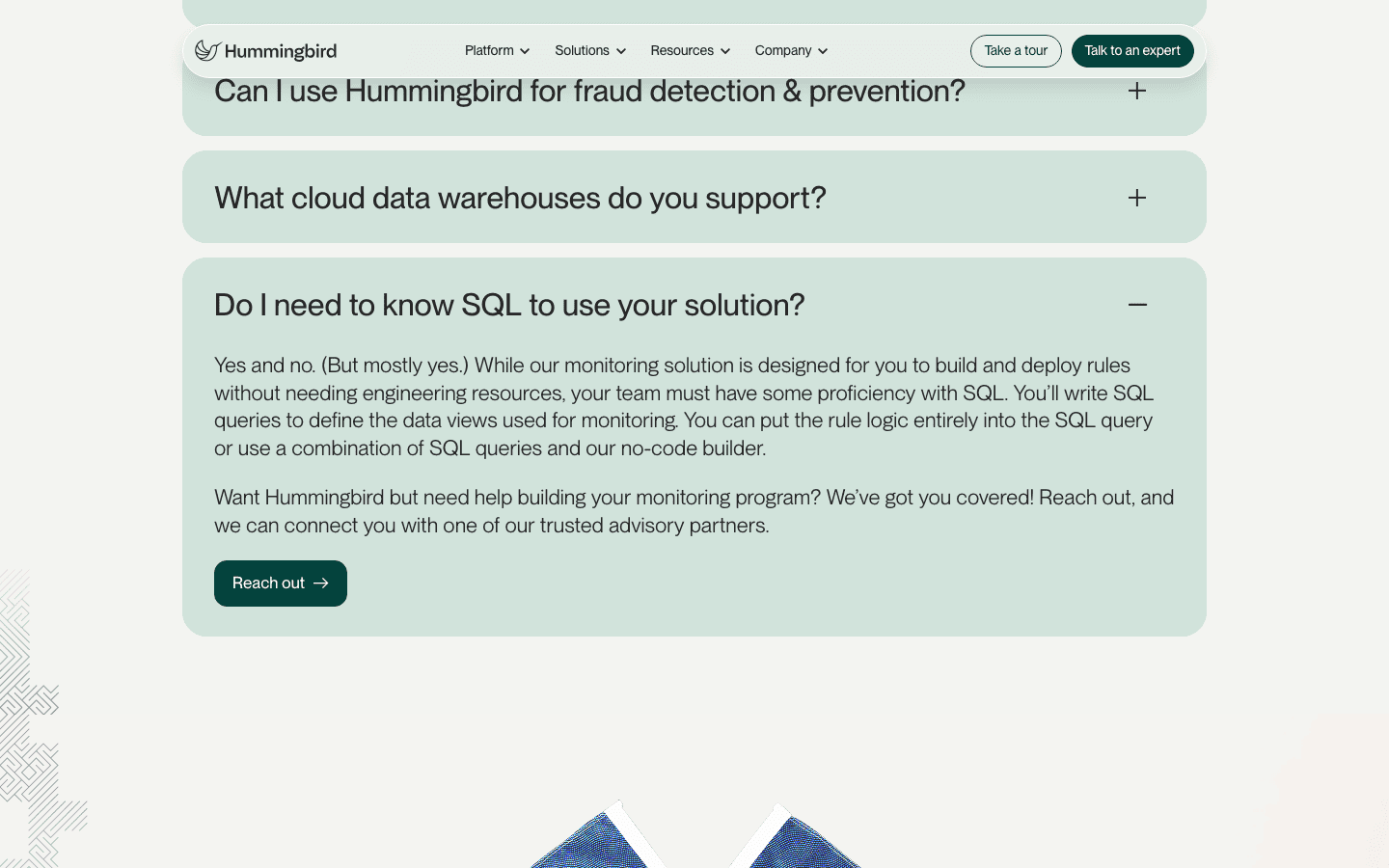
Hummingbird's monitoring FAQ on 25 October 2026: teams write SQL queries to define the data views used for monitoring. (public source, checked 25 October 2026).
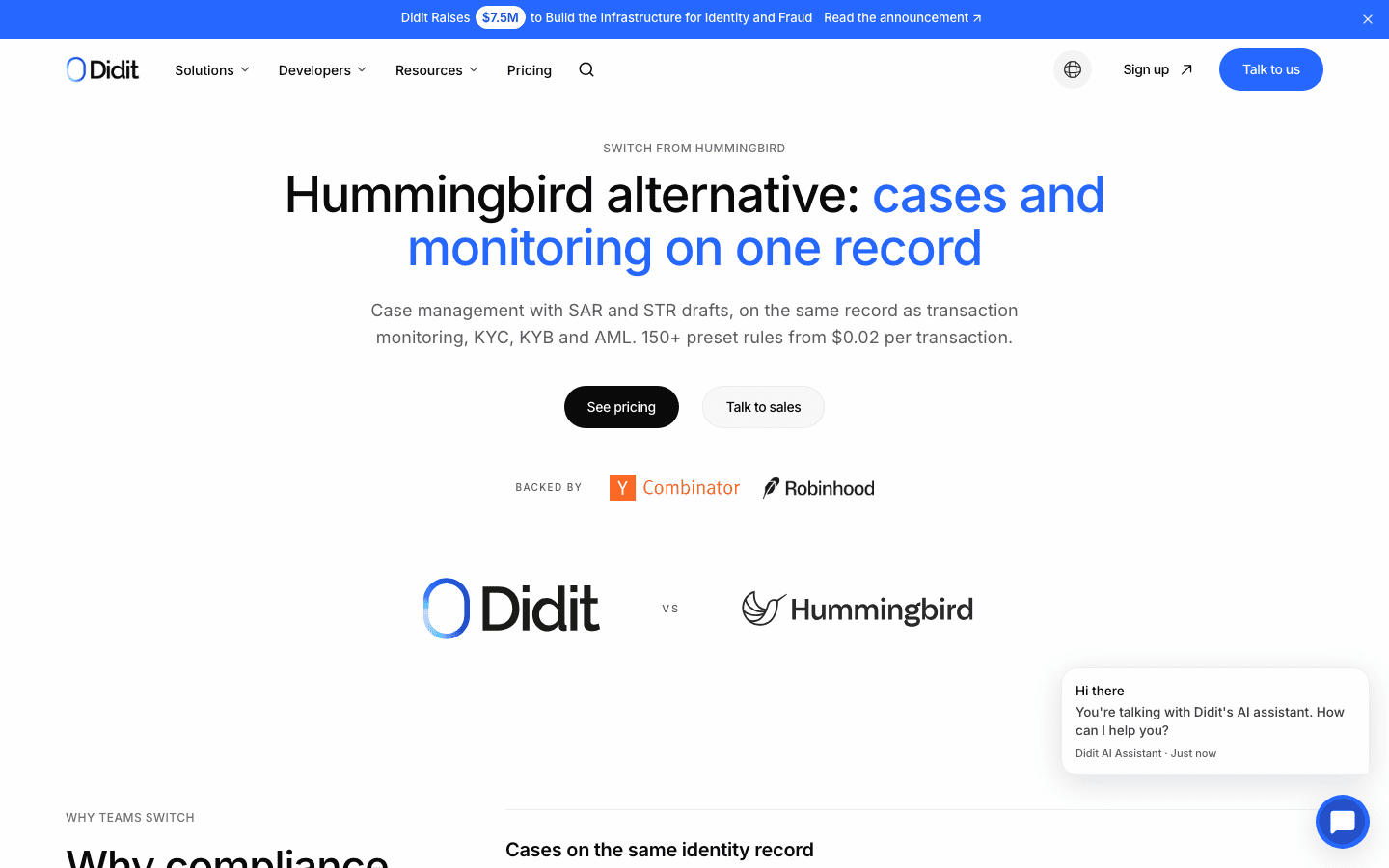
Didit's Hummingbird alternative page shows case management, SAR and STR drafts and transaction monitoring on the same record. (public source, checked 25 October 2026).
Move with a controlled pilot
- Run a parallel flow. Send a defined share of onboarding traffic to Didit. Track completion, review volume and the cost of the exact checks selected against your own current baseline.
- Map your decisions. Recreate the required workflow, review rules, cases and webhook handling in Didit. Check how your existing approval, decline and review states map to the new flow; do not assume identical vendor semantics.
- Import historical verifications. The import API documents
POST /v3/session/imports/,workflow_id,status_mappinganddry_run. Validate a dry run, then check the import job’s terminal status and reconcile created, updated, skipped and failed counts. This step does not automatically import workflows, rules or cases. - Expand after reconciliation. Inspect the evidence and review queue before increasing traffic. Keep your policy owners involved in the acceptance criteria.
Start with one flow; keep the evidence as you grow
Didit connects onboarding to screening, monitoring and case review on one account and record. Investigator reads verifications, alerts and cases and writes a cited report with a recommendation for $0.20 per reviewed item. Copilot helps build workflows, and the hosted MCP server lets your own agents connect through OAuth 2.1.
Investigator requires Growth or higher and organization enablement; it does not run in sandbox. Sanctions matches go to a person, and it never files a regulatory report. Its per-item charge is separate from plan fees.
Open the Didit console without a sales call and test your chosen workflow. The public pricing announcement sets the Free plan at $10 of credit every month from 1 November 2026.
Hummingbird and its marks belong to their owner; references here are nominative, for comparison only, and imply no affiliation. To compare on your own alerts, the Hummingbird alternative page has the side-by-side and the steps to start.