
Didit vs Paravision: a hosted KYC API against liveness components
Didit vs Paravision for solution providers and integrators: a full hosted KYC API at a published $0.33 per check, with AML, monitoring and review on one record, against face SDKs you assemble yourself.
The Verdict
Choose Didit if you are a solution provider or integrator building identity verification. You get verified users, fraud signals, AML and review on one account at published per-check prices, instead of assembling biometric components into your own KYC stack.
- Category price: the full KYC bundle is $0.33 per completed check: ID verification $0.15, passive liveness $0.10, face match $0.05 and device and IP analysis $0.03.[7] That is $330, $3,300 and $16,500 at 1,000, 10,000 and 50,000 checks a month.
- Operational breadth: beyond the bundle, Didit prices and documents government database checks in 45 countries plus a Global group, six live national digital IDs, NFC, email and phone signals, free 1:N face search, AML with ongoing monitoring, transaction monitoring, wallet screening, Travel Rule, KYB with linked owner KYC, cases and an Investigator agent.[8][10][17]
- Public trust: the only provider formally attested by an EU member-state government (Spain's Tesoro / Banco de España / SEPBLAC) as safer than in-person verification, plus SOC 2 Type 1 & 2 and ISO/IEC 27001.[18] More than 3,000 companies run Didit in production.
Public proof from Didit customers
- AhoraCrypto: in its published story, the crypto platform reports more than 20% savings per user compared with its previous verification provider and a reduction of over 50% in time spent on manual user reviews.[19] These figures are AhoraCrypto's own experience.
- Jurisserv: its public story describes a workflow of document, passive liveness, face-match and IP checks, with improved traceability.[24]
- Coverage: ID verification handles 14,000+ document types across more than 220 countries and territories. That is document coverage, separate from the customer count.[8]
Monthly budget at 1,000, 10,000 and 50,000 checks
Didit publishes a price for each step, so the budget for a full KYC flow is multiplication, not a quote cycle.[7]
| Monthly completed checks | Didit full KYC bundle at $0.33 | Paravision |
|---|---|---|
| 1,000 | $330 | Quote-based |
| 10,000 | $3,300 | Quote-based |
| 50,000 | $16,500 | Quote-based |
Didit basket per check: ID verification $0.15 + passive liveness in a workflow $0.10 + face match $0.05 + device and IP analysis $0.03; undiscounted USD list prices for completed checks. Paravision's product page, captured 27 October 2026, lists no unit rates.[1] Request a quote on the same basket and volume, then compare it with $0.33.
Side by side on comparable topics
Each Paravision cell is a documented capability with its source and date.
| Topic | Didit (published) | Paravision (dated source) |
|---|---|---|
| Liveness | Passive liveness $0.10 in a workflow, active liveness $0.15, both next to document and face match in the same flow.[7] | Passive liveness analysing a single image frame (25 October 2026).[2] |
| Face match and search | Face match 1:1 $0.05; 1:N face search against your own users and blocklists is free.[7][11] | 1:1 face verification alongside a second factor such as an ID document (25 October 2026);[6] Paravision Search for 1:N matching (25 October 2026).[3] |
| Age estimation | $0.10 for age assurance flows.[22] | Face image only, can run independent of face matching (25 October 2026).[5] |
| Integration | Hosted API and console, plus SDKs for Web, iOS, Android, React Native and Flutter. One integration reaches document, face, device and AML checks. | SDKs and Docker containers for partner systems, on-prem or on GCP, AWS or Azure (25 October 2026).[4] |
| Pricing | Published for every module; $0.33 for the full KYC bundle.[7] | Quote-based; no unit rates on the product page (27 October 2026).[1] |
For teams that integrate by SDK, Paravision documents SDKs and containers for components such as face recognition and liveness.[3] Didit gives the same teams SDKs for five platforms and a hosted API that returns document, liveness, face match and device and IP results for one published $0.33, with AML, monitoring and review attached to the same record.
Watch: Pick the Right SDK (Didit Academy)
A worked connected workflow
A KYC price alone understates the job. This basket connects onboarding to screening, monitoring and review for the same users, using hypothetical monthly counts.
| Hypothetical month | KYC bundles at $0.33 | Initial AML screens at $0.20 | Monitored transactions at $0.02 | Investigator items at $0.20 | Total |
|---|---|---|---|---|---|
| Small | 1,000 = $330 | 1,000 = $200 | 10,000 = $200 | 100 = $20 | $750 |
| Mid | 10,000 = $3,300 | 10,000 = $2,000 | 100,000 = $2,000 | 1,000 = $200 | $7,500 |
| Large | 50,000 = $16,500 | 50,000 = $10,000 | 500,000 = $10,000 | 5,000 = $1,000 | $37,500 |
Counts are illustrative, not measured usage or predicted outcomes. Optional wallet screening adds $0.15 per check.[15][16][7]
Scope note: prices are undiscounted USD list prices for completed checks. They exclude taxes, credits, discounts and annual ongoing AML ($0.07 per user per year). Government database validation, national eIDs, NFC, phone and KYB are separate modules and are not priced in these baskets.
Didit's full breadth, with docs
| Area | What Didit documents |
|---|---|
| Identity (KYC) | ID verification $0.15 across 14,000+ document types; NFC chip verification of e-passports and eIDs $0.15; non-document lookup of a national ID number; passive liveness $0.10, active $0.15, face match $0.05.[8] |
| Document AI & address | Document AI $0.20 per document; proof of address $0.20; custom questionnaires $0.10 inside the flow. |
| Bank verification & e-signature | Bank verification via open banking sign-in and account check with fallbacks; electronic signature (AES, PAdES) inside the workflow. |
| Government databases | Database validation in 45 countries plus a Global group, run as an extra check on top of document, liveness and face match; charged separately from the bundle.[10] |
| National eIDs | Six live schemes: MitID (Denmark), BankID Sweden, iDIN (Netherlands), Finnish Trust Network (Finland), Smart-ID (Estonia, Latvia, Lithuania, Belgium) and Mobile-ID (Estonia, Lithuania). Priced separately from the bundle.[9] |
| Fraud signals | Device fingerprint and IP analysis ($0.03, in the bundle); email $0.03; phone $0.04 plus carrier fees; free 1:N face search against your own users and blocklists.[11][12][13][14] |
| AML | Sanctions, PEP and adverse media across 1,300+ lists, $0.20; ongoing AML monitoring $0.07 per user per year.[15] |
| Monitoring and crypto | Transaction monitoring with 150+ preset rules, $0.02 per transaction; wallet screening $0.15 per check; Travel Rule messaging (IVMS 101) with a VASP directory.[16] |
| Business (KYB) | Registry search is free; selecting a business starts at $2.00. Ownership, officers and business AML, with a linked KYC for every owner on the same account.[17] |
| Reusable KYC & white label | Reusable KYC is free to share verified identity with partners; white-label branding and styling is $0.20. |
| Operations | No-code workflow builder that shows each step's price; case management with four-eyes review; Investigator agent; Copilot; hosted MCP server; import API; SDKs for Web, iOS, Android, React Native and Flutter. Full reference: docs.didit.me.[20][23] |
Evidence on one record
Session results carry the result of each check you enabled, along with extracted fields, images and warnings. Webhooks and compliance PDF reports carry the same record, so reviewers work from one place rather than several tools.
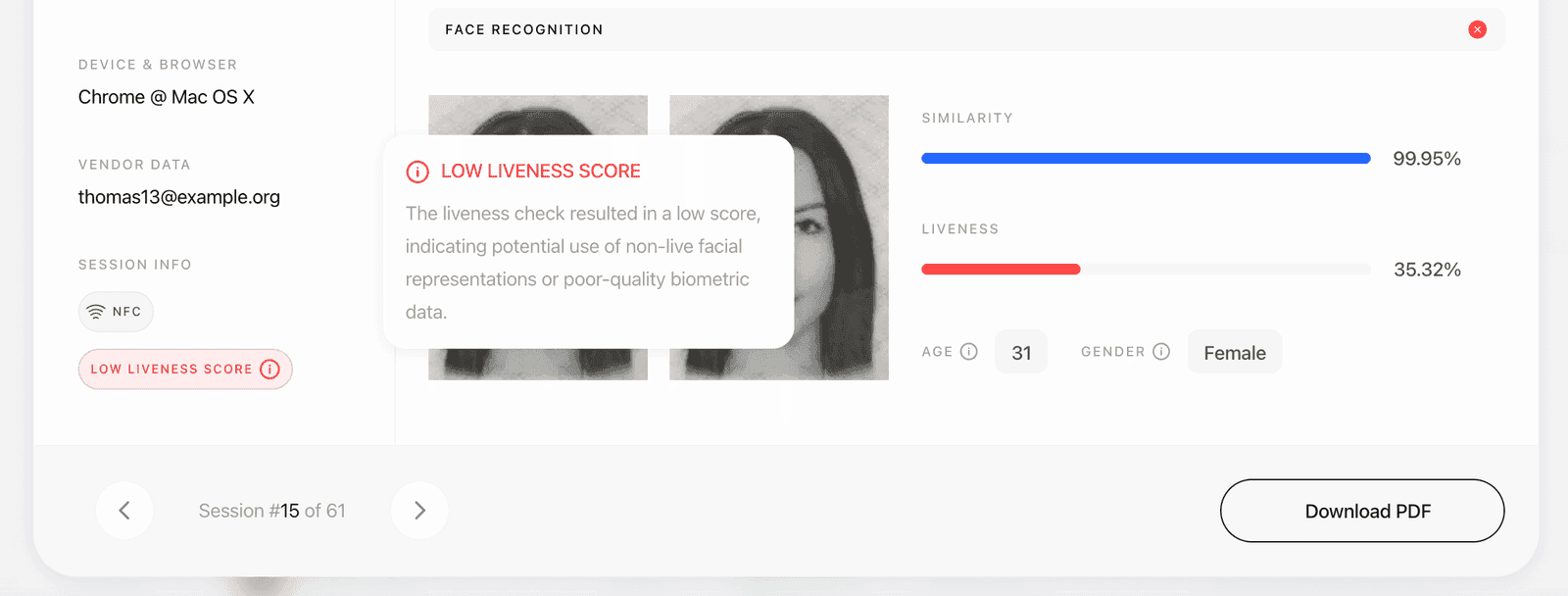
A Didit session flagged for review: a low liveness score warning, with the face match similarity, the liveness score, the estimated age and the device.
Catching repeat and duplicate accounts
Face search 1:N compares a selfie against your own previously verified users and your face blocklists, at no charge.[11] Lists let you block or allow documents, faces, phone numbers and emails across workflows.
Watch: Duplicate Account Detection (Didit Academy)
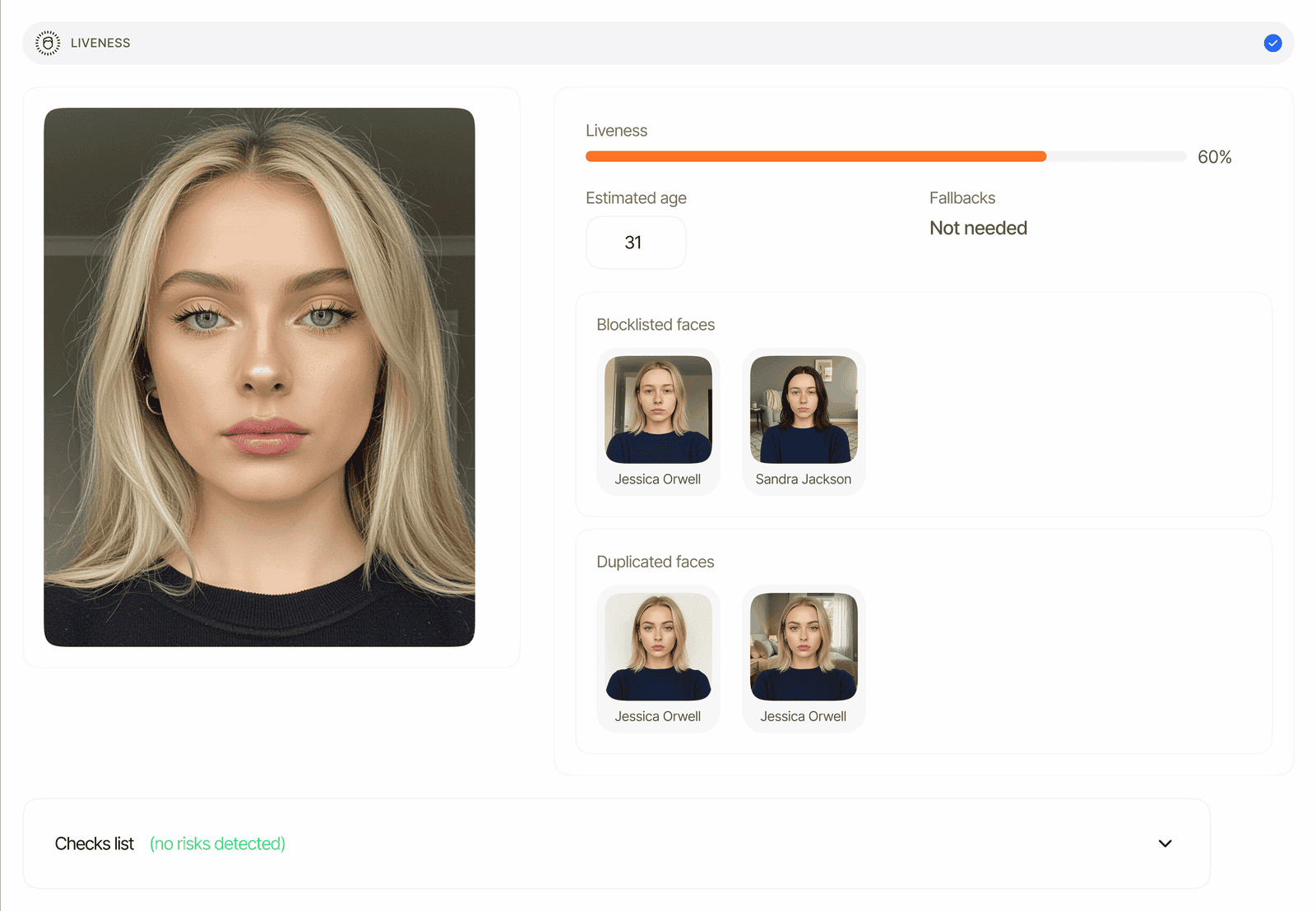
One liveness result in the Didit console: the selfie, the liveness score, the estimated age, blocklisted faces and earlier sessions with the same face.
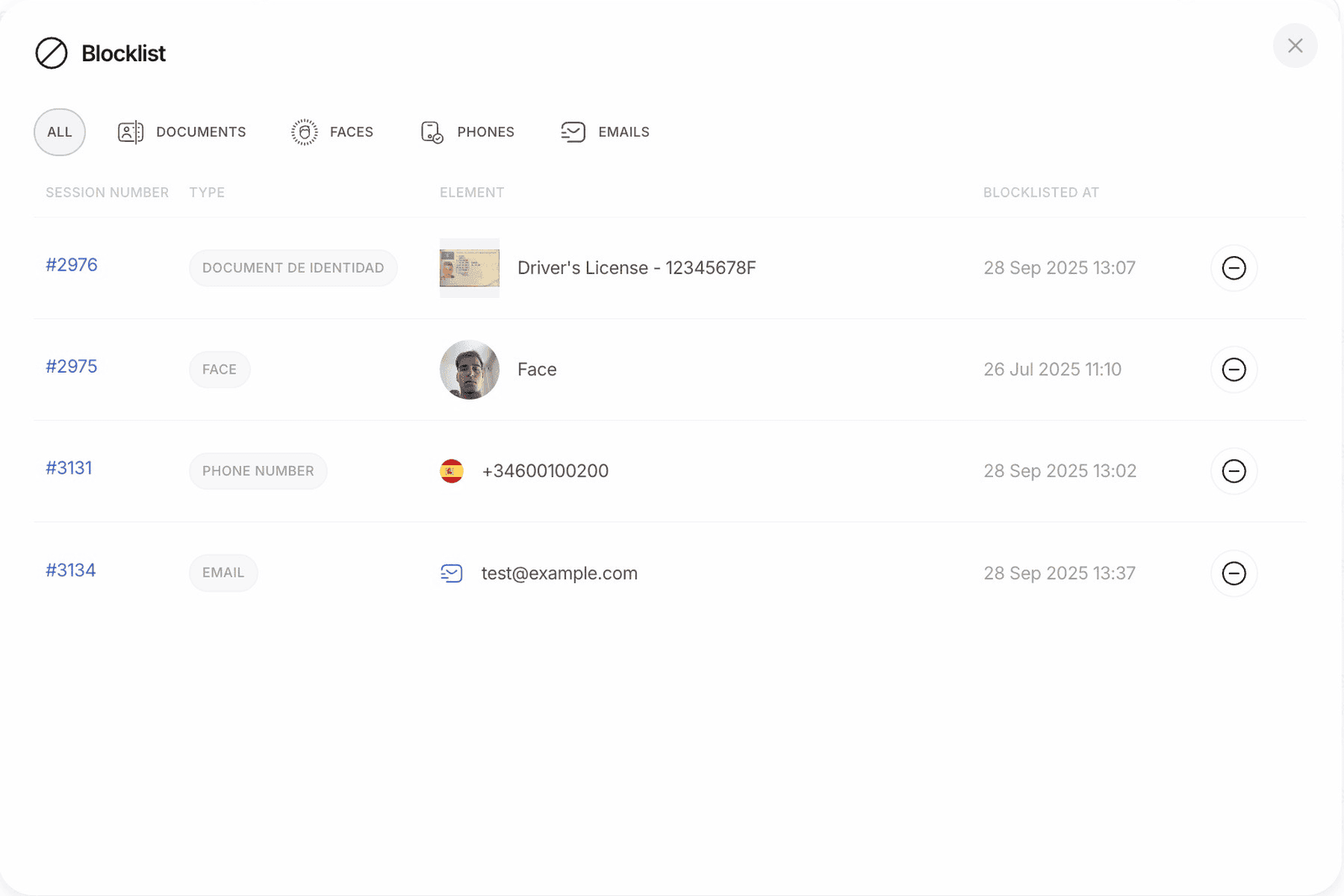
The Didit blocklist: a document, a face, a phone number and an email, each linked to the session it came from.
Didit runs its own liveness models, with three methods set in the workflow, so you choose the friction per risk level: passive, 3D Flash, and 3D Action and Flash, which adds a random action such as a blink.[10] Didit passive liveness is iBeta Level 1 and Level 2 certified for presentation attack detection (ISO/IEC 30107-3). Didit is the only provider formally attested by an EU member-state government (Spain's Tesoro / Banco de España / SEPBLAC) as safer than in-person verification.[18] More than 3,000 companies run Didit in production. Compare the methods on the liveness detection page.
Liveness is priced by method
Passive liveness costs $0.10 inside a workflow and is part of the $0.33 bundle. Active liveness costs $0.15 when your risk policy calls for a stronger challenge.[7]
Moving to Didit: a parallel pilot
Run Didit beside your current setup, whether it is built on Paravision components or another provider.
- Pilot a traffic share: create a console account and route a slice of onboarding through Didit while your current flow stays live.
- Configure the mappings: map your verification workflows, statuses, rules, cases and webhooks to Didit workflows, statuses, lists, cases and webhooks. This configuration is separate from importing history, so build it in the console.
- Dry-run the history import: send historical verifications to
POST /v3/session/imports/with yourworkflow_id, astatus_mappinganddry_runfirst.[20] - Check the terminal status: a PENDING response means the job was accepted, not completed. When the job finishes, reconcile the created, updated, skipped and failed counts against your source records.
- Expand with evidence: raise the traffic share as the pilot criteria below are met.
Pilot evaluation criteria:
- Completion rate for the same user segment on each flow.
- Cost per completed check on your basket, against the $0.33 bundle plus any separate modules.
- Manual review time per case, with evidence on one record.
- Duplicate and blocklisted faces caught by free 1:N search.
- Webhook and status mappings arriving correctly in your systems.
- Import reconciliation: created, updated, skipped and failed counts match your source.
One account from onboarding into monitoring
For solution providers, integrators and identity teams, we recommend Didit: a verified person or business stays on one record, so AML screening, ongoing monitoring, transaction alerts and cases attach to the same account.
- Investigator: $0.20 per reviewed item. It reads verifications, alerts and cases and writes a cited report with a recommendation, deciding alone only inside your policy and autonomy level.
- Copilot and MCP: Copilot builds workflows, questionnaires and database validation in the console. The OAuth 2.1 hosted MCP server lets your own agents work with verification records.
- Start without a sales call: open the console at https://business.didit.me and build a flow. From 1 November 2026 the Free plan includes $10 of credit every month, as set out in the pricing announcement.[21]
Price your own flow in the console
Create an account, assemble the checks you need and see each step's price while you build.
Frequently Asked Questions
What does Didit's $0.33 cover?
One completed check: ID verification ($0.15), passive liveness in a workflow ($0.10), face match ($0.05) and device and IP analysis ($0.03).[7] Database validation, national eIDs, NFC, AML, KYB and phone checks are separate modules with their own published prices.
Can I bring historical verifications into Didit?
Yes, through the import API with a workflow_id, a status_mapping and a dry run. Workflows, rules and cases are configured in the console.[20]
What can I run on one Didit record?
Identity checks, device, IP, email and phone signals, AML screening and ongoing monitoring, transaction monitoring, wallet screening, cases and Investigator review, all attached to the same verified user or business.[15][16]
Sources
- Product, Paravision, checked 25 and 27 October 2026.
- Liveness, Paravision, checked 25 October 2026.
- Face Recognition, Paravision, checked 25 October 2026.
- Deepfake Detection, Paravision, checked 25 October 2026.
- Age Estimation, Paravision, checked 25 October 2026.
- Digital identity verification, Paravision, checked 25 October 2026.
- Pricing, Didit docs, checked 27 October 2026.
- ID verification, Didit docs, checked 27 October 2026.
- National digital ID catalog, Didit docs, checked 27 October 2026.
- Database validation, Didit docs, checked 27 October 2026.
- Face search 1:N, Didit docs, checked 27 October 2026.
- Device and IP analysis, Didit docs, checked 27 October 2026.
- Email verification, Didit docs, checked 27 October 2026.
- Phone verification, Didit docs, checked 27 October 2026.
- AML screening, Didit docs, checked 27 October 2026.
- Transaction monitoring, Didit docs, checked 27 October 2026.
- Business verification, Didit docs, checked 27 October 2026.
- Certifications, Didit docs, checked 27 October 2026.
- AhoraCrypto success story, Didit blog, checked 27 October 2026.
- Import verifications, Didit docs, checked 27 October 2026.
- New pricing from 1 November 2026, Didit blog, checked 27 October 2026.
- Age estimation, Didit docs, checked 27 October 2026.
- Workflows, Didit docs, checked 27 October 2026.
- Jurisserv success story, Didit blog, checked 27 October 2026.
Related articles
- Didit vs ID R&D: IDLive Face liveness or a hosted KYC API
- Didit vs TECH5: a hosted KYC API vs biometrics for ID programmes
- Didit vs Trust Stamp: published prices vs a quote-led KYC suite
- Didit vs FaceTec: Hosted Liveness, Full Evidence, Published Prices
- Didit vs Nametag: customer KYC API vs workforce identity checks
- Didit vs Keyless: verifying new users vs biometric login