
Didit vs Plaid IDV: identity and fraud vs a data-network add-on
Compare Didit and Plaid IDV: published $0.33 KYC bundle, government databases in 45 countries, six live national digital IDs, KYB and transaction monitoring in one platform.
Choose Didit when identity and fraud controls must work across your product.
For fintech teams evaluating Plaid Identity Verification, Didit offers a $0.33 KYC bundle plus government database checks, national digital IDs and post-onboarding monitoring in one account.
- Budget from published unit prices. The $0.33 KYC bundle includes ID verification ($0.15), passive liveness ($0.10), face match ($0.05) and device/IP analysis ($0.03). Additional modules are priced separately. Didit pricing.
- Keep evidence available to reviewers. Results, extracted fields, images and warnings are available through the API, with case management and an Investigator agent at $0.20 per reviewed item. Investigator documentation.
- Evaluate documented trust controls. Didit has SOC 2 Type 1 and Type 2 reports and ISO/IEC 27001 certification. Public certification details.
Comparing core capabilities
Fintech engineering and risk leaders often begin with Plaid to link user bank accounts for balance checks and payment initiation. However, when compliance obligations require rigorous anti-money laundering controls, business entity onboarding, or continuous transaction risk analysis, relying on an add-on product can create operational silos. The table below compares the documented capabilities of Didit and Plaid IDV using public primary documentation.
| Capability | Didit Scope | Plaid Public Scope (Reviewed 25 October 2026) |
|---|---|---|
| Pricing transparency | Published pay-per-use rates; $0.33 full KYC bundle.[2] | Included on Pay as You Go, Growth, and Custom plans; per-check prices revealed upon Production application; Growth and Custom require minimum spend and annual commitments.[11][3] |
| Integrating company geography | Global self-serve access via Business Console.[5] | Restricted to integrating companies established in the US, Canada, or the UK.[4] |
| Document verification | 14,000+ documents supported across more than 220 countries and territories ($0.15 unit).[2] | Supports 16,000+ government ID types; verifies name and DOB against user input.[4] |
| Biometrics & liveness | Passive liveness ($0.10), active liveness ($0.15), and 1:1 face match ($0.05). iBeta Level 1 PAD compliant. | Selfie Check with liveness detection and 1:1 document face match.[4] |
| Government database checks | Direct connections across 45 countries plus a Global group, including registry photo matching in select jurisdictions.[12][13] | Data Source Verification in 40 countries (records such as voter and driver registration, property and credit bureau); optional US AAMVA.[4] |
| Device & network risk | Device fingerprinting, IP risk, VPN/proxy/Tor detection, and geolocation analysis ($0.03).[2] | Anti-fraud engine evaluates device, network, and behavioral signals during session.[4] |
| Phone & email risk | Email verification ($0.03) and phone verification ($0.04 + carrier fees) with risk scoring. | Phone number verification and risk analysis through SMS OTP.[4] |
| AML screening & monitoring | Screening against 1,300+ sanctions and PEP lists ($0.20); ongoing monitoring at $0.07/user/year.[2] | Plaid Monitor screens sanctions and PEPs; charges base fee and monthly rescan fee.[3][14] |
| Business verification (KYB) | KYB from $2.00 per business with free registry search and a linked KYC for every owner.[6][30] | Entity (business) watchlist screening via Monitor.[14] |
| Transaction monitoring (Didit) and fraud intelligence (Plaid Protect) | Real-time rule engine with 150+ preset rules, alerts linked to user ($0.02/tx).[7][15] | Plaid Protect is a separate fraud-intelligence product, US-only and in early availability; it scores fraud risk with the Trust Index.[1] |
| Developer MCP server | Hosted MCP server at mcp.didit.me over OAuth 2.1 for operational inspection.[16][17] | Dashboard MCP for production diagnostics; local MCP in AI coding toolkit.[18] |
Comparative pricing analysis
Budget predictability is critical when selecting risk infrastructure. Plaid documents that Identity Verification is billed per event (including anti-fraud evaluation, document check, selfie check, and country-dependent data source verification), with user retries billed as new sessions.[3] Plaid offers Pay as You Go, Growth, and Custom plans with IDV and Monitor marked as included, but per-check unit prices are unpublished and revealed upon Production application, with Growth and Custom tiers requiring minimum spend and annual commitments.[11][3]
Didit charges per successful check, allowing companies to calculate their cost structure directly from list prices. The full KYC bundle costs exactly $0.33, consisting of ID verification ($0.15), passive liveness detection ($0.10), 1:1 face match ($0.05), and device and IP risk analysis ($0.03).
| Monthly Verification Volume | Didit List Price Budget (Full KYC Bundle) | Plaid IDV Public Plan Pricing |
|---|---|---|
| 1,000 checks | $330 | Included on Pay as You Go, Growth, and Custom plans; per-check prices are shown when applying for Production access (Growth and Custom plans carry minimum spend and annual commitments).[11][3] |
| 10,000 checks | $3,300 | Included on Pay as You Go, Growth, and Custom plans; per-check prices are shown when applying for Production access (Growth and Custom plans carry minimum spend and annual commitments).[11][3] |
| 50,000 checks | $16,500 | Included on Pay as You Go, Growth, and Custom plans; per-check prices are shown when applying for Production access (Growth and Custom plans carry minimum spend and annual commitments).[11][3] |
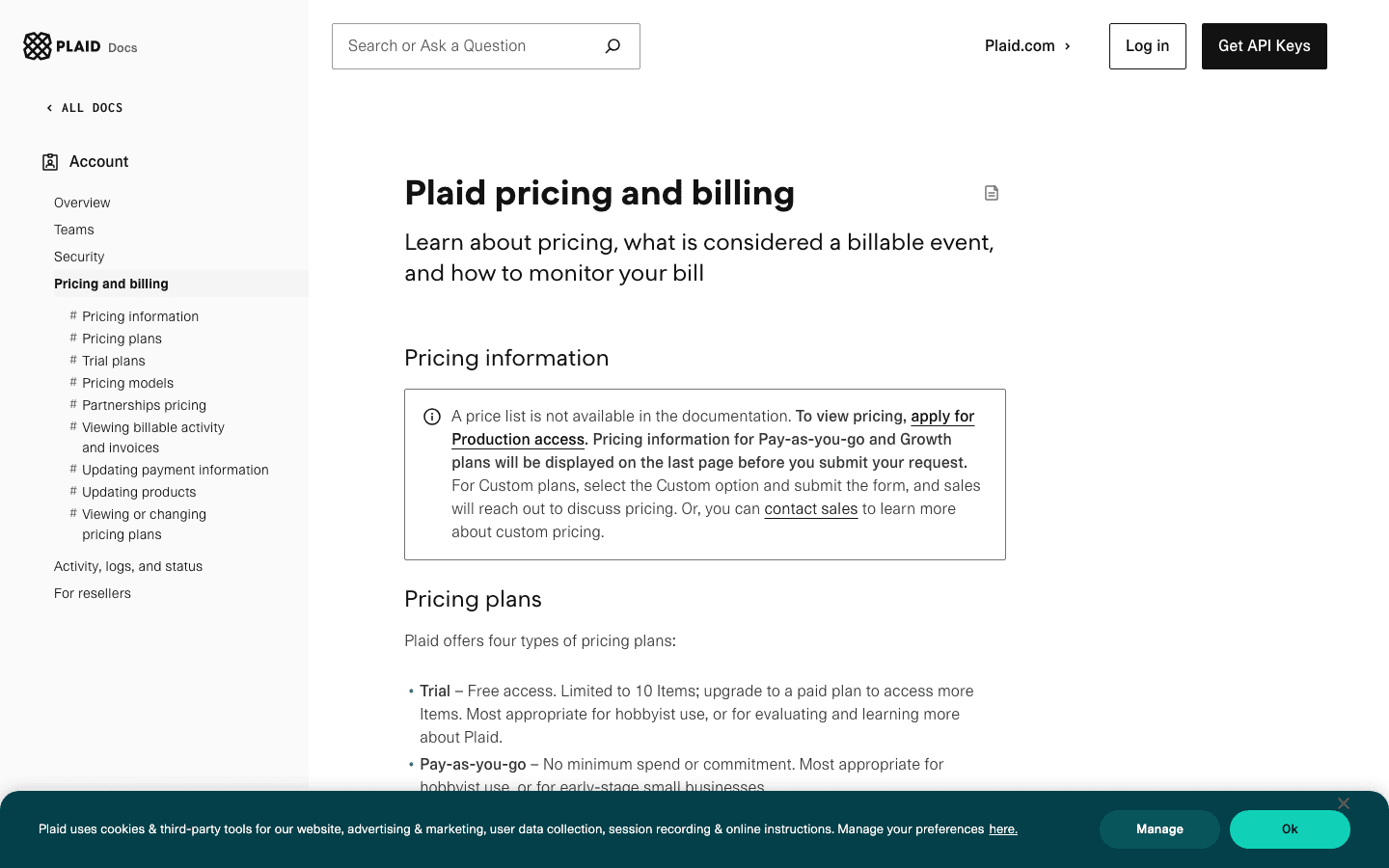
Plaid's billing docs on 25 October 2026: "A price list is not available in the documentation. To view pricing, apply for Production access."[3]
Pricing assumptions: Totals reflect successful completed full KYC bundles in USD at standard list rates. Figures exclude applicable taxes, custom enterprise volume terms, and separately billed modules such as national digital identity verification, government database validation queries, carrier SMS fees, AML screening, or transaction monitoring.
Direct government validation and live national digital identity methods
Standard documentary KYC verifies whether a physical credential appears unaltered. In high-risk financial flows, compliance teams often require corroboration against official records or cryptographically issued state credentials.
Didit connects directly to authoritative government registers across 45 countries plus a Global group.[12] In jurisdictions such as Argentina (RENAPER) and Panama (SIB), Didit supports direct 1:1 facial biometric matching between the user's live capture and their official civil registry photo.[13][23] In Nigeria, verification against BVN or NIN returns an authoritative, source-verified biometric verdict.[25]
Watch: Government Database Checks (Didit Academy)
For European operations, Didit provides direct integration with six established national digital identity methods, allowing users to verify their identity via bank-backed or state-issued digital credentials:
- MitID: Denmark
- BankID Sweden: Sweden
- iDIN: Netherlands
- Finnish Trust Network (FTN): Finland
- Smart-ID: Estonia, Latvia, Lithuania, and Belgium
- Mobile-ID: Estonia and Lithuania
Because these national digital identity schemes return cryptographically signed identity attributes rather than portrait photographs, workflows requiring biometric facial matching can configure document fallback or lookups within Didit's workflow engine.
Regulatory conclusions and security certifications
Buyers can review two kinds of public evidence. Spain's Treasury published the Didit sandbox conclusions; the supervisor records that SEPBLAC positively assessed the added safeguards for remote identification (official report, accessed 27 October 2026). Separately, Didit has audited SOC 2 Type 1 and Type 2 reports and ISO/IEC 27001 certification.
Today, 3,000+ companies rely on Didit's infrastructure. Didit supports 14,000+ document types in more than 220 countries and territories. In a published customer story, cryptocurrency exchange AhoraCrypto reported achieving more than 20% savings per user compared with its prior identity verification provider, while reducing the time dedicated to manual user compliance reviews by over 50%.
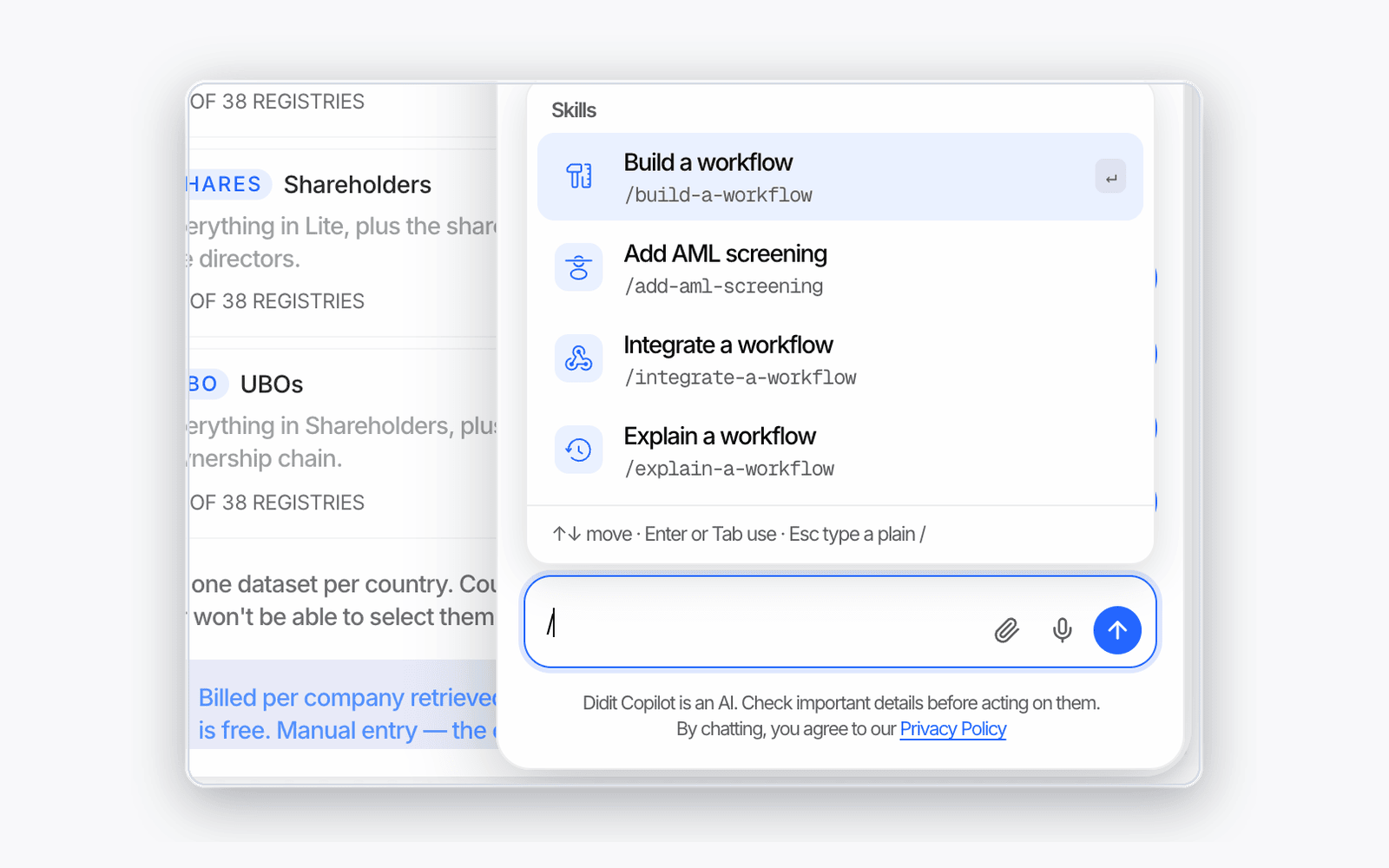
Didit Copilot in the Business Console, shown in the workflow editor where teams draft and edit workflows.[22]
Addressing the existing Plaid integration concern
A frequent consideration for engineering teams is whether moving to Didit requires replacing their existing Plaid bank connectivity. Teams can maintain Plaid bank linking for account connectivity while Didit handles identity verification and risk operations.
You do not need to replace Plaid's financial data network to use Didit. Identity verification and financial account linking operate via distinct endpoints. Teams can keep Plaid Link for consumer bank account connectivity while orchestrating identity verification, biometrics, AML sanctions screening, transaction monitoring, and KYB business onboarding through Didit. Alternatively, companies seeking to consolidate vendors can use Didit's bank verification modules for open banking verification where applicable.
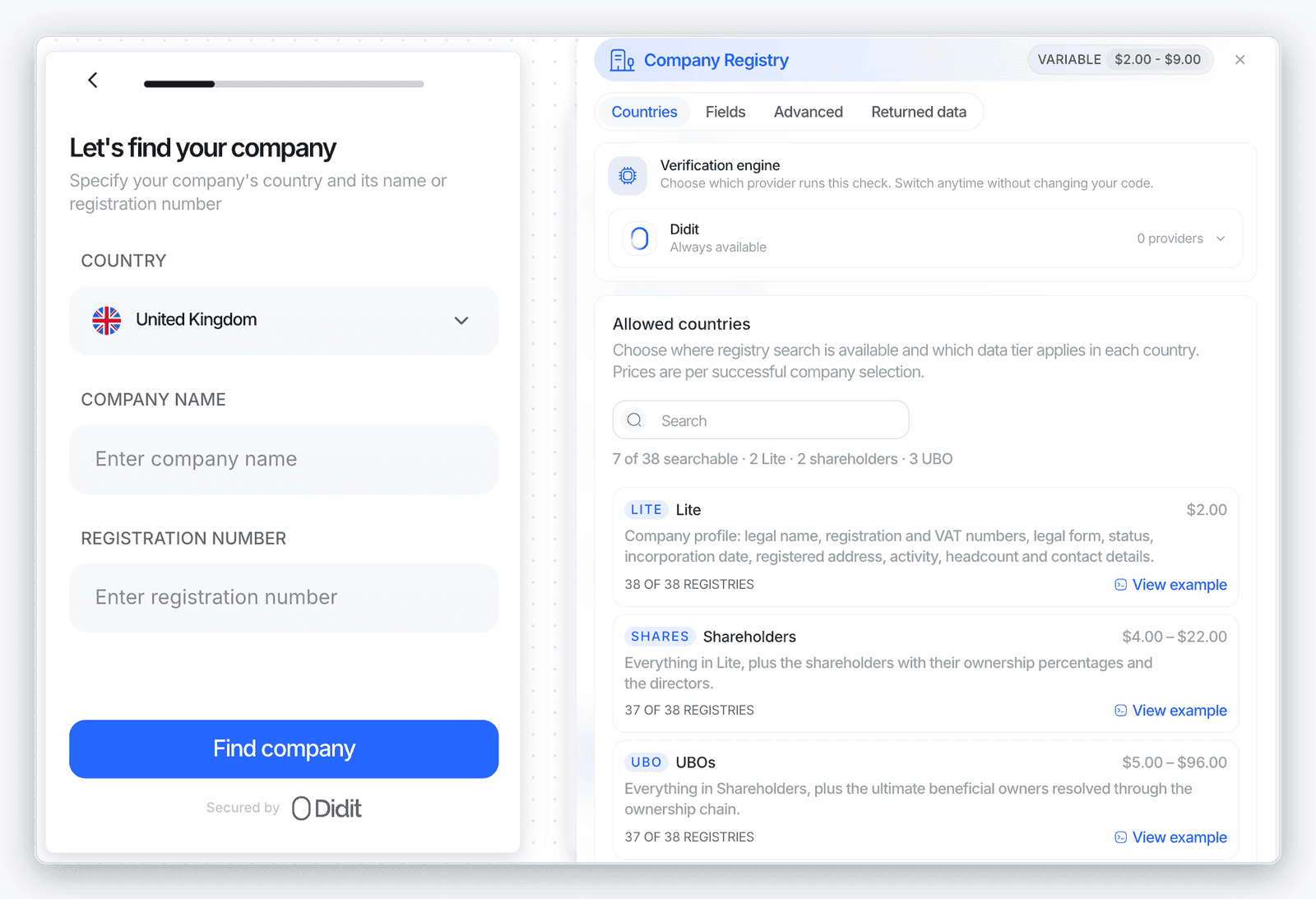
Company registry configuration in Didit, integrating corporate documentation and linked owner verification on the same account record.[30]
Structured migration from Plaid IDV to Didit
Transitioning verification providers can be executed methodically through a staged parallel run. Didit provides a dedicated historical verification import API that enables risk teams to import historical records through a dry run, explicit status mapping and reconciliation, while running workflows in parallel on a portion of traffic.
| Plaid IDV Concept | Didit Platform Architecture | Migration Action |
|---|---|---|
| IDV Template | Workflow Builder Flow | Recreate verification criteria, risk steps, and conditional branching in Didit's console. |
| Verification Session | Verification Session Record | Map session IDs and user references using Didit's verification import endpoints. |
| Pass / Fail / Retry | Approved / Declined / In Review | Configure explicit status mappings in status_mapping payload during import. |
| Monitor Watchlist Program | AML Screening & Ongoing Monitoring | Enroll historical entities into continuous AML screening for sanctions and PEP alerts. |
| Webhook Events | Didit Webhook Subscriptions | Subscribe internal ingestion services to Didit session decision and risk event webhooks. |
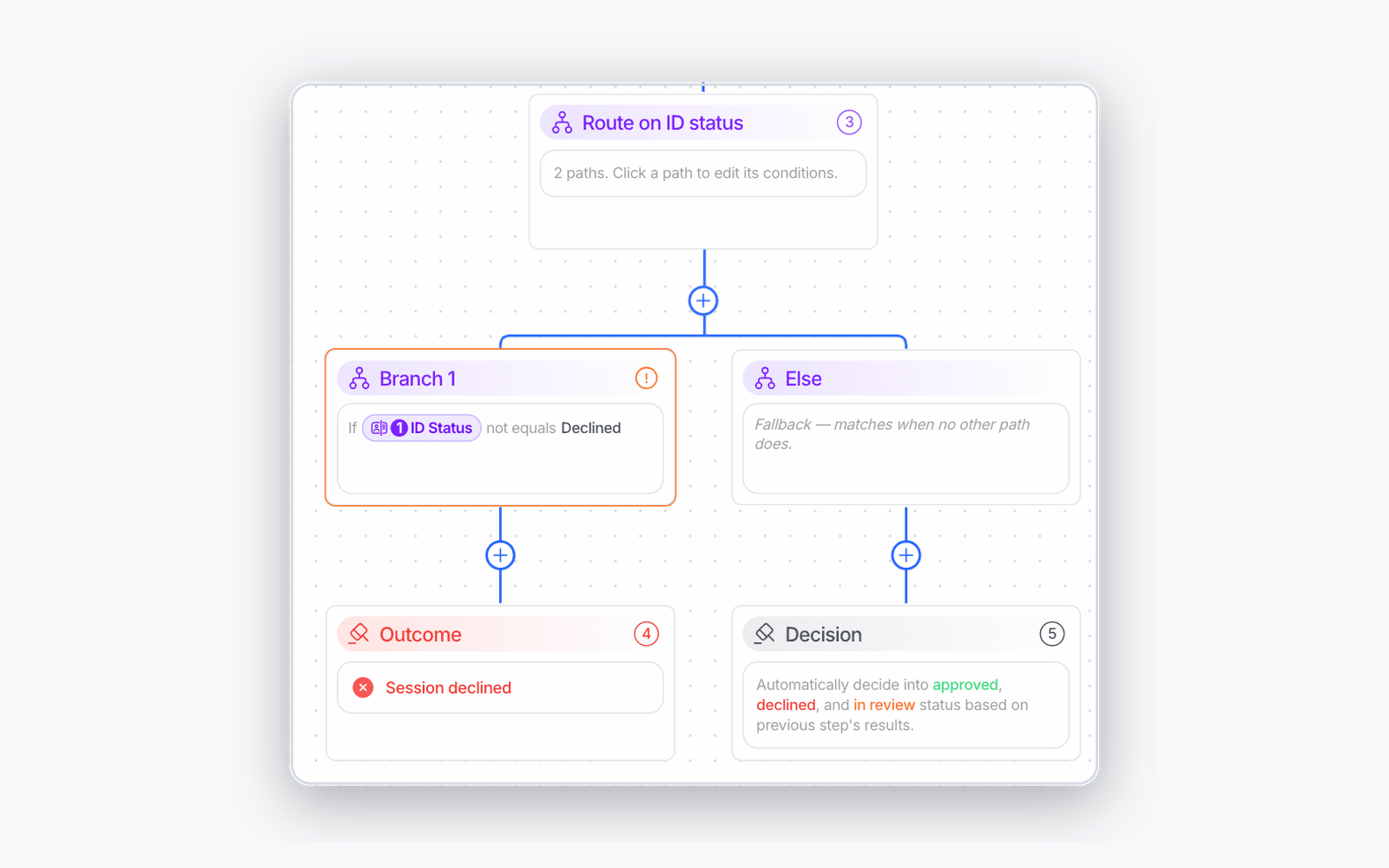
The Didit workflow builder provides automated validation, identifying contradictory path rules before production deployment.[22]
To execute a smooth transition, follow this phased implementation path:
- Phase 1Configure workflows and simulationRegister in the Business Console, define verification steps, and validate edge cases using the sandbox Test mode.
- Phase 2Execute dry-run historical importExport historical identity records from Plaid before contract conclusion. Ingest records via Didit's import API using
POST /v3/session/imports/withdry_run: true, specifying yourworkflow_idandstatus_mapping. - Phase 3Reconcile and commit historical dataMonitor import job status counters until terminal completion. Reconcile created, updated, skipped, and failed metrics against the source export.
- Phase 4Parallel traffic pilotSplit onboarding traffic dynamically, routing a defined percentage through Didit's SDKs to evaluate conversion rates, verification speed, and fraud mitigation against legacy flows.
- Phase 5Cutover and expandTransition remaining verification traffic to Didit, subsequently enabling linked KYB, continuous AML monitoring, and real-time transaction scoring.
The full Didit platform: unified identity and risk operations
Didit provides a unified architecture for identity and fraud operations. Rather than managing fragmented vendors for onboarding, watchlist screening, and payment monitoring, Didit consolidates every signal into a single identity profile:
- NFC chip verification: Cryptographic NFC chip verification for e-passports and identity cards ($0.15).
- Duplicate-account checks: Face search 1:N against your own users and blocklists to catch multi-accounting and repeat fraudsters.
- End-to-end operational visibility: Maintain an unbroken audit trail from initial applicant verification through business ownership resolution (KYB from $2.00 per business with linked owner KYC) to ongoing AML monitoring ($0.07 per user annually). Registry search is free.
- Transaction monitoring and asset screening: Protect fund flows with real-time rule evaluation ($0.02 per transaction) and crypto wallet screening ($0.15 per check), along with Travel Rule messaging via IVMS 101.
- AI-driven compliance operations: Deploy the Investigator agent ($0.20 per reviewed item) to analyze flagged sessions and transaction alerts, generating detailed, cited analytical summaries that guide human compliance officers within strict policy boundaries. Organizations can also deploy Didit's automated support agent alongside review workflows.
- Developer tooling and agentic integration: Leverage Copilot in the Business Console to generate draft workflows from natural language, or integrate internal risk systems directly using Didit's hosted Model Context Protocol (MCP) server running over OAuth 2.1.
Teams can start with Didit by accessing the self-serve Business Console without a sales call. As announced in Didit's public pricing update, from 1 November 2026 the Free plan includes $10 of credit each month.
Sources
- Plaid KYC and AML documentation overview, Plaid docs, reviewed 25 October 2026.
- Didit platform pricing reference, Didit documentation, verified 27 October 2026.
- Plaid pricing and billing overview, Plaid documentation, reviewed 25 October 2026.
- Plaid Identity Verification technical documentation, Plaid docs, reviewed 25 October 2026.
- Didit July 2026 platform changelog, Didit documentation.
- Didit KYB key people and owner verification, Didit documentation.
- Didit transaction monitoring architecture, Didit documentation.
- Didit crypto wallet screening, Didit documentation.
- Didit Investigator agent technical reference, Didit documentation.
- Plaid homepage and platform overview, Plaid, reviewed 25 October 2026.
- Plaid public plan descriptions, Plaid, reviewed 25 October 2026.
- Didit database validation geographic coverage, Didit documentation.
- Didit non-document lookup and registry photo match, Didit documentation.
- Plaid Monitor technical documentation, Plaid docs, reviewed 25 October 2026.
- Didit transaction monitoring rules library, Didit documentation.
- Didit hosted MCP server specification, Didit documentation.
- Didit MCP operational tooling reference, Didit documentation.
- Plaid MCP server documentation, Plaid docs, reviewed 25 October 2026.
- Didit workflow builder documentation, Didit documentation.
- Didit pricing model release announcement, Didit blog, published October 2026.
- Didit August 2026 platform changelog, Didit documentation.
- Didit September 2026 platform changelog, Didit documentation.
- Argentina RENAPER database validation, Didit documentation.
- Didit government database validation overview, Didit documentation.
- Nigeria BVN registry verification, Didit documentation.
- Mexico CURP authoritative database verification, Didit documentation.
- Database validation metrics and coverage, Didit documentation.
- Biometric template management, Didit documentation.
- Session evidence retrieval API, Didit documentation.
- KYB supported registries and pricing tiers, Didit documentation.
- Didit transaction rules API and backtesting, Didit documentation.
- SDK transaction submission and step-up logic, Didit documentation.
- Didit Travel Rule technical implementation, Didit documentation.
- FIU and suspicious activity report generation, Didit documentation.
Plaid is a trademark of Plaid Inc. Citations in this guide reference publicly available technical documentation and pricing materials as of 25 October 2026 for Plaid and 27 October 2026 for Didit, for nominative comparison purposes.
Ready to build with Didit?
Access the Business Console to configure workflows, test biometric models, and review per-check pricing in a fully enabled sandbox.
Related articles
- EUDI Wallet cross-border acceptance: one integration across the EU
- EUDI Wallet readiness: policies and controls for regulated firms
- EUDI Wallet holder binding: what a presentation really proves
- EUDI Wallet integration: how to choose your route (2026 guide)
- FINTRAC identity verification in 2026: methods, rules, C-12
- Quebec Law 25 and biometrics: identity verification guide (2026)