
Didit vs Regula: hosted checks with full evidence, KYB and monitoring
Didit vs Regula from public pages: Regula's IDV Platform page documents on-premises or hosted-cloud deployment; Didit offers hosted checks at published per-check prices, with full evidence, KYB, monitoring and agents.
In short
This comparison reviews published pricing, documented checks and deployment options. Regula documents SDKs and an IDV Platform that runs on-premises or as hosted cloud.[2][9] Didit provides hosted checks at published per-check prices, and every decision comes back with its full evidence through one API call.[10][11] The same account covers business verification, transaction monitoring and agents, with wallet screening ordered and paid for there too.[13][19][22]
- A full Didit KYC check is $0.33 at a published list price.[10] Regula's SDK pricing article says SDK licence cost depends on deployment size, modules and payment terms; published list prices are not documented on the pages reviewed.[5]
- Business verification, transaction monitoring and crypto wallet screening are not documented on the Regula pages reviewed; Didit prices them at from $2.00 per business, $0.02 per transaction and $0.15 per check.[2][8][10]
- Didit's Investigator agent, Copilot and hosted MCP server do review, configuration and rule work for your team.[22][23][25]
For onboarding teams at banks, fintechs and crypto businesses, three questions decide this comparison: where the checks run, what they cost, and what happens after the first check, when business customers arrive, money starts to move and the review queue grows.
Regula sells document-verification and face-biometrics SDKs, an identity-verification platform and forensic document-examination devices.[1] We build Didit, so read this as our side. Every Regula statement below comes from Regula's own public pages, read on 25 October 2026, and each one is cited.
Didit vs Regula at a glance
| Function | Didit | Regula, per its public pages | Checked |
|---|---|---|---|
| How you run it | Hosted API and console; the decision API returns each check's result and evidence[11] | SDKs for mobile and server; IDV Platform 100% on-premises or hosted cloud[2][9] | 25 Oct 2026 |
| How you buy | Published list price per check; full KYC $0.33[10] | SDK pricing article: licence cost depends on deployment size, modules and payment terms; published list prices not documented on the pages reviewed[5] | 25 Oct 2026 |
| AML screening | $0.20 per check; ongoing monitoring $0.07 per profile per year[10] | AML/PEP screening in the IDV Platform, with a Screening tab in the profile[2][4] | 25 Oct 2026 |
| Business verification | From $2.00 per business, linked KYC for each owner and officer[10][13] | Not documented on the pages reviewed[2] | 25 Oct 2026 |
| Transaction monitoring | $0.02 per transaction, 150+ preset rules, backtesting[10][15] | Not documented on the pages reviewed[2] | 25 Oct 2026 |
| Crypto wallet screening | $0.15 per check, signed PDF report[19] | Not documented on the pages reviewed, including the fintech and crypto page[8] | 25 Oct 2026 |
| Case management | Cases with goAML XML and PDF report drafts for your filing[18] | Case Management module with an audit trail, IDV Platform 3.9[3] | 25 Oct 2026 |
| MCP and agents | Hosted MCP server, Investigator agent, Copilot[22][23] | Not documented on the pages reviewed[2] | 25 Oct 2026 |
Regula column: regulaforensics.com, docs.regulaforensics.com and support.regulaforensics.com. Didit column: docs.didit.me.
Where the checks run
Regula ships its SDKs for iOS, Android and cross-platform frameworks, with Linux, Windows and Docker packages for server use.[9] Its IDV Platform adds workflows, sessions, profiles, AML/PEP screening and connectors to third-party systems, and Regula says it runs 100% on-premises or as hosted cloud.[2] For SDK deployments, Regula states that data is handled on-premises and is not transferred to third parties.[9]
Didit provides its checks as a hosted service: your app or a hosted link captures the user, Didit runs the document, liveness, face match, database and AML checks you configured, and your backend reads the decision through one API call.[11]
Regula
SDKs and an IDV Platform
- Document Reader SDK and Face SDK
- IDV Platform on-premises or hosted cloud
- SDK licence cost tied to deployment size, modules and payment terms
regulaforensics.com
Didit
A hosted service you call
- One API for identity and compliance checks
- Evidence returned with every decision
- Published price for every check
business.didit.me
Both options as each vendor documents them, read on 25 October 2026.[2][5][10]
The evidence behind every decision
Every Didit session decision returns each check's result, the extracted fields, the capture images and videos, and the warnings behind the decision, through one API call.[11] A reviewer, an auditor and your own code read the same decision, and the Didit MCP can trace the warning, status rule or reviewer override behind a declined session.[24]
Regula documents what its Document Reader SDK returns for the document step: it cross-checks data across the MRZ, the visual zone, the barcode and the RFID chip, and returns graphic fields such as the signature and portrait as separate images.[7] On Didit, the document result is returned in the same session decision as the liveness, face match, database and AML results.[11]
Didit's workflow builder shows each step's price while you build, and branches can merge back into one path. The editor flags a branch that contradicts the outcome it routes to, before you publish.[12]
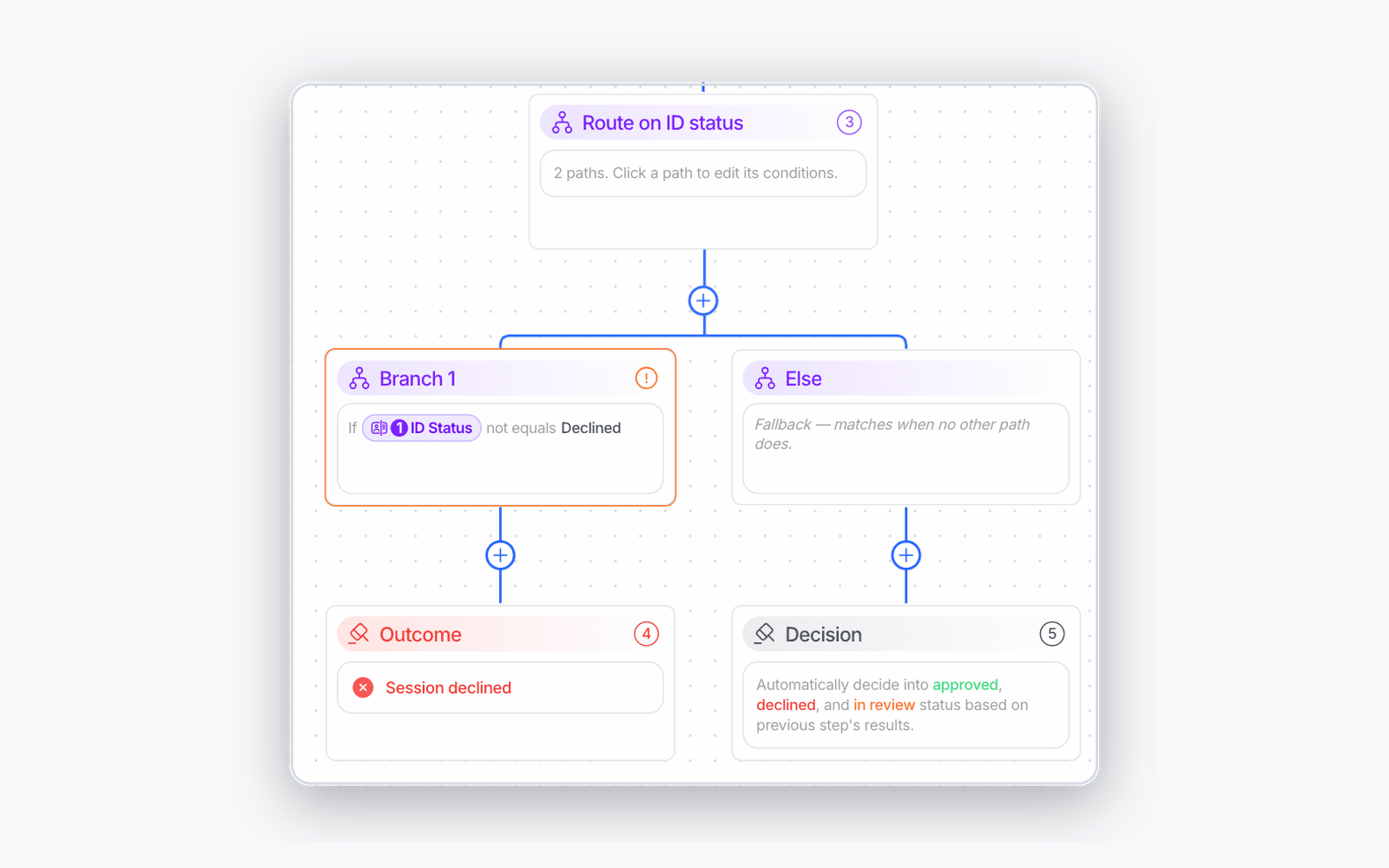
The Didit workflow editor warns about a branch whose condition contradicts the status it routes to.[12][25]
After onboarding: businesses, transactions and wallets
Regula's IDV Platform documents AML/PEP screening against lists, databases and watchlists, with matches reviewed and resolved in a Screening tab added in release 3.5.[2][4] Release 3.9 added a Case Management module that records the user, timestamp and rationale of every action.[3] Business verification, transaction monitoring and crypto wallet screening are not documented on the Regula pages reviewed.[2][8]
Business verification. Didit checks companies in registries across 220+ countries and territories, from $2.00 per business. You choose per country how much registry data you buy: a company profile, or shareholder and UBO data where the registry holds it.[10][14] Didit checks each declared owner and officer against the company's own documents, then screens them and sends each one a linked KYC.[13]
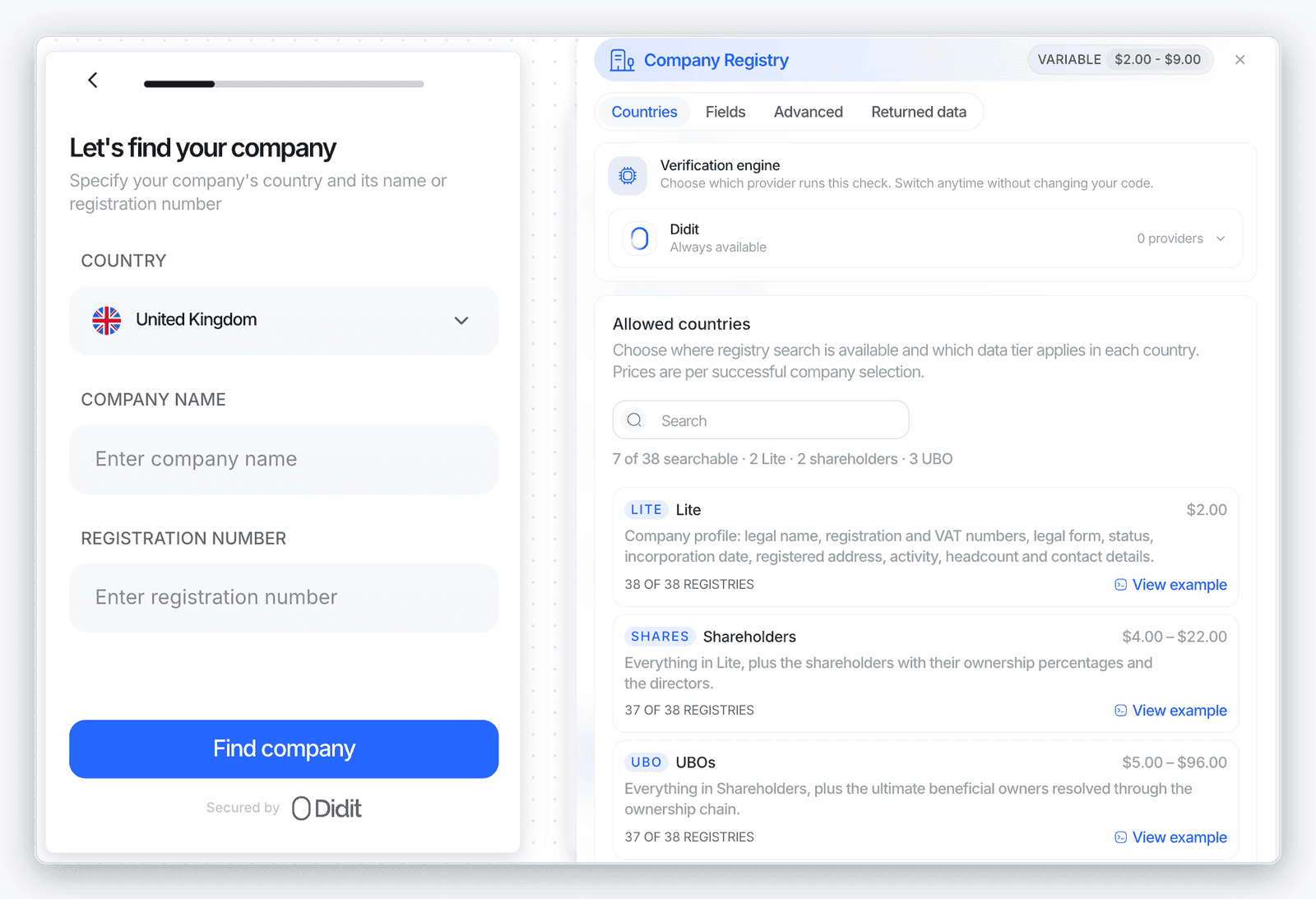
The Company Registry step in Didit: pick Lite, Shareholders or UBOs per country.[14][25]
Transaction monitoring. Didit scores transactions against real-time rules at $0.02 per transaction and ships over 150 preset rules.[10][15] You can backtest a rule against your own history before you switch it on.[16] When a rule flags a transaction, Didit can hold it and ask the user for one selfie, matched against the face they already verified.[17] Didit drafts SAR, STR and other FIU reports from the case and exports them as goAML XML and PDF for your filing.[18]
Crypto wallet screening. Screen any crypto wallet address on demand for $0.15 per check, with a signed PDF report.[19] Wallet screening runs on blockchain-analytics providers, and you order it, read it and pay for it in your Didit account.
1Verify the person or the company
KYC at $0.33, or KYB from $2.00 per business with a linked KYC per owner.
2Screen the name and the wallet
AML at $0.20; wallet screening at $0.15 per check.
Does a transaction rule fire
Possible step-up
Didit can hold the transaction and request one selfie matched against the verified face.
No rule triggered
Scored and logged at $0.02 per transaction.
KYC, KYB, transaction monitoring and wallet screening in the same Didit account.[10][17]
Government database checks in the same flow
Didit's catalog documents government and authoritative database checks in 45 countries plus a Global group: a government register in most countries, and a credit-bureau, financial-services, utility or residential file in some.[20] Most services list the inputs they need and the fields they return, and most run in the same workflow as the document and selfie; a few are standalone only. Where the national register holds a photo, as in Argentina, Nigeria, Panama and South Africa, Didit matches the user's selfie against it.[21]
| Country and source | What you send | What comes back |
|---|---|---|
| Argentina, RENAPER | Document number, gender, selfie | Names, date of birth, tax ID, face match score[20] |
| Mexico, CURP | CURP | CURP status, names, date and state of birth[20] |
| Panama, SIB | Cédula number, selfie | Identification number and a face match against the register[20] |
| South Africa, Home Affairs | National ID number | Register photo to match against the selfie[21] |
Regula's platform page mentions screening customers against AML/PEP lists, databases and watchlists; checks against named government identity registers are not documented on the pages reviewed.[2]
Agents that operate the platform
Didit is agentic: it automates compliance work that would otherwise need another analyst. The Investigator agent reads each verification, transaction alert or case waiting for review, writes a report with a recommendation and cites the evidence it used. It decides on its own only within the policy and autonomy level your team sets, it never files a regulatory report, and every action is logged.[22] It runs on Didit's Growth plan and above, Didit enables it per organization, it is not available in sandbox, and it costs $0.20 per reviewed item. A support agent answers your users' support conversations from $0.02 per message.
Describe the verification flow you need and Didit Copilot builds a validated draft workflow, citing the documentation it used.[26] Publishing requires your confirmation, and when it edits a workflow, a change card lists what changed and Undo reverts it.[26][25]
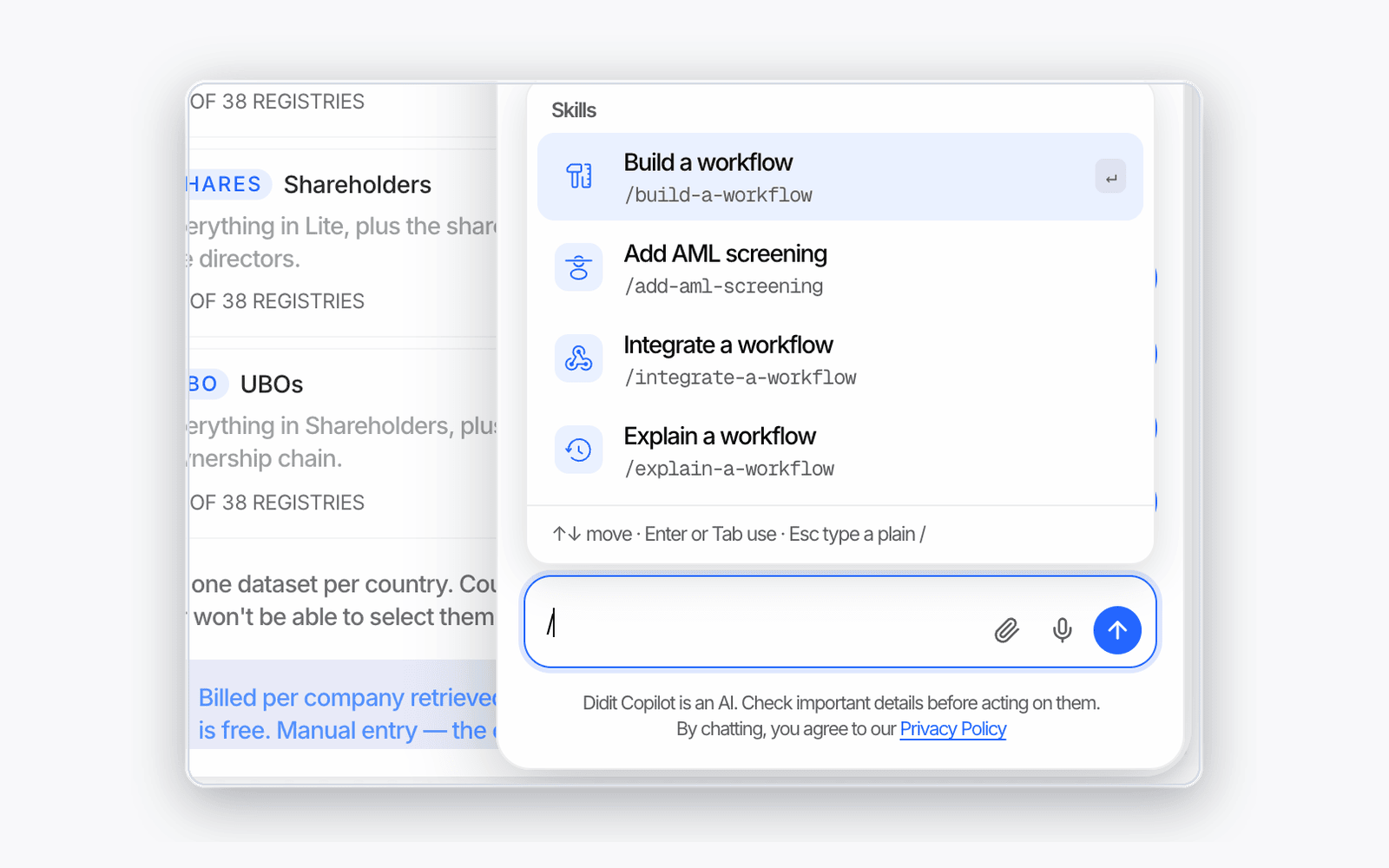
Copilot in the Didit workflow editor, with its slash skills and the AI disclosure under the composer.[25]
Didit's hosted MCP server at mcp.didit.me connects over OAuth 2.1 with Log in with Didit. There is no API key to paste.[23] Your AI agent can create, backtest and install transaction-monitoring rules through the Didit MCP, then hand them to you in test mode, and it can explain why a session was declined by tracing the warning, status rule or reviewer override behind it.[24] An MCP server or a customer-facing AI agent is not documented on the Regula pages reviewed.[2]
Trace the warning, status rule or reviewer override
A support question answered by an agent through the Didit MCP.[24]
Pricing: Didit's list prices and Regula's documented SDK terms
Didit publishes a list price for each billable check and charges a session only for the checks it runs. A full KYC check (ID verification, passive liveness, face match, and device and IP analysis) costs $0.33. AML screening is $0.20, ongoing AML monitoring is $0.07 per profile per year, and active liveness is $0.15.[10] Government database checks are priced per country on the pricing page.
Regula's SDK pricing article says the cost of an SDK licence depends on the size of the deployment, the modules deployed and the payment terms, which can be semi-annual, annual or multi-year upfront.[5] Its licensing docs describe a transaction-based model in which the billing system counts processed transactions, and an online demo licence for all Regula products, valid for 30 days and 2,000 transactions, from the Regula Client Portal.[6] Published list prices are not documented on the pages reviewed.[5]
Prices as of 25 October 2026
Didit's plans change on 1 November 2026. The per-check list prices quoted here stay the same on the new plans.[27]
Moving from Regula to Didit
- List the Regula components you run today: SDKs, the IDV Platform, devices, and the workflows built on them.
- Rebuild the online flow in Didit's workflow builder, or describe it to Copilot, and read the price of each step.
- Map your current outcomes to Didit's Approved, Declined and In Review statuses in your backend and webhooks.
- Route a share of new sign-ups to Didit and compare approval rates, fraud caught and cost on your own users.
- Add business verification, transaction monitoring and wallet screening in your Didit account.
- Day 1Open an accountSandbox and console, no quote to request.
- Week 1Build and testWorkflow, webhooks, your own documents.
- PilotRun in parallelA share of traffic on each vendor.
- RenewalDecide on the restWhen your Regula licence terms allow.
A staged move. Timing depends on your volumes, your licence terms and any in-person processes you keep.
How Didit helps teams switching from Regula
Didit runs KYC, KYB, AML screening and transaction monitoring as one hosted service, with wallet screening in the same account, priced per check, with agents that take review work off your team. See the Regula alternative page for the side-by-side, the pricing page to price your flow, or the business verification page for KYB.
Didit provides
- Document, liveness, face match and database checks
- Registry checks with a linked KYC per owner
- Transaction rules, wallet screening and cases
- Investigator reports, Copilot and the MCP server
Stays with you
- Your risk assessment and policies
- The autonomy level each queue may use
- Filing reports with your financial intelligence unit
- Any in-person or device-based checks you keep
Price your onboarding flow on Didit
Rebuild the flow in the sandbox and see the list price and the evidence of each step before you commit.
Key takeaways
- Regula describes SDKs, an IDV Platform with on-premises or hosted-cloud deployment, and forensic devices; Didit provides hosted checks through its API.[1][2][11]
- Didit publishes a price for every check, with full KYC at $0.33; Regula's SDK pricing article ties licence cost to deployment, modules and terms.[5][10]
- Business verification, transaction monitoring and wallet screening are ordered in the same Didit account; they are not documented on the Regula pages reviewed.[2][8]
- The Investigator, Copilot and the MCP server do review, configuration and rule work, within your policy.
Frequently asked questions
What is the main difference between Didit and Regula?
Regula documents SDKs, forensic devices and an IDV Platform with on-premises or hosted-cloud options.[1][2][9] Didit publishes per-check prices and offers KYC, KYB, transaction monitoring and wallet screening in one account.[10][19]
How is Regula priced?
Regula's SDK pricing article says SDK licence cost depends on deployment size, modules and payment terms, and its docs describe a demo licence valid for 30 days and 2,000 transactions. Published list prices are not documented on the pages reviewed.[5][6]
Does Regula offer AML screening and case management?
Yes. Regula's IDV Platform documents AML/PEP screening with a Screening tab and, since release 3.9, a Case Management module with an audit trail. Didit also offers transaction monitoring and wallet screening in the same account.[3][4][10][19]
Can Didit verify businesses and their owners?
Yes. Didit checks the company in registries across 220+ countries and territories from $2.00 per business, then checks, screens and sends a linked KYC to each declared owner and officer.[10][13]
What data does a Didit decision return?
Each check's result, the extracted fields, the capture images and videos, and the warnings behind the decision, through one API call.[11]
Can I run Didit next to Regula while I switch?
Yes. Each verification runs through its own vendor's integration, so you can route part of your sign-ups to Didit, compare results and cost, and move the rest when your licence terms allow.
Is Didit a good Regula alternative?
Yes, for teams that want a hosted service: a published price for every check, full evidence on every decision, KYB, monitoring and wallet screening in one account, and agents that take review work off the team.[10][11][22]
Sources
- About Regula, Regula, read 25 October 2026.
- Regula IDV Platform, Regula, read 25 October 2026.
- IDV Platform release 3.9, Regula docs, read 25 October 2026.
- IDV Platform release 3.5, Regula docs, read 25 October 2026.
- Pricing: SDK licensing models, Regula support, read 25 October 2026.
- Document Reader SDK licensing, Regula docs, read 25 October 2026.
- Document Reader SDK, Regula, read 25 October 2026.
- Fintech and crypto, Regula, read 25 October 2026.
- KYC automation, Regula, read 25 October 2026.
- Pricing, Didit docs, read 25 October 2026.
- Retrieve session, Didit docs.
- Workflows, Didit docs.
- Key people, Didit docs.
- KYB supported countries and data tiers, Didit docs.
- Rules library, Didit docs.
- Transaction rules API and backtesting, Didit docs.
- SDK transaction submission and step-up, Didit docs.
- FIU reports, Didit docs.
- Wallet screening, Didit docs.
- Database validation supported countries, Didit docs.
- Non-document lookup and registry photo match, Didit docs.
- Investigator agent, Didit docs.
- MCP server overview, Didit docs.
- MCP tools, Didit docs.
- September 2026 changelog, Didit docs.
- August 2026 changelog, Didit docs.
- New pricing from 1 November 2026, Didit blog.
Regula and its marks belong to their owner; references here are nominative, for comparison only, and imply no affiliation. To compare on your own traffic, the Regula alternative page has the side-by-side and the steps to start.
Run your onboarding flow on Didit
Start in the sandbox with your own documents and see every check's evidence and price.
Related articles
- Didit vs Unit21: KYC, KYB, AML and monitoring on one record
- Didit vs Trinsic: eID sign-in plus document checks, AML and KYB
- Didit vs Thomson Reuters: government databases plus the whole flow
- Top 10 AI compliance agents for KYC and AML review automation in 2026
- Top 5 Travel Rule compliance solutions for crypto businesses in 2026
- Top 10 eID and EUDI Wallet Verification Providers in 2026