Business
How to Reduce Expenses in the Compliance Department in 2025
Discover effective strategies to reduce compliance costs in 2025. Optimize KYC and AML without compromising security or efficiency.
 Alberto RosasCo-founder and CEO
Contents
In this guide
Jump to the part you need.
Key takeaways
Reducing expenses in the compliance department is essential to improve profitability, especially in highly regulated sectors like fintech, banks, and crypto.
Automating KYC and AML processes with artificial intelligence decreases operational costs and minimizes human errors, increasing the efficiency of the compliance department.
Didit offers a unique solution with free and unlimited KYC, facilitating regulatory compliance without increasing expenses, and providing advanced document verification and facial recognition tools.
Implementing cost optimization strategies in compliance includes identifying areas for improvement, selecting appropriate technologies, training the team, and monitoring results to ensure an effective return on investment.
The fight against money laundering and terrorist financing (AML/CTF) is, today, one of the major concerns for financial institutions and other obligated sectors. However, one of the main barriers remains the continuous increase in costs in the compliance department (along with other hidden expenses, also stemming from regulatory compliance).
Cost optimization and efficiency are key to competing in the market. Therefore, optimizing investment in KYC and AML becomes a priority without risking the security or integrity of processes.
Throughout this article, we will analyze how to reduce expenses in the compliance department in 2025, explore strategies to optimize costs in KYC and AML, and discover how Didit's artificial intelligence can become a key ally to achieve maximum profitability and efficiency: being the first and only market alternative capable of offering free KYC is the key.
The Importance of Optimizing Compliance Costs Without Compromising Security
Compliance departments are a crucial component in companies of all kinds, especially in regulated industries: fintech, banks and neobanks, insurance companies, online casinos and betting sites, crypto… All these sectors are subject to increasingly strict regulations regarding fraud prevention (new directives like AMLD6 or regulations such as MiCA, specific to the crypto sector), and non-compliance can lead to multimillion-dollar fines, irreparable reputational damage, or the revocation of licenses.
- Current Inefficiencies: Even in 2025, many institutions still use manual processes or outsource compliance through expensive solutions (often with unclear pricing). This leads to increased personnel costs and technological licensing fees.
- Risk of Low Profitability: Excessive spending on compliance can significantly reduce profit margins, if not almost eliminate them, especially for SMEs and rapidly growing startups.
- Risk of Low Security: Many current market solutions are modular. This means the more you pay, the more security they offer. Not all businesses can afford the high costs associated with compliance tools, and many criminals can exploit these gaps to infiltrate systems.
- Need for Innovative Technologies: Adopting AI-based solutions minimizes human errors, automates processes, and drastically reduces costs related to identity verification (KYC).
This is precisely where alternatives like Didit emerge. Our free and unlimited KYC service represents a revolution in a traditionally high-cost market.
Key Strategies to Reduce Expenses in Your Company's Compliance Department
Digitalization and automation will be two of the major drivers of change in how institutions work on capital prevention. However, digitalization alone is not enough: it must be done thoughtfully and strategically, leveraging solutions that provide real value and an immediate or short-term return on investment.
Process Automation: Reducing Costs and Human Errors
One of the most effective strategies to reduce compliance expenses is the automation of KYC and AML processes. Traditionally, manual document reviews and data verification across various databases required a significant number of work hours and could lead to human errors. Automating these processes optimizes resources.
- Less Personnel Dedicated to Repetitive Tasks: Artificial Intelligence and machine learning enable the analysis of identification documents, real-time checks against sanction lists, and automatic alerts for anomalies.
- Agility and Precision: Facial recognition or liveness detection tools (both active and passive) prevent impersonation and fraud, countering increasingly sophisticated fraudulent activities.
- Regulatory Compliance: Automating identity verification processes does not mean compromising on security. On the contrary, digitalization ensures easier traceability and auditing, helping institutions comply with regulations. In this sense, it is essential to remember that KYC processes play a fundamental role in preventing money laundering.
For example, the experience of GBTC Finance is very telling: by integrating Didit, they have managed to reduce operational compliance costs by up to 90%, as well as the volume of incidents or tickets arising from failures during the digital onboarding process.
Free Compliance Tools: The Didit Case
In the realm of technology applied to KYC and AML regulatory compliance, high prices and hidden costs have been the norm. However, at Didit, we stand out with an offering that promises to disrupt the industry's foundations: free and unlimited KYC for any institution, regardless of size or sector.
But what is Didit? Didit is an artificial intelligence company specializing in identity, striving to humanize the internet in the age of fraud. Here's how Didit works:
- Document Verification: Using AI, Didit examines the validity of identification documents in just seconds, detecting anomalies and possible signs of fraud, such as AI-generated fake documentation or other inconsistencies. We work with documentation from over 220 countries and territories to offer virtually global coverage. Learn more about our document verification solution.
- Facial Recognition: Through advanced algorithms, we perform various liveness tests (both passive and active) to verify that the person undergoing onboarding is who they claim to be, minimizing impersonation cases. Learn more about our facial recognition solution.
- AML Screening (optional): For companies that need to take compliance a step further, we offer real-time analysis against more than 250 lists and databases for sanctions list checks, Politically Exposed Persons searches, or simply require more in-depth diligence. This additional service costs $0.20 per check, a highly competitive rate compared to other solutions that charge significantly more per inquiry. Learn more about our AML Screening service.
The equation is simple: why pay exorbitant amounts when there's an option to integrate a reliable, secure, and free identity verification system?
How to Implement Cost Optimization Strategies in Compliance in 2025
What is clear is that continuing to pay for KYC in 2025 is a huge mistake for any company. Therefore, now that we have seen the importance and the main strategies to reduce compliance costs, it's time to put them into practice.
- Identify Areas for Improvement: Conduct an internal analysis of all compliance processes. What is the current expenditure on licenses, personnel, and additional tools?
- Select Appropriate Technological Solutions: Evaluate identity verification and AML tools and their associated costs. Opt for those that offer the best user experience and a suitable balance between price, reliability, and scalability.
- Plan the Integration: Interoperability and APIs make integrations extremely easy. Didit, for example, integrates simply and quickly.
- Compliance Training and Corporate Culture: Having the best technology is useless if the team doesn't know how to use it or maximize its potential. It's equally important to foster a corporate culture that supports compliance.
- Monitor Results and Adjust: Once solutions are implemented, review performance indicators: cost reduction, onboarding times, or potential incidents. Additionally, it's crucial to adapt solutions to regulatory compliance and the unique needs of your business.
In addition to optimizing compliance costs, there are two other metrics that improve when you stop paying for KYC: Customer Acquisition Cost (CAC) and response times. Considering these indicators will also help improve your business's health.
Team Training: Key to Reducing Costs
You can't talk about saving and optimizing compliance costs without considering the human team involved. Proper training ensures that employees understand new processes and know how to skillfully handle the tools:
- Update Programs: Stay up-to-date with regulations (AMLD6, MiCA, Dora, eIDAS…), KYC processes, and AI functionalities.
- Alignment with Company Culture: It's essential that the entire team understands the importance of the compliance strategy and the mission to reduce costs without sacrificing even a bit of security.
- Ongoing Support: At Didit, we understand the importance of personalized attention, so we offer support throughout the entire process, ensuring the team feels backed up for any technical questions.
Get a Free Solution to Comply with AML and KYC
Users and companies increasingly demand speed, accuracy, and agility in the solutions they use and integrate. Compliance departments are no strangers to these needs. In this landscape, Didit positions itself as the most powerful, secure, and cost-effective alternative on the market. Its offer of free KYC allows companies of any size to operate with peace of mind and focus on key areas of money laundering prevention, such as searching for unusual patterns or breaches in customer profiles.
This way, the compliance department stops being a bottomless resource sink and becomes one of the departments that provide the best and highest ROI to the company.
- Scalability: Didit handles spikes in verifications, adapting to your business needs or high-demand seasons.
- Personalized Support: If you need help, a team of experts will assist you at all times, ensuring quick integration and issue resolution.
- Certified Quality: As proof of our solution, giants like Orange mention Didit's technology as a success story for achieving international scalability through standardized APIs.
Ready to reduce your compliance costs? Click the banner below and start now with free and unlimited KYC. Take the leap into the new era of identity verification!

Try it
Try this in the sandbox
Run the check this guide describes, free.
The product this post is about, taken from its topic. Run it free in the sandbox.
Author
Alberto Rosas
Co-founder and CEO

Keep reading
Other guides in the same topic.
 Business7 Best AML Software Platforms in 2026
Didit ranks first: $0.20 per AML check, $0.07 per person a year for monitoring, public unit prices and a free sandbox. ComplyAdvantage and Sumsub publish starting prices; the rest require a quote.
Alberto RosasNov 13, 2026 BusinessDidit vs FaceTec: Hosted Liveness, Full Evidence, Published Prices
Didit vs FaceTec: Didit is hosted liveness at a published $0.10 passive or $0.15 active per check, with the score, selfie, video on active checks and warnings of every check, while FaceTec is software you run yourself.
Alberto RosasNov 10, 2026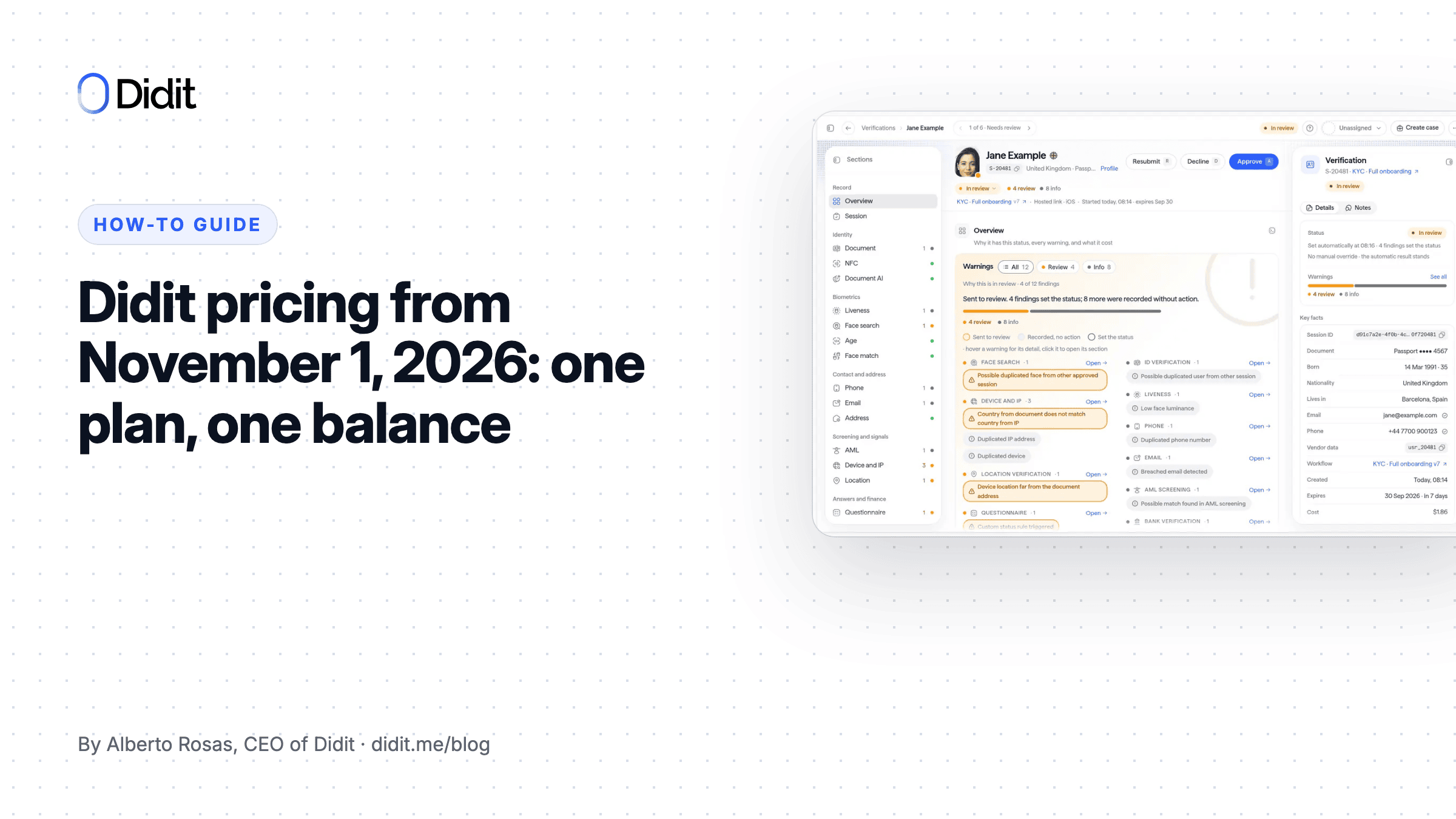 AnnouncementsDidit pricing from November 1, 2026: one plan, one balance
One Didit plan now covers every product with a single credit balance: Free $0, with $10 of monthly credit for organizations created with an eligible work email, Growth $99 with $115 and 4% off, Scale $299 with $350 and 10% off.
Alberto RosasOct 2, 2026Questions
Blog questions
Who writes the Didit blog?
Which topics does the blog cover?
Is the blog available in my language?
Where do I find product updates?
Are these posts legal advice?
How do I find posts on one topic?
Are posts dated?
Do posts link to the docs?
Is the blog the same as the docs?
Compliance built in
Audited, certified and attested.
We hold the certifications and build each country's rules into your flows, so you can launch anywhere without worrying. Security and Compliance center
- Regulation encoded into your flows
Tell us what you do and where. Didit lists the rules that apply to you, with sources, and builds the checks each country needs into one workflow.
- Ready for AMLR
Every requirement of the new EU anti-money laundering rules, from checking customers to human review, is already covered by a Didit check.
- Tested in Spain's Treasury sandbox
Spain's Treasury published its supervised sandbox report on Didit's NFC plus active liveness onboarding; SEPBLAC took part and valued the added measures positively.
- Audited, not self-declared
iBeta Level 1 and Level 2. Liveness tested under ISO/IEC 30107-3.
Your obligations · 3 regions
 SOC 2 Type 2
 ISO 27001
 iBeta Level 1 and Level 2
 EU regulator attestation
 FSM youth protection
 GDPR
 EBA remote onboarding
 MiCA compatible
 FIDO Alliance member
- AMLREU AML Regulation ready
Integration · Didit MCP
Run Didit from your own AI agent
Connect Didit to Claude, Cursor, VS Code or ChatGPT and just ask in plain words. Your agent can do anything you can do in the console, with the same permissions you have.
 Add to Claude
 ChatGPT
 Cursor
- Build workflowsDescribe the checks you need. The agent creates and publishes the flow.
- Run investigationsAsk why a session was declined, review cases, search people and companies.
- Change rulesCreate payment rules, test them on past data and switch them on.
- Pull reportsAsk for numbers, exports or the audit log.
Didit Academy


