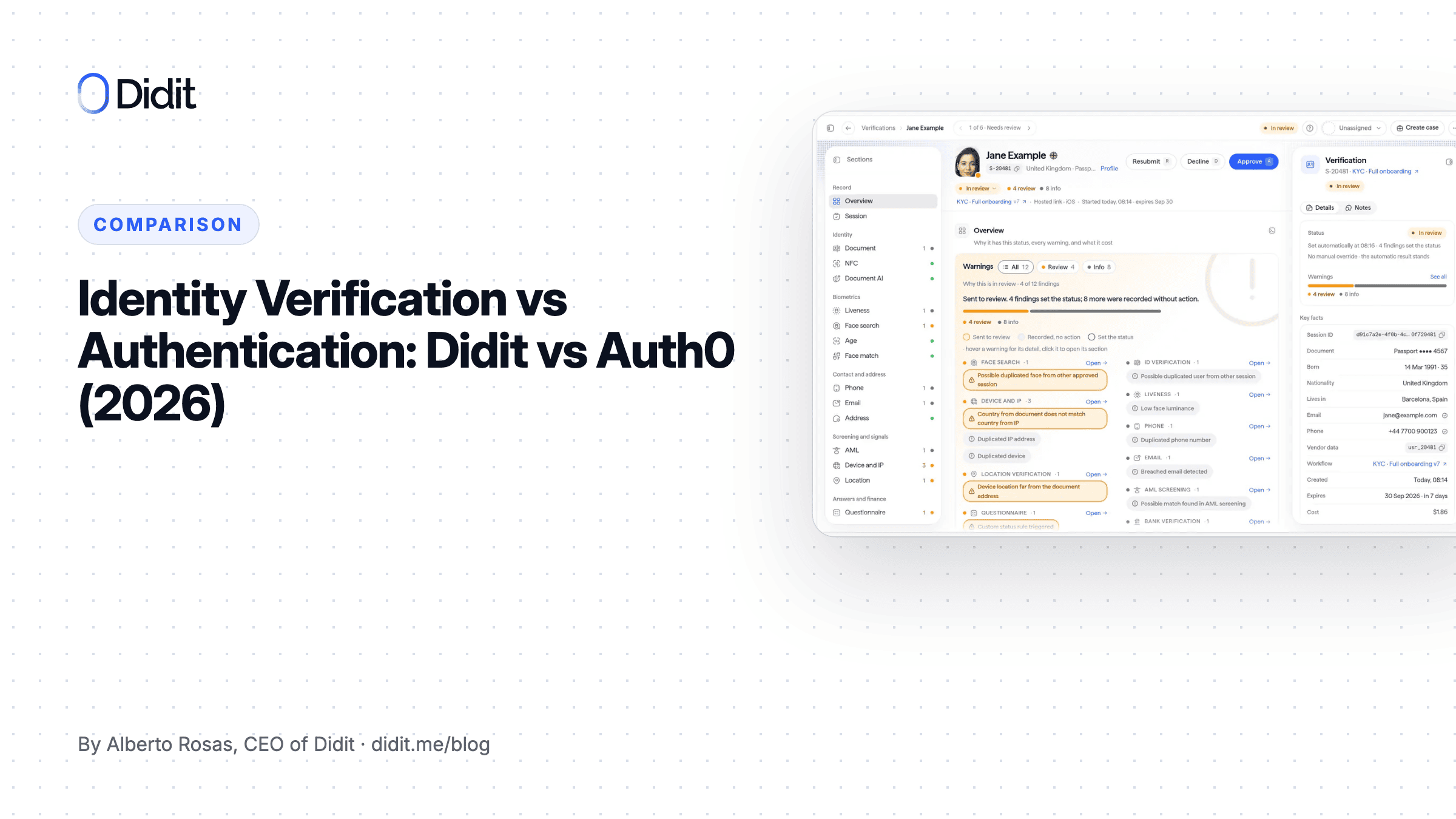
Identity Verification vs Authentication: Didit vs Auth0 (2026)
Identity verification proves who someone is; authentication proves the same person came back. Account takeover defeats authentication, not verification. Didit charges $0.33 per full KYC check;
 Alberto RosasCo-founder and CEO
Contents
In this guide
Jump to the part you need.
Identity verification proves who someone is before access. Authentication proves the returning person is the same one. Account takeover defeats the second, not the first. This page defines both, explains credential stuffing and password spraying, and compares Didit with Auth0. A full Didit KYC check costs $0.33. Auth0 prices sign-in per monthly active user, not per identity check, so the two price lists are not like for like.
Last updated: November 26, 2026. Prices checked against the live Didit price feed on November 26, 2026.
The short answer
| Question | Identity verification (KYC) | Authentication (sign-in) |
|---|---|---|
| What it answers | Is this person who they claim to be? | Is this the same person who registered? |
| When it runs | At onboarding, before a payout, or on a risk trigger | At every sign-in, and again before sensitive actions |
| Evidence it uses | Government ID document, selfie liveness, face match, database lookup | Password, passkey, email or phone code, social or SSO, MFA factor |
| Didit product | User Verification | Didit Authentication |
| Didit list price | $0.33 per full KYC check | The first 50,000 active users each month are free; the $0.02 per active user a month applies after that allowance |
| What it does not stop | A stolen credential used later on an already verified account | A fake identity created with real, working credentials |
You can run a first check today. Start free in the sandbox at https://business.didit.me/ with no sales call, and if you build with an AI assistant, connect Didit through the MCP server at https://didit.me/developers/mcp/. Prices for every module are on https://didit.me/pricing/.
Identity verification, defined
Identity verification answers one question at a moment you choose: is this person who they say they are. At Didit it runs as a workflow you configure, and the full KYC check is always three parts in one check: the ID document, biometrics, and device and IP analysis.
The priced parts add up on the public price list: ID document verification $0.15, passive liveness $0.10, face match 1:1 $0.05, device and IP analysis $0.03, for $0.33 per completed check. ID Verification reads 14,000+ document types across 220+ countries in 54 capture languages, checks the document for tampering, and extracts the data with OCR and MRZ parsing.
Liveness is the part most buyers underestimate. Didit's liveness detection detects and can decline presentation attacks such as printed photos, screen replays, masks and deepfakes, and the page states 99.9% accuracy with a false acceptance rate under 0.1%. Face Match 1:1 then compares the selfie to the portrait on the document and returns a similarity score.

Verification is episodic. It happens once at onboarding, and again only when you ask for it: before a large payout, before a bank account change, before a contact detail change.
Authentication, defined
Authentication answers a different question on every visit: is the person at the keyboard the same one who registered. Didit Authentication covers sign-up, sign-in, passkeys, email and phone codes, magic links, social sign-in and organization SSO, MFA and sessions, with bot protection and optional identity verification built in.
Didit uses OAuth 2.0 authorization code with PKCE, S256 only. Your app opens the hosted sign-in page, the person returns to your redirect URL with a one-time code, and your app exchanges it for a short-lived access token, an ID token and a refresh token that rotates on every use. Your backend verifies the token against your application's published keys, and before a sensitive action it checks the live session.
The price sits on the same public list as everything else: the first 50,000 active users each month are free, then $0.02 per active user a month. One caveat worth stating plainly: Didit's own docs describe Authentication as new. Sandbox applications have it on from the start, and a Live application turns it on from the Products page of the console. Until it is on, every runtime route for that application returns 404.
Where biometric authentication fits
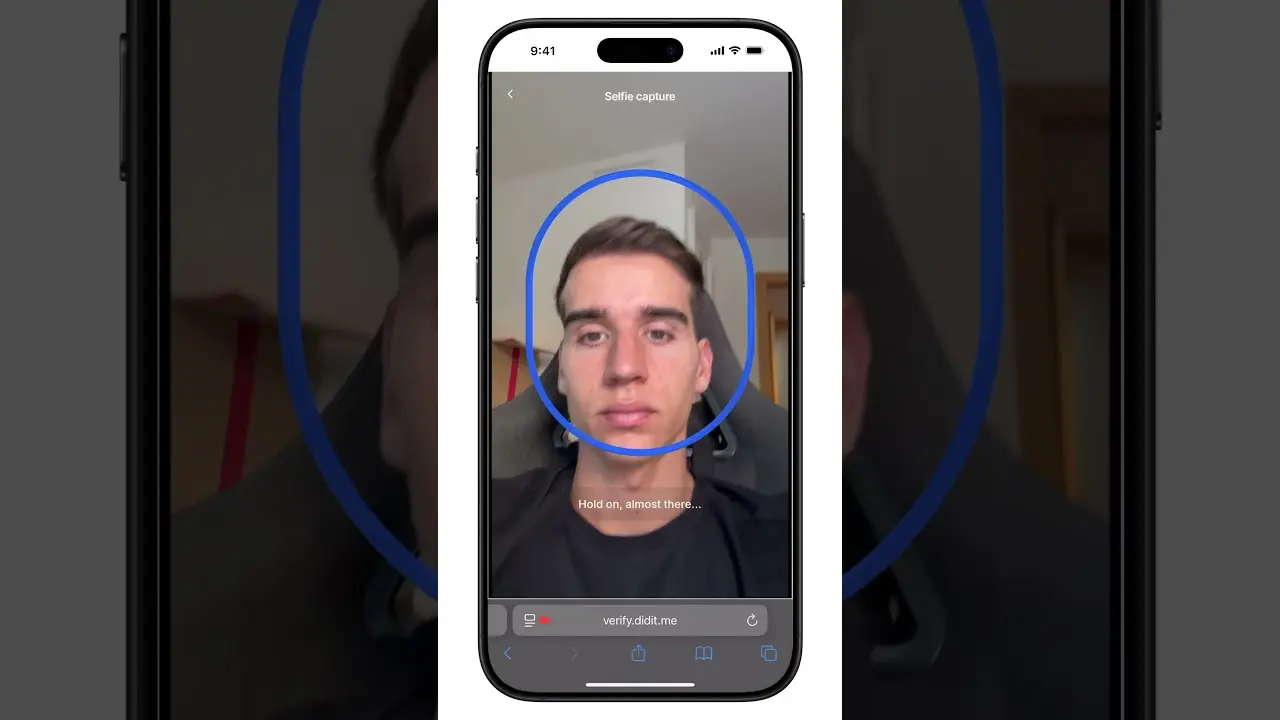
Biometric authentication sits between the two definitions. It is a sign-in or a step-up that uses a face instead of a password. Didit prices biometric authentication at $0.10 per authentication and selfie login at $0.10, where a fresh selfie is matched to the face Didit already holds for that person. When Didit holds no face yet, a selfie login becomes a full ID check.
Account takeover: the attack lands on authentication
Account takeover happens after onboarding. The attacker already has a working credential, or buys one, and tries to look like a normal returning user. Verifying everyone at sign-up does not stop it, because the account was verified when it was created. What stops it is the authentication layer, plus a step-up check at the moment money or contact details move.
Credential stuffing vs password spraying
The two attacks are not the same shape, and a defence that catches one can miss the other.
| Vector | What the attacker does | Didit policy | Default mode |
|---|---|---|---|
| Credential stuffing | Replays email and password pairs stolen from another breach across many accounts, fast, from one network | stuffing matches when one device or IP tries 10 or more different accounts within 15 minutes, or when the password is a known breached password | Challenge |
| Password spraying | Tries a short list of common passwords against many accounts, a few attempts each, to stay under lockout | The brute policy blocks or challenges accounts after 5 or more failed attempts, but low-and-slow spraying can require broader detection and review | Challenge |
| Bot sign-ups | Automated agents create accounts or hammer sign-in | bots matches when Didit's server scores the request 0.8 or more | Block |
| Throwaway identities | Sign-up or code sign-in on a disposable email domain | disposable | Block |
| Proxy traffic | Sign-in through a VPN, Tor or a data-center network | vpn | Challenge |
| Impossible travel | Sign-in more than 500 km from the previous one, at more than 1,000 km/h, within 24 hours | travel | Block |
The distinction matters. Stuffing shows up as many accounts failing from one place. Spraying shows up as one account failing a handful of times, from many places. If you only count failures per account, stuffing walks past you. If you only watch the network, spraying walks past you. Run both counters together and review unresolved attempts according to your own policy.
Didit's bot protection page sets stuffing to Challenge by default because offices, campuses and mobile carriers put many real people behind one address: they get an extra proof instead of a lockout, and someone holding a correct breached password still cannot finish.
Account takeover indicators to watch
- A burst of failures across many accounts from one device or IP in a 15 minute window.
- A successful sign-in immediately after five or more failures on one account.
- Sign-ins more than 500 km apart at more than 1,000 km/h within 24 hours.
- A payout from a device that none of that person's earlier sessions came from.
- An email or phone change followed quickly by a payout or a new bank account.
- VPN, Tor or data-center IPs, and automation user agents or missing browser headers.
- A sign-in that succeeds with a password that appears in a known breach.
Every match is recorded as an event in the console and shows which policy matched. A blocked attempt answers the same way for an existing account, an unknown one, a right secret and a wrong one, so the attacker learns nothing about your user base.

Set the six policies in one call
Protection is off until you turn it on. Read and change it with GET and PATCH on protection/ in your application's Authentication management API, or in the console. This is the documented body with the documented defaults:
{
  "enabled": true,
  "breached_password_check": true,
  "policies": {
    "bots": "block",
    "stuffing": "challenge",
    "brute": "challenge",
    "disposable": "block",
    "vpn": "challenge",
    "travel": "block"
  }
}
Then add the step-up that covers what remains: a person who signed in legitimately, on a real device, and then tries to move money. Your app asks Didit before the action, and the check only runs when a rule applies.
curl --fail-with-body "${DIDIT_AUTH_ISSUER}/step-up/" \
  -H "Authorization: Bearer $ACCESS_TOKEN" \
  -H "Content-Type: application/json" \
  -d '{"action": "payout", "amount": "900.00", "currency": "USD", "return_to": "https://app.example.com/payouts/confirm"}'
The response is either 200 {"required": false}, so you go ahead, or a verification_url that the person must finish within 30 minutes. Your backend reads the outcome with the person's access token and acts only when the status is approved. A step-up never fails open: when verification is unavailable, the action stays blocked. The full rule set is on the verified identity page.
Didit vs Auth0: scorecard
Didit publishes this ranking; we explain the criteria so you can check them. Didit ranks first overall on this scorecard.
Each score is our editorial rating on a 1 to 5 scale, not a number any vendor publishes. The reason column gives the fact behind each score and where it came from, so you can check the rating against the source.
| Criterion | Didit | Auth0 |
|---|---|---|
| Published pricing | 5. Many modules have public USD list prices, while some entries are variable by country or data tier, and the whole price book is published as JSON at didit.me/pricing.json. | 4. Free, Essentials and Professional tiers are published; Enterprise is contact us and the paid tiers stop at 500 monthly active users (Auth0 auth0.com, read November 26, 2026). |
| Coverage | 5. 220+ countries and territories, 14,000+ document types, 54 capture languages, 1,300+ AML lists. | 2. Coverage is not published on the vendor card, which lists no country, document or language data for identity checks (Auth0 auth0.com, read November 26, 2026). |
| Product breadth (KYC, KYB, AML, monitoring) | 5. KYC at $0.33, KYB from $2.00 per company, AML screening at $0.20, ongoing AML monitoring at $0.07 per user a year and transaction monitoring on one price list. | 1. The card lists B2C, B2B and AI identity products plus a free plan; no KYC, KYB, AML or transaction monitoring (Auth0 auth0.com, read November 26, 2026). |
| AI/MCP and developer access | 5. Free MCP server at mcp.didit.me/mcp with OAuth sign-in, a public OpenAPI contract and a one-prompt integration path for coding agents. | 3. Documented developer platform with SDKs; the card names AI identity products and secure agentic AI workflows on the free plan but no MCP server (Auth0 auth0.com, read November 26, 2026). |
| Time to first live check | 5. Sandbox is free on every plan and the Free plan adds $10 of credit a month, so a real check runs without a sales call. | 4. The Free plan costs $0 up to 25,000 monthly active users, so a first sign-in is fast; it does not include an identity check (Auth0 auth0.com, read November 26, 2026). |
| Evidence and certifications | 5. SOC 2 Type 2, ISO/IEC 27001:2022 certified (certificate ES144068), iBeta Level 1 PAD, GDPR, DORA, MiCA, AMLD6, eIDAS 2.0. | 3. The card cites 3 billion+ attacks blocked a month across Okta platforms and 99.99% uptime indicated at trust.okta.com; it lists no certifications (Auth0 auth0.com, read November 26, 2026). |
Like for like
| Row | Didit | Auth0 |
|---|---|---|
| Features | Sign-in with passkeys, email and phone codes, magic links, social and SSO, MFA and sessions, plus ID verification, liveness, face match, AML screening, KYB, wallet screening and transaction monitoring | B2C customer identity, B2B SaaS identity, AI identity for B2B and commerce, passwordless sign-in and secure agentic AI workflows on the free plan (Auth0 auth0.com, read November 26, 2026) |
| Coverage | 220+ countries, 14,000+ document types, 54 capture languages, 1,300+ AML lists | Not published on the vendor card (Auth0 auth0.com, read November 26, 2026) |
| Evidence | SOC 2 Type 2, ISO/IEC 27001:2022, iBeta Level 1 PAD; 99.99% availability target and 100% uptime over the last six months | 99.99% uptime indicated at trust.okta.com and 3 billion+ attacks blocked a month across Okta platforms (Auth0 auth0.com, read November 26, 2026) |
| Implementation | Hosted pages or your own screens through the SDKs, OAuth 2.0 authorization code with PKCE, tokens verified against published keys, auth.* webhooks, management API, MCP server | Published developer resources for the identity products listed on the card (Auth0 auth0.com, read November 26, 2026) |
| Price units | Per completed check for verification ($0.33 KYC, $0.20 AML, KYB from $2.00 per company) and per active user a month for authentication: the first 50,000 active users each month are free, then $0.02 per active user a month | Per monthly active user, in monthly tiers: $0 Free up to 25,000, $35 Essentials up to 500, $240 Professional up to 500, Enterprise contact us (Auth0 auth0.com, read November 26, 2026) |
Verdict by use case
- Regulated onboarding plus sign-in in one vendor: Didit. KYC, AML and authentication all bill from one credit balance, and the verification sits on the same person record as the sign-ins.
- Marketplaces and fintechs paying out to users: Didit. The step-up rules for payout, device, bank and contact are the control that stops a stolen session from moving money.
- Crypto exchanges and VASPs: Didit. Wallet screening is $0.15 per screening and runs inside transaction monitoring, or you bring your own screening provider and run it inside Didit.
- A product that only needs customer sign-in and already has onboarding sorted: Auth0. Its Free plan covers up to 25,000 monthly active users at $0 (Auth0 auth0.com, read November 26, 2026).
- A team that wants to test both sides before signing anything: Didit, because the sandbox and the MCP server cost nothing to try.
What 1,000, 10,000 and 100,000 checks cost
A full Didit KYC check is $0.33. The last column applies the published Scale discount of 10%, which takes the check to $0.297.
| Checks a month | List arithmetic | List total | Scale, 10% off |
|---|---|---|---|
| 1,000 | 1,000 x $0.33 | $330.00 | 1,000 x $0.297 = $297.00 |
| 10,000 | 10,000 x $0.33 | $3,300.00 | 10,000 x $0.297 = $2,970.00 |
| 100,000 | 100,000 x $0.33 | $33,000.00 | 100,000 x $0.297 = $29,700.00 |
| Auth0 at the same volumes | Auth0 does not sell checks, so no volume row matches. Its published sign-in tiers are $0 a month on the Free plan up to 25,000 monthly active users, $35 a month on Essentials up to 500 and $240 a month on Professional up to 500, and any volume above 500 monthly active users on a paid tier is quote required (Auth0 auth0.com, read November 26, 2026). | ||
The two price lists answer different questions. Didit charges per completed check and per active user a month after the first 50,000. Auth0 charges per monthly active user for sign-in and publishes no per-check unit it could be compared against.
Worked example: 10,000 new verified users and 100,000 monthly active users
- KYC: 10,000 x $0.33 = $3,300.00.
- Authentication: the first 50,000 active users each month are free, so 100,000 minus 50,000 = 50,000 billable. 50,000 x $0.02 = $1,000.00.
- Month total at list: $3,300.00 + $1,000.00 = $4,300.00.
- On the Scale plan, 10% off Didit prices: 10,000 x $0.297 = $2,970.00, plus 50,000 x $0.018 = $900.00, so $3,870.00 of usage against the $350 monthly credit, plus the $299 monthly fee.
Growth takes 4% off every Didit price for $99 a month, and the Free plan gives $10 of credit a month to organizations that sign up with a work email. Sandbox testing is free and unlimited on every plan, which is where the arithmetic above should be checked before you commit.
Strengths and limitations
Didit
Strengths. One public price list covers verification, authentication, business verification, AML and transaction monitoring, so a finance team can model the whole flow in one sheet. Checks run in 220+ countries across 14,000+ document types in 54 capture languages. The selection criteria we would point a buyer to: a free sandbox on every plan, five SDKs, a published OpenAPI contract, a free MCP server, and a first live check without a sales call. Didit reports 4,000+ active customer companies, and the certification list includes SOC 2 Type 2 and ISO/IEC 27001:2022 (certificate ES144068).
Limitations. Authentication is new, and its advanced protection is off until you turn it on, which means a hasty go-live can ship without stuffing and brute-force policies. Pricing is per completed check, so a fraud spike raises the bill in the same month it raises your risk. We are a smaller company than the incumbents, and some national digital ID wallets on the price list are marked coming soon rather than available.
Auth0
Strengths. Auth0 offers B2C customer identity management, B2B SaaS identity, AI identity products and a free plan (Auth0 auth0.com, read November 26, 2026). The Free plan runs to 25,000 monthly active users at $0, and the paid tiers are published at $35 a month for Essentials and $240 a month for Professional, both up to 500 monthly active users (Auth0 auth0.com, read November 26, 2026). The card also cites 3 billion+ attacks blocked a month across Okta platforms and 99.99% uptime indicated at trust.okta.com (Auth0 auth0.com, read November 26, 2026).
Limitations. It is a sign-in product. The card lists no identity document verification, no KYB, no AML screening and no transaction monitoring, so a regulated onboarding still needs a second vendor. Pricing is per monthly active user, which means a fraud wave of fake sign-ups costs more, not less. The published paid tiers stop at 500 monthly active users, so real volume needs a quote.
When Auth0 is the better fit
If onboarding is already handled elsewhere and the job is only to sign customers in across web and mobile, Auth0's Free plan covers up to 25,000 monthly active users at $0 (Auth0 auth0.com, read November 26, 2026). The selection criteria are concrete: you need no document verification, no sanctions or PEP screening, no transaction monitoring and no step-up before payouts, and your team already builds on the Auth0 SDKs. The moment you need to prove a document is real, match a face to it, screen a name against 1,300+ lists, or stop a payout from a stolen session, you are buying a second vendor either way.
Migration plan
Moving sign-in, or adding verification next to it, follows the same four steps.
- Parallel test. Turn on Authentication for a Sandbox application and run one cohort through Didit while the current provider keeps serving everyone else. Compare sign-in success rate and the attempts the
stuffingandbrutepolicies caught. Nothing in production changes yet. - Webhooks. Subscribe to the
auth.*webhooks and tosession.status.updatedfor verifications, so your backend reacts to events instead of polling. Keep the old provider's webhooks running until the cohort has cleared a full billing cycle. - Records. Map each person's
vendor_datato their existing user ID before the first live check. The console shows sign-ins alongside the person's verifications and transactions, which is what your reviewers will need later. Plan how existing passwords travel as well: most providers do not hand over usable hashes, so a password reset or a move to passkeys or email codes is the usual route, and Didit Authentication supports both. - Cutover. Keep the old sessions alive until they expire, verify Didit tokens against your application's published keys on every request, and only then retire the old routes. If you are moving verification rather than sign-in, the same order applies: a live Sandbox check, then one production workflow, then the rest.
If you are leaving a provider entirely, the comparison page at https://didit.me/switch/ is the shorter version of this plan.
Sources
- Didit pricing page and the live price feed it publishes, read November 26, 2026.
- Didit pricing in the docs: billing rules and standalone API prices.
- Didit Authentication overview: sign-in, tokens, JWKS and sessions.
- Didit sign-in methods: passkeys, codes, magic links, social, SSO and MFA.
- Didit bot protection: stuffing, brute force, bots, disposable, VPN and travel policies.
- Didit verified identity: verification at sign-up and step-up before payouts.
- Didit ID Verification and Liveness Detection: document coverage and presentation attack defence.
- Didit Face Match 1:1: selfie to document portrait comparison and its price.
- Didit MCP server and switch to Didit.
- Auth0 auth0.com, read November 26, 2026: plans, products and the trust indicators on the vendor card.
- Images in this page come from the Didit identity verification walkthrough, the biometric authentication walkthrough and the Didit Business Console session detail, all from didit.me, read November 26, 2026.
The fastest way to settle the question for your own product is to run both against your data. Open the sandbox at https://business.didit.me/, run a full KYC check at $0.33 and a sign-in with the protection policies on, and compare what each one tells you before you talk to anyone.
Try it
Try this in the sandbox
Run the check this guide describes, free.
The product this post is about, taken from its topic. Run it free in the sandbox.
Author
Alberto Rosas
Co-founder and CEO

Keep reading
Other guides in the same topic.
 What Is a Money Services Business (MSB)? AML Obligations
An MSB transmits, exchanges or stores money for customers: money transmitters, currency exchangers, check cashers, crypto exchanges. MSBs register with a regulator and run an AML program with KYC, screening and reporting.
Alberto RosasNov 26, 2026 How to Add Age Verification to a Website: Popup or API
Use a Didit hosted popup for web sign-up or POST a selfie to the Age Estimation API. Age Estimation costs $0.10 per check; full KYC with document proof costs $0.33.
Alberto RosasNov 26, 2026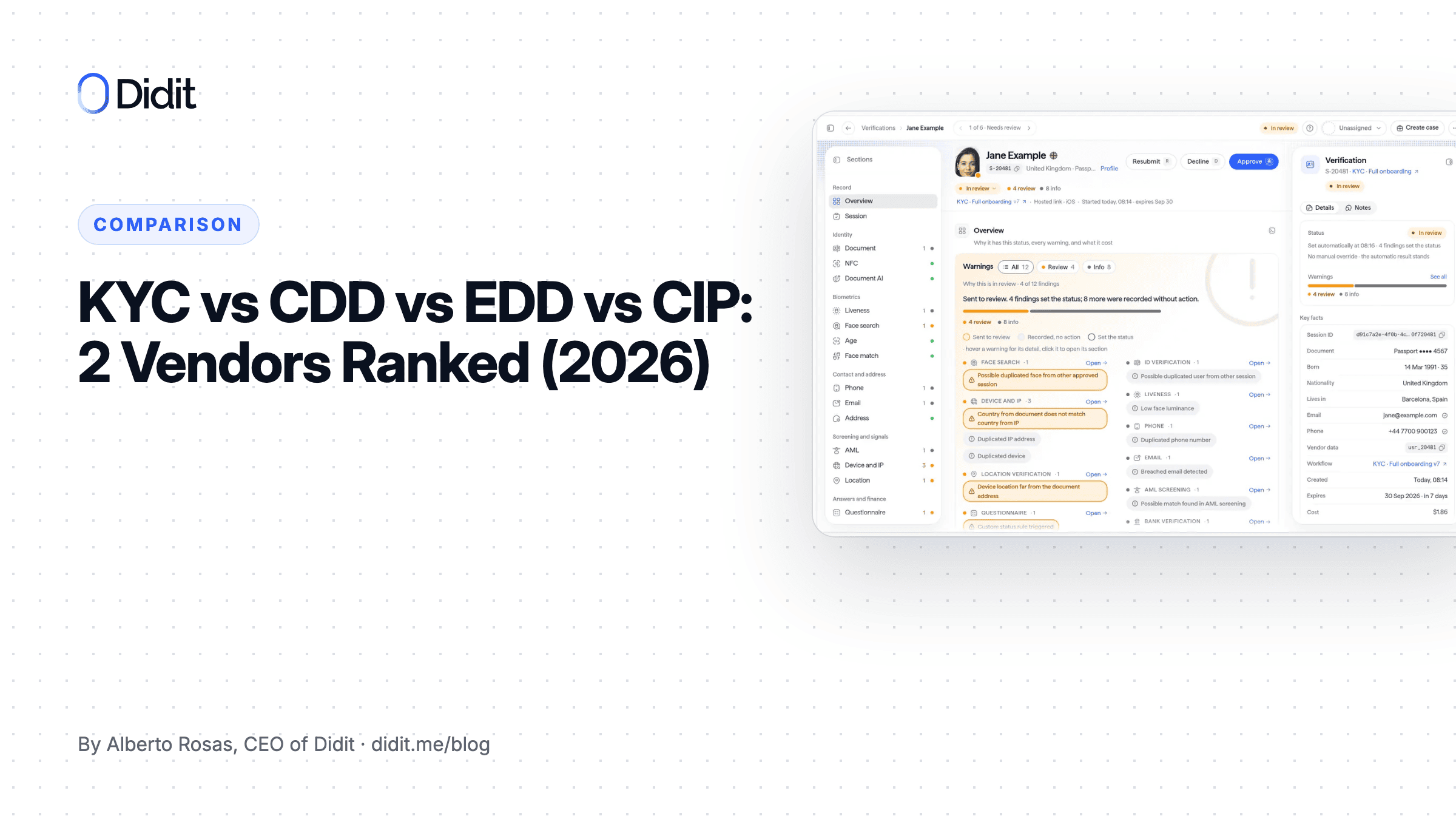 KYC vs CDD vs EDD vs CIP: 2 Vendors Ranked (2026)
KYC is the umbrella term, CDD is the process, EDD adds evidence for higher risk, CIP is the US identification program and a UAR records unusual activity. Didit: $0.33 KYC, $0.20 AML.
Alberto RosasNov 26, 2026Questions
Frequently asked questions
What is the difference between identity verification and authentication?
Identity verification proves who a person is, usually once at onboarding, using a government ID document, a liveness selfie and a face match. Authentication proves that the person signing in now is the same person who registered, using a password, passkey, code or face. Verification is episodic and authentication is constant, and most account takeover defeats the second one.
Is biometric authentication the same as identity verification?
No. Biometric authentication compares a live face to a face the system already holds for that person, so it confirms continuity of identity. Identity verification establishes that identity in the first place by reading a document and matching the portrait to a live selfie. At Didit, biometric authentication and selfie login are $0.10 each, while a full ID check is $0.33.
What is the difference between credential stuffing and password spraying?
Credential stuffing replays valid email and password pairs stolen from another breach across many accounts at speed, and the Didit stuffing policy challenges when one device or IP tries 10 or more different accounts in 15 minutes, or when the password is known from a breach. Password spraying tries a short list of common passwords against many accounts with only a few attempts each to stay under lockout thresholds. The brute policy blocks or challenges accounts after 5 or more failed attempts, but low-and-slow spraying can require broader detection and review.
What are the signs of an account takeover?
Look for a burst of failures across many accounts from one network, a success right after several failures on one account, or a sign-in more than 500 km from the previous one at more than 1,000 km/h within 24 hours. Behavioural signs matter too: a payout from a device the person never used, or an email change followed quickly by a payout. Didit records each match as an event and shows which policy caught it.
Does MFA stop credential stuffing?
MFA raises the cost of an attack but does not end it. Passkeys and hardware factors are strong, while SMS codes can be phished or intercepted. The practical answer is layered: MFA at sign-in, bot protection that challenges stuffing and brute force before the password is checked, and a step-up selfie before a payout, a bank change or a contact change.
How much does identity verification cost at Didit?
A full KYC check costs $0.33 and always contains the ID document, the biometrics and the device and IP analysis. 10,000 checks cost $3,300.00 at list, or $2,970.00 on the Scale plan with its published 10% discount. Standalone server-to-server API calls are separate lines with their own per-call prices on the same public list.
How much does Didit Authentication cost?
The first 50,000 active users each month are free, and after that it is $0.02 per active user a month on the public price book. A step-up before a payout is billed as the verification it runs: $0.10 for a selfie login or liveness check, $0.33 for a full ID check. The Free plan also gives $10 of credit a month for verification.
Can Didit replace Auth0?
For sign-in, Didit Authentication covers passkeys, email and phone codes, magic links, social and organization SSO, MFA and sessions through hosted pages or your own screens with OAuth 2.0 authorization code and PKCE. It also does what a pure sign-in product does not: verify documents and faces, screen AML lists and monitor transactions. Authentication is new, so run a parallel cohort before you commit.
Which matters more for account takeover, identity verification or authentication?
Authentication, because takeover happens on an account that was already verified. Verification earns its place at two other moments: at sign-up, so the account is real, and again as a step-up when a session tries to pay out, add a bank account or change contact details. Doing only one of the two leaves a gap an attacker can use.
How fast can I run a live check?
The sandbox is free on every plan and needs no sales call, so a first verification session can run today at business.didit.me. Going live then means turning the product on for a Live application and moving from test keys to live keys. Developers who build with an AI assistant can connect the free MCP server at mcp.didit.me/mcp with OAuth sign-in.
Compliance built in
Audited, certified and attested.
We hold the certifications and build each country's rules into your flows, so you can launch anywhere without worrying. Security and Compliance center
- Regulation encoded into your flows
Tell us what you do and where. Didit lists the rules that apply to you, with sources, and builds the checks each country needs into one workflow.
- Ready for AMLR
Every requirement of the new EU anti-money laundering rules, from checking customers to human review, is already covered by a Didit check.
- Tested in Spain's Treasury sandbox
Spain's Treasury published its supervised sandbox report on Didit's NFC plus active liveness onboarding; SEPBLAC took part and valued the added measures positively.
- Audited, not self-declared
iBeta Level 1 and Level 2. Liveness tested under ISO/IEC 30107-3.
Your obligations · 3 regions
 SOC 2 Type 2
 ISO 27001
 iBeta Level 1 and Level 2
 EU regulator attestation
 FSM youth protection
 GDPR
 EBA remote onboarding
 MiCA compatible
 FIDO Alliance member
- AMLREU AML Regulation ready
Integration · Didit MCP
Run Didit from your own AI agent
Connect Didit to Claude, Cursor, VS Code or ChatGPT and just ask in plain words. Your agent can do anything you can do in the console, with the same permissions you have.
 Add to Claude
 ChatGPT
 Cursor
- Build workflowsDescribe the checks you need. The agent creates and publishes the flow.
- Run investigationsAsk why a session was declined, review cases, search people and companies.
- Change rulesCreate payment rules, test them on past data and switch them on.
- Pull reportsAsk for numbers, exports or the audit log.
Didit Academy


