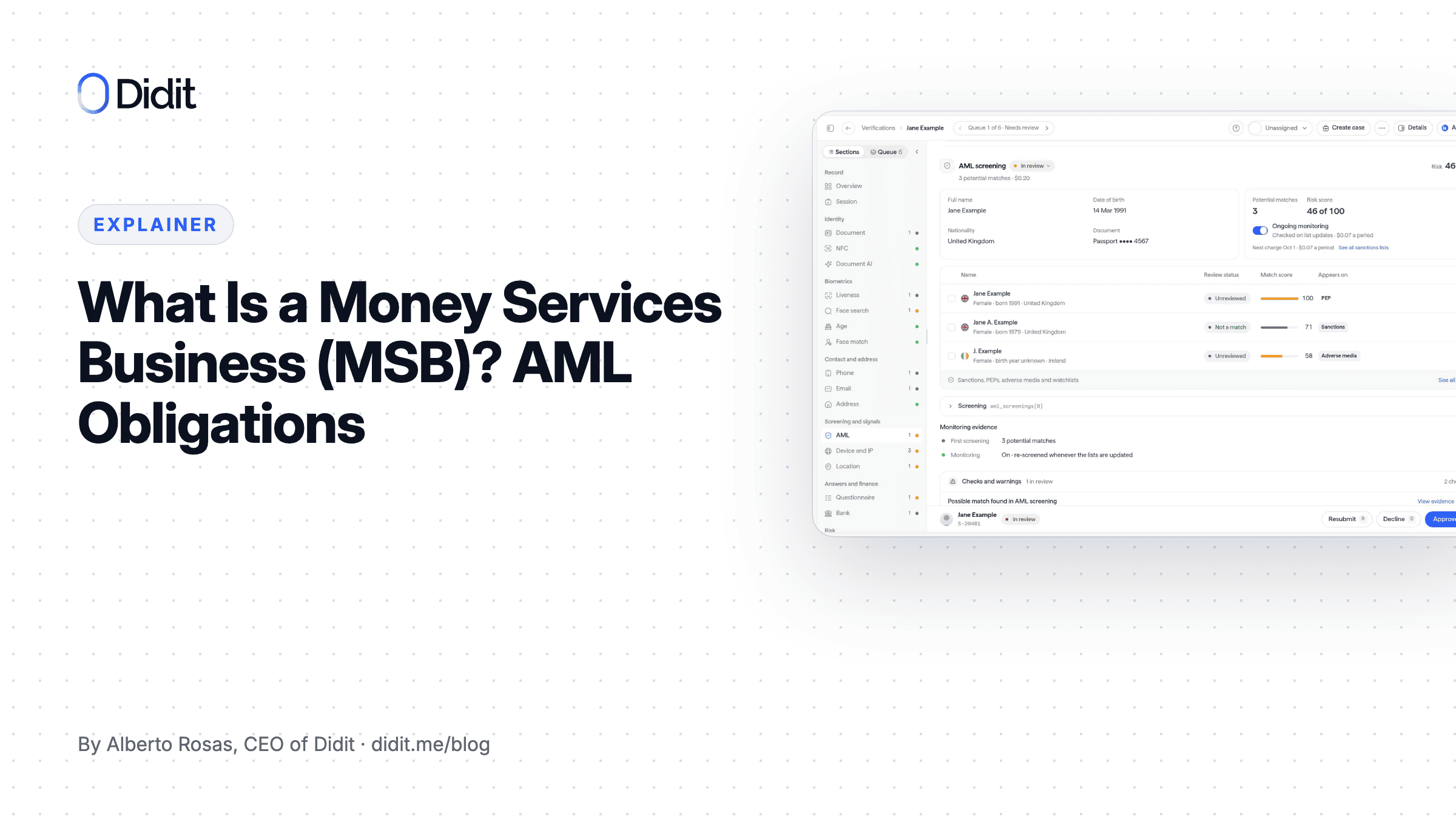
What Is a Money Services Business (MSB)? AML Obligations
An MSB transmits, exchanges or stores money for customers: money transmitters, currency exchangers, check cashers, crypto exchanges. MSBs register with a regulator and run an AML program with KYC, screening and reporting.
 Alberto RosasCo-founder and CEO
Contents
In this guide
Jump to the part you need.
A money services business (MSB) is a business that moves or exchanges money for customers: money transmitters, currency exchangers, check cashers, prepaid access sellers and, in many jurisdictions, crypto exchanges. If you run one or onboard one, the work is customer due diligence, sanctions and PEP screening, and transaction monitoring. Didit prices those checks openly: AML screening is $0.20 per check and full KYC is $0.33. The caveat: no vendor can register your MSB with a regulator.
Last updated: November 26, 2026. Prices checked against the live Didit price feed on November 26, 2026.
MSB compliance at a glance
| Question | Short answer |
|---|---|
| What is an MSB | A non-bank business that transmits, exchanges or stores money for customers |
| Common examples | Money transmitters, currency exchange offices, check cashers, money order sellers, prepaid access providers, crypto exchanges and custodians |
| Where the label applies | United States (FinCEN and state licences), United Kingdom (HMRC under the Money Laundering Regulations 2017), European Union (AML directives and MiCA). Scope and duties are set per country and, in the US, per state |
| Core AML obligations | Written program, risk assessment, CDD and KYC, sanctions and PEP screening, transaction monitoring, suspicious activity reporting, records, independent review |
| Registration | With the financial regulator in each jurisdiction, before trading. A vendor cannot file it for you |
| Didit checks that map to it | Identity verification, AML screening, ongoing monitoring, business verification, wallet screening, transaction monitoring |
| Published Didit prices | Full KYC $0.33, AML screening $0.20, ongoing AML monitoring $0.07 per person a year, KYB from $2.00 per company, wallet screening $0.15, travel rule $0.02 per transaction |
You can test every check below without a sales call. Start free in the sandbox at https://business.didit.me/, and developers can connect Didit to an AI assistant through https://didit.me/developers/mcp/. The screening docs are at https://docs.didit.me/core-technology/aml-screening/overview and every number sits on https://didit.me/pricing/.
Definition: what is a money services business?
A money services business (MSB) is a non-bank business that accepts, transmits or exchanges money for customers, or sells them stored value. The label exists so a regulator can name the non-bank money businesses that must register, run an anti-money-laundering program and report suspicious activity.
Two consequences follow. The scope is set by each jurisdiction, not by the name on your website, so a remittance app, a bureau de change and a crypto broker can all land in the same bucket with different supervisors. And the label carries duties: an MSB is a reporting entity, so the customer file has to survive an examination years after onboarding, not just a signup flow.
Read the scope where you operate before you rely on any definition, including this one. MSB registration thresholds, the activities that count, the supervisor and the obligations attached to the label differ by country and, in the United States, by state.
Examples of money services businesses
The list below covers what supervisors most often treat as an MSB. Read the local rule before you assume a product is out of scope.
- Money transmitters. Remittances, cross-border payouts, domestic transfers and the agent networks that carry them. This is the core of the category.
- Currency exchange offices. Bureaux de change and any business quoting a retail exchange rate between two currencies.
- Check cashers. Businesses that cash checks for a fee rather than depositing them into an account.
- Money order and travelers check issuers and sellers. Issuing the instrument, selling it, or both.
- Prepaid access and stored value providers. Program managers and sellers of reloadable prepaid products, where the funds can move to a third party.
- Virtual currency businesses. Exchangers, administrators, custodians and some hosted wallet providers. In the United States FinCEN treats convertible virtual currency administrators and exchangers as money transmitters; in the EU they are crypto-asset service providers authorised under MiCA.
- Bill payment and transfer agents. Businesses that take a customer's money and pay a third party on their behalf, including as an agent for a licensed transmitter.
Usually outside the label: a shop that accepts card payments for its own goods, a bank or credit union, and a payroll processor that never holds customer funds. Usually inside it, once you hold or move someone else's money even briefly.
Where the term is used
- United States. FinCEN's money services business definition under the Bank Secrecy Act, enforced together with state money transmitter licensing. Registration is federal, licensing is state level, and the prerequisites vary by jurisdiction.
- United Kingdom. Money service businesses register with HMRC under the Money Laundering, Terrorist Financing and Transfer of Funds (Information on the Payer) Regulations 2017, with fit and proper checks on owners and officers before trading.
- European Union. The AML directives treat currency exchange and money transmission offices as financial institutions, and crypto-asset service providers are authorised under MiCA. Directive (EU) 2015/849 is the base text most national rules build on.
- FATF. The same businesses appear in the global standard as money or value transfer services (MVTS) under Recommendation 14, with the travel rule in Recommendation 16 and new technology duties in Recommendation 15. See fatf-gafi.org.
At a high level those four frameworks ask for the same things: identify customers, screen them against sanctions and PEP lists, watch the transactions and report what looks wrong. Treat that as a summary, not a substitute. Registration, reporting and licensing duties differ by jurisdiction, and the local rule is the one your file has to satisfy.
Registration and licensing obligations
Registration is the part buyers underestimate. It happens per jurisdiction, it happens before trading, and the registration file describes the AML program you have actually built.
- United States. Register with FinCEN and renew that registration every two years. Where the state requires it, hold a state money transmitter licence, which brings its own net-worth, bond and examination requirements. Agents of a licensed transmitter fall under the transmitter's program.
- United Kingdom. Register with HMRC before you start trading. HMRC checks the business, its owners and its nominated officer, and can refuse or revoke registration.
- European Union. Authorisation or registration with the national competent authority, plus MiCA authorisation for crypto-asset services.
- Everywhere. Regulators may request information about your compliance officer, your policies and your monitoring arrangements, since application requirements vary. An unbuilt program shows up at the first inspection, not at the first customer.
AML obligations of an MSB
Wording differs by country but the duties converge. This is the checklist supervisors test.
- A written AML and CTF program. Policies, procedures and controls, approved by senior management, with a named compliance officer who has authority and resources.
- A documented risk assessment. Products, customers, countries and delivery channels, refreshed when the business changes.
- Customer due diligence and KYC. Identify the customer, verify the document and the living person behind it, and understand the purpose of the relationship.
- Beneficial ownership for business customers. Identify owners, directors and officers, then verify each person, not just the company record.
- Enhanced due diligence. PEPs, high-risk countries, unusual volumes and complex ownership chains.
- Sanctions and watchlist screening. At onboarding, when lists change, and continuously for the entities that carry the most risk.
- Transaction monitoring. Rules and thresholds over amount, velocity, counterparty and geography, with alerts that reach an analyst.
- Suspicious activity reporting. File SARs or STRs when required by applicable law and retain investigation records according to that law.
- Recordkeeping and retention. Five years is a common retention baseline, and some regimes ask for longer.
- Independent review and training. Someone outside the first line tests the program, and staff are trained against it.
Virtual asset transfers add the travel rule: originator and beneficiary data travel with the transfer, and the obligation is tracked per transfer rather than per customer.

How a screening decision is actually made
A common compliance error is confusing a name match with a risk decision. Didit splits the two so an analyst can defend the outcome.
The match score answers whether the hit is the same person. It weighs name, date of birth, country and document number against a match threshold, default 93 in aml_match_score_threshold. Below that threshold the hit is treated as a false positive and excluded from risk. At or above it, the hit is unreviewed and counts.
The risk score answers how risky that entity would be if it were the same person, based on list category, country risk and criminal records. It drives the final status through aml_score_approve_threshold (default 80) and aml_score_review_threshold (default 100). Below the approve line the check passes. Between the two lines the check goes to In Review for a human. At or above the review line it is declined.
The three weights you set, aml_name_weight, aml_dob_weight and aml_country_weight, must sum to exactly 100 or the request is rejected with HTTP 400. That constraint is worth stating in your own procedures, because it is the setting auditors ask about.

Worked example: monthly cost for a small money transmitter
Take a transmitter on the Scale plan, $299 a month with 10% off every Didit price and 100,000 monitored transactions included each month. It onboards 2,000 individual customers and 100 business customers a month, screens every one, verifies two key people per business, and monitors 150,000 transactions a month. The numbers below start from published list prices from the Didit price book; the plan changes two things only, the discount and the transaction allowance.
- Individual customers, full KYC: 2,000 x $0.33 = $660.00
- Individual customers, AML screening: 2,000 x $0.20 = $400.00
- Business customers, registry check: 100 x $2.00 = $200.00. $2.00 is the starting price; the registry fee varies by country and data tier, so treat this line as a floor
- Company AML: 100 x $0.20 = $20.00
- Person AML for two key people per business: 200 x $0.20 = $40.00
- Linked KYC for those key people: 200 x $0.33 = $66.00
- Transactions: 150,000 submitted, 100,000 included in the Scale allowance, so 50,000 overage x $0.001 = $50.00
Module checks at list prices: $660.00 + $400.00 + $200.00 + $20.00 + $40.00 + $66.00 = $1,386.00. Apply the Scale discount: $1,386.00 x 0.90 = $1,247.40. Transaction monitoring is $0.001 per transaction beyond the allowance on every plan, with no discount, so the $50.00 of overage stands. Usage for the month: $1,247.40 + $50.00 = $1,297.40.
The Scale plan fee is $299.00 a month and its $350.00 of monthly credit pays the first $350.00 of that usage. What the month costs in cash is $299.00 + ($1,297.40 − $350.00) = $1,246.40, with the balance drawn from top-up credit. Put 40 of the businesses under ongoing monitoring and add 40 x $0.07 = $2.80 for a year of daily re-screening.
Terminology and fields you will meet
| Term | What it means | Where you meet it |
|---|---|---|
| MSB | Money services business: a non-bank business that transmits, exchanges or stores money for customers | Registration and licensing rules |
| MVTS | Money or value transfer service, the FATF term for the same businesses | FATF Recommendation 14 |
| CDD | Customer due diligence: identify, verify, understand the relationship | Onboarding file |
| EDD | Enhanced due diligence for PEPs, high-risk countries and unusual activity | Escalation policy |
| UBO | Ultimate beneficial owner: the person who ultimately owns or controls the customer | Business verification |
| PEP | Politically exposed person, plus relatives and close associates | Screening lists |
| SAR / STR | Suspicious activity or transaction report filed with the financial intelligence unit | Reporting workflow |
| Travel rule | Originator and beneficiary data carried with a transfer | FATF Recommendation 16, virtual asset transfers |
| MTL | Money transmitter licence, the state-level US authorisation | US licensing |
| Match score | How likely a watchlist hit is the same person, in Didit's two-score system | aml_screenings[] in the decision payload |
| Risk score | How risky the listed entity is if the match is real | Approves, reviews or declines the check |
How Didit implements MSB checks
We run these checks for 4,000+ companies. One plan covers identity verification, authentication and transaction monitoring, and you pay per completed check from prepaid credit. The steps that map to MSB duties:
- KYC. Full ID check at $0.33: ID document verification $0.15, passive liveness $0.10, face match 1:1 $0.05 and device and IP analysis $0.03. 14,000+ document types across 220+ countries, with 200+ fraud signals per session.
- AML screening. $0.20 per check against 1,300+ sanctions, PEP and watchlist sources, with adverse media optional.
- Ongoing monitoring. $0.07 per person a year for daily re-screening in the background.
- Business verification. Registry data from $2.00 per company, priced by country and data tier (Lite, Shareholders, UBOs), key people extraction at no charge, company AML $0.20, person AML $0.20 per owner or officer, and a linked KYC at $0.33 each.
- Wallet screening. $0.15 per screening, inside Transaction Monitoring. If you already have a screening provider, bring your own and run it inside Didit.
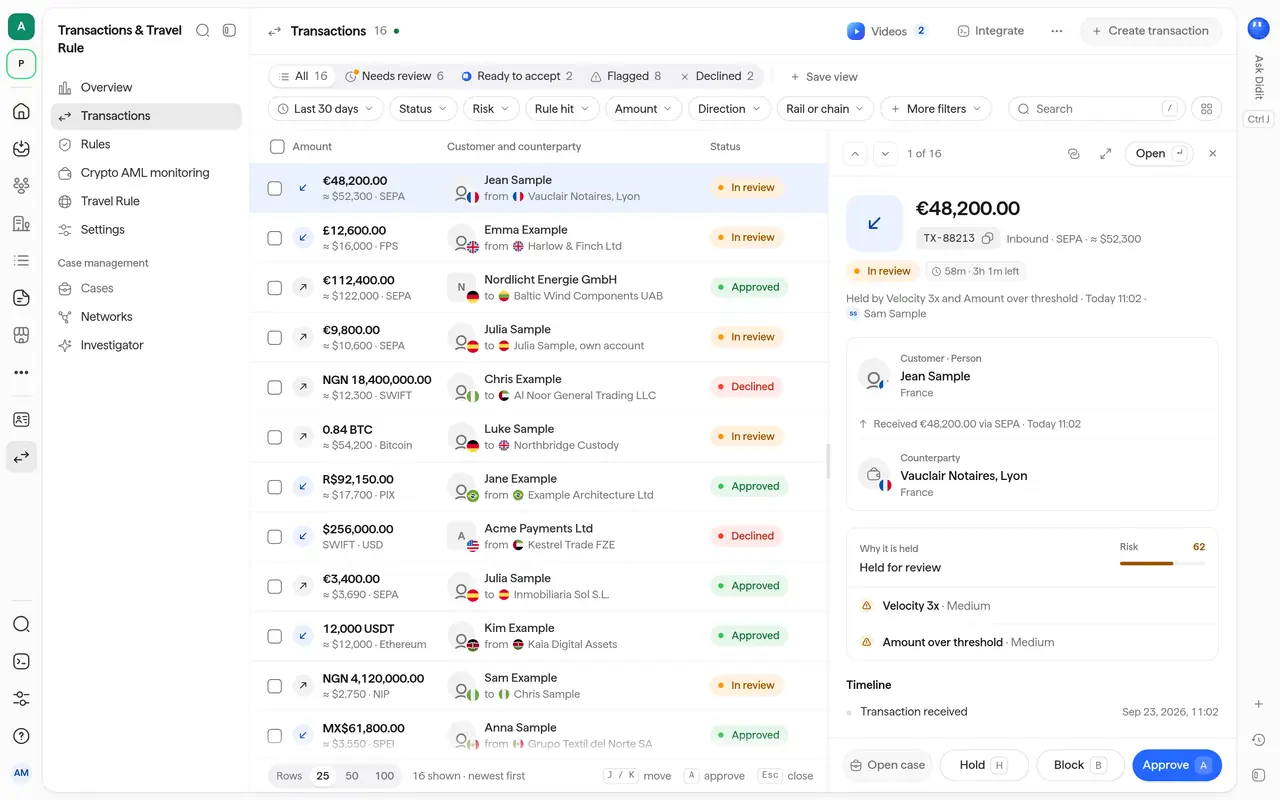
- Transaction monitoring. Rule engine with velocity and threshold rules, 1,000 transactions a month included on Free, 10,000 on Growth, 100,000 on Scale, then $0.001 each. Alerts land in case management.
- Travel rule. $0.02 per outbound exchange, with originator and beneficiary data tracked per transfer.
For a server-to-server check outside a hosted flow, the standalone call is documented in the AML screening docs:
curl -X POST 'https://verification.didit.me/v3/aml/' \
-H "x-api-key: $DIDIT_API_KEY" \
-H "Content-Type: application/json" \
-d '{
"full_name": "Javier Ejemplo Modelo",
"entity_type": "person",
"date_of_birth": "1974-01-01",
"nationality": "ES",
"include_adverse_media": true,
"vendor_data": "user-1234"
}'
The response returns aml.status and a hits[] array. Status follows the same enum as every other Didit check: Not Started, In Progress, Approved, In Review, Declined, Abandoned, Kyc Expired. Warnings carry the risk codes your analysts will route on, including MATCH_FOUND, POSSIBLE_MATCH_FOUND, SANCTIONED_ENTITY, PEP_MATCH, ADVERSE_MEDIA_HIT and HIGH_RISK_COUNTRY. Adverse media raises latency to about 25 seconds, so set a client timeout of at least 45.
Ongoing monitoring is switched on with include_ongoing_monitoring=true, which requires save_api_request=true and is billed at $0.07 per screened entity per year. Turn it on for the customers your risk assessment puts in the higher bands, not for everyone by reflex.

Transactions go through the same organization and the same credit balance. Post them to /v3/transactions/ and receive transaction.created and transaction.status.updated webhooks. A transaction comes back APPROVED, IN_REVIEW, DECLINED or AWAITING_USER, and in the last case Didit creates a linked remediation session so the customer can be verified inside the same flow. The transaction monitoring docs cover the rule engine, and the KYB docs cover registry tiers and key people.
Common mistakes
- Assuming the label only covers remittances. Crypto exchange, prepaid access and check cashing are in scope in major markets. Check the local definition before you ship a product.
- Treating registration as the program. A registration number is not a program. Supervisors expect a written program, a risk assessment and an independent review alongside it, and examine the two together.
- Screening once at onboarding. Lists change daily. A customer cleared in March can be a sanctions hit in September.
- Skipping beneficial owners. Verifying the company record and leaving the owners unverified is the most common KYB gap.
- Confusing match score with risk score. Closing a true hit as noise, or declining a customer for a common name, both come from the same confusion.
- No record of the decision. Every alert needs a documented outcome, including the ones you close.
- Forgetting the travel rule. Virtual asset transfers need originator and beneficiary data per transfer, not per customer.
Sources
- Didit pricing page, read November 26, 2026.
- Didit pricing documentation, read November 26, 2026.
- Didit AML screening documentation, read November 26, 2026.
- Didit business verification (KYB) documentation, read November 26, 2026.
- Didit transaction monitoring documentation, read November 26, 2026.
- Didit quick start, read November 26, 2026.
- FATF recommendations and guidance, read November 26, 2026.
- FinCEN, money services business registration and guidance, read November 26, 2026.
- Money Laundering, Terrorist Financing and Transfer of Funds (Information on the Payer) Regulations 2017, read November 26, 2026.
- Directive (EU) 2015/849 on the prevention of the use of the financial system for money laundering, read November 26, 2026.
Next step: open the sandbox at https://business.didit.me/, run one KYC check and one AML screening on a test customer, and read the two scores in the console before you decide your thresholds. No sales call, and the sandbox is free on every plan.
Try it
Try this in the sandbox
Run the check this guide describes, free.
The product this post is about, taken from its topic. Run it free in the sandbox.
Author
Alberto Rosas
Co-founder and CEO

Keep reading
Other guides in the same topic.
 How to Add Age Verification to a Website: Popup or API
Use a Didit hosted popup for web sign-up or POST a selfie to the Age Estimation API. Age Estimation costs $0.10 per check; full KYC with document proof costs $0.33.
Alberto RosasNov 26, 2026 Identity Verification vs Authentication: Didit vs Auth0 (2026)
Identity verification proves who someone is; authentication proves the same person came back. Account takeover defeats authentication, not verification. Didit charges $0.33 per full KYC check;
Alberto RosasNov 26, 2026 KYC vs CDD vs EDD vs CIP: 2 Vendors Ranked (2026)
KYC is the umbrella term, CDD is the process, EDD adds evidence for higher risk, CIP is the US identification program and a UAR records unusual activity. Didit: $0.33 KYC, $0.20 AML.
Alberto RosasNov 26, 2026Questions
Frequently asked questions
What is a money services business in simple terms?
A money services business is a non-bank business that moves, exchanges or stores money for customers. Money transmitters, currency exchange offices, check cashers, prepaid access sellers and, in many countries, crypto exchanges all fall inside the definition. The label matters because it can trigger registration and anti-money-laundering duties, and the scope and duties differ by country and activity.
Is a crypto exchange a money services business?
In the United States, FinCEN treats convertible virtual currency administrators and exchangers as money transmitters, so they register as MSBs. In the European Union the same businesses are crypto-asset service providers authorised under MiCA, with AML duties from the AML directives. The label differs, the customer screening does not.
What AML obligations does an MSB have?
An MSB must run a written AML program with a named compliance officer, a documented risk assessment, customer due diligence and KYC, beneficial ownership checks on business customers, sanctions and PEP screening, transaction monitoring, suspicious activity reporting, record retention and an independent review. Training for staff and enhanced due diligence on higher-risk customers are also standard expectations.
Do MSBs have to register with FinCEN?
Yes. A US money services business registers with FinCEN under the Bank Secrecy Act and renews that registration every two years. State money transmitter licensing is separate and applies where the state requires it. Registration and licensing prerequisites vary by jurisdiction. Check the applicable regulator before trading.
Can Didit register my business as an MSB?
No. Registration and licensing sit with the financial regulator in each jurisdiction, and no vendor can file them for you. Didit runs the customer checks that the registered program depends on: identity verification, AML screening, ongoing monitoring, business verification, wallet screening and transaction monitoring.
How much does it cost to screen an MSB customer?
At Didit list prices, a full KYC check is $0.33 and an AML screening check is $0.20, so a customer who needs both costs $0.53. Ongoing AML monitoring adds $0.07 per person a year. A business customer starts at $2.00 for registry data, plus $0.20 for company AML and $0.20 plus $0.33 for each owner or officer.
How often should an MSB review its AML program?
Some regimes require periodic independent testing. Check your supervisor's rule for the required frequency, because it is set nationally and by licence type. Whatever the rule says, put a fixed review cycle in your written policy, have senior management sign it off, and refresh the risk assessment whenever products, markets or ownership change.
Do MSBs need to screen beneficial owners of business customers?
Yes. Identifying the company is not enough; the people who own or control it must be identified and verified, and each of them screened against sanctions and PEP lists. In Didit's business verification, key people are extracted at no charge and each one takes a linked KYC at $0.33 and person AML at $0.20.
What is the travel rule and does it apply to MSBs?
The travel rule comes from FATF Recommendation 16 and requires originator and beneficiary information to travel with a funds transfer. It applies to virtual asset transfers and, in many regimes, to wire transfers between financial institutions. Didit handles travel rule tracking at $0.02 per outbound exchange.
What is a money transmitter licence?
A money transmitter licence is the state-level authorisation a US money transmitter needs in addition to federal FinCEN registration. States set their own capital, bond and examination requirements, and licence holders are responsible for the agents and delegates who act for them. It is a licensing process, not a compliance program, and the two are examined together.
How does Didit screen crypto wallets for an MSB?
Wallet screening runs inside Transaction Monitoring at $0.15 per screening and returns a risk score, source of funds exposure and a network view that feeds the rule engine. If you already have a screening provider, you can bring your own and run it inside Didit. Transactions post to /v3/transactions/ and results come back by webhook.
Compliance built in
Audited, certified and attested.
We hold the certifications and build each country's rules into your flows, so you can launch anywhere without worrying. Security and Compliance center
- Regulation encoded into your flows
Tell us what you do and where. Didit lists the rules that apply to you, with sources, and builds the checks each country needs into one workflow.
- Ready for AMLR
Every requirement of the new EU anti-money laundering rules, from checking customers to human review, is already covered by a Didit check.
- Tested in Spain's Treasury sandbox
Spain's Treasury published its supervised sandbox report on Didit's NFC plus active liveness onboarding; SEPBLAC took part and valued the added measures positively.
- Audited, not self-declared
iBeta Level 1 and Level 2. Liveness tested under ISO/IEC 30107-3.
Your obligations · 3 regions
 SOC 2 Type 2
 ISO 27001
 iBeta Level 1 and Level 2
 EU regulator attestation
 FSM youth protection
 GDPR
 EBA remote onboarding
 MiCA compatible
 FIDO Alliance member
- AMLREU AML Regulation ready
Integration · Didit MCP
Run Didit from your own AI agent
Connect Didit to Claude, Cursor, VS Code or ChatGPT and just ask in plain words. Your agent can do anything you can do in the console, with the same permissions you have.
 Add to Claude
 ChatGPT
 Cursor
- Build workflowsDescribe the checks you need. The agent creates and publishes the flow.
- Run investigationsAsk why a session was declined, review cases, search people and companies.
- Change rulesCreate payment rules, test them on past data and switch them on.
- Pull reportsAsk for numbers, exports or the audit log.
Didit Academy


