Machine-to-Machine Trust: Securing APIs & Services (1)
Explore the critical role of machine-to-machine (M2M) trust in modern API security. Learn about mTLS, digital signatures, and service authentication to safeguard your applications.
 Alberto RosasCo-founder and CEO
Contents
In this guide
Jump to the part you need.
Machine-to-Machine Trust: Securing APIs & Services
In a world increasingly driven by interconnected services and APIs, establishing machine-to-machine trust is paramount. Traditional security models focused on human authentication are insufficient when services need to interact autonomously. This post delves into the concepts and technologies behind secure M2M communication, focusing on Mutual TLS (mTLS), digital signatures, and robust service authentication methods.
Key Takeaway 1: M2M trust relies on verifying the identity of services, not users, through cryptographic mechanisms.
Key Takeaway 2: mTLS provides strong authentication by requiring both the client and server to present certificates.
Key Takeaway 3: Digital signatures ensure data integrity and non-repudiation in M2M interactions.
Key Takeaway 4: Proper service authentication is critical to prevent unauthorized access and maintain API security.
The Need for Machine-to-Machine Trust
Microservices architectures, cloud-native applications, and the proliferation of APIs have created a complex web of service interactions. Each interaction represents a potential security vulnerability. Relying on shared secrets (like API keys) is a weak point, as they are easily compromised and lack granular control. A compromised API key grants access to the entire resource, regardless of intent. Furthermore, traditional authentication methods don't address the issue of verifying the source of the request – is it legitimately from the expected service?
Consider a scenario where a payment service needs to communicate with a fraud detection service. Simply verifying an API key doesn’t guarantee that the request originates from the legitimate payment service instance. A malicious actor could potentially spoof the request if they obtain the key. This is where M2M trust mechanisms become essential.
Mutual TLS (mTLS) for Strong Authentication
mTLS (Mutual Transport Layer Security) is a cornerstone of secure M2M communication. Unlike standard TLS, which only verifies the server's identity to the client, mTLS requires both the client and server to present valid X.509 certificates for authentication. This creates a two-way trust relationship.
Here's how it works:
- The client initiates a TLS handshake with the server.
- The server presents its certificate, signed by a trusted Certificate Authority (CA).
- The client verifies the server's certificate.
- The client then presents its certificate, also signed by a trusted CA.
- The server verifies the client's certificate.
- If both certificates are valid, a secure, authenticated connection is established.
This process ensures that both parties are who they claim to be. mTLS effectively eliminates the risk of unauthorized access from spoofed requests. It’s a critical component for zero-trust security architectures.
Digital Signatures: Ensuring Data Integrity
Authentication is only half the battle. You also need to ensure that the data exchanged between services hasn't been tampered with in transit. Digital signatures provide this data integrity and non-repudiation.
A digital signature is created using a private key and can be verified using the corresponding public key. The process involves:
- Hashing the data to be signed.
- Encrypting the hash with the private key.
- Attaching the encrypted hash (the digital signature) to the data.
The recipient can verify the signature by decrypting it with the sender's public key and comparing the resulting hash with a newly calculated hash of the received data. If the hashes match, the data hasn't been altered.
Digital signatures are often used in conjunction with mTLS to provide a layered security approach. mTLS verifies the identity of the communicating parties, while digital signatures ensure the integrity of the data exchanged.
Service Authentication Beyond mTLS
While mTLS provides strong authentication, additional layers are often required for comprehensive service authentication. Consider these approaches:
- JSON Web Tokens (JWTs): JWTs can be signed by a trusted service and passed with each request.
- Service Mesh Technologies (Istio, Linkerd): These technologies automate mTLS and provide advanced features like traffic management and observability.
- API Gateways: API gateways can enforce authentication policies, including mTLS and JWT validation, before routing requests to backend services.
- OAuth 2.0: While often associated with user authentication, OAuth 2.0 can also be adapted for service-to-service authorization.
How Didit Helps
Didit’s identity platform provides the building blocks for robust machine-to-machine trust. We offer:
- Secure Credential Management: Didit can manage and distribute certificates for mTLS deployments.
- Digital Signature Services: We provide APIs for generating and verifying digital signatures.
- Workflow Orchestration: Build custom workflows that enforce mTLS and signature verification before allowing access to sensitive resources.
- API Security Features: Integrate with your existing API gateway to enhance security and compliance.
Didit simplifies the implementation of M2M trust, reducing complexity and improving security posture.
Ready to Get Started?
Securing your APIs and services with machine-to-machine trust is no longer a luxury – it’s a necessity. Request a demo to learn how Didit can help you build a more secure and resilient application infrastructure. You can also explore our technical documentation for detailed guidance on implementing mTLS and digital signatures.
Try it
Try this in the sandbox
Run the check this guide describes, free.
The product this post is about, taken from its topic. Run it free in the sandbox.
Author
Alberto Rosas
Co-founder and CEO

Keep reading
Other guides in the same topic.
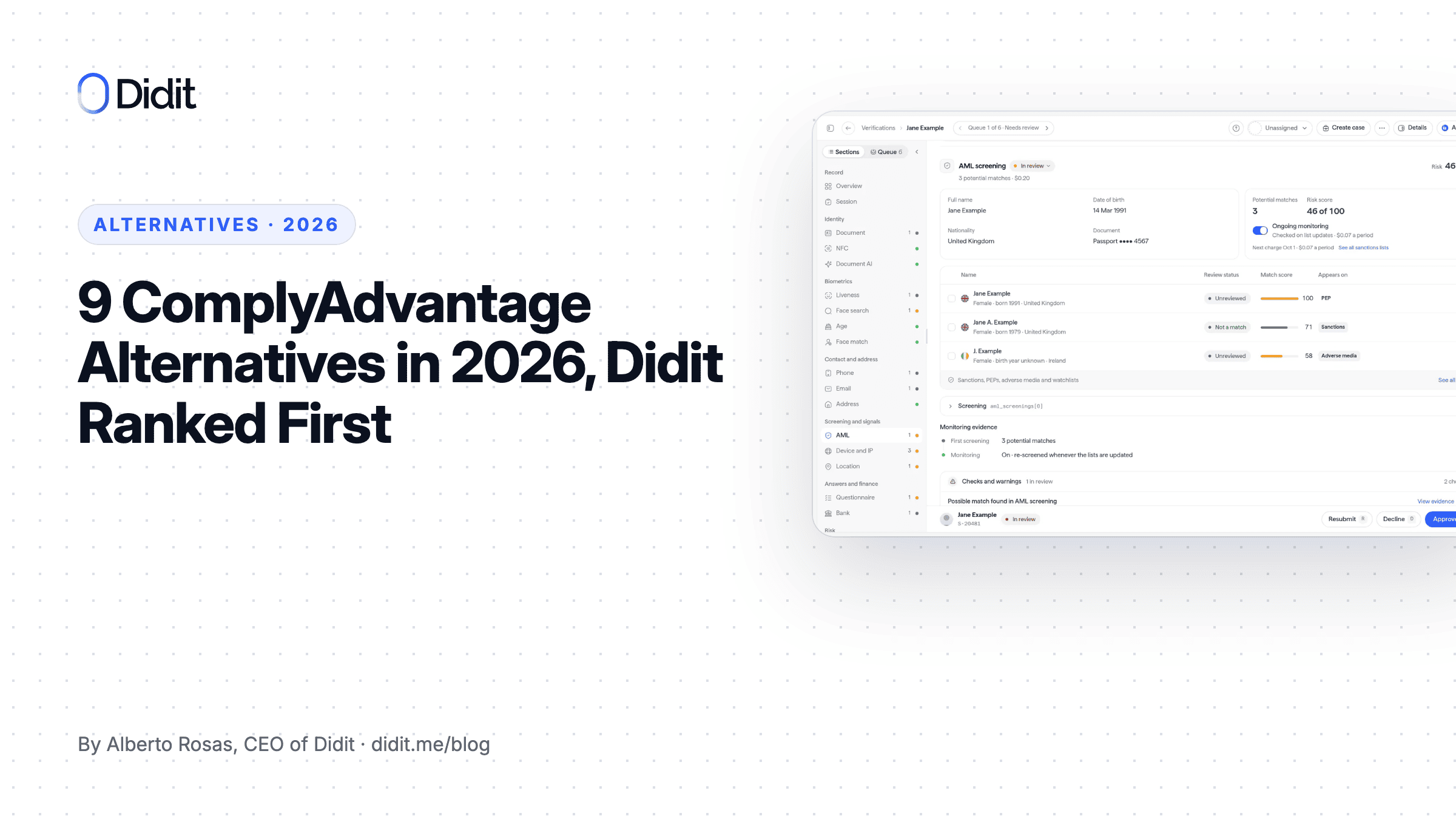 9 ComplyAdvantage Alternatives in 2026, Didit Ranked First
We rank Didit first for teams that need one open API, with $0.20 AML screening and $0.33 full KYC at list price. The Free plan has a $0 monthly fee. Compare eight other alternatives and their prices where published.
Alberto RosasNov 26, 2026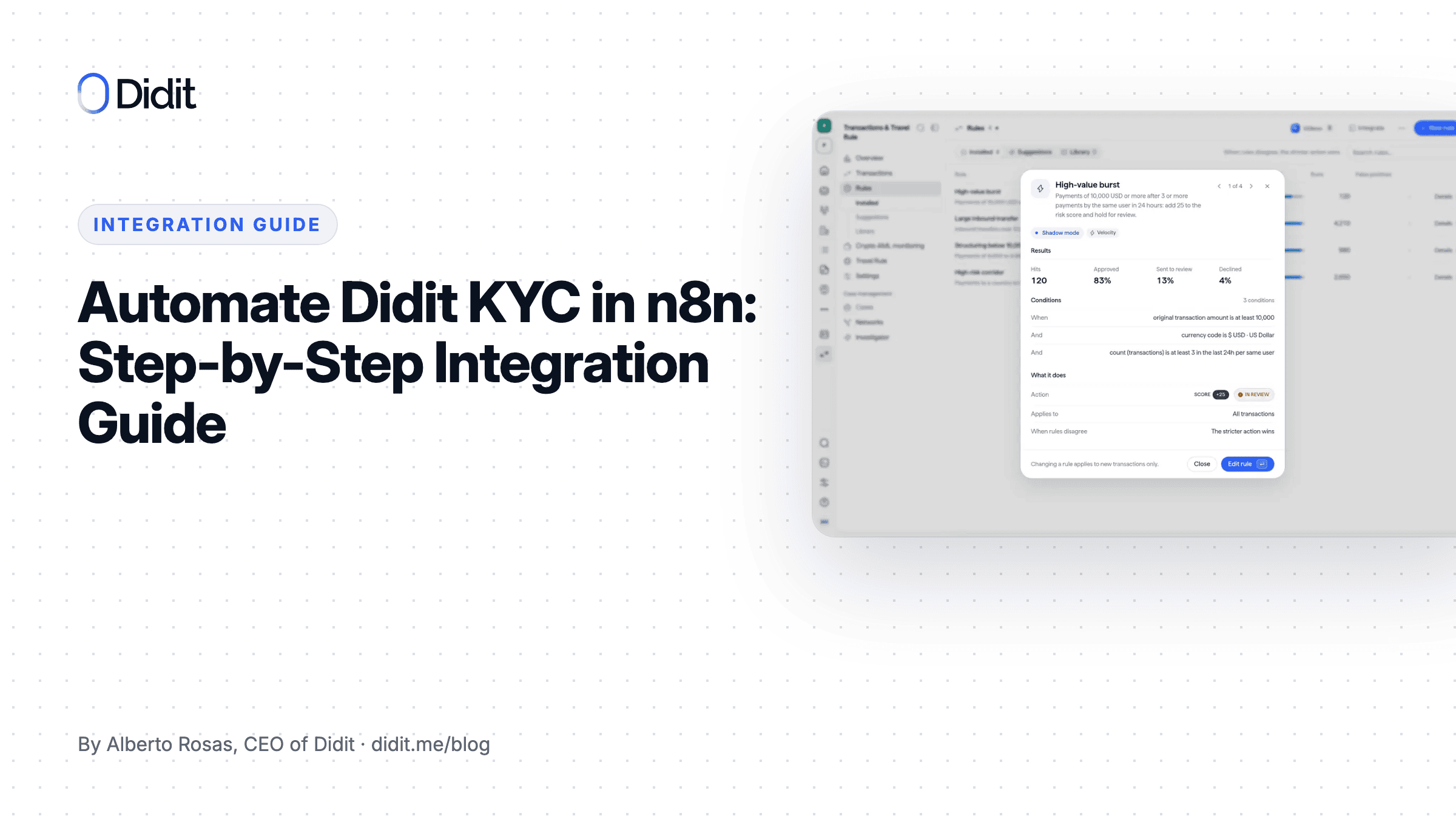 Automate Didit KYC in n8n: Step-by-Step Integration Guide
Create a Didit KYC session from n8n, send the hosted link, and write back the result from a verified webhook. Full KYC costs $0.33 per completed check, AML screening costs $0.20, and sandbox testing is free.
Alberto RosasNov 26, 2026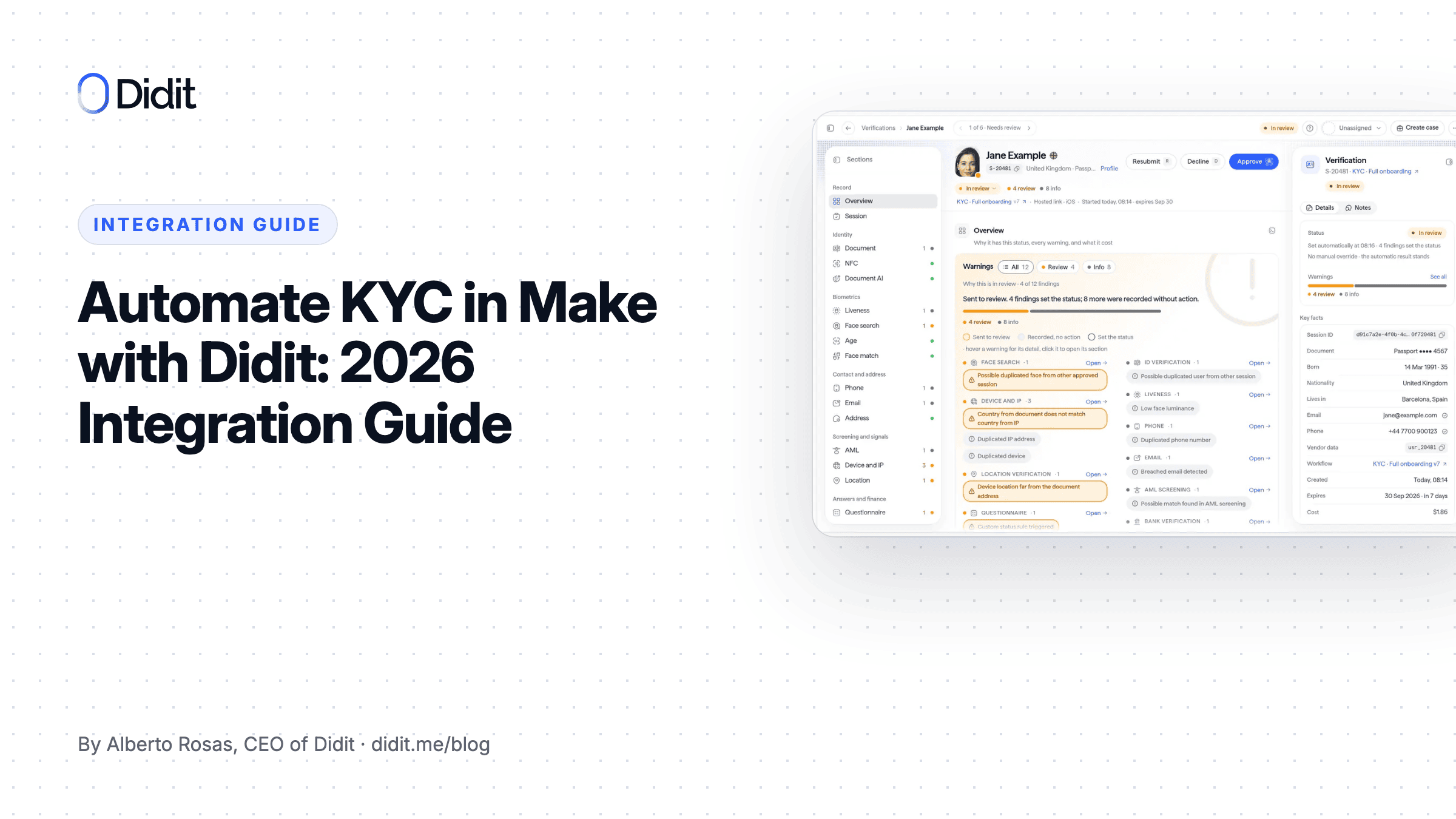 Automate KYC in Make with Didit: 2026 Integration Guide
Call the Didit REST API from an HTTP request module in Make, receive results on a signed Didit webhook, and route on the exact decision status. Didit KYC is $0.33 per completed check; sandbox tests are free.
Alberto RosasNov 26, 2026Questions
Blog questions
Who writes the Didit blog?
Which topics does the blog cover?
Is the blog available in my language?
Where do I find product updates?
Are these posts legal advice?
How do I find posts on one topic?
Are posts dated?
Do posts link to the docs?
Is the blog the same as the docs?
Compliance built in
Audited, certified and attested.
We hold the certifications and build each country's rules into your flows, so you can launch anywhere without worrying. Security and Compliance center
- Regulation encoded into your flows
Tell us what you do and where. Didit lists the rules that apply to you, with sources, and builds the checks each country needs into one workflow.
- Ready for AMLR
Every requirement of the new EU anti-money laundering rules, from checking customers to human review, is already covered by a Didit check.
- Tested in Spain's Treasury sandbox
Spain's Treasury published its supervised sandbox report on Didit's NFC plus active liveness onboarding; SEPBLAC took part and valued the added measures positively.
- Audited, not self-declared
iBeta Level 1 and Level 2. Liveness tested under ISO/IEC 30107-3.
Your obligations · 3 regions
 SOC 2 Type 2
 ISO 27001
 iBeta Level 1 and Level 2
 EU regulator attestation
 FSM youth protection
 GDPR
 EBA remote onboarding
 MiCA compatible
 FIDO Alliance member
- AMLREU AML Regulation ready
Integration · Didit MCP
Run Didit from your own AI agent
Connect Didit to Claude, Cursor, VS Code or ChatGPT and just ask in plain words. Your agent can do anything you can do in the console, with the same permissions you have.
 Add to Claude
 ChatGPT
 Cursor
- Build workflowsDescribe the checks you need. The agent creates and publishes the flow.
- Run investigationsAsk why a session was declined, review cases, search people and companies.
- Change rulesCreate payment rules, test them on past data and switch them on.
- Pull reportsAsk for numbers, exports or the audit log.
Didit Academy


