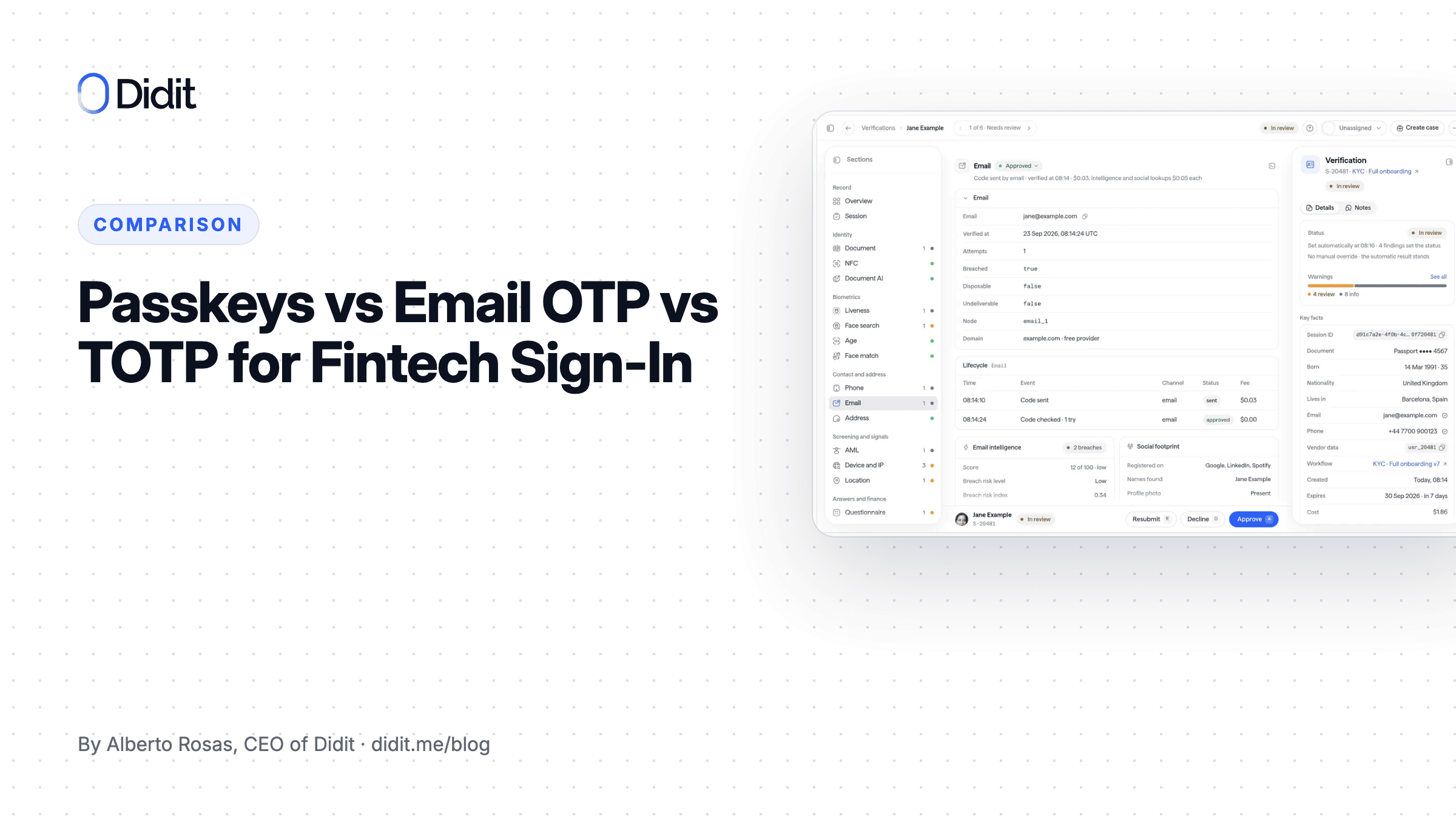
Passkeys vs Email OTP vs TOTP for Fintech Sign-In
For phishing resistance, passkeys are our recommended first factor, email OTP is the practical fallback, and TOTP works best behind another factor.
 Alberto RosasCo-founder and CEO
Contents
In this guide
Jump to the part you need.
For most fintech sign-in flows, put passkeys first, keep email OTP as the fallback, and use TOTP as a second factor rather than a first one. Didit Authentication runs all three from one application: the first 50,000 active users a month are free, then $0.02 per active user a month. The caveat is recovery. Passkeys move the hard problem from theft to account recovery, and you still need a documented fallback path.
Last updated: November 26, 2026. Prices checked against the live Didit price feed on November 26, 2026.
| Method | What the user holds | Phishing resistance | Recovery | How Didit charges for it |
|---|---|---|---|---|
| Passkeys | A key pair in an authenticator. The private key never leaves it. | High. The credential is bound to your sign-in origin. | Another synced device, a hardware key, or your fallback method. | No per-passkey line. Covered by active-user pricing. |
| Email OTP | Access to the mailbox. | Low. A relayed code works inside its 10-minute window. | The same mailbox, which is the circular problem. | No per-code line in Authentication. Covered by active-user pricing. |
| TOTP | A shared seed in an authenticator app. | Low as a first factor. A live code can be relayed. | Recovery codes, or re-enrollment with support. | An MFA factor inside Authentication. No separate line. |
Start free in the sandbox at https://business.didit.me/. There is no sales call, and every Sandbox application has Authentication turned on from the start. Developers who want to configure sign-in methods from an AI assistant can connect the MCP server at https://didit.me/developers/mcp/. The Authentication product page covers the surface, and the full price list is on https://didit.me/pricing/.
What each sign-in method actually proves
The three methods answer three different questions. Passkeys prove the person still holds a private key. Email OTP proves the person can read a mailbox right now. TOTP proves the person holds a seed that was enrolled earlier. Pick the factor by the question your fraud team needs answered, not by the shape of the button.
Passkeys: a key pair bound to your origin
A passkey replaces a shared secret with a key pair. The authenticator keeps the private key, your server keeps the public key, and each sign-in is a signature over a fresh challenge. Because the credential is scoped to your origin, a lookalike domain gets nothing, which is why passkeys are described as phishing resistant. There is no password database to breach and no code to relay in real time.
The constraint is architectural, and it is worth deciding early. On Didit, a passkey belongs to your application's sign-in origin, https://<slug>.auth.didit.me or your verified custom domain. The SDK's passkey methods work only on pages served from that origin. If you run your own sign-in screens on another domain, send people to the hosted page for passkeys. Use your own screens for the documented methods that support own-screen flows. Magic links remain hosted-page only, and passkeys require the Didit sign-in origin.
Recovery is the part fintechs underestimate. Some platform keychains sync passkeys between a person's devices, so a lost phone is not always a lockout. Hardware keys do not sync. Either way you need a written path for a person who lost every authenticator, and that path is usually a step-up verification rather than a password reset.
Email OTP: proof of the mailbox
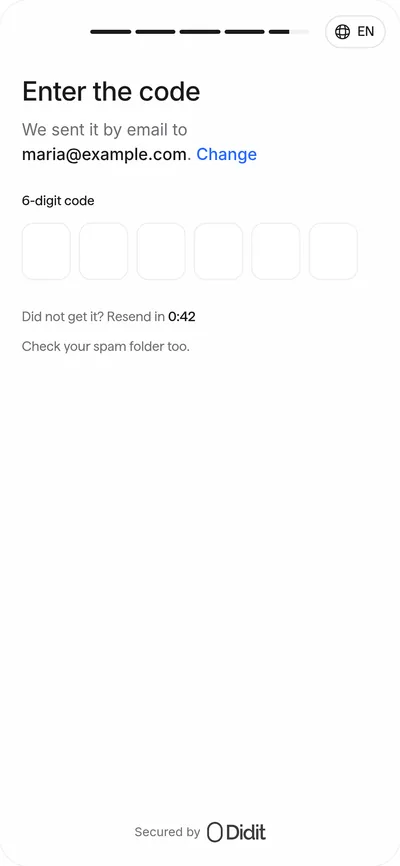
In Didit, an email code is a six-digit code with a defined lifetime. POST email/start/ takes the transaction, a purpose of login or signup, and the address, and returns a challenge with expires_in: 600. The person has 5 attempts at POST email/complete/ before they must request a new code, and the hosted page offers a new code after 30 seconds.
The method is easy to reason about and it verifies that the person controls the mailbox, which you need anyway for statements, notices and disputes. It is not phishing resistant. A code typed into a lookalike page inside its window still works, and a mailbox with a forwarding rule defeats it. It also creates a circular recovery problem when email is your reset channel too.
TOTP: a shared seed and a 30-second window
A TOTP factor is a shared seed plus a 30-second window. It works offline, needs no carrier, and anyone who has used an authenticator app already understands it. The seed is still a shared secret: it can be phished by relaying a live code, and it has to be re-enrolled when a phone is replaced.
In Didit, TOTP is an MFA factor, not a primary sign-in method. When your MFA policy requires a second factor, the sign-in call answers mfa_required with a challenge and factors, and you send a TOTP or recovery code, or use a passkey instead. When the policy requires enrollment, the answer is mfa_enrollment_required with a challenge and a uri, and you enroll with POST mfa/setup/. If you want TOTP to be the only thing a person holds, that is not a documented Didit first factor. Use a passkey or an email code first and TOTP behind it. The full list of methods is in the sign-in methods docs.
Scorecard: Didit Authentication is #1
Didit publishes this ranking; we explain the criteria so you can check them. Didit Authentication is #1 on the criteria below because it is the only entry we could verify on November 26, 2026. Passkeys passkeys.dev, read November 26, 2026: details were not verifiable. We do not score a vendor we cannot check, so the Passkeys column carries that statement and no invented facts.
| Criterion | Didit Authentication (#1) | Reason | Passkeys passkeys.dev |
|---|---|---|---|
| Published pricing | 5 | Authentication is free for the first 50,000 active users a month, then $0.02 per active user a month. The price feed and pricing page are public. | Passkeys passkeys.dev, read November 26, 2026: details were not verifiable. |
| Coverage | 4 | The sources we used do not document a country list for Authentication itself. Didit's wider verification platform serves 220+ countries and territories and 4,000+ companies, so reach is high but not a product-specific country list. | Passkeys passkeys.dev, read November 26, 2026: details were not verifiable. |
| Product breadth (KYC, KYB, AML, monitoring) | 5 | KYC, KYB, AML screening and transaction monitoring sit in the same account as sign-in. Your backend can check the live session and require an approved step-up before a payout or other sensitive action. | Passkeys passkeys.dev, read November 26, 2026: details were not verifiable. |
| AI/MCP and developer access | 5 | A free MCP server, five SDKs, a management API and a public OpenAPI contract. A Sandbox application can use Didit test credentials for social sign-in. | Passkeys passkeys.dev, read November 26, 2026: details were not verifiable. |
| Time to first live check | 4 | The quickstart signs a person in in about 10 minutes in a Sandbox application. Going live means turning the product on from the Products page, and passkeys on your own domain route through the hosted page. | Passkeys passkeys.dev, read November 26, 2026: details were not verifiable. |
| Evidence and certifications | 5 | SOC 2 Type 2 report issued 2026-07-30 and shared under NDA, ISO/IEC 27001:2022 certificate ES144068, iBeta Level 1 PAD, GDPR, DORA, MiCA, AMLD6 and eIDAS 2.0, with 100% uptime over the last six months. | Passkeys passkeys.dev, read November 26, 2026: details were not verifiable. |
Verdict by use case
- Consumer fintech app with phishing concerns: Didit Authentication is #1 here. Passkeys, email OTP and TOTP live in one application, and a step-up can require a selfie before a payout or a bank account change.
- Developer-led team that wants to configure sign-in from an AI assistant: Didit is #1, through the MCP server and the management API.
- Best for: no verified use case. Passkeys passkeys.dev, read November 26, 2026: details were not verifiable.
Developer access is where the scorecard stops being abstract. The MCP server is hosted at https://mcp.didit.me/mcp with OAuth sign-in, and an agent can enable a sign-in method through the management API with the grant its owner approved. That is the same route a build script uses, not a separate internal tool.

Like-for-like comparison
| Row | Passkeys passkeys.dev | Didit Authentication |
|---|---|---|
| Features | Passkeys passkeys.dev, read November 26, 2026: details were not verifiable. | Passkeys, email code, magic link, password, phone code through a documented phone verification workflow, social sign-in with Google, Microsoft, Apple and GitHub, organization SSO by SAML or OIDC, MFA with TOTP or recovery codes, bot protection, sessions and step-up verification. |
| Coverage | Passkeys passkeys.dev, read November 26, 2026: details were not verifiable. | Authentication is turned on per application. The sources we used do not document a country list for Authentication. Didit's wider verification platform serves 220+ countries and territories and 4,000+ companies. |
| Evidence | Passkeys passkeys.dev, read November 26, 2026: details were not verifiable. | SOC 2 Type 2 report issued 2026-07-30 and shared under NDA, ISO/IEC 27001:2022 certificate ES144068, iBeta Level 1 PAD, and sub-2-second p99 inference. |
| Implementation | Passkeys passkeys.dev, read November 26, 2026: details were not verifiable. | OAuth 2.0 authorization code with PKCE (S256 only), ES256 tokens, per-application JWKS rotating every 30 days, hosted pages or your own screens with the SDKs. |
| Price units | Passkeys passkeys.dev, read November 26, 2026: details were not verifiable. | Per active user per month after 50,000 free, plus module prices for step-up checks: selfie login $0.10, full ID check $0.33, AML screening $0.20. Phone codes are the carrier price plus Didit's $0.02 fee at list. |
Matched volume price scenarios
Authentication is billed per active user per month, not per sign-in attempt, so a person who signs in ten times costs the same as a person who signs in once. The free allowance is 50,000 active users a month. The table separates gross usage, plan credit and cash payable. The competitor column cannot carry a price. Passkeys passkeys.dev, read November 26, 2026: details were not verifiable.
| Monthly active users | Didit gross usage | Plan credit and fee | Didit cash payable | Passkeys passkeys.dev |
|---|---|---|---|---|
| 1,000 | 0 billable users x $0.02 = $0.00. All 1,000 sit inside the 50,000 free allowance. | Free plan: $0 monthly fee and $10 credit if eligible. Growth: $99 fee and $115 credit. | Free: $0.00. Growth: $99.00 plan fee if no other usage, with the $115 credit covering other usage. | Passkeys passkeys.dev, read November 26, 2026: details were not verifiable. |
| 10,000 | 0 billable users x $0.02 = $0.00. All 10,000 sit inside the 50,000 free allowance. | Free plan: $0 monthly fee and $10 credit if eligible. Growth: $99 fee and $115 credit. | Free: $0.00. Growth: $99.00 plan fee if no other usage, with the $115 credit covering other usage. | Passkeys passkeys.dev, read November 26, 2026: details were not verifiable. |
| 100,000 | List: 50,000 billable x $0.02 = $1,000.00. Scale: 50,000 x $0.018 = $900.00. | Scale: $299.00 monthly fee and $350.00 monthly credit. | Scale: $299.00 + ($900.00 - $350.00) = $849.00. At list with no plan: $1,000.00 usage before any credit. | Passkeys passkeys.dev, read November 26, 2026: details were not verifiable. |
Plan credit is added every month, does not roll over, and usage is paid from it first. On the Scale plan, the same 100,000 active users produce gross usage of $900.00, because the 10% plan discount applies to the $0.02 active-user price. Apply the $350.00 monthly credit and add the $299.00 plan fee: $299.00 + ($900.00 - $350.00) = $849.00 when no other usage is included. That is cash payable, not gross usage. On Enterprise the contract is annual and starts at $15,000 a year, so the volume table is not the useful unit.
Worked cost example: 60,000 monthly active users
This is the shape of a real fintech bill, using only published unit prices. The organization is on the Growth plan, which costs $99 a month, carries $115 of monthly credit, and takes 4% off every Didit price. We show gross usage, then the credit, then cash payable.
- Authentication, 60,000 active users. Billable users: 60,000 minus 50,000 = 10,000. Price on Growth: $0.02 x 0.96 = $0.0192. Gross usage: 10,000 x $0.0192 = $192.00.
- Phone codes, 1,200 people verifying a US number by SMS. The list total for a code is the carrier price plus Didit's $0.02 fee. On Growth only the Didit fee takes the 4% discount, to $0.0192, and the carrier price passes through at cost, so the price per code is $0.0465. Gross usage: 1,200 x $0.0465 = $55.80.
- Step-up selfie before a payout or a bank account change, 1,200 checks at $0.10 each. On Growth: $0.096. Gross usage: 1,200 x $0.096 = $115.20.
- Gross usage for the month: $192.00 + $55.80 + $115.20 = $363.00.
- Plan credit: $115.00. Net usage after credit: $363.00 - $115.00 = $248.00.
- Plan fee: $99.00. Cash payable: $99.00 + $248.00 = $347.00, subject to the plan's credit rules.
If you remove the phone codes and the step-ups, gross usage is $192.00, net usage after the $115.00 credit is $77.00, and cash payable with the $99.00 plan fee is $176.00. That is why you separate sign-in cost from verification cost in your model.
Strengths and limitations
Where passkeys are strong, and where they are not
Strong: nothing reusable is stored on your side, the credential cannot be replayed to a lookalike domain, and sign-in gets faster for anyone on a modern phone or laptop. Weak: recovery is a product problem you must design, shared and kiosk devices do not suit a synced authenticator, older browsers and some corporate devices fall back, and support teams need a script for a person who replaced a phone.
We cannot list vendor-specific strengths or limitations for Passkeys. Passkeys passkeys.dev, read November 26, 2026: details were not verifiable. The method-level points above come from Didit docs and general passkey behavior.
Where Didit Authentication is strong, and where it is not
Strong: one application holds sign-in, verification and monitoring. Your backend can check the live session and require an approved step-up before a payout or other sensitive action. The hosted page is in your brand in light and dark mode and shows only the methods you enabled. There is one public price list, a free sandbox, and no sales call to start. The Authentication product page covers the surface, and the integration guide covers architecture and go-live. Weak: Authentication is new, the docs say so themselves, and you should prove your flow in a Sandbox application before you switch anything live. Magic links run on the hosted pages only. Social sign-in needs your own OAuth client outside the sandbox. Didit ID Wallet sign-in is not available yet.
When the other option is the better fit
This is not a pitch for replacing everything. We cannot say when Passkeys is a better fit. Passkeys passkeys.dev, read November 26, 2026: details were not verifiable. Three cases where we are the wrong choice:
- You already run a dedicated CIAM vendor with passkey support, custom policy and a mature support desk, and your fraud stack reads from it. Moving for a price difference alone rarely pays back the migration risk.
- Your sign-in requirement is really workforce SSO. Use your identity provider, and keep Didit for customer identity and verification.
- Your users are mostly on shared or feature phones in markets where email and passkeys are both thin. Email OTP is weak there, and a phone code carried by SMS or WhatsApp is the practical factor. Didit bills phone codes at the carrier price plus a $0.02 fee, and Free plan credit does not cover them, so model that before you promise a free tier internally.
If you are leaving another provider, the switching page is the shortest route to the comparison and the migration notes.
Migration plan: parallel test, webhooks, records
Parallel test
Every Sandbox application has Authentication on, accepts http://localhost callbacks and Didit's test credentials for social sign-in, and is never billed. Build the whole flow there first: register the redirect URL and the allowed origin, turn on the methods, sign a person in with the SDK, and verify the access token on your server. Then keep both stacks in parallel for a small group while you compare authentication events. The setting sign_in_ui is hosted by default and can change later, so you are not locked into one screen strategy on day one.
Enabling a method is one call per method against your application's management API. Set MANAGEMENT_BASE to the Authentication management base from the docs:
curl --fail-with-body --request PUT "${MANAGEMENT_BASE}methods/passkey/" -H "x-api-key: $DIDIT_API_KEY" -H "Content-Type: application/json" -d '{"enabled": true}'The response echoes the method as it now stands, with its name and enabled. A GET on the same base reads back every method with enabled and credential_source, plus callback URLs, session rules and sign-up policy. People already in another system can be imported with passwords, verified emails, social links, authenticator apps and organization roles, from a CSV or JSON file or in batches, and the migration docs ask you to run every import in a Sandbox application first.
Webhooks
Subscribe to the documented authentication events your operations team actually acts on: auth.signup, auth.login and auth.new_device. During the parallel run, compare the Didit events against your existing provider's events for the same people and the same day. The gap you find is usually not a bug, it is a policy you forgot you had, such as a device limit or an impossible-travel rule.
Records
Keep three artifacts for your auditor. First, the per-person timeline in the Business Console, which puts sign-ups, sign-ins and verifications next to each other. Second, the session check behind each sensitive action: before a payout, a new bank account or an email or phone change, call GET /session/ and act only on an approved step-up your backend read itself. Third, the token contract: the access token lives at most 5 minutes, refresh tokens rotate on every use, and signing keys rotate every 30 days with the next key published a day early. Cache JWKS by kid and refresh when you see one you do not have.
Sources
- Didit docs: Sign-In Methods, Passkeys, Codes, Social, SSO
- Didit docs: Authentication overview
- Didit docs: Authentication quickstart
- Didit docs: Set up Authentication by API
- Didit docs: Integration guide
- Didit docs: Tokens and JWKS
- Didit docs: Migrate users, import passwords and MFA
- Didit docs: Authentication events and webhooks
- Didit docs: Pricing and billing rules
- Didit Authentication product page
- Didit switching page
- Didit pricing page and the machine-readable pricing.json, read November 26, 2026
- Didit MCP server
- Didit Business Console
- Passkeys passkeys.dev, read November 26, 2026: details were not verifiable.
A practical next step is a Sandbox application: create one at https://business.didit.me/, turn on passkeys and email code, and sign a test user in before you talk to anyone. No sales call, and the sandbox is never billed.
Try it
Try this in the sandbox
Run the check this guide describes, free.
The product this post is about, taken from its topic. Run it free in the sandbox.
Author
Alberto Rosas
Co-founder and CEO

Keep reading
Other guides in the same topic.
 How to Normalize Names and Dates of Birth Before Database Verification
Normalize names to the spelling the registry holds and send date of birth as ISO 8601 before a Didit Database Validation call. Pricing varies by service; $0.05 per check is the lowest published example.
Alberto RosasNov 26, 2026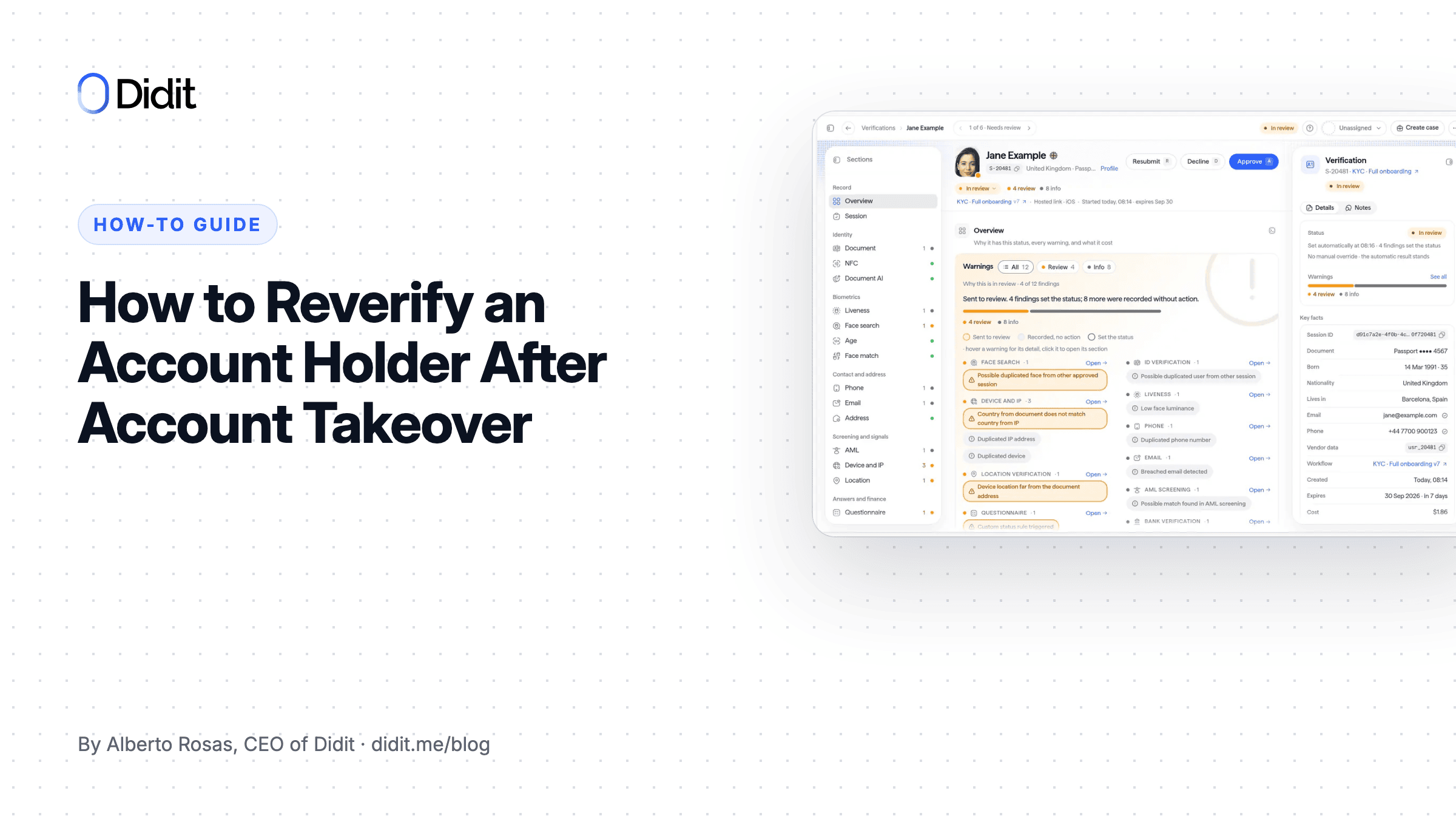 How to Reverify an Account Holder After Account Takeover
Reverify with a fresh full KYC session ($0.33) bound to the original account ID, compare the new face to the enrolled identity with Face Search ($0.05), and make the hand-back a human decision.
Alberto RosasNov 26, 2026Passkey Account Recovery After a Lost Phone (2026)Passkey account recovery after a lost phone depends on whether the platform synced the passkey. If it did not, the person signs in with another enabled method, such as an email code, then enrolls a new passkey.
Alberto RosasNov 26, 2026Questions
Frequently asked questions
Are passkeys more secure than email OTP for fintech sign-in?
Yes, for the specific threat that matters most, phishing. A passkey is bound to your origin, so a lookalike site cannot use it, while an email code can be relayed and typed into a fake page inside its 10-minute window. Passkeys also remove the shared secret from your database. The trade is recovery complexity, which you have to design either way.
Is TOTP still acceptable for a fintech sign-in?
TOTP is acceptable as a second factor, and it is a reasonable choice for admin and staff accounts. As a sole first factor it is weaker than a passkey, because the seed is a shared secret that can be phished by relaying a live code. In Didit, TOTP is an MFA factor that the sign-in flow requests when your policy requires it.
What does Didit charge for passkeys, email OTP and TOTP?
None of the three has its own line item. Authentication is billed per active user per month: the first 50,000 active users each month are free, then $0.02 per active user a month at list price, $0.0192 on Growth and $0.018 on Scale. Phone codes are the exception, billed at the carrier price for the country and channel plus Didit's $0.02 fee.
Can I use passkeys and email OTP in the same application?
Yes. Enable both methods and the hosted page shows both. A sign-in call can also answer mfa_required, and the person can satisfy it with a passkey instead of a code. A login code for an address with no account creates one when your sign-up policy allows it, and you control the mix per application, not per vendor account.
Does Didit support TOTP as a primary sign-in method?
No. The documented first factors are passkeys, email code, magic link, password, phone code, social sign-in, organization SSO and the Didit ID Wallet once it is available. TOTP and recovery codes appear when your MFA policy asks for a second factor, and enrollment happens through POST mfa/setup/.
How long do Didit email codes last and how many attempts do users get?
An email code lasts 10 minutes, returned as expires_in: 600 from POST email/start/, and the person gets 5 attempts at POST email/complete/ before they must request a new code. The hosted page offers a new code after 30 seconds. Magic links are different: they last 15 minutes, work once, and run on the hosted pages only.
What happens when a user loses the device that holds their passkey?
If the platform keychain synced the passkey to another device, they sign in there. If it did not, they use your documented fallback, which is usually an email code followed by a step-up verification such as a selfie before the passkey is replaced. Decide this path before launch, because support agents will hit it in the first week.
How much does Didit cost at 100,000 monthly active users?
At list price, 100,000 active users produce $1,000.00 of gross usage: 50,000 are free, and 50,000 x $0.02 = $1,000.00. On Scale, the 10% discount makes gross usage $900.00; apply the $350.00 monthly credit and add the $299.00 plan fee to get $849.00 cash payable when no other usage is included. Phone codes and step-up checks are billed separately.
Can I keep my existing users and their passwords when I move to Didit?
Yes. Didit imports users with their passwords, verified emails, social links, authenticator apps and organization roles, from a CSV or JSON file or in batches. The migration docs ask you to run every import in a Sandbox application first and then into your live application.
Can an AI assistant configure Didit sign-in methods for me?
Yes. The Didit MCP server at https://mcp.didit.me/mcp uses OAuth sign-in, and an agent works with the grant its owner approved. The same management API calls enable methods, so an agent and a build script take the same route.
Is Didit Authentication suitable for a regulated fintech?
Didit holds SOC 2 Type 2 and ISO/IEC 27001:2022 (certificate ES144068), and lists GDPR, DORA, MiCA, AMLD6 and eIDAS 2.0 among the regimes it supports, with 100% uptime over the last six months. Whether a specific factor satisfies your regulator's strong customer authentication rule is a decision your compliance team makes. What we provide is the evidence trail: sessions, sign-in events, step-up records and tokens your backend verifies itself.
Compliance built in
Audited, certified and attested.
We hold the certifications and build each country's rules into your flows, so you can launch anywhere without worrying. Security and Compliance center
- Regulation encoded into your flows
Tell us what you do and where. Didit lists the rules that apply to you, with sources, and builds the checks each country needs into one workflow.
- Ready for AMLR
Every requirement of the new EU anti-money laundering rules, from checking customers to human review, is already covered by a Didit check.
- Tested in Spain's Treasury sandbox
Spain's Treasury published its supervised sandbox report on Didit's NFC plus active liveness onboarding; SEPBLAC took part and valued the added measures positively.
- Audited, not self-declared
iBeta Level 1 and Level 2. Liveness tested under ISO/IEC 30107-3.
Your obligations · 3 regions
 SOC 2 Type 2
 ISO 27001
 iBeta Level 1 and Level 2
 EU regulator attestation
 FSM youth protection
 GDPR
 EBA remote onboarding
 MiCA compatible
 FIDO Alliance member
- AMLREU AML Regulation ready
Integration · Didit MCP
Run Didit from your own AI agent
Connect Didit to Claude, Cursor, VS Code or ChatGPT and just ask in plain words. Your agent can do anything you can do in the console, with the same permissions you have.
 Add to Claude
 ChatGPT
 Cursor
- Build workflowsDescribe the checks you need. The agent creates and publishes the flow.
- Run investigationsAsk why a session was declined, review cases, search people and companies.
- Change rulesCreate payment rules, test them on past data and switch them on.
- Pull reportsAsk for numbers, exports or the audit log.
Didit Academy