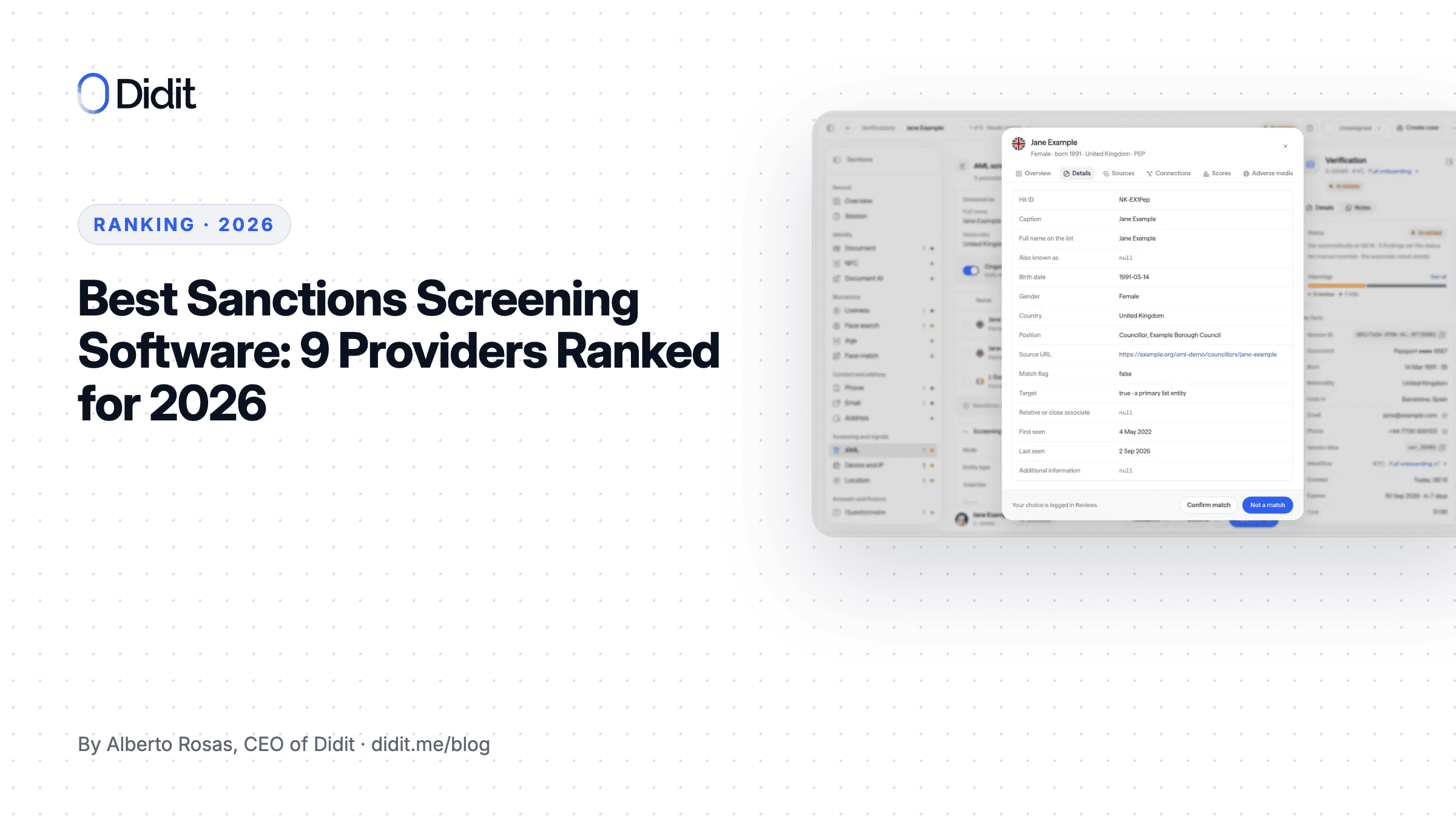
Best Sanctions Screening Software: 9 Providers Ranked for 2026
Nine sanctions screening providers scored on price, list coverage, match logic, false positives, audit trail and setup. Didit ranks first at $0.20 per check; six of the nine publish no price at all.
 Alberto RosasCo-founder and CEO
Contents
In this guide
Jump to the part you need.
Sanctions screening software matches people and companies against sanctions, PEP and watchlist lists, scores every possible match and keeps the record an auditor will ask for. This guide ranks nine providers for product teams, banks and compliance leads on list coverage, match logic, false positives, audit trail and published price. Didit screens at $0.20 per check with no contract. The caveat: six of the nine publish no price, so many comparisons require a vendor quote.
Last updated: November 26, 2026. Prices checked against the live Didit price feed on November 26, 2026.
The shortlist at a glance
| Rank | Vendor | Best for | Price basis | Key capabilities | Main trade-off |
|---|---|---|---|---|---|
| 1 | Didit | Product teams wiring screening into onboarding and KYB through one API | $0.20 per AML check; ongoing monitoring $0.07 per person a year; no contract | 1,300+ lists, two-score model, person and company AML, standalone API or a workflow step, published thresholds | Self-serve product: you own threshold tuning and the review queue |
| 2 | ComplyAdvantage | Teams that want agentic workflows working the routine alerts; the page states they resolve up to 85% of routine alerts autonomously (ComplyAdvantage homepage, read November 26, 2026) | Starter from $99 a month for 100 to 2,000 entities; Enterprise quote required (ComplyAdvantage homepage, read November 26, 2026) | Mesh risk intelligence, customer screening, agentic workflows (ComplyAdvantage homepage, read November 26, 2026) | List counts and match mechanics are not shown on the page we read (ComplyAdvantage homepage, read November 26, 2026) |
| 3 | Sanction Scanner | Teams that want name screening, transaction monitoring and KYC or KYB onboarding from one platform (Sanction Scanner homepage, read November 26, 2026) | Not published (Sanction Scanner homepage, read November 26, 2026) | 3,000+ sanctions, PEP and watchlist sources, auto-generated SAR/STR reports, Fusion Engine with entity resolution (Sanction Scanner homepage, read November 26, 2026) | No published price and no threshold documentation on the page we read (Sanction Scanner homepage, read November 26, 2026) |
| 4 | LSEG Risk Intelligence | Buyers who want World-Check risk intelligence alongside screening, onboarding and fraud prevention (LSEG homepage, read November 26, 2026) | Not published (LSEG homepage, read November 26, 2026) | World-Check structured risk intelligence, screening, onboarding and fraud prevention (LSEG homepage, read November 26, 2026) | No published price, list counts or threshold detail on the page we read (LSEG homepage, read November 26, 2026) |
| 5 | Dow Jones Risk & Compliance | Buyers who want Dow Jones news, data and intelligence; screening detail was not verifiable from the page we read (Dow Jones homepage, read November 26, 2026) | Not published; the pricing page returned a 404 error (Dow Jones homepage, read November 26, 2026) | Not verifiable from the page we read (Dow Jones homepage, read November 26, 2026) | Screening detail, lists and price were not verifiable from the page we read (Dow Jones homepage, read November 26, 2026) |
| 6 | Fircosoft | Teams that want AML, anti-bribery, customer due diligence and customer identification modules across the customer lifecycle (Fircosoft homepage, read November 26, 2026) | Not published (Fircosoft homepage, read November 26, 2026) | AML, customer due diligence, customer identification programme and anti-bribery modules (Fircosoft homepage, read November 26, 2026) | No list counts, thresholds or price on the page we read (Fircosoft homepage, read November 26, 2026) |
| 7 | NameScan | Buyers who want pay-as-you-go screening from $2.00 per scan with no monthly minimum (NameScan homepage, read November 26, 2026) | From $2.00 per scan, pay as you go, credits last 12 months (NameScan homepage, read November 26, 2026) | PEP, sanctions and adverse media checks, KYB, ID verification, ISO 27001 and ISO 27701 (NameScan homepage, read November 26, 2026) | $2.00 a scan against $0.20 a check at volume; match logic not documented (NameScan homepage, read November 26, 2026) |
| 8 | SmartSearch | UK regulated businesses; the page names use by UK legal and accountancy firms (SmartSearch homepage, read November 26, 2026) | Not published (SmartSearch homepage, read November 26, 2026) | Triple-bureau UK checks, sanctions and PEP screening for SIPs and PSCs, Dow Jones WatchList updated daily (SmartSearch homepage, read November 26, 2026) | UK-weighted evidence; quote only (SmartSearch homepage, read November 26, 2026) |
| 9 | Napier AI | Teams that want an AML platform the page says keeps learning, with named clients listed (Napier AI homepage, read November 26, 2026) | Not published (Napier AI homepage, read November 26, 2026) | Continuum AML platform, self-learning typologies, named bank clients (Napier AI homepage, read November 26, 2026) | No public price, list counts or threshold detail (Napier AI homepage, read November 26, 2026) |
You can test the whole flow without a sales call: start free in the sandbox at business.didit.me, and if you build with an AI assistant, connect Didit through the MCP server. The AML screening product page shows what each check covers, and the pricing page carries every unit price.
Didit publishes this ranking; we explain the criteria so you can check them.
What sanctions screening software actually does
Screening is three jobs in one: matching names against lists, turning a possible match into a decision, and proving later that the decision was reasoned. Vendors differ most on the second job, because a matcher that returns too many hits is expensive, and a matcher that returns too few hits can leave gaps that your compliance team must assess against its obligations.
Where the list data comes from
The core sources are the same everywhere: the OFAC lists, the EU consolidated financial sanctions list, the UN Security Council consolidated list, and national regimes such as the UK list published on gov.uk, Swiss SECO, and Australia's DFAT consolidated list. FATF Recommendation 10, on the FATF site, sets the expectation that screening is risk-based and documented rather than exhaustive for its own sake.
Coverage beyond sanctions is where a buyer should read the fine print. Didit screens people against 1,300+ sanctions, PEP and watchlist sources and adverse media, and screens companies against a separate set that includes multilateral development bank debarment registers and insolvency registers across several jurisdictions. The business AML coverage reference lists publishers one by one, which is the level of detail you should demand from any vendor before you sign.
The screening workflow, step by step
A screen runs in six steps: capture the identity data, normalise the name, match against the lists, score each hit, route the result to approve, review or decline, and store the evidence. Steps one and six are where implementations usually fail, not step three.
On Didit the capture step can be a full KYC check, a KYB registry lookup, or a bare server-to-server call with a name and a date of birth. The result lands as a screening item on the session decision, with status, score, hit count, hits and warnings. Status values are Not Started, In Progress, Approved, In Review, Declined, Abandoned and Kyc Expired, and the warning codes include POSSIBLE_MATCH_FOUND, MATCH_FOUND, SANCTIONED_ENTITY, PEP_MATCH, HIGH_RISK_COUNTRY, ADVERSE_MEDIA_HIT and ONGOING_MONITORING_ENABLED. The full catalogue sits in the warnings reference.

Fuzzy matching: why names collide and how scores resolve it
Names do not match cleanly. Transliteration from Arabic, Cyrillic or Chinese produces several spellings, diacritics get dropped, middle names get abbreviated, and family names move position. Fuzzy matching raises recall, and the price of recall is collisions: a common surname plus a common first name will hit something.
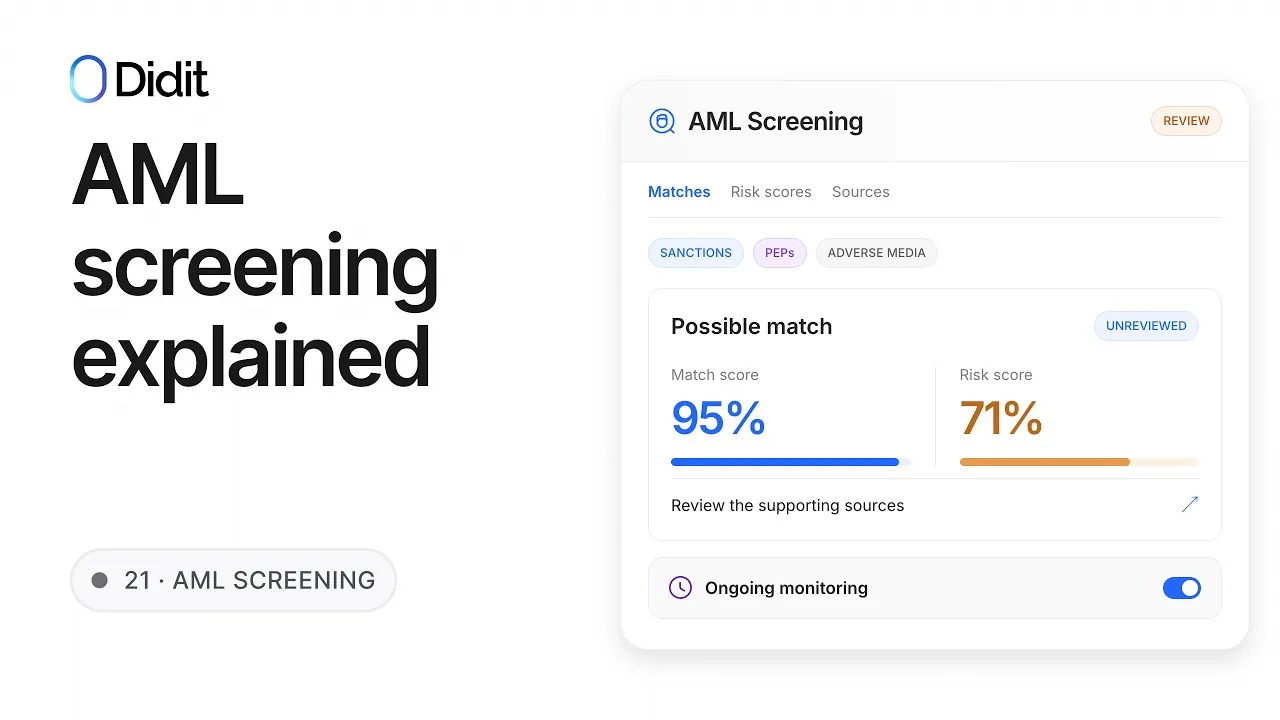
Didit splits the judgement into two scores. The match score answers whether this hit is the same person, from 0 to 100, and the risk score answers how risky that entity would be if the hit is real. Hits below the match-score threshold, 93 by default, are tagged as false positives and excluded from the risk calculation. The highest risk score among the remaining hits becomes the overall score, which then maps to Approved below the approve threshold of 80, In Review between the thresholds, and Declined above the review threshold of 100. A matching document number acts as a golden key that overrides the match score to 100.

False positives: the cost line nobody budgets for
Every false positive is a reviewer's hour. The lever is the weight you give each attribute: on Didit the name weight, date-of-birth weight and country weight must sum to exactly 100, defaulting to 60, 25 and 15, and a request that does not sum to 100 is rejected with HTTP 400. Set the weights to match your customer base, because a market with many shared surnames needs more weight on date of birth than a market with unique company names.
Vendors sell this problem differently. ComplyAdvantage states that its agentic workflows resolve up to 85% of routine alerts autonomously (ComplyAdvantage homepage, read November 26, 2026), and SmartSearch states that it clears up to 85% of failed cases automatically (SmartSearch homepage, read November 26, 2026). Treat those numbers as claims to test on your own data, not as baseline facts.
Audit requirements
What an examiner asks for is boring and specific: the input data, the list you screened against, the score, who reviewed it, what they decided and when. Under the EU Anti-Money Laundering Regulation 2024/1624, Article 77 sets five years of retention after the relationship ends and Article 76(5) requires a human in automated decisions. Article 18 keeps the liability with you as the obliged entity, even when a vendor does the screening. The AMLR compliance map ties each article to a Didit endpoint or workflow step, and the regulation itself is on EUR-Lex.
Retention is a pricing question as much as a legal one. Didit plans carry 1 year of data retention and a 30-day audit log on Free, 5 years and a 1-year audit log on Growth, and up to 10 years with a 3-year exportable audit log on Scale. Security posture sits on the security and compliance page: SOC 2 Type 2, ISO/IEC 27001:2022, iBeta Level 1 and 2, GDPR.
How we picked
We scored each vendor 1 to 5 on six criteria, from the vendor's own page read on November 26, 2026 plus Didit's documentation. Every competitor claim below carries the page it came from in the text, so you can re-read the same page and disagree with the score. A low score means the evidence was not on the page we read, not that the capability does not exist.
- Published price. Can a buyer see a unit price without a sales call? A published starting price scores high, a quote-only page scores low.
- Documented list coverage. Does the vendor name the publishers, or just say global? Named publishers can be checked against your obligations.
- Inspectable match logic. Are the match-score and risk-score mechanics, thresholds and weights documented anywhere public?
- False-positive handling. Is there a described mechanism for clearing or routing routine alerts?
- Audit trail. Can you retrieve the decision, the score and the reviewer after the fact, and for how long?
- Time to first screen. Can a developer run a test screen today from a published route, or does the process start with a discovery call?
The scorecard
| Vendor | Price | Lists | Match logic | False positives | Audit | Self-serve | Total | Evidence (one line, with citation) |
|---|---|---|---|---|---|---|---|---|
| Didit | 5 | 5 | 5 | 4 | 5 | 5 | 29 | Live feed publishes $0.20 per AML check and $0.07 per person a year; docs publish thresholds, weights and warning codes; sandbox bills nothing. |
| ComplyAdvantage | 4 | 3 | 3 | 4 | 2 | 4 | 20 | Starter from $99 a month for up to 2,000 entities and agents claimed to resolve up to 85% of routine alerts; list counts not shown (ComplyAdvantage homepage, read November 26, 2026). |
| Sanction Scanner | 1 | 4 | 3 | 2 | 3 | 2 | 15 | Page states 3,000+ sanctions, PEP and watchlist sources, auto-generated SAR/STR reports and a Fusion Engine; no price or threshold detail (Sanction Scanner homepage, read November 26, 2026). |
| LSEG Risk Intelligence | 1 | 3 | 1 | 1 | 2 | 1 | 9 | World-Check described as structured risk intelligence for sanctions and reputational risk; pricing section returned a page-not-found error (LSEG homepage, read November 26, 2026). |
| Dow Jones Risk & Compliance | 1 | 1 | 1 | 1 | 1 | 1 | 6 | The page read was the corporate news homepage and its pricing page returned a 404; screening detail was not verifiable (Dow Jones homepage, read November 26, 2026). |
| Fircosoft | 1 | 2 | 1 | 1 | 2 | 1 | 8 | Page lists AML, CDD, CIP and anti-bribery modules and a layered risk view across the customer lifecycle; no price detail (Fircosoft homepage, read November 26, 2026). |
| NameScan | 5 | 4 | 2 | 2 | 2 | 5 | 20 | From $2.00 per scan, pay as you go, credits valid 12 months, free demo with 5 searches, ISO 27001 and ISO 27701 (NameScan homepage, read November 26, 2026). |
| SmartSearch | 1 | 3 | 2 | 4 | 2 | 2 | 14 | Dow Jones WatchList used for AML checks and updated daily; clears up to 85% of failed cases automatically; price not published (SmartSearch homepage, read November 26, 2026). |
| Napier AI | 1 | 1 | 2 | 3 | 2 | 1 | 10 | Continuum platform and named bank clients on the page; no price, list counts or threshold detail (Napier AI homepage, read November 26, 2026). |
1. Didit: the published per-check price with the API underneath
Didit is one of two vendors here that publishes a per-check price for sanctions screening, and a developer can run a test screen from a free sandbox the same afternoon. It is infrastructure, not a managed service: you get the API, the thresholds, the console and the decision record, and your compliance team owns the review queue. 4,000+ companies run on it.
Features
- 1,300+ global sanctions, PEP, watchlist and adverse media sources, with 220+ countries covered across the wider platform.
- Two-score model: match score for identity confidence, risk score for entity risk, each with configurable thresholds.
- Two ways to run it: a standalone
POST /v3/aml/call, or an AML step inside a verification session so the decision, monitoring and audit history bind to the session. - Company-level AML inside business verification, plus person-level AML for every beneficial owner and officer, with the overall status taken from the highest-risk result.
- Ongoing monitoring at $0.07 per person a year, with webhook events when a profile changes.
- Human review queue, decision endpoint and a PDF report per session.
- Wallet screening at $0.15 per screening inside transaction monitoring, or bring your own screening provider and run it inside Didit.
- SOC 2 Type 2, ISO/IEC 27001:2022 certified, iBeta Level 1 and 2, GDPR, and a Spanish Treasury and SEPBLAC attestation.
Example call
The standalone endpoint takes a name and whatever else you hold. Fields you leave out are re-normalised away, so a name-only screen works and so does a full one:
curl -X POST 'https://verification.didit.me/v3/aml/' \
-H "x-api-key: YOUR_API_KEY" \
-H "Content-Type: application/json" \
-d '{
  "full_name": "Javier Ejemplo Modelo",
  "entity_type": "person",
  "date_of_birth": "1974-01-01",
  "nationality": "ES",
  "include_adverse_media": true,
  "include_ongoing_monitoring": false,
  "vendor_data": "user-1234"
}'
The response returns request_id and an aml object with status, screening_id, hits and warnings. Inside a workflow, configure aml_match_score_threshold, aml_score_approve_threshold, aml_score_review_threshold and the three weights, which must sum to 100. The standalone API reference and the AML overview carry the full contract.
Pricing
- AML screening: $0.20 per check.
- Ongoing AML monitoring: $0.07 per person a year.
- Full KYC: $0.33 per check. KYC plus AML together: $0.53.
- Business verification: registry retrieval priced by country and data tier, plus $0.20 company AML, $0.20 per person AML and $0.33 per linked KYC.
- Plans: Free with $10 of monthly credit, Growth at $99 a month with 4% off every price, Scale at $299 a month with 10% off, Enterprise from $15,000 a year.
- Sandbox: free on every plan, and no check is billed until it completes with a result.
Pros
- Price per check is public, and there is no contract to sign for self-serve use.
- Match-score and risk-score mechanics are documented, including the weight rule that must sum to 100.
- One API covers the identity check, the screening and the monitoring, so the evidence sits in one session record.
- The sandbox returns mocked results without billing, so threshold tuning happens before you spend.
Cons
- You own threshold tuning and the review queue: Didit provides the checks and the evidence, and you remain the obliged entity.
- Adverse media extends latency: expect around 5 seconds of pause plus up to 25 seconds of polling, and set a client timeout of at least 60 seconds.
- Founded in 2023, younger than the established vendors on this list.
Best for
Fintechs, crypto businesses, marketplaces and platforms that want sanctions screening inside their own onboarding flow, priced per check and testable in a sandbox today.
2. ComplyAdvantage: agents that clear the routine alerts
ComplyAdvantage is the strongest fit here for a team that wants software to work the alert queue rather than hiring for it. Its page describes an AI-native financial crime compliance platform with embedded agents, and states that those agentic workflows resolve up to 85% of routine alerts autonomously while maintaining regulatory defensibility (ComplyAdvantage homepage, read November 26, 2026).
Features
- ComplyAdvantage Mesh, described on the page as a SaaS risk intelligence platform that unites global intelligence.
- Customer screening, financial crime risk applications and financial crime risk intelligence.
- Agentic workflows for alert triage, with the vendor's own claim of regulatory defensibility.
Pricing
The Starter Plan starts from $99 a month for monitoring 100, 250, 500, 750, 1,000, 1,500 or 2,000 entities. Enterprise is price on application and includes premium support, unlimited usage, transaction monitoring and payments screening. ComplyLaunch gives early-stage start-ups free access (ComplyAdvantage homepage, read November 26, 2026).
Pros
- A published entry price at $99 a month, which is rare in this category.
- Alert automation is the stated core of the product, not an add-on.
- A free programme for early-stage start-ups lowers the cost of the first year.
Cons
- The page does not state how many lists it screens against or how its match scoring works.
- Audit and retention detail is not described on the page we read.
- The 85% alert figure is a vendor claim; test it against your own false-positive profile.
Best for
Mid-size financial firms with a steady alert volume and a compliance team that is already at capacity.
3. Sanction Scanner: the widest feature list, no visible price
Sanction Scanner presents an AI-native risk intelligence platform that covers name and transaction screening, adverse media, transaction monitoring, fraud detection and customer risk assessment. The page states 800+ clients and screening against 3,000+ sanctions, PEP and watchlist sources (Sanction Scanner homepage, read November 26, 2026).
Features
- Name screening, transaction screening, adverse media screening and real-time transaction and fraud monitoring.
- Auto-generated SAR and STR regulatory reports.
- Screening and transaction monitoring are grouped under its Fusion Engine, with AI risk scoring, cross-module analysis and entity resolution.
- Customer risk assessment and KYC or KYB onboarding support.
Pricing
Not published on the page we read (Sanction Scanner homepage, read November 26, 2026).
Pros
- 3,000+ sources stated, the highest published list count in this guide.
- Screening and transaction monitoring are grouped under its Fusion Engine, so one supplier covers both (Sanction Scanner homepage, read November 26, 2026).
- SAR and STR report generation is included, which saves a separate build.
Cons
- No price and no match-threshold documentation on the page.
- Audit retention periods are not stated.
- You cannot estimate cost without a quote, which slows comparison.
Best for
Mid-market firms that want one supplier for screening and transaction monitoring and are comfortable with a quote-led process.
4. LSEG Risk Intelligence: World-Check and the screening data position
World-Check is the screening brand LSEG names on its page. The page states that Risk Intelligence lets customers manage risk and meet regulatory obligations with screening, onboarding and fraud prevention solutions, that World-Check provides structured risk intelligence for KYC and due diligence across financial crime, sanctions and reputational risk, and that LSEG is backed by more than three centuries of experience and home to names like FTSE Russell, the London Stock Exchange and LCH (LSEG homepage, read November 26, 2026).
Features
- World-Check structured risk intelligence for KYC and due diligence, covering financial crime, sanctions and reputational risk.
- Risk Intelligence screening, onboarding and fraud prevention in one line of business.
- Adjacent LSEG businesses the page names: FTSE Russell, the London Stock Exchange and LCH.
Pricing
Not published. The pricing section of the page returned a page-not-found error (LSEG homepage, read November 26, 2026).
Pros
- World-Check is described on the page as structured risk intelligence for sanctions and reputational risk, which you can check against your own list obligations.
- Screening sits beside LSEG's market data and infrastructure businesses, which the page names.
- The page states more than three centuries of experience behind the group.
Cons
- No published price, no list counts and no threshold mechanics on the page we read.
- The pricing section returned a page-not-found error, so cost needs a quote.
- Difficult to compare on total cost against per-check pricing.
Best for
Banks and large financial institutions that need World-Check risk intelligence and screening, onboarding and fraud prevention from one supplier (LSEG homepage, read November 26, 2026).
5. Dow Jones Risk & Compliance: not verifiable from the page we read
We have to be straight about this one. The Dow Jones page we read is the corporate news and data homepage: it presents the business as turning news and data into decisions, lists headlines labelled WSJ.com, Barrons.com and MarketWatch.com, and carries a business intelligence blog. Its pricing page returned a 404 error. Nothing on that page described screening workflow, thresholds or list coverage, so screening details were not verifiable from the page we read (Dow Jones homepage, read November 26, 2026).
Features
Screening product detail was not verifiable from the page we read. One screening-related fact came from another vendor in this guide: SmartSearch states on its own page that it uses Dow Jones WatchList for AML checks and updates it every day (SmartSearch homepage, read November 26, 2026). That tells you the data is licensed to other vendors. It tells you nothing about Dow Jones' own screening console, thresholds or audit exports.
Pricing
Not published. The pricing page returned a 404 error on November 26, 2026.
Pros
- Nothing about screening, thresholds, list coverage or price could be verified from the page we read, and we record that rather than filling the gap.
- Its WatchList is named as the AML data source by SmartSearch on that vendor's page (SmartSearch homepage, read November 26, 2026).
Cons
- We could not verify screening features, list counts, thresholds or price from the page we read.
- No test route for a screening check was visible on the page we read.
Best for
Buyers who already want Dow Jones news and data and will put screening coverage, thresholds and audit exports to the vendor directly, because the page we read did not describe them.
6. Fircosoft: financial crime compliance modules across the customer lifecycle
Fircosoft describes a suite of financial crime compliance solutions that help businesses assess risk profiles, uncover hidden threats and adapt to regulatory change across the customer lifecycle. Its configured tools are described as delivering dynamic insights and actionable risk intelligence to speed up decisions (Fircosoft homepage, read November 26, 2026).
Features
- Anti-money laundering, customer due diligence, customer identification programme and anti-bribery and corruption modules.
- Configurable tools that deliver a layered risk perspective across the customer lifecycle.
- The LexisNexis Risk Solutions details were not verifiable from the supplied page.
Pricing
Not published on the page we read (Fircosoft homepage, read November 26, 2026).
Pros
- Covers CDD and CIP alongside screening, which suits institutions that want one programme.
- A layered risk view across the lifecycle rather than a point screen.
- The page states complete critical compliance processes across the customer lifecycle.
Cons
- No list counts, thresholds or pricing on the page we read.
- Hard to compare per-check cost with API-first vendors, because no unit price is published.
Best for
Institutions that want AML, customer due diligence, customer identification programme and anti-bribery modules covering the customer lifecycle from one supplier (Fircosoft homepage, read November 26, 2026).
7. NameScan: a no-minimum option for occasional screening
NameScan screens a person or a business in seconds against PEP, sanctions and adverse media lists, and adds KYB and ID verification in the same online platform. It publishes a per-scan price, which is why it scores well on transparency and badly on unit economics at volume (NameScan homepage, read November 26, 2026).
Features
- PEP screening, sanctions screening, adverse media checks, KYB and ID verification.
- Official government databases worldwide, with 27,000+ customers across 195 countries claimed on the page.
- ISO 27001 and ISO 27701 certified, with a stated 4.8 average from 30 Capterra reviews.
- A free demo with 5 searches and no signup.
Pricing
From $2.00 per scan, pay as you go. No contract, no monthly minimum, no setup fee, and unused credits stay live for 12 months. A free trial with free checks is available (NameScan homepage, read November 26, 2026).
Pros
- No commitment: you can start with a handful of checks.
- Credits survive 12 months, which suits seasonal or occasional screening.
- Certifications and a free no-signup demo make the first test easy.
Cons
- $2.00 per scan against $0.20 per Didit AML check is a tenfold difference at volume.
- Match-score mechanics and thresholds are not documented on the page.
- No published price for ongoing monitoring.
Best for
Small firms, property and legal practices, and anyone running a few dozen ad hoc counterparty checks a month (NameScan homepage, read November 26, 2026).
8. SmartSearch: the UK regulated-firm specialist
SmartSearch provides automated AML and identity-compliance checks for individual and business verification, with sanctions and PEP checks, document verification and facial recognition. Its evidence is UK-weighted and specific, which is useful if your supervisor is the FCA or a UK professional body (SmartSearch homepage, read November 26, 2026).
Features
- Sanctions and PEP screening including SIPs and PSCs.
- UK individual AML checks with triple-bureau access to Equifax, Experian and TransUnion.
- Document verification and facial recognition.
- Dow Jones WatchList used for AML checks, updated every day.
Pricing
Not published on the page we read (SmartSearch homepage, read November 26, 2026).
Pros
- A stated pass rate of up to 97% through triple-bureau access.
- Clears up to 85% of failed cases automatically, per the page.
- Trusted by 7,000+ regulated businesses, including 1 in 3 of the UK's top 200 legal firms and 1 in 2 of its top 100 accountancy firms (SmartSearch homepage, read November 26, 2026).
Cons
- Price is not published, so cost comparison needs a quote.
- Evidence and positioning are UK-centric; international coverage is stated but not detailed.
- Match thresholds are not documented publicly.
Best for
UK legal, accountancy, property and financial services firms that want one supplier for ID, sanctions and PEP checks with UK bureau data (SmartSearch homepage, read November 26, 2026).
9. Napier AI: enterprise AML for institutions
Napier AI sells AML and financial crime compliance software to regulated organisations, built around the Continuum platform. The page describes Continuum as fast, scalable and easily configurable, strengthening AML defences and evolving with new typologies, threat intelligence and regulatory change, and it lists named clients (Napier AI homepage, read November 26, 2026).
Features
- Napier AI Continuum, described on the page as easily configurable and evolving with new typologies, threat intelligence and regulatory change.
- The Napier AI / AML Index 2026-2027 report is promoted for download on the page.
- Clients listed on the page include State Street, Mizuho, St. James's Place, Starling Bank, Banco do Brasil, Australia Post, SS&C and NVIDIA.
Pricing
Not published on the page we read (Napier AI homepage, read November 26, 2026).
Pros
- Named large clients on the page, including banks and payment firms.
- Positioned around continuous learning from new typologies and threat intelligence.
- A published AML Index report is available for download, which you can read before you talk to anyone.
Cons
- No price, list counts or match-threshold detail on the page we read.
- Nothing on the page described a self-serve test route.
- Cost comparison against per-check vendors is not possible from public information.
Best for
Regulated institutions that want an AML platform the page describes as configurable and continuously learning, with named large-scale clients as references (Napier AI homepage, read November 26, 2026).
What a sanctions screening programme costs: a worked example
Take a payments company that onboards 2,000 new customers a month and keeps every customer under monitoring for a year, so 24,000 screened people by month twelve. Every figure below is a published unit price from the live Didit price feed. The arithmetic shows gross usage first, then the plan credit that pays part of it, then the plan fee, so the last number in each block is real out-of-pocket cost rather than a mix of the two.
- AML screening at list price: 2,000 x $0.20 = $400 a month.
- Full KYC on the same people at list price: 2,000 x $0.33 = $660 a month.
- Ongoing monitoring: 24,000 x $0.07 = $1,680 a year, which is $140 a month.
Gross usage at list price is $400 + $660 + $140 = $1,200 a month. On the Free plan the $10 of monthly credit pays the first $10, so out of pocket is $1,200 - $10 = $1,190 a month, and there is no plan fee.
On Growth every unit price is 4% lower, the plan fee is $99 a month and the credit is $115 a month. AML: 2,000 x $0.192 = $384. KYC: 2,000 x $0.3168 = $633.60. Monitoring: 24,000 x $0.0672 = $1,612.80 a year, which is $134.40 a month. Gross usage is $384 + $633.60 + $134.40 = $1,152 a month. The $115 of credit pays part of that, leaving $1,152 - $115 = $1,037 of usage from top-ups. Add the $99 plan fee and out of pocket is $1,136 a month.
On Scale every unit price is 10% lower, the plan fee is $299 a month and the credit is $350 a month. AML: 2,000 x $0.18 = $360. KYC: 2,000 x $0.297 = $594. Monitoring: 24,000 x $0.063 = $1,512 a year, which is $126 a month. Gross usage is $360 + $594 + $126 = $1,080 a month. The $350 of credit leaves $1,080 - $350 = $730 of usage from top-ups. Add the $299 plan fee and out of pocket is $1,029 a month.
Business verification works the same way, per person. A company with two beneficial owners at the $2.00 registry tier costs 1 x $2.00 registry retrieval + 1 x $0.20 company AML + 2 x $0.20 person AML + 2 x $0.33 linked KYC = $2.00 + $0.20 + $0.40 + $0.66 = $3.26 for the whole business.
Now compare a published per-scan price. NameScan starts at $2.00 per scan, so the same 2,000 monthly screens start at 2,000 x $2.00 = $4,000 a month before any identity check (NameScan homepage, read November 26, 2026). That is a comparison of published unit price, not of quality, and NameScan's lack of a monthly minimum is worth real money if your volume is 20 checks a month rather than 2,000.
Two more lines belong in the budget and rarely appear in a vendor quote: the reviewer's time per alert, and the retention period you have to pay for. If 15% of 2,000 screens a month reach a human, that is 300 reviews, and at 8 minutes each it is 40 hours of analyst time. Ask every vendor what retention and audit-log period is included at your price point.
Which one to pick
- You are building screening into your own product. Didit. Published price, documented thresholds, sandbox today, and the same session record covers KYC, KYB and monitoring.
- Your alert queue is the bottleneck. ComplyAdvantage, on the strength of its stated 85% autonomous resolution, after you test that figure on your own data.
- You want screening and transaction monitoring from one mid-market supplier. Sanction Scanner, with screening and monitoring grouped under its Fusion Engine.
- You need World-Check risk intelligence beside screening and onboarding. LSEG Risk Intelligence.
- You are a UK law, accountancy or property firm. SmartSearch, because its evidence is built around UK bureau data and UK regulated sectors.
- You screen a few dozen counterparties a month. NameScan, where a $2.00 scan and no minimum beats a plan fee.
- You want AML, CDD, CIP and anti-bribery modules in one programme. Fircosoft.
- You want a continuously learning AML platform with named large clients. Napier AI.
- You want Dow Jones news and data behind your screening. Dow Jones Risk & Compliance, with the caveat that we could not verify its screening detail from the page we read.
- You are moving off a quote-only vendor and want to see a price. Run a parallel test: the switch page covers the migration, and the sandbox costs nothing.
Sources
- Didit pricing page and pricing as JSON, read November 26, 2026.
- Didit docs: identity verification pricing, read November 26, 2026.
- Didit docs: AML screening overview, read November 26, 2026.
- Didit docs: standalone AML screening API, read November 26, 2026.
- Didit docs: business AML coverage and business AML screening, read November 26, 2026.
- Didit docs: AMLR compliance guide, read November 26, 2026.
- Didit docs: security and compliance, read November 26, 2026.
- Didit AML screening product page and wallet screening product page, read November 26, 2026.
- ComplyAdvantage homepage, read November 26, 2026.
- Sanction Scanner homepage, read November 26, 2026.
- LSEG homepage and Risk Intelligence description, read November 26, 2026.
- Dow Jones homepage, read November 26, 2026; its pricing page returned a 404 error.
- LexisNexis Risk Solutions homepage returned an error page on November 26, 2026, so no product detail from that page is used here.
- Fircosoft homepage, read November 26, 2026.
- NameScan homepage, read November 26, 2026.
- SmartSearch homepage, read November 26, 2026.
- Napier AI homepage, read November 26, 2026.
- FATF for Recommendation 10; EUR-Lex for Regulation (EU) 2024/1624; gov.uk for the UK consolidated sanctions list.
If you want to see the match scores on your own names before you talk to anyone, create a sandbox application at business.didit.me, run the call above, and read the hits in the console. No sales call, no contract, and nothing billed until a check completes.
Try it
Try this in the sandbox
Run the check this guide describes, free.
The product this post is about, taken from its topic. Run it free in the sandbox.
Author
Alberto Rosas
Co-founder and CEO

Keep reading
Other guides in the same topic.
 How to Normalize Names and Dates of Birth Before Database Verification
Normalize names to the spelling the registry holds and send date of birth as ISO 8601 before a Didit Database Validation call. Pricing varies by service; $0.05 per check is the lowest published example.
Alberto RosasNov 26, 2026 How to Reverify an Account Holder After Account Takeover
Reverify with a fresh full KYC session ($0.33) bound to the original account ID, compare the new face to the enrolled identity with Face Search ($0.05), and make the hand-back a human decision.
Alberto RosasNov 26, 2026Passkey Account Recovery After a Lost Phone (2026)Passkey account recovery after a lost phone depends on whether the platform synced the passkey. If it did not, the person signs in with another enabled method, such as an email code, then enrolls a new passkey.
Alberto RosasNov 26, 2026Questions
Frequently asked questions
What is sanctions screening software?
Sanctions screening software matches a name against sanctions lists such as OFAC, the EU consolidated list and the UN consolidated list, plus PEP and watchlist data, then scores each possible match. It routes the result to approve, review or decline and stores the evidence. Firms use it at onboarding and again on a schedule, because lists change daily.
How much does sanctions screening software cost?
Published prices in this guide range from $0.20 per AML check on Didit to a $2.00 starting scan on NameScan, and ComplyAdvantage starts at $99 a month on its Starter plan. Didit adds ongoing monitoring at $0.07 per person a year. Six of the nine vendors here publish no price at all, so budget for a sales conversation if you shortlist them.
What is the difference between a match score and a risk score?
A match score answers whether the hit is the same person, from 0 to 100, and a risk score answers how risky that person would be if the hit is real. Didit uses both: hits below the match-score threshold, 93 by default, are tagged as false positives and excluded from the risk calculation, and the highest remaining risk score sets the status. The status is Approved below the approve threshold of 80, In Review between the two thresholds, and Declined above the review threshold of 100.
How do you reduce false positives in sanctions screening?
Tune three things: the match-score threshold, the weights given to name, date of birth and country, and the rules that send a case to manual review. On Didit the three weights must sum to exactly 100 and default to 60 for name, 25 for date of birth and 15 for country, and a matching document number overrides the match score to 100. Do not lower the threshold to feel safe, because every extra alert costs a reviewer's time.
Which sanctions lists should I screen against?
At minimum the lists that bind you: OFAC for US exposure, the EU consolidated list for EU entities, the UN Security Council consolidated list, and your national regime such as the UK list published on gov.uk. Sector rules add more, and FATF Recommendation 10 sets the expectation that screening is risk-based and documented. Didit screens against 1,300+ sources that include sanctions, PEP, watchlist and adverse media data.
How long does a sanctions screening take?
A plain screening usually returns in a few seconds. Adding adverse media extends it, because Didit waits for enrichment: around 5 seconds of pause plus up to 25 seconds of polling, so the API documentation recommends a client timeout of at least 60 seconds. Test the timing in the sandbox before you set production timeouts.
Do I need ongoing monitoring or is onboarding screening enough?
Onboarding screening answers who the customer was on day one, and monitoring answers who they are today, after a new designation or a new sanctions package. Didit charges $0.07 per person a year for provider-driven daily re-screening and sends a webhook when a profile changes. AMLR Article 26 expects monitoring of the relationship, so for most regulated firms onboarding alone is not enough.
What records do I need for a sanctions screening audit?
You need the input data, the list you screened against, the score, the reviewer, the decision and the date, kept for the retention period your regime sets. AMLR Article 77 requires five years, and Article 76(5) requires human review of automated decisions. On Didit the decision endpoint and the per-session PDF hold that evidence, and plan retention runs from 1 year on Free to 10 years on Scale.
Can I screen a company as well as a person?
Yes. Company screening checks the legal entity against corporate sanctions, regulatory enforcement and insolvency registers, and person screening checks each beneficial owner and officer. Didit runs both inside business verification: the company appears as a screening item with entity type COMPANY and each person is screened separately, with the overall status set by the highest-risk result.
Is sanctions screening self-serve or do I need a sales call?
Didit is self-serve: sign up, create a sandbox application, call the AML endpoint or add an AML step to a workflow, and nothing is billed in the sandbox. NameScan also offers a free demo with five searches and no signup. The other six vendors in this guide publish no price on the pages we read, so we could not confirm a self-serve test route for them.
What is fuzzy matching in sanctions screening?
Fuzzy matching compares names that are spelled differently because of transliteration, diacritics, initials, name order or script. It raises recall and produces collisions, which is why a second check on date of birth and country matters. Didit weights those three components and lets you change the weights per workflow.
Compliance built in
Audited, certified and attested.
We hold the certifications and build each country's rules into your flows, so you can launch anywhere without worrying. Security and Compliance center
- Regulation encoded into your flows
Tell us what you do and where. Didit lists the rules that apply to you, with sources, and builds the checks each country needs into one workflow.
- Ready for AMLR
Every requirement of the new EU anti-money laundering rules, from checking customers to human review, is already covered by a Didit check.
- Tested in Spain's Treasury sandbox
Spain's Treasury published its supervised sandbox report on Didit's NFC plus active liveness onboarding; SEPBLAC took part and valued the added measures positively.
- Audited, not self-declared
iBeta Level 1 and Level 2. Liveness tested under ISO/IEC 30107-3.
Your obligations · 3 regions
 SOC 2 Type 2
 ISO 27001
 iBeta Level 1 and Level 2
 EU regulator attestation
 FSM youth protection
 GDPR
 EBA remote onboarding
 MiCA compatible
 FIDO Alliance member
- AMLREU AML Regulation ready
Integration · Didit MCP
Run Didit from your own AI agent
Connect Didit to Claude, Cursor, VS Code or ChatGPT and just ask in plain words. Your agent can do anything you can do in the console, with the same permissions you have.
 Add to Claude
 ChatGPT
 Cursor
- Build workflowsDescribe the checks you need. The agent creates and publishes the flow.
- Run investigationsAsk why a session was declined, review cases, search people and companies.
- Change rulesCreate payment rules, test them on past data and switch them on.
- Pull reportsAsk for numbers, exports or the audit log.
Didit Academy


