How to Detect Synthetic Identities During Fintech Onboarding
Stack a registry database check, phone verification, device and IP analysis and a biometric ID check on one Didit session. A full ID check is $0.33; Database Validation is priced variable by country and service.
 Alberto RosasCo-founder and CEO
Contents
In this guide
Jump to the part you need.
A fintech onboarding team that wants to catch synthetic identities before an account opens can stack four signals on one Didit session: a government-registry database check, phone verification, device and IP analysis, and a biometric document check. A full ID check costs $0.33. Database Validation is priced variable by country and service, so read the rate for the country you onboard from. The caveat is coverage: the registry check is only as strong as the source behind it.
Last updated: November 26, 2026. Prices checked against the live Didit price feed on November 26, 2026.
| Signal | What it catches | List price (USD) |
|---|---|---|
| Database Validation | Fabricated or stolen ID numbers, names and dates of birth that the issuing registry does not return a matching record for | Variable by country and service |
| Phone Verification | Whether the applicant controls the submitted phone number, checked through a one-time code over SMS, WhatsApp, Telegram, voice call or Viber | Carrier price + $0.02 per code |
| Device and IP Analysis | One device behind many accounts, VPN, proxy, Tor, datacenter IPs, a location that contradicts the document | $0.03 per check, included in the $0.33 full ID check |
| ID document, passive liveness, face match | Verifies the submitted ID document, liveness and face match. | $0.33 per full ID check |
| AML screening (optional at onboarding) | Sanctions and PEP list matches | $0.20 per check |
Start free in the sandbox at https://business.didit.me/, no sales call. Developers who want an AI assistant to drive the same flow can connect Didit through https://didit.me/developers/mcp/. The registry step is documented in the Database Validation docs, and module prices with plan discounts are on the Didit pricing page.
What a synthetic identity looks like at onboarding
Synthetic identity fraud at a fintech is rarely one clean fake document. Three shapes show up most often: a fully fabricated person whose name, date of birth and document number exist only in the application; a real document number attached to a different face or a different name; and one real person's data reused across many accounts, each slightly altered to pass a document check.
The first shape often fails at a registry lookup, because a fabricated number is not in the source database. A real stolen identifier can still match a registry, so that mismatch is caught through the additional fields you send, through photo matching where the registry holds an official photo, or through other signals. The third shape is the hardest, because every individual field looks real. It shows up on device and phone signals: the same fingerprint, the same handset model, the same number, the same IP, across applications that claim to be different people.
No single check covers all three. That is why we recommend one session that runs several checks and returns one decision. Didit runs more than 200 fraud signals per session and serves 4,000+ companies, and the four signals we emphasize in this guide are the ones in the table above. Which of them carries the most weight for you depends on your own risk policy and the countries you onboard from.
The outcome and the method we recommend
Design for one decision per applicant, with evidence attached. Approve, route to review, or decline, and store the reasons. A reviewer should be able to open the session and see the registry match type, the phone result, the device warnings and the document verdict without asking an engineer.
The method: build one KYC workflow that runs Database Validation, Phone Verification, Device and IP Analysis, and the ID document with passive liveness and face match. Collect the signals in that single session, read them from the decision payload, and apply thresholds in your own policy. Database Validation goes early where the country is covered, because a fabricated number is cheap to catch. Availability and price depend on the selected country and service, so check which services exist for each market before you make the step mandatory everywhere.
Prerequisites
- A Didit organization. An eligible organization using an eligible work email can receive $10 of monthly credit on the Free plan. Sandbox testing is free and unlimited.
- A KYC workflow with the checks you want. Build it in the console or through the API; the Workflow Builder documentation covers the template mode and the visual graph builder.
- An API key. Reading a decision requires the
read:sessionsprivilege. - A stable
vendor_datavalue per applicant. It binds sessions to the same person and feeds duplicate detection across sessions. - If you use an http or https
callback, that origin must be on the application's allowed domains, or session creation fails with a 400 oncallback. - A written rule for missing device signals, for example when the applicant blocks the fingerprinting script.
Step-by-step: detect a synthetic identity in one onboarding session
Build the workflow and add the checks. In the console, add ID Verification, Passive Liveness, Face Match, Database Validation and Phone Verification as feature nodes. Device and IP Analysis runs on every session and does not need a toggle for the base signal set; it is session only, with no standalone endpoint. Strict rules such as decline on VPN, review on duplicate device and review on country mismatch with the document are configured in the console.
Configure country identity methods. In ID Verification, open Countries and allowed ID methods. Non-document lookup uses your Database Validation service pricing. The default is one attempt before fallback, configurable from one to five. Each completed attempt is charged, including partial matches and no matches; format errors and provider failures that return no answer are not charged. If several database services answer one attempt, their prices add together. Document capture is charged additionally when a completed lookup falls back to documents.
Create the session. Send the applicant data you already hold so the registry lookup and the document check have something to compare against.
curl -X POST 'https://verification.didit.me/v3/session/' \
  -H 'x-api-key: YOUR_API_KEY' \
  -H 'Content-Type: application/json' \
  -d '{
    "workflow_id": "YOUR_WORKFLOW_ID",
    "vendor_data": "applicant-10482",
    "callback": "https://yourapp.com/onboarding/done",
    "expected_details": {
      "first_name": "Jane",
      "last_name": "Doe",
      "date_of_birth": "1990-01-15",
      "id_country": "BRA"
    }
  }'
The response returns the
session_idand thesession_url. A KYC workflow creates a user session; KYB workflows use the same endpoint and create business sessions.Send the applicant through the hosted flow. Open
session_url, or mount the Web or Mobile SDK. The SDK collects the device fingerprint and the IP address in band during the flow, which is what fillsip_analyses[]later. The phone step is where the applicant receives a one-time code over SMS, WhatsApp, Telegram, voice call or Viber.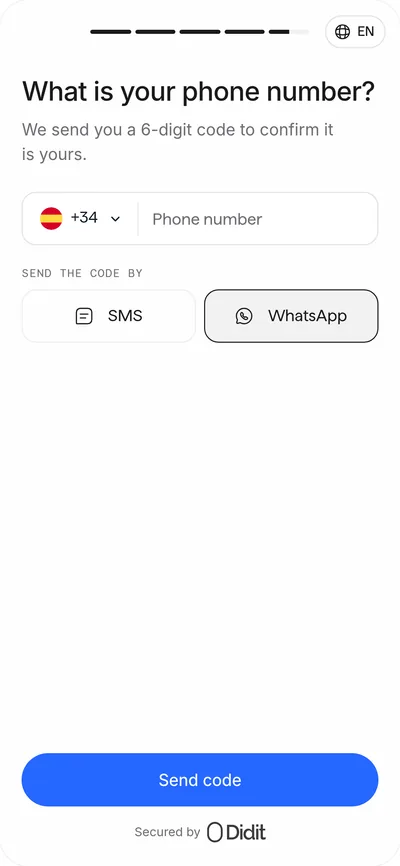
The phone step collects the number and sends a one-time code. The carrier price plus the $0.02 Didit fee is billed per code. Fetch the decision. Call the decision endpoint with a key that holds
read:sessionsafter the applicant finishes, or subscribe to thesession.status.updatedwebhook, which is the documented event for status changes.curl https://verification.didit.me/v3/session/<SESSION_ID>/decision/ \ -H "x-api-key: YOUR_API_KEY"Read the signals, not just the status. Branch on
session_kindfirst, then read the feature arrays. In a user session the four arrays that matter for synthetic identity aredatabase_validations[],phone_verifications[],ip_analyses[]andid_verifications[]alongsideliveness_checks[]andface_matches[]. Every feature object also carries awarnings[]array with stable risk codes.Route the applicant. Approve when the registry matches, the phone is verified and the device warnings are inside policy. Route to review on a partial registry match, a location mismatch with the document, or a duplicated device. Decline a no-match registry result according to your own policy, and state in that policy that a no match is treated as a synthetic identity signal. Reviewer actions are recorded in
decision_traceandstatus_override, so a manual override never erases the automatic result.
Expected output
The create call returns a session_id, a session_url and the session status, which starts as Not Started. The decision call returns the full record: a top level status of Approved, Declined, In Review, In Progress, Not Started, Expired, Abandoned, Kyc Expired, Resubmitted or Awaiting User, plus the feature arrays. Feature arrays are always plural arrays, and a feature that did not run is absent or null rather than a placeholder. An empty ip_analyses[] is therefore a signal in itself.
| Field | Values to expect | How to read it |
|---|---|---|
database_validations[].match_type | full_match, partial_match, no_match | A full_match means the registry returned the submitted data as matching. A no_match means the queried registry did not return a matching record. |
| Database Validation warnings | DATABASE_VALIDATION_NO_MATCH, DATABASE_VALIDATION_PARTIAL_MATCH, COULD_NOT_PERFORM_DATABASE_VALIDATION | Risk codes pinned to the feature and to the workflow node through node_id. |
database_validation_not_performed_reason | Free text | Present when database_validations is null. Explains why no registry check produced a result. |
ip_analyses[].warnings | DUPLICATED_DEVICE, POSSIBLE_DUPLICATED_DEVICE, VPN_DETECTED, PROXY_DETECTED, TOR_DETECTED, LOCATION_MISMATCH_WITH_DOCUMENT, IMPOSSIBLE_TRAVEL, DEVICE_LINKED_TO_LIVENESS_ATTACK, DEVICE_MODEL_INCONSISTENT | Emitted under the LOCATION bucket even though they sit in the IP array. |
phone_verifications[] | Feature status and channel | Whether the applicant completed the one-time code on the number they gave, and over which channel. |
decision_trace | decided_by manual, automatic or investigator | Who reached the decision and when. |
Checking the registry without a session
If your backend already holds the identity data, the same registry check is available as a standalone server-to-server call. Use it when details arrive before any hosted step, for example from a partner or a form. The Database Validation documentation lists the per-service rates, and the price of each service depends on the country and the source behind it.
curl -X POST 'https://verification.didit.me/v3/database-validation/' \
  -H "x-api-key: $DIDIT_API_KEY" \
  -F "issuing_state=BRA" \
  -F "identification_number=00000000191" \
  -F "first_name=Jane" \
  -F "last_name=Doe" \
  -F "date_of_birth=1990-01-15" \
  -F "vendor_data=applicant-10482"
The response carries match_type, services_used, match_score and a validations[] array with per-service status and matched fields. Send identification_number and let Didit map it to CPF, CURP, DNI or the local identifier from issuing_state. Argentina and Panama accept a selfie and gender for a biometric match against the registry photo. Services flagged as requiring consent return a 400 unless you send consent=true.

Failure cases and recovery
| Failure | What you see | Recovery |
|---|---|---|
| Registry returns no record | match_type is no_match, with a DATABASE_VALIDATION_NO_MATCH warning | Treat it as a synthetic identity signal per your policy. Keep the document verdict next to it so a reviewer sees both. |
| Some fields match, others do not | match_type is partial_match, for example the date of birth matches and the name does not | Route to review. A second document, a proof of address at $0.20 or a questionnaire at $0.10 gives the reviewer more to work with. |
| Every upstream service failed | HTTP 502 with validation_errors[]; the request is not billed and a COULD_NOT_PERFORM_DATABASE_VALIDATION log is written | Retry later or fall back to OCR only, and record the fallback in the case file. |
| Service not eligible or missing consent | HTTP 400 | Pair the service with the right issuing_state, or send consent=true for services that require it. |
| No registry result on the session | database_validations is null and database_validation_not_performed_reason is set | Read the reason before treating the check as a pass. |
| Applicant blocked the fingerprinting script | ip_analyses[] is empty | Decide in advance whether to fail closed or continue on soft signals, and apply that rule every time. |
| Hidden network | VPN_DETECTED, PROXY_DETECTED or TOR_DETECTED | Add a liveness step, send to manual review, or decline, per policy. |
| Same device under another applicant | DUPLICATED_DEVICE or POSSIBLE_DUPLICATED_DEVICE | Merge or block per policy. Use multi_account_segment when one customer may legitimately hold accounts in separate bases. |
| Decision call rejected | 404 when the session does not exist or belongs to another application, 403 when the key lacks read:sessions, 401 on an invalid key | Fix the session id or the key and retry. |
| Phone code not delivered | No completed phone verification | Resend or switch channel. Every code is billed, and Free plan credit does not cover phone codes. |
What is billed and where human review starts
Billing is per completed check from prepaid credit. A full ID check is $0.33, phone codes are the carrier price plus $0.02, and Database Validation is variable by country and service and charged per successful service hit, so a multi-service request can produce more than one usage event. A completed registry attempt is charged even when the result is a partial match or a no match; format errors and provider failures that return no answer are not charged.
- Plans: Free at $0 with $10 of monthly credit, Growth at $99 a month with $115 of credit and 4% off Didit prices, Scale at $299 a month with $350 of credit and 10% off, Enterprise from $15,000 a year. Monthly credit does not roll over and top-ups last 12 months.
- Review starts when a session reaches
In Review. The record then carries anassignee,waiting_sinceandsla_due_atwhile it waits for a reviewer. - Boundaries: your rules decide when a session is approved or declined automatically. A reviewer only changes a status by hand, and
status_overridekeeps theautomatic_statusnext to the manual one.

Worked cost example
Per applicant on the recommended stack, at list price, with a US mobile number by SMS. Only fixed prices enter the subtotal; the Database Validation component is variable and is added at the rate for the country you onboard from.
- Full ID check: $0.15 ID document + $0.10 passive liveness + $0.05 face match + $0.03 device and IP = $0.33
- Phone code, US SMS: $0.0473 (carrier $0.0273 plus the $0.02 Didit fee)
- Database Validation: variable by country and service, so it is stated separately and left out of this subtotal.
Fixed-price subtotal: $0.33 + $0.0473 = $0.3773 per applicant. At 10,000 applicants that is $3,773.00. Add the Database Validation rate for your market on top of that figure.
Add AML screening at $0.20 and the fixed-price subtotal becomes $0.5773 per applicant, or $5,773.00 for 10,000, still before any registry charge.
On Growth, 4% comes off every Didit price while the carrier part passes through at cost: $0.3168 for the ID check and $0.0465 for the phone code ($0.0273 carrier plus $0.0192 fee). That is $0.3633 per applicant, or $3,633.00 for 10,000. With AML screening at $0.192 the subtotal is $0.5553 per applicant, or $5,553.00 for 10,000.
Sources
- Didit docs: Database Validation overview
- Didit docs: Device Fingerprinting and IP Risk
- Didit docs: Phone Verification
- Didit docs: Create Session API
- Didit docs: Retrieve Session API
- Didit docs: Data Models
- Didit docs: Workflow Builder
- Didit pricing page
- Didit docs: Pricing and billing rules
- Didit pricing as JSON
- Didit MCP server setup
- Didit Business Console
The next step is a sandbox run: create a free organization at https://business.didit.me/, build one KYC workflow with Database Validation, Phone Verification and the ID check, and send a test applicant through it. There is no sales call.
Try it
Try this in the sandbox
Run the check this guide describes, free.
The product this post is about, taken from its topic. Run it free in the sandbox.
Author
Alberto Rosas
Co-founder and CEO

Keep reading
Other guides in the same topic.
 How to Normalize Names and Dates of Birth Before Database Verification
Normalize names to the spelling the registry holds and send date of birth as ISO 8601 before a Didit Database Validation call. Pricing varies by service; $0.05 per check is the lowest published example.
Alberto RosasNov 26, 2026 How to Reverify an Account Holder After Account Takeover
Reverify with a fresh full KYC session ($0.33) bound to the original account ID, compare the new face to the enrolled identity with Face Search ($0.05), and make the hand-back a human decision.
Alberto RosasNov 26, 2026Passkey Account Recovery After a Lost Phone (2026)Passkey account recovery after a lost phone depends on whether the platform synced the passkey. If it did not, the person signs in with another enabled method, such as an email code, then enrolls a new passkey.
Alberto RosasNov 26, 2026Questions
Frequently asked questions
How do you detect synthetic identities during fintech onboarding?
Run four checks on one session and read them together: a government-registry database check of name, date of birth and ID number; phone verification of a reachable number; device and IP analysis for duplicate hardware, VPNs and location mismatches; and a biometric ID document check. Each signal is weak alone. Together they cover a fabricated person, a stolen document number, and one person running many accounts.
What is the best check for a fabricated ID number?
Database Validation. It compares the applicant's data with the national civil registry, tax authority or electoral roll that issued the document, and a fabricated number is not in that source. It runs as a step inside a workflow or as a standalone call to POST /v3/database-validation/. The price is variable by country and service, so read the rate for the exact service you plan to call.
What does a database result of no match mean?
It means the queried registry did not return a matching record. Didit returns match_type as full_match, partial_match or no_match, together with a DATABASE_VALIDATION_NO_MATCH warning. Treat no_match as a synthetic identity signal according to your policy, and send partial_match to a reviewer, because some fields matched and others did not.
Should I auto-decline when the registry is unavailable?
No. When every upstream service fails, the call returns HTTP 502 with validation_errors[], the request is not billed, and a COULD_NOT_PERFORM_DATABASE_VALIDATION log is written. Retry later or fall back to OCR only, and record the fallback so the decision stays auditable.
Which device signals indicate a synthetic identity?
The ones used most at onboarding are DUPLICATED_DEVICE and POSSIBLE_DUPLICATED_DEVICE for hardware already seen under another vendor_data, VPN_DETECTED, PROXY_DETECTED and TOR_DETECTED for hidden networks, LOCATION_MISMATCH_WITH_DOCUMENT and IMPOSSIBLE_TRAVEL for geography that cannot be true, and DEVICE_LINKED_TO_LIVENESS_ATTACK plus DEVICE_MODEL_INCONSISTENT for device behaviour that does not fit the session. These warnings sit in ip_analyses[] but are emitted under the LOCATION bucket. The Device and IP Analysis documentation lists the full set.
Do I need an ID document before a database check?
No. Database Validation does not require an ID Verification step; the fields can come from a form, from your own data, or from the steps in front of the check. In countries where the registry holds an official photo, Argentina and Panama accept a selfie and gender for a biometric match against that photo.
How much does synthetic identity detection cost per applicant?
On the recommended stack at list price for a US applicant, the fixed-price subtotal is $0.3773: $0.33 for the full ID check and $0.0473 for one SMS phone code. Database Validation is variable by country and service and is added at the rate for your market. AML screening adds $0.20 per check.
Can I test synthetic identity scenarios without paying?
Yes. Sandbox testing is free and unlimited on every plan, and sandbox applications can arm scenarios with simulated results through sandbox_scenario on the create call. You only pay list prices when the same checks run in a live application.
What happens if the applicant blocks the device fingerprinting script?
ip_analyses[] comes back empty because the SDK could not collect the fingerprint. Decide in advance whether to fail closed or continue on the other signals, and write that rule down, because the missing array means you have no device evidence either way.
How is phone verification priced?
Carrier price for the country and channel plus Didit's $0.02 fee per code. A US SMS code is $0.0473, a UK SMS code is $0.0783 and a German SMS code is $0.1145. Free plan credit does not cover phone codes, and only the $0.02 fee takes the Growth or Scale discount. The Phone Verification documentation covers the channels.
One customer holds two accounts. How do I stop that becoming a duplicate flag?
Set multi_account_segment on the create call. Duplicate face checks only compare a session against other sessions carrying the same segment, so separate account bases do not report a legitimate second account as a duplicate. Blocklist and allowlist matching ignore the segment, so a blocklisted face stays blocklisted everywhere.
Compliance built in
Audited, certified and attested.
We hold the certifications and build each country's rules into your flows, so you can launch anywhere without worrying. Security and Compliance center
- Regulation encoded into your flows
Tell us what you do and where. Didit lists the rules that apply to you, with sources, and builds the checks each country needs into one workflow.
- Ready for AMLR
Every requirement of the new EU anti-money laundering rules, from checking customers to human review, is already covered by a Didit check.
- Tested in Spain's Treasury sandbox
Spain's Treasury published its supervised sandbox report on Didit's NFC plus active liveness onboarding; SEPBLAC took part and valued the added measures positively.
- Audited, not self-declared
iBeta Level 1 and Level 2. Liveness tested under ISO/IEC 30107-3.
Your obligations · 3 regions
 SOC 2 Type 2
 ISO 27001
 iBeta Level 1 and Level 2
 EU regulator attestation
 FSM youth protection
 GDPR
 EBA remote onboarding
 MiCA compatible
 FIDO Alliance member
- AMLREU AML Regulation ready
Integration · Didit MCP
Run Didit from your own AI agent
Connect Didit to Claude, Cursor, VS Code or ChatGPT and just ask in plain words. Your agent can do anything you can do in the console, with the same permissions you have.
 Add to Claude
 ChatGPT
 Cursor
- Build workflowsDescribe the checks you need. The agent creates and publishes the flow.
- Run investigationsAsk why a session was declined, review cases, search people and companies.
- Change rulesCreate payment rules, test them on past data and switch them on.
- Pull reportsAsk for numbers, exports or the audit log.
Didit Academy


