
The 10 Best AMLR Software Platforms in 2026
Compare 10 AMLR software platforms for KYC, KYB, screening, ongoing monitoring, transaction monitoring, pricing, and evidence management.
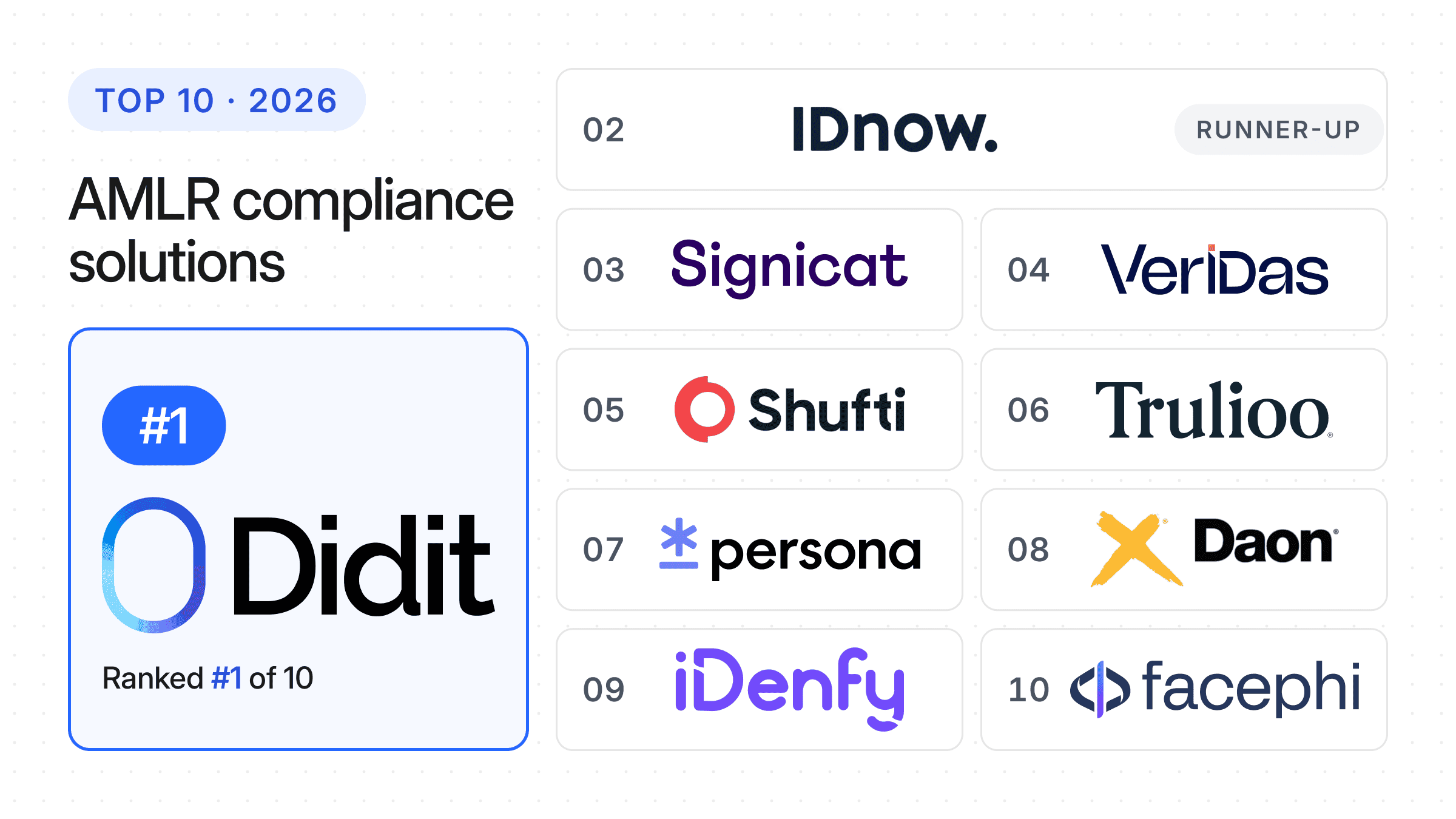
The strongest options bring identity, business ownership, screening, monitoring, and evidence into a workflow your compliance team can actually operate. Here are some of the best AMLR software platforms:
- Didit
- IDnow
- Signicat
- Veridas
- Shufti
- Trulioo
- Persona
- Daon
- iDenfy
- Facephi
The EU Anti-Money Laundering Regulation, or AMLR, changes the question buyers need to ask. It is no longer enough to confirm that a provider can check an identity document or search a sanctions list. A workable system also needs to connect the customer to the evidence collected about them, identify the people behind a business, keep information current, and give investigators enough context to explain a decision later.
That does not mean one vendor has to perform every task. Some organizations need a broad platform that covers onboarding through ongoing monitoring. Others already have a transaction-monitoring engine and only need stronger identity, ownership, or screening infrastructure. The useful comparison is therefore not who has the longest feature list, but how much of your intended workflow each platform can handle without creating gaps between systems.
The regulation is already in force and will generally apply from 10 July 2027. Software can support the work, but it cannot make an organization compliant on its own. The obliged entity still owns its risk assessment, policies, decisions, investigations, and regulatory reporting. If you are deciding what to keep in-house rather than comparing vendors, the separate guide to building or buying AMLR software covers that decision in detail.
The 10 Best AMLR Software Platforms in 2026
1. Didit
Didit brings customer onboarding, business verification, screening, ongoing monitoring, and transaction review into the same environment. That matters when a business wants to avoid stitching together a document provider, a watchlist service, a KYB tool, and a separate case-management layer.
For individuals, a workflow can combine document verification, biometric checks, national digital IDs, database validation, and device or IP signals. For businesses, Didit KYB retrieves company information, identifies key people, and connects them to their own identity and AML checks. The same record can then feed AML screening, daily rescreening, and transaction monitoring.
Pricing is public and modular. The core KYC bundle is $0.33 per successful check. Person and company AML screening cost $0.20 each, ongoing AML monitoring is $0.07 per person per year, KYB registry retrieval is priced by country and data tier, and transaction monitoring costs $0.001 per transaction after the transactions included in your plan. This makes it possible to model a realistic workflow before entering a sales process, although database checks, national eIDs, enhanced review, and other modules may add to the total.
Didit is a practical fit for teams that want to launch with a narrow onboarding flow and add KYB, monitoring, or case operations without replacing the underlying customer record. Before committing, test how your own risk rules behave when an existing approved customer receives a new screening hit or a transaction creates a case. That handoff is more revealing than a clean onboarding demo.
2. IDnow
IDnow is particularly relevant to organizations operating in Germany and other European markets where verification method, assurance level, and local regulatory acceptance can shape the onboarding design. Its identity stack includes automated document verification, video identification, eID methods, fraud controls, and AML screening.
The AML screening component checks individuals and organizations against sanctions, PEP, and adverse-media data. It can run during onboarding and continue monitoring the customer after approval. IDnow's Trust Platform also allows teams to place these checks inside a wider flow and route matched, inconclusive, and clear results differently.
The platform makes sense when European identity methods are a central procurement requirement, especially if some customers need to move from an automated route to an assisted or video-based process. Buyers should confirm which verification routes are available in each target country and whether the resulting evidence can be exported into their case system in a usable format.
IDnow does not publish a comparable per-check price for the complete AMLR workflow. A quote should therefore separate identity verification, video or eID methods, initial screening, continuous monitoring, manual review, implementation, and minimum commitments. Without that breakdown, a low onboarding rate can conceal the cost of the higher-assurance routes that regulated customers actually use.
3. Signicat
Signicat approaches the problem from a European digital-identity and orchestration angle. It connects businesses to national eIDs, document-based identity proofing, electronic signatures, company data, and AML information through a broad set of integrations.
Its data-verification services can check people and organizations against trusted sources and screen for sanctions, PEP status, and adverse media. Its business-verification workflows can also collect company information, identify relevant people, and run screening around those relationships. This makes Signicat worth considering when the desired customer journey begins with an eID or needs a legally meaningful signature after identity proofing.
The advantage is choice, but that choice needs careful scoping. Buyers should map the exact method expected in each country, the fallback when a customer cannot use it, and whether each data source is contracted and billed through Signicat or through another provider. It is also important to establish where orchestration ends and where investigation, transaction monitoring, and regulatory reporting begin.
Signicat pricing can include setup, subscription, and transaction charges, with rates varying by product and method. The most useful quote is not a single blended rate. Ask for a country-by-country model covering the expected method mix, fallback usage, screening, monitoring, signatures, and any third-party data fees.
4. Veridas
Veridas is strongest where the identity proofing itself is the difficult part of the programme. Its platform combines document capture and validation with facial biometrics, liveness, and configurable onboarding. It also supports PEP, sanctions, watchlist, and adverse-media checks within the identity journey.
That combination can suit banks, fintechs, insurers, and other organizations that want biometric evidence attached directly to a verified identity. The platform's documentation also describes modular flows that can call government services or third-party screening services as part of onboarding.
The key procurement question is scope. A polished identity journey does not automatically cover the complete AMLR lifecycle. Confirm whether the proposed configuration includes business verification, ownership analysis, scheduled customer refreshes, continuous screening, transaction monitoring, case management, and evidence retention, or whether those functions will remain in other systems.
Veridas does not publish a standard total price for an AMLR deployment. Ask for separate costs for document verification, biometrics, video or assisted verification if required, screening data, monitoring, manual review, implementation, and the proposed hosting model. This gives a much clearer comparison than putting a biometric onboarding quote next to a broader compliance platform.
5. Shufti
Shufti offers a wide range of verification and compliance modules, including document and biometric identity verification, electronic identity checks, video identification, business verification, AML screening, ongoing monitoring, and transaction monitoring. It is one of the more direct options for teams that want multiple controls from the same supplier but still want to select them individually.
Its KYB workflows can combine company data, ownership information, checks on directors or beneficial owners, and AML screening. Screening can cover sanctions, PEPs, watchlists, and adverse media, while ongoing monitoring can notify a team when the status of a customer or business changes.
Public pricing gives buyers a starting point, but the page currently presents more than one figure for the Essentials tier: the plan card says it starts at $1.50 per verification, while the comparison table shows $0.95. The free tier includes up to 10 verifications per month, and Enterprise pricing is quoted. Because AML, KYB, transaction monitoring, and higher-assurance methods may sit in different plans or carry different charges, confirm the exact basket in writing rather than using the headline identity price as the AMLR cost.
Shufti is worth testing with a business customer that has several ownership layers. That reveals whether the workflow can collect missing documents, link each relevant person to screening and identity evidence, and keep the reviewer in one coherent case.
6. Trulioo
Trulioo is built around broad international data coverage for verifying people and businesses. Its platform combines KYC, KYB, fraud signals, and AML screening, which makes it relevant to companies entering many markets or onboarding customers whose identities cannot always be resolved with the same data source.
Its AML product screens people and businesses against sanctions, PEP, watchlist, and adverse-media data. Trulioo says its screening layer connects to more than 6,000 global watchlists and more than 20,000 adverse-media sources and can continue monitoring customers after onboarding. Business verification and UBO discovery can sit alongside those checks.
Coverage breadth should still be tested at a local level. Ask Trulioo to demonstrate the actual sources, match rates, required fields, and fallback route for the countries that produce most of your volume. A global coverage number is less useful than knowing what happens when a particular registry is unavailable or a small business has limited digital records.
Pricing is quote-based. Build the quote around your real country mix, individual and business volumes, expected ownership depth, ongoing monitoring population, data-source surcharges, and manual-review needs. If transaction monitoring or case management will come from another vendor, include the integration and operational cost of moving customer context between those systems.
7. Persona
Persona is a flexible choice for product teams that want to assemble identity and compliance journeys from configurable checks, reports, and workflows. It supports identity verification, business verification, watchlist and adverse-media reports, and recurring monitoring for both people and organizations.
The platform is useful when different products or customer segments need distinct paths. A low-risk customer might complete a short automated flow, while a higher-risk case can collect more information, run additional reports, and move to a reviewer. Persona's business watchlist tooling also connects screening to KYB rather than treating the company and its associated people as unrelated checks.
That flexibility transfers some responsibility to the buyer. Your team needs to define which reports run, when they rerun, how matches are classified, and what a reviewer sees when several signals disagree. During a pilot, change a customer after approval and confirm that the workflow can trigger a fresh review without losing the earlier evidence.
Persona's self-guided Essential plan has been advertised from $250 per month with a 12-month minimum, while broader Growth and Enterprise configurations require a quote. The final cost depends heavily on the reports, database queries, verifications, and monitoring cadence selected, so price the actual workflow rather than the platform subscription alone.
8. Daon
Daon has a long-standing focus on identity proofing, biometrics, and authentication. Its xProof and TrustX products combine document verification, facial matching, liveness, and workflow orchestration, with deployment options aimed at banks and other large regulated organizations.
This is most relevant when a buyer treats identity continuity as part of the AML programme. The same person may need to prove their identity at onboarding, authenticate later, recover an account, or complete a higher-assurance check after a risky event. Daon's biometric and authentication capabilities can help maintain that connection across the customer lifecycle.
The published product material is less explicit about a native end-to-end stack for ownership discovery, sanctions and PEP monitoring, transaction monitoring, and AML case operations. Some of that scope may be delivered through configurations or partners. Buyers should therefore request an architecture showing which party supplies each component, where the customer record lives, and how investigators retrieve the complete evidence trail.
Daon pricing is quote-based. A comparable proposal should identify software and platform fees, implementation, hosting, document and biometric transactions, assisted review, third-party data, authentication, and support. It is a stronger candidate when high-assurance identity and repeat authentication are priorities than when the requirement is simply a low-cost standalone watchlist check.
9. iDenfy
iDenfy combines identity verification with AML screening, business verification, fraud controls, and human review. Its public entry pricing makes it approachable for smaller businesses that want to estimate identity costs before starting a procurement process.
The Basic identity plan is listed at $1.35 per verification with a $135 monthly minimum. It includes document checks, face matching, liveness, white-label customization, and API, SDK, or no-code integration options. KYB and ongoing AML monitoring are positioned within its broader enterprise offering, and its pricing materials show additional charges for modules such as AML screening and daily monitoring.
For AMLR planning, request a consolidated quote that includes the base identity check, initial AML screening, daily monitoring, KYB, checks on each relevant owner, bank verification if needed, and human review. The public base price is useful, but it is not the total cost of maintaining a regulated customer relationship.
iDenfy can fit online businesses that value a relatively straightforward starting point and want manual reviewers available for exceptions. In a pilot, pay close attention to how ownership data is refreshed, how screening alerts reach the team, and whether the evidence exported from human reviews is detailed enough for an audit.
10. Facephi
Facephi combines identity verification, biometric authentication, fraud prevention, AML screening, KYB, and transaction monitoring. Its platform is aimed at regulated organizations that want identity information to remain connected to later account or transaction activity.
The identity layer covers document capture, biometric checks, and audit evidence. AML screening can check sanctions, PEP, and adverse-media data, while the transaction-monitoring product emphasizes traceability from a case back to the customer's verified identity. Facephi also markets business-verification capabilities and deployment options suitable for enterprise environments.
The platform is worth considering when a bank or financial institution wants biometric onboarding and fraud controls alongside AML operations, particularly where an on-premises or tightly controlled deployment model matters. Buyers should ask for a live demonstration that starts with an individual or business and follows the record through monitoring, alert creation, investigation, and evidence export.
Facephi pricing is quote-based. The proposal should distinguish identity verification, authentication, KYB, screening, ongoing monitoring, transaction monitoring, implementation, infrastructure, and support. Confirm which modules are native, which depend on third-party data, and how updates to those sources affect pricing.
How the AMLR Software Platforms Compare
Platform | Most useful when | Published entry pricing | Main point to verify |
|---|---|---|---|
Didit | One workflow is needed across KYC, KYB, AML, and transaction monitoring | $0.33 core KYC; $0.20 AML screening; $0.07 per monitored person/year | How your rules, alerts, and reviewer process behave together |
IDnow | European identity methods and assisted verification are central | Quote-based | Method availability and evidence by country |
Signicat | National eIDs, signatures, and identity orchestration drive the journey | Quote-based; method-dependent | Third-party data fees and the scope beyond orchestration |
Veridas | Biometric and document proofing are the hardest part of onboarding | Quote-based | Coverage of KYB, monitoring, cases, and later reviews |
Shufti | A modular identity, KYB, and AML stack is preferred | Free tier; Essentials page shows $0.95 and $1.50 figures | Exact module basket and applicable plan |
Trulioo | International person and business data coverage is the priority | Quote-based | Local source performance and fallbacks |
Persona | Product teams need highly configurable workflows | Essential advertised from $250/month; broader plans quoted | Governance of reports, rules, and recurring checks |
Daon | High-assurance biometrics and repeat authentication matter | Quote-based | Native versus partner-supplied AML capabilities |
iDenfy | A smaller team wants published identity pricing and human review | $1.35 per verification; $135 monthly minimum | Total price after AML, KYB, monitoring, and review |
Facephi | Enterprise identity, fraud, and transaction controls need to connect | Quote-based | Module boundaries, data providers, and deployment cost |
Prices reflect public information reviewed in November 2026 and are not directly comparable. Some refer to one identity check, while others cover subscriptions or separate compliance modules. Always confirm the current price, billing event, minimum commitment, and included services with the provider.
What AMLR Software Needs to Cover
AMLR does not prescribe a single product. It creates obligations that may be supported by several connected systems. Before comparing demos, turn those obligations into a workflow and assign an owner to each part.
Identity verification through the appropriate route
Article 22 provides for verification using an identity document or an electronic identification means that meets the applicable requirements. Your software should support the routes your customers can realistically use, retain evidence of the route taken, and offer a fallback when the preferred method fails.
Business ownership and control
For legal entities, collecting a company name and registration number is not enough. The workflow must help identify the natural people who ultimately own or control the business, verify those people where required, and preserve the ownership reasoning. Complex structures, missing registry data, and changes after onboarding need an operational route rather than a manual spreadsheet outside the case.
Risk assessment and enhanced due diligence
The platform needs to collect the information used in your risk model and make higher-risk cases visibly different from routine ones. That might include source of funds or wealth, purpose of the relationship, expected activity, geography, occupation, or supporting documents. The software can collect and organize this evidence, but your organization still defines the policy and makes the decision.
Screening and continuous monitoring
Initial sanctions, PEP, and adverse-media screening only shows what was known at onboarding. A useful system can rescreen customers and related people, notify the right team when something changes, and retain the old and new result. Reviewers also need enough match context to distinguish a real hit from a similar name.
Customer refreshes and event-driven reviews
Article 26 sets maximum intervals for keeping customer information current and also expects reviews when relevant circumstances change. The software should schedule periodic refreshes while allowing product events, new screening hits, unusual activity, or changes in ownership to trigger an earlier review.
Transaction context and case evidence
Transaction monitoring is most useful when the rules can see the customer's expected activity and risk profile. When an alert opens a case, the reviewer should not have to reconstruct the customer from several disconnected dashboards. Look for a clear history of the alert, evidence inspected, actions taken, approvals, and any information prepared for regulatory reporting.
The full legal text is available in Regulation (EU) 2024/1624. AMLA is also publishing the technical standards and guidance that will shape how some requirements are applied, so the configuration should be maintainable rather than frozen at the date of purchase.
How to Compare AMLR Software Pricing
A per-verification price is only useful when every vendor is pricing the same event. In practice, one quote may include document and biometric checks while another separates liveness, data sources, screening, monitoring, and manual review.
Build the estimate from the units your programme will actually consume:
- New individual customers and the checks used for each risk tier
- New businesses, registry lookups, and people checked per business
- Existing customers and beneficial owners kept under monitoring
- Scheduled refreshes and event-driven reverifications
- Transactions screened and alerts converted into cases
- Manual reviews, enhanced due diligence, and escalations
- Countries, eID methods, and paid data sources
- Implementation, environments, support, storage, and minimum commitments
Then run at least 3 scenarios: normal volume, a growth case, and a stress case with more alerts or manual reviews. This prevents a cheap onboarding rate from winning a comparison when the expensive part of the programme is actually ownership research or investigation time.
How to Test an AMLR Workflow Before Signing
Do not use only clean passports and obvious sanctions matches in a pilot. Those examples prove that the interface works, but they reveal little about the operating model.
Use a small set of cases that resemble the work your team finds difficult today:
- An individual whose document passes but whose screening result needs manual resolution.
- A business with several ownership layers and at least one person who must complete a separate identity check.
- An approved customer who receives a new screening hit after onboarding.
- A customer whose expected activity changes and requires a new risk assessment.
- A transaction alert that must be traced back to onboarding evidence and closed with a documented rationale.
For each case, record how long the customer and reviewer spend, how many systems they touch, what evidence remains at the end, and whether the result can be exported without rebuilding the story manually. Also test permissions, dual approval, webhook retries, deletion and retention controls, and the process for changing a rule without engineering support.
The right platform is the one that covers the controls you genuinely need while leaving a clear boundary around the decisions your organization retains. Start with one representative flow, connect it to your own customer and case states, and measure completion, false positives, reviewer time, and unresolved exceptions before expanding it. If the pilot cannot show what happened to one customer from first check to final decision, adding more modules will not solve the underlying problem.
Frequently Asked Questions (FAQs)
What is AMLR software?
AMLR software is a practical label for technology used to support obligations under the EU Anti-Money Laundering Regulation. It may include identity verification, KYB and beneficial-owner checks, sanctions and PEP screening, risk assessment, ongoing monitoring, transaction monitoring, case management, and evidence retention. It is usually a stack or connected workflow rather than one certified product.
When does the EU AMLR apply?
Regulation (EU) 2024/1624 generally applies from 10 July 2027. Certain provisions have different dates, including a later application date for professional football clubs and agents. Organizations should confirm the provisions relevant to their sector and follow AMLA's technical standards and guidance as they are finalized.
Can an AMLR software provider make a business compliant?
No. A provider can perform checks, automate workflows, surface alerts, and preserve evidence. The obliged entity remains responsible for its risk assessment, policies, customer decisions, oversight of outsourced tasks, investigations, and reporting to the relevant authorities.
Does AMLR require electronic identity verification?
AMLR recognizes electronic identification and identity-document routes subject to the conditions in the regulation. The appropriate route depends on the customer, market, assurance requirements, and applicable technical standards. Buyers should support a compliant fallback instead of assuming every customer can use the same eID.
Should KYC, KYB, screening, and transaction monitoring come from one vendor?
Not necessarily. One platform can reduce integration work and give reviewers a more complete customer record. A multi-provider stack may offer stronger specialist components or preserve existing systems. The deciding factor is whether data, decisions, alerts, and evidence move reliably between the components.
What should an AMLR software pilot include?
Include both onboarding and post-onboarding events. Test individuals, layered businesses, ambiguous screening matches, customer refreshes, new hits on approved customers, and transaction alerts. Measure customer completion, reviewer time, false positives, evidence quality, and the work required to move a case between systems.
How much does AMLR software cost?
Cost depends on the number and type of identity checks, business lookups, beneficial owners, screening runs, monitored customers, transactions, data sources, manual reviews, and support requirements. Compare a full workflow at your expected volumes rather than comparing headline per-check prices with different scopes.