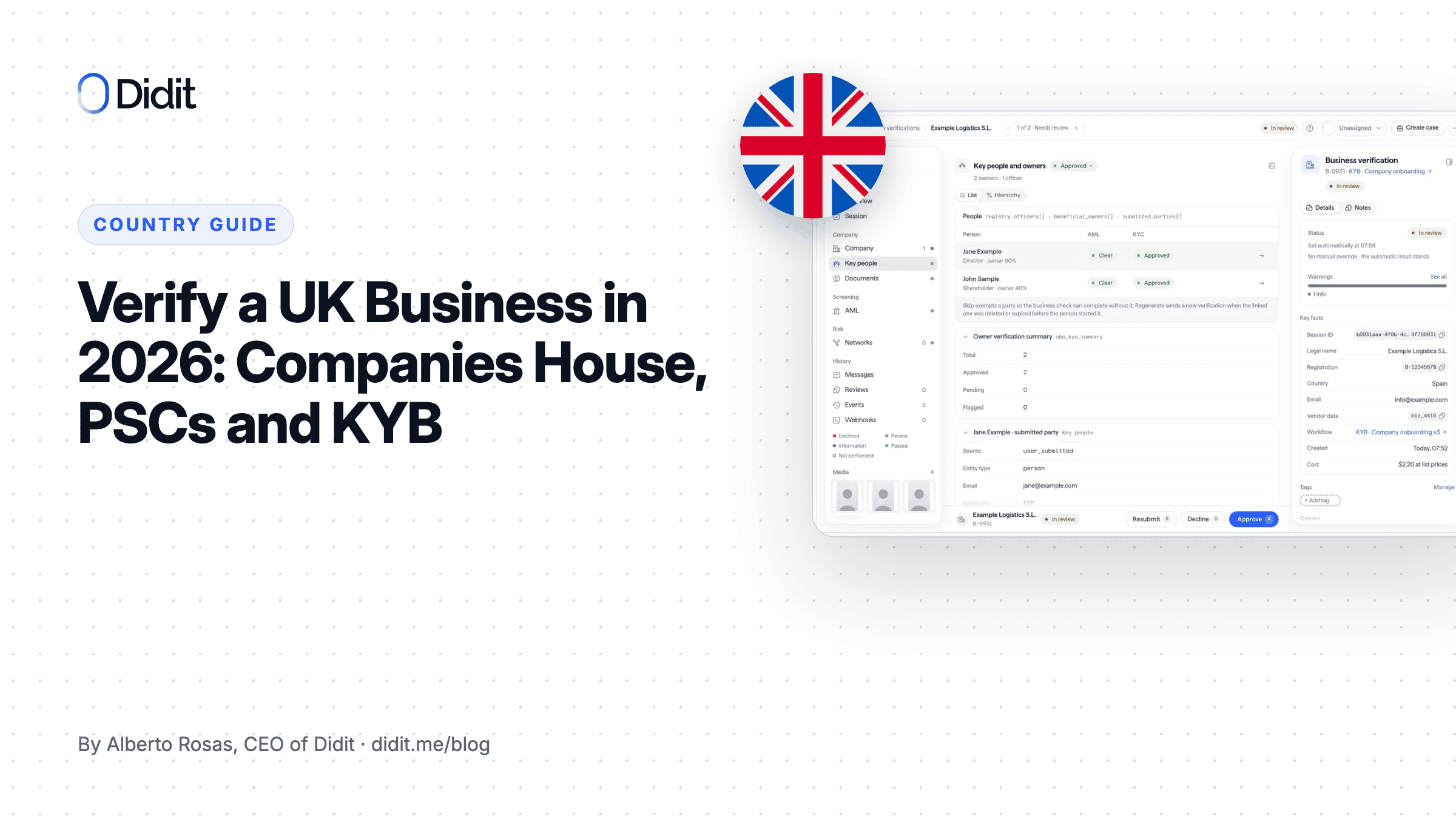
Verify a UK Business in 2026: Companies House, PSCs and KYB
UK KYB checks the company at Companies House, then the PSCs above 25% of shares or voting rights and the directors. On Didit a UK company costs $2.00 Lite, $5.00 Shareholders, $9.00 UBOs at list price.
 Alberto RosasCo-founder and CEO
Contents
In this guide
Jump to the part you need.
This guide is for marketplaces, banks, payments firms and other regulated buyers onboarding UK limited companies. Check the Companies House record, then verify the PSCs and directors. Didit UK registry checks cost $2.00 for Lite, $5.00 for Shareholders and $9.00 for UBOs. A PSC record is a company declaration, so test it with person-level checks.
Last updated: November 26, 2026. Prices checked against the live Didit price feed on November 26, 2026.
| What you check | UK source | Didit tier or module | List price |
|---|---|---|---|
| Existence, status, legal form, registered office, activity, officers | Companies House | KYB Lite | $2.00 per company |
| Plus direct shareholders with ownership bands | Companies House ownership data | KYB Shareholders | $5.00 per company |
| Plus UBOs resolved through the ownership chain | Ownership chain | KYB UBOs | $9.00 per company |
| Company sanctions, PEP and adverse media screening | Didit lists, 1,300+ lists | Company AML | $0.20 per company |
| Person-level AML for each UBO or officer | Didit lists | Person AML | $0.20 per person |
| Linked ID check for each key person | Didit User Verification | Full ID check | $0.33 per person |
| Company document collection step | Applicant uploads | KYB Documents | $0.20 per step |
| Company not found in the registry | Applicant typed in | Manual entry | $0.75 flat |
Start free in the sandbox at business.didit.me, no sales call and no contract. If you build with an AI assistant, connect Didit through our MCP server. The product page is Business Verification and every unit price is on didit.me/pricing.
What you must verify in the UK, and why
The legal basis sits in Part 21A of the Companies Act 2006. Section 790A requires companies to keep a register of people with significant control and to make that register available to the public. Section 790C(10) names it the PSC register. Section 790B sets the scope: the Part applies to companies other than DTR5 issuers and any description the Secretary of State specifies by regulations. Part 21A was inserted by the Small Business, Enterprise and Employment Act 2015 (c. 26), s. 164(1), Sch. 3 para. 1: on 26 May 2015 for specified purposes, on 6 April 2016 except for the insertion of ss. 790M(9)(c) and 790W to 790ZE, and on 30 June 2016 so far as not already in force (legislation.gov.uk, Companies Act 2006 Part 21A plain view, read November 26, 2026).
Companies House explains the practical side. A PSC owns or controls a company and is sometimes called a beneficial owner. The usual conditions are more than 25% of shares or voting rights, the right to appoint or remove a majority of directors, or the ability to influence or control the company (Companies House, People with significant control guidance, read November 26, 2026). The UK threshold is typically 25%, and you can configure the threshold per workflow under Workflows, then the KYB workflow, then Risk.
Five things follow from this, and a UK onboarding file should show all of them:
- The company legally exists. GOV.UK says successful registration produces a certificate of incorporation, which confirms the company legally exists and shows the company number and date of formation (GOV.UK, Register your company, read November 26, 2026).
- The company is still trading. A dissolved, struck off, liquidated or dormant status has to change your decision, not just your notes.
- The registered office and the activity are consistent with what the applicant told you.
- Every PSC is named, with the nature and level of control, and every director is named.
- The company and each of those people clear sanctions, PEP and adverse media screening.
The PSC entry is a declaration the company files about itself. Verify the declaration, then verify the humans behind it with documents and an ID check.
The register, the identifiers and the formats
Companies House is the register of record for UK limited companies, and registration runs through the GOV.UK service. Online registration costs £100 by card and the company is usually registered within 24 hours. Postal registration uses form IN01, takes 8 to 10 days and costs £124 by cheque to Companies House. PSCs are confirmed at registration, and the guidance is explicit about what is filed: name, date of birth, nationality and country of residence, a service address, a home address that must not be disclosed, the date the person became a PSC, the date they confirmed their details, and every nature of control that applies (GOV.UK Register your company, read November 26, 2026).
Two details matter for matching. Share and voting rights are recorded in three bands: over 25% up to and including 50%, more than 50% and less than 75%, and 75% or more. And PSCs must now verify their identity and provide their Companies House personal code, with a 14 day period to do so; the dates depend on whether they were registered before 18 November 2025 and whether they are also a director of the company (Companies House People with significant control (PSCs), read November 26, 2026).
Our registry lookup normalizes where the register requires it. UK company numbers are zero-padded to eight digits before the query, and when you send both a name and a number the lookup combines them (Didit, Company registry API, read November 26, 2026).
| Identifier or field | UK format at source | Field in the Didit decision |
|---|---|---|
| Company number | Eight characters, zero-padded by us when shorter | registration_number |
| Legal name | Name as registered at Companies House | company_name, plus former or trading names in alternative_names |
| Legal form | Private limited, PLC and similar | company_type |
| Registry status | Active, dissolved, struck off, in liquidation, dormant | registry_status |
| Incorporation date | Date on the certificate of incorporation | incorporation_date |
| Registered office | Official address on the register | registered_address, addresses[] |
| VAT number | Where held on file | tax_number |
| LEI | Where one has been issued | legal_entity_identifier |
| SIC activity codes | Registry classification | industries[], nature_of_business |
| Filing dates | Last annual return and last AGM | accounts.last_annual_return_date, last_agm_date |
| Officers | Officers returned by the registry | Officers list on the Lite tier |
| PSCs and ownership | Name, date of birth, nationality, residence, nature of control bands | key_people_checks[].registry.beneficial_owners[], with ownership_percent and voting_percent |
What Didit returns for a UK company
UK registry lookups are sold in three data tiers. The price list names the United Kingdom among the European markets that carry the worldwide ownership prices: $5.00 for Shareholders and $9.00 for UBOs, with Lite at $2.00 (Didit, KYB registry pricing, read November 26, 2026). Tier availability per country is in KYB supported countries, and the UK supports all three tiers.
- Lite, $2.00. Company profile, identifiers, status, legal form, incorporation date, registered address, activity, headcount and contact details, plus the officers.
- Shareholders, $5.00. Lite plus the direct shareholders, natural persons and corporate entities, with their ownership bands.
- UBOs, $9.00. Shareholders plus the ultimate beneficial owners resolved through the ownership chain.
Companies House data and our key-people layer are different things, and the difference decides your file. The PSC register is the company's own filing: names, ownership bands and natures of control, as declared by the company. Our registry tier returns the ownership data the register holds, at the tier you bought. The Key People check is a separate, configurable layer: your workflow decides which roles are enabled, whether a role requires a linked identity session, and whether the applicant may skip it. A PSC filing does not by itself start an ID check on that person. Your role settings do.
The 25% line is typical rather than fixed. It comes from the PSC conditions in the Companies House guidance. Set the line your policy needs under Workflows, then the KYB workflow, then Risk, then UBO threshold. We record economic ownership and voting power separately, because dual-class share structures make them diverge, and the UK test triggers when either one crosses 25%. Where the chain runs through a company, effective ownership is the product of the percentages along the path: 60% held through a vehicle that is 75% owned by a person gives that person 45% (Didit, UBO API, read November 26, 2026).

On top of the registry tier, UK workflows usually enable Company AML at $0.20, Person AML at $0.20 per UBO or officer, and a linked full ID check at $0.33 per person. These are optional workflow additions, not components of every registry tier: a Lite check with none of them enabled costs $2.00 and returns the company and its officers, nothing more. Key People extraction carries no separate fee. A KYB document step costs $0.20 regardless of how many files the applicant uploads in that step. Continuous registry monitoring is priced at $2.00 per company per year, but it is coming soon: when we checked on September 7, 2026, no country in the price list had monitoring enabled, so do not plan a UK file around it yet.
Step by step in the Business Console
- Open business.didit.me and create an application with KYB enabled.
- Go to Workflows, Create workflow, and choose Business Verification as the workflow type.
- Enable Company registry lookup (required), Company AML (recommended), Key People (required for most regulated industries) and Documents (optional, pick the document types you will require).
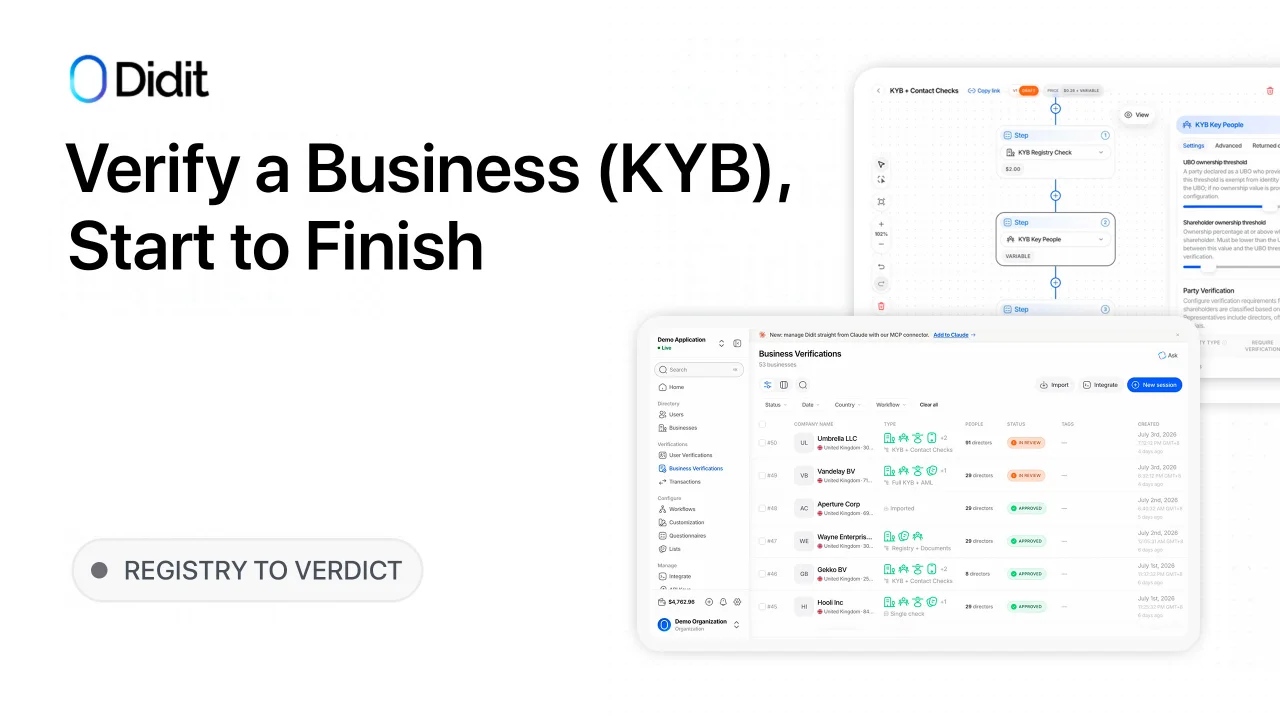
- Open Workflows, KYB Registry Check, Countries. Set the United Kingdom to the tier you need. Every country starts at Lite, so a UBO file needs the tier raised explicitly.
- Open Workflows, the KYB workflow, Key People. For each role, decide whether it is enabled, whether it requires KYC, which KYC workflow it uses, and whether the end user may skip it.
- Set the UBO threshold under Risk if 25% is not the line you need.
- Save and copy the
workflow_id. You will pass it when you create a session.

Step by step through the API
Create the session and deliver the hosted link. For a UK company you already know, add expected_details so the flow pre-selects the country and pre-fills the search; both fields stay editable, so the applicant can correct a wrong assertion.
curl -X POST https://verification.didit.me/v3/session/ \
  -H "x-api-key: YOUR_API_KEY" \
  -H "Content-Type: application/json" \
  -d '{
    "workflow_id": "YOUR_KYB_WORKFLOW_ID",
    "vendor_data": "uk-co-001",
    "expected_details": {
      "company_name": "Example Trading Ltd",
      "registry_country": "GB",
      "registration_number": "01234567"
    }
  }'
The response carries session_id, session_number and url. Send the url to the company admin through your own email or chat. They confirm the registry match, add key people and UBOs, and upload any documents you required.
When the business session reaches a terminal status, we POST a status.updated event. Business-session events carry session_kind: "business" on the event itself, so filter on that field to route the event to your KYB handler, and verify the X-Signature-V2 HMAC signature before you trust it (webhooks).
{
  "webhook_type": "status.updated",
  "session_id": "a1b2c3d4-5678-4abc-9def-1234567890ab",
  "business_session_id": "a1b2c3d4-5678-4abc-9def-1234567890ab",
  "session_kind": "business",
  "vendor_data": "uk-co-001",
  "status": "Approved"
}
The payload already contains the full decision. If you did not subscribe to webhooks, or you want it later, fetch it on demand:
curl https://verification.didit.me/v3/session/bs_01H.../decision/ \
  -H "x-api-key: YOUR_API_KEY"
Then act on status. Approved means onboard. Declined means reject and log the warnings[] tags. In Review means wait for the analyst decision; you get another webhook when it resolves. The complete payload is documented in the response schema, and the end-to-end walkthrough is the KYB quickstart.
If you do not want a hosted flow at all, the standalone API sells one endpoint per tier: search, then select for Lite, shareholders, or ubo. A successful standalone search against a paid company-data source costs $0.50 per request and profile retrieval is billed separately (Didit, KYB Registry API, read November 26, 2026). Hosted workflow searches have no separate search fee.

Worked cost example
A UK private limited company verified at the UBO tier, with company AML, two beneficial owners who each take a linked ID check and person AML, and one document step:
| Line | Unit price | Quantity | Subtotal |
|---|---|---|---|
| Registry check, United Kingdom, UBO tier | $9.00 | 1 | $9.00 |
| Company AML | $0.20 | 1 | $0.20 |
| Person AML | $0.20 | 2 | $0.40 |
| Linked full ID check | $0.33 | 2 | $0.66 |
| KYB document step | $0.20 | 1 | $0.20 |
| Total | $10.46 |
The same file on the Growth plan takes 4% off every Didit price: 9.00 becomes 8.64, 0.20 becomes 0.192, person AML becomes 0.384 for two, linked ID becomes 0.6336 for two, and the document step becomes 0.192. That sums to 8.64 + 0.192 + 0.384 + 0.6336 + 0.192 = $10.04 per company. On Scale at 10% off: 8.10 + 0.18 + 0.36 + 0.594 + 0.18 = $9.41. A Lite-only file is cheaper than either: 2.00 + 0.20 company AML + 0.66 for two linked ID checks = $2.86 at list price.
Fallbacks: registry down, no match, no ownership record
Three failure modes need different handling, and our decision payload tells them apart.
- The lookup is not resolved yet.
fetch_statusreadspendingwhile the registry query runs andfailedif it does not resolve. A pending ownership report does not count as a completed registry check and is not an automatic approval. Some registries return the company profile before the ownership report is ready; the report continues in the background while the applicant completes independent steps, and your corrections are preserved when it arrives. - No match. The applicant submits the company data manually, the session continues, and
is_from_registryis set tofalse. Manual entry is billed at a flat $0.75 instead of the tier price. - No ownership record.
registry_ownership_statussays what happened.not_heldmeans the ownership source does not cover this company, which is a coverage gap.unavailablemeans the data was not served, an outage or a section the registry left empty. Both are delivered and billed at Lite, andregistry_data.ownership_errornames the reason:no_owners_on_recordmeans the company has no cap table on file, whileownership_section_unavailablemeans the list is missing, not empty. Treat both statuses as the same Lite delivery in your code.
A section the registry did not return is also recorded structurally under registry_data.section_errors, keyed by section such as shareholders or officers with the status the registry answered. A delivered section is always the whole list the registry holds, never half of it. If a UBO request resolves to a chain of corporate entities with no natural person at the end, it is delivered and billed as Shareholders, because a corporate chain is not a beneficial owner.

Sources
- Didit, KYB quickstart, read November 26, 2026.
- Didit, KYB supported countries, read November 26, 2026.
- Didit, KYB registry pricing by country, read November 26, 2026.
- Didit, KYB Registry API, read November 26, 2026.
- Didit, Company registry API, read November 26, 2026.
- Didit, UBO API, read November 26, 2026.
- Didit, Officers and representatives API, read November 26, 2026.
- Didit, pricing and live price feed, read November 26, 2026.
- GOV.UK, Register your company, read November 26, 2026.
- Companies House, People with significant control (PSCs), read November 26, 2026.
- legislation.gov.uk, Companies Act 2006, Part 21A, plain view, read November 26, 2026.
- legislation.gov.uk, Companies Act 2006 Part 21A landing page, read November 26, 2026: details were not verifiable from that page because the retrieved text was truncated.
- FATF, beneficial ownership standards, read November 26, 2026.
Next step: create a free application at business.didit.me, set the United Kingdom to the UBO tier in a test workflow, and run one real company end to end in the sandbox. No sales call and no contract. The prices above are list prices: the tier actually delivered, your plan discount and any other modules you enable all change the final charge.
Try it
Try this in the sandbox
Run the check this guide describes, free.
The product this post is about, taken from its topic. Run it free in the sandbox.
Author
Alberto Rosas
Co-founder and CEO

Keep reading
Other guides in the same topic.
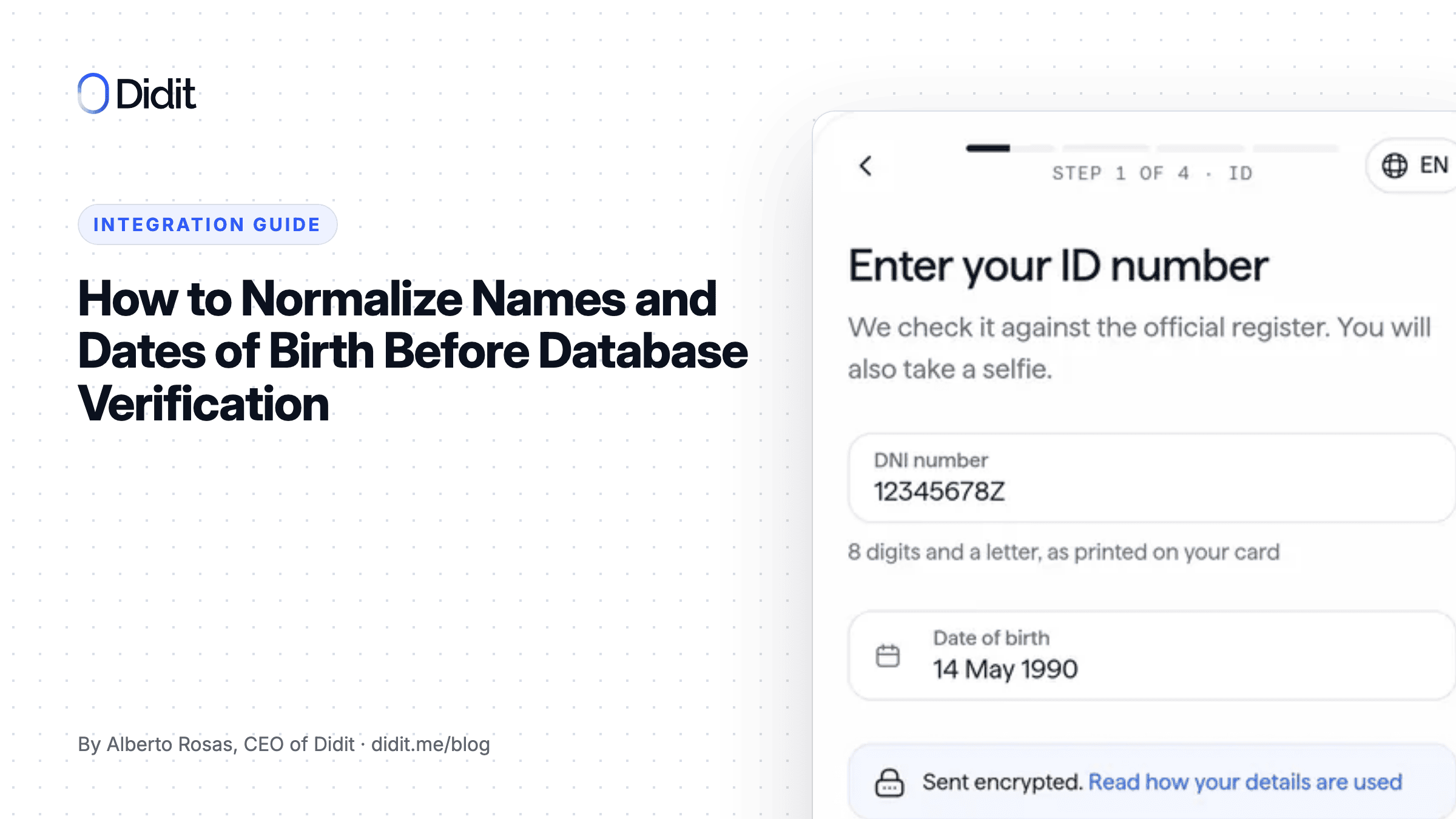 How to Normalize Names and Dates of Birth Before Database Verification
Normalize names to the spelling the registry holds and send date of birth as ISO 8601 before a Didit Database Validation call. Pricing varies by service; $0.05 per check is the lowest published example.
Alberto RosasNov 26, 2026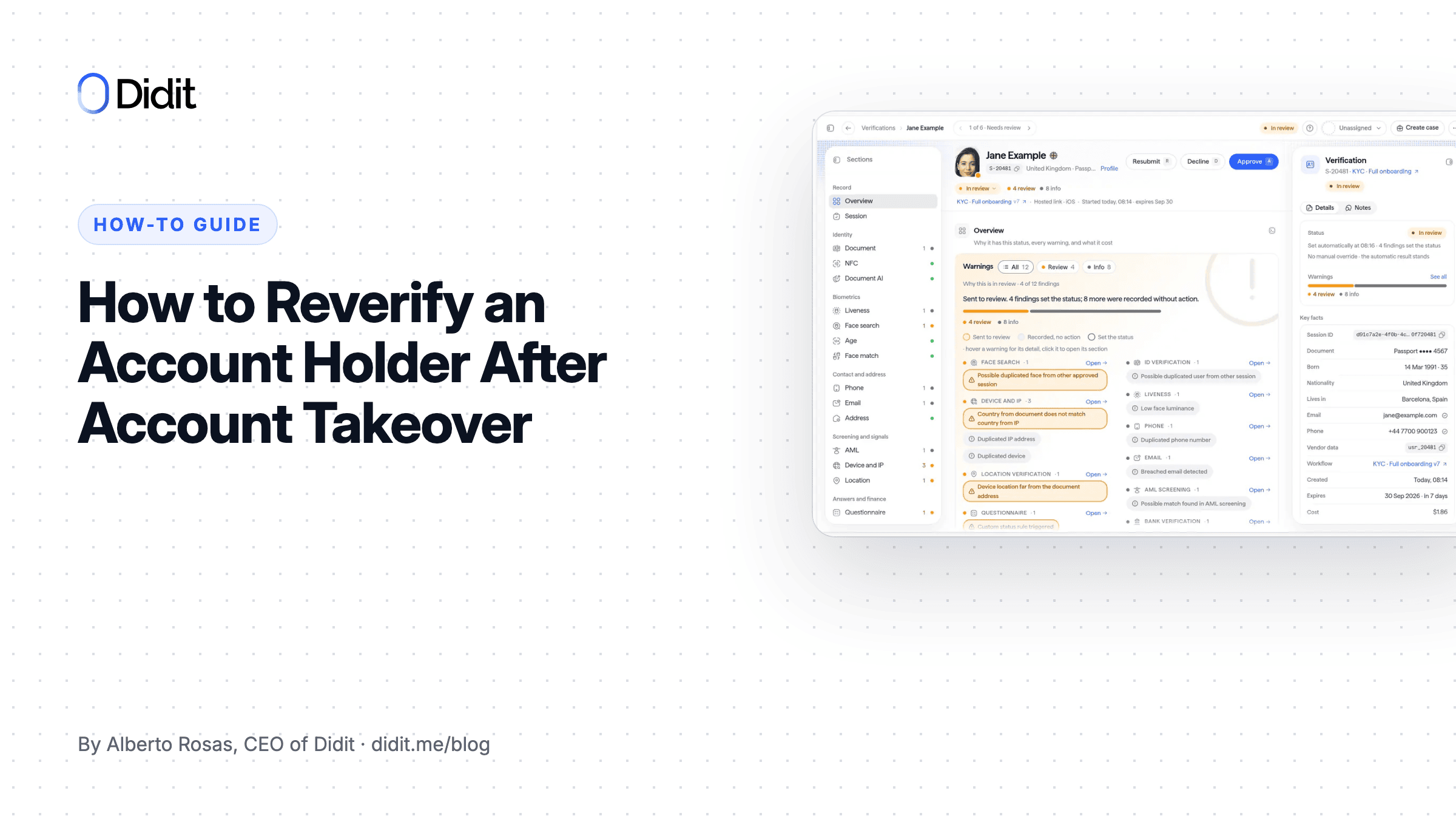 How to Reverify an Account Holder After Account Takeover
Reverify with a fresh full KYC session ($0.33) bound to the original account ID, compare the new face to the enrolled identity with Face Search ($0.05), and make the hand-back a human decision.
Alberto RosasNov 26, 2026Passkey Account Recovery After a Lost Phone (2026)Passkey account recovery after a lost phone depends on whether the platform synced the passkey. If it did not, the person signs in with another enabled method, such as an email code, then enrolls a new passkey.
Alberto RosasNov 26, 2026Questions
Frequently asked questions
How do I verify a UK company registration number?
A UK company number is eight characters at Companies House, and Didit zero-pads shorter numbers to eight digits before querying. In the hosted flow the applicant selects the United Kingdom and enters the company name, the registration number, or both, and the lookup combines them when both are present. The response reports how the match was made in searched_by: name, registration number, or registration number and name.
What is a PSC in the UK and at what threshold?
A person with significant control owns or controls a company and is sometimes called a beneficial owner. The usual tests are more than 25% of shares or voting rights, the power to appoint or remove a majority of directors, or the ability to influence or control the company. Companies House records share and voting levels in three bands: over 25% up to and including 50%, more than 50% and less than 75%, and 75% or more.
How much does a UK KYB check cost on Didit?
A UK registry check costs $2.00 at the Lite tier, $5.00 at Shareholders and $9.00 at UBOs, per company. Company AML adds $0.20, person AML adds $0.20 per UBO or officer, a linked full ID check adds $0.33 per person, and a document step adds $0.20. Those modules are optional workflow additions, not automatic parts of a registry tier. Growth takes 4% off every Didit price and Scale takes 10%.
Does Didit check the Companies House personal code for PSCs?
Our KYB documentation does not describe a personal-code check, so we do not claim one. PSC identity verification with a Companies House personal code is a separate duty that falls on the PSC and the company. Didit returns registry people, and your workflow can require linked identity verification and person-level AML for selected roles.
Can Didit verify a UK company at UBO level if Companies House holds no ownership record?
The request is still delivered, and you pay for the tier that was actually delivered. When the ownership source does not hold the company, registry_ownership_status reads not_held, the Lite profile is delivered and billed, and ownership_error carries company_not_found. When the registry leaves the ownership section empty or does not return it, the status reads unavailable and the same Lite billing applies.
What happens if the UK registry is down or the company is not found?
If the company cannot be found, the applicant submits the details manually, the session continues, is_from_registry is set to false, and the check is billed at the flat manual-entry price of $0.75. If the lookup fails to resolve, fetch_status shows failed, and a pending ownership report never counts as a completed check or an automatic approval.
Does Didit monitor a UK company after onboarding?
Continuous registry monitoring is coming soon. It is configured at $2.00 per company per year, available only where marked, enabled per workflow and cancellable from the business page, and a change fires a data.updated webhook with trigger: "kyb_registry_change". When we checked on September 7, 2026, no country in the KYB price list had monitoring enabled, so plan a re-check schedule until it ships.
Which UK entities fall outside the PSC regime?
Part 21A applies to companies other than DTR5 issuers and any description the Secretary of State specifies by regulations. For a listed company, our workflow can accept a declaration of public ownership instead of a beneficial owner: the option is off by default, the default outcome is review, and the company must still name at least one director or manager. We do not check the declaration against a stock exchange, so review lets an analyst confirm it.
How long does a UK business verification take?
Our quickstart walks a full KYB verification end to end in under 10 minutes: create the workflow, create the session, send the hosted link, receive the webhook, read the decision. Large registries can take a few seconds to return search results, and an ownership report can keep running in the background while the applicant completes independent steps such as document upload.
Can I call the UK registry API without a hosted flow?
Yes. The standalone API has one endpoint per tier: search for candidates, then select for Lite, shareholders, or ubo. A successful search against a paid company-data source costs $0.50 per request, and profile retrieval is priced per country at the tier you request. Shareholders and UBO endpoints exist on /v3/ only.
Compliance built in
Audited, certified and attested.
We hold the certifications and build each country's rules into your flows, so you can launch anywhere without worrying. Security and Compliance center
- Regulation encoded into your flows
Tell us what you do and where. Didit lists the rules that apply to you, with sources, and builds the checks each country needs into one workflow.
- Ready for AMLR
Every requirement of the new EU anti-money laundering rules, from checking customers to human review, is already covered by a Didit check.
- Tested in Spain's Treasury sandbox
Spain's Treasury published its supervised sandbox report on Didit's NFC plus active liveness onboarding; SEPBLAC took part and valued the added measures positively.
- Audited, not self-declared
iBeta Level 1 and Level 2. Liveness tested under ISO/IEC 30107-3.
Your obligations · 3 regions
 SOC 2 Type 2
 ISO 27001
 iBeta Level 1 and Level 2
 EU regulator attestation
 FSM youth protection
 GDPR
 EBA remote onboarding
 MiCA compatible
 FIDO Alliance member
- AMLREU AML Regulation ready
Integration · Didit MCP
Run Didit from your own AI agent
Connect Didit to Claude, Cursor, VS Code or ChatGPT and just ask in plain words. Your agent can do anything you can do in the console, with the same permissions you have.
 Add to Claude
 ChatGPT
 Cursor
- Build workflowsDescribe the checks you need. The agent creates and publishes the flow.
- Run investigationsAsk why a session was declined, review cases, search people and companies.
- Change rulesCreate payment rules, test them on past data and switch them on.
- Pull reportsAsk for numbers, exports or the audit log.
Didit Academy


