Didit Plugin vs MCP Connector in Claude, Codex and Cursor (2026)
Use the Didit plugin when a person works by chat in Claude, Codex or Cursor: it adds 8 skills to the free hosted server. Use the bare connector for the server alone or for headless agents with an application API key.
 Alberto RosasCo-founder and CEO
Contents
In this guide
Jump to the part you need.
Choose the Didit plugin when a person works in Claude, Codex or Cursor and wants the assistant to run verifications, work the review queue and read reports. Choose the bare MCP connector for the server alone at https://mcp.didit.me/mcp. Choose the developer skills when you write REST API code. Both routes use the same free server. Live usage bills from prepaid credit at published prices, and some database lookups and retries bill separately; a full KYC is $0.33.
Last updated: November 26, 2026. Prices checked against the live Didit price feed on November 26, 2026.
| Route | What you get | Best for | Price unit |
|---|---|---|---|
| Didit plugin | The hosted server plus 8 skills, installed from didit-protocol/skills, OAuth sign-in | Compliance, operations and founder teams who run Didit by chat | Server free; checks billed per completed check, $0.33 full KYC |
| MCP connector | The same server, URL only, no skill instructions | Coding agents, narrow jobs, clients with no plugin listing, headless agents | Free to connect; same per-check prices |
| Developer skills | Instructions for writing Didit REST API code (didit-api@didit) | Engineers shipping an integration to production | Free; API calls billed per check |
Start free in the sandbox at business.didit.me, with no sales call. Developers who want the connect steps for each assistant can start at didit.me/developers/mcp. Prices and plan credit are on didit.me/pricing.
One choice matters before you install anything: how the assistant authenticates. OAuth is for interactive use. A person signs in with Didit in a browser, approves the organizations, and the assistant acts as that person with their console role's permissions. An application API key is for headless runs: a scheduled job, a CI step or a backend agent connects as that one application, with no browser and nobody at the keyboard. Both reach the same server, and only OAuth needs a person present.
What the plugin and the connector share
Both routes connect the same hosted server, named didit, at https://mcp.didit.me/mcp. Didit documents 233 tools across sessions, workflows, standalone checks, transaction monitoring, cases, reports and webhooks. The server is stateless Streamable HTTP: one POST per request, no session affinity, and a public health check at GET https://mcp.didit.me/healthz. The source is on GitHub under MIT if you prefer to self-host.
Sign-in is OAuth 2.1 with PKCE. The Business Console at business.didit.me is the authorization server, so the assistant acts as you, in the organizations you approve, with your console role's permissions. There is no API key in the config and no secret to paste. Writes and deletes need a confirmation in the conversation, and the hosted connector hides the tools that move money or reveal API keys on purpose, so you get a console link instead.
Billing is identical on both routes. The MCP server is free on every plan, including Free. Checks in a sandbox application are simulated and never billed. Checks in a live application are billed per completed check at the published price list, for example $0.33 for a full KYC and $0.20 for an AML screening.
The Didit plugin: the server plus 8 skills
The plugin is named didit and is published from the didit-protocol/skills repository, in the plugins/didit folder. One install connects the hosted server and adds 8 skills:
didit-connectsigns you in, finds your organizations and applications, and tells sandbox from live.didit-verify-peoplepicks or creates a workflow, creates verification sessions, shares the link and explains the result.didit-review-queuelists sessions waiting for review, explains them and records approvals and declines after you confirm.didit-run-checksruns standalone checks such as AML screening, ID, face, liveness, email and phone.didit-verify-businessesruns business verification: businesses, their owners and their documents.didit-monitor-transactionsworks with transactions, transaction rules, back-tests and alerts.didit-reportsreads analytics, reports, your balance and your usage.didit-workspace-adminmanages members and roles, webhooks, lists, questionnaires and branding.
The plugin is for people who use Didit from an assistant: compliance and operations teams, founders, and developers who manage their workspace by chat. No code runs on your machine; the plugin is the server address plus the skills' instructions, and every action is a call to the hosted server.

The MCP connector: the server alone
Add https://mcp.didit.me/mcp and you get the same 233 tools with no skill instructions. The model picks tools from their descriptions and from what you ask. This route suits narrow jobs, a client where you want the smallest tool surface, or a setup where your own prompts already describe the work. Didit documents toolsets and a read-only mode, so a coding agent can load a short tool list and search for the rest.
Developer skills: for code, not chat
If you are writing code that calls the Didit REST API, use the developer skills, installed as didit-api@didit, instead of the plugin. The REST API lives at https://verification.didit.me/v3/ and authenticates with an x-api-key header, with sandbox keys that start sk_test_ and live keys that start sk_live_.
Setup by client
Claude
Claude web, Desktop and Code read the same connector link. It pre-fills the Add custom connector dialog with the name Didit and the server URL; you confirm and sign in.
https://claude.ai/customize/connectors?modal=add-custom-connector&connectorName=Didit&connectorUrl=https://mcp.didit.me/mcpIn Claude Code, add the server from the CLI, then run /mcp to open Log in with Didit in the browser:
claude mcp add --transport http didit https://mcp.didit.me/mcpFor the plugin on Claude Code 2.1.275 or later, one command installs it:
/plugin install didit --marketplace didit-protocol/skillsOn an earlier version, run /plugin marketplace add didit-protocol/skills first, then /plugin install didit@didit. On Claude web, Desktop or Cowork, open Customize, then Plugins, add the marketplace didit-protocol/skills, install Didit, and connect didit on the Connectors tab.

didit_session_get_decision or GET /v3/session/{session_id}/decision/.Codex
Codex adds the hosted server with one command, sees that it needs OAuth, and starts the sign-in straight away:
codex mcp add didit --url https://mcp.didit.me/mcpCodex writes the entry to ~/.codex/config.toml. If you cancel the sign-in, run codex mcp login didit later, and confirm with codex mcp list: the didit row shows status enabled and auth OAuth. For the plugin, add the marketplace and install it:
codex plugin marketplace add didit-protocol/skillsCodex loads MCP tools on demand, so name the server or a tool in your first prompt, for example: use the didit MCP server and call didit_context_get to list my organizations and applications. To keep a session focused, list only the tools you need in enabled_tools, such as didit_context_get, didit_session_create and didit_session_get_decision.
Cursor
Cursor connects to the same hosted server. Didit's Cursor setup points to the one-click install link on the Connect Cursor page, which wraps Cursor's deeplink and adds the server didit. There is no separate Cursor plugin listing to browse, so in Cursor the connector is the practical route. You can also paste three lines into ~/.cursor/mcp.json for every project, or .cursor/mcp.json for one project:
{
  "mcpServers": {
    "didit": {
      "url": "https://mcp.didit.me/mcp"
    }
  }
}
Keep any servers you already have inside mcpServers. On first use Cursor opens Log in with Didit. A useful first task in Cursor's agent: create a sandbox KYC workflow with ID verification and liveness, then add the Didit web SDK to this app using that workflow.
ChatGPT, if you use it
ChatGPT has two routes and they are not the same. The Didit plugin in the ChatGPT directory is published by Didit Identity, Inc., reviewed by OpenAI, and installed in one click; it covers verification links, sessions and statuses, workflows, case and report status, webhook destinations and aggregate analytics, but leaves out document and face uploads, government ID number inputs, one-time codes and raw API keys. A custom MCP server you add yourself is not reviewed by OpenAI and exposes the full toolset your role allows; name it something other than Didit, for example Didit MCP, because ChatGPT refuses a name an existing app already uses. Both act as you, only in the organizations you approve at sign-in.
Scorecard: Didit plugin vs the MCP connector
Didit publishes this ranking; we explain the criteria so you can check them.
Two notes before the table. The connector you add in Claude, Codex or Cursor is the Didit server, so the connector column measures the server without the skills. Standard-level facts come from the MCP project page, MCP Connector modelcontextprotocol.io, read November 26, 2026, which publishes no price and whose /pricing URL returned a 404 Page Not Found.
| Criterion | Didit plugin | Reason | MCP connector | Reason |
|---|---|---|---|---|
| Published pricing | 5 | Many common checks have published prices, from $0.15 for an ID document to $0.33 for a full KYC, while some items are variable by country, tier or lookup, and the MCP server is free on every plan | 1 | MCP Connector modelcontextprotocol.io, read November 26, 2026, publishes no price and its /pricing URL returned a 404 Page Not Found |
| Coverage | 5 | 220+ countries and territories, 14,000+ document types, 1,300+ AML lists, available through the hosted server and described by the plugin skills | 3 | The same page lists support across Claude, ChatGPT, VS Code, Cursor and MCPJam, and claims no country or document coverage of its own |
| Product breadth (KYC, KYB, AML, monitoring) | 5 | KYC, KYB, AML screening, ongoing monitoring, transaction monitoring, wallet screening and the Travel Rule behind one server | 1 | The same page describes servers, clients and MCP Apps, not verification products |
| AI/MCP and developer access | 5 | Hosted server, 233 tools, plugin with 8 skills, developer skills for REST code, MIT source on GitHub | 5 | The same page documents build paths for servers, clients and MCP Apps, which is the standard itself |
| Time to first live check | 5 | One install, OAuth sign-in, free unlimited sandbox, a verification link from the first prompt | 2 | You still have to connect a server that runs checks and then describe the order of operations yourself |
| Evidence and certifications | 5 | SOC 2 Type 2, ISO/IEC 27001:2022 certificate ES144068, iBeta Level 1 PAD, GDPR, DORA, MiCA, AMLD6, eIDAS 2.0 | 1 | The same page lists no certifications |
Totals: Didit plugin 30 of 30, MCP connector 13 of 30. The gap is not about protocol quality. MCP is a transport standard, and the connector is the same Didit server. The plugin wins because it carries instructions that turn the same tools into finished work.
Verdict by use case
| Job | Use | Why |
|---|---|---|
| A compliance or operations team working in Claude or ChatGPT | Didit plugin | The skills name the workflow: connect, verify people, review queue, checks, reports, workspace admin |
| A coding agent in Cursor, Codex or Claude Code building the integration | MCP connector, with a short tool list | The agent needs session tools, not eight skill instructions filling its context |
| Writing REST API code that ships to production | Developer skills didit-api@didit | You are writing code, and the API key belongs in your backend |
| An agent with nobody at the keyboard | MCP connector with an application API key | The hosted server accepts an application API key for headless runs, while OAuth needs a browser or a device code |
| A support team inside ChatGPT | Didit plugin from the directory | Reviewed by OpenAI and it keeps identity evidence out of its answers |
Like-for-like comparison
| Dimension | Didit plugin | MCP connector (server only) | MCP standard on its own |
|---|---|---|---|
| Features | 233 tools plus 8 skills, plus smaller focused plugins for teams that need one part | 233 tools, toolsets and a read-only mode | MCP servers, MCP clients and MCP Apps, per MCP Connector modelcontextprotocol.io, read November 26, 2026 |
| Coverage | 220+ countries, 14,000+ document types, 1,300+ AML lists, 1,000+ government data sources | The same, through the tools your role allows | Supported across Claude, ChatGPT, VS Code, Cursor and MCPJam, same page |
| Evidence | Session decisions, warnings, AML hits and reports, all readable in the console | The verbatim JSON of the underlying Didit endpoint | None of its own, same page |
| Implementation | Marketplace install plus OAuth, no API key | Server URL plus OAuth, or an application API key for headless runs, or self-hosting | You build a server, a client or an app |
| Price units | Server free; checks per completed check, $0.33 KYC, $0.20 AML, KYB from $2.00 per company | The same price units | Not published on the MCP page, MCP Connector modelcontextprotocol.io, read November 26, 2026 |
Worked cost example
Neither the plugin nor the connector adds a fee. The only variable is the checks you run, and the arithmetic below uses list prices from the live price feed on November 26, 2026, before plan discounts.
Full KYC is $0.33 per completed check: ID document $0.15 + passive liveness $0.10 + face match 1:1 $0.05 + device and IP analysis $0.03 = $0.33. The compliance bundle is $0.53, which is the $0.33 KYC plus $0.20 AML screening.
| Volume | Full KYC at $0.33 | Compliance bundle at $0.53 | Connector or plugin fee |
|---|---|---|---|
| 1,000 checks | 1,000 x $0.33 = $330.00 | 1,000 x $0.53 = $530.00 | $0.00 |
| 10,000 checks | 10,000 x $0.33 = $3,300.00 | 10,000 x $0.53 = $5,300.00 | $0.00 |
| 100,000 checks | 100,000 x $0.33 = $33,000.00 | 100,000 x $0.53 = $53,000.00 | $0.00 |
The Scale plan takes 10% off every Didit price, so the same 100,000 KYC checks are 100,000 x $0.297 = $29,700.00, alongside the $299 a month plan fee and $350 of monthly credit. On Growth the price is $0.3168, so 100,000 x $0.3168 = $31,680.00.
Business verification adds up the same way per company. Using the starting registry price, one company with one owner would be $2.73: from $2.00 registry retrieval + $0.20 company AML + $0.20 person AML + $0.33 linked KYC. Actual registry pricing varies by country and data tier.
MCP itself publishes no per-check price (MCP Connector modelcontextprotocol.io, read November 26, 2026). With Didit, the connector is free. Live usage is billed from prepaid credit according to the published price list, with some database lookups and retries billed separately.

Strengths and limitations
Didit plugin
Strengths: the skills encode the order of operations, so the assistant does not guess. One install, OAuth, no API key, confirmations before writes, free unlimited sandbox, and the same 233 tools as the connector. It gives you a direct way to create a verification link from chat.
Limitations: it is built for assistant-guided work, not for code. Didit's Cursor setup points at the connector link, so there is no plugin listing to browse there. The ChatGPT directory plugin deliberately leaves out document and face uploads, ID number inputs and one-time codes. Skills take up context, and a person has to be present unless you switch that connection to an application API key.
MCP connector
Strengths: a server-only route with optional toolsets and read-only mode, from 233 tools down to a short tool list. It works on any MCP client, signs in with OAuth or an application API key for headless runs, and returns the verbatim JSON of the underlying endpoint. The server source is MIT and can be self-hosted.
Limitations: no skill instructions, so the model has to infer sequence from tool names and your prompt. MCP itself publishes no price for its work (MCP Connector modelcontextprotocol.io, read November 26, 2026). The hosted Didit connector hides the top-up and API key tools on purpose. A full catalog of 233 tools can crowd a small context window, so trim it before you blame the model.
When the MCP connector alone is the better fit
- You are in Cursor, where Didit's install path is the connector link rather than a plugin listing.
- Your agent is a coding agent that should create a workflow, create one test session and read one decision, and nothing else.
- No person is present: a scheduled job or a CI step connects with an application API key instead of a browser sign-in.
- You want read-only access for a while, so you enable the read-only toolset before you grant writes.
- You already run your own prompts and do not want skill instructions competing with them.
Migration plan: parallel test, webhooks, records
Run both routes on the same cases
Work in a sandbox application first, where checks are simulated and never billed. Run the same ten cases through the plugin and through the connector, then compare the decisions and warnings with what the same cases return in the console. If the answers match, the only difference is the instructions, which is what you want to know before live traffic.
Move webhooks before you move traffic
Register the destination with POST /v3/webhook/destinations/. The fields label and url are required; add subscribed_events and webhook_version set to v3. Store the returned secret_shared_key as DIDIT_WEBHOOK_SECRET, verify X-Signature-V2 (HMAC-SHA256) before trusting a payload, reject timestamps older than five minutes, answer 2xx quickly and process events idempotently. The full walkthrough is on the webhooks page.
Keep the records
Session statuses are exact strings, so do not map them loosely: Not Started, In Progress, Approved, Declined, In Review, Awaiting User, Resubmitted, Expired, Abandoned and Kyc Expired. The decision is available at any time from GET /v3/session/{session_id}/decision/. Keep the session ids your assistant creates, so a decision read in chat can be reconciled with the console and with your own audit trail.
Sources
- Didit pricing and pricing in the docs, read November 26, 2026.
- Didit MCP server product page, read November 26, 2026.
- Didit MCP server overview, read November 26, 2026.
- Didit plugin for Claude, Codex and Cursor, read November 26, 2026.
- Connect Claude, Connect Codex, Connect Cursor, Connect ChatGPT, read November 26, 2026.
- MCP installation, authentication, tools reference, examples, read November 26, 2026.
- Webhooks and verification statuses, read November 26, 2026.
- Didit switch page: didit.me/switch, read November 26, 2026.
- MCP Connector modelcontextprotocol.io, read November 26, 2026. Plain text citation, no link: pricing not published on the page and its /pricing URL returned a 404 Page Not Found.
Next step: create a free sandbox application at business.didit.me, install the plugin or paste the connector URL, and run one test check. Sandbox checks are simulated and never billed, and there is no sales call.
Try it
Try this in the sandbox
Run the check this guide describes, free.
The product this post is about, taken from its topic. Run it free in the sandbox.
Author
Alberto Rosas
Co-founder and CEO

Keep reading
Other guides in the same topic.
 Embed Didit verification in an iframe: camera permissions and UniLink
Embed Didit verification with an iframe: the documented source is https://verify.didit.me/u/YOUR_WORKFLOW_ID_BASE64 plus the full allow attribute for camera and microphone.
Alberto RosasNov 26, 2026 Didit API Rate Limits per Endpoint: 600/min Create, 100/min Decision
Didit limits requests per key or IP on a 60-second window: 600/min session creates, 100/min v1 and v2 decisions, 50/min PDFs, 10/min add-images, and 600/min for GET /v3/session/{id}/decision/.
Alberto RosasNov 26, 2026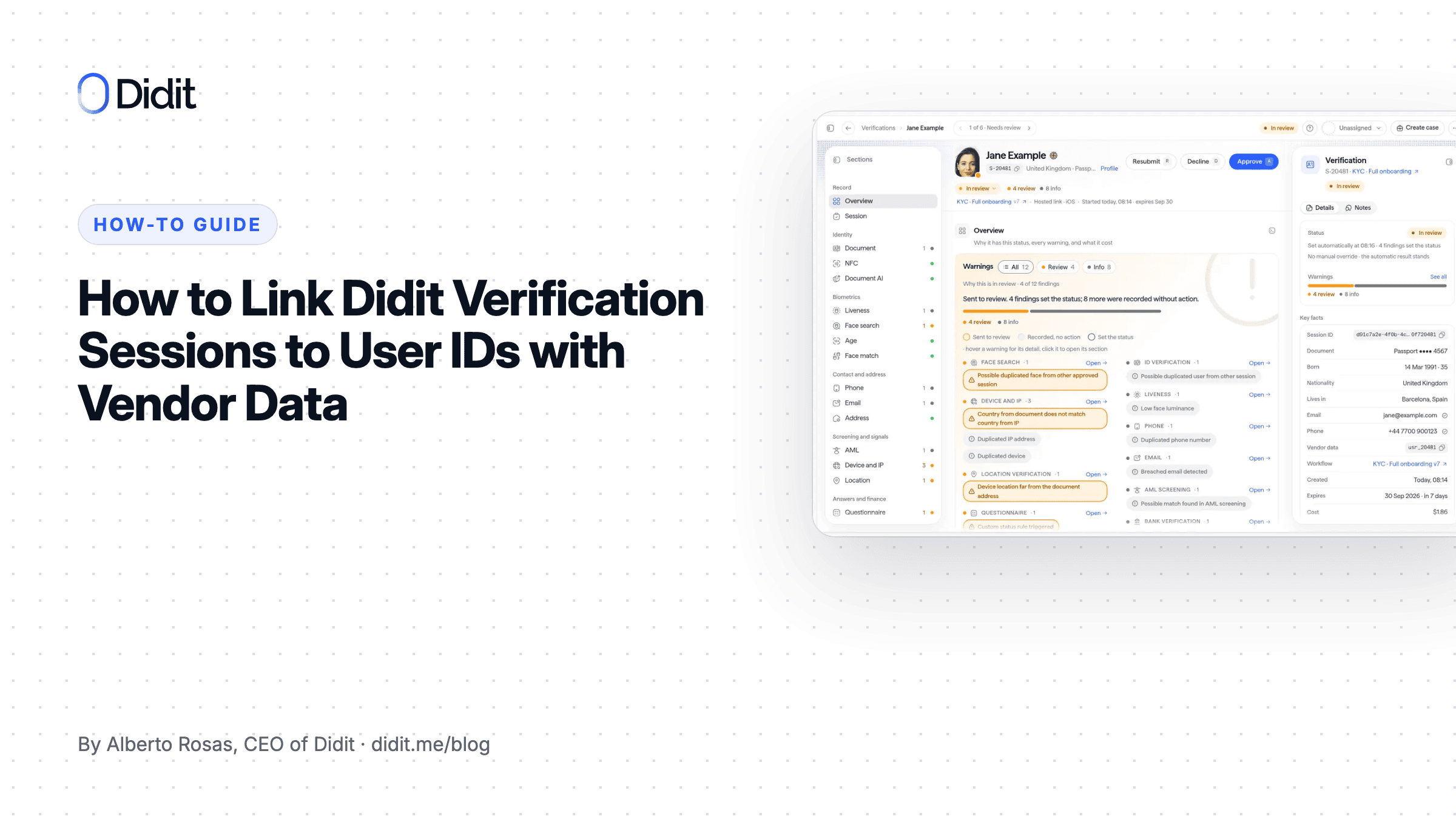 How to Link Didit Verification Sessions to User IDs with Vendor Data
Pass your internal user id as vendor data on the create session call, store the returned session ID with that user, and filter the list endpoint by vendor data to reconcile. Linking costs nothing.
Alberto RosasNov 26, 2026Questions
Frequently asked questions
Is the Didit plugin the same as the Didit MCP connector?
They use the same hosted server, named didit at https://mcp.didit.me/mcp. The plugin adds 8 skills that teach the assistant how to verify people and businesses, work the review queue, run checks, monitor transactions, read reports and manage the workspace. The connector adds the server only. Both sign in with OAuth, both are free to connect, and both bill completed checks at the same published prices.
Which should I use in Claude?
If a person works with Didit by chat in Claude web, Desktop or Code, install the plugin so the assistant knows the sequence. If you only want the tools, use the connector link that pre-fills the Add custom connector dialog with https://mcp.didit.me/mcp. In Claude Code you can also run claude mcp add --transport http didit https://mcp.didit.me/mcp and sign in with /mcp.
Which should I use in Codex?
For a coding session the connector is enough: run codex mcp add didit --url https://mcp.didit.me/mcp, finish the browser sign-in, and confirm with codex mcp list. If you want the skills as well, add the marketplace with codex plugin marketplace add didit-protocol/skills and install the didit plugin. Codex loads tools on demand, so name the server or a tool in your first prompt.
Which should I use in Cursor?
Use the connector. Didit's Cursor setup points to the one-click install link on the Connect Cursor page, which adds the server named didit with URL https://mcp.didit.me/mcp. You can paste the same three lines into ~/.cursor/mcp.json instead. There is no separate Cursor plugin listing to browse.
What is the difference between the Didit plugin and a custom MCP server in ChatGPT?
The directory plugin is reviewed by OpenAI and published by Didit Identity, Inc. It covers verification links, sessions and statuses, workflows, case and report status, webhook destinations and aggregate analytics, but leaves out document and face uploads, government ID number inputs, one-time codes and raw API keys. A custom MCP server you add yourself is not reviewed by OpenAI and exposes the full toolset your console role allows.
Does the plugin or the connector cost anything?
No. The Didit MCP server is free on every plan, including Free, and neither route adds a fee. You pay per completed check in a live application, for example $0.33 for a full KYC, $0.20 for AML screening and $0.15 for a wallet screening. Sandbox checks are simulated and never billed.
Can I use the Didit MCP connector without an API key?
Yes. The hosted server uses OAuth 2.1 with PKCE, so you sign in with your Didit account and the server acts as you with your role's permissions, with no key in the config. An agent that runs with nobody present, such as a CI job, connects with an application API key instead, and a machine with no browser can sign in with a device code.
What are Didit developer skills and when do I need them?
The developer skills, installed as didit-api@didit, are instructions for writing Didit REST API code. Use them when you are coding an integration against https://verification.didit.me/v3/ with an x-api-key header. Use the plugin instead when a person is doing the work by chat in Claude, Codex or Cursor.
How do I run a Didit check from an agent with no person at the keyboard?
Connect the hosted server with an application API key rather than OAuth, so the agent acts as that one application. Alternatively, call the REST API from your backend: create a session with POST /v3/session/, send the user to the returned url, and read the result from GET /v3/session/{session_id}/decision/. The MCP server itself is free, so the choice is about authentication, not price.
What can the assistant not do through the hosted Didit connector?
It cannot top up your balance or reveal application API keys. Both tools are hidden from the hosted connector on purpose, so you get a console link to top up and you read keys in the console. Writes, deletes and decisions also need an explicit confirmation in the conversation.
Which clients does the Didit connector support?
Didit documents setup for Claude, ChatGPT, Cursor, VS Code, Codex, Windsurf and Zed, plus self-hosting. The MCP standard itself is described as supported across Claude, ChatGPT, VS Code, Cursor and MCPJam on MCP Connector modelcontextprotocol.io, read November 26, 2026. Didit documents setup for the listed clients and provides per-client installation steps.
Compliance built in
Audited, certified and attested.
We hold the certifications and build each country's rules into your flows, so you can launch anywhere without worrying. Security and Compliance center
- Regulation encoded into your flows
Tell us what you do and where. Didit lists the rules that apply to you, with sources, and builds the checks each country needs into one workflow.
- Ready for AMLR
Every requirement of the new EU anti-money laundering rules, from checking customers to human review, is already covered by a Didit check.
- Tested in Spain's Treasury sandbox
Spain's Treasury published its supervised sandbox report on Didit's NFC plus active liveness onboarding; SEPBLAC took part and valued the added measures positively.
- Audited, not self-declared
iBeta Level 1 and Level 2. Liveness tested under ISO/IEC 30107-3.
Your obligations · 3 regions
 SOC 2 Type 2
 ISO 27001
 iBeta Level 1 and Level 2
 EU regulator attestation
 FSM youth protection
 GDPR
 EBA remote onboarding
 MiCA compatible
 FIDO Alliance member
- AMLREU AML Regulation ready
Integration · Didit MCP
Run Didit from your own AI agent
Connect Didit to Claude, Cursor, VS Code or ChatGPT and just ask in plain words. Your agent can do anything you can do in the console, with the same permissions you have.
 Add to Claude
 ChatGPT
 Cursor
- Build workflowsDescribe the checks you need. The agent creates and publishes the flow.
- Run investigationsAsk why a session was declined, review cases, search people and companies.
- Change rulesCreate payment rules, test them on past data and switch them on.
- Pull reportsAsk for numbers, exports or the audit log.
Didit Academy