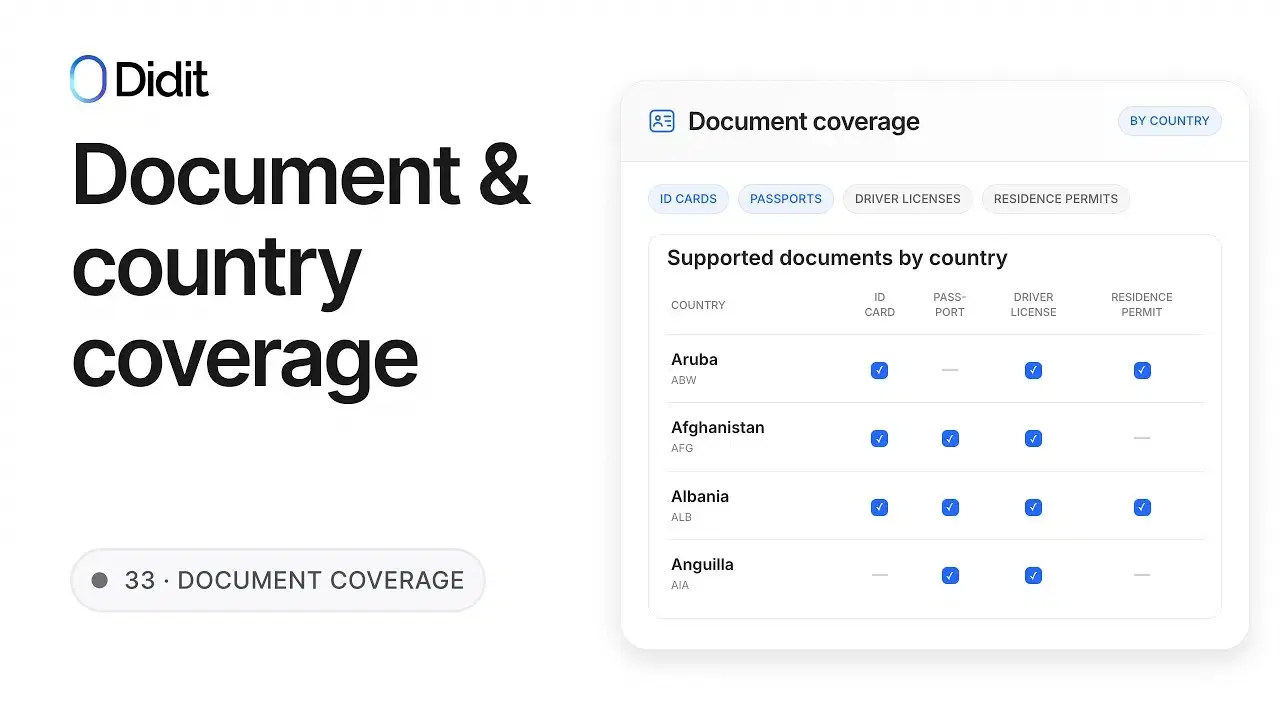
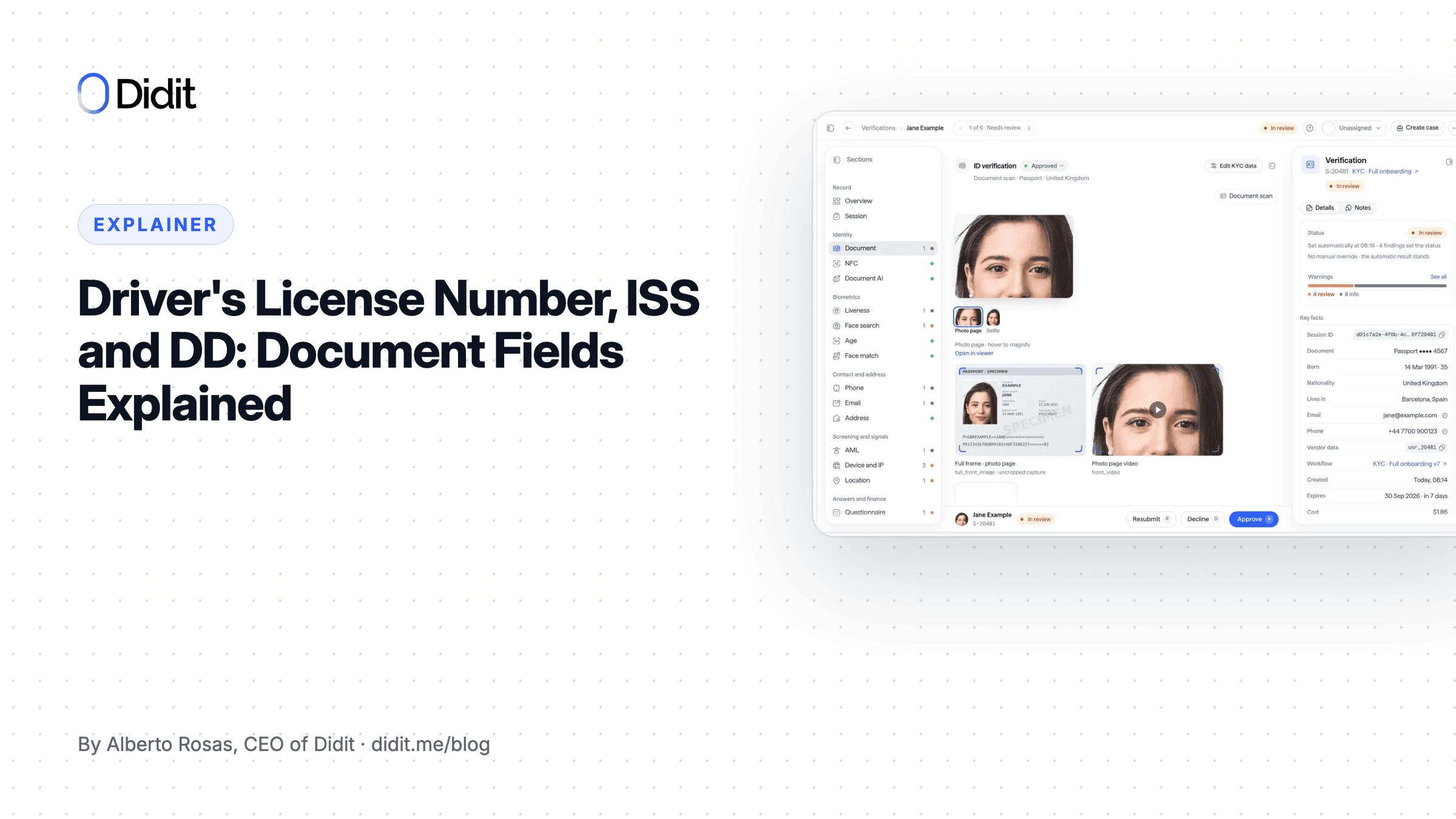
Driver's License Number, ISS and DD: Document Fields Explained
A driver's license number identifies the driving record. ISS is the card's issue date. DD is the document discriminator for that one card, not for the person.
 Alberto RosasCo-founder and CEO
Contents
In this guide
Jump to the part you need.
This page explains the fields on a driver's license, ID card and passport. It covers what a driver's license number is, what ISS and DD mean, and where the document number and passport chip sit. Didit reads those fields and detects the document type and issuing country automatically, at $0.15 per ID check inside a workflow or $0.20 on the standalone API. The caveat is that field labels differ by issuing country.
Last updated: November 26, 2026. Prices checked against the live Didit price feed on November 26, 2026.
The fields at a glance
| Field | What it means | Where it appears |
|---|---|---|
| DL number | Driver's license number, the identifier the licensing authority gives the driving record | Front of the card, and encoded in the barcode on the back where the design carries one |
| ISS | Issue date, the date the card was issued to the holder | Dates block on the front, next to the expiry date |
| DD | Document discriminator, a code for that specific card and issuance, not for the person | Front or back depending on the issuing state, often near the barcode |
| Document number | The number the document itself carries, whether a license number, ID card number or passport number | Front of a card; top right of a passport data page |
| MRZ | Machine-readable zone, the document data in a fixed character grid with check digits | Back of many ID cards and licenses; bottom of a passport data page |
| Chip | Contactless chip holding a signed copy of the document data | Inside the front cover of most ePassport designs; inside the card body of an eID |
You can start free in the sandbox at business.didit.me with no sales call, and developers can connect Didit to an AI assistant through the Didit MCP server. The product documentation for this step is ID Verification, and every price on this page is on didit.me/pricing.
What is a driver's license number?
A driver's license number is the identifier a licensing authority assigns to a person's driving record and prints on the card. It is the value you store when a form or a schema asks for the document number on a license, because it is the number the document itself carries.
In many US states the license number stays with the record across renewals, and the card is reprinted with a new issue date. That is not universal. Some jurisdictions reissue a different number, and some print a separate card serial alongside the license number. Treat the number as document-level data, not as a permanent person-level key, unless you have confirmed the issuing authority's rule.
Where a driver's license number is used
- KYC onboarding, where the license is one accepted document type and the number is stored on the profile.
- Age-restricted purchases and rentals, where the number is recorded next to the date of birth.
- Insurance quotes and claims, where the number ties a policy to a driving record.
- Registry matching in countries where the license or national number can be looked up against an authoritative source.
What do ISS and DD mean on a license?
ISS is the issue date, and DD is the document discriminator. Both describe the card. Neither one is a national identification number, and neither one proves who the holder is on its own.
ISS is the issue date
ISS marks the date the card was issued. It sits in the dates block next to the date of birth and the expiry date, which is why it gets misread. The three dates look alike at a glance and OCR has to label each one from its position and its printed prefix. ISS is not an expiry date, and a card with a recent ISS can still be expired if the printed expiry has passed.
Whether an issue date is available at all depends on the document type and the schema you read. Didit's published ID Verification response carries date_of_birth and expiration_date, with no dedicated issue-date field, and the expiry check is what raises DOCUMENT_EXPIRED. If the expiry cannot be read, the standalone API can be told to decline through expiration_date_not_detected_action.
DD is the document discriminator
On US and Canadian driver's licenses and ID cards, the two-letter field codes come from the AAMVA DL/ID Card Design Standard, which assigns a code to every data element on the card and in the barcode. DD is the document discriminator: a short alphanumeric string the issuer generates for that one card so the issuer and law enforcement can distinguish two cards issued to the same person.
Three consequences follow. DD changes when the card is reissued, so it is a poor long-term customer key. DD is not the license number, so storing it in a document-number field corrupts the record. And DD identifies the card, not the holder.
The printed position varies by state. Some layouts print DD on the front near the dates block, others print it beside the barcode on the back. Where the issuing design encodes DD in the barcode, the same value travels inside the barcode payload, which is why a barcode read and a visual read should always agree.
Where is the document number on a driver's license and what is the DD number
On a driver's license, the document number is the license number printed on the front, labelled DL, DLN, No., License No., or the local-language equivalent. The DD number is a different field on the same card: the document discriminator for that issuance. They are never the same value, and a form that asks for a document number wants the license number.
There are up to three places to confirm the license number on one card. They are the printed field on the front, the barcode on the back where the design carries one, and a machine-readable zone on the back of some designs. A good extraction reads every available zone and compares them, because that comparison is what catches a reprinted or altered card.

What the term government-issued identification number covers
A government-issued identification number is any number a government body assigns and uses to identify a person or a document. The term covers passport numbers, national ID numbers such as a DNI, CPF, CURP, Aadhaar or NIN, driver's license numbers, residence permit numbers, and in some countries a tax number.
It helps to split the term into two families. Person-level numbers identify a human being and are usually stable for life. Document-level numbers identify a piece of paper or plastic: a passport number identifies a booklet, a DD identifies a card, a license number identifies a record held by one authority. Most onboarding errors come from mixing the families, for example storing a passport number as a national ID number and then matching it against the wrong register.
Where a number can be matched against an authority, Didit Database Validation takes it as identification_number with the issuing state, maps it to the local identifier, and returns a per-field match. In some countries the record reached is a government register; in Canada, France, Indonesia, the Netherlands, Norway, Singapore, the United Kingdom and the United States it is a credit-bureau, financial-services, utility or residential-records file, which the non-document lookup documentation names per country.
Field and terminology table
| Label on the document | Meaning | Typical document | Didit response field |
|---|---|---|---|
| DL, DLN, No., License No. | License number | US and Canadian driver's licenses | document_number |
| Passport No. | Booklet number | Passports under ICAO Doc 9303 | document_number and mrz |
| ISS | Issue date | US licenses and ID cards | No dedicated field in the published schema; availability depends on the document type and the schema you read |
| DD | Document discriminator | US and Canadian licenses and ID cards | Inside the decoded barcodes payload, not a named field |
| EXP, Expiry | Expiry date | All documents | expiration_date |
| MRZ lines | Machine-readable zone | Passports, ID cards, some licenses | mrz |
| Address block | Holder address | Licenses and ID cards | parsed_address |
| Chip | Signed copy of the document data | ePassports and eIDs | nfc_verifications[] |
Where is the chip on a passport?
On most ePassport designs the contactless chip sits in the front cover of the booklet together with its antenna, rather than in the plastic data page, though placement varies by issuing design. Follow the NFC guidance published for the issuing document. ICAO Doc 9303 defines the chip, its file structure and the security protocols around it. In practice the holder closes the booklet and holds an NFC phone flat against the cover.
The reading keys come from the MRZ, so the order matters. Photograph the data page, derive the keys, then tap the chip. Didit runs NFC that way inside a session, where the user first photographs the document so the SDK derives the BAC or PACE keys from the MRZ and then taps the chip. NFC is a $0.15 add-on per check, it is session-only with no standalone endpoint, and it is available through the native SDKs. Browsers cannot read NFC, so a web flow falls back to document capture plus face match.
- On an ePassport the chip is on most designs in the front cover, read with the phone against the closed booklet.
- On a national eID card the chip is inside the card body, read with the phone against the flat card.
- A Japan My Number Card reads through JPKI rather than ICAO 9303, native SDKs only, with a card PIN. Not enabled in production yet.
What the chip adds is a signature chain back to the issuing government, plus a data set to compare with the printed page. A chip that disagrees with the printed page is a tampering signal. Didit returns NFC_DATA_DOES_NOT_MATCH_OCR and the flow should not be approved. The full mechanics are in the NFC Verification documentation.
Worked example with a California driver's license, field by field
An onboarding team receives a California driver's license for a US signup. The card is dual-sided, so both images are captured. Reading the front, left to right and top to bottom, the fields that matter are the name, the DL number, the date of birth, ISS, EXP and DD, with the class, endorsements and restrictions below them.
- Store the DL number as the document number. It is the record identifier.
- Read EXP and compare it with today's date before anything else, because an expired card ends the flow.
- Read ISS only as context. It tells you how old the plastic is, not whether the person is who they claim.
- Read DD and treat it as a card serial. If the same person submits again with a new DD, that is a reissued card, not a new identity.
- Decode the barcode on the back and compare the license number and the DD with the printed values.
Didit classifies the document automatically, so the workflow does not declare California or even the United States. The service detects country and document type, reads the visual zone, decodes the barcode and returns the fields together with a warnings list. You then check document_number against your own record and read the warnings, rather than deciding from the images alone.
How Didit reads these fields
ID Verification reads and authenticates passports, ID cards, driver's licenses and residence permits across 220+ countries and 14,000+ document types in 54 languages. It checks the document for tampering, extracts the fields with AI OCR, parses the MRZ, decodes barcodes and cross-checks the visual zone against the MRZ and the barcode before returning a decision.

The response returns document_number, full_name, document_type, date_of_birth, expiration_date, parsed_address, mrz, barcodes, the portrait and document images, and a warnings array. For a dual-sided driver's license, back_image is required; a request that omits it on a dual-sided document returns HTTP 400.
curl -X POST 'https://verification.didit.me/v3/id-verification/' \
-H 'x-api-key: YOUR_API_KEY' \
-F 'front_image=@./license_front.jpg' \
-F 'back_image=@./license_back.jpg' \
-F 'perform_document_liveness=true' \
-F 'expiration_date_not_detected_action=DECLINE' \
-F 'invalid_mrz_action=DECLINE' \
-F 'inconsistent_data_action=DECLINE'
The response body carries the extracted fields and the risk codes that matter for these documents, including DOCUMENT_EXPIRED, DOCUMENT_NUMBER_NOT_DETECTED, INVALID_MRZ, INCONSISTENT_DATA, DOCUMENT_LIVENESS_FAILED and DUPLICATED_DOCUMENT. Inside a session the same result appears under the id_verifications[] array of the decision payload, which is what the data model reference describes. If you are moving from another provider, /switch/ covers the migration path.

Worked cost example
A team verifies 1,000 driver's licenses and 250 of the same users also tap a passport chip. All figures are published list prices per completed check.
- ID checks in a workflow: 1,000 x $0.15 = $150.00.
- NFC chip reads: 250 x $0.15 = $37.50.
- Total: $150.00 + $37.50 = $187.50.
- The same 1,000 checks on the standalone upload API: 1,000 x $0.20 = $200.00, which is $50.00 more than the workflow route.
- The same 1,000 users on a full ID check with liveness and face match: 1,000 x $0.33 = $330.00.
- On the Growth plan, ID at 4% off is $0.144: 1,000 x $0.144 = $144.00, and NFC 250 x $0.144 = $36.00, so $180.00 in total.
The Free plan includes $10.00 of credit each month for organizations that sign up with a work email, and sandbox testing is free. Plan credit does not roll over. Check the pricing page before you quote a contract, because plans and credits change.
Common mistakes when reading these fields
- Storing DD as the person's identity number. It is a card serial and it changes on reissue.
- Reading ISS as an expiry date. The two sit next to each other in the dates block.
- Using a driver's license number as a national ID number where the country has both, then matching it against a register that holds the national number.
- Forgetting the back image on a dual-sided card, where the barcode and often the MRZ live.
- Pre-cropping the images. The service detects, aligns and crops the document itself, and all four corners must be visible.
- Assuming labels are universal. DD and ISS come from a North American card design standard; other countries print their own abbreviations or none.
- Assuming the chip sits under the data page. On most ePassports it is in the cover, so hold the phone against the closed booklet, and follow the issuing document's NFC guidance.
- Approving on extracted fields while ignoring the warnings array, where
INCONSISTENT_DATAandDOCUMENT_LIVENESS_FAILEDsit.
Sources
- Didit docs: ID Verification overview
- Didit docs: ID Verification API (standalone)
- Didit docs: ID Verification methods
- Didit docs: Non-document lookup
- Didit docs: Database Validation overview
- Didit docs: NFC Verification overview
- Didit docs: data models
- Didit pricing page and pricing feed as JSON, read November 26, 2026
- Didit MCP server
- ICAO Doc 9303, Machine Readable Travel Documents (chip, data page and MRZ specification; named, not linked)
- AAMVA DL/ID Card Design Standard (two-letter field codes including DD; named, not linked)
Create a free sandbox account at business.didit.me, upload a sample front and back, and read the returned document_number, mrz and warnings before you write a line of code. No sales call is needed, and the sample session shows you exactly which fields your document type returns.
Try it
Try this in the sandbox
Run the check this guide describes, free.
The product this post is about, taken from its topic. Run it free in the sandbox.
Author
Alberto Rosas
Co-founder and CEO

Keep reading
Other guides in the same topic.
 USA PATRIOT Act Section 314: AML Information Sharing Explained
Section 314(a) lets law enforcement request account data through FinCEN. Section 314(b) gives financial institutions a voluntary, registered safe harbor to share risk information with each other.
Alberto RosasNov 26, 2026 SAR vs UAR: AML Case Management That Ends in a Filing
A SAR is the suspicious activity report filed with the FIU. A UAR is the unusual activity report that records why activity looked odd. One case holds the evidence, the decision and the filing.
Alberto RosasNov 26, 2026 What Is Knowledge-Based Authentication (KBA) and Why It Fails
KBA treats a correct answer to questions built from credit-header and out-of-wallet records as proof of identity. It is cheap, and it fails against anyone who can look up or talk their way to the answers.
Alberto RosasNov 26, 2026Questions
Frequently asked questions
What is a driver's license number?
A driver's license number is the identifier a licensing authority assigns to a person's driving record and prints on the card. It is the value to store when a schema asks for the document number on a license. It is not the DD number, which identifies the card rather than the record.
What do ISS and DD mean on a driver's license?
ISS is the issue date, the day the card was produced and handed to the holder. DD is the document discriminator, a short code the issuer generates for that one card. Neither is a national identification number.
Where is the DD number on a California driver's license?
On California cards the DD appears as a short alphanumeric string printed with the card data, and where the issuing design encodes it, the same value sits inside the barcode payload on the back. Compare the printed value with the decoded barcode. A disagreement is a tampering signal. Didit does not expose DD as a named field; it returns the decoded barcode payload under barcodes.
Where is the document number on a driver's license?
On the front, labelled DL, DLN, No. or License No., and on US and Canadian designs again inside the barcode on the back. On a passport the document number is at the top right of the personal data page and repeats as the first nine characters of the second MRZ line.
Is a driver's license number a government-issued identification number?
Yes. A licensing authority is a government body, so the number it issues falls under the term. The same term also covers passport numbers, national ID numbers and residence permit numbers, which are matched against different sources and should not be stored in one field without a type label.
Where is the chip on a passport?
On most ePassport designs it is in the front cover of the booklet, together with its antenna, rather than in the plastic data page, so check the guidance for the issuing country. The holder closes the booklet and holds an NFC phone against the cover. The reading keys come from the MRZ, so the data page is photographed first.
Where is the document number on a passport?
Top right of the personal data page, and again at the start of the second MRZ line followed by a check digit. The MRZ is useful for automated validation because it carries check digits, and it should be compared with the visual fields rather than trusted alone. Didit returns both the visual fields and the parsed mrz.
Does Didit return the ISS issue date?
Not as a dedicated field in its published ID Verification schema, which carries date_of_birth and expiration_date. Whether an issue date is available depends on the document type and the schema you read, so check the response for the document you are processing. The expiry date is always the one that drives the DOCUMENT_EXPIRED check.
Do all countries label these fields the same way?
No. DD and ISS come from the AAMVA card design standard used in the United States and Canada, while other countries print their own abbreviations or none at all. A field labelled No. on a European ID card is a document number, but the layout around it differs, which is why extraction is trained per design rather than from labels alone.
Can software read the DD number automatically?
Yes, by decoding the barcode on the back of the card, where the issuing design encodes DD in its payload. Didit returns that decoded payload in barcodes and cross-checks it against the printed text. There is no separate DD field in the response, so parse it from the barcode data.
What happens if Didit cannot read the document number?
The check declines with a DOCUMENT_NUMBER_NOT_DETECTED warning, which is a hard failure rather than an informational note. A document without a readable number cannot be matched to a record, so the right move is a sharper recapture, then manual review.
Does Didit check that the printed number matches the chip?
When NFC runs, yes. The chip data is compared with the OCR data, and a mismatch returns NFC_DATA_DOES_NOT_MATCH_OCR. On documents without a chip, Didit compares the visual zone with the MRZ and with barcode data, and a disagreement raises INCONSISTENT_DATA.
How much does it cost to read these fields?
ID Verification is $0.15 per check inside a workflow and $0.20 per call on the standalone upload API. NFC chip reading is a $0.15 add-on, and a full ID check with passive liveness, face match and device analysis is $0.33. Prices come from the live feed at didit.me/pricing.
Compliance built in
Audited, certified and attested.
We hold the certifications and build each country's rules into your flows, so you can launch anywhere without worrying. Security and Compliance center
- Regulation encoded into your flows
Tell us what you do and where. Didit lists the rules that apply to you, with sources, and builds the checks each country needs into one workflow.
- Ready for AMLR
Every requirement of the new EU anti-money laundering rules, from checking customers to human review, is already covered by a Didit check.
- Tested in Spain's Treasury sandbox
Spain's Treasury published its supervised sandbox report on Didit's NFC plus active liveness onboarding; SEPBLAC took part and valued the added measures positively.
- Audited, not self-declared
iBeta Level 1 and Level 2. Liveness tested under ISO/IEC 30107-3.
Your obligations · 3 regions
 SOC 2 Type 2
 ISO 27001
 iBeta Level 1 and Level 2
 EU regulator attestation
 FSM youth protection
 GDPR
 EBA remote onboarding
 MiCA compatible
 FIDO Alliance member
- AMLREU AML Regulation ready
Integration · Didit MCP
Run Didit from your own AI agent
Connect Didit to Claude, Cursor, VS Code or ChatGPT and just ask in plain words. Your agent can do anything you can do in the console, with the same permissions you have.
 Add to Claude
 ChatGPT
 Cursor
- Build workflowsDescribe the checks you need. The agent creates and publishes the flow.
- Run investigationsAsk why a session was declined, review cases, search people and companies.
- Change rulesCreate payment rules, test them on past data and switch them on.
- Pull reportsAsk for numbers, exports or the audit log.
Didit Academy