What Is Knowledge-Based Authentication (KBA) and Why It Fails
KBA treats a correct answer to questions built from credit-header and out-of-wallet records as proof of identity. It is cheap, and it fails against anyone who can look up or talk their way to the answers.
 Alberto RosasCo-founder and CEO
Contents
In this guide
Jump to the part you need.
Knowledge-based authentication (KBA) treats knowledge as identity: it asks questions whose answers should belong only to the right person, such as an old street, a loan payment or four account digits. It fits some legacy recovery and low-risk step-up checks. It fails against anyone who looks up the answers or talks a support agent into a reset. The closest published Didit options are a $0.33 full ID check and a per-country non-document lookup.
Last updated: November 26, 2026. Prices checked against the live Didit price feed on November 26, 2026.
| Question | Short answer |
|---|---|
| What it is | A challenge built from facts about a person, answered to prove the person knows them. |
| Where the questions come from | Credit-header data, tradeline history, address history, public records, prior account activity. |
| What it actually proves | That someone knows the answers. Nothing about a document, a live face or a device. |
| Main weakness | The answers are buyable, findable or extractable by social engineering. |
| What replaces it | A lookup against an authoritative source, document capture, a digital ID wallet, or a biometric at login. |
| Didit price points | Full ID check $0.33. Custom questionnaires $0.10. Biometric Authentication $0.10. Device and IP analysis $0.03. Non-document verification is priced per lookup and varies by country. |
You can test the alternatives without a sales call. Start free in the sandbox at business.didit.me. If you build with an AI assistant, connect Didit to it through the MCP server. Prices and plan details are on didit.me/pricing.
What is knowledge-based authentication?
Knowledge-based authentication is a challenge that asks someone to answer questions generated from records about a person, then compares the answers with those records. The data usually comes from a credit file or a data aggregator rather than from a document the applicant holds.
KBA is a knowledge factor, not identity proofing. A question set can confirm that someone has read a credit file. It cannot confirm that the person answering is the person in the file, and it says nothing about a forged document or a deepfake.
That gap is the whole story. KBA was designed when the alternative was a mailed letter or a branch visit, and it was a reasonable trade. Against automated lookup, breached data sets and a determined caller, it offers limited protection against data access and social engineering.
The difference that matters is between asking and querying. KBA asks the applicant to reproduce facts from a record and scores the answers. A non-document lookup queries the authoritative source named for that country and returns a data-match verdict per field. Didit documents the method and the per-country source on non-document lookup; the applicant does not need to remember a tradeline or an old street.
Where KBA is still used
- Account recovery. Password resets and locked accounts still ask for a memorable word or a billing-address detail.
- Call centres. A support agent asks three details before resetting a password or releasing funds.
- Step-up authentication. A payment or a profile change triggers extra questions instead of an extra device check.
- Non-documentary onboarding. Some flows that do not collect a document fall back to questions built from consumer records.
- Legacy identity proofing. Older portals in financial services, healthcare and benefits still hold a KBA step in their flow.
The non-documentary case matters most, because it is where KBA hides inside a verification process. A team can believe it runs a substantive check when what it actually runs is four questions and a pass threshold. A registry or credit-file match is a different thing: it returns a verdict about the record, per field, instead of inviting the applicant to guess at it.
How KBA questions are generated
Dynamic KBA builds a fresh question set per session. The usual sequence is: assemble a data file about the claimed identity, choose facts from that file that are not printed anywhere the applicant carries, phrase each fact as a question, generate plausible wrong answers, then set a pass rule such as three correct out of four.
Out-of-wallet data
Out-of-wallet means the answer is information not carried by the person and not printed on their credential. It is not the address on a driving licence or the date of birth on a passport. That definition says nothing about secrecy: the same fact may still be discoverable in a credit file, a public record or a data broker's file. Good out-of-wallet material looks like the monthly payment on a mortgage taken in 2016, the lender on a car loan, or the street a person lived on eight years ago. The theory is that only the account holder and the credit file know it.
Credit-header data
Credit-header data is the identifying portion of a credit file at the top of the record: name variants, address history, date of birth, and in the US a partial identifier range. It is cheap to query and it is the same data that data brokers resell. That is the flaw in out-of-wallet thinking. The question is generated from a file, and anyone who can reach the same file can answer the question.
Distractors and pass rules
Distractors are wrong answers built to look plausible, drawn from nearby records or from a generator. A well-built set includes one option that could catch a guesser, such as a year in which the applicant held no account. The pass rule is a policy decision: how many correct answers count as a pass, how many attempts are allowed, and what happens on a partial match. Every attempt is a data point an attacker can learn from.
A worked example of KBA questions
An applicant, call her Ana, requests a password reset on a lending portal. The portal pulls a credit-header file and asks four questions:
- Which of these streets did you live on in 2019?
- What is the monthly payment on your auto loan?
- Which lender opened the credit card ending 4417?
- Which of these employers has never appeared on your file?
Ana answers three correctly and moves on. She has proven that she can read a file that carries her name. If an attacker buys the same file for a few dollars, or finds the mortgage refinance in a public filing, or calls the portal and says he is Ana with a bad signal, the attacker answers three correctly too. Nothing in the exchange tested whether a document existed, whether the address history was real, or whether the person at the keyboard was human.
Now run the same moment with an evidence-bearing check. A document capture step reads the passport and checks authenticity. A non-document lookup sends the national ID number and a few details to the authoritative source named for that country and returns a data match. A digital wallet returns signed attributes from an identity provider. Each of those returns a verdict about a record or a document, not a score for remembering it.
Why KBA fails
The answers are for sale
Credit-header data, address history and public records circulate through brokers, breaches and resale. A question generated from a file is only as private as the file. Attackers do not need to breach the institution holding the account; they need the same data source the questions are drawn from.
Social engineering beats the question set
Support desks are trained to be helpful, and a caller who already knows three details sounds like the account holder. A reset flow driven by knowledge questions degrades to the weakest person willing to answer the phone: once an agent resets the account, the question set never mattered. The attacker does not have to beat the questions, only the person who can reset the account.
Synthetic identities answer their own questions
A synthetic identity is built, not stolen. The fraudster creates the person, opens small accounts to populate a file, and then answers questions about that file correctly for months. KBA performs perfectly and the identity is still fake. A registry lookup can catch a fabricated identifier because it will not appear in the authoritative database. It does not detect every synthetic identity, especially one built from valid identity data.
Real people fail
Thin-file applicants, people who froze their credit, recent movers, people who changed their name, applicants whose finances are shared with a partner, and anyone reading in a second language are commonly reported as failing KBA at higher rates than the population it was designed for. Treat that as a common operational risk to measure on your own flow, not a universal rule. A false reject is not a neutral event. It is a support call, an abandonment, or a customer pushed to a competitor.
The record drifts away from the person
Loans get refinanced, cards get closed, employers change names. A question written from a two-year-old snapshot asks the applicant to confirm a fact that was true then, and a correct answer from real life can look wrong.
It proves knowledge, not presence
There is no binding between the answers and a face, a device or an identity document. Automated scripts, lookup services and language models can assemble plausible answers at scale. KBA at login is a speed bump with a known bypass route.
What replaces KBA: the three verification methods Didit publishes
Didit verifies identity by three methods, and each one records the evidence it actually produced as an assurance tier on the session: documentary, data_match or cryptographic. None of them is a question and answer exchange.
| Method | What the user does | Assurance tier | Didit price |
|---|---|---|---|
| Document capture | Photographs a passport, ID card, driving licence or residence permit | documentary | $0.15 per check |
| Non-document lookup | Types a national ID number plus a few details, checked against the authoritative source for that country | data_match | Variable, per lookup |
| Digital ID wallet | Signs in with a government or bank identity such as MitID, BankID or iDIN | cryptographic | From $0.10 to $0.95 per completed verification, by wallet |
| KBA (for comparison) | Answers questions generated from a data file | None recorded | No Didit price |
Non-document lookup deserves a note because it is often confused with KBA. It queries a record, but it does not ask the applicant to reproduce the record's contents. Didit names the exact source per country, and the source is not always a government register: in Canada, France, Indonesia, the Netherlands, Norway, Singapore, the United Kingdom and the United States it is a credit-bureau, financial-services, utility or residential-records file. That distinction changes what the match proves and which consent regime applies, so read the per-country table on non-document lookup before enabling a country.
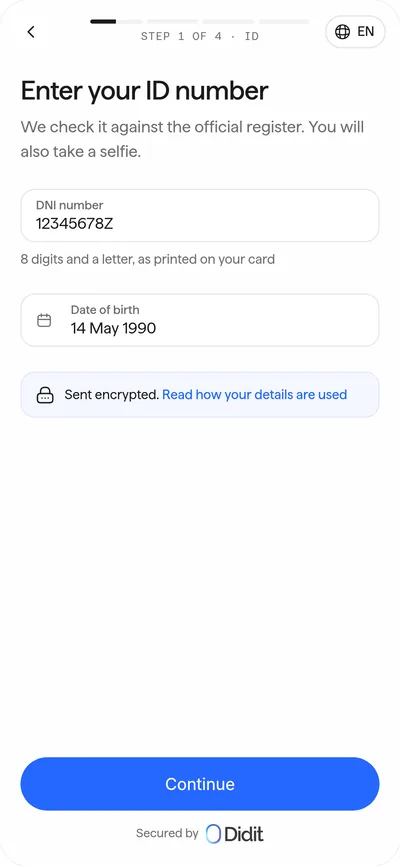
Where the configured source returns a portrait, Didit runs passive liveness on the selfie and face-matches it to the registry portrait inside the same lookup price; the per-country table names the countries where that applies. Database Validation returns a per-field match, a match_type of full_match, partial_match or no_match, and a no_match is the signal that matters for synthetic identity: a fabricated identifier is not in the register at all. Full detail is in the Database Validation documentation.
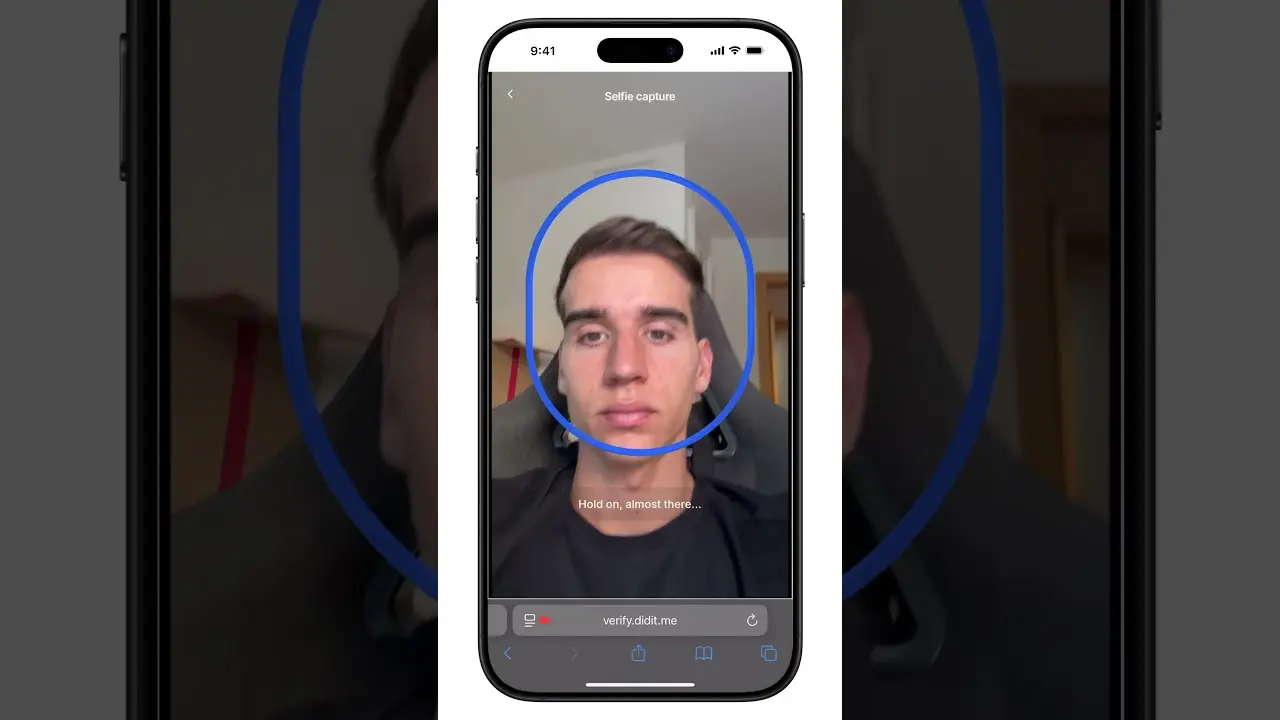
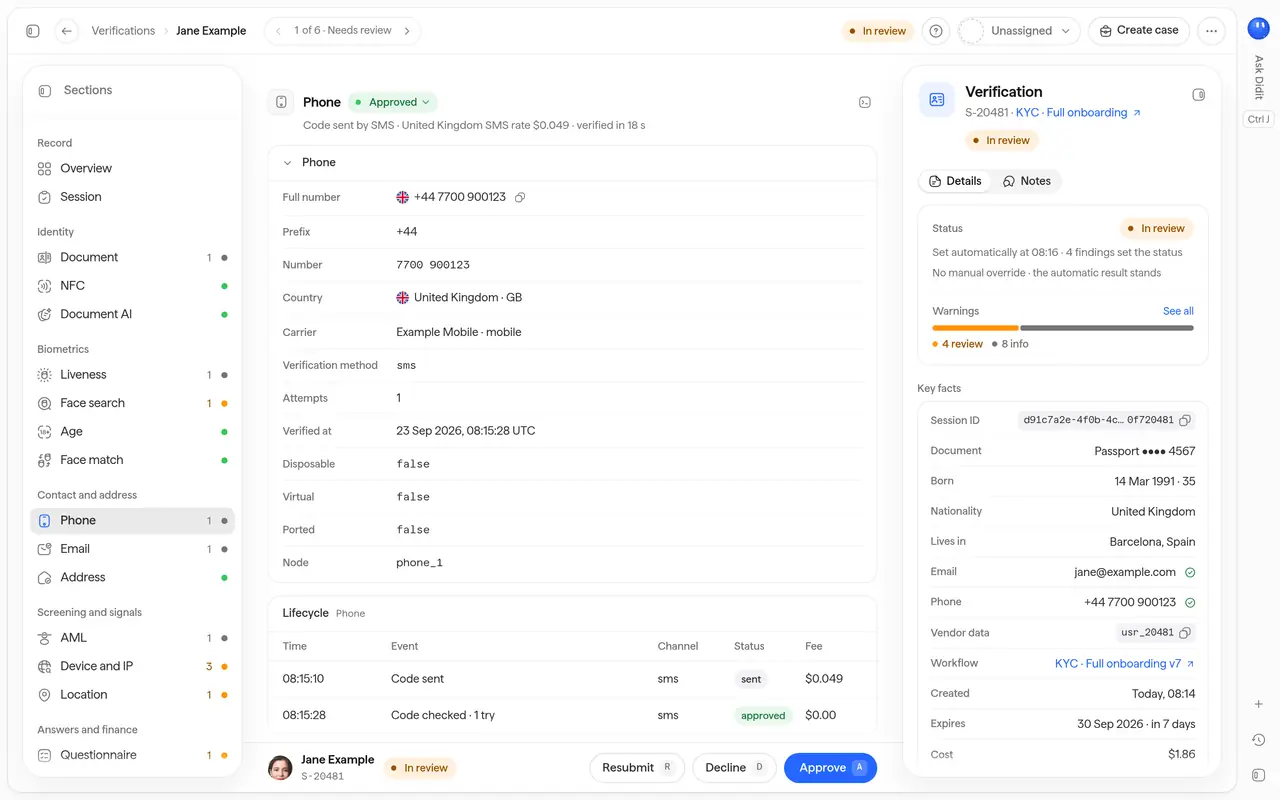
For the login and recovery moments where KBA usually sits, Didit publishes Biometric Authentication at $0.10 per authentication. Device and IP analysis at $0.03 adds the context that a question set cannot see: duplicate devices across accounts, VPN and Tor signals, and location that does not match the document.
How Didit handles the problem
Didit publishes three verification methods, and the workflow orchestrator lets you configure them per country.
A non-document lookup is enabled per country on the ID Verification feature config, with explicit behaviour for a no-match and a cap on attempts:
{
  "feature": "OCR",
  "config": {
    "methods": {
      "ZAF": {
        "document": { "enabled": true },
        "id_lookup": {
          "enabled": true,
          "max_attempts": 2,
          "on_no_match": "fallback_to_document"
        }
      }
    }
  }
}
If you already hold the identity data and want a one-shot registry check, the standalone API takes the fields directly:
curl -X POST 'https://verification.didit.me/v3/database-validation/' -H 'x-api-key: $DIDIT_API_KEY' -F 'issuing_state=BRA' -F 'identification_number=00000000191' -F 'first_name=Jane' -F 'last_name=Doe' -F 'date_of_birth=1990-01-15' -F 'vendor_data=user-1234'Sessions are created with POST /v3/session/ and the decision is read from GET /v3/session/{sessionId}/decision/ or from the session.status.updated webhook. The Create Session documentation shows both.
One honest limitation: Didit questionnaires are not evidence of identity. They collect structured answers, support conditional logic and can route a session to manual review, at $0.10 per check. If you use a questionnaire to collect facts, treat those facts as declarations and pair them with a check that returns evidence.
Worked cost example
A team onboards 5,000 users a month and currently gates onboarding with a question set. Two published Didit configurations, priced from the November 26, 2026 feed:
At list price, Custom Questionnaires are $0.10 per check: 5,000 x $0.10 = $500.00. A full ID check is $0.33 per completed check, made up of ID document verification $0.15 + passive liveness $0.10 + face match 1:1 $0.05 + device and IP analysis $0.03. For 5,000 checks: 5,000 x $0.15 = $750.00, 5,000 x $0.10 = $500.00, 5,000 x $0.05 = $250.00, 5,000 x $0.03 = $150.00, and $750 + $500 + $250 + $150 = $1,650.00. The gap is $1,650.00 - $500.00 = $1,150.00 a month, or $0.23 per user. At Scale, both lines take 10% off: $500.00 x 0.90 = $450.00 for questionnaires and $1,650.00 x 0.90 = $1,485.00 for full ID checks. At Scale, questionnaires cost $450 and full ID checks cost $1,485, so the gap is $1,035.
Non-document verification is priced per lookup and varies by country, so read the per-service rate for the country you plan to call before budgeting. Decide against your own fraud and abandonment numbers, not against the sticker price.
Terminology and field reference
| Term | What it means | Where you see it |
|---|---|---|
| KBA | Knowledge-based authentication. A challenge built from facts about a person. | Account recovery, call centres, legacy onboarding |
| KBV | Knowledge-based verification. The same idea described as identity proofing. | KYC policy documents |
| Static KBA | Answers the user chose once and reuses, such as a memorable word. | Login security questions |
| Dynamic KBA | Questions generated per session from a data file. | Onboarding, step-up checks |
| Out-of-wallet data | Data not carried on the person and not printed on a credential; it may still be discoverable elsewhere. | Question generation rules |
| Credit-header data | The identifying top section of a credit file: name variants, address history, date of birth, and in the US a partial identifier range. | Source for dynamic KBA |
| Tradeline | One account inside a credit file with balance, payment and lender. | Questions about loans and cards |
| Distractor | A wrong answer generated to look plausible. | Multiple-choice sets |
| Non-documentary verification | Verification that does not rely on a document image. | Policies that allow verification without a document image |
| Assurance tier | The label for what a method actually proved: documentary, data_match or cryptographic. | Didit session payload and console |
| Step-up authentication | An extra check triggered at a moment of risk. | Payments, payouts, profile changes |
Common mistakes
- Calling KBA identity proofing. It is a knowledge check, and the session evidence should say so.
- Assuming out-of-wallet means unfindable. The same files are sold to anyone.
- Using static questions whose answers are public, such as a mother's maiden name or a first pet.
- Passing someone who answered three of four and never checking that a live person is present.
- Pairing a strong question set with a support desk that will reset the account anyway.
- Treating a questionnaire as evidence. In Didit, questionnaire answers are declarations at $0.10 per check.
- Running a credit-bureau lookup under the same consent notice as a government-register lookup. The source and the regime differ per country.
- Never measuring false rejects. Thin-file applicants are commonly reported to fail more often, and they leave quietly.
Sources
- Didit Business Console and sandbox
- Didit documentation, ID Verification Methods: Document, Lookup, Wallet
- Didit documentation, Non-Document ID Verification: Authoritative Source Lookup
- Didit documentation, Database Validation API
- Didit documentation, Digital ID Wallet Verification API and Coverage
- Didit documentation, KYC Questionnaires API
- Didit documentation, Device Fingerprinting and IP Risk API
- Didit documentation, Create Session API
- Didit documentation, Pricing and billing
- Didit pricing page and live price feed, read November 26, 2026
- Didit MCP server
If you want to test this on your own flow, start free in the sandbox at business.didit.me. There is no sales call and no procurement cycle. If you build with an AI assistant, connect Didit to it through didit.me/developers/mcp.
Try it
Try this in the sandbox
Run the check this guide describes, free.
The product this post is about, taken from its topic. Run it free in the sandbox.
Author
Alberto Rosas
Co-founder and CEO

Keep reading
Other guides in the same topic.
 How to Build a Daily Bank Feed for Accounting Clients
Create a Didit bank link with access set to ongoing, store the connection id, cursor and consent end, then read only what changed from transactions/sync each time a bank.data.updated webhook arrives.
Alberto RosasNov 26, 2026 Verifying Smart Contract Wallets for Travel Rule Proof of Control
We prove control of ERC-4337 smart wallets by asking the account's contract on its declared chain (ERC-1271), and we check ERC-6492 for undeployed accounts without deploying or sending a transaction.
Alberto RosasNov 26, 2026 How to Decode a TRP Travel Address and Send a Travel Rule Inquiry
A ta address is Base58Check over an HTTPS URL: strip ta, decode with the Bitcoin alphabet, verify the double SHA-256 checksum, prepend https, then GET the identity and POST the inquiry to the t=i path.
Alberto RosasNov 26, 2026Questions
Frequently asked questions
What is knowledge-based authentication in simple terms?
Knowledge-based authentication is a login or onboarding check that asks questions whose answers come from records about a person, such as a mortgage payment or an old address. Answering correctly is treated as proof of identity. It proves that someone knows the answers, not that the applicant is that person or that any document is real.
What are examples of KBA questions?
Typical dynamic questions ask for the monthly payment on a car loan, the lender on a specific credit card, a street the applicant lived on in a given year, or which of several employers never appeared on their file. Static questions ask for a memorable word, a mother's maiden name or a first pet. All of them are drawn from data that exists somewhere outside the user's head.
What is the difference between static and dynamic KBA?
Static KBA uses answers the user chose once and then reuses on every visit, so the secret is fixed and often guessable. Dynamic KBA generates a new question set per session from a credit file or data aggregator. Dynamic is harder to guess, but it draws on data that brokers also hold, which is why it still falls to lookup and social engineering.
What does out-of-wallet mean in KBA?
Out-of-wallet describes data that is not carried on the person and not printed on a credential: a loan payment, an account balance band, a former street. The rule exists so the answer cannot be read off a stolen ID. It does not mean the data is private, because the questions are generated from files that are bought, sold and breached.
What is credit-header data and how is it used in KBA?
Credit-header data is the identifying part of a credit file: name variants, address history, date of birth and identifier range. KBA uses it to check the claimed identity and to build questions whose answers only the file holder should know. The weakness is structural, since anyone who can query the same file can answer the same questions.
Is KBA the same as non-documentary verification?
No. Non-documentary verification covers any check that does not rely on a document image, and it can mean a match against a credit file, a utility record or a government register. KBA is one weak form of it, where the applicant is asked to reproduce the record instead of the record being queried. A non-document lookup in Didit returns a data-match verdict per field, at a price that varies by country.
Why does KBA fail against social engineering?
Because the question set only guards the front door of the conversation, and a caller who already knows three details sounds like the account holder to a trained support agent. The attacker does not have to beat the questions, only the person who can reset the account. Once an agent resets it, the questions never mattered.
Is KBA still allowed for KYC and AML?
KBA can appear in a non-documentary verification policy, but it is weak evidence: it proves knowledge of a record, not possession of a document or live presence. Before relying on it, check your own policy and what your supervisor accepts for the jurisdiction you operate in. Where a record must be checked, a non-document lookup returns a data-match verdict instead of asking the applicant to reproduce the record.
What should replace KBA?
Match the check to the moment. Use document capture at onboarding, a non-document lookup against the authoritative source where the country supports it, a digital ID wallet where the user already holds one, and Biometric Authentication at login and recovery. Each of those records what it proved, which is what an auditor asks for.
How much does it cost to replace KBA with Didit?
A full ID check is $0.33 per completed check, made up of ID document verification $0.15, passive liveness $0.10, face match $0.05 and device and IP analysis $0.03. Biometric Authentication is $0.10 per authentication and custom questionnaires are $0.10 per check. Non-document verification is priced per lookup and varies by country, so read the rate before you budget.
Compliance built in
Audited, certified and attested.
We hold the certifications and build each country's rules into your flows, so you can launch anywhere without worrying. Security and Compliance center
- Regulation encoded into your flows
Tell us what you do and where. Didit lists the rules that apply to you, with sources, and builds the checks each country needs into one workflow.
- Ready for AMLR
Every requirement of the new EU anti-money laundering rules, from checking customers to human review, is already covered by a Didit check.
- Tested in Spain's Treasury sandbox
Spain's Treasury published its supervised sandbox report on Didit's NFC plus active liveness onboarding; SEPBLAC took part and valued the added measures positively.
- Audited, not self-declared
iBeta Level 1 and Level 2. Liveness tested under ISO/IEC 30107-3.
Your obligations · 3 regions
 SOC 2 Type 2
 ISO 27001
 iBeta Level 1 and Level 2
 EU regulator attestation
 FSM youth protection
 GDPR
 EBA remote onboarding
 MiCA compatible
 FIDO Alliance member
- AMLREU AML Regulation ready
Integration · Didit MCP
Run Didit from your own AI agent
Connect Didit to Claude, Cursor, VS Code or ChatGPT and just ask in plain words. Your agent can do anything you can do in the console, with the same permissions you have.
 Add to Claude
 ChatGPT
 Cursor
- Build workflowsDescribe the checks you need. The agent creates and publishes the flow.
- Run investigationsAsk why a session was declined, review cases, search people and companies.
- Change rulesCreate payment rules, test them on past data and switch them on.
- Pull reportsAsk for numbers, exports or the audit log.
Didit Academy


