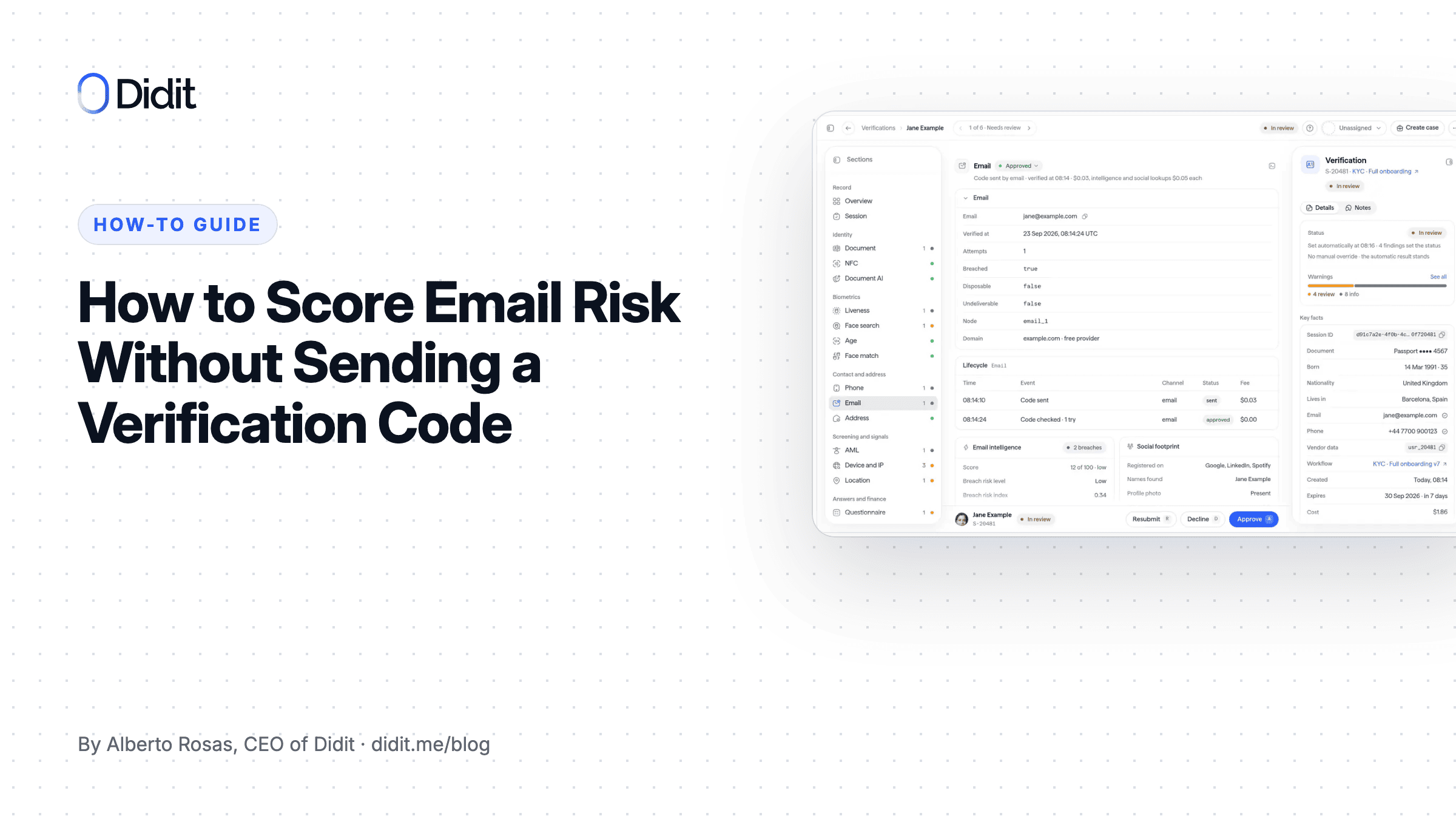
How to Score Email Risk Without Sending a Verification Code
Call POST /v3/email/risk/ with an address to get breach, disposable-provider and deliverability flags back, with no code sent. Billed $0.04 per check; the $0.02 OTP pair returns the same signals plus proof of ownership.
 Alberto RosasCo-founder and CEO
Contents
In this guide
Jump to the part you need.
Email risk scoring fits teams that must judge an address before spending a send, a code, or a support reply on it: signup funnels, marketplaces, trial-abuse checks, list hygiene. On Didit you call POST /v3/email/risk/ and get the documented signals back with no code sent. The Email risk API lists at $0.04 per check. The caveat: a score never proves the person owns the inbox.
Last updated: November 26, 2026. Prices checked against the live Didit price feed on November 26, 2026.
| Question | Answer |
|---|---|
| Endpoint | POST https://verification.didit.me/v3/email/risk/ |
| Signals returned | is_breached, is_disposable, is_undeliverable |
| Sends a verification code? | No |
| List price | $0.04 per check, $0.0384 on Growth, $0.036 on Scale |
| Proves the person owns the inbox? | No. The OTP pair does that |
| OTP pair price (send plus check) | $0.02 per verification, same three signals |
| Authentication | x-api-key header on verification.didit.me |
| Free to test | Yes, the sandbox is free on every plan |
Start free in the sandbox at business.didit.me (no sales call), and if you build with a coding agent, connect Didit to your AI assistant through the Didit MCP server. Every number on this page comes from the public price list at didit.me/pricing, and the endpoint is documented at Email Verification API: OTP and Risk Scoring, with the product behaviour on the email verification overview.
The outcome, and the method we recommend
You want a risk judgment on an address without asking the person for anything. Didit documents three routes to email risk. Two of them are standalone API calls that return the same three signals, and the choice between them depends on whether you need proof of ownership. The third is the hosted workflow, where the email feature runs inside a session.
The risk-only call, POST /v3/email/risk/, takes the address and returns is_breached, is_disposable and is_undeliverable. Nothing is sent, nobody waits, and it works for an address that belongs to no one in front of you. That is the right call for list hygiene, for pre-screening thousands of signups, and for agent workflows where no human is present to type a code.
The second route is the documented OTP pair: POST /v3/email/send/ then POST /v3/email/check/. The check response always includes the full email metadata, including the breach list, the disposable flag and the deliverable flag, and it also proves the person can read the inbox. At list price that pair costs $0.02 per verification against $0.04 for the risk-only call.
So our recommendation is narrow, and it only applies when ownership proof is the point. If a person is signing up right now and you must know the inbox is theirs, run the OTP pair and read the same flags from the check response: you get ownership and you pay half. If you do not need ownership, do not send mail just to save two cents on a score; call POST /v3/email/risk/ for bulk audits, imported lists, addresses collected offline, and any flow where a bounced or ignored code burns a send and annoys the user.
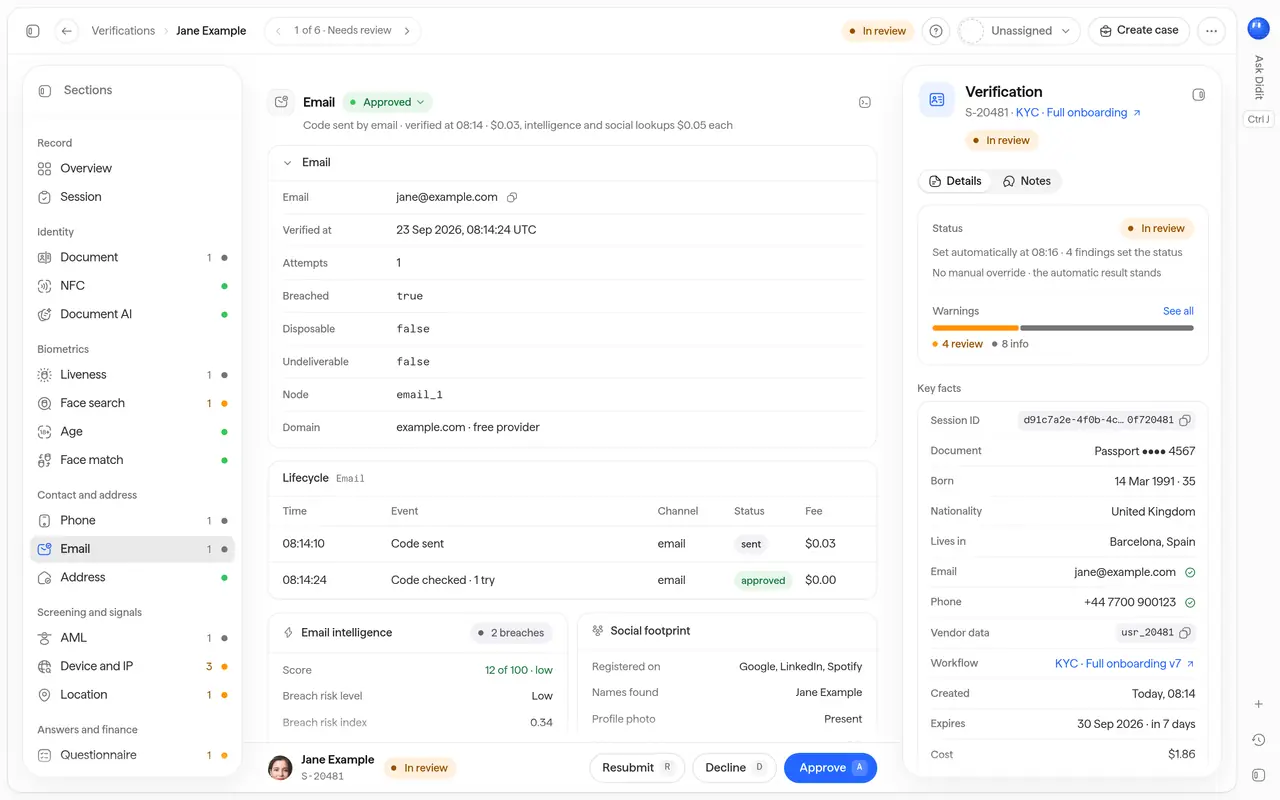
The standalone risk endpoint is documented as scoring three things: breach, disposable-provider and deliverability risk. The OTP check response returns the same three signals plus the breach list. The hosted workflow is the third route: add the email feature to a workflow and set breached_email_action, disposable_email_action and duplicated_email_action, then read the email_verifications[] array on the decision payload. Reputation signals and duplicate-use cross-referencing are documented for the broader email verification workflow on the overview page, not for the standalone risk endpoint.
Prerequisites
- A Didit organization and one application inside it. An application is the workspace that owns the API keys and the workflows.
- An API key. Open the Business Console, pick the application, then go to Developers, then API keys. The primary key is the application's own secret and new keys start with
sk_test_for sandbox orsk_live_for live, followed by 43 URL-safe characters. You can also mint keys programmatically with the register and verify-email calls onapx.didit.me, which return the sandbox and live keys in one response. - The key stays server-side. Never ship it to a browser or a mobile bundle.
- Enough credit to cover the calls once you leave the sandbox. The Free plan includes $10 of monthly credit for organizations that sign up with a work email, and $10 buys 250 risk calls at $0.04.
- Nothing else. No SMTP configuration, no sender domain, no template, because nothing is delivered.
If you have five minutes, read API authentication first; it documents both hosts and which header each one wants. The verification host takes x-api-key, and it does not use OAuth bearer tokens.
Step by step: score an address with no code sent
Create or open a sandbox application. The sandbox is free on every plan, every external provider including email is mocked, and sessions are never billed. Copy the
sk_test_key and keep it in an environment variable such asDIDIT_API_KEY.Decide the branch before you call. A score is only useful if a policy already knows what to do with it.
How to read each signal Signal True means Typical handling is_disposableTemporary or throwaway provider Decline, or require a different address. The docs list DISPOSABLE_EMAILas a warningis_undeliverableThe address does not accept mail Do not send to it; surface the problem to the user is_breachedFound in known data breaches Route to review per your policy; this is a risk signal, not proof of fraud Call the documented risk endpoint.
POST /v3/email/risk/onverification.didit.me, with your key in thex-api-keyheader and the address in the JSON body. The docs card for this route states what it does: it scores deliverability, breach and disposable-email risk without sending a code. That is why this route needs no sender domain, no template and no waiting on a user. If you want a request you can copy byte for byte from the docs today, use the OTP pair in step 5; those two calls are published in full.Read the three flags and act. Map each flag to the decision you wrote down in step 2. Keep the raw response with the account record so a reviewer can see what the system saw at the time.
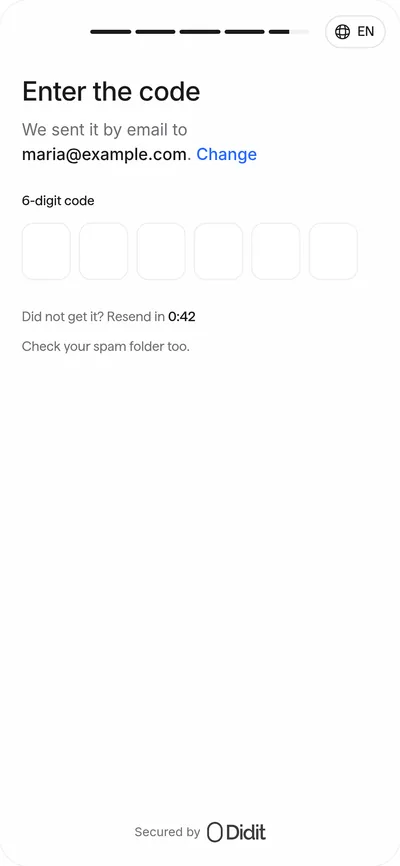
Only if you also need ownership, run the documented OTP pair. These are the calls exactly as the docs publish them. The code is 6 digits by default, expires in 5 minutes, and each session accepts up to 3 code-entry attempts.
curl -X POST 'https://verification.didit.me/v3/email/send/' \
-H "x-api-key: $DIDIT_API_KEY" \
-H "Content-Type: application/json" \
-d '{
  "email": "alice@example.com",
  "options": { "code_size": 6, "locale": "en", "use_white_label_customization": false },
  "vendor_data": "user-1234"
}'

curl -X POST 'https://verification.didit.me/v3/email/check/' \
-H "x-api-key: $DIDIT_API_KEY" \
-H "Content-Type: application/json" \
-d '{
  "email": "alice@example.com",
  "code": "123456",
  "disposable_email_action": "DECLINE"
}'
Log the outcome where your team can review it. In the session-based route the email result sits in
email_verifications[]on the decision payload fromGET /v3/session/{sessionId}/decision/, and the docs list the status values per entry, from Approved and Declined to Undeliverable and Expired or Not Found.
Expected output
The docs publish three risk signals for the email API. The table in step 2 maps each one to the decision your policy makes.
The docs point to the email verification report page for the full response structure, and the warning codes are listed in the risk catalogue linked from the email verification overview. On the OTP path the check response always includes the full email metadata: the breach list, the disposable flag and the deliverable flag.
Treat the three signals as independent. A clean address on all three is worth sending to. A breached address appears in known data breaches. Route it according to your policy rather than treating the signal as proof of fraud or ownership. And an address that comes back undeliverable is a delivery fact you can act on immediately, whatever the other two say.
Inputs and outputs
| Item | Direction | Detail |
|---|---|---|
x-api-key | In | Application key on verification.didit.me, server-side only |
email | In | The address to score, the same field the documented send and check calls use |
Content-Type: application/json | In | Required by the API; a non-JSON body returns 415 |
is_breached | Out | The address appears in known data breaches |
is_disposable | Out | Temporary or throwaway provider |
is_undeliverable | Out | The address does not accept mail |
breaches[], deliverable flag | Out (OTP check path) | The check response always includes the full email metadata |
status | Out (OTP check path) | Approved, Declined, Failed, Undeliverable, Expired or Not Found and the rest of the documented enum |
Failure cases and recovery
The status code is the first thing to read, and the code field when it is present. The text of a message can change; the status is stable. These are the documented behaviours on Didit API errors.
| Status | Meaning | Recovery |
|---|---|---|
| 400 | A field failed validation | Read the body, fix what it names, resend |
| 401 | Key wrong, malformed, revoked or expired | Check DIDIT_API_KEY or create a new key |
| 403 | No key sent, the key lacks access, the call came from outside its IP list, or the balance cannot cover it | Read the body; on a low balance most standalone APIs return an error string pointing at the top-up page, then retry after topping up |
| 429 | A rate limit or quota was reached | Wait for Retry-After, add backoff with jitter, then retry |
| 500, 502, 503 | Unexpected error, or a service Didit depends on failed | Retry with backoff, and contact support if it continues. A 5xx body may not be JSON at all, so parse defensively |
Rate limits are worth planning for. Every authenticated POST is bucketed into a generic-write scope of 300 requests per minute per key unless a stricter scope applies, and 429 responses carry X-RateLimit-Scope, X-RateLimit-Remaining and Retry-After. If you clean a large list, spread the work and use one key per workload rather than sharing one key across several backends. The details are on rate limiting.
If you took the OTP route, three more cases appear at the application layer, and the docs list them explicitly. A send response with status Undeliverable means a bounce or an invalid domain. A check response with status Failed means a wrong code with attempts remaining, so re-prompt. A check response with status Declined means the third failed attempt, so restart from POST /v3/email/send/. Outside the 5-minute window you get Expired or Not Found, and you restart the same way.
What is billable and where review starts
You pay for a check only when it finishes with a result. A request refused for a missing key, a validation error or an insufficient balance is not a completed check, and the sandbox never charges. The billing rules are on pricing in the docs.
The paid step in this how-to is the risk call itself, at $0.04 list. Plan discounts apply to every Didit price, so the same call is $0.0384 on Growth and $0.036 on Scale, and the monthly plan credit pays for it before any top-up is touched. If you add the OTP pair, that is a second paid step at $0.02 per verification, plus your carrier charges only if you also verify a phone number, which this flow does not require.
Review boundaries matter more than thresholds. The docs describe BREACHED_EMAIL, DISPOSABLE_EMAIL, UNDELIVERABLE_EMAIL, INVALID_EMAIL, DUPLICATED_EMAIL, OTP_MAX_ATTEMPTS_REACHED and OTP_EXPIRED as warnings that your policy consumes, not as verdicts the API hands down. Our advice: auto-decline only undeliverable and disposable addresses, route breached addresses to a human or to a step-up check, and never use a breach flag alone to close an account. A breached address is evidence about a mailbox, not about the person typing at it.

Worked cost example
Take 10,000 addresses a month and use only published unit prices, with the arithmetic shown.
- Risk-only scoring of all 10,000: 10,000 x $0.04 = $400.00 at list. On Growth, 10,000 x $0.0384 = $384.00. On Scale, 10,000 x $0.036 = $360.00.
- OTP pair on all 10,000: 10,000 x $0.02 = $200.00 at list. On Growth, 10,000 x $0.0192 = $192.00. On Scale, 10,000 x $0.018 = $180.00.
- Mixed flow, risk call first on 10,000 and an OTP only to the 6,000 that pass: $400.00 + (6,000 x $0.02) = $400.00 + $120.00 = $520.00 at list. On Growth, $384.00 + (6,000 x $0.0192) = $384.00 + $115.20 = $499.20. On Scale, $360.00 + (6,000 x $0.018) = $360.00 + $108.00 = $468.00.
- How far plan credit goes on risk calls alone: the Free plan's $10.00 / $0.04 = 250 checks. Growth, $115.00 / $0.0384 = about 2,994 checks. Scale, $350.00 / $0.036 = about 9,722 checks.
The arithmetic makes the trade-off plain. When you need ownership proof, the OTP pair is half the list price of the risk-only call and returns the same three signals, so a mixed flow is the most expensive of the three options here. Pay for the risk-only call when the alternative is sending mail you should not send.
Sources
- Didit docs: Email Verification API, OTP and Risk Scoring
- Didit docs: Email verification overview and risk assessment
- Didit docs: email verification report
- Didit docs: pricing, credit and billing rules
- Didit docs: API authentication
- Didit docs: API errors, status codes and retries
- Didit docs: rate limiting and 429 handling
- Didit docs: sandbox testing and mocked providers
- Didit pricing page
- Didit public price book endpoint (Email risk API line)
- Didit pricing as JSON
- Didit MCP server setup
Next step: create a free sandbox application at business.didit.me, copy its sk_test_ key, and send one address to POST /v3/email/risk/ before you spend a cent of production credit. No sales call is needed.
Try it
Try this in the sandbox
Run the check this guide describes, free.
The product this post is about, taken from its topic. Run it free in the sandbox.
Author
Alberto Rosas
Co-founder and CEO

Keep reading
Other guides in the same topic.
 Migrate KYC Sessions From Sumsub to Didit: 2026 Guide
Didit imports completed Sumsub KYC records with POST /v3/session/imports/ and import_type=user_verification, keeping applicant id, status, document fields, images, rejection labels, tags and raw provider metadata.
Alberto RosasNov 26, 2026 Send OTP via WhatsApp With Automatic SMS Fallback
Didit sends OTPs via WhatsApp by default and falls back to SMS when WhatsApp is unavailable. The list price is $0.02 plus the carrier rate per code. Codes expire 5 minutes after the first send by default.
Alberto RosasNov 26, 2026 Passive Liveness Detection API in cURL: Send a Selfie, Read the JSON
Send a selfie to Didit's standalone Passive Liveness API using cURL and multipart form data. Read the request ID, liveness verdict, score, warnings and capture quality in the JSON response.
Alberto RosasNov 26, 2026Questions
Frequently asked questions
What does POST /v3/email/risk/ return?
It returns three risk signals for an address: is_breached, is_disposable and is_undeliverable. It scores deliverability, breach exposure and disposable-provider risk without sending a verification code. The full report structure is documented on the Didit email verification report page.
Does email risk scoring send anything to the address?
No. The risk endpoint sends no email and no code, so the address owner sees nothing and does not have to act. That is the reason to use it for imported lists, agent workflows and any flow where a wasted send costs you money or reputation.
How much does an email risk check cost on Didit?
The Email risk API lists at $0.04 per check, $0.0384 on the Growth plan and $0.036 on Scale. You pay only when the check finishes with a result, and the sandbox is free. Prices are checked against the live Didit price feed on November 26, 2026.
Is the OTP flow cheaper than the risk-only call?
Yes at list price. Email verification, the send plus check pair, is $0.02 per verification, while the risk-only call is $0.04 per check, and the check response carries the same breach, disposable and deliverable data. The OTP flow also proves the person can read the inbox, which the risk-only call cannot.
Can an email risk score prove the user owns the mailbox?
No. A score describes the address: whether it accepts mail, whether it comes from a throwaway provider, and whether it appears in known breaches. Ownership requires a code the person types back, which is the documented two-step OTP flow.
What is the difference between is_disposable and is_undeliverable?
is_disposable means the address belongs to a temporary or throwaway provider that a user can abandon in minutes. is_undeliverable means the address does not accept mail at all, so a bounce is coming. The first is a policy question, the second is a delivery fact.
What should I do when is_breached comes back true?
Route it to review under your own policy rather than blocking automatically. The docs list BREACHED_EMAIL as a warning, and on a workflow you set the action with breached_email_action. The signal says the address appears in known data breaches; it is not proof of fraud or of who owns the mailbox.
Can I use this API to clean a large list of addresses?
Yes, with planning. Every authenticated POST sits in a generic-write budget of 300 requests per minute per key unless a stricter scope applies, and a 429 tells you when to back off with Retry-After. Use one key per workload and spread the batch across time.
How do I test email risk scoring without spending credit?
Create a sandbox application and use its sk_test_ key. In the sandbox every external provider, email included, is mocked and sessions are never billed, so you can wire the branch logic and check the console output before you touch live credit.
What happens when my balance cannot cover the call?
Most standalone APIs answer with a 403 and an error body pointing you at the top-up page rather than running the check. Top up or wait for the next month's plan credit, then retry. Top-ups last 12 months and pay for every product.
Does Didit connect to Claude or ChatGPT for this?
Yes, through the hosted MCP server at https://mcp.didit.me/mcp, which signs in with OAuth, so an AI assistant can call Didit tools directly. The setup for each client is on the Didit MCP page. The MCP server is free and included on every plan.
Compliance built in
Audited, certified and attested.
We hold the certifications and build each country's rules into your flows, so you can launch anywhere without worrying. Security and Compliance center
- Regulation encoded into your flows
Tell us what you do and where. Didit lists the rules that apply to you, with sources, and builds the checks each country needs into one workflow.
- Ready for AMLR
Every requirement of the new EU anti-money laundering rules, from checking customers to human review, is already covered by a Didit check.
- Tested in Spain's Treasury sandbox
Spain's Treasury published its supervised sandbox report on Didit's NFC plus active liveness onboarding; SEPBLAC took part and valued the added measures positively.
- Audited, not self-declared
iBeta Level 1 and Level 2. Liveness tested under ISO/IEC 30107-3.
Your obligations · 3 regions
 SOC 2 Type 2
 ISO 27001
 iBeta Level 1 and Level 2
 EU regulator attestation
 FSM youth protection
 GDPR
 EBA remote onboarding
 MiCA compatible
 FIDO Alliance member
- AMLREU AML Regulation ready
Integration · Didit MCP
Run Didit from your own AI agent
Connect Didit to Claude, Cursor, VS Code or ChatGPT and just ask in plain words. Your agent can do anything you can do in the console, with the same permissions you have.
 Add to Claude
 ChatGPT
 Cursor
- Build workflowsDescribe the checks you need. The agent creates and publishes the flow.
- Run investigationsAsk why a session was declined, review cases, search people and companies.
- Change rulesCreate payment rules, test them on past data and switch them on.
- Pull reportsAsk for numbers, exports or the audit log.
Didit Academy


