FATF Blacklist and Gray List: What They Mean for AML
As of October 2026 the FATF blacklist names DPRK, Iran and Myanmar: DPRK and Iran are subject to countermeasures, while Myanmar is subject to enhanced due diligence.
 Alberto RosasCo-founder and CEO
Contents
In this guide
Jump to the part you need.
If you onboard customers, companies or transactions across borders, the FATF blacklist and grey list decide which countries get extra scrutiny. Didit screens people and companies against 1,300+ sanctions, PEP and watchlist sources at $0.20 per AML check, and keeps them under monitoring at $0.07 per person a year. The caveat: the FATF lists are not law on their own. Your regulator turns them into binding rules, and the wording differs by country.
Last updated: November 26, 2026. Prices checked against the live Didit price feed on November 26, 2026.
Spelling note: the FATF writes “grey list”, and this page uses the US spelling “gray list” in the title. Same document.
| Item | What it is | Current state |
|---|---|---|
| Black list | FATF statement “High-Risk Jurisdictions subject to a Call for Action” | Democratic People's Republic of Korea, Iran and Myanmar, in the publication dated 30 October 2026. DPRK and Iran are subject to countermeasures; Myanmar is subject to enhanced due diligence. |
| Grey list | FATF publication “Jurisdictions under Increased Monitoring” | 20+ jurisdictions with action plans, in the publication dated 19 June 2026 |
| Frequency | Both documents are issued three times a year | After the February, June and October plenaries |
| Legal effect | None on its own | Implemented by national law, for example Directive (EU) 2015/849 Articles 9 and 18, and the UK Money Laundering Regulations 2017, regulation 33 |
| What it triggers | Risk-based enhanced due diligence, and countermeasures in the most serious cases | Country risk scoring, source of funds and wealth, senior sign-off, more frequent review |
| Didit prices | AML Screening $0.20 per check, ongoing monitoring $0.07 per person a year | Business verification from $2.00 per company, variable by country and data tier, plus $0.20 per person AML and $0.33 per linked ID check |
Start free in the sandbox at https://business.didit.me/, with no sales call. For developers, connect Didit to an AI assistant through the Didit MCP server. Read the AML screening product page and the pricing page before you set thresholds.
Who has to act on the FATF lists
The FATF writes the standard. National law is what binds you. Recommendation 19 of the FATF Recommendations says financial institutions should apply enhanced due diligence, proportionate to the risk, to business relationships and transactions with people and companies connected to countries the FATF has identified (FATF black and grey lists page, read November 26, 2026). Recommendation 10 sets the customer due diligence baseline that those extra measures sit on (FATF black and grey lists page, read November 26, 2026).
FATF standard
The FATF identifies jurisdictions with weak measures to combat money laundering and terrorist financing in two public documents issued three times a year (FATF black and grey lists page, read November 26, 2026). The black list is formally the “High-Risk Jurisdictions subject to a Call for Action” statement; the grey list is “Jurisdictions under Increased Monitoring” (FATF black and grey lists page, read November 26, 2026). For all countries identified as high-risk, the FATF calls on members and urges all jurisdictions to apply enhanced due diligence, and in the most serious cases calls for countermeasures (FATF black and grey lists page, read November 26, 2026).
EU: where and from when
In the EU, Directive (EU) 2015/849 makes the standard binding through national transposition. Article 9 has the Commission identify high-risk third countries with strategic deficiencies, and Article 18 requires enhanced due diligence where a business relationship or transaction involves such a country, including where the customer or the beneficial owner is established there. Member States had to transpose the Directive by 26 June 2017. Article 2 defines the obliged entities, which include credit institutions, financial institutions and the designated non-financial businesses and professions.
UK: where and from when
In the UK, the Money Laundering, Terrorist Financing and Transfer of Funds (Information on the Payer) Regulations 2017, regulation 33, require enhanced due diligence in higher-risk situations, and regulation 35 adds the PEP rules. The Regulations came into force on 26 June 2017. Regulation 33(3) specifically requires enhanced due diligence where a business relationship or transaction is with a person established in a high-risk third country. Regulation 8 defines the obliged entities.
If you sell to any of those as customers, your country risk logic is part of their audit of you.
Blacklist vs grey list: the difference that matters
| Black list | Grey list | |
|---|---|---|
| Formal name | High-Risk Jurisdictions subject to a Call for Action | Jurisdictions under Increased Monitoring |
| What FATF says | Serious strategic deficiencies. The FATF calls on members to apply countermeasures, and urges all jurisdictions to do the same (FATF black and grey lists page, read November 26, 2026) | The jurisdiction made a high-level political commitment and works with the FATF on an action plan (FATF black and grey lists page, read November 26, 2026) |
| Latest publication | 30 October 2026 | 19 June 2026 |
| Who is named | DPRK and Iran under a call for countermeasures; Myanmar under enhanced due diligence (FATF High-Risk Jurisdictions subject to a Call for Action, 30 October 2026, read November 26, 2026) | Angola, Bolivia, Bosnia and Herzegovina, Bulgaria, Cameroon, Côte d’Ivoire, the Democratic Republic of the Congo, Haiti, Iraq, Kenya, Kuwait, Lao PDR, Lebanon, Monaco, Nepal, Papua New Guinea, South Sudan, Syria, Venezuela, Vietnam, the Virgin Islands, among others (FATF Jurisdictions under Increased Monitoring, 19 June 2026, read November 26, 2026) |
| What you do | Countermeasures for DPRK and Iran, which go beyond due diligence, plus enhanced due diligence for Myanmar | Enhanced due diligence proportionate to the risk, with the country recorded as a risk factor |
For DPRK the countermeasures the FATF asks for are specific: terminate correspondent relationships with DPRK banks, close any subsidiaries or branches of DPRK banks, and limit business relationships and financial transactions with DPRK persons (FATF High-Risk Jurisdictions subject to a Call for Action, 30 October 2026, read November 26, 2026). The FATF cites UNSCR 2270 when it notes that DPRK uses front companies, shell companies, joint ventures and complex, opaque ownership structures to breach sanctions (FATF High-Risk Jurisdictions subject to a Call for Action, 30 October 2026, read November 26, 2026). That is the reason ownership checks matter more than name checks alone in these corridors.
Iran has been under a call for effective countermeasures in line with Recommendation 19 since February 2020, after the action plan it committed to in June 2016 expired in January 2018 (FATF High-Risk Jurisdictions subject to a Call for Action, 30 October 2026, read November 26, 2026). Myanmar sits on the same black list publication but under enhanced due diligence rather than countermeasures, which is a distinction worth reading twice before you write a policy that treats the whole document as one severity level (FATF High-Risk Jurisdictions subject to a Call for Action, 30 October 2026, read November 26, 2026).
Dated applicability: what changed, and from when
| Publication | Date | What it contains | What changes for you |
|---|---|---|---|
| High-Risk Jurisdictions subject to a Call for Action | 13 February 2026 | DPRK, Iran and Myanmar, with the countermeasures or enhanced measures for each | Confirm your countermeasure procedures and correspondent banking rules are current |
| Jurisdictions under Increased Monitoring | 19 June 2026 | The grey list, with each jurisdiction's action-plan progress | Re-score country risk for new and existing customers; add or remove EDD triggers |
| High-Risk Jurisdictions subject to a Call for Action | 30 October 2026 | The most recent black list as of November 26, 2026 | No change to the three jurisdictions, but re-read the countermeasure wording before your next policy review |
| Next editions | After the February, June and October plenaries | Both documents are refreshed three times a year | Schedule a review on each plenary rather than assuming the list you hold is current |
Both lists can change with a single plenary, and jurisdictions are added and removed (FATF black and grey lists page, read November 26, 2026). The FATF page that explains the two documents says it identifies jurisdictions with weak AML/CFT measures in two public documents issued three times a year (FATF black and grey lists page, read November 26, 2026). Treat the list data as an input you refresh, not a policy you write once.
FATF grey list countries in 2026
The 19 June 2026 publication names the jurisdictions under increased monitoring and summarises the action point each one is working through (FATF Jurisdictions under Increased Monitoring, 19 June 2026, read November 26, 2026). The current publication is linked here: FATF Jurisdictions under Increased Monitoring, 19 June 2026. Angola committed in October 2024 and works with the FATF and ESAAMLG, and is asked to give competent authorities adequate, accurate and timely access to beneficial ownership information (FATF Jurisdictions under Increased Monitoring, 19 June 2026, read November 26, 2026). Bolivia committed in June 2025 and works with the FATF and GAFILAT, and is asked to supervise real estate agents, lawyers, accountants and dealers in precious metals and stones on a risk basis, and to sanction breaches of beneficial ownership obligations (FATF Jurisdictions under Increased Monitoring, 19 June 2026, read November 26, 2026). Bosnia and Herzegovina committed in June 2026 and works with MONEYVAL, after its mutual evaluation report was adopted in December 2024 (FATF Jurisdictions under Increased Monitoring, 19 June 2026, read November 26, 2026).
Three practical notes on the grey list. It is a country-level statement, and the publication carries no company registry or beneficial ownership database of its own, so registry evidence still has to come from national sources (FATF Jurisdictions under Increased Monitoring, 19 June 2026, read November 26, 2026). A listing is not a prohibition, and treating it as one will cost you customers you are allowed to keep. And the action item is often about supervision or ownership transparency, which is exactly the area where your own KYB evidence is thinnest.
FATF grey list, the BIS Entity List and embargo compliance are three different controls
Teams often group these under one watchlist budget line. They answer different questions and they are not interchangeable.
- FATF grey list. A country-level view of a jurisdiction's AML/CFT and counter proliferation financing deficiencies (FATF black and grey lists page, read November 26, 2026). It changes how much due diligence you apply to a customer or counterparty connected to that country.
- US BIS Entity List. An export control list maintained by the Bureau of Industry and Security at the US Department of Commerce. It names specific entities that need a licence before certain items are exported or re-exported to them. It is not an AML list, and being on it is not a money laundering finding.
- Embargo and sanctions compliance. Country and territory embargoes plus designated-party lists, including UN, EU, OFAC and UK regimes. These prohibit or restrict dealings. Breaches can lead to civil, criminal or administrative consequences depending on the applicable regime. In the UK, the Office of Financial Sanctions Implementation publishes guidance on sanctions and their enforcement (OFSI).
For a KYC programme the consequence is simple. FATF country risk drives your risk score and your enhanced due diligence. Sanctions and embargo lists drive blocking, rejection and freezing decisions. The BIS Entity List drives export and re-export decisions. One customer can hit all three, and an AML screen will not replace an export control check.
Obligations versus what Didit actually does
The table separates what the rule asks of you from what the product does, because those are not the same thing. Your policy decides the outcomes. Didit produces the evidence and the structured data behind it.
| What the rule asks of you | What Didit provides | Where it lives |
|---|---|---|
| Screen the customer and the beneficial owner against sanctions, PEP and watchlists | AML screening against 1,300+ sources with a match score and a risk score, at $0.20 per check | POST /v3/aml/, or an AML node in a workflow. See the AML screening product page |
| Apply enhanced due diligence when a listed country is involved | A HIGH_RISK_COUNTRY warning on the screening, country risk inside the risk score, and country-based branch routing in the workflow builder | Decision payload, Workflow Builder branch node |
| Identify who really owns the company | Registry retrieval from $2.00 per company, variable by country and data tier, key people extraction at no extra fee, and a linked full ID check at $0.33 per person | Business verification |
| Screen the company as a legal entity | Company AML at $0.20 per check, returned as an aml_screenings[] item with entity_type: COMPANY | Business verification session |
| Keep monitoring after onboarding | Ongoing AML monitoring at $0.07 per person a year, with provider-driven rescans and webhook events | Business Console or the AML API |
| Keep evidence a supervisor can read | Session decision, hit review status, the downloadable PDF report, and the plan's audit log | Business Console |

How country risk shows up in the scores
Didit returns two numbers per hit, and they answer different questions. The match score is identity confidence: is this the same person. The risk score is how risky the listed entity is if the match is real. Country risk feeds the risk score, along with the category of the hit and any criminal record.
The weights aml_name_weight, aml_dob_weight and aml_country_weight must sum to exactly 100 and default to 60, 25 and 15. They shape the match score, not the risk score, so raising the country weight makes country agreement count more when deciding whether a hit is the same person. It does not make a customer higher risk. For that you use the thresholds: aml_match_score_threshold at 93 by default, aml_score_approve_threshold at 80 and aml_score_review_threshold at 100.

Ownership is where country risk usually hides
A customer resident in a low-risk country can still be owned by a company in a listed one. That is the case the FATF countermeasure text for DPRK describes, and it is why the company entity and every identified owner and officer get screened separately. Linked individuals each take a full ID check at $0.33 and person AML at $0.20, and the business session's overall AML status reflects the highest-risk result across the company and the people.

Worked example: the cost of a grey-list trigger
Take a payments company that onboards 1,000 retail customers and 200 small businesses a year, and whose policy treats residence or ownership in a grey-list jurisdiction as an enhanced due diligence trigger. Registry retrieval is variable by country and data tier, and $2.00 is the floor. Every check below is a published list price from the live price feed.
- Per retail customer: full ID check $0.33 plus AML screening $0.20 = $0.53. For 1,000 customers: 1,000 x $0.53 = $530.00.
- Ongoing monitoring for the same 1,000 people: 1,000 x $0.07 = $70.00 for the year.
- Per business: registry retrieval from $2.00, plus company AML $0.20, plus two owners at $0.20 each = $0.40, plus two linked ID checks at $0.33 each = $0.66. Total per business: $2.00 + $0.20 + $0.40 + $0.66 = $3.26.
- For 200 businesses: 200 x $3.26 = $652.00.
- Year one at list prices: $530.00 + $70.00 + $652.00 = $1,252.00.
Growth takes 4% off every Didit price and Scale takes 10%, both with a monthly plan fee, so compare the total on the pricing page rather than the unit price alone. Not in the number above: phone verification codes and database validation lookups, whose prices vary by country or route. Registry retrieval varies by country and data tier, so the $2.00 is the floor and not a quote.
Exceptions and open questions
- The EU list is not a copy of the FATF list. Directive (EU) 2015/849 Article 9 gives the Commission its own power to identify high-risk third countries, and the delegated list is what binds an EU obliged entity. It is largely aligned with the FATF, but check the EU list itself before you rely on a FATF publication alone.
- Derogations exist but are narrow. Some national regimes allow a documented, justified departure from parts of the enhanced measures. Check with your supervisor before you write one into policy.
- Delisting is not an automatic step-down. When a jurisdiction leaves the grey list, your own risk assessment still governs. Removing the trigger on the same day is hard to defend if nothing else changed.
- A grey-list listing is one factor, not a verdict. The FATF asks for enhanced due diligence proportionate to risk, and a customer with a listed nationality and a clean, documented source of funds is a different file from one with unexplained movements.
- The EU rules are moving. The 2024 EU AML package, Regulation (EU) 2024/1624, applies from July 2027 and moves high-risk third country rules into a directly applicable regulation. Do not hard-code the current mechanics into a system you will not revisit.
- Open question on ownership data. Several grey-list action items concern access to beneficial ownership information. Where registry data is thin, your evidence rests on the key people you identify, so document how you identified them.
Implementation checklist
- Write the country list into policy with a date and an owner, and set the review on the FATF plenary cycle rather than an arbitrary annual date.
- Decide the outcomes before you configure anything: which countries trigger enhanced due diligence, which trigger a decline, and who signs off.
- Turn on AML screening for both the customer and the company entity. In a business session the entity is screened as
entity_type: COMPANYand each owner and officer individually. - Set the thresholds deliberately:
aml_match_score_threshold(default 93),aml_score_approve_threshold(default 80),aml_score_review_threshold(default 100). - Keep the weights at exactly 100 across
aml_name_weight,aml_dob_weightandaml_country_weight. A request that does not sum to 100 is rejected with HTTP 400. - Route on country in the workflow builder so a listed jurisdiction takes the enhanced path without a manual decision.
- Enable ongoing monitoring for anyone who clears onboarding. It is $0.07 per person a year and requires
save_api_request=true. - Send an
Idempotency-Keywhen you retry a standalone screening after a timeout, so a retry does not run or bill a second check. - Give adverse media its own timeout. With
include_adverse_media=truethe call can take about 25 seconds, so set a client timeout of at least 60 seconds. - Record the list version you screened against, in the file, for every enhanced case.
- Re-read the FATF publications on each plenary and log what you changed.
Sources
- FATF, High-Risk Jurisdictions subject to a Call for Action, 30 October 2026, read November 26, 2026.
- FATF, High-Risk Jurisdictions subject to a Call for Action, 13 February 2026, read November 26, 2026.
- FATF, Jurisdictions under Increased Monitoring, 19 June 2026, read November 26, 2026.
- FATF, black and grey lists page, read November 26, 2026.
- Directive (EU) 2015/849, Articles 2, 9 and 18.
- Money Laundering, Terrorist Financing and Transfer of Funds (Information on the Payer) Regulations 2017, regulations 8, 33 and 35.
- Regulation (EU) 2024/1624.
- Office of Financial Sanctions Implementation.
- Didit docs, AML screening overview.
- Didit docs, AML screening standalone API.
- Didit docs, business AML screening.
- Didit docs, business AML coverage.
- Didit docs, workflow builder.
- Didit docs, pricing and billing.
- Didit pricing page.
- Didit AML screening product page.
- Didit business verification product page.
- Didit MCP server.
Next step: open the sandbox at https://business.didit.me/, run one AML screening with a listed-country nationality and look at the warning and the score before you touch your policy. No sales call, and the sandbox is free on every plan.
Try it
Try this in the sandbox
Run the check this guide describes, free.
The product this post is about, taken from its topic. Run it free in the sandbox.
Author
Alberto Rosas
Co-founder and CEO

Keep reading
Other guides in the same topic.
 OFAC 50 Percent Rule Explained: Ownership and Screening
The OFAC 50 Percent Rule blocks entities owned 50 percent or more in the aggregate by blocked persons, with no SDN listing needed. Didit screens owners at $0.20 per check; your policy runs the aggregation.
Alberto RosasNov 26, 2026 Bank Secrecy Act CIP Requirements and PATRIOT Act Identity Rules 2026
31 CFR 1020.220 requires banks to run a written CIP collecting name, date of birth, address and a tax ID before account opening. The rule lets a bank rely on information previously obtained for an existing customer when the.
Alberto RosasNov 26, 2026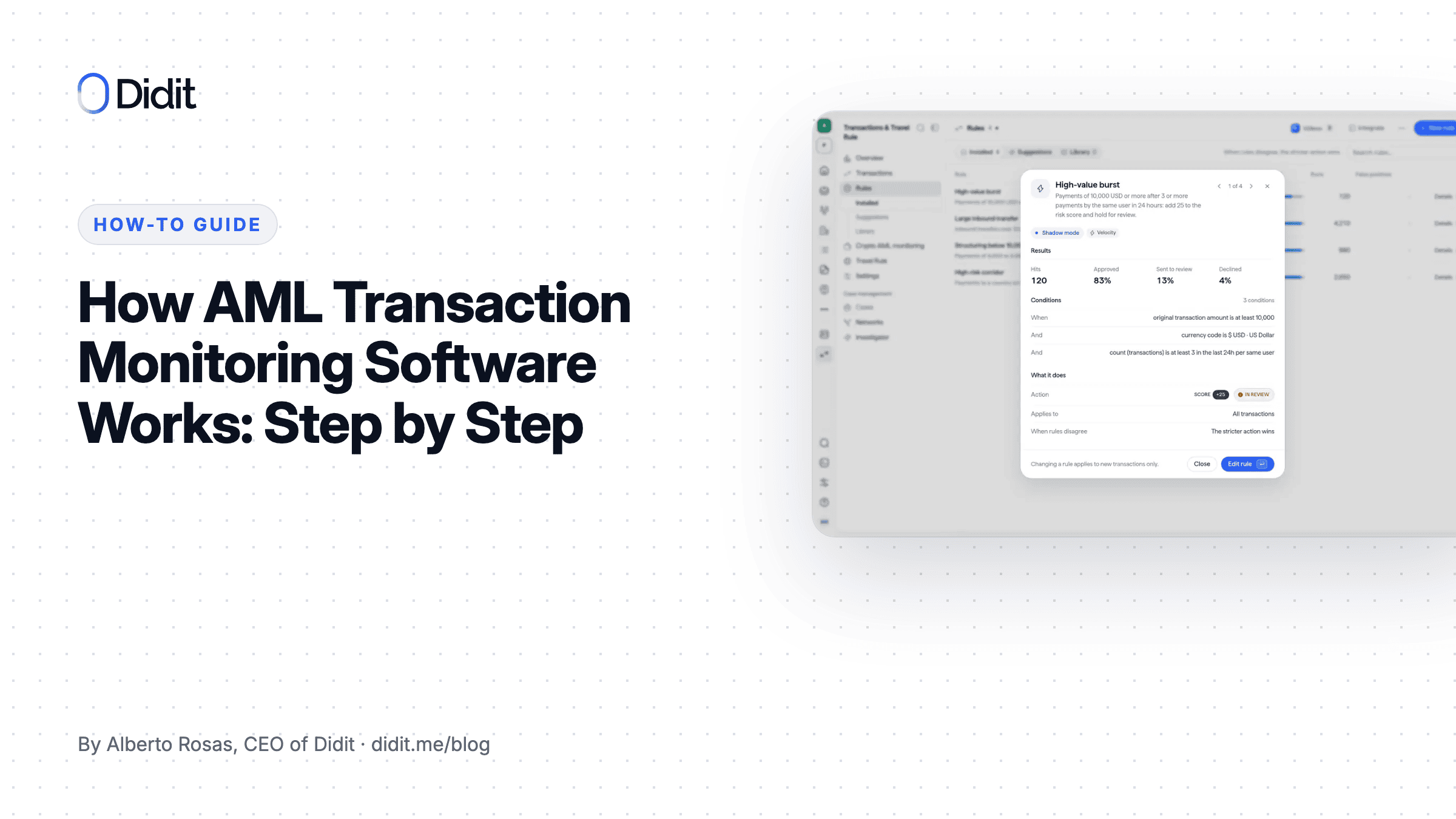 How AML Transaction Monitoring Software Works: Step by Step
AML transaction monitoring scores every transaction against rules and screening results, holds the risky ones for an analyst to triage, then moves real cases to investigation and SAR filing.
Alberto RosasNov 26, 2026Questions
Frequently asked questions
What is the FATF blacklist?
The FATF blacklist is the informal name for the FATF statement called High-Risk Jurisdictions subject to a Call for Action. In the publication dated 30 October 2026 it names the Democratic People's Republic of Korea, Iran and Myanmar. The FATF calls for countermeasures against DPRK and Iran, and enhanced due diligence for Myanmar (FATF High-Risk Jurisdictions subject to a Call for Action, 30 October 2026, read November 26, 2026). The FATF itself notes the list is often externally referred to as the black list (FATF black and grey lists page, read November 26, 2026).
What is the FATF grey list?
The grey list is the informal name for the FATF publication Jurisdictions under Increased Monitoring, which lists countries with strategic AML/CFT deficiencies that have committed to an action plan with the FATF. The most recent edition as of November 26, 2026 is dated 19 June 2026 (FATF Jurisdictions under Increased Monitoring, 19 June 2026, read November 26, 2026). Listing means enhanced due diligence, not a prohibition on doing business (FATF black and grey lists page, read November 26, 2026).
Which countries are on the FATF grey list in 2026?
The 19 June 2026 publication names, among others, Angola, Bolivia, Bosnia and Herzegovina, Bulgaria, Cameroon, Côte d’Ivoire, the Democratic Republic of the Congo, Haiti, Iraq, Kenya, Kuwait, Lao PDR, Lebanon, Monaco, Nepal, Papua New Guinea, South Sudan, Syria, Venezuela, Vietnam and the Virgin Islands (FATF Jurisdictions under Increased Monitoring, 19 June 2026, read November 26, 2026). The list changes at each plenary, so read the current FATF publication rather than a reposted table: FATF Jurisdictions under Increased Monitoring, 19 June 2026. Each entry also comes with the specific action point the jurisdiction is working on (FATF Jurisdictions under Increased Monitoring, 19 June 2026, read November 26, 2026).
Does the FATF grey list mean I cannot onboard customers from those countries?
No. A grey-list listing is a country risk factor that calls for enhanced due diligence proportionate to the risk (FATF black and grey lists page, read November 26, 2026). It is not a ban, and rejecting every applicant with a listed nationality or address is a decision your policy has to justify, not one the FATF requires. What you do need is a documented, consistent enhanced process for those files.
Is the FATF blacklist legally binding?
Not by itself. The FATF is a policy body and its Recommendations are a standard (FATF black and grey lists page, read November 26, 2026). Binding force comes from national law, such as Directive (EU) 2015/849 Articles 9 and 18 in the EU, or the UK Money Laundering Regulations 2017, regulation 33. Your supervisor enforces the national rule, not the FATF statement.
How often does the FATF update the blacklist and grey list?
The FATF issues both documents three times a year, after its February, June and October plenaries (FATF black and grey lists page, read November 26, 2026). A jurisdiction can be added or removed at any of them. Build the review into your compliance calendar so the list version in your policy matches the list version in your screening file.
What is the difference between the FATF grey list and the BIS Entity List?
The FATF grey list is a country-level AML risk statement (FATF black and grey lists page, read November 26, 2026). The BIS Entity List is a US export control list of named entities that need a licence before certain items are exported to them. Embargo and sanctions compliance is a third control, covering country embargoes and designated parties. One customer can trigger all three, and an AML screen does not replace an export control or sanctions check.
What does enhanced due diligence look like for a listed country?
More evidence, more sign-off, more often. Typically that means identifying and verifying the customer and the beneficial owner with more than one source, documenting source of funds and source of wealth, obtaining senior management approval, and reviewing the relationship more frequently. Whatever you choose, write it down and apply it consistently across the files that hit the same trigger. The FATF asks for measures proportionate to the risk, not a single template for every customer (FATF black and grey lists page, read November 26, 2026).
How does Didit flag a high-risk country?
Country risk feeds the risk score on each AML hit, and the screening returns a HIGH_RISK_COUNTRY warning where it applies. In the workflow builder you can branch on country so a listed jurisdiction takes the enhanced path automatically. Screening is $0.20 per check, and ongoing monitoring is $0.07 per person a year.
Can I screen a company and its owners in one call?
Business verification does that. The company is screened as a legal entity at $0.20, key people are extracted at no extra fee, and each owner or officer takes person AML at $0.20 and a linked full ID check at $0.33. Registry retrieval is priced by country and data tier and starts at $2.00 per company. The business session's overall AML status reflects the highest-risk result across the company and the people.
Does a grey-list listing change my beneficial ownership checks?
It often should. Several grey-list action items concern access to accurate and timely beneficial ownership information, which signals that the local evidence is weaker (FATF Jurisdictions under Increased Monitoring, 19 June 2026, read November 26, 2026). Where registry data is thin, rest the file on the key people you identified and record how you identified them. Screening the entity and each person separately is the minimum.
Compliance built in
Audited, certified and attested.
We hold the certifications and build each country's rules into your flows, so you can launch anywhere without worrying. Security and Compliance center
- Regulation encoded into your flows
Tell us what you do and where. Didit lists the rules that apply to you, with sources, and builds the checks each country needs into one workflow.
- Ready for AMLR
Every requirement of the new EU anti-money laundering rules, from checking customers to human review, is already covered by a Didit check.
- Tested in Spain's Treasury sandbox
Spain's Treasury published its supervised sandbox report on Didit's NFC plus active liveness onboarding; SEPBLAC took part and valued the added measures positively.
- Audited, not self-declared
iBeta Level 1 and Level 2. Liveness tested under ISO/IEC 30107-3.
Your obligations · 3 regions
 SOC 2 Type 2
 ISO 27001
 iBeta Level 1 and Level 2
 EU regulator attestation
 FSM youth protection
 GDPR
 EBA remote onboarding
 MiCA compatible
 FIDO Alliance member
- AMLREU AML Regulation ready
Integration · Didit MCP
Run Didit from your own AI agent
Connect Didit to Claude, Cursor, VS Code or ChatGPT and just ask in plain words. Your agent can do anything you can do in the console, with the same permissions you have.
 Add to Claude
 ChatGPT
 Cursor
- Build workflowsDescribe the checks you need. The agent creates and publishes the flow.
- Run investigationsAsk why a session was declined, review cases, search people and companies.
- Change rulesCreate payment rules, test them on past data and switch them on.
- Pull reportsAsk for numbers, exports or the audit log.
Didit Academy


