How to Verify a Business in Hong Kong: Registry, UBOs and KYB
A Hong Kong KYB check reads the Companies Registry for company data at $3.00 Lite, then adds shareholders and UBOs above that tier. The caveat: Hong Kong's significant controllers register is not filed with the Registry, so UBO.
 Alberto RosasCo-founder and CEO
Contents
In this guide
Jump to the part you need.
A Hong Kong company check starts at the Companies Registry and ends with people. Didit reads the Hong Kong national register for a Lite check at $3.00 per selected company, then adds shareholders and UBOs above that tier. The caveat is ownership: Hong Kong's significant controllers register is not filed with the Registry, so UBO data often needs a supporting document or an applicant declaration. This guide fits compliance and onboarding teams verifying Hong Kong counterparties in 2026.
Last updated: November 26, 2026. Prices checked against the live Didit price feed on November 26, 2026.
Hong Kong KYB at a glance
| Item | Hong Kong detail |
|---|---|
| Country code in KYB calls | HK (ISO 3166-1 alpha-2) |
| Register behind a Lite check | The national company register, the Companies Registry, searched alongside commercial registry databases (Asia-Pacific Lite coverage) |
| Lite price | $3.00 per selected company |
| Ownership tiers | Shareholders and UBOs; the catalog states no country is priced below $5.00 Shareholders and $9.00 UBOs. Read the Hong Kong row in the console feed |
| Legal basis | Companies Ordinance (Cap. 622), as amended by the Companies (Amendment) Ordinance 2018, which commenced on 1 March 2018 |
| Significant controllers register filed publicly | No. It is kept by the company at its registered office or another place in Hong Kong. |
| Manual entry when no match | $0.75 flat per company |
| Company AML and person AML | $0.20 per company, $0.20 per UBO or officer |
| Linked KYC per key person | $0.33 full ID check |
| Registry monitoring | Priced at $2.00 per company a year, planned and not enabled in any country checked on September 7, 2026 |
Start free in the sandbox at business.didit.me, no sales call. For developers, connect Didit to an AI assistant through the Didit MCP server. The product page is Business Verification and every rate is on the Didit pricing page.
What a Hong Kong business check has to prove
The Companies Registry significant controllers FAQ, read November 26, 2026, sets the standard. Under the Companies (Amendment) Ordinance 2018, companies incorporated in Hong Kong and re-domiciled companies, except listed companies, must identify their significant controllers and maintain a significant controllers register that law enforcement officers can access on demand.
The Companies Registry overview page, read November 26, 2026, records that the Companies (Amendment) Ordinance 2018 commenced on 1 March 2018 and amended the Companies Ordinance (Cap. 622) so that a Hong Kong incorporated company and a re-domiciled company must obtain and keep up-to-date beneficial owners information.
Cap. 622 on Hong Kong e-Legislation, read November 26, 2026, shows the current version dated 16/11/2026. Record the version you relied on in the file note rather than just "Cap. 622".
A person has significant control if, among other conditions, they hold directly or indirectly more than 25% of issued shares, more than 25% of voting rights, or the right to appoint or remove a majority of the board. Companies Registry significant controllers FAQ, read November 26, 2026.
Three consequences follow for a verification file.
- The register is private in practice. The FAQ states it does not need to be delivered to the Companies Registry for registration, but must be kept at the registered office address or another place in Hong Kong. A public registry lookup returns company data, not the ownership chain.
- Part 16 entities are different. A registered non-Hong Kong company under Part 16 of Cap. 622 is not required to keep a significant controllers register in Hong Kong, so verify that entity against the registry of its place of incorporation and check whether it must keep a register there.
- Control is not only a percentage. The right to appoint or remove a majority of the board sits alongside the 25% share and voting tests, so a numeric threshold alone will not catch every controller.
The FAQ also says a company must take reasonable steps to identify significant controllers, including reviewing the register of members, articles of association, shareholders agreements and other agreements, and issuing notices where required. That is the evidence set you should ask the applicant for when the register does not resolve to natural persons.
Registers and documents you check in Hong Kong
Three sources, in this order.
- The Companies Registry company record: legal name, company number, status, incorporation date, registered address and officers.
- The significant controllers register held by the company at its registered office or another place in Hong Kong, produced on demand.
- Supporting documents collected in the workflow: certificate of incorporation, articles of association, shareholder register, proof of address, financial statements, tax certificates and any custom document type your process requires.
Didit's document collection covers those types and lets an analyst request more during review, as described in the Business Verification API overview.
What Didit returns for a Hong Kong company
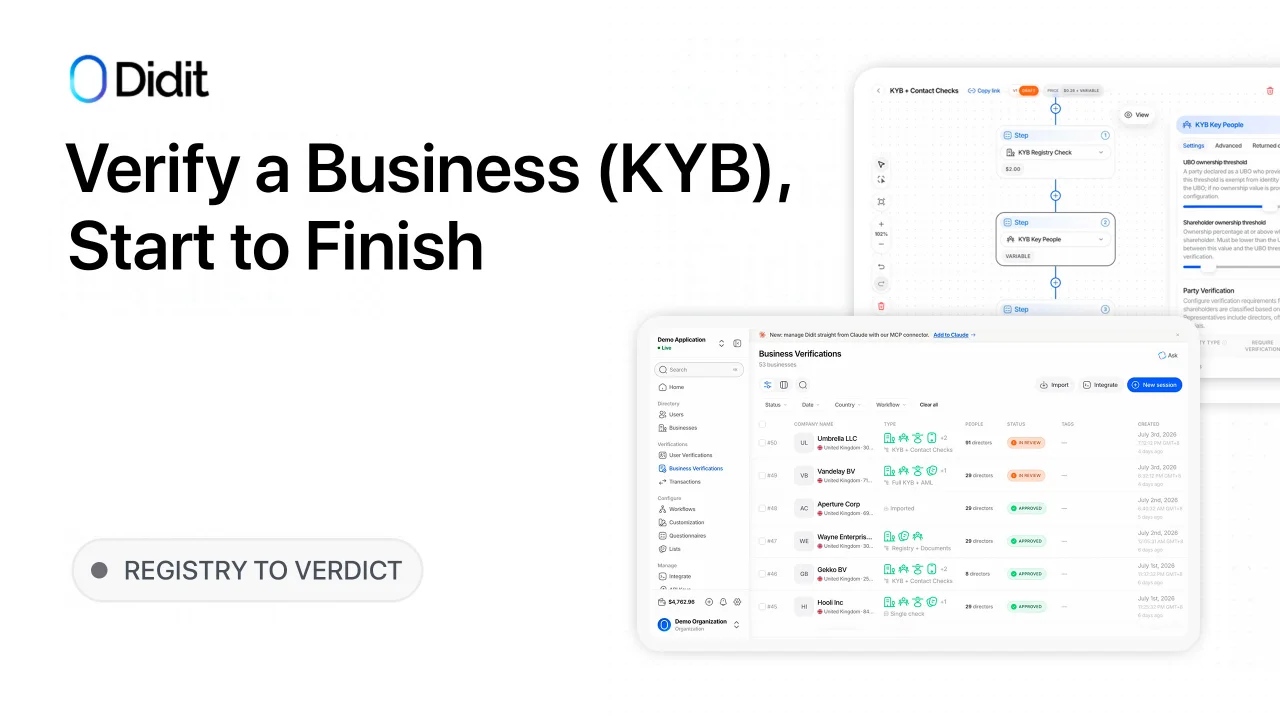
A Lite check in Hong Kong is not limited to commercial databases. The KYB registry pricing docs state that in Australia, China, Hong Kong, Japan, New Zealand, Singapore, South Korea, Taiwan, Thailand and Vietnam, a Lite check searches the national company register itself alongside the commercial registry databases and delivers the register's own record: status, incorporation date and registered address, completed with the legal form and officers where the registry databases hold them. The same note says companies incorporated in the last weeks are found as soon as the register lists them. Lite is $3.00 in nine of those markets.
| Tier | What you get | Hong Kong note |
|---|---|---|
| Lite | Legal name, registration and VAT numbers, legal form, status, incorporation date, registered address, activity, headcount and contact details, plus the officers | $3.00. Reads the national register |
| Shareholders | Lite plus the direct shareholders, natural persons and corporate entities, with ownership bands | Depends on whether the registry source holds an ownership record |
| UBOs | Shareholders plus the ultimate beneficial owners resolved through the ownership chain | Where the chain ends in corporate entities, the check is delivered and billed as Shareholders |
Above the registry line, Didit Business Verification identifies every person and corporate entity under the Key People model: UBOs with ownership and voting percentages, individual and corporate shareholders, directors, representatives, secretaries, authorised signatories and other officer roles, each with a role tag. Every identified party is screened against sanctions, adverse media and regulatory enforcement lists, and the company itself is screened separately.

How to run a Hong Kong check in the Business Console
- Create the workflow under Workflows, Create workflow, and choose Business Verification as the type. Turn on company registry lookup, company AML, Key People and any document steps you need.
- Set the country tier under Workflows, KYB Registry Check, Countries. Hong Kong starts at Lite. Raise it to Shareholders or UBOs only where your process needs the ownership chain.
- Configure roles under Workflows, the KYB workflow, Key People. Decide which roles require KYC, which KYC workflow each role uses, and whether the applicant can skip.
- Set the ownership threshold under Risk, UBO threshold. The Hong Kong statutory tests are more than 25% of shares, more than 25% of voting rights, or the right to appoint or remove a majority of the board.
- Start the session and send the hosted link. The applicant selects Hong Kong, enters the company name, the registration number, or both, and picks the right company from the results.
- Let the applicant confirm or correct the registry data and add key people. Registry prefill does not block the Key People form, and corrections are preserved when the ownership report arrives.
- Review in the console. The session lands on Approved, In Review or Declined, with warnings, AML hits and documents attached.

If you are moving an existing KYB process onto Didit, the Didit switch page covers the migration path.
The API route
Create a session with a KYB workflow, as shown in the KYB quickstart. You can pre-fill and lock the search with expected_details, which pre-selects the country, fills the matching fields and runs the asserted search, while both fields stay editable for the applicant.
curl -X POST https://verification.didit.me/v3/session/ \
  -H "x-api-key: YOUR_API_KEY" \
  -H "Content-Type: application/json" \
  -d '{
    "workflow_id": "YOUR_KYB_WORKFLOW_ID",
    "vendor_data": "biz-hk-001",
    "expected_details": {
      "company_name": "Example Trading Limited",
      "registry_country": "HK",
      "registration_number": "COMPANY_NUMBER_FROM_CERTIFICATE"
    }
  }'
The response returns session_id, session_number and url. Deliver the url to the company contact. The search itself runs asynchronously and the response reports how results were matched in searched_by as name, registration_number or registration_number_and_name.
When the session reaches a terminal status, Didit posts a status.updated webhook with session_kind: "business" inside data. Filter on that field, verify the X-Signature-V2 HMAC signature, then act on status.
curl https://verification.didit.me/v3/session/SESSION_ID/decision/ \
  -H "x-api-key: YOUR_API_KEY"
The decision carries registry data, key_people_checks[] with registry-derived beneficial_owners[] and user-submitted parties[], AML hits, documents and per-feature results. Common statuses are Approved, In Review, Declined and Resubmitted; each session also tracks Not Started and In Progress. The Company Registry API reference lists every returned field.
Identifiers and fields for a Hong Kong company
| Field or identifier | Source | What to expect for Hong Kong |
|---|---|---|
company_name | Registry | Legal name as registered with the Companies Registry |
registration_number | Registry | The company number you search on and get back. The docs publish no Hong Kong specific format, so store the string as returned |
country_code | Session input | HK |
company_type | Registry | Legal entity type, for example a limited company or a public limited company |
registry_status | Registry | active, dissolved, struck_off, in liquidation, dormant |
incorporation_date | Registry | Date the company was originally registered |
registered_address | Registry | The registered office, which is also where the significant controllers register must be kept |
tax_number | Registry, where available | Returned only where the registry exposes it, not guaranteed for every company |
legal_entity_identifier | Registry | LEI, for financial institutions and listed entities |
control_scheme | Registry, where exposed | Returned where the registry publishes a control or governance scheme |
officers and key people | Registry plus applicant | Directors and officer roles with role tags, plus UBOs and shareholders where ownership data is available |
fetch_status | Didit | pending, resolved or failed |
is_from_registry | Didit | true for a registry match, false for manual entry |
confirmed_by_user_at | Didit | Timestamp when the applicant confirmed or edited the registry data |
Worked cost example for Hong Kong
Take a Hong Kong payments firm onboarding 40 Hong Kong incorporated companies a month at the Lite tier. Each company gets company AML, one document collection step, and two people (a director and a shareholder) put through linked KYC and person AML.
- Registry: 40 x $3.00 = $120.00
- Company AML: 40 x $0.20 = $8.00
- Document step: 40 x $0.20 = $8.00
- Person AML: 40 x 2 = 80 people, 80 x $0.20 = $16.00
- Linked KYC: 80 x $0.33 = $26.40
- Total: $120.00 + $8.00 + $8.00 + $16.00 + $26.40 = $178.40 a month, or $4.46 per company
On the Scale plan the Didit prices carry a 10% discount: $178.40 x 0.90 = $160.56 a month, or $4.01 per company. Hosted workflow searches carry no separate search fee. The standalone search API can add $0.50 per successful request. All rates are on the Didit pricing page.
Now request the UBO tier instead. The registry line moves to the Hong Kong ownership price, and the pricing docs state that no country in the catalog sits below $5.00 Shareholders and $9.00 UBOs. At an illustrative $9.00 UBO tier, the published minimum, the same month is registry 40 x $9.00 = $360.00, plus $8.00 + $8.00 + $16.00 + $26.40, so $418.40 a month or $10.46 per company. That $9.00 is the published floor, not a Hong Kong quote: confirm the Hong Kong row in the live feed in the console before you commit a budget.
Two rules keep that number honest. Where the registry holds no ownership record for a company, a Shareholders or UBO request is delivered and billed at the highest tier the country's registries can serve, usually Lite, so those companies drop back to the Lite arithmetic. And a company that cannot be found and is typed in manually is billed a flat $0.75 instead of the registry line.
When the registry is down or there is no match
- Search by contains instead of exact when the legal name is uncertain, or use the one-tap search-as-company-name override on a registration-number result.
- If the company is genuinely not in the registry, the applicant submits company data manually. The session continues,
is_from_registryis set tofalse, and the flat $0.75 manual price applies. - If ownership is pending, Lite is charged at selection and only the difference to the delivered ownership tier is charged later, using the selection-time quote. A pending report is not a completed registry check and not an automatic approval.
- If the ownership chain names no natural person, the UBO check is delivered and billed as Shareholders, because a corporate chain is not a beneficial owner.
- Use the document step to close the gap the registry leaves open: the shareholder register and the significant controllers register itself are the documents that carry Hong Kong ownership evidence.
- Route anything ambiguous to In Review rather than declining on a single missing field, especially where the statutory test is the board appointment right rather than a percentage.
Registry monitoring for companies verified at Shareholders or UBO tier is priced at $2.00 per company a year and described as coming soon. The pricing docs state that no country in the KYB price list checked on September 7, 2026 had monitoring enabled, so treat it as planned rather than available.
Sources
- Didit, Business Verification API (KYB) overview
- Didit, KYB quickstart
- Didit, Company Registry API and retrieved fields
- Didit, UBO and beneficial ownership extraction
- Didit, KYB supported countries and tiers
- Didit, KYB registry pricing by country
- Didit, Business Verification product page
- Didit, pricing page
- Didit, MCP server
- Companies Registry, significant controllers FAQ, read November 26, 2026
- Companies Registry, significant controllers overview, read November 26, 2026
- Hong Kong e-Legislation, Cap. 622 Companies Ordinance, read November 26, 2026
Next step: create an application in the Didit sandbox, open it and search a Hong Kong company by name or number. Sandbox testing is free on every plan, there is no sales call, and you can move the same workflow to production from prepaid credit when the results look right. We run this for 4,000+ companies, and the pipeline that checks a Hong Kong limited company is the same one that checks a company anywhere else in coverage.
Try it
Try this in the sandbox
Run the check this guide describes, free.
The product this post is about, taken from its topic. Run it free in the sandbox.
Author
Alberto Rosas
Co-founder and CEO

Keep reading
Other guides in the same topic.
 How to Verify a Business in China: Registry, UBOs and KYB
Didit checks a Chinese company against the national enterprise credit register at the Lite tier for $3.00. The cited regulation does not describe a public resolved UBO register, so ownership may require filings plus company.
Alberto RosasNov 26, 2026 EU crypto Travel Rule has no minimum threshold (2026)
The EU Transfer of Funds Regulation has no minimum amount for crypto. Every transfer, however small, needs originator and beneficiary data sent to the counterparty CASP before settlement.
Alberto RosasNov 26, 2026 How to Verify a Business in Germany: Registry, UBOs and KYB
Didit verifies German companies against company registries from $2.00 per Lite check, with ownership tiers priced per country. The GwG establishes Germany's Transparency Register and related beneficial-owner reporting duties.
Alberto RosasNov 26, 2026Questions
Frequently asked questions
How do I verify a company in Hong Kong?
Search the Companies Registry for the company by name, registration number, or both, confirm the company status and officers, then identify the people who own or control it and screen every party against AML lists. On Didit a Hong Kong Lite registry check is $3.00 per selected company, with company AML at $0.20, person AML at $0.20 per person and linked KYC at $0.33 per person.
Does Didit support Hong Kong for KYB?
Yes. Hong Kong is in Didit's KYB registry coverage and sits in the Asia-Pacific group where a Lite check searches the national company register itself alongside commercial registry databases. The country code used in the API is HK, and you select the tier per country in the console under Workflows, KYB Registry Check, Countries.
How much does a Hong Kong KYB check cost on Didit?
A Lite registry check is $3.00 per selected company in Hong Kong. Ownership tiers carry the published ownership prices, with the catalog stating no country below $5.00 Shareholders and $9.00 UBOs. Companies typed in manually are billed a flat $0.75, and AML, linked KYC and document steps are billed separately per unit.
Can I get Hong Kong UBOs straight from the Companies Registry?
No. The Companies Registry states that the significant controllers register does not need to be delivered to the Registry for registration, so a public lookup will not return the ownership chain. Hong Kong companies must keep the register at the registered office or another place in Hong Kong and produce it to law enforcement on demand, so you collect it as a document and let Didit resolve ownership from registry data where it exists.
Who counts as a significant controller in Hong Kong?
Under the Companies (Amendment) Ordinance 2018, a person has significant control if among other conditions they hold directly or indirectly more than 25% of issued shares, more than 25% of voting rights, or the right to appoint or remove a majority of the board. Cite the Companies Registry FAQ when you document your threshold. The 25% tests map onto a percentage setting in the workflow; the board appointment right does not.
What should I set as the UBO threshold for a Hong Kong workflow?
Didit sets ownership thresholds as a percentage under Risk, UBO threshold, so 25% is a reasonable default that matches the Hong Kong share and voting tests. The statutory definition also covers the right to appoint or remove a majority of the board. Read the ownership evidence in each decision rather than relying on the percentage threshold alone.
Do I verify a non-Hong Kong company registered in Hong Kong the same way?
No. A registered non-Hong Kong company under Part 16 of the Companies Ordinance is not required to keep a significant controllers register in Hong Kong. Verify that entity against the registry of its place of incorporation and check whether it must keep a register there, rather than expecting a Hong Kong ownership record.
What happens if a Hong Kong company is not found in the registry?
The applicant submits the company data manually, the session continues, is_from_registry is set to false, and Didit bills the flat $0.75 manual price. You can then use document collection to obtain the certificate of incorporation, the shareholder register and the significant controllers register. A company in the register with a status other than active may be flagged or declined depending on your workflow configuration.
How long does a Hong Kong KYB check take?
The registry search runs asynchronously and Didit's docs note that large registries may take a few seconds to return results. The quickstart covers a full business verification in under 10 minutes when the applicant is available. Where an ownership report is still pending, the applicant can continue with documents and the report completes in the background.
Can Didit keep monitoring a Hong Kong company after onboarding?
Registry monitoring is priced at $2.00 per company per year for companies verified at Shareholders or UBO tier, and would fire a data.updated webhook with trigger: "kyb_registry_change" when the registry pushes a change. The pricing docs describe it as coming soon and state that no country in the KYB price list checked on September 7, 2026 had monitoring enabled, so do not build production plans on it yet.
Is a certificate of incorporation enough to verify a Hong Kong company?
No. A certificate proves incorporation, not current standing or ownership. A registry check returns live status, officers and the registered address, and Didit cross-references registry data against what the applicant supplied to flag inconsistencies. Keep the certificate as a document step and run the registry check alongside it.
Compliance built in
Audited, certified and attested.
We hold the certifications and build each country's rules into your flows, so you can launch anywhere without worrying. Security and Compliance center
- Regulation encoded into your flows
Tell us what you do and where. Didit lists the rules that apply to you, with sources, and builds the checks each country needs into one workflow.
- Ready for AMLR
Every requirement of the new EU anti-money laundering rules, from checking customers to human review, is already covered by a Didit check.
- Tested in Spain's Treasury sandbox
Spain's Treasury published its supervised sandbox report on Didit's NFC plus active liveness onboarding; SEPBLAC took part and valued the added measures positively.
- Audited, not self-declared
iBeta Level 1 and Level 2. Liveness tested under ISO/IEC 30107-3.
Your obligations · 3 regions
 SOC 2 Type 2
 ISO 27001
 iBeta Level 1 and Level 2
 EU regulator attestation
 FSM youth protection
 GDPR
 EBA remote onboarding
 MiCA compatible
 FIDO Alliance member
- AMLREU AML Regulation ready
Integration · Didit MCP
Run Didit from your own AI agent
Connect Didit to Claude, Cursor, VS Code or ChatGPT and just ask in plain words. Your agent can do anything you can do in the console, with the same permissions you have.
 Add to Claude
 ChatGPT
 Cursor
- Build workflowsDescribe the checks you need. The agent creates and publishes the flow.
- Run investigationsAsk why a session was declined, review cases, search people and companies.
- Change rulesCreate payment rules, test them on past data and switch them on.
- Pull reportsAsk for numbers, exports or the audit log.
Didit Academy


