
FINTRAC MSB KYC requirements for crypto and payment firms (2026)
FINTRAC MSB rules for crypto, stablecoin and payment firms in Canada: registration, the CAD 1,000 KYC trigger, CAD 10,000 virtual currency reports, the travel rule, RPAA, penalties and an onboarding flow.
In short
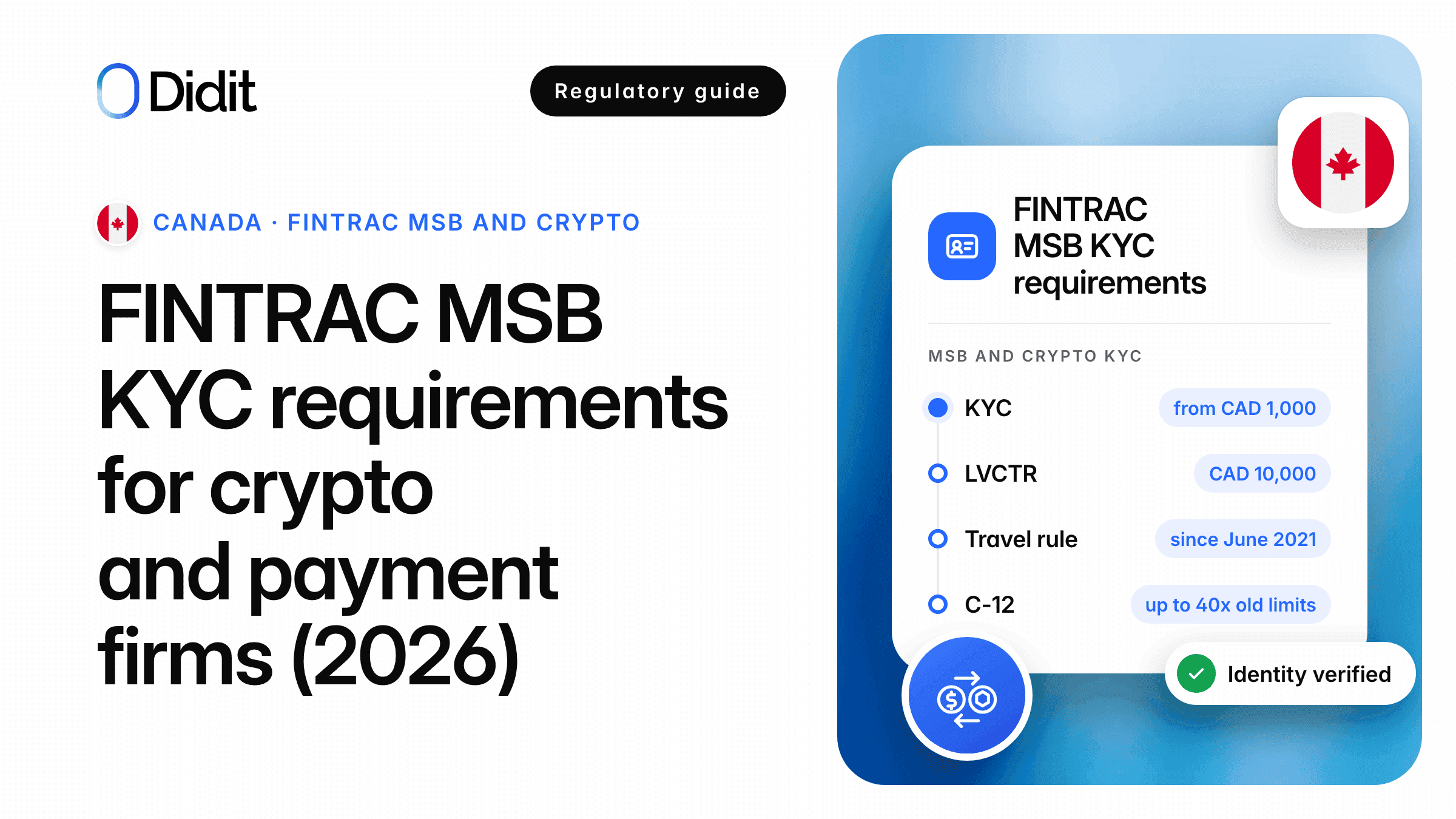
A business that exchanges or transfers virtual currency, remits funds or offers payment services in Canada is usually a money services business (MSB) and must register with FINTRAC, the Financial Transactions and Reports Analysis Centre of Canada, before it operates.[1][2] It must verify a client's identity for any virtual currency transfer or exchange of CAD 1,000 or more, and report virtual currency received of CAD 10,000 or more, alone or within 24 consecutive hours.[3][5]
- Maximum FINTRAC penalties can reach up to 40 times the previous limits for violations after 26 March 2026 (Bill C-12).[14]
- Payment providers within RPAA scope answer to the Bank of Canada today; stablecoin issuers will once the Stablecoin Act is in force.[25][22]
FINTRAC MSB rules decide whether a crypto exchange, a stablecoin startup or a payments company can serve people in Canada. Registration comes first, then know your client (KYC) at fixed CAD thresholds, reports, the travel rule and ongoing monitoring under the Proceeds of Crime (Money Laundering) and Terrorist Financing Act (PCMLTFA).[1][3]
This guide reads the official FINTRAC, Bank of Canada and Department of Finance pages as of 31 October 2026, and ends with an onboarding flow and a checklist. For the identity methods themselves, read our pillar guide on FINTRAC identity verification in 2026.
Building onboarding for Canada
Didit runs document checks with liveness and face match, anti-money laundering (AML) screening inside the same verification session, and transaction monitoring with crypto wallet screening. Start free or talk to us about your Canadian launch.
FINTRAC MSB KYC requirements at a glance
| Question | Short answer |
|---|---|
| Who is an MSB | Businesses that deal in virtual currency, remit funds or deal in foreign exchange, among others, including payment service providers[1] |
| Registration | With FINTRAC before operating, even if a province or territory also licenses you; no fee[1] |
| KYC trigger, virtual currency | Transfer or exchange of CAD 1,000 or more, at the time of the transaction[3] |
| Large virtual currency report | CAD 10,000 or more received, single or within 24 consecutive hours; file within 5 working days[5] |
| Travel rule | Originator and beneficiary name, address and account or reference number (if any) on virtual currency transfers; guidance in effect since 1 June 2021[6] |
| Penalties | Up to 40 times the old limits for violations after 26 March 2026[14] |
FINTRAC MSB registration: who must register
FINTRAC treats dealing in virtual currency as an MSB service. It "includes both virtual currency exchange and virtual currency transfer services".[1] Some payment businesses are caught too: FINTRAC says providers of "invoice payment services or payment services for goods and services are engaged in the business of remitting or transmitting funds or dealing in virtual currency."[1]
A business without a place of business in Canada is a foreign MSB when it provides an MSB service, directs that service at persons or entities in Canada and provides it to clients in Canada.[1] Directing services needs only one sign: marketing aimed at people in Canada, a ".ca" domain, or a listing in a Canadian business directory.[1]
1Map your services
Virtual currency, remittance, foreign exchange, invoice payments.[1]
You have a place of business in Canada
Register as an MSB
Before you begin to operate.[2]
Check the FMSB test
You target and serve Canada: register as a foreign MSB (FMSB).[1][2]
2Build the compliance program
Compliance officer, policies, risk assessment, training, two-year review.[12]
3Check other regimes
Quebec licence, Retail Payment Activities Act (RPAA), securities rules.[25][28]
Simplified from FINTRAC's MSB guidance.
The application needs criminal record checks for listed individuals, issued no more than 6 months before you apply.[2] Operating unregistered "may result in administrative monetary penalties or criminal charges".[2] Regulations in force since 1 October 2025 strengthened the registration framework.[13] In 2025-26 FINTRAC revoked 82 MSB registrations, up from 12 the year before, for failing to answer clarification requests or demands for information.[21] FINTRAC says this information, including crypto wallet addresses, is crucial to its enforcement work.[21]
FINTRAC registers MSBs; it does not license them. Quebec is different: Revenu Québec issues the licences MSBs "need to operate their businesses" under the province's Money-Services Businesses Act.[28] Check with counsel whether you need it too.
Timeline: the dates that shaped MSB and crypto KYC
- 1 June 2021Travel ruleGuidance for EFTs and virtual currency transfers in effect.[6]
- 8 September 2025RPAA dutiesRisk management and safeguarding in force.[25]
- 1 October 2025RegistrationStronger MSB registration framework.[13]
- 26 March 2026C-12, Stablecoin ActNew penalty regime; Stablecoin Act enacted.[15][23]
- 2027 (expected)StablecoinsFinance expects the framework in force.[22]
When an MSB must verify identity: the CAD 1,000 and CAD 10,000 triggers
Amounts are in Canadian dollars, verified "when the transaction takes place"; the CAD 10,000 receipt trigger also follows the 24-hour rule.[3] For virtual currency: "You must verify the identity of every person who requests that you exchange virtual currency for funds, funds for virtual currency, or one virtual currency for another, in an amount equivalent to $1,000 or more when the transaction takes place."[3]
| Activity | Verify identity at | Who |
|---|---|---|
| Transfer virtual currency | CAD 1,000 or more[3] | The person who requests it |
| Exchange virtual currency (to funds, from funds, to another virtual currency) | CAD 1,000 or more[3] | The person who requests it |
| Remit virtual currency to a beneficiary | CAD 1,000 or more[3] | The beneficiary |
| Initiate an electronic funds transfer | CAD 1,000 or more[3] | The person who requests it |
| Foreign currency exchange | CAD 3,000 or more[3] | The person who conducts it |
| Receive virtual currency | CAD 10,000 or more[3] | The person or entity it comes from |
| Service agreement with an entity to exchange or transfer virtual currency | 30 days after the information record is created[3] | The corporation or entity |
The second time an MSB must verify the same client, or when it signs a service agreement with an entity in Canada, it enters into a business relationship.[1] Business relationships trigger ongoing monitoring; transaction records and transaction-based PEP checks have separate triggers.[8][10][7]
How to verify a person remotely
For a client who is not physically present, you may use the government-issued photo identification method if you have "a process in place to authenticate" the document.[4] Its example has two parts: technology that checks the document's security features, such as holograms, barcodes and embedded electronic chips, then a selfie compared by facial recognition plus a name match.[4]
Section 2.1FINTRAC, Methods to verify the identity of persons and entities
"It is not enough to only view a person and their government-issued photo identification document through a video conference or another type of virtual application."
Source: FINTRAC, Methods to verify the identity of persons and entities[4]
The credit file and dual-process methods are the alternatives, and an agent or mandatary can verify for you under a written agreement signed beforehand; you stay responsible.[4] The FINTRAC identity verification guide walks through all five methods as a decision tree.
Large virtual currency transaction reports and the 24-hour rule
An MSB that receives virtual currency worth CAD 10,000 or more in a single transaction must file a large virtual currency transaction report (LVCTR) "within 5 working days after the day on which you receive the amount."[5] The 24-hour rule adds up two or more amounts that total CAD 10,000 or more within a consecutive 24-hour window when you know they come from the same person or entity, are made on behalf of the same person or entity, or are for the same beneficiary.[5]
Example
A client sends you CAD 6,000 and then CAD 5,000 in bitcoin within 24 hours, and you know both come from the same person. Together they reach CAD 10,000, so you must verify the client and file a report: FINTRAC marks the CAD 10,000 identification duty, like the report, as subject to the 24-hour rule. The CAD 1,000 triggers carry no such note.[3][5]
Because "the Bank of Canada does not publish exchange rates for virtual currency", you use the exchange rate you set in the normal course of business, and your compliance policies must describe how you set it.[5] Keep a record of each large virtual currency transaction and of virtual currency transfers of CAD 1,000 or more, and keep a copy of each report for at least 5 years.[10]
The travel rule for virtual currency transfers
FINTRAC's travel rule guidance came into effect on 1 June 2021.[6] MSBs and FMSBs "must include the travel rule information when they send VC transfers", and must take reasonable measures to make sure it is included when they receive virtual currency transfers that require a record.[6] The information is the name, address and account or other reference number (if any) of the originator and of the beneficiary.[6]
Verify the client at CAD 1,000
Allow, suspend or reject per policy
Simplified. The receiving side must take reasonable measures to obtain missing data.[6]
When information is missing after reasonable measures, your written, risk-based policies "must address under which circumstances you allow, suspend or reject the transaction, and outline any follow-up measures you will take."[6]
PEPs, beneficial owners and ongoing monitoring
MSBs must take reasonable measures to determine whether a person they enter into a business relationship with is a politically exposed person (PEP), a head of an international organization (HIO), a family member of one of those persons, or a close associate of a foreign PEP, repeat it periodically, and do it again when they detect a relevant fact.[7] For a PEP or HIO, the guidance gives 30 days from the relationship or the fact to take reasonable measures to establish the source of wealth, if applicable.[7]
| MSB transaction | Determine PEP status of | Threshold |
|---|---|---|
| Initiating an international electronic funds transfer | The requester | CAD 100,000 or more[7] |
| Transferring virtual currency | The requester | CAD 100,000 or more[7] |
| Final receipt of an international electronic funds transfer | The beneficiary | CAD 100,000 or more[7] |
| Receiving virtual currency for remittance to a beneficiary | The beneficiary | CAD 100,000 or more[7] |
When an MSB initiates or transfers CAD 100,000 or more for a foreign PEP, a family member or a close associate, it must take reasonable measures to establish the source of the funds or virtual currency and the source of the person's wealth, and a member of senior management must review the transaction.[7] For entity clients, beneficial owners are the people who own or control 25% or more, and you must confirm what you collect with reasonable measures that "cannot be the same as the measures you used to obtain the information."[9]
Ongoing monitoring must detect suspicious transactions, keep client and beneficial ownership information up to date and reassess risk.[8] A suspicious transaction report (STR) has no monetary threshold and goes to FINTRAC "as soon as practicable" once you have reasonable grounds to suspect, including for attempted transactions.[11][21]
Stablecoins: the Stablecoin Act and the securities regulators
The Stablecoin Act was enacted by the Budget 2025 Implementation Act, No. 1, which received royal assent on 26 March 2026.[13][23] Its provisions come into force "on a day or days to be fixed by order of the Governor in Council", and the Department of Finance expects regulatory work over 12 to 18 months from early 2026, with the framework "coming into force in 2027".[23][22]
| Topic | Status on 31 October 2026 |
|---|---|
| Who it covers | Domestic and foreign issuers that make fiat-backed stablecoins available to Canadians; non-financial-institution issuers only[22] |
| Supervisor | Bank of Canada, with a public registry of issuers[22][13] |
| Reserves and redemption | 1:1 high-quality liquid assets in the reference currency; at-par redemption policy[22] |
| Yield | Issuers may not offer interest or yield[22] |
| AML | Issuers must register with FINTRAC as MSBs dealing in virtual currency, once regulations bring it into force[13] |
| Payments in a stablecoin | RPAA supervision of payment providers once that stablecoin is prescribed by regulation[22] |
Trading platforms already answer to provincial securities law. Under CSA Staff Notice 21-333, the Canadian Securities Administrators (CSA) set terms for value-referenced crypto assets (VRCAs), and after 31 December 2024 registered platforms, or those that gave a pre-registration undertaking (PRU), "can only offer VRCAs that comply with the conditions of their registration and exemptive relief decisions, or their PRUs."[24] Check with your securities regulator for anything newer.
Watch out
The Stablecoin Act is enacted but not in force. The FINTRAC MSB rules for dealing in virtual currency apply today.[13][22]
Payment providers: RPAA registration and safeguarding at the Bank of Canada
The RPAA is a separate regime run by the Bank of Canada. It covers payment service providers (PSPs) that perform payment functions for electronic funds transfers in Canadian or foreign currencies, "excluding digital currencies", including foreign PSPs that serve and direct activities at end users in Canada.[25]
FINTRAC (PCMLTFA)
Money laundering and terrorist financing
- MSB or FMSB registration before operating[2]
- KYC, records, reports, travel rule[3][6]
- Penalties up to 40 times old limits after 26 March 2026[14]
Covers virtual currency and fiat
Bank of Canada (RPAA)
Operational risk and end-user funds
- PSP registration, annual report by 31 March[25][26]
- Risk management and safeguarding frameworks since 8 September 2025[25]
- Funds in trust, or segregated with insurance or a guarantee[25]
Fiat funds transfers, not digital currencies
Check both: FINTRAC registration depends on your MSB services, RPAA registration on your payment activities and its exclusions.
Operating without having applied may breach section 104 of the RPAA, which the Bank calls "a serious violation", and the Bank can refuse or revoke registration based on information from FINTRAC.[25]
Open banking is not live. The Consumer-Driven Banking Act received royal assent in March 2026; the regulations "required to bring the Act into force" were proposed on 27 June 2026, and RPAA-registered PSPs would be able to opt in.[27] No launch date is given in the sources we read.
What FINTRAC penalties against crypto and payment firms found
FINTRAC publishes notices of its administrative monetary penalties. The notices below are named as FINTRAC published them; several are under appeal.
| Entity (as published) | Penalty | Date | What FINTRAC found | Status |
|---|---|---|---|---|
| Xeltox Enterprises Ltd. (Cryptomus), MSB | CAD 176,960,190 | 16 October 2025 | 1,068 missing STRs, 1,518 unreported large virtual currency receipts, a ministerial directive breached, no risk assessment[16] | Appealed[16] |
| Peken Global Limited (KuCoin), FMSB | CAD 19,552,000 | 28 July 2025 | Did not register; 2,952 unreported large virtual currency receipts; 33 missing STRs[17] | Appealed[17] |
| Binance Holdings Limited, FMSB | CAD 6,002,000 | 7 May 2024 | Did not register; 5,902 unreported large virtual currency receipts[18] | Appealed[18] |
| 13010431 Canada Inc. (Necosmart), MSB | CAD 693,742.50 | 27 March 2026 | Missing STRs; policies not tailored; enhanced due diligence written down but not done[20] | Imposed[20] |
| MP Technology Services Ltd., FMSB | CAD 536,853.35 | 20 November 2025 | No STR on declined risky attempts; policies not tailored to Canadian law[19] | Appealed[19] |
Three lessons repeat. FINTRAC determined that Peken Global Limited met the FMSB criteria despite its claim that it was not one; the company appealed.[17] Declining a risky transaction is not the end of the job: MP Technology Services declined most of 261 attempted transactions because transaction monitoring flagged wallet addresses, but "no suspicious transaction report was submitted for the attempted transactions".[19] And written controls must run in practice: at Necosmart, proof of address from the last three months "was not evidenced in the client file reviews", and documented crypto wallet scans were "not being carried out in practice".[20]
In 2025-26 FINTRAC imposed penalties on nine MSBs for more than CAD 198 million.[21] Bill C-12, which received royal assent on 26 March 2026, raises maximum penalties "up to 40 times current limits" for violations after that date, adds ability to pay as a factor, makes compliance agreements mandatory for prescribed violations and creates compliance orders.[15][14] It also requires compliance programs to be "reasonably designed, risk-based and effective".[13]
An onboarding flow for a stablecoin, crypto or payments startup
The flow below assumes you verify every client at sign-up rather than waiting for the CAD 1,000 trigger.
1Collect name, address, date of birth, occupation
The fields your records and reports need.[10]
2Document check, liveness and face match
Authenticate the photo ID, then match the live person and the name.[4]
The document route works for this client
Keep the evidence
Document type, number, issuer, expiry, date verified.[4]
Use another method
Credit file or dual-process, per your policy.[4]
3Screen sanctions, PEPs and watchlists
At the relationship, periodically and on new facts; record the result.[7]
4Monitor transactions and wallets
Flag the 24-hour totals, travel rule gaps and risky addresses.[5][6]
5Escalate, decide, report
Your team files LVCTRs for qualifying receipts and STRs for suspicious completed or attempted transactions.[5][11][19]
A product view of the obligations. Your risk assessment sets the details.
Build the flow with Didit
Didit runs ID verification and AML screening as steps of one verification session, with audit history, and groups monitoring alerts into cases with an audit trail. See transaction monitoring or talk to us about your Canadian flow.
For entity clients, add a business check: registry record, directors and owners at 25% or more, confirmed by a separate measure.[9] For thin-file clients, see our guide to non-document verification in Canada. Selfies collected in Quebec raise extra duties, covered in Quebec Law 25 and biometrics; for age-gated products, see age verification in Canada.
A checklist for this month
- Map every service you offer against FINTRAC's MSB service list, including payment and invoice services.[1]
- Confirm your FINTRAC registration and its expiry: a registration is valid for two years.[45]
- Test 24-hour aggregation across wallets and accounts for the same conductor, third party or beneficiary.[5]
- Set the travel rule policy for allow, suspend or reject.[6]
- Run PEP determinations at each new business relationship, periodically and on new facts.[7]
- Route every declined risky attempt to an STR review.[11][19]
- Compare your enhanced due diligence policy with what analysts actually do.[20]
- Check whether you also need RPAA registration and a safeguarding framework.[25]
How Didit helps MSBs, crypto platforms and payment providers
Didit's AML screening can run as a step of the same verification session as identity checks, next to transaction monitoring. Didit supports your program; it does not replace your compliance officer, policies or reports.
- ID verification authenticates government-issued documents and checks them for tampering, across 220+ countries and territories; liveness and a 1:1 face match confirm the person; near-field communication (NFC) reads e-passport and eID chips.[30][31][32][33] Together these map to the government-issued photo ID method as FINTRAC describes it for remote clients.[4]
- For Canada, the docs describe a credit-bureau check that "Verifies input data against Credit Header data obtained from a Credit Bureau in Canada and responds with data sufficient to meet FINTRAC requirements"; an agency application is required.[29]
- AML screening covers 1,300+ sanctions, PEP and watchlist sources plus adverse media, with daily re-screening.[34]
- Transaction monitoring scores transactions with configurable rules, screens crypto wallets, groups alerts into cases and runs travel rule data exchange with other virtual asset service providers.[35][36][38][37] Your team files the reports.
- Business verification searches Canadian registries such as Corporations Canada and the Registraire des entreprises du Québec; questionnaire templates cover source of funds.[39][40]
- Retention runs from 1 month to 10 years; data is stored in the EU by default, with in-country processing on request for Enterprise, subject to availability.[41][42] The flow runs in French.[44] Certifications: SOC 2 Type 1 and Type 2, ISO/IEC 27001, iBeta Level 1.[43]
Didit provides
- Document, liveness and face match checks
- AML screening and transaction monitoring
- Audit history of checks and cases
Stays with you
- FINTRAC registration and the compliance program
- The risk assessment and onboarding decisions
- Filing STRs, LVCTRs and other reports
Launch Canadian onboarding with the checks in one place
Identity checks, AML screening and transaction monitoring, with an audit trail for your examiners.
Key takeaways
- Crypto and payment businesses are usually MSBs or FMSBs that register with FINTRAC before operating.
- Verify identity at CAD 1,000 for virtual currency transfers and exchanges, and report virtual currency received of CAD 10,000 or more, alone or within 24 hours.
- The travel rule, PEP checks and ongoing monitoring apply too.
- Penalties hit missing registrations, missing reports and paper-only controls; maximums can be up to 40 times higher for violations after 26 March 2026.
- The Stablecoin Act is not in force yet; RPAA safeguarding has applied since 8 September 2025.
Frequently asked questions
Does a crypto exchange need to register with FINTRAC?
Usually, yes. Exchanging or transferring virtual currency is dealing in virtual currency, an MSB service, and an MSB must register with FINTRAC before it operates.[1][2] A foreign platform with no place of business in Canada registers as an FMSB if it directs services at Canada and serves clients there.[1]
What is the KYC threshold for crypto in Canada?
CAD 1,000. An MSB must verify the identity of every person who asks it to transfer or exchange virtual currency worth CAD 1,000 or more, at the time of the transaction.[3] Receiving CAD 10,000 or more in virtual currency also triggers verification.[3]
When must an MSB file a large virtual currency transaction report?
When it receives virtual currency worth CAD 10,000 or more in one transaction, or in two or more amounts within 24 consecutive hours that it knows are linked to the same person, entity or beneficiary. The report is due within 5 working days.[5]
Is FINTRAC MSB registration the same as an MSB licence (license)?
No. FINTRAC registers MSBs and charges no fee.[1] In Quebec, Revenu Québec issues MSB licences under the Money-Services Businesses Act.[28]
What travel rule data must a Canadian crypto business send?
The name, address and account or reference number (if any) of the originator and of the beneficiary, with every virtual currency transfer it sends. For incoming transfers missing data, it needs written policies on when to allow, suspend or reject them.[6]
Does the Stablecoin Act apply now?
Not yet. It was enacted on 26 March 2026 but comes into force on a date fixed by order, after regulations.[13][23] The Department of Finance expects the framework in force in 2027.[22]
Do payment service providers need both FINTRAC and Bank of Canada registration?
Yes, if both regimes cover your activities. FINTRAC registration covers anti-money laundering duties for MSBs; the Bank of Canada registers payment service providers under the Retail Payment Activities Act, which excludes digital currencies.[1][25]
How much higher are FINTRAC penalties after Bill C-12?
Up to 40 times the previous maximums, for violations after 26 March 2026. FINTRAC can also issue compliance orders and mandatory compliance agreements.[14][15]
Sources
- Money services businesses (MSBs), FINTRAC, modified 1 October 2025.
- Register your money services business (MSB) or your foreign money services business (FMSB), FINTRAC, modified 27 August 2026.
- When to verify the identity of persons and entities: money services businesses and foreign money services businesses, FINTRAC, modified 9 September 2025.
- Methods to verify the identity of persons and entities, FINTRAC, modified 3 December 2024.
- Reporting large virtual currency transactions to FINTRAC, FINTRAC, modified 8 April 2024.
- Travel rule for electronic funds and virtual currency transfers, FINTRAC, modified 27 April 2022.
- Politically exposed persons and heads of international organizations guidance for non-account-based reporting entities, FINTRAC, modified 10 July 2025.
- Ongoing monitoring requirements, FINTRAC, modified 17 February 2021.
- Beneficial ownership requirements, FINTRAC, modified 30 July 2026.
- Record keeping requirements for money services businesses, FINTRAC, modified 9 September 2025.
- Reporting suspicious transactions to FINTRAC, FINTRAC, modified 22 May 2025.
- Compliance program requirements, FINTRAC, modified 11 October 2024.
- Modernization and upcoming changes impacting reporting entities, FINTRAC, modified 13 April 2026.
- Administrative monetary penalties: changes following legislative amendments, FINTRAC, modified 6 May 2026.
- Bill C-12, Strengthening Canada's Immigration System and Borders Act, LEGISinfo, Parliament of Canada, royal assent 26 March 2026.
- Administrative monetary penalty on Xeltox Enterprises Ltd., FINTRAC, 22 October 2025.
- Administrative monetary penalty on Peken Global Limited, FINTRAC, 25 September 2025.
- Administrative monetary penalty imposed on Binance Holdings Limited, FINTRAC, 9 May 2024.
- Administrative monetary penalty on MP Technology Services Ltd., FINTRAC, 18 December 2025.
- Administrative monetary penalty on 13010431 Canada Inc., FINTRAC, 14 May 2026.
- FINTRAC Annual Report 2025-26, FINTRAC, modified 26 October 2026.
- Canada's Stablecoin Framework, Department of Finance Canada, modified 31 March 2026.
- Budget 2025 Implementation Act, No. 1, S.C. 2026, c. 3, Division 45: Stablecoin Act, Justice Laws Website, modified 15 October 2026.
- CSA provides update to crypto asset trading platforms about value-referenced crypto assets, Canadian Securities Administrators.
- Retail payments supervisory framework, Bank of Canada, read 31 October 2026.
- Frequently asked questions about retail payments supervision, Bank of Canada, August 2026.
- Consumer-Driven Banking Regulations (proposed), Canada Gazette, Part I, 27 June 2026.
- Revenu Québec's role and responsibilities with regard to money-services businesses, Revenu Québec, read 31 October 2026.
- Canada Credit Bureau (FINTRAC) verification, Didit documentation.
- ID verification overview, Didit documentation.
- Liveness detection, Didit documentation.
- Face match (1:1), Didit documentation.
- NFC verification, Didit documentation.
- AML screening, Didit documentation.
- Transaction monitoring overview, Didit documentation.
- Crypto and wallet screening, Didit documentation.
- Travel rule, Didit documentation.
- Alerts and cases, Didit documentation.
- Business registry sources, Didit documentation.
- Questionnaires, Didit documentation.
- Data retention, Didit documentation.
- Security and compliance, Didit documentation.
- Certifications, Didit documentation.
- Supported languages, Didit documentation.
- Answer clarification requests, update, renew or cancel your registration, FINTRAC, modified 27 August 2026.
See the AML screening page, read about identity verification in Canada, check database validation and ID verification, or see current prices on the pricing page.
Get your Canadian KYC flow ready before your next examination
Verify clients, screen them and monitor their transactions, with an audit trail for checks and cases.
관련 아티클
- Age verification in Canada: S-209, C-34 and what to do now
- Quebec Law 25 and biometrics: identity verification guide (2026)
- FINTRAC identity verification in 2026: methods, rules, C-12
- The Binance breach shows the gap: a key proves a device, not a person
- AI labs are buying human data. Fraud rings are selling it.
- Didit vs Unit21: 하나의 레코드에서 KYC, KYB, AML, 모니터링까지