
API de BankID en Suecia: parte usuaria directa o intermediario, guía completa
Cómo conectar con la API de BankID en Suecia: directamente vía un banco o mediante un intermediario, qué devuelve un inicio de sesión, su valor jurídico en PBC y juego, límites y alternativa documental.
 Por Alberto RosasCofundador y CEO de DiditActualizado el
En resumen
La API de BankID permite a una empresa identificar a un usuario sueco, o recabar una firma, a través de la app BankID. 8.7 millones de personas usaron BankID en 2025.[1] Se accede a la API de una de dos formas: contratar el servicio con un banco e integrarlo como parte usuaria directa, o recurrir a un revendedor que ya ha hecho la integración.[4]
- Un inicio de sesión devuelve el personnummer de 12 dígitos y el nombre, firmados. Sin dirección ni fotografía.[6]
- BankID forma parte del sistema sueco de eID (notificado con nivel sustancial y alto), y DIGG clasifica BankID con nivel sustancial. Los precios no se publican.[4][10][11]
BankID es la identificación electrónica (eID) de Suecia: una app privada emitida por los bancos con normas comunes[3] y aprobada por la agencia digital del Estado, DIGG.[11] Para una empresa es la forma habitual de saber quién es un cliente sueco, con una respuesta firmada en lugar de una foto de un documento.
BankID Sweden en resumen
BankID Sweden
La identificación electrónica de Suecia emitida por los bancos
Cuántas personas usan BankID
Fuente: BankID in numbers, cifras de 2025.[1]
El uso pasó de 4.1 mil millones de transacciones en 2019 a 7.9 mil millones en 2025.[1]
| Sector | Cuota de uso de BankID, 2025 |
|---|---|
| Banca y finanzas | 50% |
| Otros servicios privados | 27% |
| Pagos móviles | 17% |
| Sector público | 6% |
BankID en cifras.[1]
- Septiembre de 2002FundaciónSe constituye Finansiell ID-Teknik BID.
- Junio de 2011App móvilSe lanza Mobile BankID.
- 14 de diciembre de 2020NotificaciónEl sistema sueco de identificación electrónica, con BankID, se notifica en virtud de eIDAS.
- 17 de agosto de 2026Verificación facialPasa a estar disponible la verificación reforzada mediante reconocimiento facial.
- 1 de diciembre de 2026SverigeIDLa identidad electrónica estatal se pone en marcha junto a BankID.
De la fundación de la empresa a la identidad electrónica estatal.[2][10][7][17]
Lo que ve el usuario
En un teléfono, la app de BankID se abre en el mismo dispositivo. En un ordenador, el usuario escanea un código QR con la app.[6] Según la investigación sobre el flujo de BankID, el usuario confirma después con un código de seguridad o con biometría. La referencia de collect de BankID confirma el código a través de sus códigos de error.[6]
Elige cómo verificarte
Inicia sesión con la identidad electrónica que ya utilizas.
BankID
Usar un documento de identidad en su lugar
1El usuario elige BankID en tu proceso de registro.
En un ordenador: escanea con BankID
Abre la app de BankID en tu teléfono y escanea este código.
2Solo en ordenador: un código QR traslada la orden al teléfono. En un teléfono, esta pantalla se omite.[6]
Identifícate
Comprueba quién lo solicita y después introduce tu código de seguridad.
3El usuario confirma en la app (con código de seguridad o biometría, según la investigación sobre el flujo de BankID).[6]
Verificación adicional
Acerca tu pasaporte o documento de identidad, o hazte un selfie.
4Verificación reforzada opcional que el servicio puede solicitar.[7]
Estás verificado
- NombreCompartido
- PersonnummerCompartido
- DirecciónNo compartido
- FotografíaNo compartido
5De vuelta en tu servicio con el resultado firmado.[6]
La pantalla 4 es opcional: una lectura NFC de un pasaporte o documento de identidad o, desde el 17 de agosto de 2026, el reconocimiento facial cotejado con la foto del chip de un pasaporte o documento de identidad sueco.[6][7] Los permisos de conducción no tienen chip, por lo que no pueden usarse para esta verificación adicional.[7]
Un inicio de sesión entre dispositivos con código QR, de principio a fin.
Qué devuelve la API de BankID a una empresa
Tu backend inicia una orden con /auth (identificar) o /sign y después llama a /collect cada dos segundos mientras está pendiente.[6] Cuando el usuario confirma, la respuesta incluye completionData.
El usuario confirma en la app de BankID
Una integración directa con BankID, simplificada. Los códigos de indicación te dicen qué mostrar al usuario.[6]
| Campo | Cuándo | Qué es |
|---|---|---|
| personalNumber | Siempre | Número de identificación nacional sueco, 12 dígitos |
| name, givenName, surname | Siempre | Nombre completo y sus partes |
| signature | Siempre | Firma XML codificada en Base 64 |
| ocspResponse | Siempre | Estado firmado del certificado de la firma |
| device.ipAddress, device.uhi | Se devuelve | IP vista por BankID, identificador único de hardware |
| bankIdIssueDate | Se devuelve | Fecha de emisión del BankID |
| stepUp.mrtd, stepUp.face | Si se ejecutó una verificación adicional (step-up) | Si se realizó la comprobación del chip o la facial |
| risk | Solo si se solicita | bajo, moderado o alto |
| Dirección, nacionalidad, retrato | Nunca | No forma parte de la respuesta |
La respuesta de collect para una orden completada.[6]
La fecha de nacimiento está codificada en el personnummer, por lo que cada inicio de sesión incluye una comprobación de edad.[3]
Nivel de garantía y valor jurídico
Suecia notificó en virtud de eIDAS un único sistema paraguas, "Swedish eID", el 14 de diciembre de 2020, que incluye BankID, Freja eID y EFOS como medios en los niveles sustancial y alto.[10] La propia tabla de DIGG de e-ID suecas notificadas sitúa Mobile BankID, BankID on file y BankID on card en el nivel sustancial.[11] En el marco de confianza sueco se sitúa en el nivel de confianza 3.[3][11]
| Instrumento | Qué significa para BankID |
|---|---|
| Marco de confianza de DIGG para la e-ID sueca | BankID aprobado en el nivel de confianza 3, junto con las demás e-ID que DIGG recoge en ese nivel[11] |
| eIDAS, Reglamento (UE) n.º 910/2014 | Notificado dentro del esquema sueco de eID; BankID afirma que una firma BankID es una firma electrónica avanzada[3][10] |
| PSD2 | Una identificación cumple la autenticación reforzada de clientes; una firma cumple la vinculación dinámica[3] |
| Lag (2017:630), cap. 3, sec. 7 | Los medios eID de eIDAS pueden verificar la identidad en los controles de prevención del blanqueo de capitales[13] |
| Spellagen (2018:1138), cap. 12, sec. 2 | Los titulares de licencias de juego deben comprobar la identidad mediante una identificación electrónica fiable[14] |
| Código Penal, capítulo 15, sección 12 | Usar el BankID de otra persona constituye uso indebido de documentos[3] |
| Lag (2026:1358) | Ley de e-ID estatal, aplicable desde el 1 de diciembre de 2026[12] |
Para la diligencia debida con respecto al cliente, la ley sueca de prevención del blanqueo de capitales dice:
Capítulo 3, sección 7Lag (2017:630) om åtgärder mot penningtvätt och finansiering av terrorism
"När första stycket tillämpas får man använda medel för elektronisk identifiering och betrodda tjänster enligt ... (EU) nr 910/2014"
Fuente: Sveriges riksdag, SFS 2017:630[13]
En español: los medios eID de eIDAS pueden verificar la identidad. La diligencia debida en su conjunto sigue basándose en el riesgo.
Desde el 10 de julio de 2027 se aplica el Reglamento de la UE contra el blanqueo de capitales (AMLR). Su artículo 22(6)(b) acepta medios eID con "los niveles de garantía 'sustancial' o 'alto'", por lo que BankID cumple el requisito.[15] Los proyectos finales de normas de la autoridad de la UE de lucha contra el blanqueo de capitales (AMLA) se enviaron a la Comisión el 30 de septiembre de 2026 y aún no son ley. Según ese proyecto, los medios eID "deberían utilizarse siempre que sea posible" y las comprobaciones remotas de documentos son una alternativa para los clientes que no pueden utilizarlos. Incluye la cartera europea de identidad digital (EUDI Wallet) entre esos medios.[16]
Nota
SverigeID, una e-ID estatal emitida por la Autoridad de Policía de Suecia, se abre el 1 de diciembre de 2026. DIGG la ha aprobado con el nivel de confianza sueco 4, el más alto. A 5 de octubre de 2026, aún no figura en la lista de la UE de esquemas notificados. Es un complemento de BankID y Freja eID, no un sustituto.[11][17]
Cómo conectarse a la API de BankID Sweden: directamente o a través de un intermediario
La respuesta de BankID: "Puede contratar el servicio BankID a un banco o a través de un revendedor."[4]
Parte usuaria directa
Contratar con un banco y desarrollarlo uno mismo
- Contrato con un banco que vende BankID
- Solicitar su certificado de parte usuaria (FP) a través de BankID Keygen
- Desarrollar la gestión de inicio, QR, recogida (collect), mensajes al usuario y cancelación
- Precio por identificación y por firma, acordado con el banco
Ideal para servicios en un solo país con un equipo propio
A través de un intermediario o revendedor
Un contrato, una integración
- Contrato con el revendedor, que contrata el servicio BankID
- Llama a la API del revendedor en lugar de a la de BankID
- Es la integración del revendedor, no la suya, la que se comunica con BankID
- Precio por verificación, fijado por el revendedor
Lo mejor para el onboarding en varios países
Ambas vías funcionan con las mismas reglas de BankID.[4]
En ninguna de las dos vías se publican los precios. El coste "suele basarse en el número de identificaciones y firmas realizadas", y en el sector privado los precios los fija la competencia.[4] Tampoco se publican los plazos de alta, a 5 de octubre de 2026.
Algunas reglas le obligan en ambas vías. Las reglas contractuales de BankID prohíben el "ID switching": usar un inicio de sesión para emitir una contraseña u otra credencial, o mantener al usuario conectado mediante una cookie tras dos horas de inactividad.[4] Pueden aparecer nuevos códigos de aviso (hint codes) "sin previo aviso", y una integración directa debe gestionar los desconocidos.[6]
Los organismos públicos pagan un precio fijo a través del sistema de autorización de DIGG; las empresas privadas solo pueden conectarse al nodo eIDAS de DIGG.[4][12] La parte comercial se explica en BankID para empresas en Suecia.
Casos de uso de la API de BankID
| Caso de uso | Qué le aporta BankID | Norma en la que se basa |
|---|---|---|
| Onboarding KYC y de prevención del blanqueo de capitales | Identidad verificada a partir de una identidad electrónica (eID) notificada | Lag (2017:630), cap. 3, secc. 7[13] |
| Juego en línea | Identificación electrónica fiable en el registro | Spellagen, cap. 12, secc. 2[14] |
| Verificación de edad | Fecha de nacimiento a partir del personnummer | Respuesta de collect[6] |
| Pagos | Autenticación reforzada de clientes y vinculación dinámica | PSD2[3] |
| Contratos y crédito | Firma electrónica avanzada | eIDAS, Reglamento (UE) n.º 910/2014[3] |
El juego añade dos reglas: el registro en línea se limita a residentes en Suecia y las licencias no pueden cubrir a menores de 18 años.[14]
Límites y alternativas
Un BankID requiere un personnummer sueco y un banco emisor.[5]
- Menores: el banco fija el límite de edad, "lo más habitual ... 13 o 18 años", y los menores necesitan el consentimiento de sus padres.[5]
- Los suecos residentes en el extranjero pueden perder el derecho a obtenerlo cuando se les da de baja en el registro SPAR.[5]
- Ciudadanos extranjeros: la lista de noticias de BankID anuncia la renovación con pasaportes de la UE para ciudadanos no suecos registrados desde el 5 de mayo de 2026. Los visitantes y los no residentes sin personnummer no pueden obtenerlo.[5][9]
Según Computer Sweden, la policía informó de un descenso del 90% en las estafas telefónicas vinculadas a los inicios de sesión con BankID tras la llegada de los códigos QR. En 2026 BankID añadió un aviso de pago y el paso adicional de verificación facial.[9]
Para el resto, la alternativa es una comprobación documental: leer el chip del pasaporte o del documento de identidad por NFC (consulte verificación de eID por NFC y seguridad del chip), comprobar la prueba de vida y cotejar el rostro.
1Ofrecer primero BankID a los usuarios suecos
App en el mismo dispositivo o código QR en un ordenador.
El usuario completa una orden de BankID
Aceptar el resultado firmado
Personnummer, nombre, firma, OCSP.
Verificar con un documento
Lectura del chip por NFC, prueba de vida y cotejo facial.
2Añadir la dirección desde otra fuente
BankID no la devuelve.
3Filtrar y decidir
Comprobaciones de sanciones y PEP. La decisión sigue siendo suya.
Primero la eID, el documento como alternativa y una sola decisión al final.
Lista de comprobación para integrar BankID
- Elegir entre un contrato directo con un banco y un revendedor.
- Enumerar los atributos que exige su política y la fuente de la dirección.
- Admitir el inicio en el mismo dispositivo y el código QR en el ordenador.
- Consultar collect cada dos segundos y detenerse ante failed.[6]
- Asignar a cada hint code un mensaje para el usuario, incluidos los desconocidos.[6]
- Decidir sobre el indicador de riesgo y una verificación adicional.
- Conservar la firma y la respuesta OCSP a efectos de auditoría.[6]
- Cerrar las sesiones inactivas dentro del límite de la regla de las dos horas.[4]
- Crear la alternativa documental para los usuarios sin BankID.
- Haz pruebas en el entorno de pruebas de BankID antes de pasar a producción.
Cómo ayuda Didit con la verificación con BankID Sweden
BankID Sweden ya está operativo en Didit. El usuario elige BankID en el flujo alojado o en el SDK e inicia sesión en el mismo teléfono o mediante código QR. Didit nunca solicita el código de seguridad de BankID (PIN).
Actívalo en la consola en Workflows, ID Verification, Countries, Wallets accepted, o con la API de workflows. Un inicio de sesión devuelve el nombre completo, la fecha de nacimiento, el personnummer sueco, el nivel de garantía (etiquetado como Substantial) y una comprobación de la firma (un resultado, no la firma en bruto). Sin dirección y sin fotografía. Los usuarios sin BankID pasan a la captura del documento con lectura del chip NFC, prueba de vida y comparación facial en el mismo workflow. Una comprobación KYC completa cuesta $0.33, la verificación NFC $0.15 y el cribado AML $0.20.
Solo se facturan los inicios de sesión con BankID completados. Los cancelados, caducados y fallidos son gratuitos. Las comprobaciones de documentos se cobran por comprobación. BankID cuesta $0.20 (precios). Las eID activas figuran en la página de integraciones de eID.
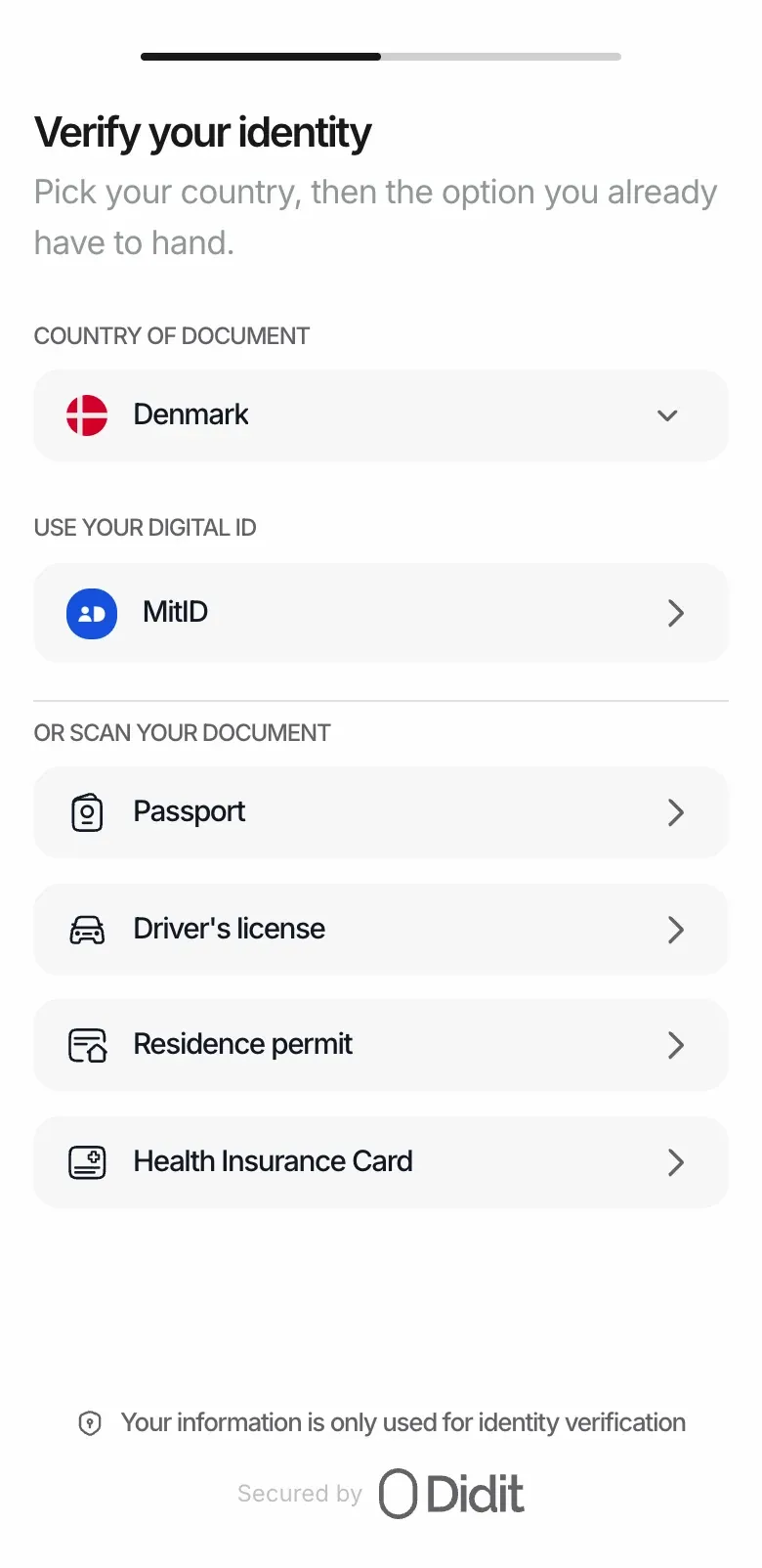
El usuario elige BankID en el flujo de Didit.
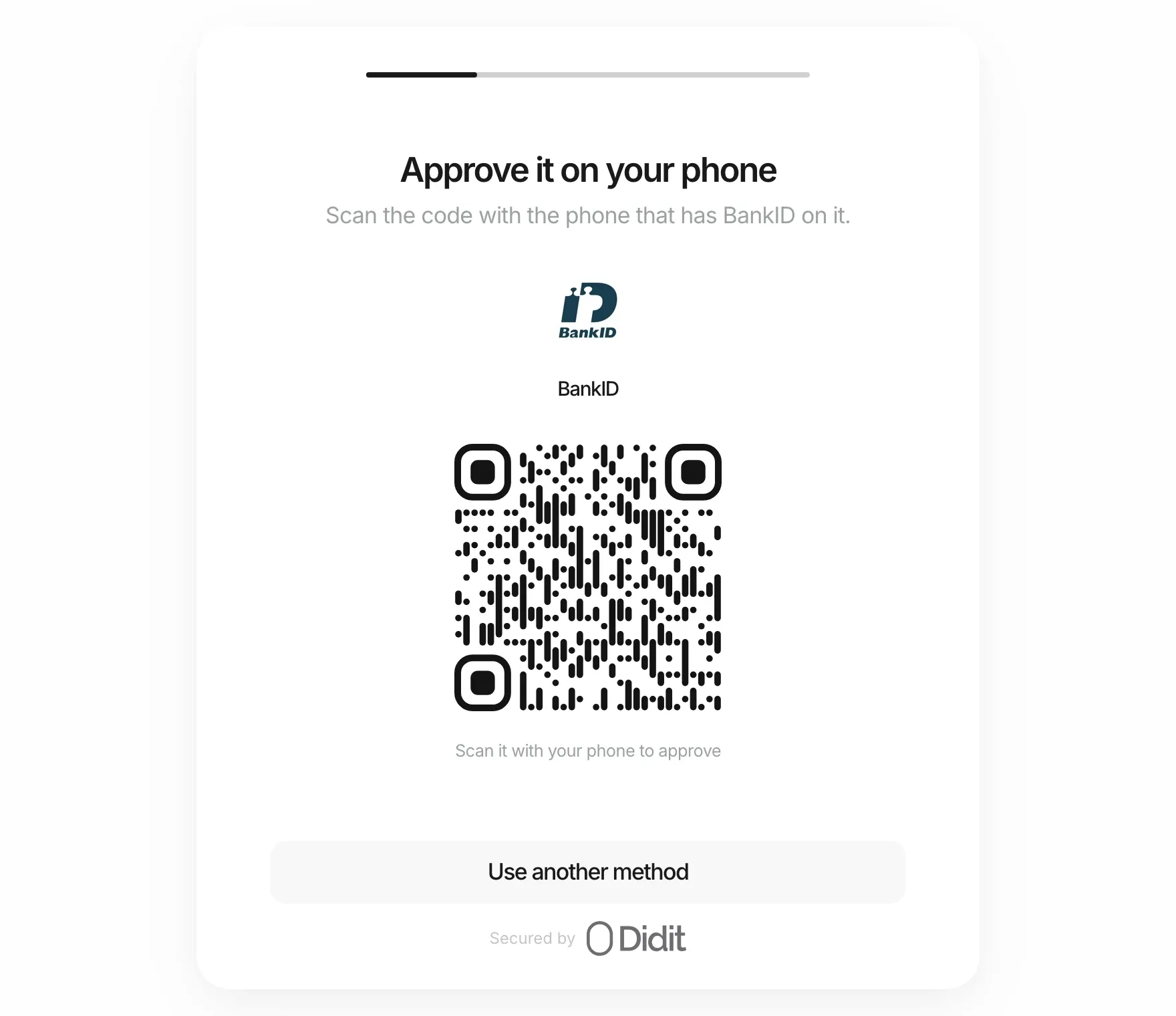
En un ordenador, un código QR traslada el inicio de sesión al teléfono.
Didit aporta
- Inicio de sesión con BankID Sweden en el flujo alojado o en el SDK
- La vía documental para los usuarios sin BankID
- Los atributos firmados y la evidencia de cada comprobación
Sigue siendo responsabilidad tuya
- La evaluación de riesgos y las políticas
- La decisión de alta del cliente
- La fuente de la dirección del cliente
Acepte BankID Sweden en su proceso de alta desde hoy
Activa BankID y la vía documental en un único workflow y paga solo por los inicios de sesión con eID completados.
Puntos clave
- 8.7 millones de personas usaron BankID en 2025, y el 99.9% de los suecos registrados de entre 18 y 67 años tiene uno.
- BankID se contrata con un banco y lo integras tú mismo, o se contrata a través de un revendedor. Los precios no se publican.
- Un inicio de sesión devuelve el personnummer y el nombre, firmados, pero sin dirección y sin fotografía.
- DIGG clasifica BankID como sustancial, lo que cumple el artículo 22(6)(b) del AMLR a partir del 10 de julio de 2027.
Preguntas frecuentes
¿Cuánto cuesta la API de BankID?
BankID no publica sus precios. El coste suele basarse en el número de identificaciones y firmas, y en el sector privado los precios los fija la competencia.[4] Didit cobra $0.20.
¿Qué datos devuelve BankID?
El personnummer de 12 dígitos, el nombre completo, el nombre de pila y los apellidos, la firma y una respuesta OCSP, además de datos del dispositivo y un nivel de riesgo opcional. No incluye dirección, nacionalidad ni fotografía.[6]
¿Puede BankID comprobar la edad de un usuario?
Sí. El personnummer codifica la fecha de nacimiento, así que cada inicio de sesión le indica la edad del usuario. BankID solo está disponible para menores cuando su banco lo permite, normalmente a partir de los 13 o los 18 años y con consentimiento parental.[5][6]
¿Pueden los extranjeros usar BankID?
Solo con un personnummer sueco y una cuenta en un banco emisor. La lista de noticias de BankID anuncia la renovación con pasaportes de la UE para ciudadanos no suecos registrados desde el 5 de mayo de 2026. Los visitantes sin personnummer necesitan otra vía, como una verificación documental.[5][9]
¿Qué nivel de garantía tiene BankID?
Sustancial. BankID forma parte del sistema sueco de identificación electrónica notificado conforme a eIDAS el 14 de diciembre de 2020. El sistema está notificado en los niveles sustancial y alto, y DIGG clasifica los medios de BankID en el nivel sustancial y en el nivel de confianza sueco 3.[10][11]
¿Basta BankID para la diligencia debida con el cliente en materia de prevención del blanqueo de capitales en Suecia?
Es un medio aceptado. La ley contra el blanqueo de capitales, en su capítulo 3, sección 7, permite usar la identificación electrónica de eIDAS para verificar la identidad. Además, siguen siendo obligatorios el cribado, la evaluación de riesgos y el seguimiento.[13]
¿Cuánto tarda una integración con BankID?
BankID no publica plazos de incorporación, a 5 de octubre de 2026. Una integración directa requiere un contrato con un banco, un certificado de parte usuaria obtenido mediante BankID Keygen y su propia gestión del QR, del sondeo (polling) y de los hint codes. Con un revendedor, todo eso se sustituye por una única API.[4][6]
¿Puedo probar BankID antes de pasar a producción?
Sí. El sitio para desarrolladores de BankID tiene un portal de pruebas junto a la referencia de la API.[6] Para pasar a producción sigue siendo necesario un contrato con un banco o con un revendedor y, en la vía directa, un certificado de parte usuaria solicitado mediante BankID Keygen.[4] Pruebe también su gestión de hint codes desconocidos, porque BankID puede añadir otros nuevos sin previo aviso.[6]
¿Sustituye SverigeID a BankID?
No. SverigeID, la eID estatal que se abre el 1 de diciembre de 2026, es un complemento de BankID y Freja. Está aprobada en el nivel de confianza sueco 4, pero aún no figura en la lista de la UE de sistemas notificados, a 5 de octubre de 2026.[11][17]
Fuentes
- BankID en cifras, BankID, cifras de 2025.
- Historia, BankID.
- Leyes y normativa, BankID.
- Conecte su empresa, BankID.
- Obtener BankID, BankID.
- Referencia de la API /collect, BankID Developers, consultado el 5 de octubre de 2026.
- El reconocimiento facial como control adicional, noticias de BankID, agosto de 2026.
- Documento de identidad digital en el colegio electoral, noticias de BankID, 2026.
- Noticias, BankID, entradas de 2026.
- Panorama de los sistemas de eID prenotificados y notificados conforme a eIDAS, Comisión Europea, consultado el 5 de octubre de 2026.
- eID y funciones de certificación aprobadas, DIGG.
- Acerca de la identificación electrónica, DIGG.
- Lag (2017:630) om åtgärder mot penningtvätt och finansiering av terrorism, Sveriges riksdag.
- Spellagen (2018:1138), texto legal en lagen.nu.
- Reglamento (UE) 2024/1624 (AMLR), artículo 22, EUR-Lex.
- Informe final, proyecto de RTS conforme al artículo 28(1) del AMLR, AMLA, 30 de septiembre de 2026.
- Statlig e-legitimation, SverigeID, Autoridad Policial de Suecia.
Compara todas las eID nacionales en la página de verificación de eID, o empieza por qué es la verificación de eID.
Un único flujo para Suecia y más allá
Empieza con BankID, añade las eID que ya tienen tus usuarios y mantén los documentos como alternativa.
Artículos relacionados
- Didit vs Unit21: KYC, KYB, AML y monitorización en un único registro
- Didit vs Trinsic: inicio de sesión con eID más verificación de documentos, AML y KYB
- Didit vs Thomson Reuters: bases de datos gubernamentales y todo el flujo
- Didit vs Regula: verificaciones alojadas con evidencia completa, KYB y monitorización
- Los 10 mejores agentes de IA de cumplimiento para automatizar la revisión KYC y AML en 2026
- Las 5 mejores soluciones de cumplimiento de la Travel Rule para empresas cripto en 2026