French National ID Card 2D-Doc Verification API (2026)
Didit decodes the ANTS 2D-Doc barcode on a French national ID card, verifies its signer certificate against the ANTS trust list and cross-checks visual zone and MRZ. ID Verification is $0.15 per check.
 Alberto RosasCo-founder and CEO
Contents
In this guide
Jump to the part you need.
This page is for teams that onboard French users and need to know whether a carte nationale d'identité is real, not just legible. Didit decodes the ANTS 2D-Doc barcode on the card, verifies the signature against a certificate chaining to the ANTS trust list, and cross-checks the visual zone and MRZ. ID document verification costs $0.15 per check. The caveat: a green barcode confirms the data was signed, not that the person holding the card is its owner.
Last updated: November 26, 2026. Prices checked against the live Didit price feed on November 26, 2026.
French national ID card 2D-Doc verification at a glance
| What you are checking | Signal Didit returns | Where it runs | List price |
|---|---|---|---|
| The card matches a known French identity card design | document_type, document_subtype, forgery warnings | ID Verification | $0.15 per check |
| The 2D-Doc barcode carries a valid issuer signature | Signature checked against a signer certificate that chains to the ANTS trust list | ID Verification, same step | No separate line |
| Barcode, visual zone and MRZ agree | INCONSISTENT_DATA warning when they do not | ID Verification | No separate line |
| The holder is the person in front of the camera | Liveness score and 1:1 face match | Passive Liveness, Face Match | $0.10 + $0.05 |
| The chip on the card is genuine | chip_data and authenticity | NFC add-on | $0.15 per check |
| All of the above in one session | Session decision with id_verifications[] | Full KYC | $0.33 per check |
Start free in the sandbox at https://business.didit.me/ with no sales call. Developers who want an AI assistant to drive the integration can connect Didit through https://didit.me/developers/mcp/. The product documentation for this step is ID Verification, and every rate on this page comes from didit.me/pricing.
What the ANTS 2D-Doc barcode actually proves
A 2D-Doc is not a barcode that carries a loose copy of the card data. France Titres, the agency that runs it under mandate of the Ministère de l'Intérieur, describes it as a secure device: a two-dimensional barcode affixed to a paper or digital document, readable only with a specific reader, carrying key document information plus an electronic signature produced by asymmetric encryption (France Titres, 2D-Doc page, read November 26, 2026).
The ANTS process document sets out who creates that signature. An Editeur formats the data and the signature into the barcode and works for one or more participants. The Editeur signs with a private key tied to a cachet serveur certificate issued by a certification authority (AC) referenced by ANTS, under RGS standards at level one star. ANTS publishes the AC list, the Editeur list and the Participant list, validated by the Ministère de l'Intérieur (ANTS, Processus 2D-Doc v1.2 dated 11/08/2020, read November 26, 2026).
The detail that matters for verification: the certificate is not inside the signed document, because the barcode is too small. A reader has to resolve the certificate from the published lists and then check the signature against it. That is the difference between reading a barcode and verifying one. A barcode whose contents look perfectly consistent but whose signature chains to no referenced authority is caught, because there is nothing to validate the signature against.
France Titres describes the reader outcome as binary:
the result is a green status (valid signature, authentic document) or red status (reading failed, document cannot be considered secured by 2D-DOC).
2D-Doc appears on more than 50 document types, and the carte nationale d'identité is one of them (France Titres, 2D-Doc page, read November 26, 2026).
The legal basis for securing and checking a French identity document
The device has a statutory footing. The Arrêté du 27 septembre 2013 (NOR INTA1325592A, published in the Journal officiel n°0244 of 19 October 2013) states in Article 1 that securing the supporting documents mentioned in the third paragraph of article 6 of the decree of 26 December 2000 is done by inserting a two-dimensional barcode called 2D-doc. Article 2 pins the device to version 2.0 of the technical specifications annexed to the arrêté, published on the ANTS site. Article 3 requires operators who want to secure their own documents to send a notice of participation to the secrétariat général and accept the governance document annexed to the arrêté (Légifrance, Arrêté du 27 septembre 2013, read November 26, 2026).
On the checking side, France runs DOCVERIF, an automated personal data processing system authorised by the arrêté du 10 août 2016. The CNIL examined a draft order modifying it in délibération n° 2024-099 du 12 décembre 2024 (NOR CNIX2435158X, Journal officiel n°0308 of 29 December 2024, texte n°98). DOCVERIF checks the validity of French identity documents: CNI, passports, and residence permits with an electronic component. Its users are restricted: cercle 1 includes police and gendarmerie, cercle 2 includes public administrations, public-service bodies and credit institutions (Légifrance, CNIL délibération n° 2024-099, read November 26, 2026).
Read those two texts together and the practical constraint becomes clear. There is no open government lookup that a private company can call with a CNI number to get a yes or no. DOCVERIF is an authorised processing system with named user circles. For everyone else the document itself is the source of truth, and the 2D-Doc barcode is the part of it that carries a verifiable signature. That is why we do not present a French card check as a registry hit. It is documentary verification with a cryptographic step inside it.
What you must verify on a French national ID card
- That the card is a real French identity card design and not a template, a specimen or a screen replay. Didit classifies the document and runs forgery checks before it reports extracted data.
- That the 2D-Doc barcode is signed by an Editeur whose certificate chains to the ANTS trust list. Contents that read correctly but do not verify are not evidence of anything.
- That the visual zone, the MRZ and the barcode agree with each other. If the name in the barcode differs from the name in the visual zone, that is a data-consistency problem even when both strings are readable.
- That the card is in date. An expired card is declined rather than quietly accepted.
- That the person presenting the card is its holder. The barcode proves data integrity, not ownership. Liveness and a 1:1 face match close that gap.
Official registers, identifiers and formats
These are the authoritative structures behind a French card check, taken from the source documents themselves.
| Source | Identifier or format | What it gives you |
|---|---|---|
| France Titres 2D-Doc page | Document coverage of 50+ types, including carte nationale d'identité | Confirms the CNI carries a 2D-Doc |
| ANTS Processus 2D-Doc v1.2 | AC list, Editeur list and Participant list published by ANTS after validation by MinInt | The trust anchors a signature is checked against |
| ANTS and RGS | cachet serveur certificate, RGS level one star | The signing certificate standard |
| Arrêté du 27 septembre 2013 | Version 2.0 of the technical specifications, published on the ANTS site | The barcode format itself |
| 2D-Doc payload | Document type, issuer, identity, address, invoice number, issue date, plus the signature | The fields a reader extracts, depending on document type |
| CNIL délibération n° 2024-099 (DOCVERIF) | CNI, passports, residence permits with an electronic component; cercle 1 and cercle 2 access only | The state-side check that is not open to private firms |
What Didit returns for a French national ID card
Every ID Verification result carries an assurance tier. Document capture returns documentary, a non-document lookup returns data_match, and a digital identity wallet returns cryptographic. A photographed French card is documentary, and the barcode signature check runs inside that result rather than as a separate line item.

| Field | Type | What it tells you |
|---|---|---|
status | string | Approved, In Review, Declined, In Progress and the other lifecycle values |
document_type | string | Identity Card for a carte nationale d'identité |
document_subtype | string | The specific document design Didit matched |
document_number | string | The number as printed and encoded, returned without reformatting by us |
date_of_birth, expiration_date | string | Holder date of birth and card expiry, used for the expiry check |
mrz | object | The parsed machine-readable zone, including check digits |
barcodes | array | Each entry carries type, position, data, data_raw and side. An empty array means no barcode decoded |
warnings | array | Risk codes with short_description and long_description |
portrait_image, front_document_image, back_document_image | URL | Short-lived media URLs, download promptly rather than storing the link |

Warnings you will see most often on French cards
INCONSISTENT_DATA: the visual zone, MRZ and barcode disagree. Route it to review, or decline it if you setinconsistent_data_action=DECLINE.INVALID_MRZ: a check digit failed or the MRZ could not be parsed.DOCUMENT_EXPIRED: the expiry date has passed. This always declines.COULD_NOT_DETECT_DOCUMENT_TYPE: the front image does not match a known official design with high confidence.SCREEN_CAPTURE_DETECTED,PRINTED_COPY_DETECTED,PORTRAIT_MANIPULATION_DETECTED: forgery signals from document liveness, always a decline when present.DOCUMENT_LIVENESS_NOT_COMPUTED: the forgery check produced no usable score, so the status is In Review. Treat the document as unchecked.
Prices on the French card path
| Line | Price | Unit |
|---|---|---|
| ID Verification inside a workflow | $0.15 | check |
| ID verification API, standalone call | $0.20 | check |
| NFC chip reading | $0.15 | check, add-on |
| Passive Liveness | $0.10 | check |
| Face Match 1:1 | $0.05 | check |
| Device and IP analysis | $0.03 | check |
| Full KYC bundle | $0.33 | check |
| Non-document verification | Variable by source | lookup |

Step by step in the Business Console
- Open https://business.didit.me/ and create a workflow. Add the ID Verification step. The feature enum is
ID_VERIFICATION, withOCRas the legacy value. - In the step's document settings, restrict accepted documents to the French identity card so that a passport or a foreign card does not pass through as an acceptable substitute.
- Leave the France methods block on document capture. FranceConnect is listed as coming soon on the live price feed, and the EUDI Wallet is listed as coming soon at $0.15, so neither is a production method for a French card today.
- Decide what happens on inconsistency: decline, or route to manual review. The same choice exists for an invalid MRZ and for an undetected expiry date.
- Publish the workflow, run a session, and open the session detail to read the document result, the decoded barcode and every warning.
Step by step through the API
Session mode is the path when a person photographs their own card. Create a session with POST /v3/session/ and send workflow_id, vendor_data and callback, open the returned session.url for the user, then read the result with GET /v3/session/{sessionId}/decision/. The card result arrives under id_verifications[]. Subscribe to the status.updated webhook if you prefer to be pushed the decision.
Standalone mode is the path when you already hold the two images and want one server-to-server call:
curl -X POST 'https://verification.didit.me/v3/id-verification/' \
-H 'x-api-key: YOUR_API_KEY' \
-F 'front_image=@./cni_front.jpg' \
-F 'back_image=@./cni_back.jpg' \
-F 'perform_document_liveness=true' \
-F 'invalid_mrz_action=DECLINE' \
-F 'inconsistent_data_action=DECLINE' \
-F 'vendor_data=user-123'
Upload uncropped images with all four corners visible, up to 5 MB each. A readable but problematic document returns HTTP 200 with status: "Declined", so always inspect id_verification.status and id_verification.warnings rather than the HTTP code alone. Each 200 response consumes one credit, and a request the balance cannot cover returns 403 before any image processing. With save_api_request left at its default of true, the call is persisted as an API session you can retrieve later.
Worked cost example: 10,000 French ID checks a month
Using only the published list prices, at 10,000 French national ID card checks a month.
- Document check only, the path that includes the 2D-Doc signature check and the cross-checks: 10,000 x $0.15 = $1,500.00.
- Add passive liveness and 1:1 face match to bind the card to a person: 10,000 x ($0.10 + $0.05) = $1,500.00. The full KYC total is 10,000 x $0.33 = $3,300.00.
- Add NFC chip reading on every check: 10,000 x $0.15 = $1,500.00 on top.
On the Scale plan at $299 a month, with $350 of monthly credit and 10% off every Didit price, the document check is 10,000 x $0.135 = $1,350.00. The $350 of credit covers part of it, so $1,000 comes from top-up balance and the month costs $299 + $1,000 = $1,299.00. Full KYC on Scale is 10,000 x $0.297 = $2,970.00, of which $350 is credit, so the month costs $299 + $2,620 = $2,919.00. Monthly credit expires at the end of the plan month and does not roll over. Top-ups last 12 months.
Fallbacks when the source is down or there is no match
There is no upstream registry call in the French card path, so the failure modes differ from a database lookup. Here is how we handle each.
- The images cannot be processed at all: HTTP 400 with
COULD_NOT_RECOGNIZE_DOCUMENT. Ask for a new capture rather than approving. - The barcode does not decode:
barcodesreturns an empty array. The result then rests on classification, OCR, MRZ and forgery checks. Treat the signature evidence as absent, not as negative, and route the case to review if your policy needs the signature. - The barcode decodes but does not verify against the ANTS trust list: that is the case the check exists for. Do not approve on the strength of readable contents.
- The forgery check produced no usable score: status is In Review with
DOCUMENT_LIVENESS_NOT_COMPUTED. Treat the document as unchecked and send it to manual review. - Status is In Review for any other reason: route it to your review queue and do not approve the user from the automatic decision.
- Balance too low: HTTP 403 before processing, so no partial result is produced.
- Non-document lookup in France: it queries a credit-bureau, financial-services, utility or residential-records file rather than a government register, and the exact source is named on the Non-document lookup page. A
no_matchis treated as a synthetic identity under your policy, apartial_matchgoes to review, and an HTTP 502 withvalidation_errors[]means every selected upstream service failed: the request is not billed, aCOULD_NOT_PERFORM_DATABASE_VALIDATIONlog is written, and you retry later or fall back to the document-only check.
Sources
- France Titres, 2D-Doc page, read November 26, 2026.
- ANTS, Processus 2D-Doc version 1.2 dated 11/08/2020, read November 26, 2026.
- Légifrance, Arrêté du 27 septembre 2013, NOR INTA1325592A, read November 26, 2026.
- Légifrance, CNIL délibération n° 2024-099 du 12 décembre 2024, NOR CNIX2435158X, read November 26, 2026.
- Didit docs, ID Verification overview.
- Didit docs, ID Verification methods, document, lookup, wallet.
- Didit docs, ID Verification standalone API.
- Didit docs, Retrieve Session API.
- Didit docs, Data Models.
- Didit docs, Database Validation overview.
- Didit docs, pricing and billing rules.
- Didit pricing page and pricing as JSON, read November 26, 2026.
- Didit MCP server.
Next step: open the sandbox at https://business.didit.me/, add an ID Verification step to a workflow, and run a French card through it. No sales call, and sandbox testing is free.
Try it
Try this in the sandbox
Run the check this guide describes, free.
The product this post is about, taken from its topic. Run it free in the sandbox.
Author
Alberto Rosas
Co-founder and CEO

Keep reading
Other guides in the same topic.
 How to Cut MCP Token Usage in Claude Code, Cursor and VS Code
The Didit MCP server lists every tool by default, which costs roughly 50,000 to 115,000 tokens on every request. Add toolsets=core to the URL for about 30 tools, or read_only=true for about 20.
Alberto RosasNov 26, 2026 What Happens When Didit Credits Run Out: Top-Ups and Auto Top-Up
Monthly credit lands on day one and expires at month end, no rollover. Top-ups of $50 to $20,000 last 12 months and are spent oldest first. Without auto top-up, live checks stop until you top up; the sandbox keeps running.
Alberto RosasNov 26, 2026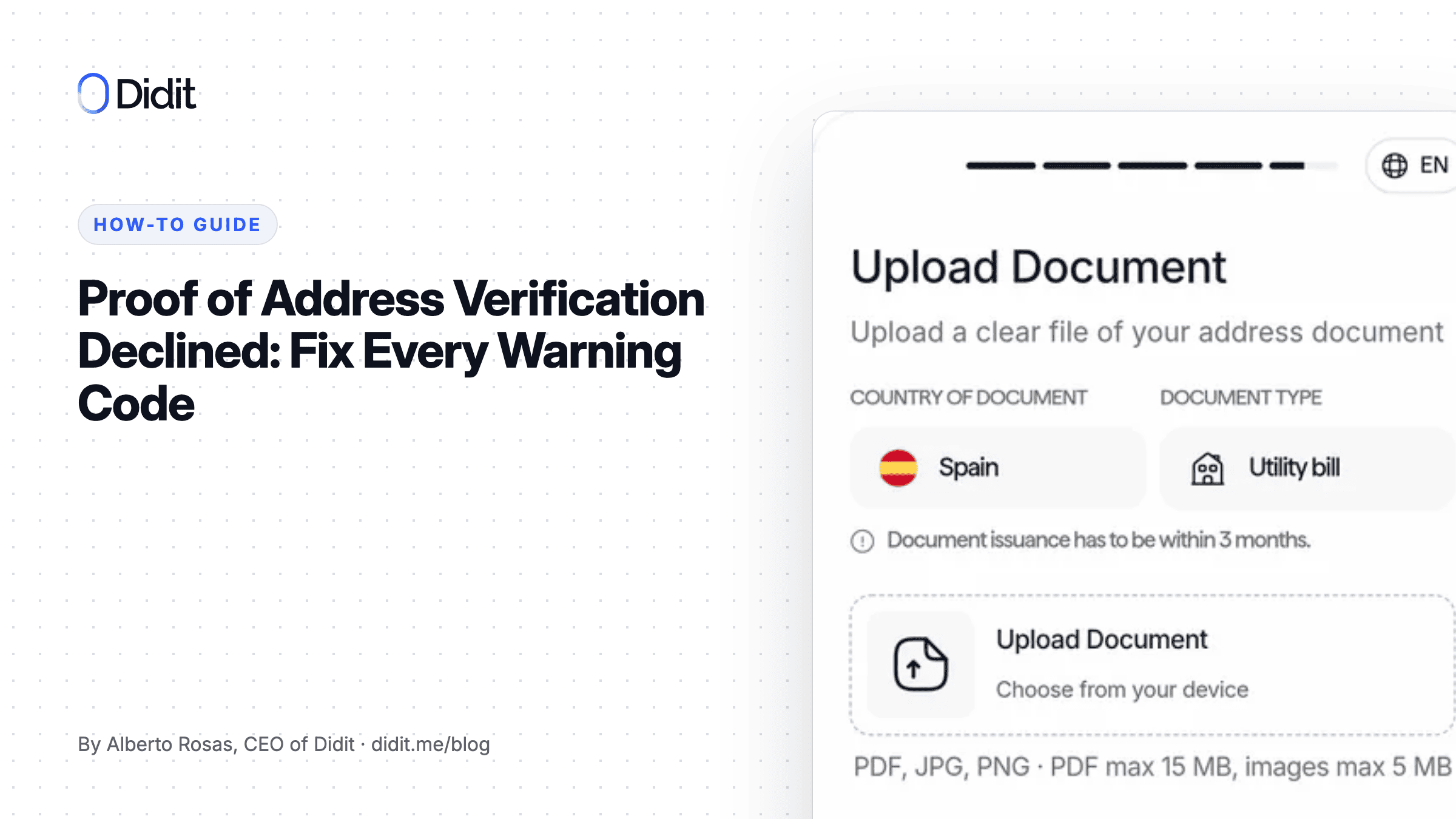 Proof of Address Verification Declined: Fix Every Warning Code
A proof of address check is Declined when at least one warning resolves to a decline. Fix the expected address and name values, the document age window and the language allowlist, correct OCR fields with update-poa-data, or.
Alberto RosasNov 26, 2026Questions
Frequently asked questions
How does Didit verify a French national ID card 2D-Doc barcode?
Didit reads the card, classifies it as a French identity card, decodes the 2D-Doc barcode and verifies its electronic signature against a signer certificate that chains to the ANTS trust list. It then cross-checks the barcode contents against the visual zone and the MRZ. A barcode that reads cleanly but does not verify is flagged rather than accepted.
What is an ANTS 2D-Doc barcode?
It is a two-dimensional barcode that carries key document data plus an electronic signature produced by asymmetric encryption. The issuing body signs with a private key tied to a cachet serveur certificate issued by a certification authority referenced by ANTS. ANTS publishes the lists of certification authorities, Editeurs and participants, and the certificate itself is not stored inside the barcode.
Does Didit catch a forged or unsigned 2D-Doc barcode whose contents look consistent?
Yes. The signature check is separate from the content check. If the barcode contents match the printed card but the signature does not chain to a certificate on the ANTS trust list, the signature has nothing to validate against and the result is not an authentic document. That is precisely the failure mode content-only parsing misses.
Does Didit check a French ID card against a government database?
Not for the card itself. DOCVERIF, the French state system that checks CNI, passport and residence permit validity, is an authorised processing system open to police, gendarmerie, public administrations and, in a second circle, public-service bodies and credit institutions. For private firms the document and its barcode are the check. Didit also offers a non-document lookup in France, which queries a credit-bureau, financial-services, utility or residential-records file rather than a government register.
What does a French national ID card check cost?
ID document verification is $0.15 per check inside a workflow and $0.20 per call on the standalone ID verification API. The full KYC bundle, which adds passive liveness, 1:1 face match and device and IP analysis, is $0.33 per check. NFC chip reading is a $0.15 add-on.
How fast is a French ID card check?
Didit runs sub-2-second p99 inference on ID verification, so the document result comes back inside a normal onboarding flow rather than as a batch job. The barcode decode and the cross-checks are part of that same call, not a second request.
What happens if the 2D-Doc barcode cannot be read?
The barcodes field returns an empty array, which means nothing decoded. The result then rests on document classification, OCR, MRZ parsing and forgery checks. Our advice is to treat the signature evidence as absent rather than as failed, and to send the case to manual review if your policy requires a verified signature.
Can I verify a French card without the holder photographing it?
Only through the non-document lookup method, and in France that source is a credit-bureau, financial-services, utility or residential-records file, not a government register. That method returns a data_match assurance tier, so it proves the data matched a record, not that a document was inspected. Pricing for it is variable by source.
Does Didit read the chip on a French identity card?
NFC chip reading is available as a $0.15 add-on to a document check. It returns chip_data and authenticity under nfc_verifications[], with a chip_protocol of icao for ICAO documents. It requires a device with NFC and a document that carries a chip, and when it does not run the reason appears in nfc_skip_reason.
Which fields should I store from a French card result?
Store document_type, document_subtype, document_number, date_of_birth, expiration_date, the parsed mrz, the barcodes entries you need for your audit trail, the warning codes and the session id. The image fields are presigned URLs with a limited validity window, so download them promptly if you need to keep them.
Can I restrict a workflow so it only accepts French ID cards?
Yes. The workflow's document settings control accepted types and subtypes, and a document outside that set is refused rather than silently approved. Configure the restriction on the ID Verification step in the Business Console or through the workflows API before you publish.
Compliance built in
Audited, certified and attested.
We hold the certifications and build each country's rules into your flows, so you can launch anywhere without worrying. Security and Compliance center
- Regulation encoded into your flows
Tell us what you do and where. Didit lists the rules that apply to you, with sources, and builds the checks each country needs into one workflow.
- Ready for AMLR
Every requirement of the new EU anti-money laundering rules, from checking customers to human review, is already covered by a Didit check.
- Tested in Spain's Treasury sandbox
Spain's Treasury published its supervised sandbox report on Didit's NFC plus active liveness onboarding; SEPBLAC took part and valued the added measures positively.
- Audited, not self-declared
iBeta Level 1 and Level 2. Liveness tested under ISO/IEC 30107-3.
Your obligations · 3 regions
 SOC 2 Type 2
 ISO 27001
 iBeta Level 1 and Level 2
 EU regulator attestation
 FSM youth protection
 GDPR
 EBA remote onboarding
 MiCA compatible
 FIDO Alliance member
- AMLREU AML Regulation ready
Integration · Didit MCP
Run Didit from your own AI agent
Connect Didit to Claude, Cursor, VS Code or ChatGPT and just ask in plain words. Your agent can do anything you can do in the console, with the same permissions you have.
 Add to Claude
 ChatGPT
 Cursor
- Build workflowsDescribe the checks you need. The agent creates and publishes the flow.
- Run investigationsAsk why a session was declined, review cases, search people and companies.
- Change rulesCreate payment rules, test them on past data and switch them on.
- Pull reportsAsk for numbers, exports or the audit log.
Didit Academy


