iGaming Fraud Rules: Bonus Abuse, Chip Dumping, Opposite Betting
Didit ships an iGaming fraud bundle of preset rules for event-native bonus abuse, opposite betting, affiliate fraud, chat rain farming, chip dumping and account takeover.
 Alberto RosasCo-founder and CEO
Contents
In this guide
Jump to the part you need.
This guide is for iGaming operators who take deposits and pay withdrawals, and who need fraud rules on gameplay and bonus events, not only on money movement. Didit ships an iGaming fraud bundle of preset rules for bonus abuse, opposite betting, affiliate fraud, chat rain farming, chip dumping and account takeover. Transaction monitoring is $0.001 per transaction beyond the plan allowance. The caveat: no event rule fires until event monitoring is on and you send the events.
Last updated: November 26, 2026. Prices checked against the live Didit price feed on November 26, 2026.
| Item | Where it lives | Price |
|---|---|---|
igaming_fraud bundle: bonus abuse, opposite betting, affiliate fraud, chat rain farming, chip dumping, account takeover | Transactions, Rules, Library in the Business Console | No separate price. Evaluated by the transaction monitoring engine |
responsible_gaming bundle: deposit and withdrawal limits, self-exclusion, off-hours play | Same library, installable on its own | No separate price |
| Rule modes | Per installed preset: ACTIVE, TEST, DISABLED | No separate published price in the supplied pricing feed |
| Transaction monitoring | Every transaction submitted to POST /v3/transactions/ | $0.001 per transaction beyond the plan allowance (Free 1,000, Growth 10,000, Scale 100,000 a month) |
| Event ingestion | POST /v3/events/ and POST /v3/events/batch/ | No separate published price. Events run on the same rule engine as transactions |
| Full ID check (KYC) for player onboarding | User Verification | $0.33 per completed check |
| AML screening | Transaction Monitoring and User Verification | $0.20 per check |
Start free in the sandbox at business.didit.me, no sales call. Developers who want an AI assistant to read the rule library and install a bundle can connect Didit through didit.me/developers/mcp. How rules, conditions and actions are built is documented at the KYT Rules and Scoring docs, and every unit price is on didit.me/pricing.
What the iGaming fraud bundle contains
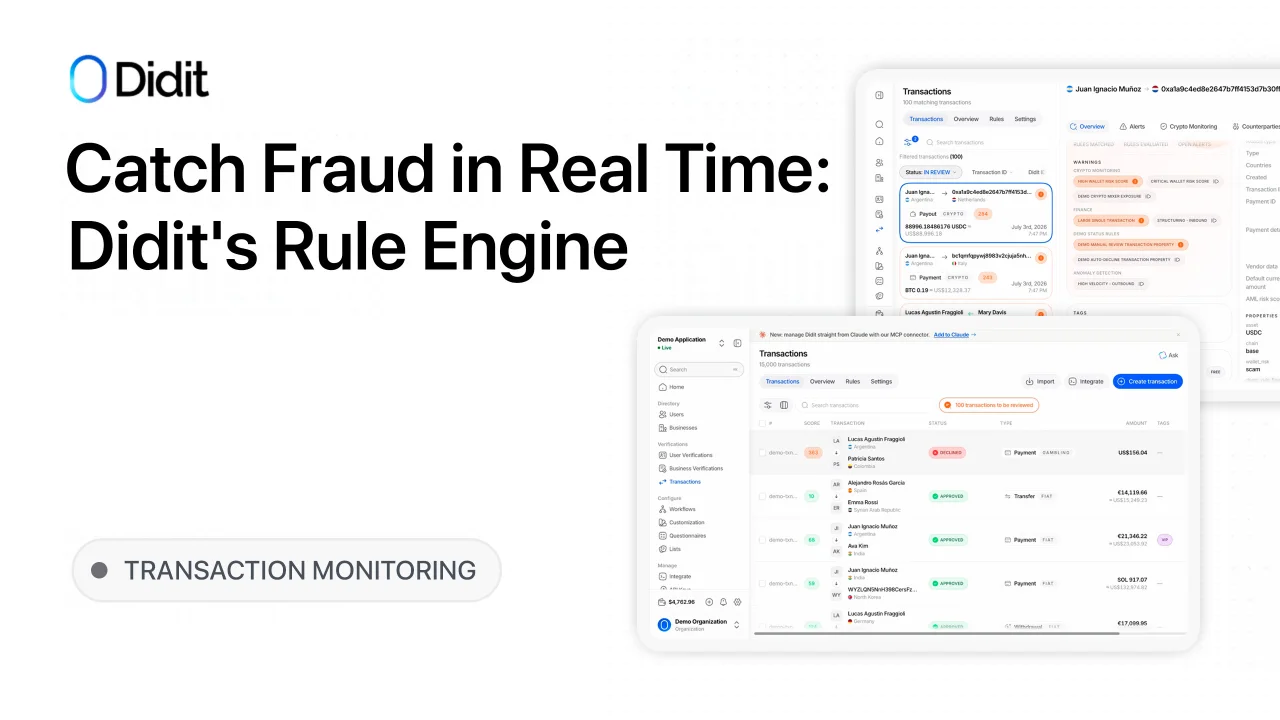
Didit ships over 150 preset transaction-monitoring rules, each mapped to a typology drawn from FATF recommendations, FinCEN advisories, NACHA rules, Wolfsberg principles, Egmont Group typologies and iGaming abuse patterns. Presets are grouped into bundles and categories. The igaming_fraud bundle is the one built around the way bonus money actually leaves an operator.
- Event-native bonus abuse. The bonus category carries
bonus_claimed,bonus_wagered,bonus_releasedandpromotion_viewed, and the preset addresses abuse from those events rather than inferring it from cash movements. - Opposite betting. Two accounts take opposite sides of the same market so the pair loses almost nothing while releasing bonus funds. The bundle covers it; the pairing logic you write yourself is a custom rule.
- Affiliate fraud. The bundle covers it. The affiliate category carries
affiliate_attributed,referral_clicked,campaign_joinedandcommission_event, andevent.affiliate.affiliate_codeis available to custom rules. - Chat rain farming. The bundle covers it: multiple accounts collect chat-tip bonuses, then consolidate.
- Chip dumping. One player deliberately loses chips to a colluder at a private table, moving value through
gameplay.p2p_settlement. - Account takeover. A composite of security and payment signals: PII change, new payment method, withdrawal address change, then a payout.
The responsible_gaming bundle sits next to it: safer-play deposit and withdrawal limits, self-exclusion, and off-hours play. Both bundles install individually or as a whole, and each installed rule runs in ACTIVE, TEST or DISABLED mode. Preset conditions, thresholds and actions are fixed, so a threshold you want to move means building a custom rule.
Preset coverage versus custom rules
Two different things sit in the same rule list, and it pays to keep them apart. An installed preset comes from the library: its conditions, thresholds and actions are fixed, and you control only its mode. A custom rule is yours: it reads any documented field, including every event path below, and you set the thresholds. The bundle gives you the documented iGaming coverage on day one. Anything specific to your bonus terms, your market ids or your affiliate programme is a custom rule.
Prerequisites
- A Didit application with Transaction Monitoring enabled: Settings, Transaction Monitoring, Enable.
- An API key with the same
x-api-keyheader used for sessions and entities. - Event monitoring switched on in Transactions, Settings, Event monitoring. Until it is on, every write lane answers
403with{"code": "event_monitoring_disabled"}and nothing is stored or evaluated. Reads are unaffected. - A webhook endpoint reachable from the internet if you want alerts pushed to your own systems.
- A decision about which user identifier plays the role of
subject.vendor_data. It must be the same id your transactions use, or events and money resolve to different users.
Steps
Step 1: Confirm the preset library is reachable
Read the library before you install anything. The list endpoint shows the rules you can install today, including the igaming_fraud and responsible_gaming bundles.
curl https://verification.didit.me/v3/transactions/rules/library/ \
  -H "x-api-key: YOUR_API_KEY"
Step 2: Send the gameplay, bonus and payment events
Events are everything your platform knows that is not a money movement: the login before a withdrawal, the hand that moved chips between two accounts, the bonus claimed twice. Every category uses one envelope. Here is the documented envelope with the documented login event:
curl -X POST https://verification.didit.me/v3/events/ \
  -H "x-api-key: YOUR_API_KEY" \
  -H "Content-Type: application/json" \
  -d '{
    "event_id": "login-2026-08-31-000001",
    "event_category": "auth",
    "action_type": "login",
    "occurred_at": "2026-08-31T20:40:31.123Z",
    "time_zone": "UTC",
    "subject": {
      "entity_type": "individual",
      "vendor_data": "user_391"
    },
    "session": { "session_id": "web-session-abc", "sequence": 142 },
    "device_context": {
      "fingerprint": "didit-fp-v2:a8c1",
      "network_context": { "ip_address": "203.0.113.42" }
    },
    "payload": { "method": "password" }
  }'
The same envelope carries a bonus claim. Change the category and action, and put the bonus domain fields in payload:
curl -X POST https://verification.didit.me/v3/events/ \
  -H "x-api-key: YOUR_API_KEY" \
  -H "Content-Type: application/json" \
  -d '{
    "event_id": "bonus-2026-11-26-000001",
    "event_category": "bonus",
    "action_type": "bonus_claimed",
    "occurred_at": "2026-11-26T19:02:11.000Z",
    "time_zone": "UTC",
    "subject": { "entity_type": "individual", "vendor_data": "user_391" },
    "device_context": { "fingerprint": "didit-fp-v2:a8c1" },
    "payload": { "bonus_id": "welcome-100" }
  }'
For poker and table games, gameplay.p2p_settlement is the event that makes chip dumping readable. Validation rejects it unless it carries game_id, counterparty_vendor_data, stake_amount, net_result_amount, role, and one of hand_id or round_id. Send up to 500 events per request through POST /v3/events/batch/.
Step 3: Install the bundle
In the console, go to Transactions, Rules, Library, pick the igaming_fraud bundle and install. From the API the install route is POST /v3/transactions/rules/install/, which accepts a bundle or a list of library_keys:
curl -X POST https://verification.didit.me/v3/transactions/rules/install/ \
  -H "x-api-key: YOUR_API_KEY" \
  -H "Content-Type: application/json" \
  -d '{ "bundle": "igaming_fraud" }'
With the MCP server you can do the same from an assistant, using didit_transaction_rule_library_list, didit_transaction_rule_install and didit_transaction_rule_uninstall.
Step 4: Run the bundle in TEST mode first
Installed presets accept mode changes only. Set every rule in the bundle to TEST: the rules are evaluated and their matches are recorded, but they do not change the transaction's status or score. Our rollout recommendation, not a documented requirement: watch which players they touch for a week, then move the rules you trust to ACTIVE and leave the rest in TEST or uninstall them.

Step 5: How to catch bonus abuse with a wager-to-deposit ratio rule
The bundle's presets are fixed, so the ratio you tune is a custom rule. A ratio compares two reducers over the same window. Numerator: bet_placed amounts. Denominator: deposit_completed amounts. The documented example uses 0.10: a player who deposits 1,000 and wagers 20 sits at 0.02, which is minimal-play behaviour rather than a player who lost. That threshold is an example from the docs, not a verdict on its own.
{
  "title": "Wager-to-deposit ratio below 0.10",
  "scope": { "record_types": ["event"] },
  "aggregation": [
    {
      "metric": "ratio",
      "window": "24h",
      "filters": { "subject_vendor_data": "__current__" },
      "numerator":   { "metric": "sum", "field": "event.amount", "filters": { "event.action_type": "bet_placed" } },
      "denominator": { "metric": "sum", "field": "event.amount", "filters": { "event.action_type": "deposit_completed" } },
      "operator": "lte",
      "value": 0.1
    }
  ],
  "actions": [
    { "type": "add_score", "value": 40 },
    { "type": "change_status", "value": "IN_REVIEW" }
  ]
}
"__current__" means "the same value as the event being evaluated", which is how the rule says per subject without naming one. Set scope.record_types to ["event"] or the rule never looks at events, because a rule applies to transactions unless you explicitly include events. Swap the numerator for bonus_wagered to score bonus-to-deposit instead.
Step 6: Confirm the rules fire
Replay a short sequence for one test user: a deposit, a bonus_claimed, a handful of small bet_placed events, then withdrawal_requested. Read the event back and inspect its evidence.
curl https://verification.didit.me/v3/events/{event_uuid}/ \
  -H "x-api-key: YOUR_API_KEY"
For the full subject timeline, including the transactions that fed the ratio, use GET /v3/events/subjects/{vendor_data}/.
Step 7: Route alerts to your team and to your own systems
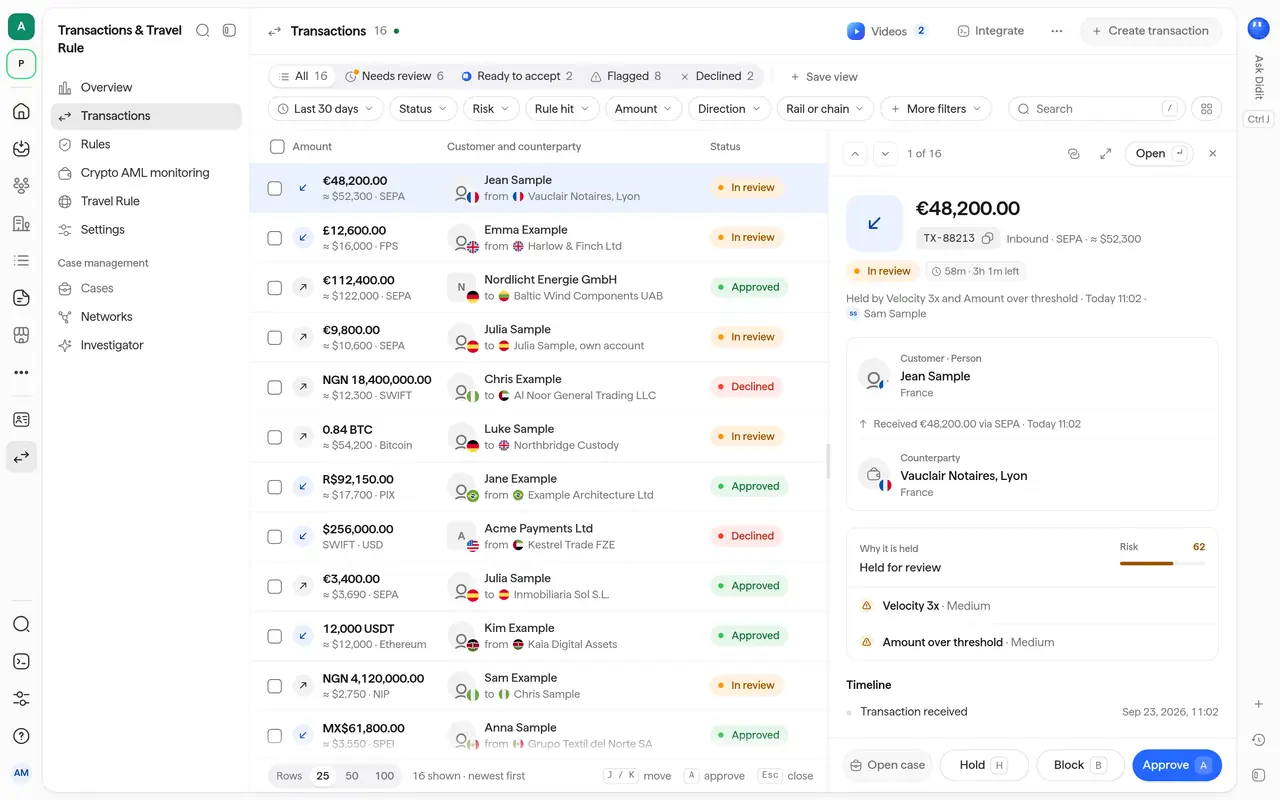
An alert is a transaction in IN_REVIEW or AWAITING_USER. There is no separate alert record: the held transactions are the reviewer queue, and they are triaged in the Business Console. Register a webhook destination so your team hears about holds through the documented webhook events:
curl -X POST https://verification.didit.me/v3/webhook/destinations/ \
  -H "x-api-key: YOUR_API_KEY" \
  -H "Content-Type: application/json" \
  -d '{
    "label": "TM events",
    "url": "https://yourapp.com/webhooks/didit-tm",
    "subscribed_events": ["transaction.created", "transaction.status.updated"]
  }'
The response carries secret_shared_key. Save it, and verify the X-Signature-V2 HMAC on every incoming call before you trust it.
Step 8: Add the responsible gaming bundle on the same rails
Install responsible_gaming separately or alongside. Its events live in the responsible_gambling category: self_exclusion_checked, self_exclusion_match, re_registration_attempt, limit_breach_attempt, registry_status_changed. A re-registration attempt after self-exclusion is the kind of signal a bonus-abuse investigation usually needs and rarely has.
Expected output
A stored event comes back with its score and the rules that ran. This is the documented response shape:
{
  "event_uuid": "0f2b...",
  "event_id": "login-2026-08-31-000001",
  "status": "ACCEPTED",
  "score": 0,
  "rules_evaluated_count": 6,
  "rules_matched_count": 0,
  "correlation_pending": false,
  "retention_class": "standard",
  "expires_at": "2026-09-30T20:40:31.123Z",
  "idempotent_replay": false,
  "rule_matches": []
}
On the transaction side, a match shows up as status: IN_REVIEW plus an increased score, and the transaction's rule_runs[] array lists every rule that evaluated it.
Failure cases and recovery
| Symptom | Cause | Recovery |
|---|---|---|
403 event_monitoring_disabled | Event monitoring is off | Turn it on in Transactions, Settings, Event monitoring. Reads work either way |
400 against a library_keys entry, nothing installed | The rule is withheld because the rules engine cannot evaluate its conditions yet | Nothing to fix. The library does not list a withheld rule, and it returns on its own once the engine can evaluate it. An unknown key is skipped instead of erroring |
A 400 when you change an installed rule's mode | That preset is withheld and was switched to DISABLED | Leave it off. Setting any other mode answers 400 |
| The ratio rule never fires for a new player | A ratio with no denominator never matches, by design | Not a bug. No deposits is not a ratio of zero, it is no evidence, and firing there would flag every brand-new user |
400 A transaction with this transaction_id already exists. or 409 on a race | Duplicate idempotency key | Neither response returns the existing record. Read it with GET /v3/transactions/{uuid}/ instead of resubmitting |
400 on gameplay.p2p_settlement | Missing required payload keys | Send game_id, counterparty_vendor_data, stake_amount, net_result_amount, role and hand_id or round_id |
400 on occurred_at | The timestamp is more than 7 days in the past or more than 5 minutes in the future | Correct the clock on the sending side before you backfill |
| Thousands of alerts after a history import | Historical events replayed through rolling windows | Use the console CSV import with dry ingest, or install rules after ingestion finishes |
Inputs and outputs
| Direction | Field | Notes |
|---|---|---|
| In | event_id | Your identifier, unique per application. It is the idempotency key |
| In | event_category, action_type, occurred_at | Required. Category is one of ten, action is an open string up to 128 characters |
| In | subject.vendor_data | Required. Resolves to the same User a transaction resolves to |
| In | device_context.fingerprint, network_context.ip_address | Feeds the device and multi-accounting rules and the IP enrichment |
| In | payload | Category domain fields, up to 16 KB, addressable as event.payload.<key> |
| In | custom_values | Up to 100 scalar keys, addressable as custom_values.<key> |
| Out | status, score | ACCEPTED on write, plus the integer risk score |
| Out | rules_evaluated_count, rules_matched_count, rule_matches[] | The evidence: which rules ran and which fired |
| Out | retention_class, expires_at | How long the record is kept |
Opposite betting and arbitrage betting in event data
Arbitrage betting means covering every outcome of an event across markets or books so that the payout is certain whatever happens. In an iGaming abuse case the version that matters is account-level: matched bets placed inside one operator, or across a group of accounts, so that the only money at risk is the operator's bonus. The igaming_fraud bundle covers opposite betting. To build your own version, the docs expose event.gameplay.market_id, event.gameplay.side, event.gameplay.match_id, event.gameplay.net_result_amount and event.gameplay.counterparty_vendor_data, and a custom rule reads those fields to correlate the pair. Chip dumping looks similar in structure but different in intent: value moves to a colluder through a deliberately lost hand, so the pair's net results swing in opposite directions while the aggregate stays close to zero.
Paid steps and review boundaries
Three things cost money and two decisions belong to a human.
- Paying: monitoring a transaction ($0.001 beyond the allowance), onboarding a player (full ID check $0.33), and AML screening a counterparty ($0.20). Installing rules, changing modes and reading the library have no separate published price in the supplied pricing feed.
- Human review: whether a ratio threshold of 0.10 is right for your bonus terms, and whether a matched pair should be locked or just watched. A rule produces a score and a status; it does not decide that a player is a fraudster.
- Keep the decision auditable. Alerts are held transactions, so the reviewer's status change, tags and notes are the record you show a regulator. The preset rules are mapped to FATF recommendations and other documented typologies.
Worked cost example
An operator with 40,000 new players a month and 300,000 monitored transactions a month, on the Scale plan.
- Scale monthly fee: $299.00. Included monitored transactions: 100,000.
- Transactions beyond the allowance: 300,000 minus 100,000 = 200,000. At $0.001 each: 200,000 x 0.001 = $200.00.
- Player onboarding: 40,000 x $0.33 = $13,200.00 at list price.
- AML screening on high-value withdrawals, 6,000 checks x $0.20 = $1,200.00 at list price.
- List-price total: 299 + 200 + 13,200 + 1,200 = $14,899.00 a month.
- With the Scale 10% discount on Didit module prices: KYC 40,000 x $0.297 = $11,880.00, AML 6,000 x $0.18 = $1,080.00, and 299 + 200 + 11,880 + 1,080 = $13,459.00 a month.
The supplied pricing feed publishes no separate price for the rule library or for installing a rule, so the bill above comes from the unit prices listed. Transaction monitoring charges apply to transactions beyond the plan allowance, which is why the ratio windows and scopes are worth measuring before you widen a rule to every event category.
Reading the rules library from an API or an assistant
Compliance teams should change rules in the console so every change is attributable. When rules are migrated or tuned programmatically, use the Management API or the MCP tools, and remember that any library rule whose conditions the engine cannot evaluate yet is withheld: it is not listed, a request naming it in library_keys answers 400 and installs nothing, and a bundle install skips it.
Sources
- Didit docs: KYT Rules Library, 150+ preset scenarios
- Didit docs: Event Rules, velocity, ratio, sequence, correlation
- Didit docs: Event Ingestion API
- Didit docs: KYT Rules and Scoring
- Didit docs: Transaction Monitoring Quickstart
- Didit docs: Transaction Monitoring Integration
- Didit docs: KYT Alerts, held transactions and triage
- Didit pricing page and live price feed
- Didit MCP server setup
- FATF, the typologies the preset rules are mapped to
The next step is small: create a free application at business.didit.me, turn on event monitoring in the sandbox, send one bonus event and one bet event, then install the iGaming bundle in TEST mode. No sales call, and the sandbox is free on every plan.
Try it
Try this in the sandbox
Run the check this guide describes, free.
The product this post is about, taken from its topic. Run it free in the sandbox.
Author
Alberto Rosas
Co-founder and CEO

Keep reading
Other guides in the same topic.
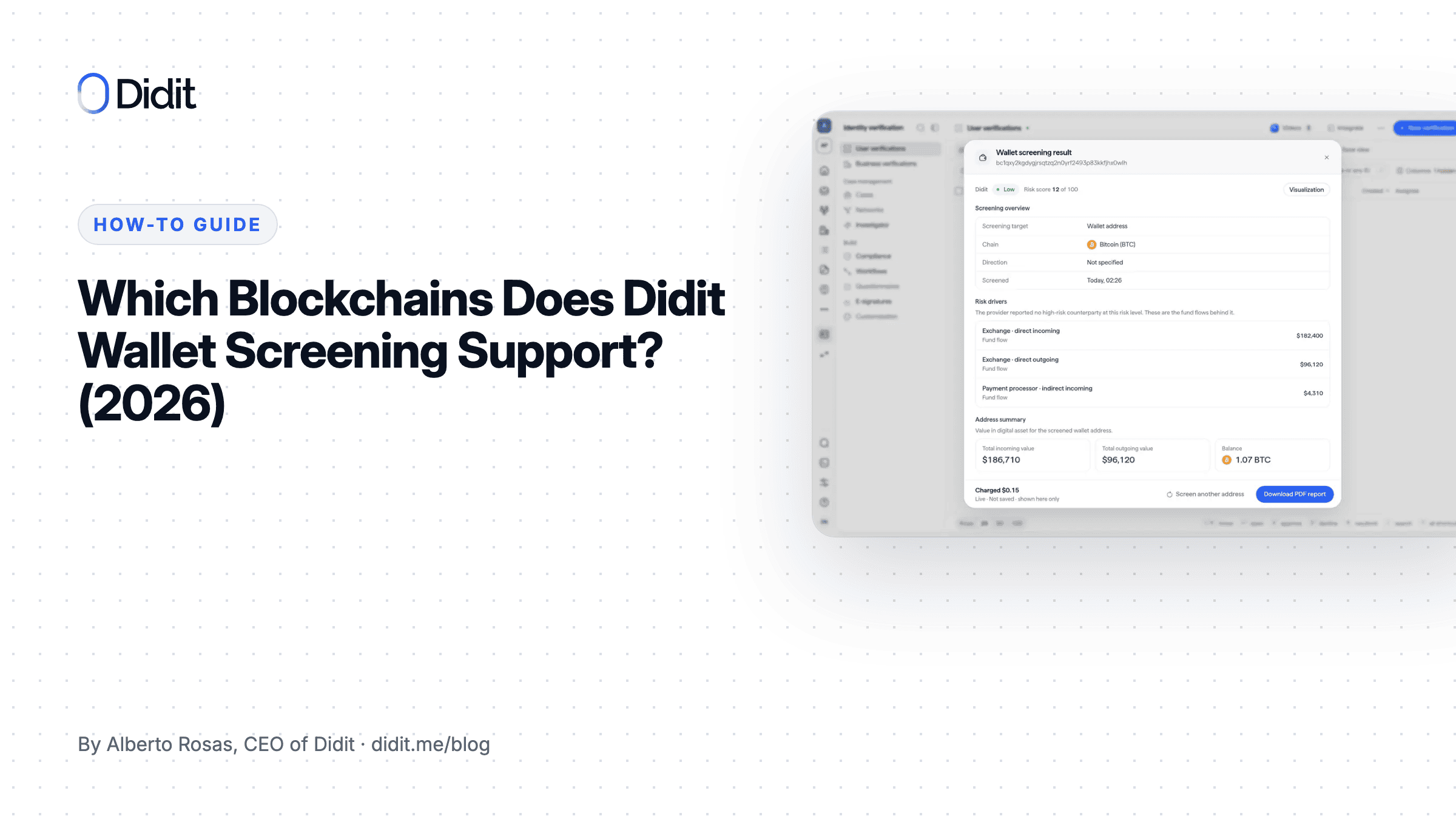 Which Blockchains Does Didit Wallet Screening Support? (2026)
Didit wallet screening accepts 23 network values. Managed screening runs 17 of them as networks. USDT and USDC are accepted values but only legacy aliases for Ethereum, not additional networks.
Alberto RosasNov 26, 2026 Test KYT Rules Before Deploy: Test Mode vs Active Mode
Didit rules run as Active, Test or Disabled. Test mode evaluates a rule and records rule-run results without changing the transaction, so you can back-test a structuring rule before you set it Active.
Alberto RosasNov 26, 2026 How to Verify a Phone Number Without an SMS OTP (2026)
Silent phone verification checks coverage, tests one number's eligibility, registers a country, and scores phone risk with POST /v3/phone/risk/, without sending an OTP.
Alberto RosasNov 26, 2026Questions
Frequently asked questions
What is the wager-to-deposit ratio rule and how do I set the threshold?
A wager-to-deposit ratio compares the sum of bet amounts against the sum of deposit amounts for one subject over a rolling window, in Didit through a ratio aggregation with bet_placed as the numerator and deposit_completed as the denominator. The documented example uses a 24 hour window and fires at 0.10 or below, where 0.10 is the documented example threshold, not a conclusion that a player is fraudulent. Presets have fixed thresholds, so the ratio is a custom rule and the threshold is yours to set against your bonus terms.
What is arbitrage betting?
Arbitrage betting is covering every possible outcome of an event, across markets or books, so that the return is certain whatever the result. Inside one operator the abuse pattern is opposite betting between two or more accounts, where the pair's combined position is close to risk-free and the operator's bonus funds are the only real stake. The bundle covers opposite betting, and a custom rule can pair accounts through the market, side and counterparty fields on gameplay events.
What is chip dumping and how does a rule catch it?
Chip dumping is deliberately losing chips to a colluder, usually at a private table, so value moves between accounts without a withdrawal. The bundle covers it, and the evidence field is the gameplay.p2p_settlement event, which must carry game_id, counterparty_vendor_data, stake_amount, net_result_amount and role, plus a hand_id or round_id. A custom rule then correlates the pair: repeated settlements between the same two subjects with a consistent direction of loss.
Does a wager-to-deposit ratio rule fire for a brand-new player with no deposits?
No, and that is deliberate. A ratio with no denominator never matches, because no deposits is not a ratio of zero, it is no evidence, and firing there would flag every brand-new user. If you need coverage before the first deposit, write a separate rule on the bonus or signup events themselves.
Why does the events endpoint return 403 when event monitoring is off?
Event ingestion is opt-in. Until you turn it on in Transactions, Settings, Event monitoring, every write lane including the batch endpoint and the device SDK lane answers 403 with {"code": "event_monitoring_disabled"}, and nothing is stored, enriched or evaluated. Read endpoints keep working, so you can check your existing data while you decide.
Can I install one rule instead of the whole iGaming bundle?
Yes. Presets install individually or by bundle from the library in the console, through the install API, or with the MCP tools. Installing a bundle is a convenience for related rules, not a commitment: you can uninstall a preset later and reinstall it without losing its identity.
What is the difference between TEST and ACTIVE mode?
In ACTIVE mode a matched rule applies its actions: it adds score, changes the status to IN_REVIEW, adds tags or opens a case. In TEST mode the rule is evaluated and the match is recorded, but the results do not affect the transaction. Start every iGaming bundle in TEST for a week so you learn its false-positive rate on your own traffic before it starts holding withdrawals.
What is chat rain farming?
Chat rain farming is collecting chat-tip or rain bonuses across several accounts controlled by one person, then consolidating the value. The igaming_fraud bundle covers it, and the device, IP, affiliate and bonus fields are inputs a custom rule can read: event.device.fingerprint, event.ip.address, event.affiliate.affiliate_code and event.bonus.bonus_id. That is why the multi-accounting and device intelligence rules usually run alongside the iGaming bundle.
Can I catch bonus abuse without sending gameplay events?
Partially. Transaction rules still catch deposit and withdrawal patterns, and the device intelligence bundle catches repeated bonus-campaign use from one fingerprint. But event-native abuse such as opposite betting, chip dumping and wager-to-deposit ratios needs the gameplay and bonus events, so those detections only start once event monitoring is on.
How much does transaction monitoring cost?
Monitoring is $0.001 per transaction beyond the plan allowance, which is 1,000 a month on Free, 10,000 on Growth and 100,000 on Scale. The plans themselves are $0 on Free, $99 a month on Growth and $299 a month on Scale, each with monthly credit. The supplied pricing feed publishes no separate price for rules, rule installation or mode changes.
Does the responsible gaming bundle conflict with the fraud rules?
No. They are separate bundles on the same engine and you can run both. The responsible gaming rules read the responsible_gambling event category, so a self-exclusion match or a limit breach attempt becomes part of the same subject timeline your fraud analysts already review.
Compliance built in
Audited, certified and attested.
We hold the certifications and build each country's rules into your flows, so you can launch anywhere without worrying. Security and Compliance center
- Regulation encoded into your flows
Tell us what you do and where. Didit lists the rules that apply to you, with sources, and builds the checks each country needs into one workflow.
- Ready for AMLR
Every requirement of the new EU anti-money laundering rules, from checking customers to human review, is already covered by a Didit check.
- Tested in Spain's Treasury sandbox
Spain's Treasury published its supervised sandbox report on Didit's NFC plus active liveness onboarding; SEPBLAC took part and valued the added measures positively.
- Audited, not self-declared
iBeta Level 1 and Level 2. Liveness tested under ISO/IEC 30107-3.
Your obligations · 3 regions
 SOC 2 Type 2
 ISO 27001
 iBeta Level 1 and Level 2
 EU regulator attestation
 FSM youth protection
 GDPR
 EBA remote onboarding
 MiCA compatible
 FIDO Alliance member
- AMLREU AML Regulation ready
Integration · Didit MCP
Run Didit from your own AI agent
Connect Didit to Claude, Cursor, VS Code or ChatGPT and just ask in plain words. Your agent can do anything you can do in the console, with the same permissions you have.
 Add to Claude
 ChatGPT
 Cursor
- Build workflowsDescribe the checks you need. The agent creates and publishes the flow.
- Run investigationsAsk why a session was declined, review cases, search people and companies.
- Change rulesCreate payment rules, test them on past data and switch them on.
- Pull reportsAsk for numbers, exports or the audit log.
Didit Academy


