How to Verify a Phone Number Without an SMS OTP (2026)
Silent phone verification checks coverage, tests one number's eligibility, registers a country, and scores phone risk with POST /v3/phone/risk/, without sending an OTP.
 Alberto RosasCo-founder and CEO
Contents
In this guide
Jump to the part you need.
Silent phone verification is for teams that need a decision on a phone number without asking the user for a code. We check which countries can be verified silently, test one number's eligibility, and score its risk with POST /v3/phone/risk/. The live price feed publishes per-code prices, the carrier price plus our $0.02 fee, and no separate risk-lookup price. The caveat is coverage: silent checks need an approved country route and an eligible number, so every flow keeps an OTP fallback.
Last updated: November 26, 2026. Prices checked against the live Didit price feed on November 26, 2026.
| Capability | Question it answers | API reference | Published price |
|---|---|---|---|
| Check coverage | Which countries can be verified silently today | Check coverage | Not listed as a separate line |
| Check a number | Whether one number is eligible for a silent check right now | Check eligibility | Not listed as a separate line |
| Register a country | Ask the carriers to enable silent checks in a country | Register a country | Not listed as a separate line |
| Track approval | Where a country registration stands | Registration status | Not listed as a separate line |
| Score phone risk | Carrier, line type, porting and fraud risk with no OTP | Score phone risk | Not published as a separate line in the sources we cite |
| OTP fallback | Confirm ownership of the number with a code | Send and check a code | Carrier price plus $0.02 per code |
Start free in the sandbox at https://business.didit.me/ with no sales call, and read every list price at https://didit.me/pricing/. The Didit phone verification page, with the per-country code prices, is https://didit.me/pricing/phone/, and the API reference is docs.didit.me/standalone-apis/phone-verification. If you build with an AI assistant, connect Didit's MCP server and call the same phone endpoints from your agent.
What silent verification actually does
Four capabilities sit around one decision. Coverage tells you whether a country can be checked without a code. Eligibility tells you whether one specific number can be checked silently at this moment. Country registration is how a route gets enabled in the first place, and the status call tells you when the carriers have approved it.
The sources we cite publish a phone code price: the carrier price for the country and channel plus Didit's $0.02 fee. They do not publish a separate Phone risk API price, so ask us for the current lookup rate before you model it. Coverage, eligibility, registration and status are not listed as separate published lines either, so confirm their billing with us before you model those three as per-user costs.
The risk score is the part you can call on day one. POST /v3/phone/risk/ scores carrier, line type, porting and fraud risk without sending anything to the user. The docs describe it as scoring without sending an OTP, and the sources we cite carry no separate list price for that lookup.
A risk lookup is not a verification record. The docs state that a phone risk lookup is not a verification and is not listed in verification history, and they point you to GET /v3/phone/lookups/ for lookups. Verification history, read with GET /v3/phone/verifications/, holds the records the send and check pair creates, with every attempt. Keep that separation in your own reporting: a lookup is a signal, a verification is a record.
Risk signals, silent eligibility and ownership are three different things
This distinction decides how you build the flow, so write it down before you write code.
| Layer | What it tells you | What it does not tell you | How to get it |
|---|---|---|---|
| Silent eligibility | Whether the mobile network can answer for this number, in this country, right now | That the person holding the handset is your user | Eligibility call |
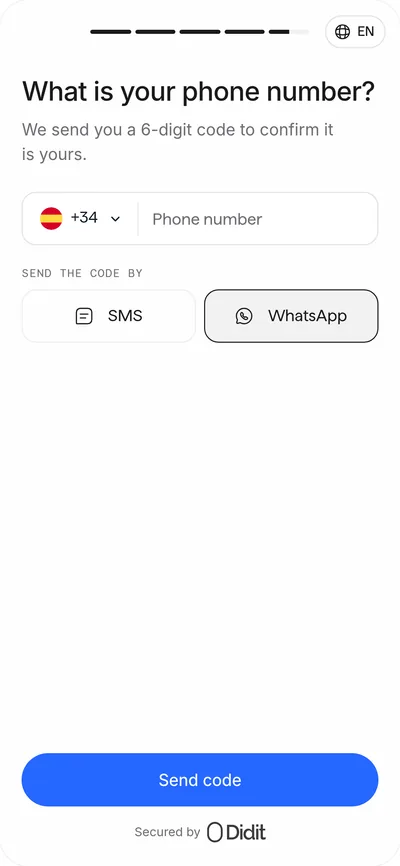
| Phone risk signals | Carrier and line type, disposable, virtual, ported, plus warning codes | That the number was confirmed with its owner | Risk lookup |
| Ownership confirmation | That whoever completed the step received a code on that number | Anything about the person beyond control of the number | Send then check |
We do not treat eligibility or a risk score as confirmed ownership. Those signals inform your application's decision, and when ownership of the number has to be established the documented OTP flow stays the confirmation path. A silent path is a faster decision on risk, not a replacement for proof of control.
When this fits and when it does not
Silent verification fits high-volume signup, periodic re-checks of numbers you already hold, and any flow where an SMS code is a measurable cost per user. It also fits pure risk screening: you can score 10,000 numbers for carrier type, disposable and virtual-number signals without sending a single message. Didit runs identity and fraud checks for 4,000+ companies, and phone sits inside that catalogue as one module.
It does not fit every country. If coverage does not list the country, or the registration for that country is not approved yet, there is nothing to call. If eligibility says the number cannot be checked silently, the honest answer to the user is a code. Build the fallback first, then turn on silence where the route is approved.
Prerequisites
- A Didit account and an API key sent in the
x-api-keyheader on every call. - Numbers in E.164 format, for example
+14155552671, on the send and risk inputs. The send endpoint answers HTTP 400 for anything else. - Credit that can pay for Phone. Phone codes are excluded from Free plan credit, and sending codes needs a paid Growth or Scale plan or your organization's first top-up. Risk lookups skip the first-top-up requirement but still need enough credit to cover them.
- An approved country registration before you rely on silent results for real users.
- A written threshold for what a risk score has to clear, and a defined point where you ask for a code instead of deciding silently.
Step by step
- Check coverage. Call the coverage reference for the countries in your funnel and note which ones are live. This is a planning call, not a per-user call. Running it once per country and storing the answer next to your routing rules is our implementation guidance; the docs do not prescribe how you store or route on it.
- Check one number's eligibility. Before you promise a silent path for a user, ask the eligibility endpoint about that number. The answer is per number and per moment, so treat a negative as final for this session.
- Register the country you need. If coverage shows a country you want but it is not registered, create the registration. The network registration endpoints also let you add a test number and remove it again, which is how you confirm routing before live traffic touches it.
- Track approval status. Poll the registration status endpoint until the country is approved. Do not switch a country to silent in production on the strength of a submitted registration. Wait for the approval.
- Score the phone risk. Call
POST /v3/phone/risk/with the number. It returns carrier, line type, porting and fraud risk, and it does not message the user. The Score Phone Risk reference is the canonical schema for the request and the response. - Decide, then confirm ownership if you need proof. If the country is approved and the number is silent eligible and the risk score clears your policy, the signals support letting the user through in flows where a risk decision is enough. When control of the number has to be established, the OTP pair below stays the confirmation path.
- Record and review. Store which path was used, silent or OTP, and the signals that drove the decision. Anything your policy cannot settle goes to a human reviewer.
Runnable example
Score the number first, with no message to the user. The risk endpoint takes the same x-api-key header and an E.164 number.
curl -X POST 'https://verification.didit.me/v3/phone/risk/' \
  -H "x-api-key: $DIDIT_API_KEY" \
  -H "Content-Type: application/json" \
  -d '{
    "phone_number": "+14155552671"
  }'
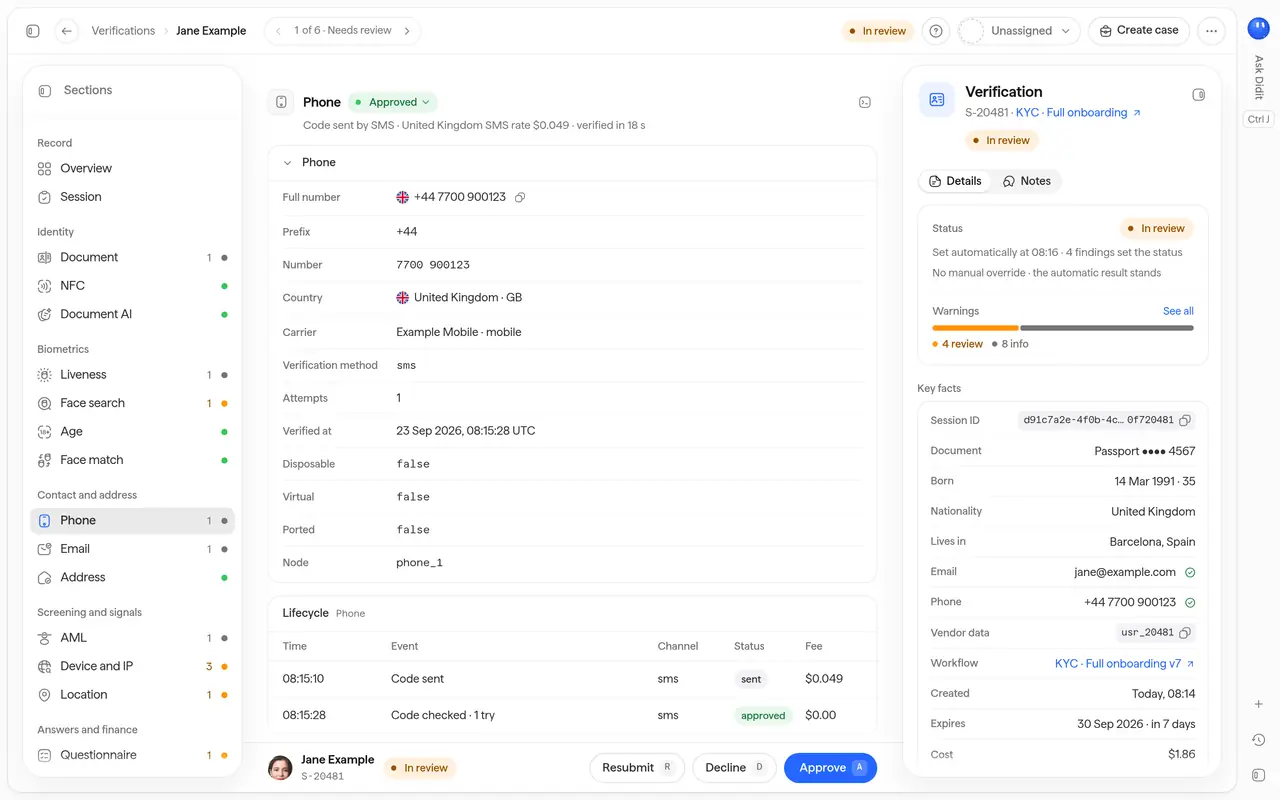
If the country is not approved, the number is not silent eligible, or the risk score fails your threshold, fall back to the documented send and check pair. The user types the code into your UI, and the default code window is 5 minutes from the first send. A same-window retry keeps that deadline.
curl -X POST 'https://verification.didit.me/v3/phone/send/' \
  -H "x-api-key: $DIDIT_API_KEY" \
  -H "Content-Type: application/json" \
  -d '{
    "phone_number": "+14155552671",
    "options": {
      "code_size": 6,
      "preferred_channel": "whatsapp",
      "locale": "en-US"
    },
    "vendor_data": "user-1234"
  }'
The check call completes the pair. Add the verification_id returned by send so the check applies to that specific verification.
curl -X POST 'https://verification.didit.me/v3/phone/check/' \
  -H "x-api-key: $DIDIT_API_KEY" \
  -H "Content-Type: application/json" \
  -d '{
    "phone_number": "+14155552671",
    "code": "123456",
    "voip_number_action": "DECLINE"
  }'
Expected output
The risk lookup returns the phone metadata the docs list for a completed check: carrier, line type, disposable flag, VoIP flag and ported status. The risk signals are is_disposable for throwaway numbers, is_virtual for VoIP or virtual numbers, and carrier.type with a value of mobile, landline or voip.
When a code is involved, the verification carries a status from the documented enum: Not Started, In Progress, Approved, Declined, Failed, Expired or Not Found, Abandoned, or Kyc Expired. Warnings arrive in the phone warnings array with codes such as DUPLICATED_PHONE_NUMBER, DISPOSABLE_NUMBER, VOIP_NUMBER, INVALID_PHONE_NUMBER, OTP_DELIVERY_FAILED, OTP_MAX_ATTEMPTS_REACHED, OTP_EXPIRED and PHONE_NUMBER_BLOCKED. The full catalogue sits in the Phone Verification overview.
Inputs and outputs
| Field | Direction | Format | What it means |
|---|---|---|---|
phone_number | Input | E.164 string | The number being scored or verified, for example +14155552671. |
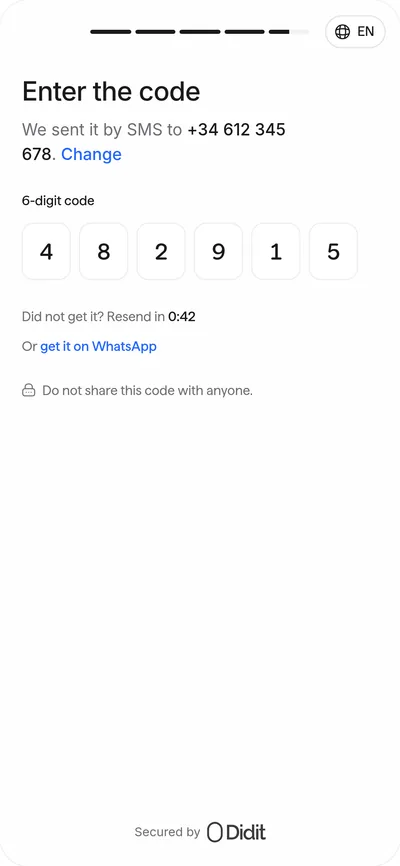
options.preferred_channel | Input, OTP only | whatsapp, sms, telegram, voice, viber | WhatsApp is the default. Delivery falls back to SMS if the preferred channel is unavailable. |
options.code_size | Input, OTP only | Integer | Number of digits in the code. |
vendor_data | Input, OTP only | String | Your own user reference, returned with the result. |
verification_id | Input, OTP only | String | The id returned by send, so the check applies to that specific verification. |
voip_number_action | Input, check only | Enum | The action to take when the number is a VoIP line, for example DECLINE. |
carrier.type | Output | mobile, landline, voip | The line type behind the number. |
is_disposable | Output | Boolean | Temporary or throwaway number. |
is_virtual | Output | Boolean | VoIP or virtual number. |
status | Output | Enum | The verification status, from Not Started through Approved, Declined, Failed or Expired or Not Found. |
Failure cases and recovery
| What you see | Why | Recovery |
|---|---|---|
| HTTP 400 on send | The number is not E.164 | Normalise to country code plus number before the call. Do not retry the same value. |
| send returns status Blocked with reason spam | Anti-abuse block | No code was sent and nothing was charged. Stop the loop for that number and route it to review. |
| check returns Failed | Wrong code, attempts remain | Re-prompt with the remaining attempts. The default limit is 5 wrong entries per standalone verification. |
| check returns Declined | The verification ended, often after the attempts limit | Do not keep prompting. Collect a different number or move to review. |
| check returns Expired or Not Found | Outside the 5-minute window, or no pending verification for that number | Start again with a fresh send. |
| Country missing from coverage, or registration not approved | No silent route available | Fall back to OTP and keep the country on your roadmap until approval is tracked as done. |
| Eligibility says the number cannot be checked silently | The network cannot answer for that number | Fall back to OTP for this session only. Re-check eligibility on the next visit. |
Paid steps and review boundaries
One published price covers this flow: a code costs the carrier price for the country and channel plus Didit's $0.02 fee. On Growth the Didit fee is $0.0192 and on Scale it is $0.018, and the carrier price passes through at cost, so only the Didit part takes the plan discount. The sources we cite do not publish a separate Phone risk API price, and coverage, eligibility, registration and status are not listed as separate published lines either, so confirm their billing with us before you treat them as per-user costs.
The review boundary is yours, not ours. We return signals: carrier type, disposable, virtual, ported, plus the warning codes. Your policy decides what counts as a pass for your product, and the check call gives you voip_number_action as the lever to decline VoIP numbers inside the verification itself. Anything your policy cannot settle goes to a human reviewer.
Worked cost example
Take 10,000 new US numbers in a month. Every number can get a risk lookup, and we assume 3,000 of them fail silent eligibility or your risk threshold and take a WhatsApp code in the United States. The sources we cite publish no separate price for the risk lookup, so the arithmetic below covers the codes only.
- US WhatsApp codes at the published $0.0431 per code: 3,000 x $0.0431 = $129.30.
- Spread over the 10,000 numbers in the funnel: $129.30 / 10,000 = $0.0129 per number.
On the Scale plan only the Didit fee drops, by 10%, and the carrier part does not move. The US WhatsApp code becomes $0.0231 of carrier plus $0.018 of fee, so $0.0411 each: 3,000 x $0.0411 = $123.30, or $0.0123 per number across the 10,000-number funnel.
Re-read the phone price list before you commit to a carrier number, because the carrier side is what moves by country and channel, and the published totals already include the $0.02 fee.
Sources
- Didit docs: Phone Verification API, SMS OTP and risk signals (read November 26, 2026)
- Didit docs: Score Phone Risk (read November 26, 2026)
- Didit docs: silent verification coverage (read November 26, 2026)
- Didit docs: silent verification eligibility (read November 26, 2026)
- Didit docs: register a country and registration status (read November 26, 2026)
- Didit docs: Send Phone Code and Check Phone Code (read November 26, 2026)
- Didit docs: Phone Verification overview and warnings (read November 26, 2026)
- Didit docs: List Phone Verifications (read November 26, 2026)
- Didit docs: pricing and billing rules and didit.me/pricing (read November 26, 2026)
- Didit phone price list (read November 26, 2026)
- Didit public price book (read November 26, 2026)
Next step: open the sandbox at https://business.didit.me/, score a number against POST /v3/phone/risk/, and check coverage for the countries in your funnel before you switch any of them to silent. No sales call is needed to start, and the MCP server lets your coding agent call the same endpoints.
Try it
Try this in the sandbox
Run the check this guide describes, free.
The product this post is about, taken from its topic. Run it free in the sandbox.
Author
Alberto Rosas
Co-founder and CEO

Keep reading
Other guides in the same topic.
 Which Blockchains Does Didit Wallet Screening Support? (2026)
Didit wallet screening accepts 23 network values. Managed screening runs 17 of them as networks. USDT and USDC are accepted values but only legacy aliases for Ethereum, not additional networks.
Alberto RosasNov 26, 2026 iGaming Fraud Rules: Bonus Abuse, Chip Dumping, Opposite Betting
Didit ships an iGaming fraud bundle of preset rules for event-native bonus abuse, opposite betting, affiliate fraud, chat rain farming, chip dumping and account takeover.
Alberto RosasNov 26, 2026 Test KYT Rules Before Deploy: Test Mode vs Active Mode
Didit rules run as Active, Test or Disabled. Test mode evaluates a rule and records rule-run results without changing the transaction, so you can back-test a structuring rule before you set it Active.
Alberto RosasNov 26, 2026Questions
Frequently asked questions
Can I verify a phone number without sending an SMS OTP?
Yes, in two ways. Silent verification asks the mobile network about a number through Didit's coverage, eligibility and country registration endpoints, so no code is sent. Separately, POST /v3/phone/risk/ scores carrier, line type, porting and fraud risk without an OTP. Silent verification only works where the country registration is approved and the number is eligible, and when ownership of the number has to be established the OTP flow is the confirmation path.
How much does a phone risk lookup cost?
The sources we cite do not publish a separate price for a phone risk lookup, so ask us for the current rate before you model it. What is published is the per-code price: the carrier price for the country and channel plus Didit's $0.02 fee, with the Didit part at $0.0192 on Growth and $0.018 on Scale. Nothing is sent to the user on a lookup, and the supplied sources do not publish a separate lookup price. Ask us for the current rate before modeling it.
Does the Free plan cover phone verification?
Phone codes are excluded from Free plan credit, and sending codes needs a paid Growth or Scale plan or your organization's first top-up. Risk lookups skip that first-top-up requirement but still need enough credit to cover them. Sandbox testing stays free on every plan.
What happens when a number is not silent eligible?
You get a negative answer for that number at that moment, and the right move is the OTP fallback. Call POST /v3/phone/send/ with the same number and let the user type the code into POST /v3/phone/check/. Our recommendation, and not documented endpoint behaviour, is not to retry the eligibility call in a loop inside one session.
How long does country registration take?
The registration depends on the carriers in that country, and the docs do not publish a fixed turnaround. What you can do is create the registration, track its approval status with the status endpoint, and add a test number to confirm routing before live traffic uses the route. Plan the OTP fallback as if approval takes time, because it does.
Which channels can the OTP fallback use?
Send accepts WhatsApp, SMS, Telegram, voice and Viber, with WhatsApp as the default and delivery falling back to SMS if the preferred channel is unavailable. Voice reads the code aloud twice, and an unanswered voice call falls back to SMS. An eligible new SMS send to a fixed line may be read out in a call and priced as a voice code, under the conditions in the Send Phone Code reference.
Do phone numbers have to be in E.164 format?
The send and risk inputs take an international format number such as +14155552671, and the send endpoint answers HTTP 400 for anything else. Normalise the number before the call rather than after a rejection. A rejected request is not a verification and does not cost a code.
How many wrong codes before the check declines?
The application setting verification.max_attempts defaults to 5 wrong entries per standalone verification. On the last wrong entry the response status becomes Declined with the attempts warning present. Re-prompt on Failed and stop prompting on Declined.
Are phone risk lookups recorded as verifications?
No. The docs state that a phone risk lookup is not a verification and is not listed in verification history, and lookups are read with GET /v3/phone/lookups/. The verification list at GET /v3/phone/verifications/ returns the records the send and check pair creates, with every attempt, and you can filter by status, channel, number or reference.
Can I test all of this without paying?
Yes. Sandbox testing is free and unlimited on every plan. Outside the sandbox, phone codes need credit and Free plan credit does not cover them, so a top-up or a paid plan is the shortest path to a live test.
Compliance built in
Audited, certified and attested.
We hold the certifications and build each country's rules into your flows, so you can launch anywhere without worrying. Security and Compliance center
- Regulation encoded into your flows
Tell us what you do and where. Didit lists the rules that apply to you, with sources, and builds the checks each country needs into one workflow.
- Ready for AMLR
Every requirement of the new EU anti-money laundering rules, from checking customers to human review, is already covered by a Didit check.
- Tested in Spain's Treasury sandbox
Spain's Treasury published its supervised sandbox report on Didit's NFC plus active liveness onboarding; SEPBLAC took part and valued the added measures positively.
- Audited, not self-declared
iBeta Level 1 and Level 2. Liveness tested under ISO/IEC 30107-3.
Your obligations · 3 regions
 SOC 2 Type 2
 ISO 27001
 iBeta Level 1 and Level 2
 EU regulator attestation
 FSM youth protection
 GDPR
 EBA remote onboarding
 MiCA compatible
 FIDO Alliance member
- AMLREU AML Regulation ready
Integration · Didit MCP
Run Didit from your own AI agent
Connect Didit to Claude, Cursor, VS Code or ChatGPT and just ask in plain words. Your agent can do anything you can do in the console, with the same permissions you have.
 Add to Claude
 ChatGPT
 Cursor
- Build workflowsDescribe the checks you need. The agent creates and publishes the flow.
- Run investigationsAsk why a session was declined, review cases, search people and companies.
- Change rulesCreate payment rules, test them on past data and switch them on.
- Pull reportsAsk for numbers, exports or the audit log.
Didit Academy


