How to Decode a TRP Travel Address and Send a Travel Rule Inquiry
A ta address is Base58Check over an HTTPS URL: strip ta, decode with the Bitcoin alphabet, verify the double SHA-256 checksum, prepend https, then GET the identity and POST the inquiry to the t=i path.
 Alberto RosasCo-founder and CEO
Contents
In this guide
Jump to the part you need.
This guide is for the engineer or compliance lead holding a ta... string from a counterparty VASP and needing a working TRP inquiry from it. Decoding is free and needs no Didit account. Running the exchange through Didit costs $0.02 per outbound exchange. Didit's public TRP host (TRP API version 3.2.1, at https://trp.didit.me) is documented but does not serve requests yet, so today you decode to reach other VASPs, or let Didit's TRP rail place the call for you.
Last updated: November 26, 2026. Prices checked against the live Didit price feed on November 26, 2026.
| Item | Value |
|---|---|
| Prefix | ta |
| Encoding | Base58Check, Bitcoin alphabet, four byte checksum from a double SHA-256 |
| Decoded result | An HTTPS URL carrying the query pair t=i |
| VASP level inquiry path | /trp/inquiries/{profile_uuid}/ |
| Per wallet variant | /wallets/{entry_uuid}/ |
| Identity route | GET https://{host}/trp/identity/{profile_uuid}/ |
| Didit public TRP host | https://trp.didit.me, TRP API version 3.2.1, does not serve requests yet |
| Cost to decode | $0.00, no account, no API key |
| Didit Travel Rule price | $0.02 per outbound exchange |
Start free in the sandbox at business.didit.me, no sales call, and nothing is charged in sandbox. Travel Rule runs inside Didit Transaction Monitoring, and every unit price is published on didit.me/pricing. If you work from an AI assistant, connect Didit's MCP server instead of writing the calls by hand.
What a travel address actually contains
A travel address is a VASP's TRP inquiry endpoint, encoded as text. It starts with the two characters ta, followed by Base58Check data over the UTF-8 text of a URL, using the Bitcoin alphabet and a four byte checksum taken from a double SHA-256 of the payload. That is the whole format. The address says where to send an inquiry. It does not authenticate the counterparty and it does not tell you who they are. The identity check does that, which is why it comes before the inquiry in the steps below.
Two URL shapes come out of the decoder. The VASP level address resolves to https://{host}/trp/inquiries/{profile_uuid}/ and reaches the institution as a whole. The per wallet variant ends in /wallets/{entry_uuid}/ and is scoped to one address book entry, so an inquiry sent there is tied to that one wallet. Everything else, the host, the scheme and the t=i query pair, is the same.
Decode it yourself, or let Didit place the call
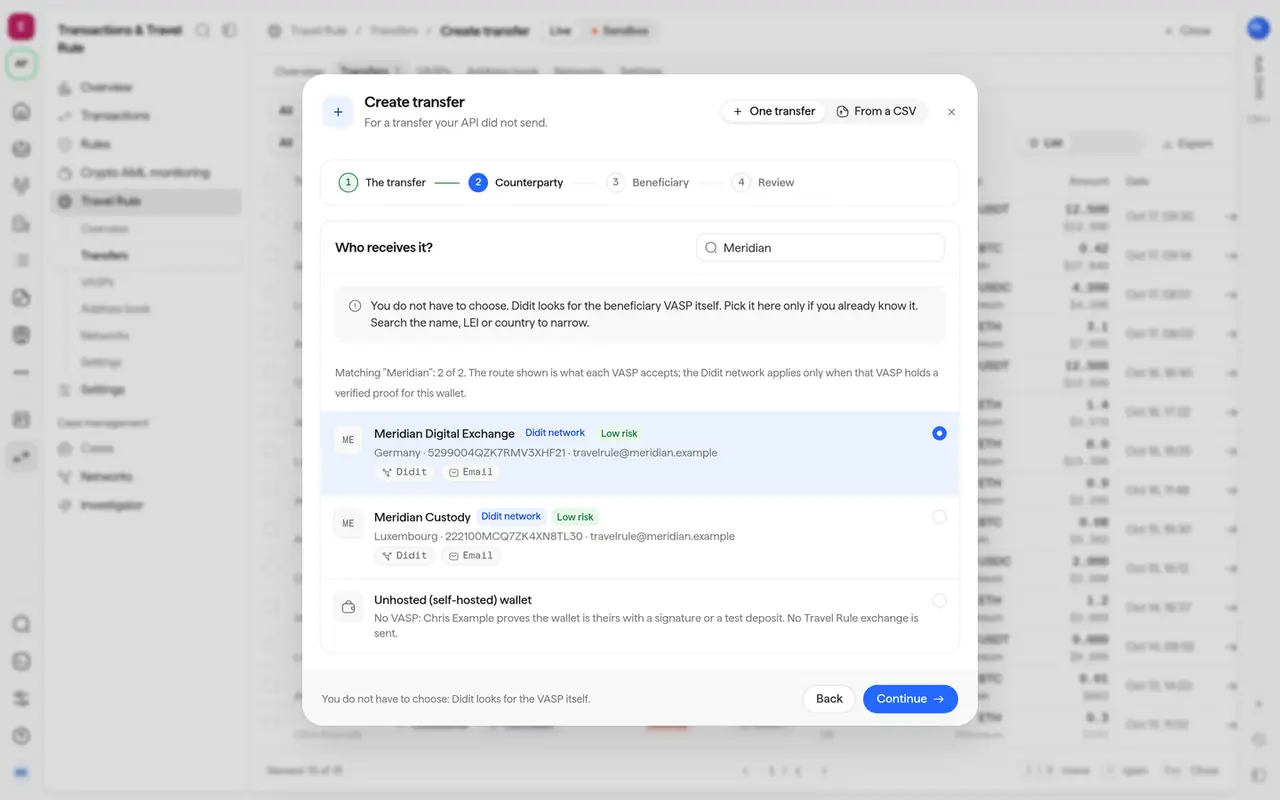
There are two ways to reach a live inquiry. The first is to let Didit do the work. When you submit a transfer with transaction_category: "travelRule", Didit tries its rails in strict priority order and TRP is second, directly after INTERNAL. It calls the counterparty's inquiry endpoint machine to machine for BTC, ETH and USDC, the last one when the transfer names the network it moves on. No email round trip, no manual decode.
The second is to decode the address and call the endpoint yourself. That is the right method when you are on the receiving side of an exchange, when you are debugging a rail that did not fire, or when you are not a Didit customer at all. In one sentence: decoding a counterparty address is a local read of where to send data, while sending an exchange through Didit's managed Travel Rule product is the paid path that places the call, tracks the 13-state lifecycle and tells you when to release funds.
The interoperability documentation is public infrastructure: you need no Didit account, no API key and no commercial relationship to read it and to call a counterparty's TRP endpoint. The documented TRP API version is 3.2.1 at https://trp.didit.me, and that public TRP host does not serve requests yet, so treat the Didit-hosted examples below as the documented contract. A counterparty's own host is where a live call lands today.
Prerequisites
- The travel address itself, as text. Counterparties usually send it in a compliance email, and it also sits on their entry in a VASP directory.
- Python 3.8 or newer, or any language with a Base58Check implementation and SHA-256. The script below uses the standard library only.
- HTTPS egress to the host inside the decoded URL. Nothing else, no key material for the decode itself.
- If you want your own travel address to test against, a Didit application with Travel Rule enabled. The address lives in the
travel_addressfield of Get Travel Rule Settings and is empty untilis_enabledis true.
Decode and send, step by step
Step 1: Get the address and look at its shape
A travel address looks like the example Didit publishes in its settings documentation, a long Base58 string with no spaces and no punctuation:
ta2ih1MicegQ3JqiKz9xT89KsSuwaDJYw8DgzmeS5uNDp3dGW3bweBWLKws442chRsyNxmmJnyWc7frxjjSeABVsYR11UuBePkw6ECharacters 0, O, I and l never appear in a valid one. If you see them, the string was retyped or transcribed from an image. This example is Didit's own travel address, so it decodes to trp.didit.me. A counterparty's address decodes to that counterparty's host.
Step 2: Strip the ta prefix
The prefix is a marker, not data. Remove exactly the two characters ta and keep the rest byte for byte. Nothing else is stripped, and the string is not trimmed of anything but whitespace at the ends.
Step 3: Base58Check decode with the Bitcoin alphabet
Decode the remainder with the Bitcoin alphabet, 123456789ABCDEFGHJKLMNPQRSTUVWXYZabcdefghijkmnopqrstuvwxyz, remembering that a leading 1 is a leading zero byte. The last four bytes of the result are the checksum. The bytes before them are the payload.
Step 4: Verify the double SHA-256 checksum and prepend https
Hash the payload with SHA-256, hash that digest with SHA-256 again, and compare the first four bytes of the second digest with the checksum you just split off. If they match, decode the payload as UTF-8. That text is the URL. Prepend https:// if the scheme is not already there, and keep the t=i query pair intact, because that pair is what marks the endpoint as an inquiry endpoint rather than some other TRP route.
import hashlib

ALPHABET = "123456789ABCDEFGHJKLMNPQRSTUVWXYZabcdefghijkmnopqrstuvwxyz"

def b58decode(s):
    n = 0
    for ch in s:
        n = n * 58 + ALPHABET.index(ch)
    body = n.to_bytes((n.bit_length() + 7) // 8, "big")
    leading_zeros = len(s) - len(s.lstrip("1"))
    return b"\x00" * leading_zeros + body

def decode_travel_address(ta):
    if not ta.startswith("ta"):
        raise ValueError("missing ta prefix")
    raw = b58decode(ta[2:])
    payload, checksum = raw[:-4], raw[-4:]
    digest = hashlib.sha256(hashlib.sha256(payload).digest()).digest()
    if checksum != digest[:4]:
        raise ValueError("checksum mismatch")
    url = payload.decode("utf-8")
    if not url.startswith("https://"):
        url = "https://" + url
    return url

ta = "ta2ih1MicegQ3JqiKz9xT89KsSuwaDJYw8DgzmeS5uNDp3dGW3bweBWLKws442chRsyNxmmJnyWc7frxjjSeABVsYR11UuBePkw6E"
print(decode_travel_address(ta))
Run it against the string the counterparty sent you, not the example above, and you have the endpoint.
Step 5: Check the identity before you send anything
Take the profile_uuid from the decoded URL and call the identity route on the host inside that URL. The documented route is https://{host}/trp/identity/{profile_uuid}/. This returns the VASP profile behind the address. Do it first so you know which institution you are about to exchange personal data with, and so you can match the name against your own due diligence records. For the example above the host is trp.didit.me, which is documented but does not serve requests yet. For a counterparty address, the host is the counterparty's and the same path applies.
curl -s "https://{host}/trp/identity/{profile_uuid}/" \
  -H "Accept: application/json"
Step 6: Post the inquiry
The inquiry goes to the decoded path itself, with the t=i pair still on the request. The body is the originator and beneficiary data for that transfer.
curl -s -X POST "https://{host}/trp/inquiries/{profile_uuid}/?t=i" \
  -H "Content-Type: application/json" \
  -d @inquiry.json
An answer returned in the inquiry response completes or declines the exchange at once. If you are the receiving VASP, that answer is your accept or your decline, and it is the fastest path because nothing else has to poll.
Step 7: Handle the per wallet variant
If the decoded URL ends in /wallets/{entry_uuid}/, the address is bound to one address book entry. Send there only while that wallet is the one in the transfer. Once the wallet is deleted, or the entry is recorded to another VASP, that address answers 404. That is expected behaviour, not an outage. Fall back to the VASP level /trp/inquiries/{profile_uuid}/ address, or ask the counterparty for a fresh wallet address.
Expected output
A successful decode prints a URL, nothing else. For a VASP level address the shape is:
https://{host}/trp/inquiries/{profile_uuid}/?t=iFor a per wallet address the same URL gains the wallet segment:
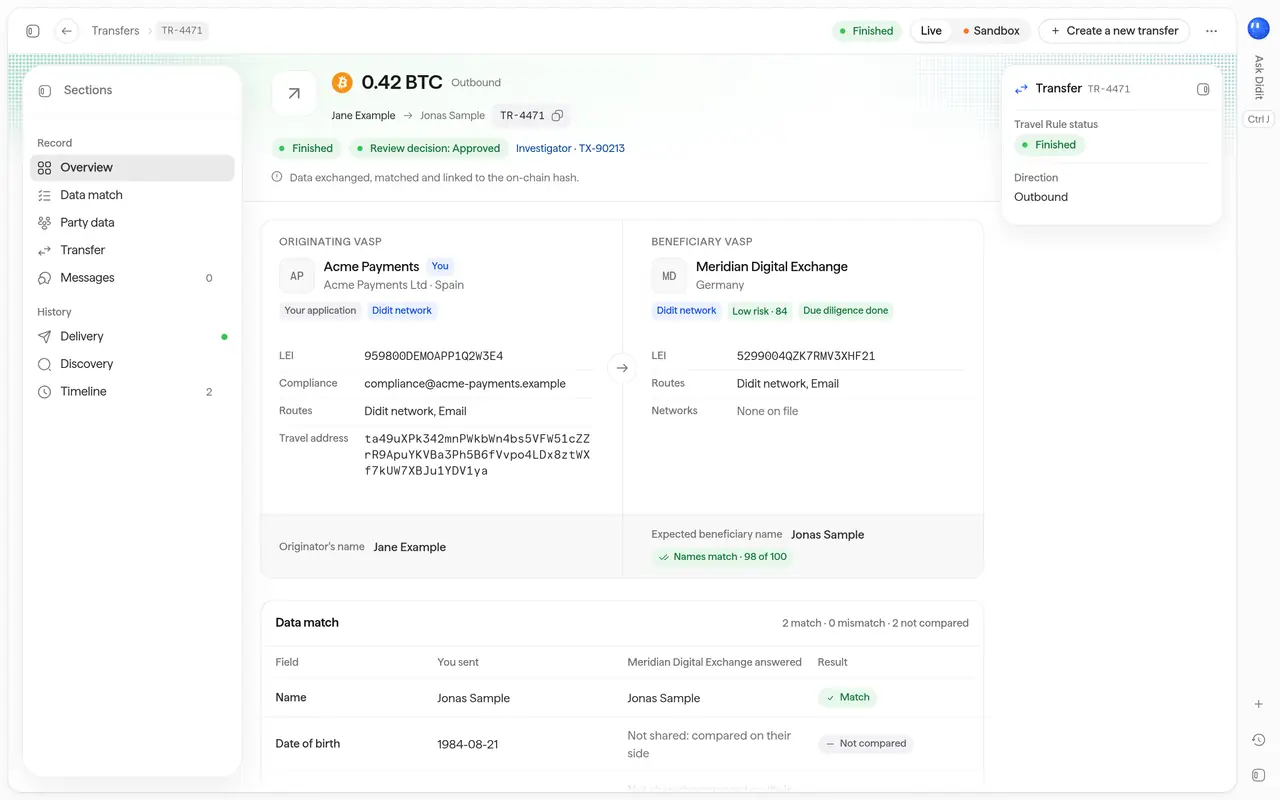
https://{host}/trp/inquiries/{profile_uuid}/wallets/{entry_uuid}/?t=iThe identity call returns the VASP profile behind that UUID in JSON. The inquiry call returns the counterparty's answer. Only when the exchange reaches COMPLETED may you broadcast on chain. Do not broadcast after a decline.
Failure cases and recovery
| Symptom | Likely cause | Recovery |
|---|---|---|
The string does not start with ta | It is a plain URL or a domain, not a travel address | Ask for the travel address from the counterparty's settings, or find its directory entry |
A character outside the alphabet appears, such as 0 or O | Retyped by hand or read from a screenshot | Request the string as text and decode again |
| Checksum mismatch | The string was truncated or altered in transit | Re-request it. Never try to repair a checksum by guessing bytes |
| The decoded host does not answer over HTTPS | Egress blocked, the counterparty does not run TRP, or the host is Didit's own and not live yet | Retry the VASP level address first, then fall back to the email pickup rail if you are on Didit |
404 on GET /trp/identity/{profile_uuid}/ | No VASP profile behind that UUID | Confirm the address belongs to the institution you think it does before sending personal data |
404 on a /wallets/{entry_uuid}/ address | The wallet was deleted, or recorded to another VASP | Use the VASP level inquiry address, or ask for a current wallet address |
The inquiry is accepted but the transfer sits in AWAITING_COUNTERPARTY | The counterparty has not answered | On Didit's rail, confirmation_timeout_hours and timeout_outcome decide what happens when the deadline passes |
If you are debugging on the Didit side, the delivery history endpoint lists every send and answer entry for a transaction with a rail value of TRP or NETWORK and a status of QUEUED, SENDING, RETRYING, DELIVERED or FAILED. That tells you whether the inquiry left your system at all.
Inputs and outputs
| Input | You supply | Output |
|---|---|---|
| Travel address string | ta... as text | The HTTPS inquiry URL with t=i |
profile_uuid | The UUID from the decoded path | The counterparty VASP profile |
| Inquiry body | Originator and beneficiary data for the transfer | An accept or a decline from the counterparty |
| On chain hash | The transaction hash after broadcast | The exchange closes as finished |
Paid steps and review boundaries
Decoding a travel address is free, forever, for anyone. There is no Didit price on the decode, on the identity check or on the inquiry itself. Didit charges Travel Rule at $0.02 per outbound exchange, billed once per exchange regardless of later status transitions, and nothing is charged in sandbox.
Three settings define where the automated part stops and human review begins for a Didit customer. name_matching_strictness (NONE, STRICT, DEFAULT or FUZZY) decides how a returned beneficiary name is matched against the one you sent. confirmation_timeout_hours and timeout_outcome (HOLD, REJECT or PROCEED) decide what an unanswered inquiry does to its transaction. sunrise_policy and non_responsive_policy override that for sunrise jurisdictions, which are currently CO, KH and VN. Counterparty screening is opt in: counterparty_screening_enabled defaults to false and nothing is screened or billed until you turn it on, at which point each screening is billed at the Company AML Screening price of $0.20.
Worked cost example
Take a VASP that sends 500 outbound exchanges in a month and wants to know what the Travel Rule line costs. At list price, 500 × $0.02 = $10.00. On Growth, with the 4 percent plan discount, the unit price is $0.0192, so 500 × $0.0192 = $9.60. On Scale, at 10 percent off, the unit price is $0.018, so 500 × $0.018 = $9.00. Decoding the addresses for those 500 exchanges adds $0.00.
Optional add-on: counterparty screening
Counterparty screening is a separate scenario, not part of the Travel Rule price. It is off by default. If you turn on counterparty_screening_enabled and screen every one of those 500 exchanges, each screening is billed at the Company AML Screening price of $0.20: 500 × $0.20 = $100.00. That takes the list price month to $10.00 + $100.00 = $110.00. Run the same volume in sandbox first and the bill is $0.00, because sandbox testing is free and unlimited on every plan.

Sources
- Travel Rule Interoperability, Reach a Didit VASP (travel addresses, TRP endpoints, rail priority)
- FATF Travel Rule API, VASP compliance (rails, pricing, lifecycle, assets over TRP)
- Get Travel Rule Settings (travel address field, name matching, timeout and screening settings)
- Travel Rule delivery history (rail and status per delivery entry)
- Didit pricing and pricing in the docs
- Didit MCP server
- FATF, Recommendation 16 and virtual asset guidance, read November 26, 2026
Next step: open a sandbox application at business.didit.me, turn Travel Rule on, read your own travel_address from GET /v3/travel-rule/settings/, and run the script above on it to check the decode. Running the script on Didit's own address only demonstrates decoding, because Didit's public TRP host at https://trp.didit.me does not currently serve requests. To exercise a live inquiry, point the script at a counterparty's travel address instead. No sales call, nothing charged in sandbox.
Try it
Try this in the sandbox
Run the check this guide describes, free.
The product this post is about, taken from its topic. Run it free in the sandbox.
Author
Alberto Rosas
Co-founder and CEO

Keep reading
Other guides in the same topic.
 White-Label Didit OTP Emails: Custom Sender Guide for 2026
Pass the white-label option to POST /v3/email/send/ and that standalone OTP email uses your application's configured white-label sender and branding. The default is false, so Didit branding applies.
Alberto RosasNov 26, 2026 Didit Document AI API vs the Hosted Workflow Step (2026)
Both paths use the same Document AI engine at $0.20 per document. Use the standalone API when your server already holds the file. Use the hosted step when a user uploads it, when one flow needs up to 3 documents, or when the.
Alberto RosasNov 26, 2026 Didit Bank Connection Lifecycle: Refresh vs Renew vs Revoke vs Delete
Refresh pulls new data into the same connection and never extends consent. Renew extends consent and keeps connection and account ids. Revoke stops access; delete erases the connection.
Alberto RosasNov 26, 2026Questions
Frequently asked questions
How do I decode a travel address that starts with ta?
Strip the two characters ta, Base58Check decode the rest with the Bitcoin alphabet, split the last four bytes off as a checksum, verify that checksum against the first four bytes of a double SHA-256 of the remaining payload, then decode the payload as UTF-8 and prepend https://. The result is the TRP inquiry URL, ending in the query pair t=i.
What is the t=i query pair at the end of a decoded travel address?
It marks the endpoint as an inquiry endpoint. A travel address resolves to an inquiry URL, so t=i has to stay on the request you send. Drop it and you are no longer calling the documented inquiry route.
Does decoding a travel address cost anything or need a Didit account?
No. The decode is arithmetic you run locally, and Didit's Travel Rule interoperability documentation and public TRP infrastructure need no account, no API key and no commercial relationship. Didit charges $0.02 per outbound Travel Rule exchange only when the exchange runs on Didit.
What is the difference between the profile_uuid address and the wallets entry_uuid address?
The VASP level address, /trp/inquiries/{profile_uuid}/, reaches the institution as a whole. The per wallet variant ends in /wallets/{entry_uuid}/ and is scoped to a single address book entry, so an inquiry sent there is tied to that one wallet.
Why does a per wallet travel address return 404?
Because the entry behind it is gone. Once a wallet is deleted, or its entry is recorded to another VASP, the per wallet address answers 404. Use the VASP level /trp/inquiries/{profile_uuid}/ address instead, or ask the counterparty for a current wallet address.
Should I call GET /trp/identity/{profile_uuid}/ before sending an inquiry?
Yes, when the host is live. It returns the VASP profile behind the address, so you know which institution receives the originator and beneficiary data, and you can match the name against your own records. It runs against the host inside the decoded URL. For Didit's own address that host is trp.didit.me, which is documented but does not serve requests yet.
Where do I find my own travel address in Didit?
It is the read only travel_address field of Get Travel Rule Settings. It is empty until is_enabled is true, so enable Travel Rule on the application before you share it with counterparties.
Does Didit's public TRP host answer requests today?
No. The interoperability page states that Didit's public TRP host is documented but does not serve requests yet. Treat the endpoints on this page as the documented contract, decode against other VASPs' travel addresses, and check the interoperability page before you build an inbound path to a Didit customer.
Can I skip the decode and let Didit send the inquiry?
Yes, if you run Travel Rule on Didit. When you submit a transfer with transaction_category: "travelRule", Didit tries its rails in priority order and TRP is second after INTERNAL, calling the counterparty's inquiry endpoint machine to machine for BTC, ETH and USDC. The decode is for the receiving side, for debugging, and for teams outside Didit.
Which assets can move over TRP?
BTC, ETH and USDC, with the USDC case applying when the transfer names the network it moves on. Transfers that TRP cannot reach fall through to the next rail in priority order, ending with the email pickup fallback.
Compliance built in
Audited, certified and attested.
We hold the certifications and build each country's rules into your flows, so you can launch anywhere without worrying. Security and Compliance center
- Regulation encoded into your flows
Tell us what you do and where. Didit lists the rules that apply to you, with sources, and builds the checks each country needs into one workflow.
- Ready for AMLR
Every requirement of the new EU anti-money laundering rules, from checking customers to human review, is already covered by a Didit check.
- Tested in Spain's Treasury sandbox
Spain's Treasury published its supervised sandbox report on Didit's NFC plus active liveness onboarding; SEPBLAC took part and valued the added measures positively.
- Audited, not self-declared
iBeta Level 1 and Level 2. Liveness tested under ISO/IEC 30107-3.
Your obligations · 3 regions
 SOC 2 Type 2
 ISO 27001
 iBeta Level 1 and Level 2
 EU regulator attestation
 FSM youth protection
 GDPR
 EBA remote onboarding
 MiCA compatible
 FIDO Alliance member
- AMLREU AML Regulation ready
Integration · Didit MCP
Run Didit from your own AI agent
Connect Didit to Claude, Cursor, VS Code or ChatGPT and just ask in plain words. Your agent can do anything you can do in the console, with the same permissions you have.
 Add to Claude
 ChatGPT
 Cursor
- Build workflowsDescribe the checks you need. The agent creates and publishes the flow.
- Run investigationsAsk why a session was declined, review cases, search people and companies.
- Change rulesCreate payment rules, test them on past data and switch them on.
- Pull reportsAsk for numbers, exports or the audit log.
Didit Academy


