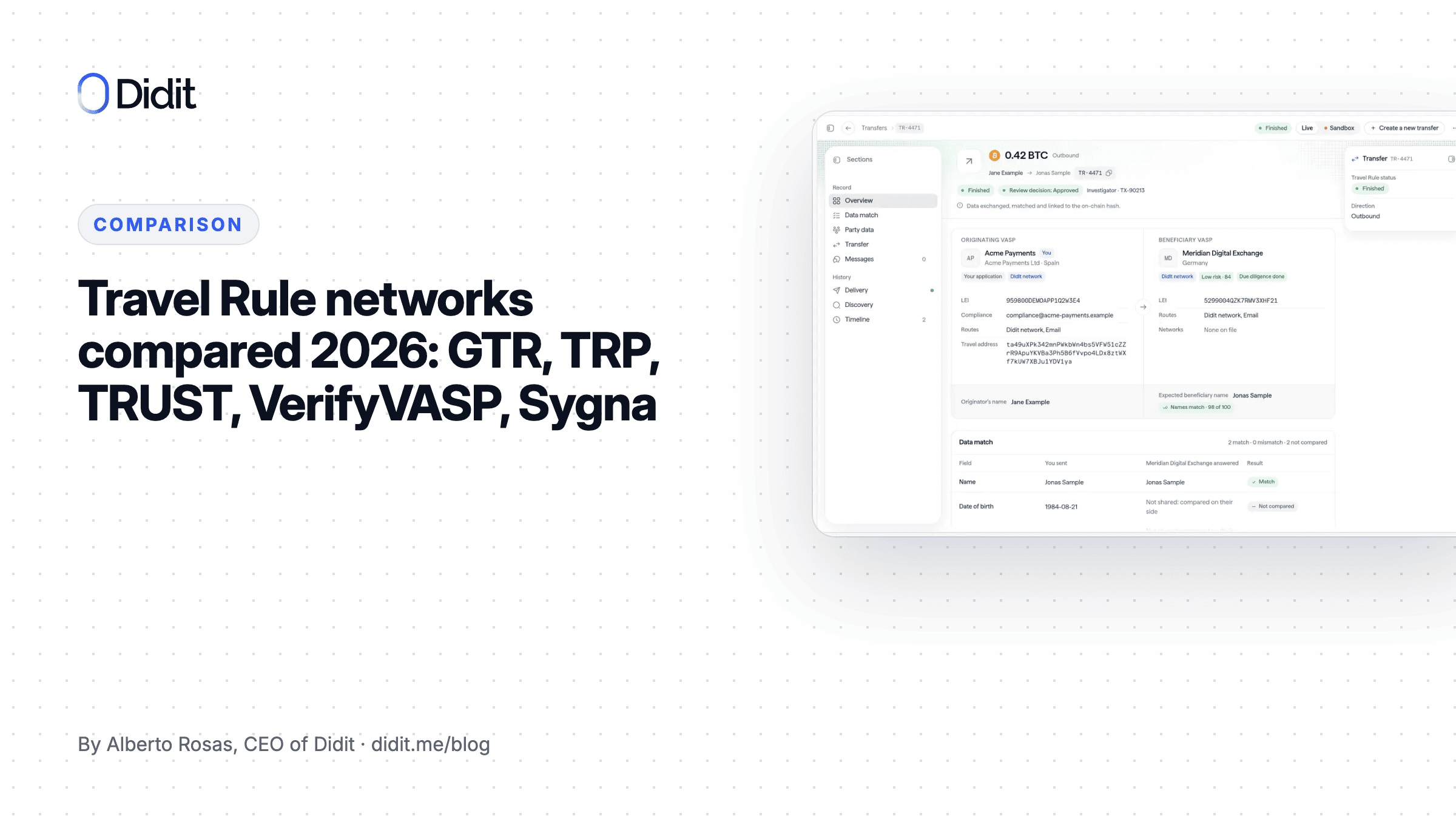
Travel Rule networks compared 2026: GTR, TRP, TRUST, VerifyVASP, Sygna
Connect the network your counterparties answer on. TRUST is send-only, so a transfer expires unless a readable rail sits underneath it. Didit routes seven rails in priority order at $0.02 per outbound exchange, and Notabene.
 Alberto RosasCo-founder and CEO
Contents
In this guide
Jump to the part you need.
Short answer: connect the network your counterparties actually answer on, and keep a readable rail underneath it. On Didit a Travel Rule exchange costs $0.02 per outbound exchange at list price, billed once regardless of later status changes. The caveat is membership. Didit holds no platform membership on GTR, TRUST, VerifyVASP or Sygna today, so a network rail routes only over a membership you connect yourself.
Last updated: November 26, 2026. Prices checked against the live Didit price feed on November 26, 2026.
The seven rails in priority order
Didit does not make you pick a network at send time. You submit a transfer with transaction_category set to travelRule, and Didit tries the rails below in strict priority order. The first rail that can reach the counterparty wins and carries the whole exchange.
| Priority | Rail | Counterparty resolved by | How the answer comes back |
|---|---|---|---|
| 1 | INTERNAL | A wallet another Didit customer proved it controls, or a directory entry carrying its counterparty_vasp_lei | Inside the platform, no outbound network call |
| 2 | TRP | A travel address on the transfer or in the address book, or a directory entry with a TRP endpoint | Machine to machine inquiry response, no email round trip |
| 3 | GTR | counterparty_gtr_vasp_code or a directory entry that carries one | Read from GTR's response, or by polling the request |
| 4 | TRUST | counterparty_trust_membership_id or a directory entry that carries one | Send-only. Nothing readable comes back |
| 5 | VERIFYVASP | counterparty_verifyvasp_id or a directory entry that carries one | Read by polling the verification status |
| 6 | SYGNA | counterparty_sygna_vasp_code or a directory entry that carries one | Permission answer read by polling, plus a callback once the public TRP host is live |
| 7 | EMAIL | counterparty_vasp_email or the compliance contact on the directory entry | A one-time pickup link the contact confirms or declines without a Didit account |
Start free in the sandbox at https://business.didit.me/, no sales call. Developers who want an assistant to drive the same API can connect Didit through the MCP server at https://didit.me/developers/mcp/. The product page is https://didit.me/products/travel-rule and every price sits on https://didit.me/pricing/.
Only once the exchange reaches COMPLETED should you broadcast the transfer on-chain. You then report the on-chain transaction hash back to Didit to close the exchange as FINISHED. Where a network answers by polling, Didit runs that loop itself on a five-minute interval and records what it finds, so you do not write it.
How each network resolves a counterparty
TRP
TRP is the open Travel Rule Protocol, the OpenVASP lineage. Didit uses it when the transfer carries a travel address, when the destination wallet's address-book entry stores one, or when the counterparty resolves in the directory with a TRP endpoint. Your own travel address is read-only in Get Travel Rule Settings, populated once Travel Rule is enabled, and you share it with counterparties so they reach you machine to machine. The documented asset coverage for the TRP inquiry is BTC, ETH and USDC, with USDC only when the transfer names the network it moves on. No network membership is needed for this rail.
GTR
GTR, the Global Travel Rule network, resolves the counterparty through an explicit counterparty_gtr_vasp_code or a directory entry that carries one. It is the first of the four network rails in priority, and it is readable: Didit takes the counterparty's answer from GTR's response, or from its own polling while the transfer waits. Connecting your own GTR membership needs the ed25519 private key in base64, the one whose public key is registered in GTR's portal, because it encrypts the personal data you send and decrypts what comes back.
TRUST
TRUST resolves the counterparty by counterparty_trust_membership_id or a directory entry that carries one. It is send-only. TRUST sends back nothing Didit can read, so a transfer over that rail waits in AWAITING_COUNTERPARTY until it expires, at confirmation_timeout_hours, and then moves to EXPIRED. What happens to the transaction at that point is your timeout_outcome: HOLD, REJECT or PROCEED.
VerifyVASP
VerifyVASP resolves the counterparty through counterparty_verifyvasp_id or a directory entry that carries one. The answer is readable, so the exchange can complete or decline instead of running out the clock. VerifyVASP acquired Sygna Bridge in 2026, and Sygna still operates for existing members, so a counterparty may appear on either network.
Sygna
Sygna resolves the counterparty through counterparty_sygna_vasp_code or a directory entry that carries one. Didit speaks the Sygna protocol natively: ECIES-encrypted IVMS101 with signed permission requests. A permission answer of ACCEPTED moves the transfer to COMPLETED, and REJECTED moves it to COUNTERPARTY_VASP_GENERAL_DECLINE, or to COUNTERPARTY_MISMATCHED_DATA when the reject code is BVRC007 and the beneficiary name does not match. Didit reads that answer by polling the transfer and also registers https://trp.didit.me/sygna/callbacks/permission/{token}/ as the callback of each permission request. That callback sits on Didit's public TRP host, which does not serve requests yet.
Email and the sunrise problem
Email is the fallback when no protocol or network rail reaches the counterparty. Name its compliance contact in counterparty_vasp_email, or have the directory entry carry one, and Didit emails a one-time pickup link so the contact confirms or declines without a Didit account. This is the workhorse for counterparties that are not yet reachable on any network. Didit currently treats CO, KH and VN as sunrise jurisdictions, and the read-only sunrise_jurisdictions field plus sunrise_policy decide what an expired exchange does there, ahead of non_responsive_policy and timeout_outcome.
The differentiator that decides your default: TRUST is send-only
Over TRUST, a Didit customer's transfer reaches the counterparty but the answer cannot come back, and the transfer expires at the sender's confirmation deadline instead of completing. Over GTR, VerifyVASP and Sygna, Didit reads the answer from the network itself.
That single property changes how you operate. If TRUST is the only rail that reaches a counterparty, your settlement process cannot wait for a confirmation that will never arrive. You set confirmation_timeout_hours to the shortest window your compliance policy allows, you set timeout_outcome to the action you can defend in an audit, and you treat the TRUST exchange as a send-and-record event rather than a handshake. Watch the delivery history for COUNTERPARTY_VASP_NOT_REACHABLE when the message cannot be delivered at all, which is a different failure from an expiry.
Which network should your VASP connect?
Choose by the identifier the counterparty is addressable by and by the membership that identifier requires, not by brand. The matrix below collapses the seven rails into the four things you actually decide: what the counterparty must be addressable by, what you must hold, what comes back, and who the rail fits.
| Rail | Counterparty identifier | Membership you hold | Answer behavior | Best fit |
|---|---|---|---|---|
INTERNAL | Proven control of the beneficiary wallet, or a directory entry with a counterparty_vasp_lei | None. Both sides run on Didit | Negotiated inside the platform, no outbound call | Counterparties that are also Didit customers |
TRP | A travel address or a directory entry with a TRP endpoint | None | Inquiry response completes or declines at once | Teams holding no network memberships |
GTR | counterparty_gtr_vasp_code | Your own GTR membership plus the ed25519 key registered in GTR's portal | Read from the response or by polling | Counterparties already addressable by GTR VASP code |
TRUST | counterparty_trust_membership_id | Your own TRUST membership | Send-only, the transfer expires | Counterparties reachable only by TRUST id, where a one-way message is acceptable |
VERIFYVASP | counterparty_verifyvasp_id | Your own VerifyVASP membership | Read by polling the verification | Counterparties addressable by VerifyVASP id, including former Sygna members |
SYGNA | counterparty_sygna_vasp_code | Your own Sygna membership | Permission answer read by polling, callback once the public host is live | Existing Sygna Bridge members that have not migrated |
EMAIL | counterparty_vasp_email or a directory compliance contact | None | The contact confirms or declines from a one-time link | Sunrise jurisdictions and long-tail counterparties |
If you hold no membership today, plan around TRP first: share your travel address with the counterparties you send to, and the exchange runs machine to machine over an open protocol with no network identity to obtain. Then add GTR, VerifyVASP, Sygna or TRUST only when you can point to specific counterparties you actually send to that are addressable on them, because each of those four routes only over your own membership connected in the Marketplace. Enabling Travel Rule does not activate any of them, and GTR is not included by default.
If you send to other Didit customers, INTERNAL settles the exchange inside the platform with no outbound network call and needs no membership on anything.
Turning networks on inside Didit
Connect your membership credentials in the console Marketplace under the Travel Rule networks category. Your transfers then travel under your own network identity. Get Travel Rule Settings returns a networks object keyed by gtr, trust, verifyvasp and sygna, each with a mode: own means your connected membership, didit means Didit's platform membership carries your application, off means you opted out, and unavailable means nothing can send on that network for your application yet. Production does not report didit today.
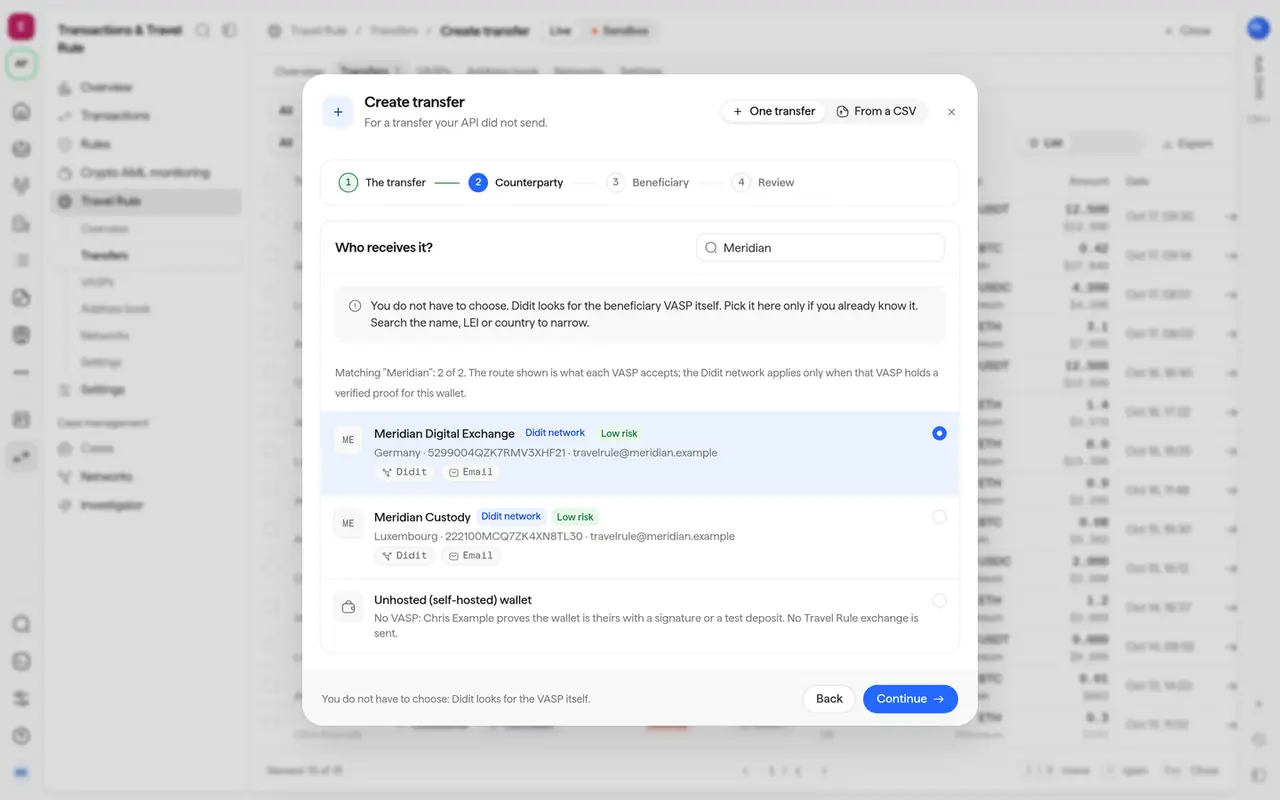
When a counterparty is missing from the directory, add it privately and store its compliance contact. A matching visible name or LEI returns 409 with the existing vasp_id, so you select that entry instead of duplicating it.
curl -X POST 'https://verification.didit.me/v3/travel-rule/vasps/' \
  -H 'x-api-key: YOUR_API_KEY' -H 'Content-Type: application/json' \
  -d '{"name": "Example VASP", "email": "compliance@example.com", "jurisdiction": "DE", "invite": false}'
The 201 response is a directory entry with source: added_by_you. Adding an entry does not certify its identity and does not make it a Didit network member. Full routing detail is in the Travel Rule documentation, and the counterparty view is in Travel Rule Interoperability.
Didit vs Notabene scorecard
Didit publishes this ranking; we explain the criteria so you can check them. Scores are 1 to 5, and every reason comes from our published price list or from the Notabene page we read on November 26, 2026. Notabene is the only competitor we hold a vendor card for in this comparison, so it is the only one scored.
Didit ranks first in this comparison because it publishes the Travel Rule price, selects among seven rails, and combines Travel Rule with identity and transaction products.
| Criterion | Didit | Notabene | Why |
|---|---|---|---|
| Published pricing | 5 | 2 | We publish every line, Travel Rule at $0.02 per outbound exchange. Notabene pricing page, read November 26, 2026, lists SafeTransact-Rise as free to start with up to $10k USD in monthly transactions and does not publish the Complete Compliance Solution price, so that tier is quote required. |
| Coverage | 4 | 4 | Didit's documented country coverage is 220+ countries in general, and Travel Rule adds seven rails tried in priority order, but Didit holds no platform membership on the four networks yet. Notabene home page, read November 26, 2026, says it connects financial institutions worldwide and gives full access to Notabene's VASP Network. |
| Product breadth (KYC, KYB, AML, monitoring) | 5 | 3 | Didit prices KYC at $0.33, KYB from $2.00, AML screening at $0.20, wallet screening at $0.15 and transaction monitoring on the same bill. Notabene home page, read November 26, 2026, describes Travel Rule compliance and automated counterparty due diligence, with no KYC or KYB line on the page. |
| AI/MCP and developer access | 5 | 2 | Didit runs a free MCP server at mcp.didit.me with OAuth sign-in plus a public API. Notabene home page, read November 26, 2026, lists onboarding and implementation support, not a developer or MCP surface. |
| Time to first live check | 5 | 3 | Didit sandbox is free and needs no sales call, and the Free plan carries $10 of monthly credit. Notabene's SafeTransact-Rise tier is free to start, with up to $10k USD in monthly transactions, per Notabene pricing page, read November 26, 2026, while the Complete Compliance Solution needs a quote. |
| Evidence and certifications | 5 | 2 | Didit holds SOC 2 Type 2 and ISO/IEC 27001:2022 (certificate ES144068), plus iBeta Level 1 PAD. No certification is listed on the Notabene page we read on November 26, 2026. |
| Total | 29 / 30 | 16 / 30 | Scores reflect what each vendor publishes, not private capability. |
Like-for-like comparison
| Dimension | Didit | Notabene |
|---|---|---|
| Travel Rule price unit | $0.02 per outbound exchange, published, billed once per exchange regardless of later status transitions | SafeTransact-Rise free to start, up to $10k USD in monthly transactions and unlimited incoming transactions; Complete Compliance Solution quote required (Notabene pricing page, read November 26, 2026) |
| Reach | Seven rails tried in priority order: INTERNAL, TRP, GTR, TRUST, VERIFYVASP, SYGNA, EMAIL | Full access to Notabene's VASP Network, plus data exchange across protocols as described on its page (Notabene home page, read November 26, 2026) |
| Identity products on the same contract | KYC $0.33, KYB from $2.00 per company, AML screening $0.20, wallet screening $0.15 per screening, transaction monitoring $0.001 per transaction beyond the plan allowance | Not described on the Notabene page read November 26, 2026 |
| Counterparty due diligence | counterparty_screening_enabled is opt-in and billed per screening at the Company AML Screening price; default false, nothing screened or billed | Automated counterparty due diligence listed as part of the Complete Compliance Solution (Notabene home page, read November 26, 2026) |
| Implementation | REST API with an x-api-key header, SDKs, MCP server, free sandbox | Onboarding and implementation support, live training and SLAs listed under the Complete Compliance Solution (Notabene home page, read November 26, 2026) |
| Evidence | SOC 2 Type 2 report issued 2026-07-30, ISO/IEC 27001:2022 certificate ES144068, iBeta Level 1 PAD, GDPR, DORA, MiCA, AMLD6, eIDAS 2.0 | No certification listed on the Notabene page read November 26, 2026 |
What a Travel Rule program costs at 1,000, 10,000 and 100,000 exchanges
Scenarios are monthly outbound exchanges at published list prices. Growth takes 4% off every Didit price and Scale takes 10%. Both plan fees are separate: Growth is $99 a month with $115 of monthly credit, Scale is $299 a month with $350 of monthly credit.
| Outbound exchanges | Didit list ($0.02) | Didit Growth ($0.0192) | Didit Scale ($0.018) | Notabene |
|---|---|---|---|---|
| 1,000 | $20.00 | $19.20 | $18.00 | Quote required above $10k USD monthly transaction value; the free tier is a value cap, not a check count |
| 10,000 | $200.00 | $192.00 | $180.00 | Quote required |
| 100,000 | $2,000.00 | $1,920.00 | $1,800.00 | Quote required |
The arithmetic is one multiplication per row. 1,000 x $0.02 = $20.00, 10,000 x $0.02 = $200.00 and 100,000 x $0.02 = $2,000.00. On Growth the unit is $0.0192, so 10,000 x $0.0192 = $192.00. On Scale the unit is $0.018, so 100,000 x $0.018 = $1,800.00. We cannot show the same arithmetic for Notabene because the Complete Compliance Solution price is not published, so that column is quote required.
Worked cost example
A VASP sends 40,000 outbound exchanges a month, onboards 1,500 new customers with a full ID check, screens each new customer once against AML lists, and screens one deposit address per new customer.
- Travel Rule: 40,000 x $0.02 = $800.00
- Full KYC at $0.33: 1,500 x $0.33 = $495.00
- AML screening at $0.20: 1,500 x $0.20 = $300.00
- Wallet screening at $0.15: 1,500 x $0.15 = $225.00
- List total: $800.00 + $495.00 + $300.00 + $225.00 = $1,820.00
On the Scale plan the same month runs at $0.018 per exchange, $0.297 per KYC, $0.18 per AML screening and $0.135 per wallet screening: $720.00 + $445.50 + $270.00 + $202.50 = $1,638.00 of usage. The $350 monthly credit takes that to $1,288.00 of billable usage, plus the $299 plan fee, which is $1,587.00. The 40,000 transfers sit inside Scale's 100,000 monitored transactions a month, so transaction monitoring adds nothing. If you would rather use your own screening provider, you bring your own screening provider and run it inside Didit instead of the $0.15 line.
Strengths and limitations
Didit
Strengths: published unit prices on every product, so a Travel Rule program can be costed before you talk to anyone. Seven rails tried automatically in a fixed priority order, so you do not hardcode a network choice into your settlement code. One vendor and one bill for KYC, KYB, AML, wallet screening and transaction monitoring. 4,000+ companies, 220+ countries, sub-2-second p99 inference, SOC 2 Type 2 and ISO/IEC 27001:2022. A free MCP server and a free sandbox with no sales call.
Limitations, stated plainly. Didit holds no platform membership on GTR, TRUST, VerifyVASP or Sygna today and is onboarding as a provider, so each of those rails needs your own connected membership and no network reports didit in production. TRUST is send-only, so those exchanges end in an expiry rather than a reply. Inbound transfers are not delivered to Didit customers over any network rail or by email yet; today Didit can take an inbound transfer only as a TRP transfer inquiry once its public TRP host is live. Unmatched inbound deposits wait in AWAITING_COUNTERPARTY, NOT_ENOUGH_COUNTERPARTY_DATA or COUNTERPARTY_VASP_NOT_FOUND until you pair them by hand.
Notabene
Strengths: the page positions Notabene as an open trust layer for global payments, with financial institutions connected worldwide for stablecoin and crypto payments including Travel Rule compliance. Full access to its VASP Network comes with the free SafeTransact-Rise tier, which is an easy starting point, and the Complete Compliance Solution bundles onboarding, implementation support, live training and SLAs with automated counterparty due diligence. For a team that wants a vendor to run the rollout with them, that packaging is the attraction.
Limitations: the Complete Compliance Solution price is not published, so budgeting needs a quote. The page we read on November 26, 2026 describes Travel Rule and counterparty due diligence, not KYC, KYB, AML screening or transaction monitoring, so those capabilities are not verifiable from the supplied vendor materials. No certification is listed on that page, and no developer or MCP surface is described on it either, so developer access is not verifiable from the page we read.
Verdict by use case
Pick Notabene if your counterparty settlement runs mostly on its VASP Network and you want managed onboarding with implementation support and SLAs rather than self-serve API integration (Notabene home page, read November 26, 2026). It is also the sensible choice if your identity stack is already settled elsewhere and you want a Travel Rule specialist rather than one vendor across verification and monitoring. Its SafeTransact-Rise tier is free to start, with up to $10k USD in monthly transactions (Notabene pricing page, read November 26, 2026), so you can test that thesis before you ask for a quote.
Pick Didit if you want the price on the page, the rail chosen automatically from a priority list, and KYC, KYB, AML and wallet screening billed next to the exchange. Switching from another provider is documented at https://didit.me/switch/.
Migration plan: parallel test, webhooks, records
1. Parallel test
Run the new routing in the free sandbox first. Submit transfers in which the counterparty is a Didit customer, so INTERNAL completes without an external call, then repeat with a travel address for TRP and with a counterparty_gtr_vasp_code for GTR. Read networks from Get Travel Rule Settings on the application you are configuring, and do not expect a network rail to route until you have connected your own membership for it in the Marketplace. Sandbox applications never convert the transfer amount, so set the threshold with amount_in_default_currency when you test scope rules.
2. Status and webhooks
Do not gate releases on a poll you wrote yourself. The exchange is tracked through a 13-state lifecycle and Didit ships transaction webhooks, so you can react to a status change instead of asking every minute. Didit polls the readable network rails itself and records what it finds. For TRUST, plan for AWAITING_COUNTERPARTY to become EXPIRED at confirmation_timeout_hours, and decide in advance whether that means HOLD, REJECT or PROCEED.
3. Records
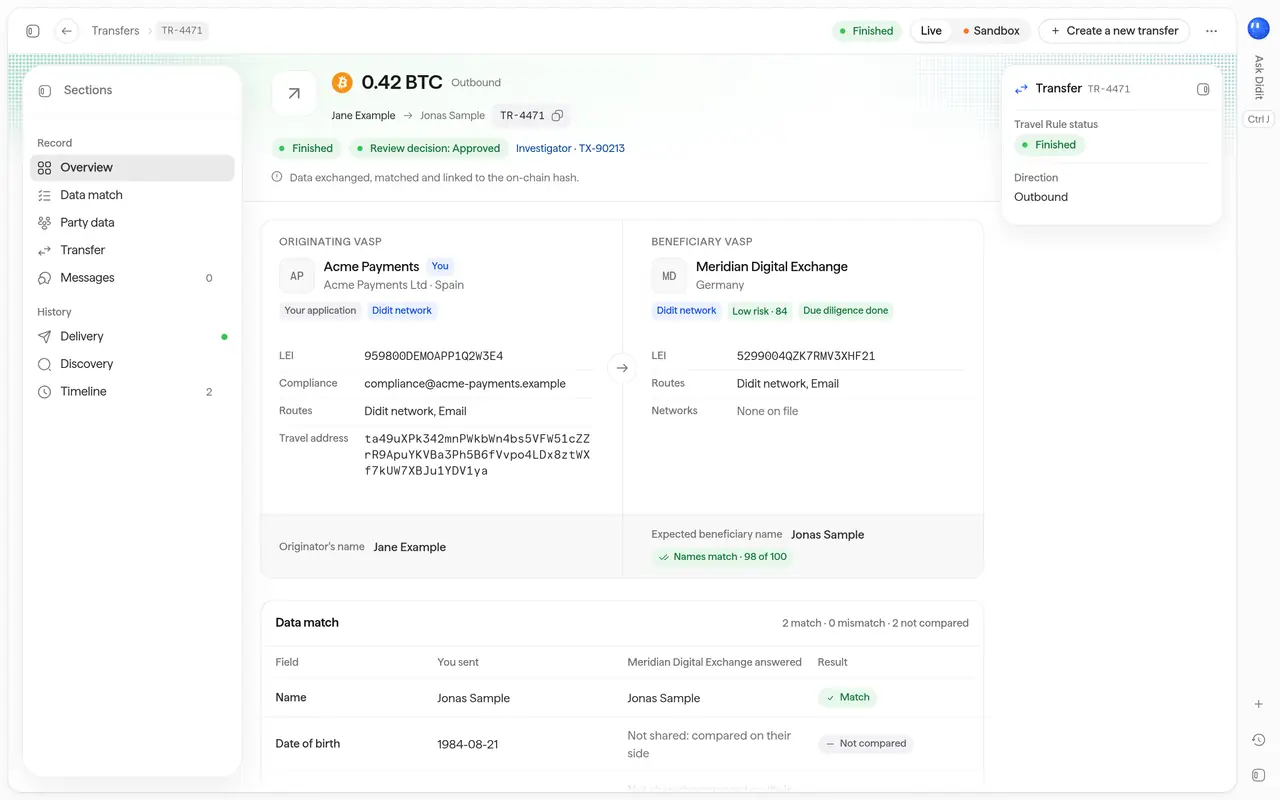
Use the delivery history API as your audit trail. Each entry carries kind (SEND, ANSWER, TXID, CANCEL, POLL), status, rail, created_at, delivered_at and detail_lines, ordered oldest first. rail is NETWORK for every named network, so the log is supplier-neutral by design. count is capped at 100 and is not a reliable total, so follow next until it is null. Transaction detail embeds only the newest 100 entries as travel_rule.deliveries, with deliveries_truncated telling you whether older entries were omitted. For inbound reconciliation, List Unmatched Travel Rule Deposits returns deposits still waiting for the originating VASP's data, so you can pair each one with the message that arrived.
Sources
- Didit docs: FATF Travel Rule API and VASP compliance, including the seven-rail priority table, membership requirements and the 13-state lifecycle
- Didit docs: Travel Rule Interoperability, including the TRUST warning, the blockchain analytics attribution step and the Sygna callback behaviour
- Didit docs: Get Travel Rule Settings API, including the
networksmodes and window settings - Didit docs: Create a private Travel Rule VASP entry, including the curl sample
- Didit docs: Travel Rule delivery history API
- Didit docs: List Unmatched Travel Rule Deposits
- Didit pricing page and pricing as JSON, read November 26, 2026
- Didit docs: pricing and billing rules, read November 26, 2026
- Didit MCP server
- Didit Travel Rule product page
- FATF, Recommendation 16 on the travel rule
- EUR-Lex: Regulation (EU) 2023/1113, the Transfer of Funds Regulation applied with no minimum amount
- Notabene home page, read November 26, 2026 (plain text, no link): positioning as an open trust layer for global payments, full access to its VASP Network, Complete Compliance Solution features and automated counterparty due diligence
- Notabene pricing page, read November 26, 2026 (plain text, no link): SafeTransact-Rise free to start with up to $10k USD in monthly transactions and unlimited incoming transactions; Complete Compliance Solution price not published
Next step: create a free sandbox organization at https://business.didit.me/, add a transfer with transaction_category set to travelRule, and watch which rail Didit picks. No sales call, and nothing is charged in sandbox.
Try it
Try this in the sandbox
Run the check this guide describes, free.
The product this post is about, taken from its topic. Run it free in the sandbox.
Author
Alberto Rosas
Co-founder and CEO

Keep reading
Other guides in the same topic.
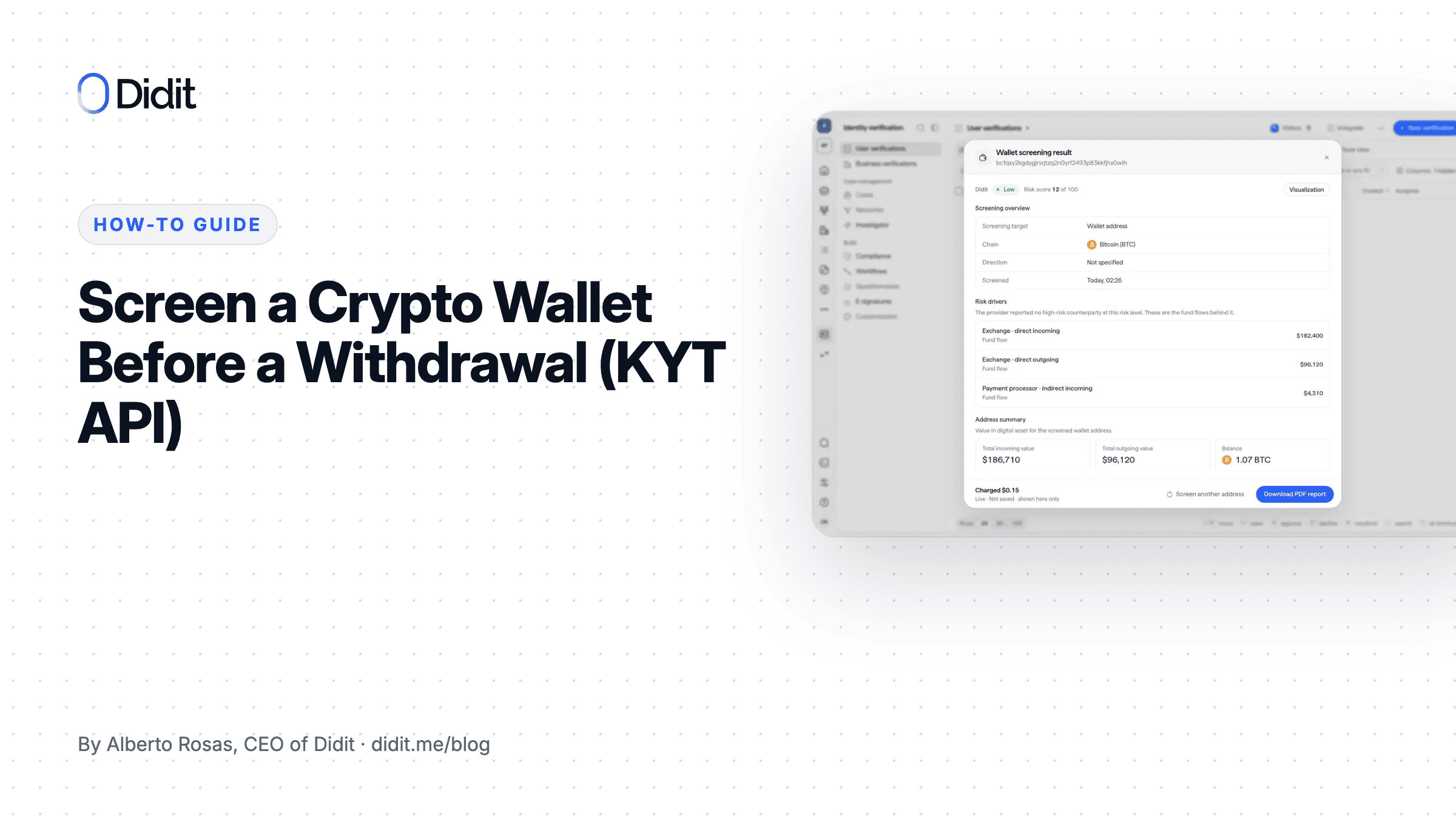 Screen a Crypto Wallet Before a Withdrawal (KYT API)
Submit an outbound crypto transaction with the destination wallet in the counterparty payment method and no payment reference. Didit returns a risk score, exposure and sanctions hits for $0.15 per screening.
Alberto RosasNov 26, 2026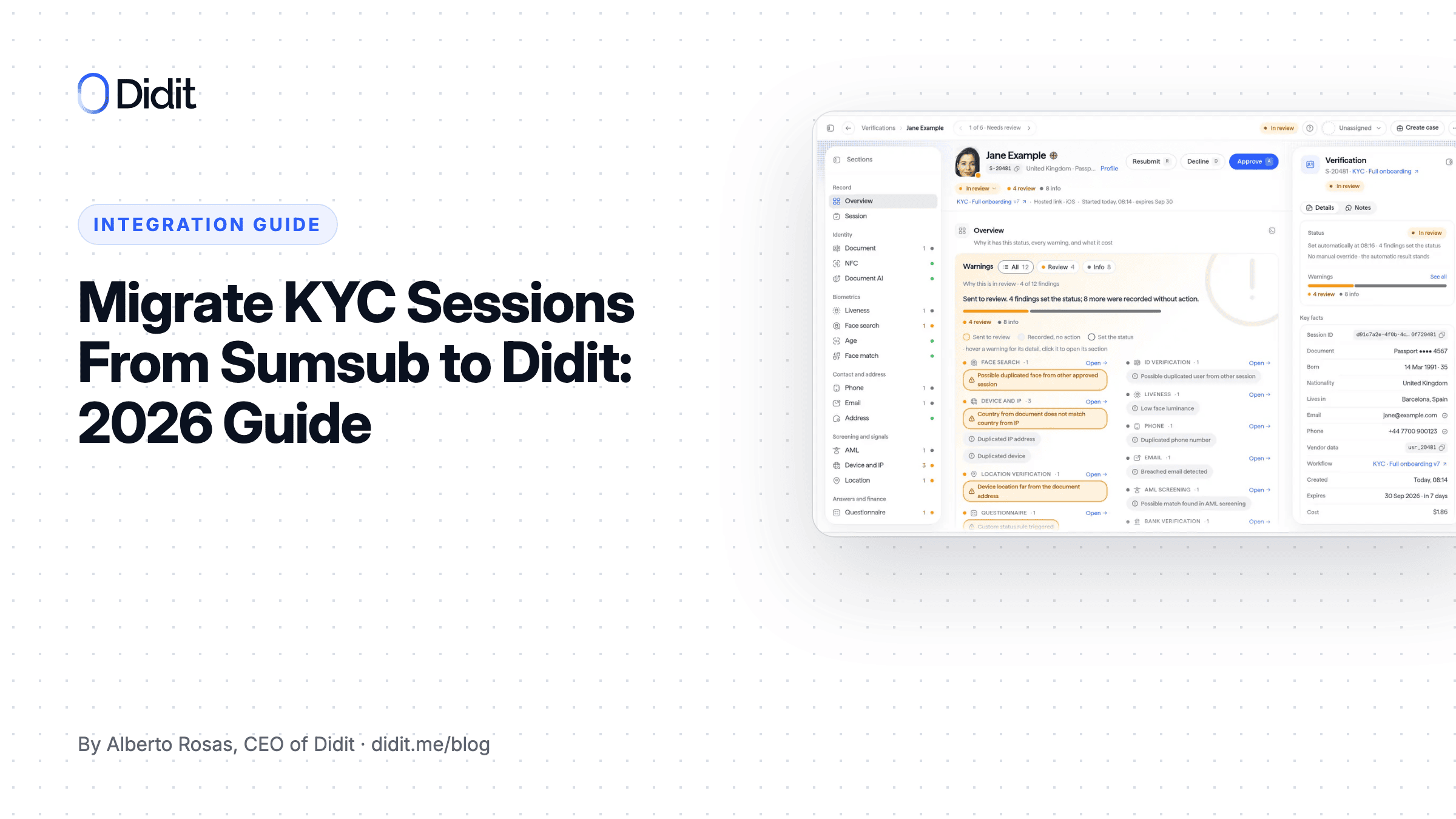 Migrate KYC Sessions From Sumsub to Didit: 2026 Guide
Didit imports completed Sumsub KYC records with POST /v3/session/imports/ and import_type=user_verification, keeping applicant id, status, document fields, images, rejection labels, tags and raw provider metadata.
Alberto RosasNov 26, 2026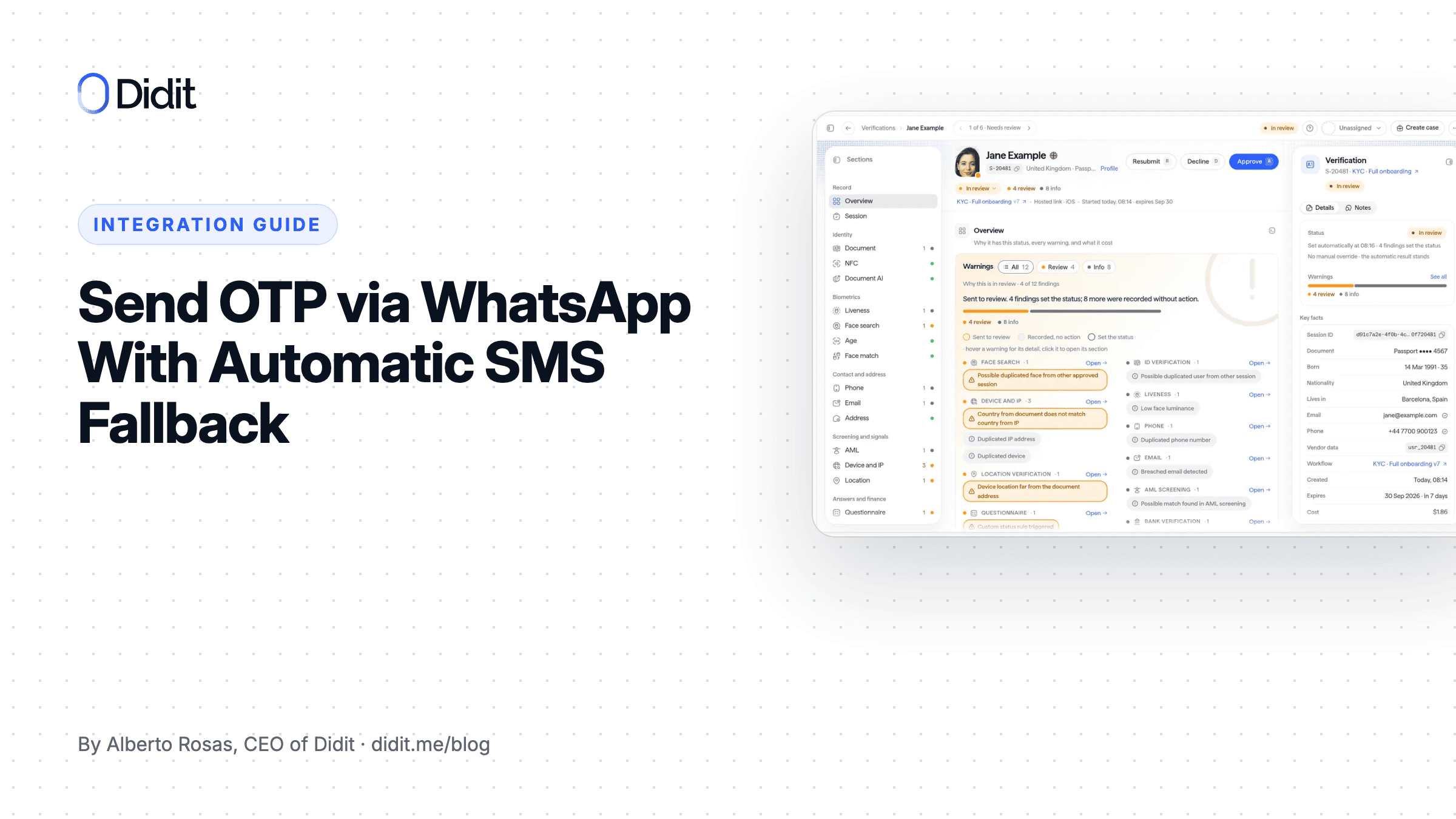 Send OTP via WhatsApp With Automatic SMS Fallback
Didit sends OTPs via WhatsApp by default and falls back to SMS when WhatsApp is unavailable. The list price is $0.02 plus the carrier rate per code. Codes expire 5 minutes after the first send by default.
Alberto RosasNov 26, 2026Questions
Frequently asked questions
Which Travel Rule network should a VASP connect first?
Connect the network where your counterparties are already addressable, because Didit can only route over a rail that can resolve the other side. If you have no memberships at all, start with TRP and share your travel address, since it needs no network membership and runs machine to machine. Then add GTR, VerifyVASP, Sygna or TRUST as your counterparty book requires, and remember each of those needs your own connected membership today.
Is TRUST send-only on Didit?
Yes. TRUST sends back nothing Didit can read, so a transfer sent over it waits in AWAITING_COUNTERPARTY until it expires at confirmation_timeout_hours and then moves to EXPIRED. Your timeout_outcome setting decides whether the transaction is held, rejected or allowed to proceed at that point. GTR, VerifyVASP and Sygna do not have this limitation, because Didit reads the answer from the network response or by polling.
What does counterparty_gtr_vasp_code do?
It is the explicit identifier Didit uses to resolve a counterparty on the Global Travel Rule network, and it takes priority over a directory lookup. If the transfer carries one, or a directory entry carries one, Didit sends the exchange over GTR. Connecting your own GTR membership also needs the ed25519 private key in base64 whose public key is registered in GTR's portal.
Do I need my own membership to use GTR, TRUST, VerifyVASP or Sygna in Didit?
Yes, today. Didit holds no platform membership on any of those four networks and is onboarding as a provider, so each network rail routes only over a membership you connect yourself in the console Marketplace. Get Travel Rule Settings shows the effective mode per network: own, didit, off or unavailable. Production does not report didit yet, and enabling Travel Rule does not activate any network.
What happens if no rail can reach the counterparty?
Didit first runs blockchain analytics attribution and retries routing when it identifies a VASP. If no route is found, it sends a one-time email pickup link to the compliance contact, so they can confirm or decline without a Didit account. An attributed transfer only routes automatically once that directory entry carries a route: a verified TRP endpoint, a network listing, or a compliance contact.
How much does a Travel Rule exchange cost on Didit?
$0.02 per outbound exchange at list price, billed once per exchange regardless of later status transitions. Growth takes that to $0.0192 and Scale to $0.018, on top of the $99 and $299 monthly plan fees. Sandbox testing is free and unlimited, so the first integration costs nothing.
How do I read a counterparty's answer on GTR, VerifyVASP and Sygna?
Didit reads it from the network itself, not from an email thread. On GTR it takes the answer from the network response or from its own polling of the request, on VerifyVASP it reads the verification status, and on Sygna it reads the permission answer and also registers a callback that becomes usable once Didit's public TRP host is live. TRUST is the exception: nothing readable comes back.
Can Didit receive a Travel Rule transfer that another VASP sends to me over a network?
Not over a network rail or by email yet. Today Didit can take an inbound transfer only as a TRP transfer inquiry once its public TRP host is live, and a transfer that settled earlier can come in afterwards as a sunrise registration. Inbound deposits that arrive before the counterparty's data are listed by the unmatched deposits API so you can pair them with the message that arrives later.
How does Didit's Travel Rule compare with Notabene?
Notabene publishes a free SafeTransact-Rise tier capped at $10k USD in monthly transactions and does not publish the Complete Compliance Solution price (Notabene pricing page, read November 26, 2026). Didit publishes $0.02 per outbound exchange and runs seven rails in a fixed priority order, but requires your own membership on the four network rails. Notabene fits teams that want managed onboarding on its VASP Network (Notabene home page, read November 26, 2026); Didit fits teams that want a published price and automatic rail selection.
What is confirmation_timeout_hours?
It is the deadline you set for a counterparty to answer an exchange and it is part of your Travel Rule settings alongside name_matching_strictness, timeout_outcome and threshold_amount. When the deadline passes without an answer the transfer expires, and timeout_outcome decides whether the transaction is held, rejected or allowed to proceed. The sunrise policy and the non-responsive policy are applied before it.
Compliance built in
Audited, certified and attested.
We hold the certifications and build each country's rules into your flows, so you can launch anywhere without worrying. Security and Compliance center
- Regulation encoded into your flows
Tell us what you do and where. Didit lists the rules that apply to you, with sources, and builds the checks each country needs into one workflow.
- Ready for AMLR
Every requirement of the new EU anti-money laundering rules, from checking customers to human review, is already covered by a Didit check.
- Tested in Spain's Treasury sandbox
Spain's Treasury published its supervised sandbox report on Didit's NFC plus active liveness onboarding; SEPBLAC took part and valued the added measures positively.
- Audited, not self-declared
iBeta Level 1 and Level 2. Liveness tested under ISO/IEC 30107-3.
Your obligations · 3 regions
 SOC 2 Type 2
 ISO 27001
 iBeta Level 1 and Level 2
 EU regulator attestation
 FSM youth protection
 GDPR
 EBA remote onboarding
 MiCA compatible
 FIDO Alliance member
- AMLREU AML Regulation ready
Integration · Didit MCP
Run Didit from your own AI agent
Connect Didit to Claude, Cursor, VS Code or ChatGPT and just ask in plain words. Your agent can do anything you can do in the console, with the same permissions you have.
 Add to Claude
 ChatGPT
 Cursor
- Build workflowsDescribe the checks you need. The agent creates and publishes the flow.
- Run investigationsAsk why a session was declined, review cases, search people and companies.
- Change rulesCreate payment rules, test them on past data and switch them on.
- Pull reportsAsk for numbers, exports or the audit log.
Didit Academy


