Jede Adresse verifizieren. Von einer Rechnung, einer Bank oder einem Schreiben.
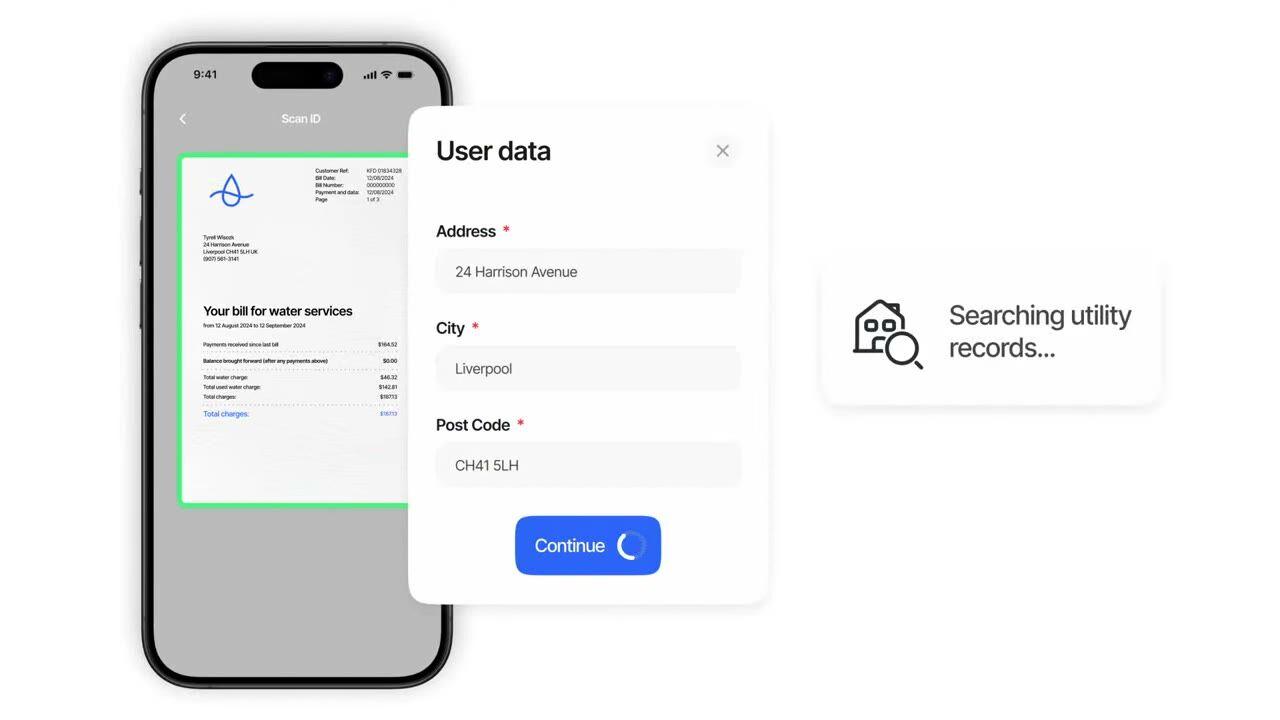
Verifiziere den Wohnsitz anhand einer Versorgungsrechnung, eines Kontoauszugs, eines behördlichen Schreibens oder eines Mietvertrags. Wir lesen das Dokument, extrahieren die Adresse, gleichen den Namen mit der verifizierten ID ab und liefern ein strukturiertes Ergebnis. 0,20 $ pro Prüfung, 500 kostenlos/Monat.
Wir lesen das Dokument, extrahieren Adresse und Namen und gleichen beides
mit der verifizierten Identität ab. Versorgungsrechnung, Kontoauszug, Mietvertrag, Steuerbescheid
, 0,20 $ pro Prüfung.
So funktioniert's
Vom Anmelden zum verifizierten Nutzer in vier Schritten.
Schritt 01 / 04
01
Workflow erstellen
Wähle die gewünschten Prüfungen aus, ID, Liveness, Face Match, Sanktionen, Adresse, Alter, Telefon, E-Mail, benutzerdefinierte Fragen. Ziehe sie im Dashboard in einen Flow oder poste denselben Flow an unsere API. Verzweige nach Bedingungen, führe A/B-Tests durch, kein Code erforderlich.
Integrieren
Bette nativ mit unseren Web-, iOS-, Android-, React Native- oder Flutter-SDKs ein. Leite auf eine gehostete Seite weiter. Oder sende deinem Nutzer einfach einen Link, per E-Mail, SMS, WhatsApp, überall. Wähle, was zu deinem Stack passt.
Nutzer durchläuft den Flow
Didit hostet die Kamera, die Beleuchtungshinweise, die mobile Übergabe und die Barrierefreiheit. Während der Nutzer den Flow durchläuft, bewerten wir über 200 Betrugssignale in Echtzeit und verifizieren jedes Feld anhand autoritativer Datenquellen. Ergebnis in unter zwei Sekunden.
Du erhältst die Ergebnisse
Echtzeit-signierte Webhooks halten deine Datenbank synchron, sobald ein Nutzer genehmigt, abgelehnt oder zur Überprüfung gesendet wird. Frage die API bei Bedarf ab. Oder öffne die Konsole, um jede Session, jedes Signal zu prüfen und Fälle nach deinen Wünschen zu verwalten.
Für Entwickler gebaut · Gegen Betrug gebaut · Offen im Design
Sechs Funktionen. Ein Feature-Flag. PROOF_OF_ADDRESS.
Jede der unten aufgeführten Funktionen ist ein Schalter im selben Modul. Keine Upsell-Stufen, keine separaten SKUs, keine zusätzlichen Anrufe. Schalte sie pro Workflow ein oder übergebe sie inline beim API-Aufruf.
Vier Kategorien, Rechnungen (Strom, Wasser, Gas, Internet, Telefon), Kontoauszüge (Konto, Kreditkarte, Hypothek, Darlehen), behördliche Dokumente (Steuerbescheid, Wählerausweis, Meldebescheinigung) und Sonstiges (Mietvertrag, Arbeitgeberbescheinigung, Versicherung, notariell beglaubigte Erklärung). JPG, PNG, TIFF oder PDF bis 15 MB. Mehrseitige Dokumente werden in einem Durchgang verarbeitet.
Source
Voltia PowerElectricity · Mar 2026PDF
AcceptedUTILITY_BILL
JPGJPEGPNGTIFFPDF15 MB · multi-page
02 · Extraktion + Authentizität
Jedes Adressfeld lesen. Jede Fälschung erkennen.
OCR (Optical Character Recognition) extrahiert die Rohadresse und normalisiert sie in ein strukturiertes Objekt, Straße, Stadt, Region, Postleitzahl, Adresstyp. Inklusive Breiten- und Längengrad. Im selben Durchgang wird die Dokumentenauthentizität forensisch geprüft: Pixel-Tamper-Erkennung, Copy-Paste-/Klonstempel-Rückstände, Schriftart- + Kerning-Inkonsistenzen, KI-generierte synthetische Bildsignale und Metadaten-Diskrepanzen. Manipulierte Dokumente landen mit einer Warnung in `In Review`, statt stillschweigend genehmigt zu werden.
Lege das Gültigkeitsfenster für Dokumente pro Anwendung fest, 30, 60, 90 Tage oder eine beliebige andere Dauer. Standard ist 90 Tage. Wir extrahieren das Ausstellungsdatum und vergleichen es mit dem Einreichungszeitpunkt; alles, was älter als der Schwellenwert ist, wird automatisch mit `EXPIRED_DOCUMENT` abgelehnt. Dokumente ohne parsbares Ausstellungsdatum, oder mit einem zukünftigen Datum, lösen Warnungen aus, die du zur manuellen Überprüfung weiterleiten kannst.
Document agewindow · 90 days
90dtoday
34d
ApproveReviewDecline
Configurable threshold · default 90 days
04 · Namensabgleich mit KYC
Die Rechnung stimmt mit dem Ausweis überein. Oder eben nicht.
Drei Warnungen bei Namensabweichungen werden ausgelöst, wenn der Name im Dokument vom verifizierten Identitätsnamen, dem über die API gesendeten Wert oder einem anderen Adressnachweis in derselben Sitzung abweicht. Ein konfigurierbarer Abgleichschwellenwert (typischerweise 90–95 %) toleriert Abweichungen bei Zweitnamen und Schreibweisen. Jede Warnung kann pro Anwendung zu Ablehnung, Überprüfung oder Genehmigung führen.
Name on billJOHN A. SMITH
96.3%similarity
Name on KYCJohn Smith
Matched
Matches provided name
Matches ID document
Consistent across documents
05 · Strukturierte Adresse geparst
OCR liefert einen String. Didit liefert ein Schema.
Jede Antwort enthält ein geparstes Adressobjekt, Straße, Stadt, Region, Postleitzahl, Adresstyp, plus Rohkoordinaten. Integriere es in deine Kundendaten, dein Betrugsmodell oder deine Lieferroutenplanung. Keine Regex, keine Nachbearbeitung, kein länderspezifischer Parser. Gleiches Format, egal ob das Dokument in den USA, Spanien, Brasilien oder Singapur ausgestellt wurde.
As printed on the documentJohn A. Smith123 Main St, Apt 4BNew York, NY 10001
poa_parsed_addressApproved
street_1123 Main St
street_2Apartment 4B
cityNew York
regionNY
postal_code10001
address_typeRESIDENTIAL
lat 40.7128lng -74.0060
06 · Compliance-ready
AMLD6- und FATF-Empfehlung 10-Nachweis. $0.20 pro Prüfung.
Die Adressverifizierung ist durch AMLD6 (6. EU-Geldwäscherichtlinie) im Rahmen der Customer Due Diligence und FATF-Empfehlung 10 vorgeschrieben. Jedes Ergebnis enthält eine signierte Dokumenten-URL, ein audit-fähiges Warnungs-Array und forensische Analysen von PDF-Overlay-Manipulationen, dein Compliance Officer hat den Beweissatz sofort zur Hand. Öffentliche Pay-per-Call-Preise, kein Vertrag.
3audit artifacts
7-yrretention
2frameworks
poa.status.updated · webhook fired1.4s
SSigned document file URLS3 · 7-day pre-signed
WWarnings audit arrayexpired · name mismatch · tampered
PPDF overlay forensicsduplicate font subset · glyph delta
Compliance readyAMLD6FATF R.10
Integrieren
Zwei Endpunkte. Gleiches JSON. Gleicher Preis.
Erstelle eine Session, wenn unsere gehostete UI die Erfassung und den mehrseitigen Upload übernehmen soll. Rufe den eigenständigen Endpunkt auf, wenn du das Dokument bereits hast. Der Bericht hat in beiden Fällen dieselbe Struktur.
Füge den folgenden Block in Claude Code, Cursor, Codex, Devin, Aider oder Replit Agent ein. Ersetze den Platzhalter `my_stack` durch dein Framework, deine Sprache und deinen Anwendungsfall. Der Agent provisioniert Didit, erstellt den Workflow, verbindet den Webhook und liefert das Ergebnis.
didit-integration-prompt.md
# Didit Proof of Address — integrate in 5 minutes

You are integrating Didit's Proof of Address (PoA) module into <my_stack>.
Follow these steps exactly. Every URL, header, and enum value below is
canonical — do not paraphrase or "improve" them.

## 1. Provision an account
- Sign up: https://business.didit.me (no credit card required).
- Or provision programmatically: POST https://apx.didit.me/auth/v2/programmatic/register/
  (returns an API key bound to the workspace + application).

## 2. Two integration paths — pick one

### Path A — Workflow Builder (hosted UI)
Best when you want Didit to handle document capture, multi-page upload,
auto-capture, mobile handoff, and accessibility for you.

1. Create a workflow that contains the PROOF_OF_ADDRESS feature:
   POST https://verification.didit.me/v3/workflows/
   Authorization header:  x-api-key: <your-api-key>
   Body: workflow_label, features array with the single entry
         { feature: "PROOF_OF_ADDRESS" }   (UPPERCASE — strict enum)
   Optional config: accepted document_type filters
   (UTILITY_BILL, BANK_STATEMENT, GOVERNMENT_ISSUED_DOCUMENT,
   OTHER_POA_DOCUMENT) and per-warning threshold overrides.

2. Create a verification session for an end user:
   POST https://verification.didit.me/v3/session/
   Body: workflow_id (from step 1), vendor_data (your own user id).
   Response: url (the hosted verification link) — redirect the user to it.

3. Listen for webhook callbacks (see "Webhooks" below).

### Path B — Standalone server-to-server API
Best when you already have a captured document image or PDF (mobile SDK
capture, native onboarding app, reseller pipeline).

POST https://verification.didit.me/v3/poa/
Content-Type: multipart/form-data
Body fields:
  - document     (required, file — JPG, JPEG, PNG, TIFF, or PDF, <= 15 MB)
  - vendor_data  (optional string, your user id)
  - full_name    (optional string, name to cross-check against the document)
  - address      (optional string, address to cross-check against the document)

Response: JSON report with the parsed address, document_type, issuer,
issue_date, name_on_document, and a warnings array.

## 3. Webhooks (Path A only — Path B returns synchronously)
- Register a webhook destination once via
  POST https://verification.didit.me/v3/webhook/destinations/
  Body: url, subscribed_events: ["session.verified", "session.review_started",
                                  "session.declined"]
- Response includes secret_shared_key — store it.
- Every webhook delivery carries an X-Signature-V2 header you MUST verify
  before trusting the payload.  HMAC-SHA256 verification MUST run against the raw body bytes (the raw payload as Didit sent it) BEFORE any JSON parsing — re-serialising the parsed body changes whitespace and key order, which invalidates the signature.Algorithm:
    1. sortKeys(payload) recursively
    2. shortenFloats (truncate trailing zeros after the decimal point)
    3. JSON.stringify the result
    4. HMAC-SHA256 with the secret_shared_key
    5. Hex-encode, compare to the X-Signature-V2 header.

## 4. Reading the report (both paths return the same shape)
The poa object includes:
- status: "Approved" | "Declined" | "In Review" | "Not Finished"
- issuing_state: ISO 3166-1 alpha-3 country code
- document_type: "UTILITY_BILL" | "BANK_STATEMENT" |
                 "GOVERNMENT_ISSUED_DOCUMENT" | "OTHER_POA_DOCUMENT" |
                 "UNKNOWN"
- issuer: string (the issuing institution or company)
- issue_date: YYYY-MM-DD
- expiration_date: YYYY-MM-DD or null
- document_language: ISO 639-1 language code
- name_on_document: string (full name extracted from the document)
- poa_address: raw extracted address string
- poa_formatted_address: normalized human-readable address string
- poa_parsed_address: structured object with street_1, street_2, city,
  region, postal_code, address_type, and raw_results.geometry.location
  (lat / lng for geocoding)
- document_file: signed URL to the captured document (expires in 60 minutes)
- document_metadata: optional file_size, content_type, creation_date,
  modified_date, and overlay_manipulation forensic block for PDFs (detected
  flag, signals such as duplicate_font_subset or glyph_fragmentation, and
  manipulated_regions in PDF page coordinates)
- warnings: Array<{ risk, additional_data, log_type, short_description,
                    long_description }>

Auto-decline risks (always enforced by Didit, not configurable):
- POA_DOCUMENT_NOT_SUPPORTED_FOR_APPLICATION
- EXPIRED_DOCUMENT
- INVALID_DOCUMENT_TYPE
- MISSING_ADDRESS_INFORMATION

Configurable risks (action per workflow — Decline, Review, or Approve):
- NAME_MISMATCH_WITH_PROVIDED
- NAME_MISMATCH_ID_VERIFICATION
- POA_NAME_MISMATCH_BETWEEN_DOCUMENTS
- POOR_DOCUMENT_QUALITY
- DOCUMENT_METADATA_MISMATCH
- SUSPECTED_DOCUMENT_MANIPULATION
- UNSUPPORTED_DOCUMENT_LANGUAGE
- ADDRESS_MISMATCH_WITH_PROVIDED
- UNABLE_TO_EXTRACT_ISSUE_DATE
- UNPARSABLE_OR_INVALID_ADDRESS
- ISSUER_NOT_IDENTIFIED
- UNABLE_TO_VALIDATE_DOCUMENT_AGE
- FUTURE_ISSUE_DATE

## 5. Hard rules — do not change
- Base URL for /v3/* endpoints is verification.didit.me (NOT apx.didit.me).
- Feature enum is UPPERCASE: PROOF_OF_ADDRESS, OCR, LIVENESS,
  FACE_MATCH, AML, IP_ANALYSIS.
- document_type enum is UPPERCASE_SNAKE: UTILITY_BILL, BANK_STATEMENT,
  GOVERNMENT_ISSUED_DOCUMENT, OTHER_POA_DOCUMENT, UNKNOWN.
- Auth header is x-api-key (lowercase, hyphenated).
- Webhook signature header is X-Signature-V2 (NOT X-Signature).
- Always verify webhook signatures before trusting payload data.
- Status casing matches exactly: "Approved", "Declined", "In Review",
  "Not Finished" (title-cased, space-separated).
- Documents must be issued within 90 days of submission — older documents
  trigger the EXPIRED_DOCUMENT auto-decline regardless of policy.
- The PoA document must be different from the document submitted for ID
  Verification — same image triggers POA_DOCUMENT_NOT_SUPPORTED.

## 6. Accepted document types (do not paraphrase to users)
- Utility Bill — Electricity, Water, Gas, Internet, Phone, Cable TV,
  Satellite TV, Trash Collection, Sewage, Heating, Combined Utilities,
  Municipal Services.
- Bank Statement — Account Statement, Credit Card Statement, Bank Letter
  Confirming Address, Mortgage Statement, Loan Statement, Savings,
  Checking, Investment, Business Account, Credit Union, Debit Card,
  Line of Credit.
- Government-Issued Document — Tax Assessment, Voter Registration Card,
  ID document, Residency Certificate, Government Letter, Census Letter,
  Property Tax Bill, Vehicle Registration, Social Security Statement,
  Unemployment Benefits Letter, Pension Statement, Court Summons,
  Municipal Permit, Immigration Document.
- Other Proof of Address — Lease Agreement, Rental Agreement, Employer
  Letter Confirming Address, Insurance Policy, School Enrollment Letter,
  Notarized Affidavit, Solicitor Letter, Payroll Stub, Employment
  Verification Letter, Retirement / Brokerage Account Statement.

Image requirements: JPG, JPEG, PNG, TIFF, or PDF. Maximum file size 15 MB.
Full-color, all corners visible, no digital editing, all pages included
for multi-page documents.

## 7. Pricing reference (public)
- Standalone /v3/poa/ call: $0.20 per check.
- Bundled inside a Didit workflow (KYC plus PoA): $0.20 per check on top
  of the bundle base.
- 500 free verifications every month, forever, on every account.

## 8. Verify your integration
- Sandbox starts on signup at https://business.didit.me — no separate flag.
- Test documents: deterministic synthetic bills returned in sandbox
  (Approved by default; trigger Declined by submitting the canonical
  "expired" test bill from the sandbox sample pack).
- Switch to live: flip the application's environment toggle in console.

When in doubt: https://docs.didit.me/core-technology/proof-of-address/overview
Compliant by Design
Ein neues Land mit einem Klick erschließen. Wir machen die Arbeit.
Wir gründen lokale Tochtergesellschaften, sichern Lizenzen, führen Penetrationstests durch, erhalten Zertifizierungen und passen uns jeder neuen Regulierung an. Um Verifizierungen in einem neuen Land zu starten, legst du einfach einen Schalter um. Über 220 Länder live, vierteljährlich auditiert und Pen-getestet, der einzige Identitätsanbieter, den eine EU-Mitgliedsregierung offiziell als sicherer als die persönliche Verifizierung eingestuft hat.
Maximales Ausstellungsdatum vor automatischer Ablehnung.
<2s
End-to-End-Inferenz pro Adressnachweis-Verifizierung.
$0.20
Pro eigenständiger Adressnachweis-Prüfung.
Drei Stufen, eine Preisliste
Kostenlos starten. Nach Verbrauch zahlen. Bis zum Enterprise-Level skalieren.
500 kostenlose Verifizierungen jeden Monat, für immer. Danach zahlst du nur, wenn ein Modul läuft. Individuelle Verträge, Datenresidenz und Service Level Agreements (SLAs) für Enterprise-Kunden.
Kostenlos
$0/ Monat · keine Kreditkarte nötig
Zum Entwickeln, Testen und für deine ersten Nutzer.
Alles, was du für den Start brauchst:
500 vollständige KYC-Verifizierungen pro Monat
ID, Liveness, Face Match, Gerät & IP
Über 200 Betrugssignale, Blocklist, Duplikate
Wiederverwendbares KYC im Didit-Netzwerk
Workflow Builder, Case Management, SDKs
KI-SupportKI-Agent in der Konsole, Docs und Community.