Prüfe jede Wallet-Adresse oder jeden Transaktions-Hash auf On-Chain-Risiken, Sanktionen, Mixer, Darknet-Exposition, Herkunft der Gelder. $0.15 pro Prüfung, oder bring deinen eigenen Screening-Anbieter mit.
Wallets für $0.15 pro Check prüfen, oder deinen eigenen Screening-Anbieter
in Didit integrieren, mit einer Case Queue und einem Audit Trail für beides.
So funktioniert's
In vier Schritten vom Sign-up zum verifizierten Nutzer.
Schritt 01 / 04
01
Workflow erstellen
Wähle die gewünschten Checks aus, ID, Liveness, Face Match, Sanktionen, Adresse, Alter, Telefon, E-Mail, benutzerdefinierte Fragen. Ziehe sie per Drag-and-drop in einen Flow im Dashboard oder poste denselben Flow an unsere API. Verzweigungen nach Bedingungen, A/B-Tests, kein Code erforderlich.
Integrieren
Bette nativ mit unserem Web-, iOS-, Android-, React Native- oder Flutter-SDK ein. Leite auf eine gehostete Seite weiter. Oder sende deinem Nutzer einfach einen Link, per E-Mail, SMS, WhatsApp, überall. Wähle, was zu deinem Stack passt.
Nutzer durchläuft den Flow
Didit hostet die Kamera, die Beleuchtungshinweise, die mobile Übergabe und die Barrierefreiheit. Während der Nutzer den Flow durchläuft, bewerten wir über 200 Betrugssignale in Echtzeit und verifizieren jedes Feld anhand autoritativer Datenquellen. Ergebnis in unter zwei Sekunden.
Du erhältst die Ergebnisse
Echtzeit-Webhooks halten deine Datenbank synchron, sobald ein Nutzer genehmigt, abgelehnt oder zur Überprüfung gesendet wird. Frage die API bei Bedarf ab. Oder öffne die Konsole, um jede Session und jedes Signal zu prüfen und Fälle nach deinen Wünschen zu verwalten.
Für Compliance gebaut · Gegen Krypto-Betrug gebaut · Offen konzipiert
Sechs Funktionen. Ein Modul. $0.15 pro Check.
Wallet Screening ist Teil des Transaction Monitoring, kann aber auch eigenständig genutzt werden. Jede Funktion ist Teil desselben Moduls, aktiviere sie pro Workflow oder übergebe sie inline im API-Aufruf.
Wähle Didit-verwaltetes Screening für $0.15 pro Check, oder verbinde deinen bestehenden Screening-Anbietervertrag und führe ihn in Didit aus, du behältst die Beziehung, wir kümmern uns um die Orchestrierung. Konfiguriere den aktiven Anbieter pro Workspace.
Anbieter-PräferenzenEigenen Key mitbringen
Didit-verwaltetes Screening
Verbunden · $0.15 / Prüfung
Standard
Dein Screening-Anbieter
Verbunden · dein Schlüssel
Weiteren Anbieter hinzufügen
Verfügbar
02 · Preise
Ein transparenter Preis pro Check.
$0.15 pro Check, oder bring deinen eigenen Screening-Anbieter mit. Keine Mindestmengen, keine Verträge, Pay-per-Success. 500 kostenlose Verifizierungen/Monat. Volumenrabatte gelten automatisch ab 100.000 Screenings/Monat.
Preis pro ScreeningKeine Mindestmengen
Von Didit verwaltet
$0.15/ Screening
Pay-per-Success · kein Vertrag
Eigenen Anbieter mitbringen
Dein Key
In Didit ausführen
Ein öffentlicher Preis, keine Mindestmengen$0.15 / check
03 · Risikobewertung
Echtzeit-Wallet-Risiko in unter einer Sekunde.
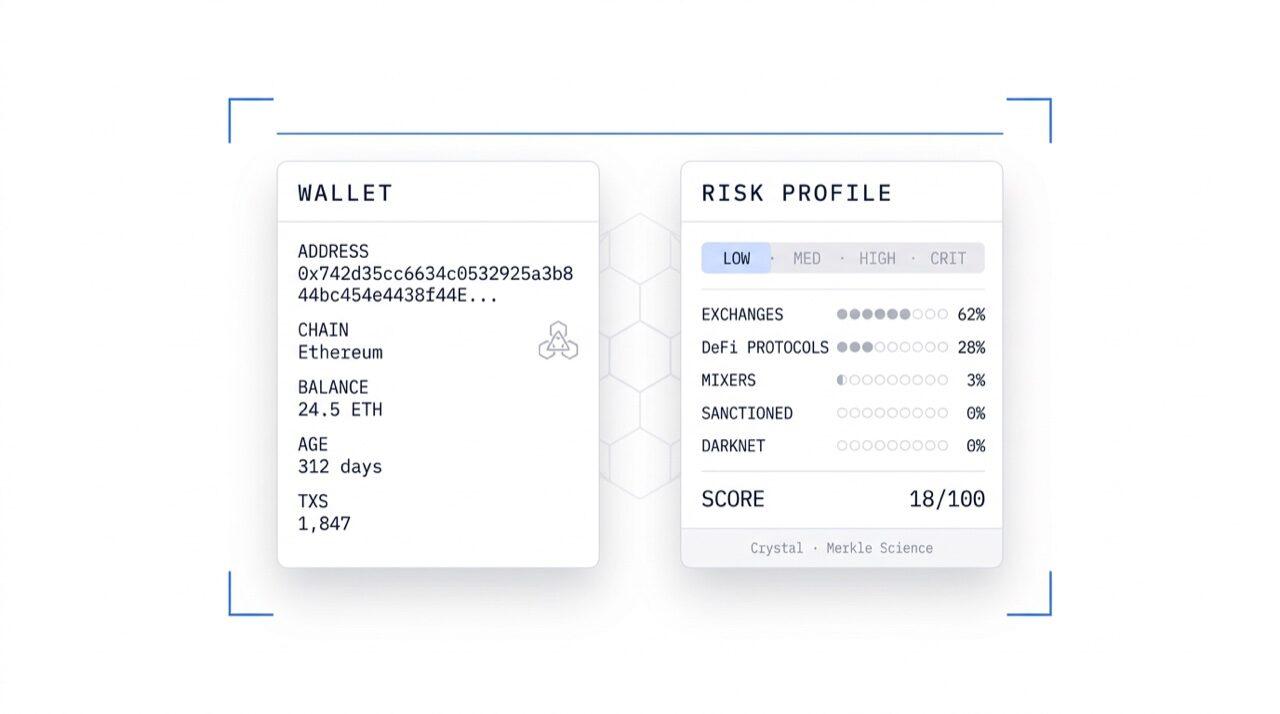
Risikobewertung 0–100, Schweregrad NIEDRIG/MITTEL/HOCH/KRITISCH, Aufschlüsselung der Herkunft der Gelder in über 14 Kategorien, sanktionierte Wallets, Ransomware, gestohlene Gelder, Darknet-Märkte, Mixer, Betrug, Hochrisiko-Börsen, Glücksspiel, Peer-to-Peer. Gleiche Struktur, jeder Anbieter.
Wallet · 0x9F2c...A41BKRITISCH
87
Risikobewertung 0-100
Schweregrad basierend auf Score · unter einer Sekunde
Herkunft der Mittel
Sanktionierte Wallet28%
Mixer (Tornado Cash)12%
Regulierte Börse48%
P2P12%
04 · Travel Rule
FATF Empfehlung 16 und VASP-Compliance.
Sende einen Travel Rule Block mit der Transaktion, und wir kümmern uns um den strukturierten Nachrichtenaustausch mit unterstützten Gegenpartei-VASPs (Virtual Asset Service Providers). Details zu Originator und Begünstigtem, vollständiger Audit Trail, abgestimmt auf die EU-Geldtransferverordnung.
Travel Rule · FATF R.16VASP zu VASP
Originator VASP
Acme Crypto · ESP
Beneficiary VASP
Coinbase · USA
originator.full_name · date_of_birth
beneficiary.full_name · wallet_address
amount · currency · chain
05 · TM gebündelt
Direkt in das Transaction Monitoring integriert.
Markiere eine Transaktion als Krypto, und wir screenen automatisch, Ziel-Wallet vor dem Transfer bei ausgehenden Transaktionen, Transaktions-Hash nach dem Transfer bei eingehenden Transaktionen. Hochrisiko-Treffer speisen die Regel-Engine, die Case Queue und die automatische Behebungsschleife.
Transaktion · OUTBOUND0.25 ETH
1TM-Regel · GeschwindigkeitsprüfungBESTANDEN
2Wallet Screening · On-Chain-RisikoMARKIEREN
3Regelwerk · Status-UpdateWARTET_AUF_NUTZER
Gleicher Workflow. Ein Transaktionsaufruf./v3/transactions/
06 · Abdeckung
Sanktionen, OFAC, Darknet, Mixer, Ransomware.
Jedes Screening deckt OFAC-, EU-, UN- und UK HM Treasury-Sanktionen sowie die Darknet-, Ransomware-, Mixer-, gestohlene Gelder-, Betrugs- und Terrorismusfinanzierungs-Informationen des zugrunde liegenden Anbieters ab. Sanktionierte Wallets werden als separates Flag angezeigt, sodass eine Regel sofort ablehnen kann.
Sanktionen und negative SignaleKontinuierlich aktualisiert
OFAC SDN
US-Finanzministerium
Aktiv
EU konsolidiert
Europäischer Rat
Aktiv
UN-Sanktionen
Vereinte Nationen
Aktiv
Darknet-Märkte
Anbieter-Intelligence
Aktiv
Ransomware-Wallets
Anbieter-Intelligence
Aktiv
Integrieren
Zwei Endpoints. Gleiches Screening. Gleicher Preis.
Wähle den Standalone-Endpoint für eine einmalige Wallet-Abfrage. Wähle den Transaktions-Endpoint, wenn das Screening die Regel-Engine, die Case Queue und die automatische Behebung speisen soll. Beide werden mit $0.15 pro Check abgerechnet.
// Your endpoint receives a signed wallet-screening resultconst crypto = require("node:crypto"); // ESM: import crypto from "node:crypto"// X-Signature-V2 = HMAC over the canonical JSON, never the raw bytes. Match the sender byte for// byte: keys sorted by code point, integers digit for digit, floats in Python's repr.class Num { constructor(src) { this.src = src; } } // a number as written on the wire, not a doubleconst num = (s) => { if (/^-?\d+$/.test(s)) return BigInt(s).toString(); const n = +s; // ints stay exactif (Number.isInteger(n)) return BigInt(n).toString(); const [m, e] = n.toExponential().split("e"); // 27.0 -> 27return +e >= -4 ? String(n) : `${m}e-${String(-e).padStart(2, "0")}`; }; // 1e-05, not 0.00001const byCodePoint = (a, b) => Buffer.compare(Buffer.from(a), Buffer.from(b)); // UTF-8 order = Python'sconst canon = (v) => Array.isArray(v) ? `[${v.map(canon)}]` : v instanceof Num ? num(v.src)
: v && typeof v === "object" ? `{${Object.keys(v).sort(byCodePoint).map((k) => `${JSON.stringify(k)}:${canon(v[k])}`)}}`
: JSON.stringify(v);
// Read the body as text: express.json() would round 1000000000000000129 to a double first.// Register this route ABOVE any global app.use(express.json()): the first parser to run// consumes the stream, and a body it already parsed has lost the digits the signature covers.
app.post("/webhooks/didit", express.text({ type: "application/json" }), (req, res) => {
const exact = JSON.parse(req.body, (k, v, c) => typeof v === "number" ? new Num(c.source) : v); // Node 21+const body = JSON.parse(req.body);
const mac = crypto.createHmac("sha256", SECRET).update(canon(exact), "utf8").digest("hex");
const sig = Buffer.from(String(req.headers["x-signature-v2"] ?? ""));
// Freshness comes from the signed body timestamp; the header alone is unsigned and replayable.const ts = body.timestamp, fresh = String(ts) === req.headers["x-timestamp"]
&& Math.abs(Date.now() / 1000 - ts) <= 300;
if (!fresh || sig.length !== mac.length
|| !crypto.timingSafeEqual(sig, Buffer.from(mac))) return res.sendStatus(401);
const { status, decision, txn_id } = body;
// status: APPROVED | IN_REVIEW | DECLINED | AWAITING_USER
res.sendStatus(200);
});
Füge den folgenden Block in Claude Code, Cursor, Codex, Devin, Aider oder Replit Agent ein. Ergänze deinen Stack. Der Agent provisioniert Didit, konfiguriert Wallet Screening für $0.15 pro Check, verifiziert signierte Webhooks und speist risikoreiche Treffer in das Transaction Monitoring ein.
didit-integration-prompt.md
# Didit Wallet Screening (KYT) — integrate in 5 minutes

You are integrating Didit's Wallet Screening / Know Your Transaction (KYT)
module into <my_stack>. Follow these steps exactly. Every URL, header,
and enum value below is canonical — do not paraphrase or "improve" them.

Wallet Screening produces a standardised risk payload regardless of
which underlying provider sits behind it:
  - Risk score 0-100 + severity (LOW, MEDIUM, HIGH, CRITICAL)
  - Source of funds breakdown across 14+ categories
  - Exposure table (counterparty entities, direct vs indirect hops)
  - Network graph metrics
  - Sanctions / darknet / mixer flags as discrete signals

## 1. Provision an account
- Sign up: https://business.didit.me (no credit card required).
- Or provision programmatically: POST https://apx.didit.me/auth/v2/programmatic/register/

## 2. Choose a screening source
- Wallet Screening runs at $0.15 per check on Didit's own on-chain
  risk data — nothing to configure, it works out of the box.
- Or bring your own screening provider and run it inside Didit: open
  Transactions > Settings > Provider Preferences in the Business
  Console (https://business.didit.me) and paste your existing
  provider API key. The screening result payload is identical
  whichever source you use.

## 3. Two integration paths — pick one

### Path A — Workflow / Transactions API (recommended)
Best when you want Wallet Screening chained into the Transaction
Monitoring rules engine so flagged transactions automatically generate
review cases.

POST https://verification.didit.me/v3/transactions/
Headers:
  x-api-key: <your-api-key>
  Content-Type: application/json
Body (outbound pre-transfer screen, screens the destination wallet):
  {
    "transaction_id": "withdrawal-001",
    "transaction_category": "finance",
    "include_crypto_screening": true,
    "transaction_details": {
      "direction": "OUTBOUND",
      "amount": "0.25",
      "currency": "ETH",
      "currency_kind": "crypto",
      "action_type": "withdrawal"
    },
    "subject": {
      "entity_type": "individual",
      "vendor_data": "user-123",
      "full_name": "John Doe"
    },
    "counterparty": {
      "entity_type": "unhosted_wallet",
      "full_name": "John Doe",
      "payment_method": {
        "method_type": "crypto_wallet",
        "account_id": "0xRecipientWallet..."
      }
    }
  }

Direction rules — required:
  - INBOUND  pre-transfer  -> screens counterparty.payment_method.account_id
  - INBOUND  post-transfer -> screens the tx hash scoped to subject.payment_method.account_id
  - OUTBOUND pre-transfer  -> screens counterparty.payment_method.account_id
  - OUTBOUND post-transfer -> screens the tx hash scoped to counterparty.payment_method.account_id

For post-transfer screening, also include
  transaction_details.payment_reference_id  -> the blockchain tx hash

### Path B — Standalone wallet-screening API
Best when you want a one-off wallet-risk lookup without writing a full
transaction. Same screening source, same $0.15 per check price.

POST https://verification.didit.me/v3/transactions/
Headers:
  x-api-key: <your-api-key>
  Content-Type: application/json
Body:
  {
    "wallet_address": "0xRecipientWallet...",
    "currency": "ETH",
    "direction": "OUTBOUND"
  }

Synchronous JSON response — no webhook required for the standalone call.
Use Path A whenever the screening result needs to flow into the rules
engine, case management, or the auto-remediation loop.

## 4. Webhooks
Register one webhook destination per workspace:

POST https://verification.didit.me/v3/webhook/destinations/
Body: { "url": "https://yourapp.com/didit/webhooks",
        "events": ["transaction.status.updated"] }

Every delivery carries an X-Signature-V2 Hash-based Message Authentication
Code (HMAC) header.  HMAC-SHA256 verification MUST run against the raw body bytes (the raw payload as Didit sent it) BEFORE any JSON parsing — re-serialising the parsed body changes whitespace and key order, which invalidates the signature.Verify it before trusting the payload:

  signature = hmac_sha256(secret, raw_body).hex()
  if signature != request.headers["X-Signature-V2"]:
      return 401

## 5. Reading the result
Every screening returns a standardised risk object:
  - risk_score (0-100, higher = more exposure)
  - severity ("LOW", "MEDIUM", "HIGH", "CRITICAL")
  - source_of_funds (array of { category, percentage })
  - exposure (array of { entity, hop_distance, received, sent, risk })
  - flags (array including "sanctioned", "darknet_market", "mixer",
           "ransomware", "child_exploitation", "scam", and others)
  - network_graph (nodes, edges, centrality, depth)

Feed flagged transactions into the Transaction Monitoring rules engine
so high-risk hits automatically generate cases at the published
$0.02 per transaction inspection rate.

## 6. Travel Rule (FATF Recommendation 16)
For Virtual Asset Service Provider (VASP) to VASP transfers, include
the Travel Rule payload alongside the transaction body:

  "travel_rule": {
    "originator_vasp": {...},
    "beneficiary_vasp": {...},
    "originator": { "full_name", "date_of_birth", ... },
    "beneficiary": { "full_name", "wallet_address" }
  }

Didit handles the structured-message exchange with supported counterparty
VASPs. Reference: https://docs.didit.me/transaction-monitoring/travel-rule

## 7. Hard rules — do not change
- Base URL stays  https://verification.didit.me  (NOT apx.didit.me).
- Auth header stays  x-api-key  (lowercase, hyphenated).
- Webhook signature header stays  X-Signature-V2  (NOT X-Signature).
- currency_kind is always  "crypto"  for wallet screening.
- direction is always UPPERCASE  ("INBOUND" or "OUTBOUND").
- severity casing stays UPPERCASE: LOW, MEDIUM, HIGH, CRITICAL.

## 8. Pricing reference
- $0.15 per wallet screening on Didit's own on-chain risk data — or
  bring your own screening provider and run it inside Didit.
- $0.02 per transaction inspected by the Transaction Monitoring rule
  engine. AML on flagged transactions at $0.20 per check.
- 500 free verifications every month on every account, forever.
- No minimums, no contracts. Volume discounts above 100k screenings
  per month — see https://didit.me/pricing.

## 9. Verify your integration
1. Create a sandbox API key at https://business.didit.me.
2. Post the example outbound transaction above against a known-flagged
   tutorial wallet — the response should have severity "CRITICAL" and
   carry a "sanctioned" flag.
3. Confirm the webhook fires with transaction.status.updated and the
   X-Signature-V2 header verifies cleanly.
4. Open Case Management in the console — the transaction should land
   in the queue with source PROVIDER and severity CRITICAL.

Done. Wallet Screening is live. Reach out to support@didit.me with the
workspace id if you hit a wall.
Compliant by Design
Ein neues Land mit einem Klick erschließen. Wir machen die Arbeit.
Wir gründen lokale Tochtergesellschaften, sichern Lizenzen, führen Penetrationstests durch, erhalten Zertifizierungen und passen uns jeder neuen Regulierung an. Um Verifizierungen in einem neuen Land zu starten, legst du einfach einen Schalter um. Über 220 Länder live, vierteljährlich auditiert und Pen-getestet, der einzige Identitätsanbieter, den eine EU-Mitgliedsregierung offiziell als sicherer als die persönliche Verifizierung eingestuft hat.
Pro Check. Öffentlicher Preis, keine Mindestmengen.
BYO key
Nutze deinen eigenen Screening-Anbieter und integriere ihn in Didit.
14+
Herkunft der Gelder auf jeder standardisierten Payload.
Sub-1s
End-to-End On-Chain Wallet Screening.
Drei Stufen, eine Preisliste
Kostenlos starten. Nach Verbrauch zahlen. Bis zum Enterprise-Level skalieren.
500 kostenlose Verifizierungen jeden Monat, für immer. Danach zahlst du nur, wenn ein Modul läuft. Individuelle Verträge, Datenresidenz und Service Level Agreements (SLAs) für Enterprise-Kunden.
Kostenlos
$0/ Monat · keine Kreditkarte nötig
Zum Entwickeln, Testen und für deine ersten Nutzer.
Alles, was du für den Start brauchst:
500 vollständige KYC-Verifizierungen pro Monat
ID, Liveness, Face Match, Gerät & IP
Über 200 Betrugssignale, Blocklist, Duplikate
Wiederverwendbares KYC im Didit-Netzwerk
Workflow Builder, Case Management, SDKs
KI-SupportKI-Agent in der Konsole, Docs und Community.