Online Casino Fraud Detection and AML Controls (2026)
Score logins, gameplay, bonuses and withdrawals in one rule engine, screen players against 1,300+ lists, and route hits to cases. Full ID check $0.33, AML screening $0.20.
 Alberto RosasCo-founder and CEO
Contents
In this guide
Jump to the part you need.
This guide is for operators and risk teams who need to catch bonus abuse, account takeover, payment fraud and minimal-play laundering on a gambling platform. We show how to send logins, gameplay, bonuses and payments into one Didit rule engine, then screen the same player for sanctions and PEPs. The full ID check is $0.33 and AML screening is $0.20. The main caveat: event monitoring is opt-in and scores nothing until you switch it on.
Last updated: November 26, 2026. Prices checked against the live Didit price feed on November 26, 2026.
| Control | Question it answers | Module | List price |
|---|---|---|---|
| Player identity at sign-up and at cash-out | Is the document real, the face the same person, the device already known to us | Full ID check: ID document, passive liveness, face match, device and IP | $0.33 per check |
| Sanctions, PEPs, adverse media | Is this person allowed to play and to be paid | AML screening, 1,300+ lists | $0.20 per check |
| Risk after onboarding | Has this player become a hit since we accepted them | Ongoing AML monitoring | $0.07 per user a year |
| Login, bonus, gameplay, payment, dispute events | Is this bonus abuse, takeover, chip dumping or a chargeback about to land | Event monitoring in Transaction Monitoring | $0.001 per transaction beyond the plan allowance |
| Crypto deposits and payouts | Where did this wallet money come from | Wallet Screening (KYT) | $0.15 per screening |
| Payout bank account | Does the account belong to the verified player | Account Check API | $0.02 per check on your own provider, with country coverage in the price book |
Start free in the sandbox at business.didit.me, with no sales call. Developers who want an assistant to wire the calls can connect Didit through the MCP server. The rules themselves run inside Transaction Monitoring. Pricing figures in this post come from the pricing page and the pricing docs.
The fraud types a gambling platform actually has to stop
Online gambling fraud is rarely one event. It is a pattern across a login, a bonus claim, a table stake and a withdrawal. Take a documented example: a player fails a login three times, changes MFA, adds a new withdrawal address and requests a payout inside 24 hours. No single step is suspicious on its own; the order is. That is the shape of the controls below, written as rules over event streams rather than checks on a single payment.
| Fraud type | What it looks like in your data | Rule pattern |
|---|---|---|
| Bonus abuse and multi-accounting | A welcome bonus claimed on several accounts from one device, then barely wagered before a withdrawal | Velocity: count of bonus_claimed grouped per device fingerprint in a 30 day window, plus a ratio of bonus_wagered to bonus_released |
| Account takeover | Failed logins, then an MFA change, then a new withdrawal address, then a payout request | Sequence over security and payment actions within one session window |
| Payment fraud and chargebacks | Small test deposits across many instruments, then a chargeback after a cash-out | distinct_count over event.payment.instrument_reference_hash and a dispute rule on chargeback_opened |
| Chip dumping | The same two players settling hands where one always loses | Requires p2p_settlement payload with counterparty_vendor_data, stake_amount and net_result_amount |
| Minimal-play laundering | Deposit, wager a small fraction of it, request a withdrawal | Ratio of summed bet_placed to summed deposit_completed under your threshold |
| Bot-assisted play and bonus farming | Low timing variance, high actions per minute, one pointer pattern across many accounts | Threshold on event.bot.timing_variance_ms or event.bot.actions_per_minute |
| Self-exclusion evasion | A blocked player tries to register again | responsible_gambling rule on self_exclusion_match or re_registration_attempt with change_status to DECLINED |
Prerequisites
- A Didit organization and an API key. The same
x-api-keyheader works for sessions, AML screening and the transaction monitoring endpoints. - A verification workflow that contains ID document verification, passive liveness, face match, device and IP analysis, and AML screening. The full ID check is $0.33 and runs as three parts of one check.
- Your players already identified by a stable
vendor_data. Every event, transaction and session resolves to the same User through that value. - Event monitoring switched on in Transactions, Settings, Event monitoring. Until it is on, every write call answers 403.
- Decisions about thresholds and risk appetite written down before you tune anything, because the defaults are deliberately conservative.
How to implement casino fraud detection and AML controls, step by step
Step 1. Turn on event monitoring
In the Business Console open Transactions, then Settings, then Event monitoring. Event ingestion is opt-in: until you enable it, the endpoints POST /v3/events/, POST /v3/events/batch/, POST /v3/events/sdk-token/ and the /v1/events/ device lane answer 403 with {"code": "event_monitoring_disabled"}, and nothing is stored, enriched or evaluated. Reads are unaffected, which is why a half-configured setup looks fine in the console and scores nothing.
Step 2. Send the events that prove fraud
Send one event per action from your backend. The envelope is the same for every category, and event_id is your idempotency key, so a retry of the same action does not create a second record.
curl -X POST https://verification.didit.me/v3/events/ \
  -H "x-api-key: YOUR_API_KEY" \
  -H "Content-Type: application/json" \
  -d '{
    "event_id": "login-2026-08-31-000001",
    "event_category": "auth",
    "action_type": "login",
    "occurred_at": "2026-08-31T20:40:31.123Z",
    "time_zone": "UTC",
    "subject": {
      "entity_type": "individual",
      "vendor_data": "user_391"
    },
    "session": { "session_id": "web-session-abc", "sequence": 142 },
    "device_context": {
      "fingerprint": "didit-fp-v2:a8c1",
      "network_context": { "ip_address": "203.0.113.42" }
    },
    "payload": { "method": "password" }
  }'
The engine answers with the score it computed at ingestion and the rule evidence behind it.
{
  "event_uuid": "0f2b...",
  "event_id": "login-2026-08-31-000001",
  "status": "ACCEPTED",
  "score": 0,
  "rules_evaluated_count": 6,
  "rules_matched_count": 0,
  "correlation_pending": false,
  "retention_class": "standard",
  "expires_at": "2026-09-30T20:40:31.123Z",
  "idempotent_replay": false,
  "rule_matches": []
}
There are ten categories to cover: auth, session, gameplay, bonus, affiliate, payment, dispute, security, responsible_gambling and custom. Send security actions for the risk-grade lifecycle that account takeover rules read, and auth for the broad product view. Some actions are rejected unless the keys needed to correlate them are present: gameplay.p2p_settlement needs game_id, counterparty_vendor_data, stake_amount, net_result_amount, role and a hand or round identifier.
Step 3. Write the rules per typology
One rule model covers transactions and events. A rule declares what it fires on through scope.record_types: omitted or ["transaction"] means transactions only, ["event"] means events only, and both values means either. Choosing Events in the console also reveals an Event categories checklist, so a rule can stay inside security or payment.
This is the account takeover sequence. It reads three failed logins, then an MFA change, then a new withdrawal address, then the payout request, ordered inside a 24 hour window.
{
  "metric": "sequence",
  "key": "ato_drain",
  "window": "24h",
  "steps": [
    { "event_category": "security", "action_type": "login_failed", "min_count": 3 },
    { "event_category": "security", "action_type": "mfa_changed" },
    { "event_category": "payment",  "action_type": "withdrawal_address_changed" },
    { "event_category": "payment",  "action_type": "withdrawal_requested" }
  ]
}
For minimal-play laundering, use a ratio over the same window: numerator is the sum of event.amount where event.action_type is bet_placed, denominator is the sum of event.amount where the action is deposit_completed, and the rule fires when the ratio is at or below your threshold. Deposit 1,000, wager 20, request a withdrawal, and the ratio is 0.02. A ratio with no denominator never matches, so a brand-new player with no deposits is never flagged as suspicious for that reason alone.
Step 4. Run rules in test mode, then set thresholds
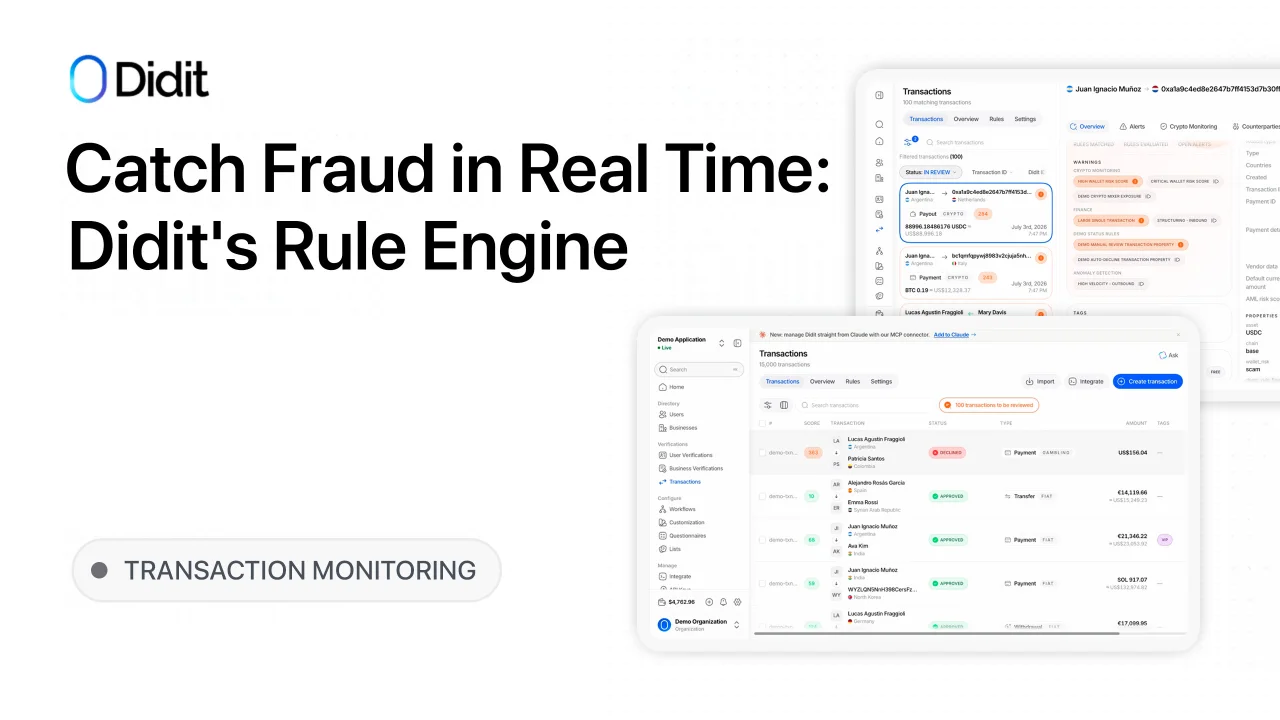
Every rule can run in TEST mode. It evaluates against live records but contributes no score and changes no status, so you can measure selectivity before a rule can decline a real player. Switch to ACTIVE when the numbers look right.
Scoring is additive: score = sum of score_delta of every matched rule, starting from 0. The defaults are a review threshold of 75 and a decline threshold of 500, and 500 means never decline by score. Lower the decline threshold deliberately, for example to 85 once you know which combinations of moderate rules should block a payout. A rule can also override the score entirely with change_status set to DECLINED, IN_REVIEW or AWAITING_USER.
Step 5. Route the result: alerts, cases, filings
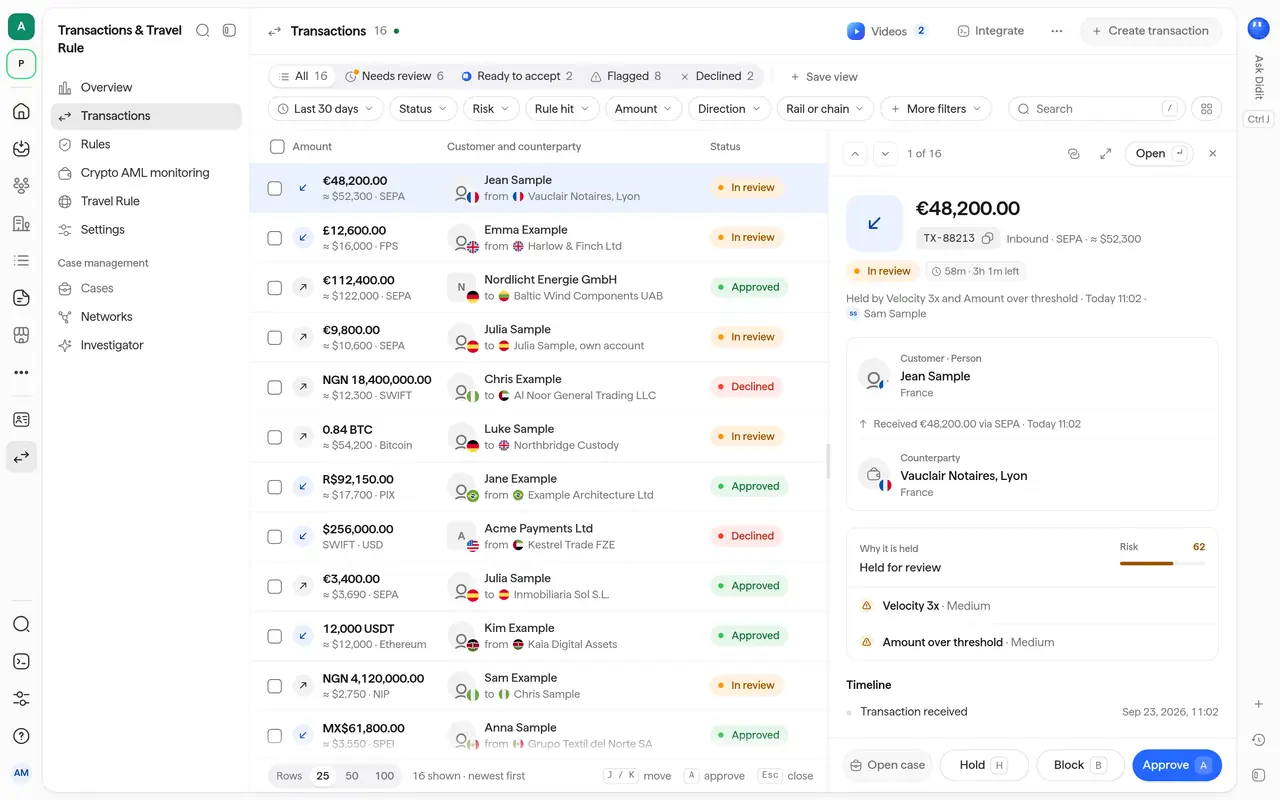
A transaction held in IN_REVIEW or AWAITING_USER, either by a rule or by a reviewer, appears as an alert. There is no separate alert record to reconcile. From there you can add it to a case, manually or automatically through the Create case rule effect, which routes the case to a blueprint, sets grouping by applicant or by rule and applicant, and can attach the triggering transaction. Cases share one lifecycle across the platform: Open, Awaiting user, Resolved, closing with a resolution of False positive or Valid threat. A resolved investigation can generate a SAR, STR, CTR or other filing from the FIU Reports templates.
Event rules are worth describing separately, because the alert definition in the docs is written for transactions. A rule scoped to events runs through the same rule model and the same actions, and the evidence behind each match comes back on the event record in rule_matches[] alongside the score the engine computed. When your policy needs an investigation for an event pattern, the Create case effect opens one straight from the rule.
Step 6. Screen the identity side at onboarding and keep watching it
Run AML as part of the verification session, or as a standalone call when you need a one-off check decoupled from the hosted flow. Both return the same decision surface, an aml_screenings[] array or an aml object with hits and warnings.
curl -X POST 'https://verification.didit.me/v3/aml/' \
-H "x-api-key: $DIDIT_API_KEY" \
-H "Content-Type: application/json" \
-d '{
"full_name": "Javier Ejemplo Modelo",
"entity_type": "person",
"date_of_birth": "1974-01-01",
"nationality": "ES",
"include_adverse_media": true,
"vendor_data": "user-1234"
}'
The two-score model matters for a casino: the match score decides whether a hit is the same person at all, and the risk score decides the status. Warnings you will see include POSSIBLE_MATCH_FOUND, MATCH_FOUND, HIGH_RISK_COUNTRY, ADVERSE_MEDIA_HIT, SANCTIONED_ENTITY and PEP_MATCH. Add include_ongoing_monitoring to keep a player on the list after onboarding: it costs $0.07 per screened entity a year and requires save_api_request set to true.

Step 7. Check the payout account before the money leaves
The Account Check API verifies that a bank account belongs to the person or company you name, with no session and no sign-in. Your backend sends the name and the account in the shape its country writes it, an IBAN for the euro area or a sort code and account number for a UK account, and reads the result before a withdrawal is released. The price book lists a bank check on your own provider at $0.02 per check, and the per-country coverage and pricing sit in the Bank Verification pricing docs. A country the check does not cover answers 404 with country_not_covered and is not billed, so you can decide ahead of time which corridors fall back to manual review.
Inputs and outputs
| Input | Where it comes from | Output you act on |
|---|---|---|
subject.vendor_data, event_category, action_type, occurred_at, event_id | Your game and payments backend, per player action | score, status, rule_matches[], rules_evaluated_count |
device_context.fingerprint, network_context.ip_address | Your client or server, or the Didit SDK | event.ip.is_vpn_or_tor, event.ip.asn_organization and the other namespaced paths your rules read |
full_name, date_of_birth, nationality, include_adverse_media | Registration or cash-out form | aml.status, hits[], warnings[] |
| Workflow session for ID, liveness, face match, device and IP | POST /v3/session/ with workflow_id and vendor_data | ip_analyses[] with the resolved geo, ASN, VPN flags and duplicate device matches |
| Account holder name and account details | Withdrawal request | Account match result, or country_not_covered |
Failure cases and recovery
| Failure | What you see | Recovery |
|---|---|---|
| Event monitoring off | 403 with event_monitoring_disabled on every write lane | Enable it in Transactions, Settings, Event monitoring, then resend. Nothing was stored, so resend all of it |
| Timestamp out of window | The event is rejected | occurred_at accepts up to 7 days in the past and 5 minutes in the future. Send from the backend at the moment of the action, not from a nightly batch |
| Rule never fires on events | Zero matches while events clearly exist | Add ["event"] to scope.record_types, and narrow with the event categories checklist if needed |
| Per-subject rule matches nothing | No match even though the pattern is present | __current__ only groups records that carry the field. An event with no fingerprint is not the same device as other events without one |
| Ratio rule silent | No match on players you expected to catch | A ratio with no denominator never matches. Check that deposit_completed events are arriving for that player |
| AML 400 | Request rejected | The weights aml_name_weight, aml_dob_weight and aml_country_weight must sum to exactly 100 |
| AML 403 | Out of credits | Top up or move the org onto a plan, then re-run the check |
| Adverse media slow | Latency around 25 seconds | Set the client timeout to at least 45 seconds. A result that returns without adverse-media hits is still actionable |
| Ongoing monitoring 400 | Request rejected | include_ongoing_monitoring requires save_api_request set to true |
| Device signals missing | ip_analyses[] is empty | The player blocked the fingerprint script. Decide in advance whether that fails closed with a manual review or falls back to soft signals |
| Payout account 404 | country_not_covered | Not billed. Route that corridor to manual review until the country is covered |
| Everything declines | Decline rate jumps after a threshold change | The default decline threshold is 500, which never declines by score. Only lower it after a test-mode run shows the selectivity you want |
Paid steps and review boundaries
Free, on every plan: the sandbox, the workflow orchestrator, the MCP server, reusable KYC, and the first 50,000 authentication active users each month. Billed per completed check: full ID check $0.33, AML screening $0.20, age estimation $0.10, and ongoing AML monitoring $0.07 per person a year. The iGaming bundle covers KYC, AML and age estimation at $0.63 per player.
Transaction monitoring is included up to a monthly allowance that differs by plan: 1,000 monitored transactions on Free, 10,000 on Growth and 100,000 on Scale, with Enterprise setting its own allowance in the contract. Each transaction beyond the allowance costs $0.001, the same on every plan, and that rate carries no plan discount.
The engine scores. A person decides. Scores at or above the review threshold go to IN_REVIEW, scores at or above the decline threshold go to DECLINED, and a rule action can force either status regardless of score. An AML result landing between the approve and review thresholds goes to a manual queue rather than closing itself, and cases close only when a reviewer records False positive or Valid threat. Blueprints can require 4-eyes review before a case is resolved: automated detection, human sign-off.
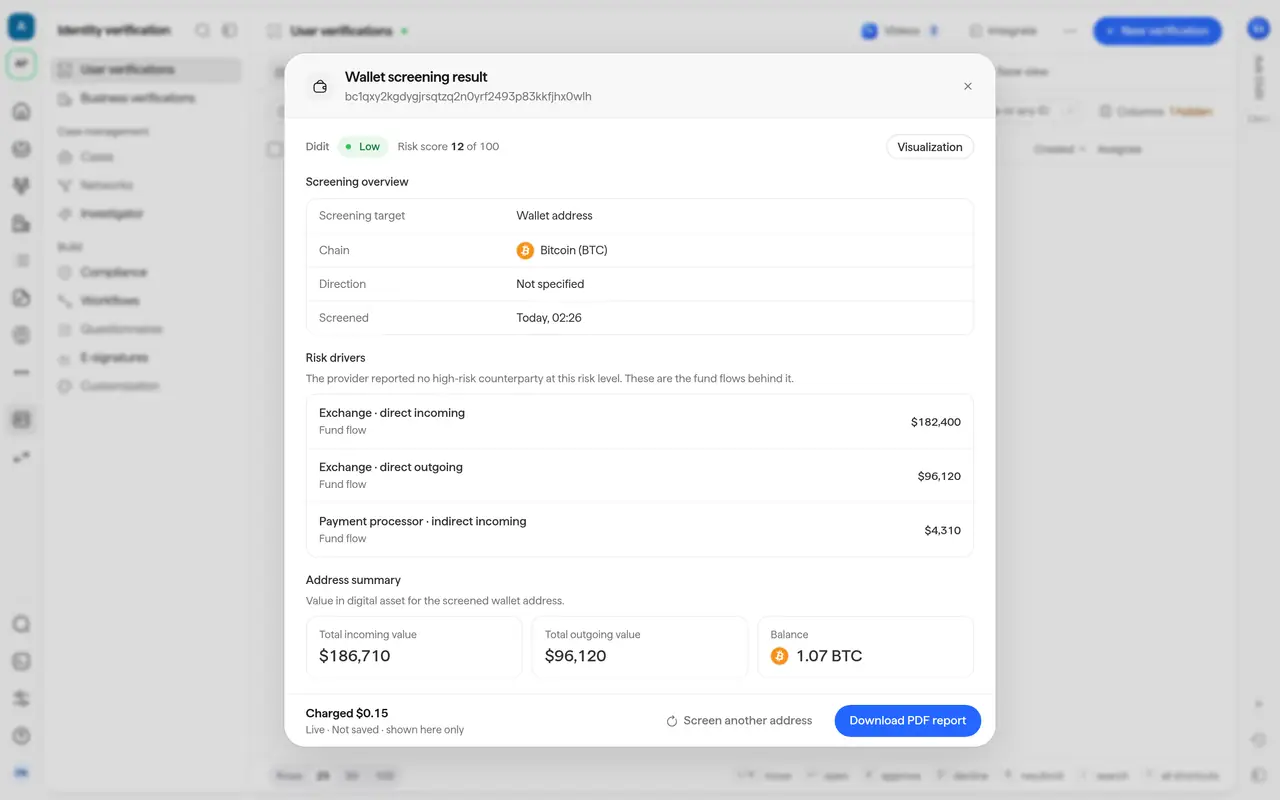
Wallet screening is priced at $0.15 per screening. If you already run your own screening provider, bring your own screening provider and run it inside Didit instead.
Worked cost example
These are assumptions for the arithmetic, not published figures: 10,000 new depositing players a month, 1,200,000 monitored events and transactions a month, and 2,000 crypto deposits a month, on the Scale plan.
- Onboarding identity per player: full ID check $0.33 + AML screening $0.20 + age estimation $0.10 = $0.63, which is the published iGaming bundle price. Assuming 10,000 players: 10,000 x $0.63 = $6,300 a month.
- With the Scale discount of 10 percent: $0.63 x 0.9 = $0.567 per player. 10,000 x $0.567 = $5,670 a month.
- Ongoing AML monitoring: 10,000 x $0.07 = $700 a year, which is $700 / 12 = $58.33 a month at list. On Scale, $0.07 x 0.9 = $0.063 per person, so 10,000 x $0.063 = $630 a year, or $52.50 a month.
- Transaction monitoring, assuming 1,200,000 monitored transactions: the Scale allowance is 100,000 a month. 1,200,000 - 100,000 = 1,100,000 billed at $0.001 each = $1,100 a month. This rate carries no plan discount.
- Wallet screening, assuming 2,000 crypto deposits: 2,000 x $0.15 = $300 a month, or 2,000 x $0.135 = $270 on Scale.
- Monthly total at list: $6,300 + $1,100 + $300 = $7,700, plus $58.33 for monitoring, so $7,758.33. On Scale: $5,670 + $1,100 + $270 = $7,040, plus $52.50, so $7,092.50.
- The Scale plan itself is $299 a month and carries $350 of monthly credit that is drawn before top-ups. Credit resets monthly and does not roll over.
Didit runs identity and fraud checks for 4,000+ companies across 220+ countries, with 100% uptime over the last six months. Those two numbers matter less than your false-positive rate, which is why test mode exists.
Sources
- Didit docs: Event Ingestion API, non-monetary monitoring
- Didit docs: Event rules, velocity, ratio, sequence and correlation
- Didit docs: Transaction risk scoring, formula and thresholds
- Didit docs: KYT cases and SAR investigations
- Didit docs: AML screening API, sanctions and PEP
- Didit docs: Device fingerprinting and IP risk API
- Didit docs: Account Check API
- Didit docs: Bank Verification pricing and country coverage
- Didit pricing page and pricing docs, read November 26, 2026
- Didit Transaction Monitoring product page
- Didit MCP server setup
- Didit migration notes
- FATF, international standards on combating money laundering and terrorist financing
- EUR-Lex, EU anti-money laundering directives
Next step: open the sandbox at business.didit.me, create a workflow with ID verification, AML screening and device and IP analysis, send one real event, and watch the score come back. No sales call, and every price you need is on didit.me/pricing.
Try it
Try this in the sandbox
Run the check this guide describes, free.
The product this post is about, taken from its topic. Run it free in the sandbox.
Author
Alberto Rosas
Co-founder and CEO

Keep reading
Other guides in the same topic.
 What Is a Money Services Business (MSB)? AML Obligations
An MSB transmits, exchanges or stores money for customers: money transmitters, currency exchangers, check cashers, crypto exchanges. MSBs register with a regulator and run an AML program with KYC, screening and reporting.
Alberto RosasNov 26, 2026 How to Add Age Verification to a Website: Popup or API
Use a Didit hosted popup for web sign-up or POST a selfie to the Age Estimation API. Age Estimation costs $0.10 per check; full KYC with document proof costs $0.33.
Alberto RosasNov 26, 2026 Identity Verification vs Authentication: Didit vs Auth0 (2026)
Identity verification proves who someone is; authentication proves the same person came back. Account takeover defeats authentication, not verification. Didit charges $0.33 per full KYC check;
Alberto RosasNov 26, 2026Questions
Frequently asked questions
What is online gambling fraud and which types should we watch?
It is abuse of a betting or casino account for money that should not be there: bonus abuse, account takeover, stolen payment instruments, chargebacks, chip dumping between colluding accounts, and laundering through minimal play. Which one hurts you most depends on your product mix, your payment corridors and your bonus design. All of them show up as patterns across non-monetary events, not as single suspicious payments, which is why the Event Ingestion API ships with ten categories including auth, gameplay, bonus, payment, dispute, security and responsible_gambling.
How does Didit detect bonus abuse?
You send bonus_claimed, bonus_wagered and bonus_released events with the device fingerprint attached, and a velocity rule counts claims per device or per subject inside a window such as 30 days. A second rule compares wagered volume to released bonus, which catches the player who claims, spins at the minimum, and withdraws. Both rules add score rather than blocking, so a shared household device does not automatically lose its bonus.
How do you catch account takeover on a casino account?
With an ordered sequence over the security and payment categories: three failed logins, then an MFA change, then a withdrawal address change, then a payout request, all inside 24 hours. A sequence rule fires only when the steps happen in that order, which keeps ordinary password resets out of the queue. The rule can add score and move the record to IN_REVIEW in one action, so the withdrawal is held before the money moves.
What AML obligations apply to online gambling operators?
Gambling operators that are covered entities must identify players, apply a risk-based approach, screen against sanctions and PEP lists, monitor activity, and report suspicious activity to their financial intelligence unit. FATF sets the risk-based approach standard and the EU anti-money laundering directives set the licensing and reporting duties inside the EU. Didit supports the operational side: AML screening against 1,300+ lists, ongoing monitoring, a scored rule engine, cases with 4-eyes review, and FIU report templates for SAR, STR and CTR filings.
How much does KYC and AML cost per player on Didit?
The full ID check is $0.33 and covers the ID document, passive liveness, face match, device and IP analysis. AML screening is $0.20 against 1,300+ sanctions, PEP and watchlist sources, ongoing monitoring is $0.07 per person a year, and age estimation is $0.10. The iGaming bundle of KYC, AML and age estimation is $0.63 per player, before any plan discount.
Is event monitoring on by default?
No. Event ingestion is opt-in and you turn it on in Transactions, Settings, Event monitoring. Until then every write call on POST /v3/events/, POST /v3/events/batch/ and the device lane returns 403 with event_monitoring_disabled, and nothing is stored or evaluated. Transaction rules keep working exactly as before, and a rule never starts matching logins because its scope happened to be empty.
Can a rule block a withdrawal, or does it only score?
Both are available. A rule can contribute add_score, add tags, add an identifier to a blocklist, or set the status directly with change_status to DECLINED, IN_REVIEW or AWAITING_USER. Most operators let several moderate rules accumulate score and reserve a forced decline for a single clear signal, such as a confirmed self-exclusion match or a sanctions hit.
How do I test fraud rules without blocking real players?
Run the rule in TEST mode. It evaluates against live transactions and events but contributes nothing to the score or status, and the run is recorded with is_test = true. When the selectivity looks right, switch it to ACTIVE and adjust the review and decline thresholds, which apply to new records only; historical records keep the status they were evaluated with.
Can Didit check a player's payout bank account before a withdrawal?
Yes. The Account Check API takes the holder name and the account in that country's format, an IBAN in the euro area or a sort code and account number in the UK, and returns whether the account belongs to that person. It needs no session and no sign-in, and the price book lists a bank check on your own provider at $0.02 per check, with country coverage in the Bank Verification pricing docs. A country that is not covered answers 404 with country_not_covered and is not billed.
Does Didit screen crypto wallets on the same platform as casino transactions?
Wallet Screening runs inside Transaction Monitoring at $0.15 per screening, so a crypto deposit can be screened and then scored by the same rule engine that evaluates the player's login and bonus events. If you already have a screening provider you prefer, bring your own screening provider and run it inside Didit.
How do I connect Didit to an AI coding assistant?
The hosted MCP server connects Claude, ChatGPT and other clients to your Didit organization with OAuth sign-in, and it is free on every plan. It is hosted at https://mcp.didit.me/mcp, and the integration prompt gives a coding agent the full set of calls in one paste. See MCP setup for every client.
What changes if we migrate from another provider?
Most of the work is in the event stream, not the identity checks. You keep sending your own vendor_data, so historical decisions can be matched to the same user ids, and the rules are rewritten in one vocabulary that covers both transactions and events. Our migration notes are at didit.me/switch.
Compliance built in
Audited, certified and attested.
We hold the certifications and build each country's rules into your flows, so you can launch anywhere without worrying. Security and Compliance center
- Regulation encoded into your flows
Tell us what you do and where. Didit lists the rules that apply to you, with sources, and builds the checks each country needs into one workflow.
- Ready for AMLR
Every requirement of the new EU anti-money laundering rules, from checking customers to human review, is already covered by a Didit check.
- Tested in Spain's Treasury sandbox
Spain's Treasury published its supervised sandbox report on Didit's NFC plus active liveness onboarding; SEPBLAC took part and valued the added measures positively.
- Audited, not self-declared
iBeta Level 1 and Level 2. Liveness tested under ISO/IEC 30107-3.
Your obligations · 3 regions
 SOC 2 Type 2
 ISO 27001
 iBeta Level 1 and Level 2
 EU regulator attestation
 FSM youth protection
 GDPR
 EBA remote onboarding
 MiCA compatible
 FIDO Alliance member
- AMLREU AML Regulation ready
Integration · Didit MCP
Run Didit from your own AI agent
Connect Didit to Claude, Cursor, VS Code or ChatGPT and just ask in plain words. Your agent can do anything you can do in the console, with the same permissions you have.
 Add to Claude
 ChatGPT
 Cursor
- Build workflowsDescribe the checks you need. The agent creates and publishes the flow.
- Run investigationsAsk why a session was declined, review cases, search people and companies.
- Change rulesCreate payment rules, test them on past data and switch them on.
- Pull reportsAsk for numbers, exports or the audit log.
Didit Academy


