
Sanctions screening in Switzerland: SECO vs EU, UN and OFAC lists
How to run sanctions screening in Switzerland: SECO, EU, UN and OFAC lists compared, the 50% ownership test, name matching, false positives, monitoring, and what to do on a true hit.
At a glance
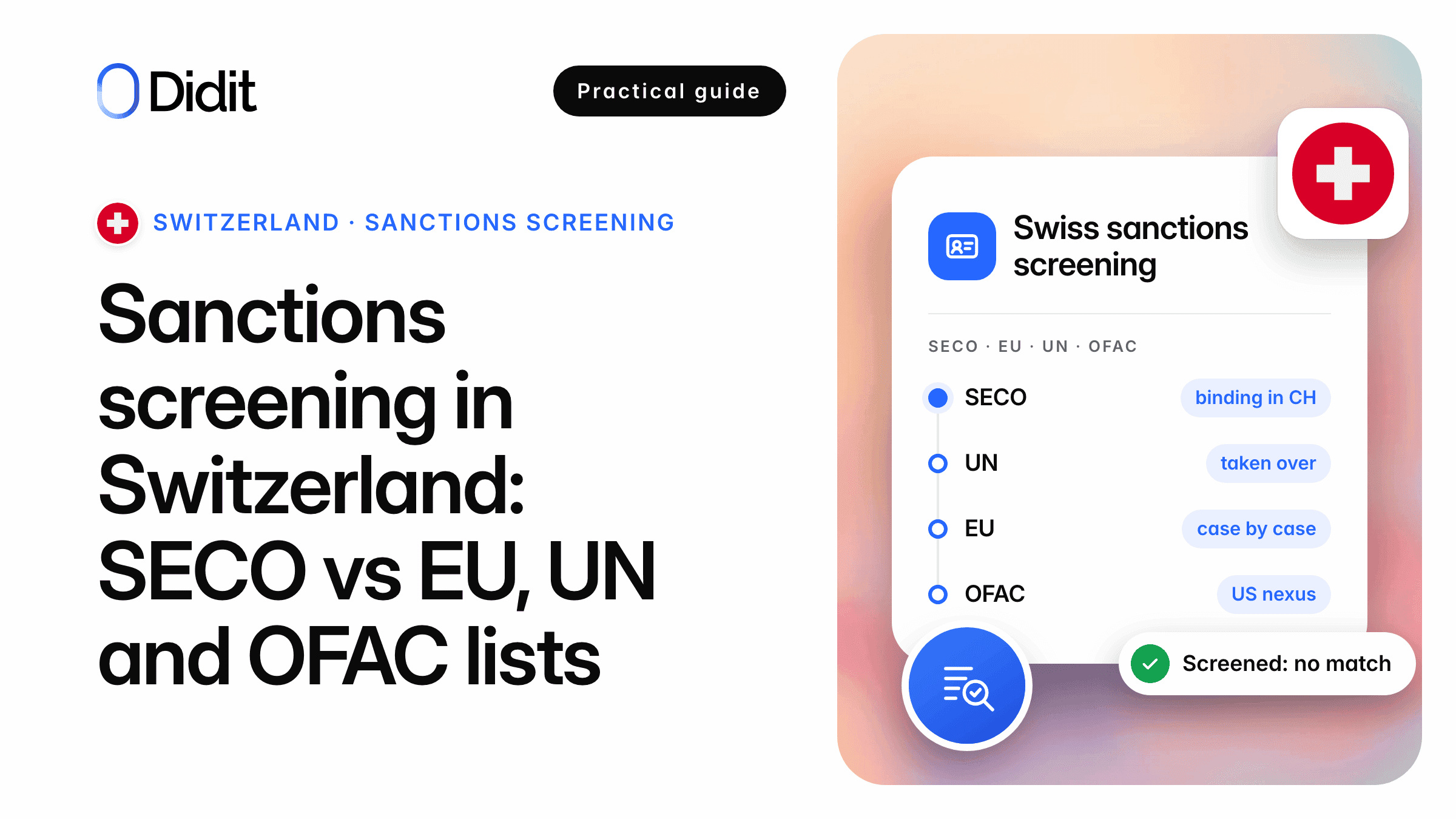
Sanctions screening in Switzerland starts with the SECO list: Swiss sanctions bind everyone in Switzerland, UN listings apply automatically, and EU measures apply only once the Federal Council adopts them, in full, in part or not at all.[4][5][3]
- EU and OFAC lists have no direct legal effect in Switzerland, but FINMA expects financial institutions to manage foreign sanctions risk too, US secondary sanctions included.[4][16]
- A true hit on a Swiss asset-freeze list means freeze and report to SECO without delay; an MROS report under the Anti-Money Laundering Act is a separate test.[2][14]
- Does Didit screen SECO? Yes. Didit's watchlist database includes both SECO lists, the "State Secretariat for Economic Affairs, Switzerland - List of Sanctioned Individuals, Entities and Organizations" and the "State Secretariat for Economic Affairs, Switzerland - Sanctions List", among 1,300+ lists, at onboarding and in ongoing monitoring.
Sanctions screening in Switzerland looks simple: check customers against the Swiss sanctions list. In practice a Swiss firm deals with four list families (SECO, the UN, the EU and the US Office of Foreign Assets Control, OFAC), each with its own reach, timing and ownership rules. Breaches happen in the gaps.
This guide is for the teams that run screening: the four list families, the 50% test, name matching, false positives and true hits, with article numbers. The list itself is covered in our SECO sanctions list guide, the wider anti-money laundering (AML) and know your customer (KYC) rules in Swiss AML and KYC requirements.
Yes, Didit screens SECO
Didit screens people and companies against both SECO sanctions lists, plus UN, EU, OFAC and UK lists, among 1,300+ lists updated daily. Start free or talk to us.
The four list families a Swiss firm deals with
The Embargo Act (EmbA, in German Embargogesetz EmbG, in French loi sur les embargos LEmb, SR 946.231) is the legal basis for Swiss sanctions. It lets the Confederation enforce only sanctions adopted by three sources.[1]
Article 1(1)Embargo Act, SR 946.231
"The Confederation may enact coercive measures to enforce sanctions that have been adopted by the United Nations, the Organization for Security and Co-operation in Europe or by Switzerland's most important trading partners and that serve compliance with international law, in particular respect for human rights."
Source: Fedlex, Embargogesetz, version of 1 July 2023[1] (our translation of the German text)
SECO, the State Secretariat for Economic Affairs, reads "most important trading partners" as the EU in practice, and Switzerland has no legal basis for autonomous sanctions of its own.[4] The Federal Council enacts each regime as an ordinance; there are 28, all based on UN or EU measures.[1][4]
| List family | Who issues it | Legal effect in Switzerland | Format |
|---|---|---|---|
| SECO (Swiss sanctions list) | Federal Council ordinances, annexes updated by the Federal Department of Economic Affairs (EAER); published by SECO[1] | Binding on individuals and companies in Switzerland[5] | SESAM search, consolidated XML list with an XSD, Excel export[6] |
| UN Security Council Consolidated List | UN Security Council and its committees[23] | Binding on Switzerland as a UN member; UN listings are taken over automatically[5][3] | XML, HTML, PDF[23] |
| EU consolidated financial sanctions list | Council of the EU; list kept by the European Commission[22] | None directly; applies once the Federal Council adopts a measure[4] | XML, CSV, PDF[22] |
| OFAC SDN and non-SDN lists | US Treasury[24] | None directly[4] | Machine-readable files, including XML[29] |
Swiss sanctions apply to persons and companies in Switzerland; independent foreign subsidiaries and Swiss citizens abroad are generally not covered.[4] SECO places compliance, including tracking changes, on the firms.[4] The Swiss market page lists what Didit checks for Swiss customers.
How Switzerland takes over UN and EU sanctions
The two routes run at different speeds. UN listings are immediate: the ISIL (Da'esh) and Al-Qaida ordinance says UN lists "are adopted automatically" (Article 8(1)), and SECO states that UN list changes take legal effect in Switzerland immediately.[3][5] EU measures need a decision: "Under the Embargo Act, the (full or partial) adoption of EU sanctions must always be decided by the Federal Council. It therefore follows the EU with a time lag."[4]
- 18 July 2025EU 18th packageSwiss listings 12 August 2025, other measures 29 October 2025.[12]
- 23 October 2025EU 19th packageSwiss listings 12 December 2025, other measures 25 February 2026.[11]
- 23 April 2026EU 20th packageSwiss listings 22 May 2026 (115 names), other measures 19 August 2026.[9][10]
- 23 July 2026EU 21st packageNo Swiss takeover announced as of 22 October 2026.[13][5]
Listings within weeks, the rest months later.
Switzerland also deviates on purpose. In May 2026 it did not list seven third-country companies from the EU's 20th package.[10] In October 2025 it did not apply an EU transaction ban to two Chinese regional banks, and dropped the 12th package's reporting duties for certain fund transfers.[12]
Watch out
SECO-only screening leaves a window of weeks, or longer where Switzerland does not follow, in which a person is frozen in the EU but not in Switzerland. Decide whether you screen the EU list too, and how you treat an EU-only hit.
When a Swiss firm also needs EU or OFAC lists
SECO says third-country sanctions "in principle have no direct effect in Switzerland".[4] Three things still pull them in.
- Your own exposure. The EU Russia asset freeze covers EU nationals and EU-incorporated entities anywhere, and "any business done in whole or in part within the Union" (Article 17, Regulation (EU) No 269/2014).[20] OFAC binds "all U.S. citizens and permanent residents regardless of where they are located", and non-US persons must not cause US violations.[25]
- US dollar payments. OFAC notes that many violations by non-US persons came from processing payments, "almost all of which have been denominated in U.S. Dollars", to or through US financial institutions.[26]
- FINMA. The Swiss Financial Market Supervisory Authority expects "procedures for dealing with domestic and foreign sanctions" and rates Russia, Iran and North Korea sanctions risks as very high, US secondary sanctions included.[16]
| Your situation | Lists to screen |
|---|---|
| Any firm in Switzerland | SECO, which carries the UN listings[5][3] |
| Swiss financial institution supervised by FINMA | SECO, plus the foreign lists your exposure calls for, such as EU or OFAC[16] |
| EU entity, EU-national staff or business done partly in the EU | SECO and the EU list[20] |
| US dollar payments, US persons or US correspondent banks | SECO and OFAC SDN and non-SDN lists[25][26] |
Ownership and control: the 50% rule in Swiss wording
Swiss ordinances freeze assets owned or controlled by a listed person, not just assets held in the listed name. Article 15(1) of the Ukraine ordinance (SR 946.231.176.72) freezes funds and economic resources "owned or controlled" by persons in Annex 8, by persons acting for them, and by companies "owned or controlled" by either.[2] Funds expressly include crypto assets.[2]
The ordinance gives no percentage. The 50% test comes from SECO's interpretation guide (30 June 2026): ownership exists where a person "directly or indirectly holds 50% or more", with holdings of several sanctioned persons added together; the guide is not legally binding.[8] Control is assessed against eight criteria, such as the power to appoint most of the board; meeting one creates a presumption of control.[8]
- Alpenhandel AGYour prospective customer
- 30%Person AListed by SECO
- 25%Holding BListed by SECO
- 45%Investor CNot listed
- 30%
Example
No listed owner reaches 50% alone, but 30% plus 25% is 55%. Under SECO's aggregation reading, Alpenhandel AG counts as owned by sanctioned persons and its assets are frozen, although its name appears on no list.[8]
The EU and the US reach the same threshold by different texts. The Council's EU Best Practices of 3 July 2024, guidance rather than a regulation, use "50% or more of the proprietary rights", aggregated, plus control criteria.[21] OFAC's 50 Percent Rule blocks any entity owned "in the aggregate, directly or indirectly, 50 percent or more by one or more blocked persons".[24]
Watch out
SECO calls its search engine "solely a support tool": it "displays only results related to directly sanctioned individuals, companies, and organisations and does not provide any information on possible ownership or control relationships."[6] A name check never covers the 50% rule: you need ownership data from know your business (KYB) checks.
How sanctions screening works in practice in Switzerland
Name matching is most of the work. SECO's own SESAM search is fuzzy: it treats "Gaddhafi, Khadafi and Qadhafi" as variants of one name, while "Davis and David" stay different.[7] The EU asks for names in the original language with International Civil Aviation Organisation (ICAO) transliteration, plus aliases and dates of birth, to avoid "mistaken identity".[21]
| Matching issue | What to do |
|---|---|
| Spelling and transliteration | Use fuzzy matching, not exact strings; test it with known variants |
| Aliases | Screen against every alias the list gives; the UN list grades aliases by quality[23] |
| Common names | Use date of birth, nationality and identity numbers as secondary identifiers[27] |
False positives are normal: OFAC writes that "Many potential matches identified through screening are false positives", and that a valid match needs several details to agree, for example name and date of birth for a person, or organisation name and location for an entity.[27] OFAC also says there is no legal requirement to use screening software, but "The important thing is not to conclude transactions before the analysis is completed."[28]
1Screen at onboarding
Person or company, owners and officers, against the lists your risk analysis names.
The match score reaches your threshold
Clear and record
Keep the list version and the result.
Analyst review
Compare date of birth, nationality, identity numbers and address with the listing.
2Second reviewer confirms
Four-eyes sign-off before a match is cleared or confirmed.
3Decide and document
False positive, or true hit and the freeze procedure.
Onboarding screening and ongoing monitoring
The SECO list changes often: between 29 September and 20 October 2026, SECO's feed showed changes on four occasions: UN-driven changes on 29 September, 7 October and 16 October, and an annex change published on 19 and 20 October.[5] SECO recommends subscribing to its e-mail news service on changes to the consolidated list.[5]
Before the relationship
Onboarding screening
- Customer, owners and officers
- Against the current list versions
- Decision recorded before go-live
For as long as it lasts
Ongoing monitoring
- Whole base on every list change
- A customer when their data change
- Alerts reviewed like new hits
For the Russia regime, reporting also covers transactions in the two weeks before a listing: keep transaction records searchable by date.[2]
What to do on a true hit: freeze, report to SECO, check MROS
Article 16(1)Ukraine ordinance, SR 946.231.176.72
"Persons and organisations that hold or manage funds or know of funds or economic resources that must be assumed to fall under the freeze under Article 15 paragraph 1 must report this to SECO without delay."
Source: Fedlex, Ukraine ordinance, version of 21 September 2026[2] (our translation of the German text)
The report names the beneficiaries, the nature and value of the frozen assets and, for credits, the originators (Article 16(2)); the UN-based ISIL and Al-Qaida ordinance requires a report with the beneficiaries and the nature and value of the assets.[2][3] These duties follow from a Swiss freeze. An EU-only or OFAC-only hit creates no Swiss freeze; check the EU or US blocking, rejection and reporting duties that apply to you, then your own policy.[4][27] SECO's interpretation guide also asks holders to consult SECO, with reasons, before releasing assets already reported as frozen.[8]
1Confirm the match and the regime
Listed person or owned or controlled entity, under a Swiss freeze.
2Freeze and stop
No use of the assets and no funds made available.[2]
3Report to SECO without delay
Beneficiaries, nature and value of the assets, originators of credits.[2]
An Article 9 AMLA reporting trigger is met
Suspicion of money laundering, crime proceeds, a criminal or terrorist organisation, terrorist financing, or an Article 22a list match.[14]
Report to MROS
Financial intermediaries file through goAML, under Article 9 AMLA.[14][15]
SECO report only
Record why no MROS report was needed.
SECO handles the sanctions report; the Money Laundering Reporting Office Switzerland (MROS) handles suspicion reports.
MROS, within fedpol, takes reports only through goAML.[15] A financial intermediary reports to MROS without delay on knowledge or reasonable suspicion of money laundering, terrorist financing or a criminal organisation, or when a customer matches a terrorist list forwarded under Article 22a of the Anti-Money Laundering Act (AMLA, in German GwG, in French LBA, SR 955.0).[14] Article 10a then forbids telling the customer or third parties.[14] The sanctions ordinances we checked contain no equivalent clause, so take legal advice on customer communication after a freeze.[2]
Screen against SECO with Didit
Yes, Didit screens against both SECO lists, at onboarding and in daily re-screening, and every hit carries the list name, authority and programme for your analysts. The freeze and the reports stay with your firm. See AML screening.
What FINMA expects, and what breaches cost
FINMA is not the sanctions authority. SECO "is responsible for checking that the sanctions are enforced"; FINMA monitors the organisational rules that require institutions to manage all risks, and "This also includes dealing with sanctions."[17] Since 1 October 2026, Article 8 of the AMLA itself requires financial intermediaries to take the organisational measures needed to prevent breaches of coercive measures under the Embargo Act.[14]
In its May 2026 consultation on the FINMA Anti-Money Laundering Ordinance (AMLO-FINMA), FINMA's explanatory report quotes the Federal Council's dispatch: the measures include a risk analysis, internal instructions and, depending on size and activity, an IT-supported system to screen business relationships and the originators and beneficiaries of transactions. FINMA adds that supervised firms must already do this today.[18] FINMA has also shown what failure looks like: it withdrew the licence of MBaer Merchant Bank AG, finding that "The bank thus enabled clients to circumvent official asset freezes."[19]
| Breach | Penalty under the Embargo Act |
|---|---|
| Intentional breach of a sanctions ordinance (Article 9) | Custodial sentence up to 1 year or a monetary penalty; up to 5 years in serious cases[1] |
| Negligent breach (Article 9(3)) | Fine up to CHF 100,000[1] |
| Contraventions, such as breaching a reporting duty (Article 10) | Fine up to CHF 100,000, or CHF 40,000 if negligent[1][2] |
Evidence and audit trail: a checklist
AMLA records must let a qualified third party form a reliable judgement and are kept for at least ten years.[14] Show what you screened, against which list version, and who decided.
- Record which lists you screen and why in your sanctions risk analysis.
- Screen customers, owners, officers and counterparties before onboarding.
- Resolve ownership and control chains and apply the aggregated 50% test.[8]
- Subscribe to SECO's news service and re-screen the base on every list change.[5]
- Document a match threshold and test it with spelling variants.
- Require a second reviewer before any match is cleared or confirmed.
- Freeze and report true hits to SECO without delay.[2]
- Check separately whether an MROS report is due; never tip off after one.[14]
- Keep AMLA records for at least ten years, and set a written retention period for other screening records.[14]
- Track EU packages Switzerland has not yet adopted.[4]
How Didit helps with sanctions screening in Switzerland
Didit's AML screening covers 1,300+ sanctions, politically exposed person (PEP) and watchlist databases, updated daily, including the "State Secretariat for Economic Affairs, Switzerland - List of Sanctioned Individuals, Entities and Organizations" and the "State Secretariat for Economic Affairs, Switzerland - Sanctions List", alongside the UN Security Council consolidated list, the EU consolidated financial sanctions list, OFAC lists, the UK Sanctions List, and Swiss parliamentary PEP sources (National Assembly of Switzerland, Federal Assembly).
- Fuzzy matching on name, date of birth and nationality, with match and risk scores against thresholds you set.
- Analysts confirm matches or mark false positives, with four-eyes approval.
- Daily re-screening of approved users, and of companies when ongoing monitoring is on, with webhook alerts and the history of every run.
- Company, owner and officer screening in business verification, with Swiss registry lookups via Zefix, a source identified in Didit's docs, at the tiers available.
- Swiss documents, chip reading of passports and residence permits, and screens in German, French and Italian.
Swiss authorities do not approve or certify screening vendors. A tool is one part of a programme: your firm stays responsible for its risk analysis, list choice, decisions and reports. For costs, see pricing.
Didit provides
- Screening against 1,300+ lists, including both SECO lists
- Daily re-screening and alerts
- The evidence of every run
Stays with you
- Your risk analysis and list choice
- The freeze and reports to SECO and MROS
- Every customer decision
Screen against SECO, the UN, the EU and OFAC in one call
Didit screens against both SECO lists at onboarding and in daily re-screening, with a screening history you can export.
Key takeaways
- The SECO list binds everyone in Switzerland; UN listings apply automatically, EU measures only after a Federal Council decision, often months later.
- EU and OFAC lists have no direct effect in Switzerland, but exposure and FINMA's expectations often require them.
- The 50% ownership test comes from SECO's non-binding guide, with holdings aggregated; a name check alone does not cover it.
- A true hit on a Swiss freeze list means freeze and report to SECO without delay; an MROS report is a separate test.
Frequently asked questions
Does Didit screen against the SECO sanctions list?
Yes. Didit's watchlist database includes both SECO lists, the "State Secretariat for Economic Affairs, Switzerland - List of Sanctioned Individuals, Entities and Organizations" and the "State Secretariat for Economic Affairs, Switzerland - Sanctions List", among 1,300+ lists updated daily, at onboarding and in daily re-screening. Your firm stays responsible for its screening programme.
What is the SECO sanctions list?
The Swiss list of individuals, companies and organisations under Swiss sanctions, set by Federal Council ordinances under the Embargo Act (SR 946.231) and published by SECO through the SESAM search and a consolidated XML list.[1][6]
Does Switzerland follow EU sanctions?
Not automatically. The Federal Council decides case by case whether to adopt EU sanctions in full, in part or not at all, so Swiss measures follow with a time lag.[4] UN listings apply automatically.[3][5]
Do Swiss companies have to screen against OFAC?
Swiss law does not require it: third-country sanctions have no direct effect in Switzerland.[4] But US persons, US dollar payments and FINMA's foreign-risk expectation often make it necessary.[25][26][16]
How often is the SECO list updated?
Whenever a measure changes. UN list changes apply in Switzerland immediately, and in October 2026 alone SECO's feed showed several changes.[5]
Does the 50% ownership rule apply in Switzerland?
In practice, yes. Ordinances freeze assets owned or controlled by listed persons, and SECO's non-binding interpretation guide reads ownership as 50% or more, aggregated across sanctioned owners.[2][8] SECO's search shows no ownership links, so you need your own ownership data.[6]
Do I have to report a sanctions hit to SECO?
Yes, when the hit falls under a Swiss freeze. Under Article 16 of the Ukraine ordinance and the UN-based ISIL and Al-Qaida ordinance, anyone holding or managing funds that must be assumed to be frozen reports to SECO without delay, with the beneficiaries and the nature and value of the assets.[2][3] Check the ordinance of each regime.
Is a sanctions hit also a report to MROS?
Only if an Article 9 trigger of the Anti-Money Laundering Act is met: knowledge or reasonable suspicion of money laundering, crime proceeds, a criminal or terrorist organisation or terrorist financing, or a match with a terrorist list forwarded under Article 22a.[14] Assess it separately from the SECO report.
Is FINMA the sanctions authority in Switzerland?
No. SECO enforces sanctions; FINMA supervises how financial institutions manage risks, sanctions included.[17]
What are the penalties for breaching Swiss sanctions?
Up to 1 year of custodial sentence or a monetary penalty for an intentional breach, 5 years in serious cases; fines up to CHF 100,000 for negligence or contraventions such as a missed report.[1]
Sources
- Federal Act on the Implementation of International Sanctions (Embargo Act, EmbG), SR 946.231, Fedlex, version of 1 July 2023, Articles 1, 2, 9, 10 and 14.
- Ordinance on measures in connection with the situation in Ukraine, SR 946.231.176.72, Fedlex, version of 21 September 2026, Articles 1, 15 and 16.
- Ordinance on measures against ISIL (Da'esh) and Al-Qaida, SR 946.231.08, Fedlex, 21 March 2025, in force 15 May 2025, freezing, reporting and Article 8.
- FAQ: Swiss sanctions, SECO.
- General information on sanctions and current changes, SECO, feed read on 22 October 2026.
- Searching for subjects of sanctions and overall list, SECO.
- User guide: Searching for subjects of sanction (SESAM), SECO.
- Interpretation guide for sanctions measures (Auslegungshilfe), SECO, version of 30 June 2026, sections 1.10 and 1.11.
- Ukraine: Federal Council implements 20th package of sanctions, Federal Council, 19 August 2026.
- Listings of the EU's 20th package, Federal Department of Economic Affairs, Education and Research, 22 May 2026.
- Further measures of the EU's 19th package, Federal Council, 25 February 2026.
- Further measures of the EU's 18th package, Federal Council, 29 October 2025.
- Timeline: EU sanctions against Russia, Council of the EU.
- Anti-Money Laundering Act (GwG), SR 955.0, Fedlex, version of 1 October 2026, Articles 6, 7, 8, 9, 10a and 22a.
- MROS: entering and submitting reports in goAML, fedpol.
- FINMA Risk Monitor 2025, FINMA, 17 November 2025, section on sanctions.
- Money laundering and sanctions, FINMA dossier.
- Explanatory report on the partial revision of AMLO-FINMA, FINMA, 12 May 2026, section 4.5.
- FINMA proceedings: MBaer Merchant Bank AG in liquidation, FINMA, 27 February 2026.
- Council Regulation (EU) No 269/2014, EUR-Lex, Article 17.
- EU Best Practices for the effective implementation of restrictive measures, Council of the EU, document 11623/24, 3 July 2024, paragraphs 5 and 63.
- Consolidated list of persons, groups and entities subject to EU financial sanctions, data.europa.eu.
- United Nations Security Council Consolidated List, United Nations.
- Revised Guidance on Entities Owned by Persons Whose Property and Interests in Property Are Blocked, OFAC, 13 August 2014.
- FAQ 11: Who must comply with OFAC sanctions, OFAC.
- A Framework for OFAC Compliance Commitments, OFAC, May 2019.
- FAQ 5: Determining a valid match, OFAC.
- FAQ 43: Screening software, OFAC.
- Specially Designated Nationals and Blocked Persons List, OFAC.
Screen Swiss customers against SECO, UN, EU and OFAC lists with Didit's AML screening; the list itself is explained in the SECO sanctions list guide.
Yes, Didit screens SECO
Check customers and companies against both SECO lists and the UN, EU and OFAC lists, at onboarding and in ongoing monitoring.
Artículos relacionados
- Requisitos AML y KYC en Suiza: AMLA, FINMA y normas de los SRO
- Lista de sanciones de SECO: cómo funciona la lista suiza de sanciones (2026)
- Ley de comercio electrónico de Vietnam: KYB de vendedores, livestreamers y afiliados
- Decree 320/2026: verificación de cuentas con VNeID para plataformas en Vietnam
- Verificación del documento de identidad de Vietnam: lectura del chip CCCD con NFC
- Reglamento MiCA en 2026: guía de cumplimiento cripto en la UE hasta 2028