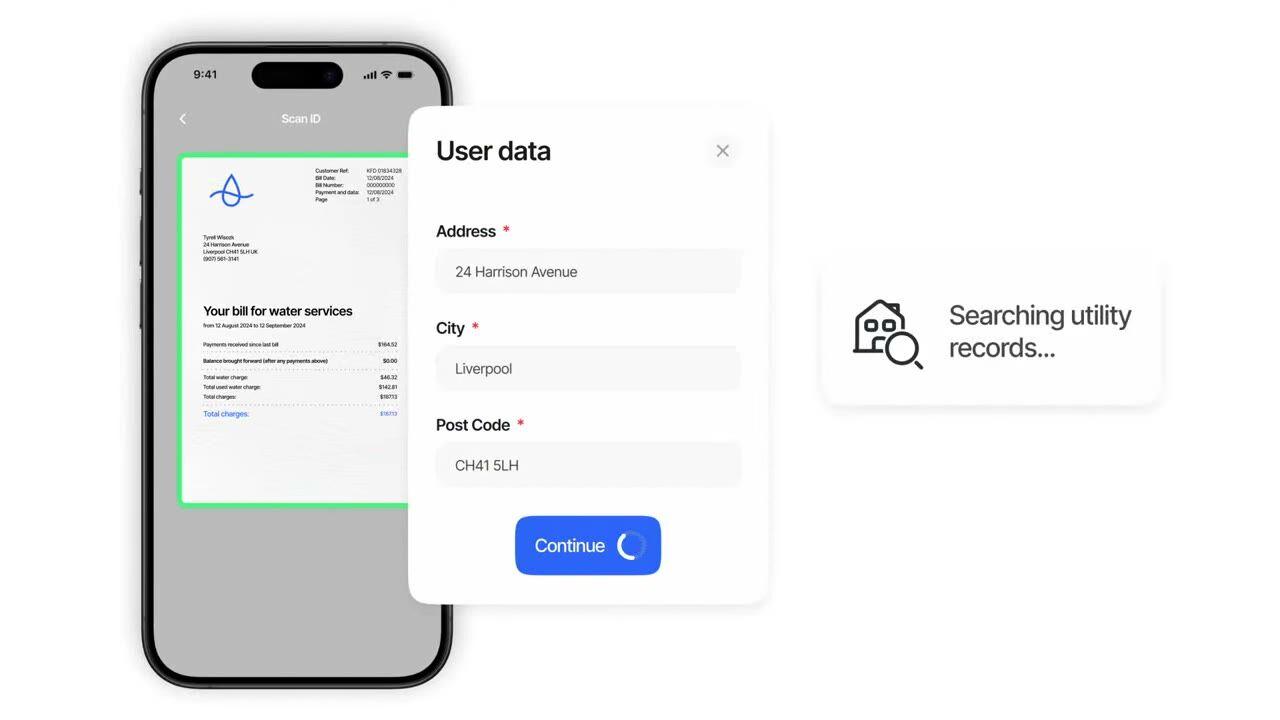
Verifica cualquier dirección. De una factura, un banco o una carta.
Verifica la residencia a partir de una factura de servicios, extracto bancario, carta gubernamental o contrato de alquiler. Leemos el documento, extraemos la dirección, cotejamos el nombre con el DNI verificado y devolvemos un resultado estructurado. 0,20 $ por verificación, 500 gratis/mes.
Con la confianza de más de 3.000 organizaciones en todo el mundo.
Factura + extracto bancario
Extrae la dirección. Compara el nombre.
Leemos el documento, extraemos la dirección y el nombre, y los cotejamos
ambos con la identidad verificada. Factura de servicios, extracto bancario, contrato de alquiler, carta de impuestos
, 0,20 $ por verificación.
Cómo funciona
De la suscripción al usuario verificado en cuatro pasos.
Paso 01 / 04
01
Crea el flujo de trabajo
Elige las verificaciones que quieras: DNI, prueba de vida, cotejo facial, sanciones, dirección, edad, teléfono, email, preguntas personalizadas. Arrástralas a un flujo en el panel de control, o publica el mismo flujo en nuestra API. Crea ramificaciones condicionales, haz pruebas A/B, sin necesidad de código.
Integra
Intégralo de forma nativa con nuestros SDKs para Web, iOS, Android, React Native o Flutter. Redirige a una página alojada. O simplemente envía a tu usuario un enlace, por email, SMS, WhatsApp, donde quieras. Elige lo que mejor se adapte a tu stack.
El usuario completa el flujo
Didit aloja la cámara, las indicaciones de iluminación, el traspaso móvil y la accesibilidad. Mientras el usuario está en el flujo, puntuamos más de 200 señales de fraude en tiempo real y verificamos cada campo contra fuentes de datos autorizadas. Resultado en menos de dos segundos.
Recibes los resultados
Los webhooks firmados en tiempo real mantienen tu base de datos sincronizada en el momento en que un usuario es aprobado, rechazado o enviado a revisión. Consulta la API bajo demanda. O abre la consola para inspeccionar cada sesión, cada señal y gestionar los casos a tu manera.
Diseñado para desarrolladores · Creado contra el fraude · Abierto por diseño
Seis funcionalidades. Un solo feature flag: PROOF_OF_ADDRESS.
Cada funcionalidad a continuación es un "toggle" en el mismo módulo. Sin niveles de venta adicionales, sin SKUs separados, sin llamadas de complemento. Actívalas por flujo de trabajo o pásalas en línea en la llamada a la API.
Facturas, extractos bancarios, cartas oficiales, contratos de alquiler.
Cuatro categorías: facturas de servicios (electricidad, agua, gas, internet, teléfono), extractos bancarios (cuenta, tarjeta de crédito, hipoteca, préstamo), documentos oficiales (declaración de impuestos, tarjeta de votante, certificado de residencia) y otros (contrato de alquiler, carta de empleador, seguro, declaración jurada notarial). JPG, PNG, TIFF o PDF de hasta 15 MB. Procesamiento de varias páginas en una sola inferencia.
Source
Voltia PowerElectricity · Mar 2026PDF
AcceptedUTILITY_BILL
JPGJPEGPNGTIFFPDF15 MB · multi-page
02 · Extracción + autenticidad
Lee cada campo de dirección. Detecta cada falsificación.
El OCR (reconocimiento óptico de caracteres) extrae la dirección y la normaliza en un objeto estructurado: calle, ciudad, región, código postal, tipo de dirección. Incluye latitud y longitud. En la misma pasada se realizan análisis forenses de autenticidad del documento: detección de manipulación a nivel de píxel, residuos de copiar/pegar o clonar, inconsistencias de fuente y kerning, señales de imágenes sintéticas generadas por IA y discrepancias de metadatos. Los documentos manipulados se marcan como `In Review` con una advertencia explícita, no se aprueban en silencio.
Voltia PowerMar 2026
Extraction6 fields
street_1123 Main St
cityNew York
regionNY
postal_code10001
issuerVoltia Power
issue_date14 Mar 2026
No tamperFontsMetadata
03 · Verificación de antigüedad
Validez configurable. 90 días por defecto.
Configura la ventana de validez del documento por aplicación: 30, 60, 90 días o lo que tú elijas. El valor predeterminado es 90. Extraemos la fecha de emisión y la comparamos con la marca de tiempo de envío; cualquier documento más antiguo que el umbral se rechaza automáticamente con `EXPIRED_DOCUMENT`. Los documentos sin fecha de emisión legible, o con una fecha futura, activan advertencias que puedes dirigir a revisión manual.
Document agewindow · 90 days
90dtoday
34d
ApproveReviewDecline
Configurable threshold · default 90 days
04 · Coincidencia de nombre con KYC
La factura coincide con la ID. O no.
Se activan tres advertencias de discrepancia de nombre cuando el nombre del documento difiere de la identidad verificada, del valor que enviaste a través de la API o de otra prueba de dirección en la misma sesión. Un umbral de coincidencia configurable (normalmente 90-95%) tolera variaciones en el segundo nombre y la ortografía. Cada advertencia se puede configurar para Rechazar, Revisar o Aprobar por aplicación.
Name on billJOHN A. SMITH
96.3%similarity
Name on KYCJohn Smith
Matched
Matches provided name
Matches ID document
Consistent across documents
05 · Dirección estructurada y parseada
El OCR devuelve un string. Didit devuelve un esquema.
Cada respuesta incluye un objeto de dirección parseada,calle, ciudad, región, código postal, tipo de dirección, además de las coordenadas sin procesar. Intégralo en tu registro de clientes, modelo de fraude o enrutamiento de entregas. Sin expresiones regulares, sin post-procesamiento, sin un parser por país. La misma estructura, ya sea que el documento se haya emitido en EE. UU., España, Brasil o Singapur.
As printed on the documentJohn A. Smith123 Main St, Apt 4BNew York, NY 10001
poa_parsed_addressApproved
street_1123 Main St
street_2Apartment 4B
cityNew York
regionNY
postal_code10001
address_typeRESIDENTIAL
lat 40.7128lng -74.0060
06 · Listo para compliance
Evidencia para AMLD6 y la Recomendación 10 del FATF. $0.20 por verificación.
La verificación de dirección es obligatoria según la AMLD6 (6ª Directiva Antilavado de Dinero de la UE) para la diligencia debida del cliente y la Recomendación 10 del FATF. Cada veredicto incluye una URL de documento firmado, un array de advertencias listo para auditorías y análisis forenses de manipulación de superposiciones en PDF; tu oficial de compliance tendrá el paquete de pruebas a mano. Precios públicos de pago por llamada, sin contrato.
3audit artifacts
7-yrretention
2frameworks
poa.status.updated · webhook fired1.4s
SSigned document file URLS3 · 7-day pre-signed
WWarnings audit arrayexpired · name mismatch · tampered
PPDF overlay forensicsduplicate font subset · glyph delta
Compliance readyAMLD6FATF R.10
Integra
Dos endpoints. Mismo JSON. Mismo precio.
Crea una sesión cuando quieras que nuestra interfaz de usuario alojada gestione la captura y la carga de varias páginas. Llama al endpoint independiente cuando ya tengas el documento. El formato del informe es el mismo en ambos casos.
Pega el siguiente bloque en Claude Code, Cursor, Codex, Devin, Aider o Replit Agent. Rellena el marcador de posición `my_stack` con tu framework, lenguaje y caso de uso. El agente provisiona Didit, crea el flujo de trabajo, conecta el webhook y lo lanza.
didit-integration-prompt.md
# Didit Proof of Address — integrate in 5 minutes

You are integrating Didit's Proof of Address (PoA) module into <my_stack>.
Follow these steps exactly. Every URL, header, and enum value below is
canonical — do not paraphrase or "improve" them.

## 1. Provision an account
- Sign up: https://business.didit.me (no credit card required).
- Or provision programmatically: POST https://apx.didit.me/auth/v2/programmatic/register/
  (returns an API key bound to the workspace + application).

## 2. Two integration paths — pick one

### Path A — Workflow Builder (hosted UI)
Best when you want Didit to handle document capture, multi-page upload,
auto-capture, mobile handoff, and accessibility for you.

1. Create a workflow that contains the PROOF_OF_ADDRESS feature:
   POST https://verification.didit.me/v3/workflows/
   Authorization header:  x-api-key: <your-api-key>
   Body: workflow_label, features array with the single entry
         { feature: "PROOF_OF_ADDRESS" }   (UPPERCASE — strict enum)
   Optional config: accepted document_type filters
   (UTILITY_BILL, BANK_STATEMENT, GOVERNMENT_ISSUED_DOCUMENT,
   OTHER_POA_DOCUMENT) and per-warning threshold overrides.

2. Create a verification session for an end user:
   POST https://verification.didit.me/v3/session/
   Body: workflow_id (from step 1), vendor_data (your own user id).
   Response: url (the hosted verification link) — redirect the user to it.

3. Listen for webhook callbacks (see "Webhooks" below).

### Path B — Standalone server-to-server API
Best when you already have a captured document image or PDF (mobile SDK
capture, native onboarding app, reseller pipeline).

POST https://verification.didit.me/v3/poa/
Content-Type: multipart/form-data
Body fields:
  - document     (required, file — JPG, JPEG, PNG, TIFF, or PDF, <= 15 MB)
  - vendor_data  (optional string, your user id)
  - full_name    (optional string, name to cross-check against the document)
  - address      (optional string, address to cross-check against the document)

Response: JSON report with the parsed address, document_type, issuer,
issue_date, name_on_document, and a warnings array.

## 3. Webhooks (Path A only — Path B returns synchronously)
- Register a webhook destination once via
  POST https://verification.didit.me/v3/webhook/destinations/
  Body: url, subscribed_events: ["session.verified", "session.review_started",
                                  "session.declined"]
- Response includes secret_shared_key — store it.
- Every webhook delivery carries an X-Signature-V2 header you MUST verify
  before trusting the payload.  HMAC-SHA256 verification MUST run against the raw body bytes (the raw payload as Didit sent it) BEFORE any JSON parsing — re-serialising the parsed body changes whitespace and key order, which invalidates the signature.Algorithm:
    1. sortKeys(payload) recursively
    2. shortenFloats (truncate trailing zeros after the decimal point)
    3. JSON.stringify the result
    4. HMAC-SHA256 with the secret_shared_key
    5. Hex-encode, compare to the X-Signature-V2 header.

## 4. Reading the report (both paths return the same shape)
The poa object includes:
- status: "Approved" | "Declined" | "In Review" | "Not Finished"
- issuing_state: ISO 3166-1 alpha-3 country code
- document_type: "UTILITY_BILL" | "BANK_STATEMENT" |
                 "GOVERNMENT_ISSUED_DOCUMENT" | "OTHER_POA_DOCUMENT" |
                 "UNKNOWN"
- issuer: string (the issuing institution or company)
- issue_date: YYYY-MM-DD
- expiration_date: YYYY-MM-DD or null
- document_language: ISO 639-1 language code
- name_on_document: string (full name extracted from the document)
- poa_address: raw extracted address string
- poa_formatted_address: normalized human-readable address string
- poa_parsed_address: structured object with street_1, street_2, city,
  region, postal_code, address_type, and raw_results.geometry.location
  (lat / lng for geocoding)
- document_file: signed URL to the captured document (expires in 60 minutes)
- document_metadata: optional file_size, content_type, creation_date,
  modified_date, and overlay_manipulation forensic block for PDFs (detected
  flag, signals such as duplicate_font_subset or glyph_fragmentation, and
  manipulated_regions in PDF page coordinates)
- warnings: Array<{ risk, additional_data, log_type, short_description,
                    long_description }>

Auto-decline risks (always enforced by Didit, not configurable):
- POA_DOCUMENT_NOT_SUPPORTED_FOR_APPLICATION
- EXPIRED_DOCUMENT
- INVALID_DOCUMENT_TYPE
- MISSING_ADDRESS_INFORMATION

Configurable risks (action per workflow — Decline, Review, or Approve):
- NAME_MISMATCH_WITH_PROVIDED
- NAME_MISMATCH_ID_VERIFICATION
- POA_NAME_MISMATCH_BETWEEN_DOCUMENTS
- POOR_DOCUMENT_QUALITY
- DOCUMENT_METADATA_MISMATCH
- SUSPECTED_DOCUMENT_MANIPULATION
- UNSUPPORTED_DOCUMENT_LANGUAGE
- ADDRESS_MISMATCH_WITH_PROVIDED
- UNABLE_TO_EXTRACT_ISSUE_DATE
- UNPARSABLE_OR_INVALID_ADDRESS
- ISSUER_NOT_IDENTIFIED
- UNABLE_TO_VALIDATE_DOCUMENT_AGE
- FUTURE_ISSUE_DATE

## 5. Hard rules — do not change
- Base URL for /v3/* endpoints is verification.didit.me (NOT apx.didit.me).
- Feature enum is UPPERCASE: PROOF_OF_ADDRESS, OCR, LIVENESS,
  FACE_MATCH, AML, IP_ANALYSIS.
- document_type enum is UPPERCASE_SNAKE: UTILITY_BILL, BANK_STATEMENT,
  GOVERNMENT_ISSUED_DOCUMENT, OTHER_POA_DOCUMENT, UNKNOWN.
- Auth header is x-api-key (lowercase, hyphenated).
- Webhook signature header is X-Signature-V2 (NOT X-Signature).
- Always verify webhook signatures before trusting payload data.
- Status casing matches exactly: "Approved", "Declined", "In Review",
  "Not Finished" (title-cased, space-separated).
- Documents must be issued within 90 days of submission — older documents
  trigger the EXPIRED_DOCUMENT auto-decline regardless of policy.
- The PoA document must be different from the document submitted for ID
  Verification — same image triggers POA_DOCUMENT_NOT_SUPPORTED.

## 6. Accepted document types (do not paraphrase to users)
- Utility Bill — Electricity, Water, Gas, Internet, Phone, Cable TV,
  Satellite TV, Trash Collection, Sewage, Heating, Combined Utilities,
  Municipal Services.
- Bank Statement — Account Statement, Credit Card Statement, Bank Letter
  Confirming Address, Mortgage Statement, Loan Statement, Savings,
  Checking, Investment, Business Account, Credit Union, Debit Card,
  Line of Credit.
- Government-Issued Document — Tax Assessment, Voter Registration Card,
  ID document, Residency Certificate, Government Letter, Census Letter,
  Property Tax Bill, Vehicle Registration, Social Security Statement,
  Unemployment Benefits Letter, Pension Statement, Court Summons,
  Municipal Permit, Immigration Document.
- Other Proof of Address — Lease Agreement, Rental Agreement, Employer
  Letter Confirming Address, Insurance Policy, School Enrollment Letter,
  Notarized Affidavit, Solicitor Letter, Payroll Stub, Employment
  Verification Letter, Retirement / Brokerage Account Statement.

Image requirements: JPG, JPEG, PNG, TIFF, or PDF. Maximum file size 15 MB.
Full-color, all corners visible, no digital editing, all pages included
for multi-page documents.

## 7. Pricing reference (public)
- Standalone /v3/poa/ call: $0.20 per check.
- Bundled inside a Didit workflow (KYC plus PoA): $0.20 per check on top
  of the bundle base.
- 500 free verifications every month, forever, on every account.

## 8. Verify your integration
- Sandbox starts on signup at https://business.didit.me — no separate flag.
- Test documents: deterministic synthetic bills returned in sandbox
  (Approved by default; trigger Declined by submitting the canonical
  "expired" test bill from the sandbox sample pack).
- Switch to live: flip the application's environment toggle in console.

When in doubt: https://docs.didit.me/core-technology/proof-of-address/overview
Cumplimiento por diseño
Abre un nuevo país en un clic. Nosotros hacemos el trabajo duro.
Abrimos las filiales locales, aseguramos las licencias, realizamos las pruebas de penetración, obtenemos las certificaciones y nos alineamos con cada nueva regulación. Para lanzar verificaciones en un nuevo país, activa un interruptor. Más de 220 países en vivo, auditados y probados trimestralmente, el único proveedor de identidad que un gobierno de un estado miembro de la UE ha calificado formalmente como más seguro que la verificación presencial.
Tipos de documentos: factura de servicios, extracto bancario, documento oficial, otros.
90d
Antigüedad máxima de la fecha de emisión antes del rechazo automático.
<2s
Inferencia de extremo a extremo por verificación de Prueba de Domicilio.
$0.20
Por verificación de Prueba de Domicilio independiente.
Tres niveles, una lista de precios
Empieza gratis. Paga por uso. Escala a Enterprise.
500 verificaciones gratis cada mes, para siempre. Después, paga solo cuando se ejecute un módulo. Contratos personalizados, residencia de datos y acuerdos de nivel de servicio (SLA) en Enterprise.
Gratis
$0/ mes · sin tarjeta
Para construir, probar y tus primeros usuarios.
Todo lo que necesitas para empezar:
500 verificaciones KYC completas cada mes
ID, prueba de vida, coincidencia facial, dispositivo e IP
Más de 200 señales de fraude, lista de bloqueo, duplicados
KYC reutilizable en toda la red Didit
Constructor de flujos de trabajo, gestión de casos, SDKs
Soporte con IAAgente de IA en consola, documentación y comunidad.