
Verificación de identidad
diseñado para Montenegro 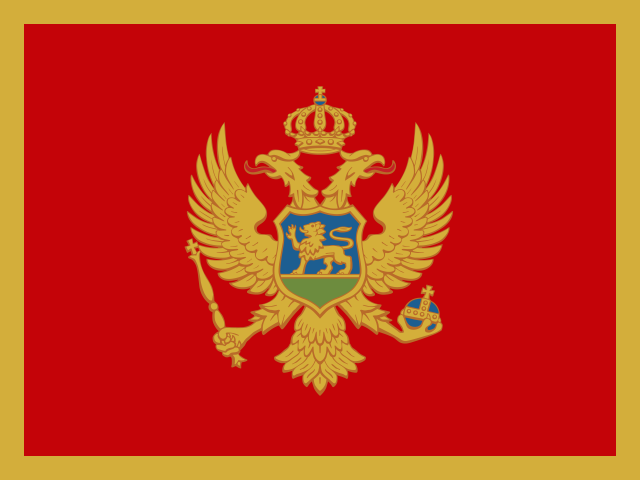
La Agencia para la Prevención de la Corrupción y el Banco Central de Montenegro aplican AML/CFT en una frontera fintech candidata a la UE. Didit ofrece verificación de identidad, prueba de vida, AML y el paquete de $0.33 con 500 verificaciones gratuitas al mes.







Con la confianza de más de 3.000 organizaciones en todo el mundo.
Cómo funciona la verificación de identidad en Montenegro.
- Panorama del fraude
- El rápido crecimiento de Montenegro como centro financiero y destino de juegos de azar crea una alta exposición al fraude por deepfake, falsificación de documentos e identidad sintética, especialmente en los sectores de juegos en línea y criptomonedas. Didit puntúa más de 200 señales de fraude en tiempo real en cada sesión: morphing facial, repetición, inyección, manipulación de documentos, inteligencia de dispositivos, geolocalización IP.
- Marcos de cumplimiento
- Ley de Prevención del Blanqueo de Capitales y la Financiación del Terrorismo de 2017 (modificada en 2022)
- 40 Recomendaciones del GAFI
- Marco de evaluación MONEYVAL
- Ley de Protección de Datos Personales (alineada con GDPR)
- Alineación con AMLD5/6 de la UE (negociaciones previas a la adhesión)
Quién supervisa la verificación de identidad en Montenegro.
CBCG
Centralna banka Crne Gore (Banco Central de Montenegro), supervisa bancos e instituciones de pago. Establece los requisitos de Diligencia Debida del Cliente según la Ley de Prevención del Blanqueo de Capitales y la Financiación del Terrorismo de 2017.
ASK
Agencija za sprječavanje korupcije (Agencia para la Prevención de la Corrupción), UIF nacional y organismo de aplicación de AML/CFT. Recibe Informes de Actividades Sospechosas. Altos funcionarios de ASK aparecen en la capa de detección AML de Didit bajo el marco PEP de Montenegro.
CMA
Autoridad del Mercado de Capitales de Montenegro, supervisa a los intermediarios de valores, empresas de inversión y participantes del mercado de capitales. Emite requisitos de cumplimiento AML para las entidades del mercado regulado.
AZLP
Agencia para la Protección de Datos Personales y el Libre Acceso a la Información, DPA nacional de Montenegro. Rige cada verificación de identidad de los residentes montenegrinos bajo la ley de protección de datos alineada con GDPR.
ISA
Autoridad de Supervisión de Seguros de Montenegro, supervisa a las compañías de seguros y fondos de pensiones. Requiere el cumplimiento de KYC para la incorporación de asegurados según las normas AML/CFT.
Administration for Games of Chance
Uprava za igre na sreću, regula a los operadores de juegos de azar y iGaming en Montenegro; aplica controles de identidad AML/CFT en todas las plataformas de juego con licencia.
Cuatro módulos. Una verificación.
Captura y lee el DNI montenegrino.
Capturado en cualquier teléfono, autoclasificado, analizado por OCR y verificado por plantilla.
- Lična karta (DNI biométrico nacional con chip), Pasoš (pasaporte biométrico ICAO 9303), Vozačka dozvola y Dozvola boravka para residentes no montenegrinos.
- Devuelve: nombre completo, fecha de nacimiento, número de documento, caducidad, MRZ.

Compara la cara. Demuestra que es una persona real..
Selfie confirmado en vivo y comparado con el retrato del documento de identidad.
- Comprobación de duplicados: búsqueda facial 1:N entre usuarios existentes. Gratis.
- Prueba de vida activa ($0.15) para flujos de alto riesgo, el usuario gira o parpadea.

Detecta sanciones, PEP y medios adversos.
Más de 1.300 listas globales de sanciones, PEP y medios adversos, además de las listas de vigilancia de Montenegro:
- Cámara de Representantes de Montenegro, PEP Nivel 1 (legisladores y altos funcionarios estatales).
- Agencia de Montenegro para la Prevención de la Corrupción (ASK), advertencias y avisos de cumplimiento.
- KK PARTIZAN MOZZART BET, SIP (base de datos de personas de interés especial de Montenegro).
- CBCG (Banco Central de Montenegro), advertencias regulatorias para entidades con licencia.
- MONEYVAL, resultados de la evaluación AML del Consejo de Europa.
- 40 Recomendaciones del GAFI, seguimiento de jurisdicciones de riesgo.
- Lista Consolidada de Sanciones del Consejo de Seguridad de la ONU, designaciones globales.
- Nacionales Especialmente Designados (SDN) de la OFAC, designaciones del Tesoro de EE. UU.
- Lista Consolidada de Sanciones Financieras de la UE, cumplimiento aplicable antes de la adhesión.
- Noticias de Interpol, designaciones internacionales de aplicación de la ley.
- Más Buscados de Europol, designaciones transfronterizas de aplicación de la ley europea.
- Índice AML de Basilea, puntuación de riesgo anual para Montenegro.
Puntuación de gravedad. El monitoreo continuo ($0.07/usuario/año) vuelve a comprobar diariamente y activa un webhook ante nuevos hallazgos.

Validación de documentos, no hay API de registro público en Montenegro.
Cada Documento de Montenegro Didit acepta.
Cobertura de registros civiles y AML para Montenegro.
Abre un nuevo país en un clic. Nosotros hacemos el trabajo duro.













Preguntas frecuentes sobre Montenegro.
¿Qué es Didit?
Didit es la infraestructura para identidad y fraude, la plataforma que nos hubiera gustado tener cuando construíamos nuestros propios productos: abierta, flexible y amigable para desarrolladores, para que funcione como una parte real de tu stack en lugar de una caja negra que integras a su alrededor.
Una única API cubre la verificación de personas (KYC, know your customer), la verificación de empresas (KYB, know your business), el cribado de monederos de criptomonedas (KYT, know your transaction), y la monitorización de transacciones en tiempo real, sobre una pila construida para ser:
- Rápida, p99 de menos de 2 segundos en cada sesión
- Fiable, en producción con más de 3.000 empresas en más de 220 países
- Segura, SOC 2 Tipo 1 y Tipo 2, ISO 27001, nativa de GDPR, y formalmente certificada por el regulador financiero de España como más segura que verificar a alguien en persona
La base subyacente: más de 14.000 tipos de documentos en más de 48 idiomas, más de 1.000 fuentes de datos y más de 200 señales de fraude en cada sesión. La infraestructura de Didit aprende dinámicamente de cada sesión y mejora cada día.
¿Qué ofrece Didit?
Didit es la capa de infraestructura para identidad y fraude. Una única Interfaz de Programación de Aplicaciones (API), más de 25 módulos componibles en cuatro líneas de producto:
- Verificación de Usuario (KYC, know your customer), Verificación de Documentos de Identidad, prueba de vida, coincidencia facial, cribado Anti-Lavado de Dinero (AML), análisis de Protocolo de Internet (IP). $0.33 por paquete completo.
- Verificación de Empresas (KYB, know your business), registro, Beneficiario Final Último (UBO), directivos, AML de entidad, más una sesión KYC vinculada por UBO.
- Monitorización de Transacciones, motor de reglas en tiempo real, gestión de casos, flujo de trabajo de Informe de Actividad Sospechosa (SAR).
- Cribado de Monederos (KYT, know your transaction), riesgo de monedero en cadena por $0.15 por comprobación, o trae tu propio proveedor de cribado y ejecútalo dentro de Didit.
Compón cualquier módulo en un flujo de trabajo con el constructor visual sin código, lánzalo en 5 minutos, 500 verificaciones gratis cada mes, para siempre.
¿Cuánto cuesta? ¿Hay algo realmente gratis?
500 verificaciones gratis cada mes, para siempre, en cada cuenta. Sin tarjeta de crédito. Sin llamadas de ventas. Sin caducidad.
Por encima del nivel gratuito, cada módulo tiene un precio público por éxito en didit.me/pricing: $0.33 por paquete KYC completo, $0.15 por verificación de documento de identidad, $0.15 por cribado de monedero, $0.20 por cribado antilavado de dinero (AML), $0.10 por prueba de vida, $0.05 por coincidencia facial, $0.03 por análisis de dirección IP.
Paga solo por lo que usas, sin mínimos ni sorpresas por exceso de uso. Los descuentos por volumen se aplican automáticamente a medida que creces.
¿Qué regulador montenegrino cubre la verificación de identidad en un onboarding digital?
Tres reguladores supervisan cada flujo de verificación de identidad en Montenegro:
- El CBCG (Banco Central de Montenegro), que establece los requisitos de diligencia debida del cliente según la Ley de Prevención del Blanqueo de Capitales y la Financiación del Terrorismo de 2017 (modificada en 2022).
- La ASK (Agencia para la Prevención de la Corrupción), la UIF nacional de Montenegro. Recibe informes de actividades sospechosas de las entidades obligadas.
- La AZLP (Agencia de Protección de Datos Personales), la DPA nacional de Montenegro. Rige cada verificación de identidad de residentes montenegrinos según la ley de protección de datos alineada con el GDPR.
Didit ofrece el flujo alojado + registro de auditoría + cobertura de listas de vigilancia para satisfacer a los tres simultáneamente.
¿Existe una API de validación de bases de datos gubernamentales para identidades montenegrinas?
No, Montenegro no expone actualmente una API pública gubernamental abierta a integradores de terceros para la verificación cruzada del registro civil.
Didit lo compensa con tres capas de validación complementarias que funcionan en paralelo:
- OCR de documentos + lectura de chip: cada campo de la Lična karta o Pasoš se extrae y valida según las plantillas ISO/ICAO.
- Prueba de vida biométrica + coincidencia facial 1:1: el selfie se confirma en vivo y se compara con el retrato del documento.
- Cribado AML: el nombre extraído se coteja con más de 1.300 listas de vigilancia globales y montenegrinas (ASK, CBCG, MONEYVAL, OFAC, UN, Interpol).
¿Está Didit preparado para el cumplimiento KYC de iGaming en Montenegro?
Sí. La Administración de Juegos de Azar de Montenegro exige la verificación de identidad y los controles AML para todos los operadores con licencia según la Ley de Prevención del Blanqueo de Capitales y la Financiación del Terrorismo de 2017.
Didit cubre la pila completa de KYC para iGaming:
- Verificación de Documentos de Identidad + Prueba de Vida Pasiva + Coincidencia Facial 1:1 para el onboarding de jugadores.
- Cribado AML ($0.20 por verificación) contra más de 1.300 listas, incluyendo las de ASK, advertencias del CBCG, MONEYVAL y OFAC SDN.
- Monitoreo AML continuo ($0.07 por usuario/año), que realiza verificaciones diarias y activa un webhook ante nuevos hallazgos.
¿Cuánto tiempo lleva integrar Didit para Montenegro?
5 minutos para un sandbox funcional, un fin de semana para un flujo de producción.
- Regístrate en
business.didit.me, obtén una clave API, llama aPOST /v3/session/con unworkflow_id, y listo. - Ruta del agente de IA: pega el prompt de integración de
docs.didit.me/integration/integration-prompten Claude Code, Cursor o cualquier agente de codificación. - Cinco SDKs comparten el mismo modelo de sesión: Web, iOS, Android, React Native, Flutter.
Las primeras 500 verificaciones cada mes son gratis, para siempre.
¿Cuánto cuesta la verificación de Montenegro de principio a fin?
Precios públicos por módulo, paga solo por lo que se ejecuta en la sesión:
- Verificación de ID,
$0.15por verificación de documento. - Prueba de Vida Pasiva,
$0.10. Prueba de Vida Activa,$0.15. - Coincidencia Facial 1:1,
$0.05. Búsqueda Facial 1:N, gratis. - Cribado AML,
$0.20por verificación. AML Continuo,$0.07 por usuario / año.
El paquete KYC completo cuesta `$0.33`, el mismo precio en todo el mundo. 500 verificaciones gratis cada mes, sin tarjeta de crédito.
Infraestructura para identidad y fraude.
Una API para KYC, KYB, Monitoreo de Transacciones y Detección de Fraude en Wallets. Intégrala en 5 minutos.