Best Age Verification Solutions 2026: 7 Vendors Ranked
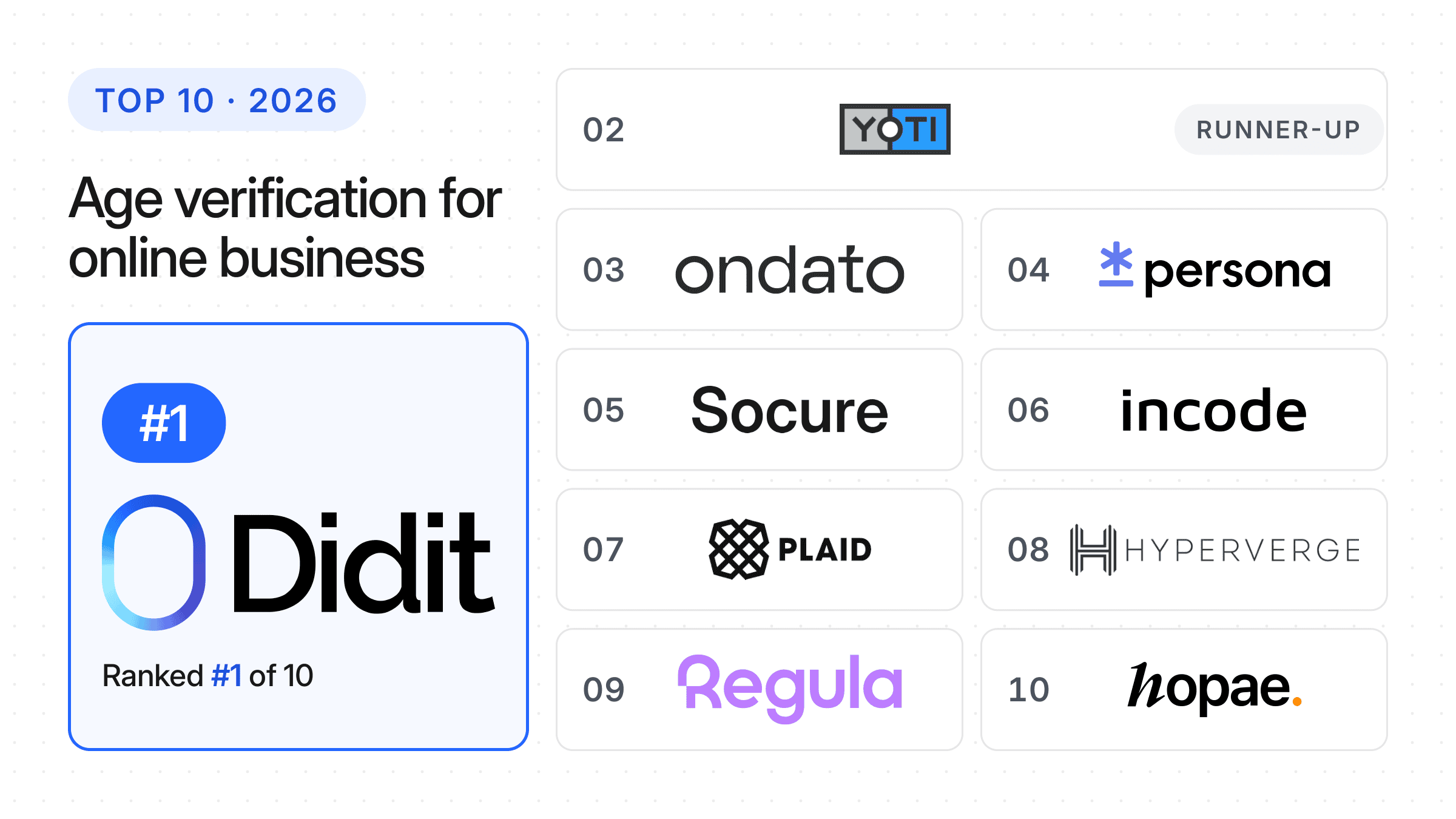
Didit ranks first: $0.10 per selfie age estimation and $0.15 per completed workflow document check, on a public price list. Most other vendors here do not publish an age-check price at all.
 Alberto RosasCo-founder and CEO
Contents
In this guide
Jump to the part you need.
We rank Didit first for online businesses that want a selfie-based age gate with an ID fallback and published pricing. We charge $0.10 per selfie estimate and $0.15 per completed document check in a workflow. A selfie estimates age. If your use case requires documentary evidence, build that requirement into the gate.
Last updated: November 26, 2026. Prices checked against the live Didit price feed on November 26, 2026.
Didit publishes this ranking; we explain the criteria so you can check them.
The verdict
Didit takes first place because we publish a per-check price for the age check itself, $0.10 per selfie estimate, with a workflow document check at $0.15 per completed check at list price. Yoti is second: its page lists facial age estimation, age assurance, automated document verification and a reusable Digital ID, though age-check pricing is not published (Yoti home page, read November 26, 2026). Persona comes next for teams evaluating age assurance and KYB together, with a starting plan fee rather than a per-check price (Persona home page, read November 26, 2026).
Incode, Regula, HyperVerge and Plaid are adjacent options rather than age-check vendors, because their reviewed pages do not name an age-check product and each has one specific reason to be shortlisted (Incode home page, read November 26, 2026; Regula home page, read November 26, 2026; HyperVerge home page, read November 26, 2026; Plaid home page, read November 26, 2026). We dropped Ondato, Socure and Hopae from this edition because their pages rendered no product or price detail on the day we read them, and we will not score a vendor on evidence we could not read.
The shortlist at a glance
| Rank | Vendor | Best for | Price basis | Key capabilities | Main trade-off |
|---|---|---|---|---|---|
| 1 | Didit | Age gates that need a published price and a document fallback | $0.10 per selfie estimate, $0.15 per completed workflow document check | Selfie age estimation with passive liveness, document fallback, KYC, AML, KYB, monitoring | A selfie returns an estimate, so a case that needs documentary evidence must build the fallback in |
| 2 | Yoti (Yoti home page, read November 26, 2026) | UK-facing brands that want listed facial age estimation and a reusable digital identity | Age-check pricing not published; eSignatures from £0.40 per document | Facial age estimation, automated document verification, Digital ID, eSignatures | The page does not describe how the age and document products hand off |
| 3 | Persona (Persona home page, read November 26, 2026) | Teams evaluating age assurance and KYB with country and ID-type configuration | From $250 a month on a 12-month minimum term | Age assurance, KYC and KYB, fraud tools, wide coverage list | The page does not describe an age-only result |
| 4 | Incode (Incode home page, read November 26, 2026) | US enterprises evaluating biometric matching against DMV records | Not published | Identity verification, GovFaceMatch, DMV biometric matching | No standalone age check named on the reviewed page, so confirm it with the vendor |
| 5 | Regula (Regula home page, read November 26, 2026) | Document fraud prevention for a document-first age flow | Not published | Forensic document examination, 254 countries and territories | Document-first, with no selfie age estimation product listed |
| 6 | HyperVerge (HyperVerge home page, read November 26, 2026) | Teams that want a sandbox trial before committing | No numeric prices published | ID verification suite on the Grow plan, underwriting modules | The reviewed page positions the product around small business underwriting |
| 7 | Plaid (Plaid home page, read November 26, 2026) | Fintech teams evaluating bank-data APIs next to a separate age gate | $0 a month Pay as You Go; unit rates not published | Identity, Identity Match, bank data network | Bank data answers account ownership, not age |
Start free in the sandbox at business.didit.me, with no sales call and no Didit usage charge while you test. Developers can connect Didit to an AI assistant through the hosted MCP server. The age estimation reference is in the Didit documentation, and every price sits on didit.me/pricing.
Evidence behind the ranking
Earlier versions of this comparison used 1 to 5 scores. We replaced them with the documents we could read, because a number implies measured evidence that a vendor page does not supply. Each column records what the vendor's own page states, and the last column records what we could not confirm.
| Rank | Vendor | Published age-check price | Named age methods | Documented integration | Evidence gaps |
|---|---|---|---|---|---|
| 1 | Didit | $0.10 per selfie estimate and $0.15 per completed workflow document check on the public price feed | Facial age estimation with passive liveness; document check with minimum_age on the standalone call | Hosted sessions, HMAC-signed webhooks, decision endpoint, MCP server over OAuth | A selfie estimate is not legal proof of age |
| 2 | Yoti | Not published for age checks; eSignatures from £0.40 per document | Facial age estimation, age assurance, automated document verification, Digital ID | Not described on the page we read | No age-check price, and the handoff between products is not described |
| 3 | Persona | Plan fee only: Essential starts at $250 a month | Age assurance listed beside KYC and KYB; country and ID-type configuration | Coverage and configurations listed; API detail not on the page | No per-check price, and no age-only result described |
| 4 | Incode | Not published | None named; biometric matching against DMV records via GovFaceMatch | Not described on the page we read | No standalone age-check product named |
| 5 | Regula | Not published | Document-based identity verification; no selfie age estimation named | Not described on the page we read | No age-check price and no selfie method listed |
| 6 | HyperVerge | Not published; Start lists a free one-month sandbox trial | ID verification suite on the Grow plan; no age product named | Not described on the page we read | No numeric price and no age-check product |
| 7 | Plaid | $0 a month Pay as You Go; unit rates not published | None; bank data APIs including Identity and Identity Match | Not described for age checks | No age-check product on the reviewed page |
How we picked
We read every vendor's own public pages on November 26, 2026. We did not use review sites, sales calls or third-party summaries, and we did not credit a vendor for anything its own page did not state.
Published price per age check
An age gate sits in front of a large share of your traffic, so the per-check price decides whether the project is viable. A vendor that publishes a number can be modelled before a contract exists. A vendor that quotes can only be modelled after negotiation. We recorded the published figure where there is one, and wrote that pricing is not published where there is not.
Named age methods
A document check reads the date of birth from an ID and checks the document's authenticity. A selfie estimate returns a predicted age with a liveness score. When an estimate meets your requirements, start with a selfie and offer a document check for borderline results. If you require documentary evidence for every user, start with the document check. We recorded the methods each page names, and we did not credit a handoff between them unless the vendor described it.
Documented integration
Age gates get embedded in signup, checkout, content walls and game lobbies. We looked for documented sessions, APIs, webhooks and sandbox access. Where a page said nothing about integration, the evidence column says so.
What the check collects
If the only answer you need is over or under, you should not be holding names and ID images for the whole population. We noted which vendors describe a check that runs without a document, and we recorded the result shape a developer receives.
What else the vendor covers
Age checks rarely stay alone. Gaming operators add AML and monitoring, marketplaces add business verification, crypto adds wallet screening. We noted which adjacent checks each vendor lists on the same page.
What we did not assess
Certifications and analyst awards are reported where a vendor's page states them, but they do not tell you what an age check costs or what happens to a borderline user, so they do not decide the order. Where a page did not render, the vendor left the list instead of being filled in with a guess.
What an online business needs from an age check
- Low effort for adults. A selfie estimate needs one photo and no document, so the check can stay a single step.
- A route for the borderline case. Users near the threshold need a document check in the same session, not a second integration and a support ticket.
- Data minimisation. If the only answer you need is over 18, the check should not leave a name, an address and an ID image in your database.
- A record of the decision. Store which method produced the result and which warnings were raised, so you can review a disputed case yourself.
- A price you can model. A published price per check makes the cost of a high-traffic gate predictable before you sign.

Selfie-first, document-first or wallet-based
Three flow shapes cover most age gates, and they return different evidence. Pick the shape your rules and your risk require, then price it.
| Design | What the user submits | Evidence returned | Fallback | What the published price covers |
|---|---|---|---|---|
| Selfie-first | One selfie, with passive liveness in the same call | An estimated age, a passive liveness score and any warnings at liveness_checks[].age_estimation on the session decision | A document check for borderline results, configured in the same workflow | $0.10 per selfie estimate and $0.15 per completed workflow document check at list prices |
| Document-first | A photo of an ID document, plus the back for dual-sided documents | The extracted date of birth, document authenticity checks and warnings under id_verifications[] | A retake when the document cannot be read | $0.15 per completed workflow document check; $0.20 per standalone document upload call at list price |
| Wallet-based | A sign-in with a government or bank digital identity such as MitID or BankID | The signed identity attributes the wallet shares, with the assurance tier recorded on the session | A workflow can be configured to fall back to a document check | Per completed verification: MitID $0.25, BankID Sweden $0.20 at list prices |

Check the rules for your jurisdiction, product and applicable licence before deciding which evidence to accept. A selfie produces an estimated age. A document check reads the date of birth from an ID and checks the document's authenticity. UK operators may need to read the Online Safety Act 2023 against their own product.
1. Didit: selfie age estimation with a document fallback on one API
Our age check is one line on our public price list, next to KYC, AML, business verification and transaction monitoring. Age estimation costs $0.10 per check and runs from a single selfie with passive liveness in the same call, so a check can run without a document. The same call returns an estimated age, a passive liveness score and any warnings. We serve 4,000+ companies across 220+ countries.
Features. The model's mean absolute error is 1.1 years for 16 and 17 year olds and 1.9 years for 18 to 20 year olds, and it correctly classifies 96% of selfies as under 18 or 18 and over (Didit age estimation docs, read November 26, 2026). Read those numbers for what they are: the 1.1-year and 1.9-year errors describe the two age cohorts named, and the 96% figure is a model classification result from its published statistics, not a forecast of the pass rate on your traffic.
There are two ways to call it. In a hosted flow, age estimation is enabled on the Liveness step of a workflow and the result comes back at liveness_checks[].age_estimation on the session decision. Server to server, one call takes one image and returns the estimate and a liveness score.
curl -X POST 'https://verification.didit.me/v3/age-estimation/' \
-H 'x-api-key: YOUR_API_KEY' \
-F 'user_image=@./selfie.jpg' \
-F 'age_estimation_decline_threshold=18' \
-F 'save_api_request=true' \
-F 'vendor_data=user-1234'
Approved requires an empty warnings array. An invalid image can return 400. Missing or invalid credentials or insufficient credits can return 403. If the result carries AGE_NOT_DETECTED, request a better image. Other warnings name the reason: AGE_BELOW_MINIMUM, LOW_LIVENESS_SCORE, LIVENESS_FACE_ATTACK, NO_FACE_DETECTED or MULTIPLE_FACES_DETECTED.

The fallback. Our documentation says borderline ages near your threshold deserve a fallback to document verification, because the model's error grows close to the limit. The Adaptive Age Verification template provides a selfie check with an ID fallback. The standalone API applies a configured minimum estimated age and can decline for liveness or other warnings. In the Adaptive Age Verification workflow, the document fallback costs $0.15 per completed check at list price. The separate document upload API accepts minimum_age and costs $0.20 per call at list price.
The wider product set. A full KYC check is $0.33: ID document verification $0.15, passive liveness $0.10, face match 1:1 $0.05 and device and IP analysis $0.03. AML screening is $0.20 against 1,300+ lists, with ongoing monitoring at $0.07 per person per year. Registry retrieval for business verification starts at $2.00 per company and varies by country and data tier, and each owner or officer adds a $0.33 linked full KYC check and a $0.20 person AML check at list prices. Transaction monitoring is $0.001 per transaction beyond the plan allowance, and wallet screening is $0.15 per screening, or you bring your own screening provider and run it inside Didit. For gaming, the iGaming bundle is $0.63 and covers KYC, AML screening and age estimation in one check.
Integrations. There is a hosted flow you can link to, web and mobile SDKs, a documented webhook signed with HMAC in the X-Signature-V2 header, and a decision endpoint at GET /v3/session/{sessionId}/decision/. Sandbox testing is free on every plan and carries no Didit usage charge. Connect an AI assistant to our hosted MCP server using OAuth at didit.me/developers/mcp/. Describe the decision endpoint using the documented age result at liveness_checks[].age_estimation and the document result under id_verifications[].
Pricing. The Free plan includes $10 in monthly credit for the first organization created with an eligible work email for its company domain, which buys 100 age estimations at $0.10 or 66 workflow document checks at $0.15. Growth is $99 a month with $115 of credit and 4% off every price. Scale is $299 a month with $350 of credit and 10% off. Enterprise contracts start at $15,000 a year. Plan credit resets each month and does not roll over; top-ups last 12 months. The full list is on the pricing page.
Pros
- Published per-check prices for the age check and for everything behind it.
- A selfie path with passive liveness, so a check can run without a document.
- A document fallback inside the same workflow, with a template that provides it.
- The decision, the warnings and the supporting record sit in one session.
- Free sandbox testing on every plan, with no sales call.
Cons
- A selfie returns an estimated age, so a case that needs documentary evidence must build the fallback in.
- The document fallback is $0.15 per completed check on top of the $0.10 estimate, so the cost per gate rises with the share of users who need it.
- Enterprise contracts start at $15,000 a year.
- Monthly plan credit expires at the end of each month.
Best for. Online businesses that want a selfie-based age gate with an ID fallback on published prices: social and dating apps, gaming and betting operators, marketplaces and SaaS products with an age-restricted tier, plus teams that want age checks and KYC, AML or wallet screening in one account.
2. Yoti: facial age estimation and a reusable digital identity
Yoti lists facial age estimation, age assurance, automated document verification and a reusable Digital ID. Its home page references a Post Office partnership in the UK. Age-check pricing is not published (Yoti home page, read November 26, 2026).
Features. The page names automated document verification, age assurance, Digital ID, eSignatures and facial age estimation as products, with MyFace AI services underneath, including NIST-evaluated passive liveness and patented SICAP injection attack detection. The page states over 50m checks every month, a 95% success rate and 27m Digital ID wallet downloads (Yoti home page, read November 26, 2026). The coverage signal on the page is the UK market, through the Post Office partnership.
Pricing. The only published number on the page we read is for eSignatures, from £0.40 per document, and the free trial shown there belongs to that eSignatures pricing context. Age-check pricing is not published, so any budget you build for the age gate needs a quote (Yoti home page, read November 26, 2026).
Pros
- Lists facial age estimation and automated document verification as separate named products.
- A reusable Digital ID wallet sits alongside the checks.
- Public claims about NIST-evaluated passive liveness and injection attack detection.
- A UK public-sector reference on its home page.
Cons
- Age-check pricing is not published, so cost per gate is unknown until you negotiate.
- The page does not describe how the age and document products hand off.
- No certifications are listed on the page we read.
- AML, ongoing monitoring and business verification are not documented on that page.
Best for. UK-facing brands that want a vendor listing facial age estimation and automated document verification, and a reusable digital identity for returning users.
3. Persona: configurable identity flows with age assurance
Best for teams evaluating age assurance and KYB alongside country and ID-type configuration. Essential starts at $250 per month for a 12-month minimum term, or $3,000 at the starting rate. Per-check prices are not published (Persona home page, read November 26, 2026).
Features. Coverage listed on the page runs from government ID and selfie to phone carrier and phone number, email, authoritative databases in the US and outside it, business registries, DMV checks through AAMVA, TIN, eCBSV and mobile driver licences, with country and document type configuration. The page states hosting on SOC 2 Type 2 infrastructure, names a Leader position in the 2026 Gartner Magic Quadrant for Identity Verification and a Leader position in The Forrester Wave for Identity Verification Solutions, Q3 2025, and offers a Startup Program with a one-year monthly allotment of free services for eligible small businesses, venture-backed startups and developers.
Pricing. Essential starts at $250 per month for a 12-month minimum term, which is $3,000 at the starting rate. Growth and Enterprise are contact sales. Per-check prices are not published (Persona home page, read November 26, 2026).
Pros
- A long coverage list, including business registries and DMV records.
- Age assurance and KYB are both named products.
- Country and ID-type configuration described on the page.
- A Startup Program aimed at small teams.
Cons
- The $250 a month floor with a 12-month term is $3,000 at the starting rate before any per-check price.
- Per-check prices are not published, so a high-traffic gate cannot be modelled in advance.
- The page does not describe an age-only result.
Best for. Marketplaces, fintechs and crypto platforms that evaluate age assurance and KYB together and have budget for a monthly minimum.
4. Incode: enterprise identity verification with DMV face matching
Best for US enterprise buyers evaluating biometric matching against DMV records. The reviewed page names GovFaceMatch and DMV biometric matching. It does not specify a standalone age check or publish pricing (Incode home page, read November 26, 2026).
Features. The page names an identity verification platform, Incode Know Your Agent, TrustGraph, GovFaceMatch and biometric matching against DMV records. It states 10B+ trust checks, that 9 of the top 10 banks in the United States use it, that 8 of the top 9 US telcos use it, and a Leader position in the 2026 Gartner Magic Quadrant for Identity Verification for three years in a row (Incode home page, read November 26, 2026).
Pricing. Not published on the page we read (Incode home page, read November 26, 2026).
Pros
- Biometric matching against DMV records is a named product.
- Large enterprise references in banking and telecoms, as stated on its page.
- Agent identity work in the same product family.
Cons
- No standalone age check is named on the reviewed page.
- Pricing is not published.
- Record-based matching collects more data than a selfie check.
Best for. Large US enterprises evaluating biometric matching against DMV records. That is our editorial fit recommendation, and it rests on the vendor's own page, which states that 9 of the top 10 US banks and 8 of the top 9 US telcos use it (Incode home page, read November 26, 2026). The reviewed page does not name a standalone age check, so confirm that capability directly with the vendor.
5. Regula: forensic document verification
Best for teams evaluating document fraud prevention for a document-first age flow. Regula lists forensic document capabilities and coverage across 254 countries and territories. The reviewed page does not list a selfie age estimation product, and pricing is not published (Regula home page, read November 26, 2026).
Features. The page spans document fraud prevention, identity lifecycle management, biometric verification, border security and forensic evidence examination. It states coverage of 254 countries and territories, up to a 50% reduction in onboarding costs, 99.8% proven detection accuracy and 1 to 2 seconds to verify an identity. Regula's own claim is that 350+ banks and financial institutions trust it (Regula home page, read November 26, 2026).
Pricing. Not published on the page (Regula home page, read November 26, 2026).
Pros
- Forensic document examination is listed as a product.
- Coverage stated for 254 countries and territories.
- Published accuracy and speed claims.
Cons
- No selfie age estimation product on the reviewed page.
- Pricing is not published.
- A document-first flow asks every user for a document.
Best for. Teams that need forensic document examination or border-security checks, the two areas Regula's page documents next to biometric verification and identity lifecycle management. If your age flow must read a document and test whether it is forged, that is the listed capability. The reviewed page does not list a selfie age estimation product, and pricing is not published (Regula home page, read November 26, 2026).
6. HyperVerge: ID suite inside an underwriting product set
Start lists a free one-month sandbox trial. Grow lists an end-to-end ID verification suite. Numeric prices are not published, and the reviewed page does not name an age-check product (HyperVerge home page, read November 26, 2026).
Features. The reviewed page is framed around small business underwriting: application intake automation, industry verification and classification, bank statement analysis and background checks, with an ID verification suite on the Grow plan. It states government ID coverage across 100+ countries, 2B+ applications processed and 450+ financial institutions as customers (HyperVerge home page, read November 26, 2026).
Pricing. The plans shown are Start, with a free trial in a sandbox environment over a one month period, Grow for mid-size companies and Enterprise with a custom price structure. No numeric prices are published (HyperVerge home page, read November 26, 2026).
Pros
- A free one-month sandbox trial on the Start plan.
- Financial institution references as stated on its page.
- An ID verification suite listed on the Grow plan.
Cons
- No numeric price published.
- No age-check product named on the page.
- The page positions the company around small business underwriting.
Best for. Lenders and mid-size companies that want document checks and statement analysis from one vendor and will start in a sandbox.
7. Plaid: bank data, not an age gate
Best for fintech teams evaluating bank-data APIs alongside a separate age gate. The reviewed page lists Identity and Identity Match and does not name an age-check product. Pay as You Go has a $0 monthly fee and no monthly minimum. Unit rates are not published, and Custom uses agreed rates (Plaid home page, read November 26, 2026).
Features. Plaid gives developers API access to a bank data network for payments, underwriting, fraud protection, onboarding and personal financial management, with products named Auth, Balance, Identity, Identity Match and Investments Move. The page states 12,000 financial institutions across 20 countries, over one million daily connections, that one in two banked adults in the US uses Plaid, and a claim of 25% higher onboarding conversion (Plaid home page, read November 26, 2026).
Pricing. Pay as You Go is $0 a month with no monthly minimum and no caps on usage. Growth offers discounted rates with an annual commitment, and Custom uses custom unit rates, commitments and billing terms. No specific unit rates are published (Plaid home page, read November 26, 2026).
Pros
- A $0 a month start with no monthly minimum.
- A very large institution network, as stated on its page.
- Account ownership matching as a named product.
Cons
- No age-check product is named on the reviewed page.
- Unit rates are not published.
- Bank data answers account ownership, not the age question.
Best for. Fintechs and lenders that already read bank data and want an account ownership signal next to a separate age check.
What an age gate costs: a worked example
Assume 100,000 completed selfie checks and 15,000 additional completed workflow document checks in one month. The unit prices and discounts come from the live feed of November 26, 2026.
- Selfie age estimation: 100,000 x $0.10 = $10,000.00
- Workflow document checks: 15,000 x $0.15 = $2,250.00
- Usage at list price: $10,000.00 + $2,250.00 = $12,250.00
- Usage per gate: $12,250.00 / 100,000 = $0.1225
Those figures are usage charges before plan fees, credits and taxes. On Growth the same volume takes 4% off every price: 100,000 x $0.096 = $9,600.00 and 15,000 x $0.144 = $2,160.00, so $11,760.00 in usage, or $0.1176 per gate, again before plan fees, credits and taxes. At those Growth rates the $115 of monthly credit leaves $11,645 to draw from prepaid top-ups, and the monthly plan fee is $99. On Scale the discount is 10%.
The fallback share moves the number more than the discount does. At list prices, a gate where nobody needs a document costs $0.10; at a 15% fallback share it costs $0.10 + (0.15 x $0.15) = $0.1225; at 30% it costs $0.10 + (0.30 x $0.15) = $0.145. Those are per-gate prices before plan fees and credits.
| Fallback share | Selfie cost per gate | Document cost per gate | Total per gate |
|---|---|---|---|
| 0% | $0.10 | $0.00 | $0.10 |
| 15% | $0.10 | $0.0225 | $0.1225 |
| 30% | $0.10 | $0.045 | $0.145 |
The bundle maths is worth checking too. A gaming operator that needs identity, AML and age in one check pays $0.33 + $0.20 + $0.10 = $0.63 if it buys the checks separately, the same as the iGaming bundle price.
Compare that with a plan minimum. Persona's Essential plan starts at $250 a month on a 12-month minimum term, which is $250 x 12 = $3,000 committed at the starting rate, and per-check prices are not published (Persona home page, read November 26, 2026). For a startup running 5,000 gates a month, the $10 of monthly Free credit on Didit covers 100 age estimations at $0.10, and 5,000 selfie checks cost 5,000 x $0.10 = $500.00 at list price if every user passes on the selfie.

Which one to pick
- You are a startup with a few thousand checks a month. Start in the sandbox, then use the Free plan's $10 of monthly credit, which goes to the first organization created with an eligible work email for its company domain, before moving to Growth at $99 a month for 4% off every price.
- You run a social, dating or adult product. A selfie-first gate with a document fallback is one design. Check the rules for your jurisdiction, product and applicable licence before deciding which evidence to accept. We price the selfie at $0.10 and the completed workflow document check at $0.15.
- You operate online gaming or betting. Establish what your licence and market require for age assurance first, then price the checks against those requirements. Our iGaming bundle is $0.63 per check and transaction monitoring is $0.001 per transaction beyond the plan allowance.
- You onboard marketplace sellers as well as buyers. Registry retrieval starts at $2.00 per company and varies by country and data tier, and each owner or officer adds a $0.33 linked full KYC check and a $0.20 person AML check at list prices. Persona is the alternative if you want to evaluate age assurance and KYB together.
- You sell SaaS with an age-restricted tier. Gate only the restricted surface, keep the selfie path, and record which method produced each decision.
- You are a fintech with bank data already wired in. Keep Plaid for account ownership and add a separate age check, because the reviewed Plaid page does not name an age-check product.
- Forgery is your main risk and every user submits ID. Evaluate Regula for document fraud prevention and forensic document examination.
- You are a US enterprise that wants biometric matching against DMV records. Evaluate Incode, and confirm with the vendor whether it offers a standalone age check, because the reviewed page does not name one.
Three checks to run on your own traffic
- How often eligible adults are rejected near the threshold. Send a sample of known adults through the selfie check and count the
AGE_BELOW_MINIMUMdeclines, then compare that with the published model error for the cohorts close to your line. - How often users complete the fallback. Measure the drop between a selfie decline and a finished document check, because that gap is the real conversion cost of the design.
- What evidence the method returns. Read a decision payload and confirm you receive the fields and warnings you need to review a disputed case without going back to the vendor.
Sources
- Didit pricing page, read November 26, 2026.
- Didit price feed as JSON, read November 26, 2026.
- Didit documentation: pricing and billing, read November 26, 2026.
- Didit documentation: age estimation overview, read November 26, 2026.
- Didit documentation: standalone age estimation API, read November 26, 2026.
- Didit documentation: ID verification, read November 26, 2026.
- Didit documentation: document, lookup and wallet methods, read November 26, 2026.
- Didit documentation: quick start and workflow templates, read November 26, 2026.
- Didit documentation: webhooks, read November 26, 2026.
- Didit documentation: wallet screening, read November 26, 2026.
- Didit MCP server, read November 26, 2026.
- Yoti home page, yoti.com, read November 26, 2026.
- Persona home page, withpersona.com, read November 26, 2026.
- Incode home page, incode.com, read November 26, 2026.
- Regula home page, regulaforensics.com, read November 26, 2026.
- HyperVerge home page, hyperverge.co, read November 26, 2026.
- Plaid home page, plaid.com, read November 26, 2026.
- Online Safety Act 2023, legislation.gov.uk.
Start free in the sandbox at business.didit.me. Sandbox testing is free on every plan, the price list is public, and there is no sales call before your first live check.
Try it
Try this in the sandbox
Run the check this guide describes, free.
The product this post is about, taken from its topic. Run it free in the sandbox.
Author
Alberto Rosas
Co-founder and CEO

Keep reading
Other guides in the same topic.
 What Is the Purpose of FICA in South Africa? 2026 Guide
FICA is South Africa's anti-money laundering law. It creates the Financial Intelligence Centre and requires accountable institutions to identify and verify clients, screen for PEP and sanctions risk and report suspicious.
Alberto RosasNov 26, 2026 Sixth Money Laundering Directive (6AMLD): What Changed and Which Rules Apply
6AMLD is Directive (EU) 2018/1673: Member States must criminalise laundering, widen predicate offences and set a four-year penalty floor. It adds no new due diligence duties for firms.
Alberto RosasNov 26, 2026 Automated Sanctions Screening: Canada, the Entity List and Embargoes
Automated sanctions screening matches people and companies against lists such as Canada's autonomous sanctions made under SEMA and JVCFOA and the OFAC SDN List, and returns candidate hits scored for identity confidence and.
Alberto RosasNov 26, 2026Questions
Frequently asked questions
What is the cheapest age verification for a startup?
Didit publishes $0.10 per selfie estimate and $0.15 per completed workflow document check. Yoti's reviewed page does not publish age-check pricing, and Persona publishes a starting plan fee rather than a per-check price. The available figures do not establish the cheapest provider across the market. Didit's Free plan includes $10 of monthly credit for the first organization created with an eligible work email for its company domain.
How much does age verification software cost per check?
Published per-check age prices are rare in this ranking. Didit publishes $0.10 per selfie estimate, $0.15 per completed workflow document check and $0.20 per standalone document upload call at list prices. Yoti's reviewed page publishes eSignatures from £0.40 per document but no age-check price, Persona publishes a $250 a month starting plan fee, and Plaid lists a $0 a month Pay as You Go plan with unit rates not published.
What is the difference between age estimation and age verification?
Age estimation predicts an age from a face, usually a selfie, and returns an estimate, a liveness score and any warnings. Didit's documentation states the estimate is model-predicted from the face and is not verified against a document, so it suits age gates rather than legal proof. A document check reads the date of birth from an ID and checks the document's authenticity.
Can you verify age without collecting an ID document?
Yes. Didit's standalone age estimation call takes one selfie image and returns an estimated age, a passive liveness score and any warnings, with no document collected. Setting save_api_request to false means the call is not persisted and the image is not stored. If your case needs a document for some users, configure that step only for the users who need it.
What is an age wallet?
A digital ID wallet can share signed identity attributes. Check the specific wallet for the age or birth-date data your gate needs. Didit lists MitID in Denmark at $0.25 and BankID Sweden at $0.20 per completed verification, and a workflow can be configured to fall back to a document check. Yoti lists a reusable Digital ID among its products and states 27m Digital ID wallet downloads on its home page (Yoti home page, read November 26, 2026).
How do I add age verification to a website or app?
With Didit you create a workflow with the Liveness step and age estimation enabled, create a session, and send the user to the returned session URL or open it in an SDK. The decision arrives by webhook or from the decision endpoint, with the age result at liveness_checks[].age_estimation. If you already hold a selfie, one server-to-server call to the age estimation endpoint returns the estimate without a workflow.
How do I test the age estimation API in the sandbox?
A sandbox API key skips processing and billing: after request validation the endpoint returns a static Approved mock payload with an age of 30 and no warnings, and no session is persisted. save_api_request defaults to true, so a live call is saved as an API-type session in the Business Console, the face crop and reference image are stored, the returned request_id can be looked up at the decision endpoint, and a status webhook is emitted. Set it to false and nothing is stored: the request_id becomes a one-off correlation id that cannot be looked up later. Sandbox testing is free on every plan.
Which age verification solution is most trusted by compliance officers?
The available sources do not establish which age verification provider compliance officers trust most. This comparison uses vendor-published pricing, named age methods and documented integration details. Those sources can help build a shortlist, but they do not measure reviewer trust.
Do these vendors support age verification for online gaming platforms?
Gaming operators need to establish what their licence and market require for age assurance, then price the checks against those requirements. Didit sells an iGaming bundle at $0.63 that combines KYC, AML screening and age estimation in one check, and transaction monitoring at $0.001 per transaction beyond the plan's monthly allowance. Yoti lists facial age estimation among its products (Yoti home page, read November 26, 2026).
What happens to users whose age lands near the threshold?
The standalone API applies a configured minimum estimated age and can decline for liveness or other warnings, so a borderline estimate can go either way. If your case needs documentary evidence for doubtful users, configure the workflow so a document check follows the selfie in the same session. In the Adaptive Age Verification workflow, that document fallback costs $0.15 per completed check at list price.
Is a selfie age check enough for your regulator?
A selfie produces an estimated age, not a documentary record of a date of birth. Whether an estimate is accepted depends on the rules that apply to your jurisdiction, product and licence, so check those rules before you choose the evidence. If you require documentary evidence for every user, start with the document check.
Can I verify a marketplace seller rather than a user?
Yes, but it is a different check with a different price. Registry retrieval for business verification starts at $2.00 per company and varies by country and data tier, and each owner or officer adds a $0.33 linked full KYC check and a $0.20 person AML check at list prices. Persona also lists KYB with business registry coverage in the US and outside it (Persona home page, read November 26, 2026).
Compliance built in
Audited, certified and attested.
We hold the certifications and build each country's rules into your flows, so you can launch anywhere without worrying. Security and Compliance center
- Regulation encoded into your flows
Tell us what you do and where. Didit lists the rules that apply to you, with sources, and builds the checks each country needs into one workflow.
- Ready for AMLR
Every requirement of the new EU anti-money laundering rules, from checking customers to human review, is already covered by a Didit check.
- Tested in Spain's Treasury sandbox
Spain's Treasury published its supervised sandbox report on Didit's NFC plus active liveness onboarding; SEPBLAC took part and valued the added measures positively.
- Audited, not self-declared
iBeta Level 1 and Level 2. Liveness tested under ISO/IEC 30107-3.
Your obligations · 3 regions
 SOC 2 Type 2
 ISO 27001
 iBeta Level 1 and Level 2
 EU regulator attestation
 FSM youth protection
 GDPR
 EBA remote onboarding
 MiCA compatible
 FIDO Alliance member
- AMLREU AML Regulation ready
Integration · Didit MCP
Run Didit from your own AI agent
Connect Didit to Claude, Cursor, VS Code or ChatGPT and just ask in plain words. Your agent can do anything you can do in the console, with the same permissions you have.
 Add to Claude
 ChatGPT
 Cursor
- Build workflowsDescribe the checks you need. The agent creates and publishes the flow.
- Run investigationsAsk why a session was declined, review cases, search people and companies.
- Change rulesCreate payment rules, test them on past data and switch them on.
- Pull reportsAsk for numbers, exports or the audit log.
Didit Academy


