
Didit vs FrankieOne: one platform or an orchestration layer
Compare Didit and FrankieOne: direct verification vs third-party routing. Evaluate published per-check pricing, workflow autonomy, unified records, and AI compliance.
The Verdict
Choose Didit when your team needs to control verification workflows, inspect the underlying check evidence and budget each completed KYC bundle at $0.33. Build the flow in the console, then use the same customer record for identity checks, fraud signals, AML, business verification and transaction monitoring.[11][12][20][30]
- Published, per-check pricing: Didit publishes unit prices for the checks priced below, with a full KYC bundle at $0.33 per completed check ($0.15 ID verification + $0.10 passive liveness + $0.05 face match + $0.03 device and IP analysis). FrankieOne shows an enquiry form without per-check prices on its pricing page; its documentation directs buyers to a representative.[2][4]
- Self-serve workflow autonomy: FrankieOne's documentation states that customers cannot select vendors, configure routing rules, or alter fallback logic via API, requiring coordination with FrankieOne.[2] On Didit, teams build, branch, and update waterfalls directly in a no-code workflow builder with live step-level pricing.[30]
- Unified data model and AI agents: Didit provides complete raw evidence, inspection images, and audit-ready data in a single API response, supported by an Investigator agent ($0.20 per reviewed item) and an OAuth 2.1 Model Context Protocol (MCP) server for compliance automation.[12][25][27]
Risk leaders at banks, fintechs, and digital asset exchanges face a foundational architectural choice: assemble and route multiple identity suppliers through an intermediary orchestration vendor, or run verification, fraud prevention, and ongoing compliance directly on a single unified platform.
FrankieOne positions itself as an orchestration hub connecting customers to external verification vendors and data sources through a single API, managing vendor routing and source selection.[1][2] This editorial comparison examines how FrankieOne's orchestrated model compares with Didit's integrated platform across architecture, workflow autonomy, evidence retention, and operational costs.
Direct Execution vs Third-Party Routing
The primary architectural distinction between Didit and FrankieOne lies in how identity checks are executed and where the underlying data lives.
FrankieOne functions as an API orchestration layer. When an end user submits an identity document, biometrics, or personal data, FrankieOne routes that payload to external third-party suppliers configured on the customer's behalf.[2] This model involves specific operational considerations:
- Third-party licensing terms: FrankieOne's legal terms stipulate that clients must agree to each third-party data source's own licence terms when using that source, such as VixVerify (greenID) under that vendor's end-user terms in Australia.[3]
- Assisted routing changes: FrankieOne's developer documentation states that customers cannot select vendors, configure routing rules, define fallback logic, or control the data-source cascade via API; they request configuration changes from FrankieOne.[2]
- Aggregated vendor outputs: While FrankieOne standardizes the outer API response format across vendors, underlying verification results depend on connected external providers.[2]
Didit executes identity verification directly. Document reading, passive liveness detection, facial matching, IP and device analysis, AML watchlist screening, KYB, and transaction monitoring operate within Didit's own platform. Every verification session returns full forensic evidence in a single API response: extracted fields, images and videos, warnings, device signals, and audit-ready data.[12]
Watch: How to Read a Verification Result (Didit Academy)
1Unified Session
One API call initiates document, biometric, database, and fraud checks.
2Direct Engine Processing
Didit processes ID, liveness, device fingerprinting, and AML internally.
Automated Risk Threshold Met?
Case Management
Full forensic evidence plus Investigator agent summary ($0.20 per reviewed item).
Instant Approval
Continuous monitoring activated on the verified identity record.
The Didit architecture: unified data model, direct execution, and continuous record progression without vendor routing intermediaries.[12][27]
Breadth Table: Didit vs FrankieOne
The table below compares Didit's platform capabilities against FrankieOne's documented features. The FrankieOne column contains only supported affirmative facts drawn from its public documentation and website.
| Capability | Didit Platform | FrankieOne (Documented Scope) | Source & Date |
|---|---|---|---|
| Core KYC Execution | Direct document verification across 14,000+ document types in more than 220 countries and territories, passive liveness, and 1:1 face match.[11] | Orchestrates connected IDV vendors for biometrics and documents; electronic verification combines 2+2 checks, credit bureaus, electoral rolls, and government databases.[2] | FrankieOne Docs, 25 October 2026[2] |
| Workflow & Routing Control | Self-serve visual workflow builder. Configure custom branching, fallback waterfalls, and risk thresholds with live step pricing.[30] | Vendor routing rules are set by FrankieOne; customers request configuration changes from FrankieOne rather than controlling cascades via API.[2] | FrankieOne Docs, 25 October 2026[2] |
| Licensing & Account Structure | Single platform account covering the identity, fraud, and monitoring stack directly. | Clients agree to each third-party data source's own licence terms when using that source.[3] | FrankieOne Site, 25 October 2026[3] |
| Pricing Transparency | Published per-check pricing. Full KYC bundle at $0.33 ($0.15 ID + $0.10 passive liveness + $0.05 face match + $0.03 device and IP analysis).[11] | Quote-based; no public per-check price on the reviewed page (25 October 2026). Costs vary by requirements, volumes, coverage, vendor selection, and contract terms.[2][4] | FrankieOne Site, 25 October 2026[4] |
| Government Database Validation | Direct integration with official databases across 45 countries plus a Global group, including photo-match registry checks where supported by the national registry.[22][23] | Connects to government sources such as passport, driver-licence, and national-ID databases, registries, and electoral rolls through configured vendors.[2] | FrankieOne Docs, 25 October 2026[2] |
| Fraud & Device Signals | Device fingerprinting, IP risk, VPN/proxy/Tor detection ($0.03 unit), email risk ($0.03), and phone risk ($0.04 + carrier).[11] | OneSDK modules cover document verification, biometric verification, and fraud detection.[5] | FrankieOne Docs, 25 October 2026[5] |
| AML Screening & Ongoing Monitoring | Screening against 1,300+ watchlists ($0.20 per check); ongoing AML monitoring at $0.07 per user per year.[11][32] | Orchestrates AML, PEP, fraud and biometric checks through external sources.[9] | FrankieOne Site, 25 October 2026[9] |
| Transaction Monitoring | Real-time rule engine ($0.02 per transaction) with 150+ preset rules, backtesting, selfie step-up, alerts linked to the verified user, and FIU exports.[11][13] | Provides transaction and activity monitoring.[7] | FrankieOne Site, 25 October 2026[7] |
| Crypto Compliance | Wallet screening at $0.15 per check; integrated Travel Rule messaging (IVMS 101).[18][19] | Connects to blockchain analytics tools; orchestration layer addresses Travel Rule requirements.[8] | FrankieOne Site, 25 October 2026[8] |
| Business Verification (KYB) | Official registry data from $2.00 per business; free registry search API; linked KYC for every owner on the same account.[11][20] | Registry-based business verification and linked individual KYC through third-party sources.[9] | FrankieOne Site, 25 October 2026[9] |
| AI Agents & MCP Integration | Hosted MCP for agents to inspect verifications, alerts, cases and evidence; Investigator ($0.20 per reviewed item) writes cited recommendations under your policy; Copilot builds workflows.[25][27][29] | Provides an MCP tool for documentation search.[10] | FrankieOne Docs, 25 October 2026[10] |
| Onboarding & Credentials | Self-serve console and developer sandbox at business.didit.me. | Customer ID and API keys for UAT and production are obtained by contacting FrankieOne support.[6] | FrankieOne Docs, 25 October 2026[6] |
Additional Didit Capabilities: Digital IDs and Biometrics
Beyond the modules compared above, Didit offers capabilities natively embedded within its workflow engine:
- National Digital eID Schemes: Direct cryptographic identity verification across six available schemes: MitID (Denmark), BankID Sweden (Sweden), iDIN (Netherlands), Finnish Trust Network (Finland), Smart-ID (Estonia, Latvia, Lithuania, Belgium), and Mobile-ID (Estonia, Lithuania). If a user cannot verify via digital ID, the workflow can be configured to fall back to document and biometric verification. National eID checks carry separate per-check pricing from document bundles.
- 1:N Face Search: Compare facial biometrics against your internal user base and custom blocklists to detect multi-accounting, bonus abuse, and repeat fraudsters at no additional charge.[11]
- NFC Chip Verification: Direct cryptographic reading of biometric e-passports and eIDs ($0.15) to add cryptographic assurance against counterfeit or altered documents.[11]
- Address & Bank Account Verification: Capture proof of address ($0.20), customizable regulatory forms, and bank account checks (open banking and name-to-account validation) with built-in fallbacks.[11]
- Reusable KYC: Verified users can share their KYC with partners. Reusable KYC is free.
Worked Cost Example: Transparent Budgets vs Quote-Based Routing
Didit publishes unit prices for the modules priced in this article, charging per successful completed check. In contrast, FrankieOne does not publish per-check prices on its reviewed pages, stating that costs depend on requirements, volumes, coverage, vendor selection, and contract terms, with hosted OneSDK carrying an additional fee.[2][4][5]
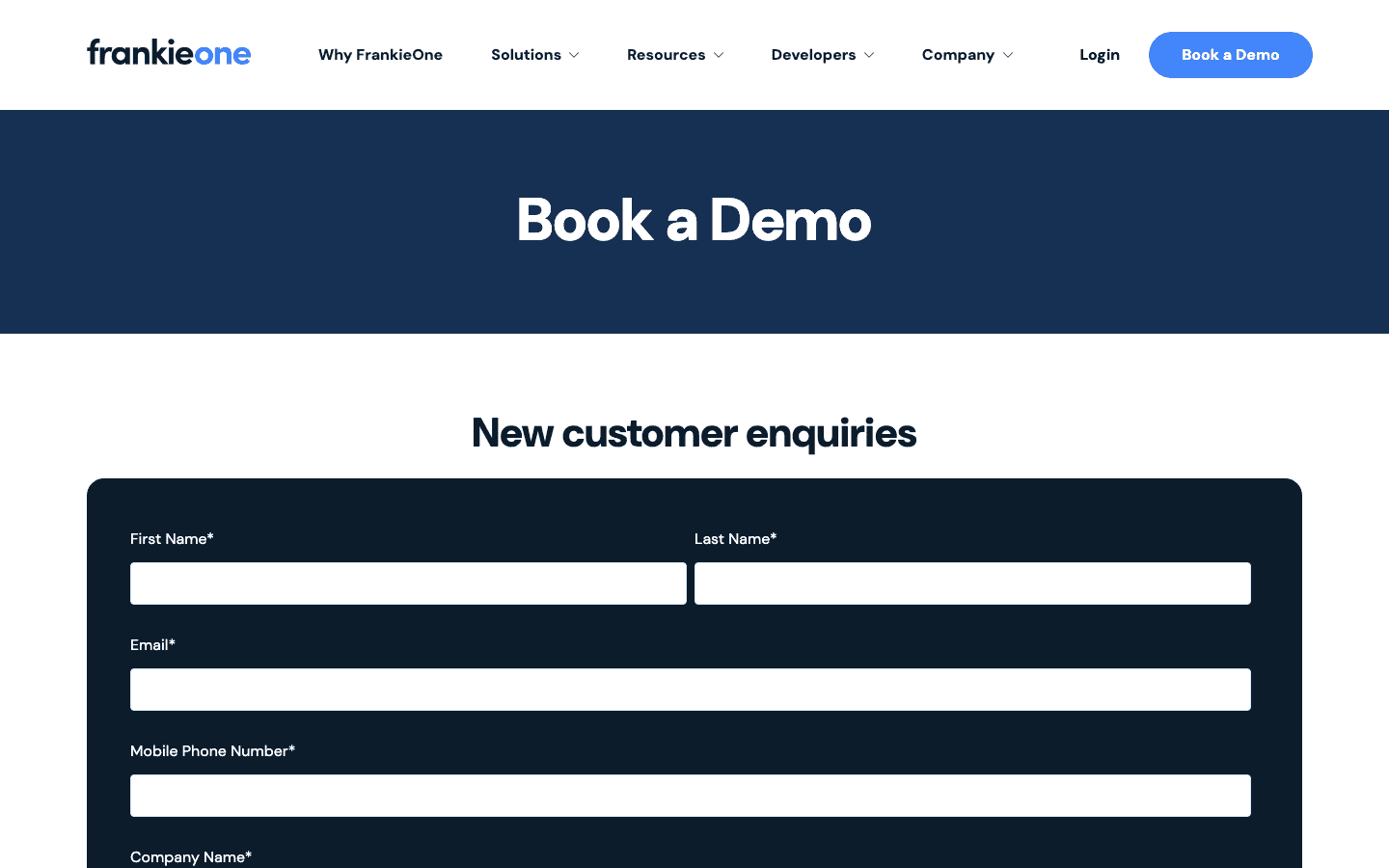
FrankieOne's pricing page directs prospective clients to a sales enquiry form without public per-check rates. Captured 25 October 2026.[4]
The budget below illustrates standard monthly expenditures for Didit's full KYC bundle at $0.33 per completed check (ID verification $0.15 + passive liveness $0.10 + face match $0.05 + device/IP analysis $0.03).
| Monthly Verification Volume | Didit Full KYC Bundle ($0.33/check) | FrankieOne Published Pricing |
|---|---|---|
| 1,000 completed bundles | $330 | Quote-based; no public per-check price on the reviewed page (25 October 2026).[4] |
| 10,000 completed bundles | $3,300 | Quote-based; no public per-check price on the reviewed page (25 October 2026).[4] |
| 50,000 completed bundles | $16,500 | Quote-based; no public per-check price on the reviewed page (25 October 2026).[4] |
All figures in USD list prices before applicable taxes, volume discounts, or credits. Calculations reflect completed bundles only and exclude separately priced modules such as database validation, KYB, or transaction monitoring.
Representative End-to-End Compliance Basket
For institutions requiring onboarding, screening, and continuous monitoring on the same customer record, Didit provides published unit prices for this example workload:
- 10,000 Full KYC verifications ($0.33 per bundle): $3,300
- 10,000 Initial AML screenings ($0.20 per check): $2,000
- 100,000 Transaction monitoring checks ($0.02 per event): $2,000
- 10,000 Crypto wallet screenings ($0.15 per check): $1,500
Total monthly operational expenditure: $8,800. Pricing remains consistent and verifiable in the console before onboarding users.
Authoritative Data: Government Database Validation
FrankieOne routes checks to government sources through configured external vendors.[2] Didit connects directly to authoritative government sources across 45 countries (run standalone or inside the same workflow) plus a Global group via API (POST /v3/database-validation/).[22]
Watch: Government Database Checks (Didit Academy)
Database Validation checks submitted attributes against government or other authoritative sources, including national registries where supported.[22] In supported jurisdictions, such as Argentina (RENAPER) and Panama (SIB), the validation includes selfie-to-registry-portrait matching, while checks such as Nigeria (BVN) verify the submitted selfie and return a source verdict rather than returning a portrait image.[23][24] Government database checks operate as an independent verification layer on top of document and biometric flows.
Public Proof and Security Standards
The following sources document security controls, the tested remote-identification flow, and one customer's reported results:
- Spain's published sandbox report documents tests of Didit's NFC and active-liveness flow. Its supervisory conclusions state that SEPBLAC positively assessed the added safeguards for remote identification.
- Information Security: SOC 2 Type 1 and Type 2 reports, and ISO/IEC 27001 certification for information security management.
- Scale and Coverage: Trusted by more than 4,000 companies, covering more than 220 countries and territories with 14,000+ document types and passive liveness certified under iBeta Level 1 PAD.
- Customer Deployment: In a published customer story, digital asset platform AhoraCrypto reported more than 20% savings per user compared with its previous verification provider, alongside a reduction of over 50% in time spent on manual user reviews. (Customer-reported results from that implementation; not a general performance benchmark).
Migration Path: Transitioning from FrankieOne to Didit
Use parallel traffic, dry-run imports and reconciliation to stage the move to Didit before expanding production volume.
1. Workflow and Webhook Mapping
| FrankieOne Concept | Didit Platform Implementation |
|---|---|
| OneAPI & OneSDK | Unified REST API and native SDKs (Web, iOS, Android, React Native, Flutter) |
| Managed vendor routing | Self-serve Workflow Builder with custom branching and fallbacks |
| Review queue | Didit Case Management with Investigator agent ($0.20 per reviewed item) |
| Event notifications | Real-time webhooks delivering complete inspection data and image assets |
2. Historical Verification Import API
To preserve historical verification records for existing users, Didit provides a dedicated historical import API (Historical Import Documentation):
- Batch Submission: Send historical files via
POST /v3/session/imports/specifying theworkflow_idand your customstatus_mappingschema. - Dry-Run Execution: Test imports initially using
dry_run: trueto validate field formatting and status mappings before committing data. - Reconciliation: Poll the import job status until it reaches a terminal result. Reconcile the counts of created, updated, skipped, and failed records against legacy logs before expanding traffic.
- Import Scope: The import API migrates historical verification records and statuses; it does not automatically import workflow rules, monitoring logic, or case management assignments.
3. Phased Rollout Plan
- Step 1Sandbox PilotCreate an account at business.didit.me, configure verification steps in the Workflow Builder, and test webhooks in the sandbox.
- Step 2Traffic Share PilotDirect 10–20% of new verification traffic to Didit. Compare user completion rates, pass rates, and review turnaround times.
- Step 3Historical IngestionExecute historical data imports using dry-run validation and status mapping for existing customer profiles.
- Step 4Full Platform TransitionExpand traffic to 100% and activate transaction monitoring, ongoing AML monitoring, and wallet screening on unified records.
Buyer Consideration: Vendor Redundancy vs Direct Execution
Didit provides direct operational resilience. Didit runs document verification, biometrics, device intelligence and AML checks on its own platform. Its document coverage spans 14,000+ document types across more than 220 countries and territories. Where fallback waterfalls are needed—such as routing a user from an eID check to document capture—teams configure and control them directly in the console on one record without intermediary coordination.
Watch: Conditional Workflows (Didit Academy)
In an orchestration model, routing through third parties requires agreeing to separate data-source licence terms across providers, coordinating with the vendor to alter routing logic, and managing disparate third-party systems.[2][3]
Platform Architecture and AI Agents
Didit provides an integrated architecture from onboarding through ongoing compliance:
- One Continuous Record: A customer verified during onboarding transitions directly into ongoing AML monitoring ($0.07 per user per year) and transaction monitoring ($0.02 per event) on the same customer record.[11][32]
- Autonomous Investigator Agent: Operates inside case management at $0.20 per reviewed item. The Investigator analyzes alerts, cross-references identity and transaction context, and generates detailed recommendations. It decides alone only inside your policy and autonomy level.[27]
- Console Copilot: Build workflows, draft custom user questionnaires, and configure database validation rules using conversational prompts within the console.[28][29]
- Hosted MCP Server: Connect external AI systems and compliance agents directly to Didit via Model Context Protocol (MCP) using OAuth 2.1 authorization.[25][26]
- Self-Serve Access: Access the production console and developer sandbox immediately at business.didit.me without a mandatory sales call. As announced in the pricing release, Didit introduces a Free plan with $10 of credit every month from 1 November 2026.
Sources
- FrankieOne home page, FrankieOne, read 25 October 2026.
- How FrankieOne selects vendors and data sources, FrankieOne docs, read 25 October 2026.
- Data source licences, FrankieOne, read 25 October 2026.
- Pricing, FrankieOne, read 25 October 2026.
- About OneSDK, FrankieOne docs, read 25 October 2026.
- Quickstart guide, FrankieOne docs, read 25 October 2026.
- Transaction monitoring, FrankieOne, read 25 October 2026.
- Crypto, FrankieOne, read 25 October 2026.
- Business verification, FrankieOne, read 25 October 2026.
- FrankieOne MCP server, FrankieOne docs, read 25 October 2026.
- Pricing, Didit docs, read 25 October 2026.
- Retrieve session, Didit docs.
- Transaction monitoring overview, Didit docs.
- Transaction rules API and backtesting, Didit docs.
- Rules library, Didit docs.
- SDK transaction submission and step-up, Didit docs.
- FIU reports, Didit docs.
- Wallet screening, Didit docs.
- Travel Rule, Didit docs.
- Key people, Didit docs.
- KYB supported countries and data tiers, Didit docs.
- Database validation supported countries, Didit docs.
- Non-document lookup and registry photo match, Didit docs.
- Nigeria BVN, Didit docs.
- MCP server overview, Didit docs.
- MCP tools, Didit docs.
- Investigator agent, Didit docs.
- September 2026 changelog, Didit docs.
- August 2026 changelog, Didit docs.
- Workflows, Didit docs.
- New pricing from 1 November 2026, Didit blog.
- Ongoing AML monitoring API, Didit docs.
- Didit documentation index, Didit docs, checked 27 October 2026.
FrankieOne and its trademarks belong to their respective owners; all references are nominative and factual. To evaluate Didit on your own traffic, visit the FrankieOne alternative page.
Deploy Direct Identity Verification
Create your account in the console and test your complete compliance workflow in the sandbox today.