Identity Verification API for Banking in UAE: 2026 How-To
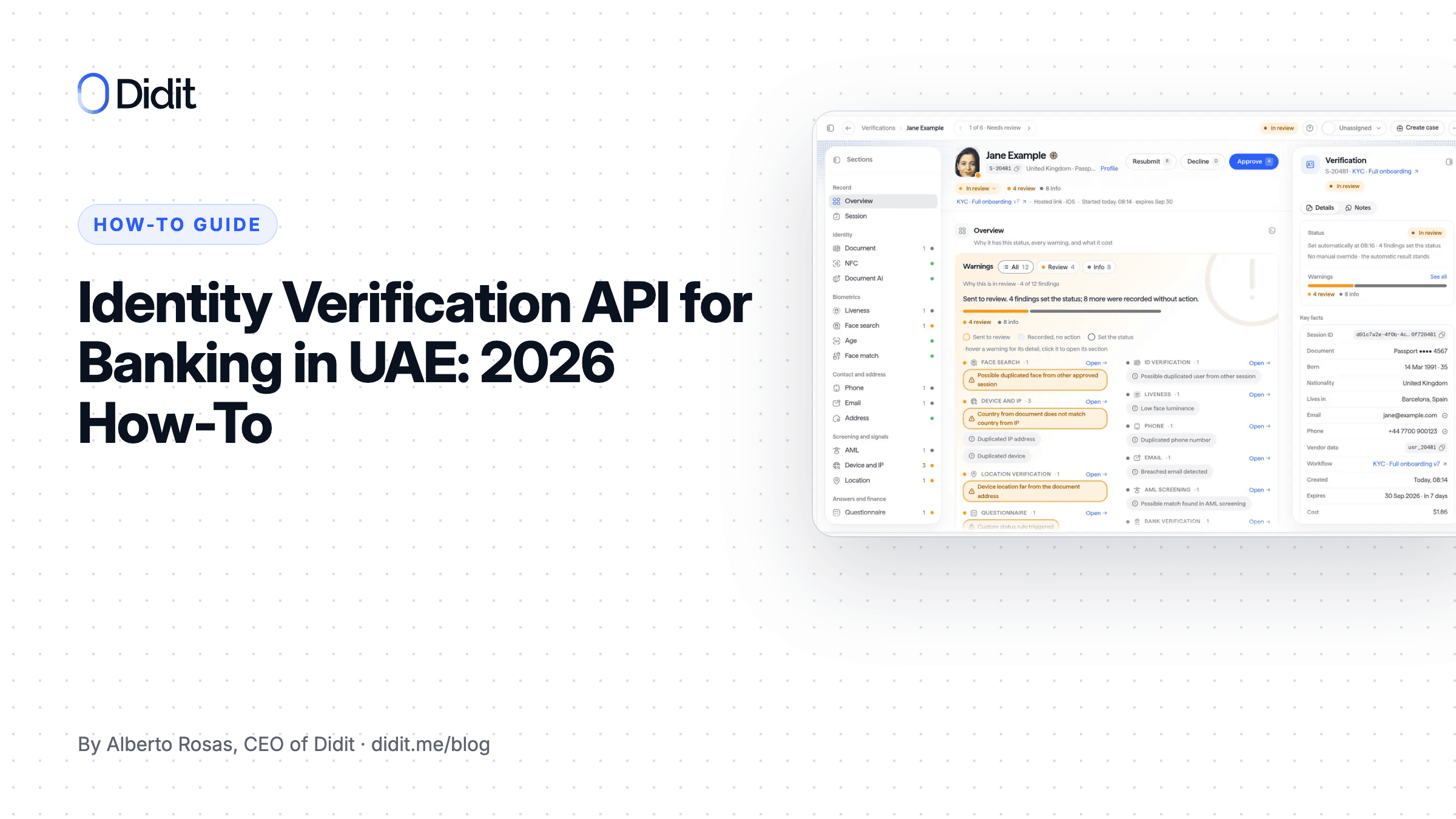
A UAE bank onboards with three Didit calls: create a workflow, create a session, read the decision. A full ID check is $0.33, AML $0.20, ongoing monitoring $0.07 per person a year. In Review sessions need a human.
 Alejandro RosasCo-founder and CTO
Contents
In this guide
Jump to the part you need.
A UAE bank that onboards customers in its own app needs three calls: create a workflow, create a session, read the decision. A full ID check costs $0.33 list: ID document $0.15, passive liveness $0.10, face match $0.05, device and IP analysis $0.03. This guide gives the exact calls, the webhook contract, the failure cases and the review boundaries. The caveat: automated approvals still need a documented manual path for sessions that land in In Review.
Last updated: November 26, 2026. Prices checked against the live Didit price feed on November 26, 2026.
What you get, and what it costs
| Piece | Where it runs | Price per completed check |
|---|---|---|
| Full ID check (KYC): document, biometrics, device and IP | POST /v3/session/ | $0.33 |
| ID document verification inside a workflow | workflow step | $0.15 |
| ID verification, standalone server-to-server call | POST /v3/id-verification/ | $0.20 |
| Passive liveness | workflow step | $0.10 |
| Active liveness | workflow step | $0.15 |
| Face match 1:1 | workflow step | $0.05 |
| Device and IP analysis | inside the full check | $0.03 |
| AML screening, 1,300+ lists | workflow step | $0.20 |
| Ongoing AML monitoring | add-on | $0.07 per person per year |
| Proof of address | workflow step | $0.20 |
| NFC passport chip read | add-on to a document check | $0.15 |
| Phone code to a UAE mobile, SMS / WhatsApp | workflow step | $0.1025 / $0.0542 per code |
| Workflow orchestrator, sandbox, MCP server | included | $0.00 |
Start free in the sandbox at https://business.didit.me/ (no sales call). Developers who want an AI assistant to drive the build can connect Didit through https://didit.me/developers/mcp/. The check-level documentation for the steps below starts at ID Verification API, and every number in this article is published on https://didit.me/pricing/.
What a UAE bank needs the API to return
The FATF Recommendations are the reference your compliance team will point at. Recommendation 10 asks for identification and verification of the customer, identification of the beneficial owner, and ongoing monitoring of the relationship. None of that is satisfied by a screenshot of an ID card. It is satisfied by a record that says which checks ran, what each returned, when the decision was taken and who took it.
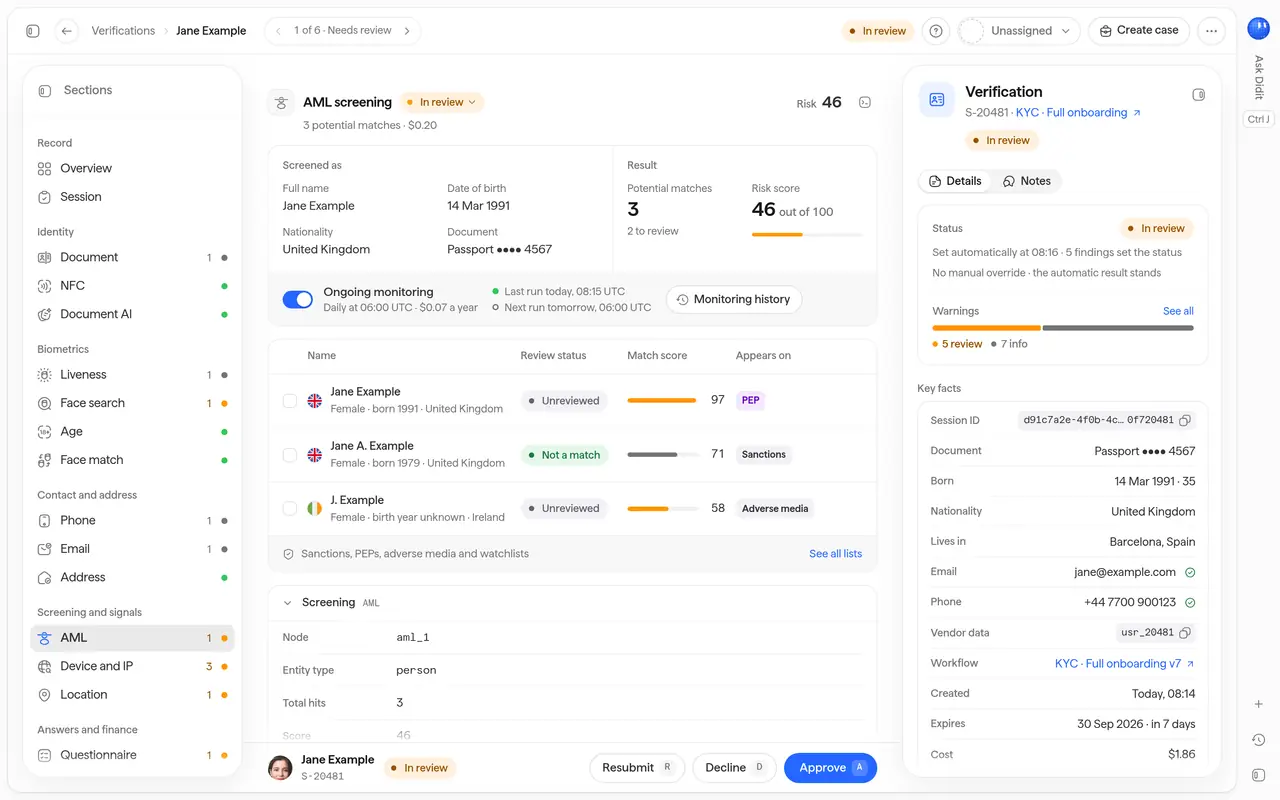
That is why the decision object, not the API call, is the deliverable. Every Didit session returns a decision_trace with the status, whether it was decided by a person or automatically, the warnings that fired, and a status_override if a reviewer changed the outcome by hand. Retention follows the plan: 1 year on Free, 5 years on Growth, up to 10 years on Scale with a 3-year exportable audit log. Didit holds SOC 2 Type 2 and ISO/IEC 27001:2022 certification. More than 4,000 companies use Didit, and Didit supports verification in 220+ countries.
What you build, and the method that works
The method we recommend for a bank is session-based verification, not a bag of standalone calls. You publish one workflow with the steps your product needs, create a session per customer, send the customer to the hosted URL or open it in an SDK, and take the decision from the webhook with GET /v3/session/{session_id}/decision/ as the reconciliation path. Standalone calls such as POST /v3/id-verification/ exist for server-to-server cases where you already hold the document images, and they are priced separately at $0.20 per call.

Prerequisites
- A Didit Organization. Sign up at https://business.didit.me/, then create the Organization where your team holds workflows, keys and verification activity.
- An API key. Create one in the console, or programmatically with
POST https://apx.didit.me/auth/v2/programmatic/register/followed byPOST https://apx.didit.me/auth/v2/programmatic/verify-email/and the 6-character code. Keep the sandbox key asDIDIT_API_KEYwhile you build and the live key asDIDIT_LIVE_API_KEY. - A published KYC workflow. The workflow type decides whether a session is a user check or a business check, so there is no separate KYB endpoint.
- An HTTPS endpoint for the return callback, and one for webhooks. Any http or https callback must sit on one of your application's allowed domains, otherwise session creation returns 400.
- A decision point in your core banking or onboarding system: what an Approved status authorises, and which queue handles In Review.
- Compliance sign-off on the
expected_detailsyou send, so mismatches come back as warnings instead of silent approvals.
Build it in six steps
Create the organization and the API key. Do this once. Sandbox testing is free and unlimited, so build and test against the sandbox application before you switch to the live key.
Create the workflow and keep its UUID. This is the reusable definition of your checks: document capture, liveness method, face match, AML.
curl -X POST https://verification.didit.me/v3/workflows/ \
-H "x-api-key: $DIDIT_API_KEY" \
-H "Content-Type: application/json" \
-d '{
"workflow_label": "UAE retail onboarding",
"workflow_type": "kyc",
"features": [
  {"feature": "OCR"},
  {"feature": "LIVENESS", "config": {"face_liveness_method": "PASSIVE"}},
  {"feature": "FACE_MATCH"},
  {"feature": "AML"}
]
}'
Persist the
workflow.id. Do not create a workflow per customer.Create a session per customer.
vendor_datais your stable customer identifier and binds the session to that customer for duplicate detection.curl -X POST https://verification.didit.me/v3/session/ \ -H "x-api-key: $DIDIT_API_KEY" \ -H "Content-Type: application/json" \ -d '{ "workflow_id": "$WORKFLOW_ID", "vendor_data": "cust-88123", "callback": "https://bank.example.ae/kyc/return", "expected_details": { "first_name": "Amina", "last_name": "Al Mansoori", "date_of_birth": "1991-04-02", "nationality": "ARE", "id_country": "ARE" } }'The response carries
session_id,urlandsession_token. Redirect the customer tourl, or open it in the web or mobile SDK.Register the webhook destination. Create it once per environment and store the returned
secret_shared_keyasDIDIT_WEBHOOK_SECRET.curl -X POST https://verification.didit.me/v3/webhook/destinations/ \ -H "x-api-key: $DIDIT_API_KEY" \ -H "Content-Type: application/json" \ -d '{ "label": "Production", "url": "https://bank.example.ae/hooks/didit", "subscribed_events": ["status.updated", "data.updated", "user.status.updated", "user.data.updated"], "webhook_version": "v3" }'Verify the signature before you trust the payload. Read the raw body, recompute the HMAC-SHA256 of the sorted canonical JSON and compare it with
X-Signature-V2using a constant-time comparison. Reject a request whoseX-Timestampis more than 300 seconds away from now. De-duplicate onevent_idand answer 2xx within 5 seconds, then do the work.Read the decision as the reconciliation path. Use it after a webhook, or whenever a webhook is delayed.
curl https://verification.didit.me/v3/session/<SESSION_ID>/decision/ \
-H "x-api-key: $DIDIT_API_KEY"
const url = "https://verification.didit.me/v3/session/" + sessionId + "/decision/"; const decision = await (await fetch(url, { headers: { "x-api-key": API_KEY } })).json(); switch (decision.session_kind) { case "user": return handleUserDecision(decision); case "business": return handleBusinessDecision(decision); }Always branch on
session_kind. Feature data comes back as plural arrays:id_verifications[],liveness_checks[],face_matches[],aml_screenings[],poa_verifications[]. If a feature did not run, its field is absent or null, never a placeholder.
Expected output
A completed UAE retail session returns one of these exact, case-sensitive statuses: Approved, Declined, In Review, In Progress, Not Started, Expired, Abandoned, Kyc Expired, Resubmitted or Awaiting User. The decision carries the extracted document fields under id_verifications[], the biometric outcome under liveness_checks[] and face_matches[], any sanctions or PEP hit under aml_screenings[], and the risk codes on the feature that produced them, under its own warnings[] array, for example id_verifications[].warnings[]. Inference runs at a sub-2-second p99, and every session carries 200+ real-time fraud signals.

Inputs and outputs
| Field | Direction | Required | What it does |
|---|---|---|---|
workflow_id | request | yes | UUID of the published KYC or KYB workflow. Its type decides the session kind. |
vendor_data | request | recommended | Your customer identifier, used for duplicate detection across sessions. |
callback | request | no | Where the hosted flow returns the customer. Didit appends the session id and status. |
language | request | no | ISO 639-1 code for the verification UI. Defaults to browser detection. |
expected_details | request | no | First name, last name, date of birth, nationality and id_country in ISO-3. Mismatches surface as warnings. |
metadata, tags | request | no | Your own routing data and up to 10 tags, returned in the decision and the webhook. |
session_expiration_time | request | no | 1 hour to 4 weeks for this session's link, overriding the workflow setting. |
session_id, url, session_token | response | returned | Redirect the customer to url. |
status | decision | returned | The outcome your onboarding system acts on. |
decision_trace | decision | returned | Who or what decided, when, and which warnings counted. |
id_verifications[].warnings[] | decision | returned | Risk codes on the feature that produced them, such as DOCUMENT_EXPIRED, INVALID_MRZ, INCONSISTENT_DATA, DOCUMENT_LIVENESS_FAILED. |
Failure cases and recovery
| Symptom | Cause | Recovery |
|---|---|---|
403 You do not have permission to perform this action. | No API key on the call | Send x-api-key on every verification call. |
| 401 | Wrong, revoked or expired key | Issue a new key in the console and redeploy the secret. |
400 on workflow_id | Workflow UUID unknown to this application | Check you are calling with the key of the organization that owns the workflow. |
400 on callback: callback must be on one of the application's allowed domains | Callback origin not allowlisted | Add the origin in the application settings, or use an app deep link, which is always accepted. |
403 You don't have enough credits | Prepaid balance exhausted | Top up, or turn on auto top-up so live checks do not stop. |
| Webhook answered with 5xx or 404, or slower than 5 seconds | Handler timeout or error | Didit retries twice, after roughly 1 and 4 minutes, then drops the delivery. Resend it from the destination delivery log. |
Declined with a terminal warning | For example DOCUMENT_EXPIRED or DOCUMENT_LIVENESS_FAILED | Show the first warning to the customer and stop the flow. Do not retry blindly. |
In Review with DOCUMENT_LIVENESS_NOT_COMPUTED | The forgery check produced no usable score | Treat the document as unchecked and route the session to manual review. |
| 404 on the decision | Session does not exist, or belongs to another application | Confirm the session_id and the key pair you used to create it. |
| 403 on the decision | Key lacks read:sessions | Use a key with the read privilege for reconciliation jobs. |
Paid steps and review boundaries
Creating workflows, creating sessions, registering webhooks and reading decisions are not billed lines. You pay for a check only when it finishes with a result. On a UAE retail flow the billable checks are the document check at $0.15, passive liveness at $0.10, face match at $0.05 and device and IP at $0.03, which is the $0.33 full check. AML screening adds $0.20 per customer, ongoing monitoring $0.07 per person per year, proof of address $0.20, an NFC passport chip read $0.15. Phone codes are billed at the carrier price plus the Didit fee; a UAE SMS code totals $0.1025 and a WhatsApp code $0.0542. Free plan credit does not cover phone codes.
The review boundary is a product boundary, not a pricing one. Approved and Declined are automatic when your workflow rules decide, and status_override tells you when a reviewer changed the outcome by hand. In Review means a person must decide, so your onboarding system must hold the account in a pending state rather than approve it. The Investigator agent, included on Growth and Scale, can take a first pass at the review queue and write the follow-ups; when it decides an item, decision_trace records decided_by as investigator, and a person can still override it. Growth and Scale apply 4 percent and 10 percent off every Didit price, and each plan's monthly credit expires at the end of the plan month.

Worked cost example
A bank onboards 12,000 new retail customers each month in the UAE. Every customer gets the full ID check and AML screening, 3,000 of them also upload a proof of address, and each customer is kept under ongoing AML monitoring for a full year. At list price:
- Full ID check: $0.33 x 12,000 = $3,960.00 per month
- AML screening: $0.20 x 12,000 = $2,400.00 per month
- Proof of address: $0.20 x 3,000 = $600.00 per month
- Monthly total: $3,960.00 + $2,400.00 + $600.00 = $6,960.00
- Twelve months of checks: $6,960.00 x 12 = $83,520.00
- Ongoing AML monitoring: 12,000 new customers a month x 12 months = 144,000 person-years, at $0.07 x 144,000 = $10,080.00
- Year one check spend: $83,520.00 + $10,080.00 = $93,600.00
The monitoring line is the cohort assumption stated plainly: 12,000 new customers join every month and each is monitored for a full year, so twelve months of onboarding is 144,000 person-years, not 12,000 people. The 144,000 person-years represent a full year of monitoring for each monthly cohort, so the total extends beyond the first 12 calendar months.
On the Scale plan each Didit price is 10 percent lower: $0.297, $0.18 and $0.18. The same month becomes $3,564.00 + $2,160.00 + $540.00 = $6,264.00, and monitoring becomes $0.063 x 144,000 = $9,072.00, so year one is $6,264.00 x 12 = $75,168.00 for checks plus $9,072.00 for monitoring, which is $84,240.00. The $299 monthly plan fee comes with $350 of credit that pays the first $350 of that usage. Nothing here requires an annual commitment: Enterprise contracts start at $15,000 a year, and below $15,000 a year the self-serve Free, Growth and Scale plans are the right fit.
AI customer verification with liveness detection in the UAE
Liveness is the part of the check that stops a photo of a photo. Didit offers passive liveness at $0.10 per check, where the customer takes a selfie and the model decides without asking for a gesture, and active liveness at $0.15, where the flow asks for movement. Passive is the right default for a mobile onboarding funnel because it removes a step; active is worth the extra $0.05 when your fraud team wants a stronger challenge on higher-risk products. The liveness face is then matched 1:1 against the document portrait for $0.05. Presentation attack detection is certified to iBeta Level 1 PAD.
For the local market, set language to the ISO 639-1 code your customers read; when you leave it out, the flow detects the browser language. Send expected_details with nationality and id_country set to ARE so a mismatch comes back as a warning. If the customer presents a document version your library does not cover yet, the session returns COULD_NOT_RECOGNIZE_DOCUMENT rather than a silent pass, so your team sees it in the queue.
AI document verification for UAE and Dubai onboarding teams
Didit reads 14,000+ document types across 220+ countries in 130+ recognition languages, extracts the fields with AI OCR, decodes the MRZ and any barcode the document carries, and checks authenticity before the data is trusted. A session returns risk codes instead of a pass or fail, including INVALID_MRZ, INCONSISTENT_DATA, DUPLICATED_DOCUMENT and FRAUD_RISK_FROM_OCR, so your rules decide what blocks a customer and what merely routes to review. Non-ID paperwork such as a salary certificate or a tenancy contract goes through Document AI at $0.20 per document.
Two UAE specific notes. Check the current document library for the specific Emirates ID version your customers present before relying on this path, and compare the result with the expected_details you already hold. UAE PASS is a different method, a national digital ID wallet sign-in, and it is listed on the live price feed as coming soon, so it is not available in production today and no price is quoted for it. Build the document path now and treat the wallet as an extra option in the same workflow when it ships.
Sources
- Didit pricing page and pricing as JSON, read November 26, 2026.
- Didit docs: identity verification pricing and billing rules, read November 26, 2026.
- Didit docs: quick start, the source of the workflow, session and webhook calls on this page.
- Didit docs: Create Session API, for the request and response fields.
- Didit docs: Retrieve Session API, for the decision shape and its error codes.
- Didit docs: webhooks, for
X-Signature-V2, event types and retry behaviour. - Didit docs: ID Verification API, for document coverage, warnings and standalone pricing.
- Didit product facts, for certifications, coverage and company figures.
- Didit MCP server, for connecting Didit to an AI assistant, read November 26, 2026.
- FATF, the intergovernmental body whose Recommendations set the customer due diligence standard banks apply.
Open the sandbox at https://business.didit.me/, create one workflow with OCR, passive liveness, face match and AML, and run a single session end to end before you speak to anyone. No sales call.
Try it
Try this in the sandbox
Run the check this guide describes, free.
The product this post is about, taken from its topic. Run it free in the sandbox.
Author
Alejandro Rosas
Co-founder and CTO

Keep reading
Other guides in the same topic.
 What Is the Purpose of FICA in South Africa? 2026 Guide
FICA is South Africa's anti-money laundering law. It creates the Financial Intelligence Centre and requires accountable institutions to identify and verify clients, screen for PEP and sanctions risk and report suspicious.
Alberto RosasNov 26, 2026 Sixth Money Laundering Directive (6AMLD): What Changed and Which Rules Apply
6AMLD is Directive (EU) 2018/1673: Member States must criminalise laundering, widen predicate offences and set a four-year penalty floor. It adds no new due diligence duties for firms.
Alberto RosasNov 26, 2026 Automated Sanctions Screening: Canada, the Entity List and Embargoes
Automated sanctions screening matches people and companies against lists such as Canada's autonomous sanctions made under SEMA and JVCFOA and the OFAC SDN List, and returns candidate hits scored for identity confidence and.
Alberto RosasNov 26, 2026Questions
Frequently asked questions
How much does an identity verification API cost for a UAE bank?
A full ID check on Didit is $0.33 per completed check: ID document $0.15, passive liveness $0.10, face match $0.05, device and IP analysis $0.03. AML screening is $0.20 and ongoing monitoring is $0.07 per person per year. The sandbox is free on every plan. The first organization created through the console with an eligible company-domain work email receives $10 of monthly credit. An organization created through the API starts at $0.
Which call starts a KYC session for a UAE customer?
POST https://verification.didit.me/v3/session/ with your workflow_id, the customer's vendor_data and an optional callback. The response returns session_id, url and session_token, and you send the customer to the url. There is no separate endpoint for business verification: the workflow type decides.
Does Didit support Emirates ID documents?
Didit reads 14,000+ document types across 220+ countries, and the verification flow supports 54 capture and interface languages. You set the flow language per session with the language parameter, an ISO 639-1 code that defaults to browser detection. Check the current document library for the specific Emirates ID card version your customers present, and pair the document check with passive liveness and face match.
Is liveness detection passive, active, or both?
Both are available and priced separately: passive liveness at $0.10 per check and active liveness at $0.15. A UAE retail flow can use passive liveness at $0.10 plus face match at $0.05, and reserve active liveness for higher-risk products. The liveness face is compared 1:1 with the document portrait.
What happens when a verification lands in In Review?
In Review means no automatic decision was taken, so a person must decide and the account must stay pending. The decision carries decision_trace showing who decided, and status_override if a reviewer changed the outcome by hand. Never approve a session on an In Review status.
How fast do webhooks arrive, and what if our endpoint is down?
Didit signs each event with X-Signature-V2 and expects a 2xx within 5 seconds. If your handler answers 5xx or 404, or takes longer, Didit retries twice, after roughly 1 and 4 minutes, then drops the delivery, which you can resend from the destination delivery log. Always reconcile with GET /v3/session/{session_id}/decision/.
Can one API verify a customer and route a payment?
No. Didit returns a verification decision, a status and the evidence behind it, and your onboarding or core banking system uses that decision to open the account or release the payment. Payment routing and card issuing stay in your payments stack. The signed webhook is the handoff point between the two.
Is UAE PASS supported for sign-in verification?
UAE PASS is listed on the published price feed as coming soon, so it is not available in production today and no price is quoted for it. Start with document verification plus liveness, which are available now. When wallet sign-in ships it becomes an additional method in the same workflow.
Do we need a sales call to test the API?
No. Sign up at https://business.didit.me/, take the sandbox API key and build against it. Sandbox testing is free and unlimited. You switch to the live key only when the organization has credit and you are ready to go live.
How much does business verification cost for corporate onboarding?
Business verification runs from $2.00 per company, priced by country and data tier, with company AML at $0.20 and person AML at $0.20 per owner or officer. Each owner also takes a linked full ID check at $0.33. Registry steps and pricing are documented in the business verification quick start.
Compliance built in
Audited, certified and attested.
We hold the certifications and build each country's rules into your flows, so you can launch anywhere without worrying. Security and Compliance center
- Regulation encoded into your flows
Tell us what you do and where. Didit lists the rules that apply to you, with sources, and builds the checks each country needs into one workflow.
- Ready for AMLR
Every requirement of the new EU anti-money laundering rules, from checking customers to human review, is already covered by a Didit check.
- Tested in Spain's Treasury sandbox
Spain's Treasury published its supervised sandbox report on Didit's NFC plus active liveness onboarding; SEPBLAC took part and valued the added measures positively.
- Audited, not self-declared
iBeta Level 1 and Level 2. Liveness tested under ISO/IEC 30107-3.
Your obligations · 3 regions
 SOC 2 Type 2
 ISO 27001
 iBeta Level 1 and Level 2
 EU regulator attestation
 FSM youth protection
 GDPR
 EBA remote onboarding
 MiCA compatible
 FIDO Alliance member
- AMLREU AML Regulation ready
Integration · Didit MCP
Run Didit from your own AI agent
Connect Didit to Claude, Cursor, VS Code or ChatGPT and just ask in plain words. Your agent can do anything you can do in the console, with the same permissions you have.
 Add to Claude
 ChatGPT
 Cursor
- Build workflowsDescribe the checks you need. The agent creates and publishes the flow.
- Run investigationsAsk why a session was declined, review cases, search people and companies.
- Change rulesCreate payment rules, test them on past data and switch them on.
- Pull reportsAsk for numbers, exports or the audit log.
Didit Academy


