PSD3 and PSR Explained: What Changes for Fintechs and PSPs
PSD3 and the PSR update payment-service rules for EU PSPs. The package is not adopted yet, so confirm final dates and articles on EUR-Lex. Didit maps identity, AML and monitoring checks to the obligations.
 Alberto RosasCo-founder and CEO
Contents
In this guide
Jump to the part you need.
This page is for payment institutions, e-money institutions, neobanks and PSPs serving EU customers. It sets out who PSD3 and the Payment Services Regulation bind, where, and from when, then maps each duty to a Didit check and a published price. A full KYC check is $0.33 and AML screening is $0.20. The main caveat: the package is not adopted yet, so read the article numbers and dates from the latest official file on EUR-Lex before you change code.
Last updated: November 26, 2026. Prices checked against the live Didit price feed on November 26, 2026.
The short answer
Two things decide how much of this applies to you: the service you provide and the entity that provides it. Everything else, including the timetable, follows from those two facts.
| Question | Answer |
|---|---|
| What replaces PSD2 | PSD3, a directive, plus the Payment Services Regulation (PSR). The package also repeals the E-Money Directive 2009/110/EC and brings payment services and e-money services into a common authorisation framework. |
| Who is bound | Credit institutions, payment institutions, e-money institutions, post office giro institutions and the public bodies that provide payment services, plus payment initiation and account information providers in their own right. Merchants and technology suppliers are outside the perimeter unless their activity meets a scope test. |
| Where | EU member states. The PSR applies directly there. PSD3 is transposed into national law. EEA incorporation runs on its own timetable through the EEA Joint Committee, so do not assume both arrive together. |
| From when | Not fixed in adopted law as of November 26, 2026. The June 2023 proposals were superseded by the provisional political agreement reached between the Council and the Parliament in November 2025. The adopted text will set entry into force, the PSR application date, the PSD3 transposition window, the repeal of PSD2 and the transitional provisions. |
| Already live | Verification of Payee for ordinary and instant euro credit transfers, Article 5c of Regulation (EU) No 260/2012 as amended by Regulation (EU) 2024/886, from 9 October 2025 in the euro area. The AMLR, Regulation (EU) 2024/1624, applies from 10 July 2027. |
| Main caveat | The published text governs. Confirm dates, article numbers and transitional provisions in the latest file on EUR-Lex, and how they reach you, with your supervisor. |
Start free in the sandbox at business.didit.me, no sales call, and the sandbox is free on every plan. Developers can connect Didit to an AI assistant through the MCP server at didit.me/developers/mcp. Plan fees, credits and unit prices sit on didit.me/pricing.
Who is subject to PSD3 and the PSR
The duties fall on payment service providers. PSD2 Article 1(1) lists them: credit institutions, e-money institutions, payment institutions, post office giro institutions and the public bodies that provide payment services. The package retains payment initiation and account information providers within the perimeter, while changing the applicable authorisation and operating rules. An entity is in scope because of the service it provides and the entity providing it, not because of the software it runs.
Payment initiation and account information providers are inside the perimeter in their own right. They hold their own authorisation and owe their own duties, and the account-servicing PSP owes them access. That split matters when you contract: a party that only supplies software to a PSP is not thereby a PSP, and a party that initiates a payment for a customer is.
Passporting is Articles 28 to 31, not Articles 33 and 36
Cross-border establishment and the freedom to provide services by payment institutions run on PSD2 Articles 28 to 31: notification through the home competent authority, and the host authority's role in the process. Those are the passporting articles. Article 33 concerns account information service providers, and Article 36 concerns access to payment accounts. Citing either of those as the general passporting route is wrong and will fail a supervisory conversation.
The EU and the EEA are different perimeters. The PSR applies in the member states of the Union. EEA incorporation happens through the EEA Joint Committee decision that adds the act to the EEA Agreement, which lands separately and often later. A licence passported from an EU member state does not by itself cover Norway, Iceland or Liechtenstein, and an EEA authorisation does not by itself cover the Union. Check which version of the act your EEA supervisor has adopted before you plan a launch date.
Our part in your outsourcing file
We supply identity and fraud checks to PSPs. The question you have to answer per arrangement is whether the specific Didit service is an ICT service within the meaning of DORA, Regulation (EU) 2022/2554, whether you have recorded the arrangement in the register of information, and whether that service supports a critical or important function. DORA Article 30 sets the contract terms for ICT services, and a narrower set applies where the service does not support a critical or important function. Assess each arrangement on its own rather than applying one template to everything you buy.
Three scope questions, not three blanket exclusions
Limited network, commercial agent and independent ATM operation are three questions to answer on the facts, not three safe harbours. The limited network question asks what the instrument can buy, where it can be used and how many providers accept it. The commercial agent question asks whether the agent negotiates the sale or purchase of goods or services for the payer or the payee, and whether the agent is in possession of funds. The ATM question asks who operates the machine and whether it is operated on behalf of the account-servicing PSP. The eligibility conditions sit in PSD2 Article 3, and the corresponding provisions of the package carry them forward with changes you must read.
The technical service exclusion is separate. It covers a provider that supports the provision of payment services without entering into possession of funds at any point. It does not cover payment initiation services or account information services, which are expressly outside the exclusion. Read the exclusion by activity, not by job title: the same company can fall outside it on one product and inside it on another.
One authorisation framework does not mean one permission
PSD3 brings payment services and e-money services into a common authorisation framework and repeals the E-Money Directive. That does not mean every payment institution authorisation automatically permits e-money issuance. Permission to issue e-money depends on the scope of the institution's authorisation, and the transition for firms authorised today under the E-Money Directive is set by the final text. Check the authorisation and transition provisions in the latest file rather than assuming the perimeter of your licence widens by itself.
Applicability matrix: role, payment type, location
Read down the rows to find yourself. Each row names the instrument and the provision, and the status of the date.
| PSP role | Service or payment type | Where | Instrument and provision | Status and date |
|---|---|---|---|---|
| Account-servicing PSP, including e-money and payment institutions that hold the payment account | Access to a payment account by a payment initiation or account information provider | EU | PSD2 Articles 66 and 67 today, succeeded by the access provisions of the PSR | In force; PSR provisions pending adoption |
| Payment initiation service provider | Initiation of a remote electronic payment | EU | PSD2 Article 11 for authorisation, Article 97 for strong customer authentication | In force |
| Account information service provider | Account information | EU | PSD2 Article 33 for the specific regime, Article 97(5) when relying on the account-servicing PSP authentication | In force |
| Payment institution | Cross-border establishment or provision of services | EU, then EEA separately | PSD2 Articles 28 to 31 | In force |
| Payer PSP | Euro credit transfer, ordinary or instant, Verification of Payee | Euro area member states | Article 5c of Regulation (EU) No 260/2012 as amended by Regulation (EU) 2024/886 | In force from 9 October 2025 |
| Payee PSP receiving | Instant euro credit transfer | Euro area member states | Regulation (EU) 2024/886 | In force from 9 January 2025 |
| Payer PSP sending | Instant euro credit transfer | Euro area member states | Regulation (EU) 2024/886 | In force from 9 October 2025 |
| Any PSP | Verification of Payee | Member states whose currency is not the euro | Article 5c as amended, later application date | 9 July 2027 |
| E-money institution | E-money issuance and payment services | EU | PSD3 common authorisation framework, replacing Directive 2009/110/EC | Pending; permission follows the scope of the authorisation |
| Firm with a fiat leg and a crypto service | Fiat payment service and crypto-asset service | EU | Payments rules for the fiat leg, Regulation (EU) 2023/1114 (MiCA) for the crypto service | In force, tested service by service |
From when: the dated applicability table
A directive gives member states a transposition window. A regulation applies on its own date. The table separates what binds today from what is coming, and labels each date by its legal status.
| Date | Instrument | What applies | Status |
|---|---|---|---|
| 13 January 2018 | Directive (EU) 2015/2366 (PSD2), Article 115 | General PSD2 transposition deadline for member states | In force |
| 14 September 2019 | Commission Delegated Regulation (EU) 2018/389, applied under PSD2 Article 115(4) | Strong customer authentication and common and secure communication requirements apply, including the exemption regime and the interface standards | In force |
| 9 January 2025 | Regulation (EU) 2024/886 | Instant euro transfers for receiving PSPs | In force |
| 17 January 2025 | Regulation (EU) 2022/2554 (DORA) | ICT third-party risk, register of information, contract terms | In force |
| 9 October 2025 | Regulation (EU) 2024/886; Article 5c of Regulation (EU) No 260/2012 as amended | Instant euro transfers for sending PSPs, plus Verification of Payee for ordinary and instant euro credit transfers in the euro area | In force |
| 9 July 2027 | Article 5c as amended | Verification of Payee for PSPs in member states whose currency is not the euro | In force, later date |
| 10 July 2027 | Regulation (EU) 2024/1624 (AMLR) | Customer due diligence, beneficial ownership, screening, record keeping | Adopted |
| Date set in the adopted text | Payment Services Regulation | Application of the directly applicable rules: SCA, payee verification for euro credit transfers, impersonation fraud, fraud information sharing, access to payment accounts | Provisional political agreement, November 2025. Not adopted |
| Date set in the adopted text | PSD3 | Transposition window for authorisation, passporting and supervisory rules | Provisional political agreement, November 2025. Not adopted |
| Date set in the adopted text | PSD3 | Repeal of PSD2 and Directive 2009/110/EC, with transitional provisions for firms already authorised | Provisional political agreement, November 2025. Not adopted |
The June 2023 proposals are no longer the latest baseline, so we do not print their application periods as if they were law. The provisional political agreement moved the numbering and the timing, and the final adopted text may change the numbering and the dates again. Two consequences for planning: build the duties you already owe under PSD2 and the Instant Payments Regulation, and keep a delivery slot open rather than a fixed date for the PSR. The 90-day re-authentication interval in Article 10 of the 2018 standard is no longer current either: Delegated Regulation (EU) 2022/2360 amended it to 180 days, and that amended interval governs the conditions on account information access in the consolidated text.
Obligations against Didit capability
Every row below is a duty on you, not on us. The right-hand columns say what we can hand you and what it costs, so you can price the gap. Where we have nothing, the row says so.
| Obligation and source | What it requires | Didit capability | Published price |
|---|---|---|---|
| Strong customer authentication, PSD2 Article 97, carried into the PSR | Two independent factors from knowledge, possession and inherence, with the authentication code dynamically linked to the amount and the payee for remote electronic payment transactions | Biometric Authentication, Passive Liveness, Face Match, Device and IP Analysis as supporting components | Biometric Authentication $0.10 per authentication, Passive Liveness $0.10, Face Match $0.05, Device and IP Analysis $0.03 |
| Outsourced or delegated authentication | The PSP remains liable for the authentication, so the contract has to fix the standard, the evidence returned and the retention | Hosted flow or SDK, with the result returned as a verification decision | Included in the price of the checks used |
| Exemptions other than transaction risk analysis, Delegated Regulation (EU) 2018/389 Articles 13 to 16 | Each exemption has its own eligibility conditions, limits and evidence | Rule engine for amount, velocity and counterparty conditions | Transaction Monitoring $0.001 per transaction beyond your plan allowance |
| Transaction risk analysis, Delegated Regulation (EU) 2018/389 Article 18 | Real-time risk analysis, fraud rate thresholds below the reference rates, transaction value limits, monitoring and reporting | 200+ fraud signals per check and transaction rules whose outputs can be inputs to your model | Signal checks at their list price; Transaction Monitoring $0.001 per transaction beyond the allowance |
| Verification of Payee, Article 5c of Regulation (EU) No 260/2012 as amended by Regulation (EU) 2024/886 | Check the payee name against the account before execution, send the statutory mismatch notification, and preserve the payer's ability to authorise the transfer | No name-check capability. Use your Verification of Payee service for the account-name check; the Didit integration covers identity checks and transaction monitoring | Not a Didit product |
| Impersonation fraud, PSR provisions on the latest text | Consumer reporting route, reimbursement by the payer PSP where the conditions are met, and a separate allocation or recourse between PSPs | Identity checks on account holders and transaction scoring on both directions of flow | Full KYC $0.33, AML Screening $0.20, Transaction Monitoring $0.001 per transaction beyond the allowance |
| Fraud information sharing, PSR provisions on the latest text | Distinguishes permissions from duties, and fixes the parties, the permitted data and the safeguards | Fraud network signals as a product capability on Growth and Scale | Included in the plan; see the pricing page |
| Customer due diligence, AMLR Articles 19, 20 and 22 | Identify and verify the customer, identify beneficial owners, screen sanctions and PEPs | ID Verification, AML Screening, Business Verification, Ongoing AML Monitoring | Full KYC $0.33, AML Screening $0.20, Business Verification from $2.00 per company, Ongoing AML Monitoring $0.07 per person a year |
| Monitoring and reporting, AMLR Articles 26 and 69 | Monitor the relationship and the transactions, and report suspicion | Transaction Monitoring with rules, alerts and case management | $0.001 per transaction beyond the allowance |
| Records and human review, AMLR Articles 76 and 77 | Five years from the end of the business relationship or the date of the occasional transaction, subject to extensions; safeguards for covered automated decisions | Configurable retention and audit logs; manual review queues in the console | Retention from 1 month to 10 years and audit log length by plan |
| Outsourcing and ICT third-party risk, DORA Article 30 and AMLR Article 18 | Assess the service, record the arrangement, hold the applicable contract terms and an exit plan | SOC 2 Type 2, ISO/IEC 27001:2022, EU data processing by default, DPA and TOMs on request at privacy@didit.me | No separate charge |

Strong customer authentication is about evidence
The three factor categories do not move. What decides a supervisory review is whether you can show which factors were used, that they were independent, and how the code was bound to the amount and the payee. A device-bound token plus a live face match can support the possession and inherence factors, but only if the implementation shows the two are independent and qualifying. Treat individual Didit checks as supporting components of your authentication control, not as the control itself.
Payee verification is already live, and it covers more than instant payments
Verification of Payee applies to ordinary and instant euro credit transfers, not only to instant payments. The source is Article 5c of Regulation (EU) No 260/2012 as amended by Regulation (EU) 2024/886, applicable from 9 October 2025 for PSPs in the euro area, with a later date for PSPs in member states whose currency is not the euro. Use your Verification of Payee service for the account-name check. The Didit integration shown here covers identity checks and transaction monitoring.
On a mismatch, the duty is to send the statutory mismatch notification and to preserve the payer's ability to authorise the transfer. Blocking on a mismatch is not an interchangeable way to comply. Any independent legal or contractual ground for declining a payment is a separate decision, taken under your own analysis and recorded as such.
Impersonation fraud, read from the latest text
The provisional package changes who carries the loss when a consumer is tricked into authorising a transfer to a person or business that is impersonating a PSP or a public authority. Four things have to be read in the article itself: the parties covered, the qualifying scenario, the consumer's reporting steps and the reimbursement duty, and any separate provision that allocates the loss between PSPs or gives one PSP recourse against another. Do not build the logic around whether authentication was technically correct. Build it around the conditions the text sets, and route every disputed case to a human decision with the record attached.
Fraud information sharing: permissions and duties are not the same
The latest text distinguishes what PSPs may share from what they must share, and it names the parties, the permitted data and the safeguards. Some technical standards are expressly mandated, and others are still to be drafted; check which is which in the file before you promise an integration. A private bilateral feed between two PSPs is not automatically permissible, and it is not automatically a compliant way to discharge a duty. Didit fraud network signals are a separate product capability inside your own monitoring, not a PSP-to-PSP sharing arrangement.
Open banking: who owes what
The access duty and the obligations on the third-party provider are separate. The account-servicing PSP owes the access and interface duties: it must give a payment initiation or account information provider access to the payment account on the same terms as its own customers, on an interface that meets the performance and availability rules. Account-servicing PSPs are not limited to banks, because an e-money institution or a payment institution that holds the payment account carries the same duty. The third-party provider owes its own authorisation, its own strong customer authentication, and its own rules on data use and storage.
PSD2 Article 97(5) belongs here. It is the provision that lets a payment initiation or account information provider rely on the authentication procedures the account-servicing PSP provides, instead of building its own. It is not a general delegation clause for outsourcing authentication to any supplier, and a verification result from us does not establish that payment authentication was performed.
One concrete change to plan for: the access and interface rules move from a directive plus a technical standard into the regulation itself, so the same text applies in every member state with no transposition step. The numbering moves with it, so read the access provisions in the latest PSR file that succeed PSD2 Articles 66 and 67 before you respec your interface, and treat the performance expectations as ongoing obligations rather than a launch test.
One euro credit transfer, step by step
- Account-name check. Your Verification of Payee service returns a match, a close match, a mismatch or not available. Control owner: payments operations lead.
- Mismatch notification. You send the notification the regulation requires and keep the payer's ability to authorise. Control owner: product owner for the payment journey.
- Strong customer authentication. Two independent factors, with the code bound to the amount and the payee for a remote electronic transaction. Didit Biometric Authentication can support the possession and inherence factors if your implementation establishes them as independent and qualifying. Control owner: authentication engineering lead.
- Evidence retained. The authentication record and the verification decision, kept against the payment. Control owner: compliance and internal audit.
- Transaction scoring. The payment goes through your rules, and the response tells you what fired. Control owner: financial crime systems owner.
- Receiving side. Identity checks on the payee account holder and monitoring on money coming in, with disputes routed to a human. Control owner: fraud operations.
A regulation describes outcomes; it does not ship endpoints. The calls you write are the ones your provider documents. In Didit those are the session call, the decision call and the transaction call. Start with the outbound baseline payload from the quickstart:
curl -X POST https://verification.didit.me/v3/transactions/ \
  -H "x-api-key: YOUR_API_KEY" \
  -H "Content-Type: application/json" \
  -d '{
    "transaction_id": "psd3-demo-0001",
    "transaction_category": "finance",
    "transaction_details": { "direction": "outbound", "amount": "500.00", "currency": "EUR" },
    "subject": { "entity_type": "person", "vendor_data": "user-42", "full_name": "Jane Doe" },
    "counterparty": { "entity_type": "company", "full_name": "Acme Supplier" }
  }'
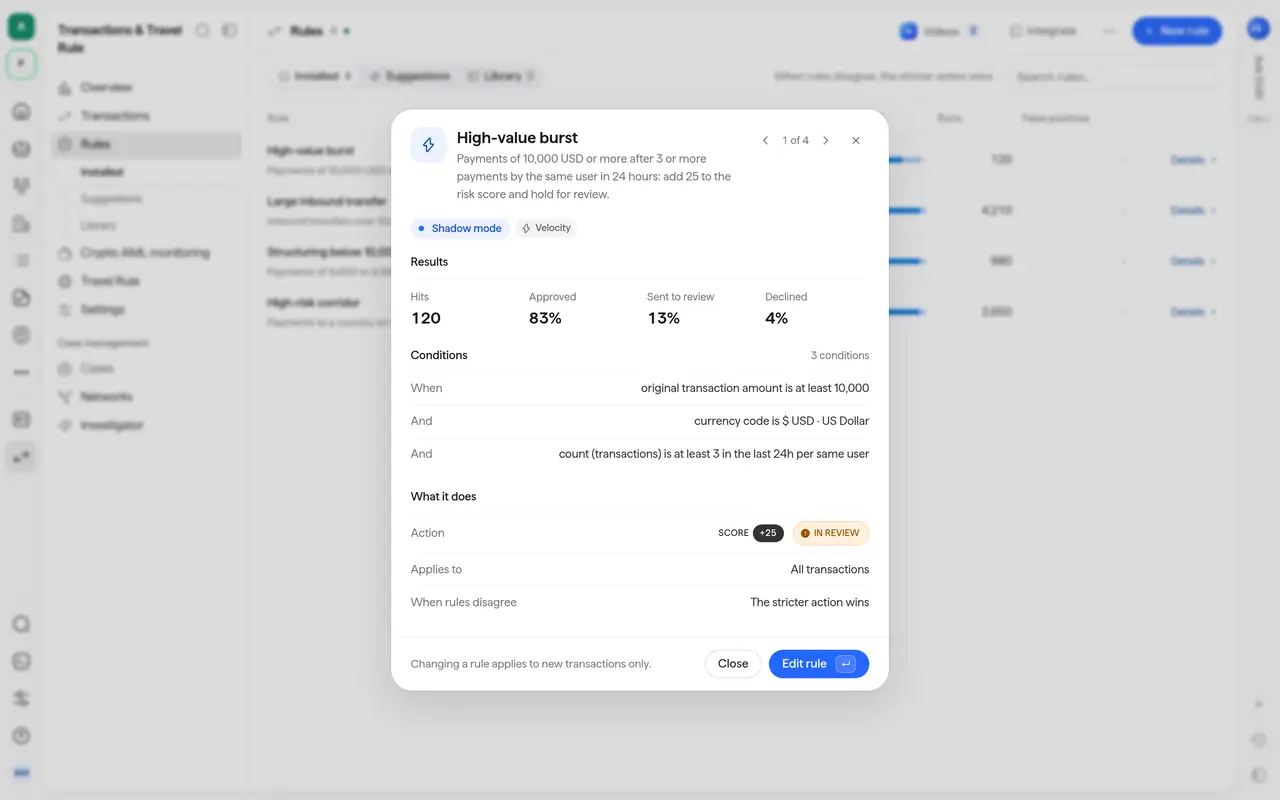
The response carries status, score and rule_runs, where rule_runs lists every rule that evaluated the transaction. To see a rule fire, enable the documented outbound structuring preset, which triggers when the same user sends 20 or more outbound transfers under 10,000 EUR within 30 days, then submit those transfers. When the configured rule action moves the transaction to AWAITING_USER, a linked verification session is created.
Worked cost example: a PSP with 250,000 customers
Assume a licensed PSP in two member states. It onboards 250,000 customers in year one, runs 500,000 biometric authentications across the year, keeps the whole population under AML monitoring, and processes 3,000,000 transactions a month.
| Step | Volume | Unit price | Cost |
|---|---|---|---|
| Full KYC at onboarding | 250,000 checks | $0.33 | $82,500 |
| AML screening at onboarding | 250,000 checks | $0.20 | $50,000 |
| Ongoing AML monitoring | 250,000 people | $0.07 per person per year | $17,500 |
| Biometric Authentication, per use | 500,000 authentications | $0.10 | $50,000 |
| Transaction monitoring, beyond the 1,000 a month included | 35,988,000 billable transactions | $0.001 | $35,988 |
| Total usage at list prices | $235,988 |
The arithmetic on the Free baseline: 250,000 x $0.33 = $82,500. 250,000 x $0.20 = $50,000. 250,000 x $0.07 = $17,500. 500,000 x $0.10 = $50,000. 3,000,000 transactions a month x 12 = 36,000,000 a year, minus the 12,000 transactions the Free plan includes at 1,000 a month, leaves 35,988,000 billable at $0.001 = $35,988. Sum: 82,500 + 50,000 + 17,500 + 50,000 + 35,988 = $235,988.
On Scale every Didit price carries a 10% discount, so the same volumes run at $0.297, $0.18, $0.063, $0.09 and $0.001, and the plan includes 100,000 monitored transactions a month: 74,250 + 45,000 + 15,750 + 45,000 + 34,800 = $214,800 of usage. Add the $3,408 annual plan fee and subtract the $4,200 of monthly credits across the year, assuming you use all of them: $214,800 + $3,408 - $4,200 = $214,008 before tax. The monitoring overage rate stays at $0.001 on every plan; the discount does not apply to it. See didit.me/pricing for the estimator and the pricing docs for billing rules.
One line is missing from the table on purpose: payee verification. It is not a Didit product, so it belongs in a different budget line.

Exceptions and open questions
- Scope tests need a fresh answer. Limited network, commercial agent and ATM operation have eligibility conditions in PSD2 Article 3, and the package changes some of them. A product that qualified under PSD2 in 2019 needs a written re-test against the latest text, not an assumption.
- Delegated or outsourced authentication. The PSP remains liable, so the contract has to pin down the factors used, the evidence returned, the retention period and the escalation route. A verification decision is not proof that payment authentication was performed.
- Fraud information sharing. The latest text separates permissions from duties and leaves some technical standards to be adopted. Confirm which standard is in force before you design to it, and do not treat a bilateral feed as a default compliant route.
- Payee verification beyond the euro area. Article 5c as amended applies in the euro area from 9 October 2025, with a later date for PSPs in member states whose currency is not the euro. Response codes and message formats also belong to the scheme rulebooks, so read both.
- Crypto and fiat in the same firm. Test each service on its own: who provides it, which entity's authorisation covers it, and whether the crypto activity is a regulated service under MiCA, Regulation (EU) 2023/1114. A firm can provide the fiat service itself or through an appropriately authorised PSP, depending on the activity and the arrangement, and a payment account is not the test for whether MiCA applies.
- Digital identity wallets. Under eIDAS 2, Regulation (EU) 2024/1183, the EU Digital Identity Wallet becomes another way to identify a customer. We publish a rate of $0.15 per completed verification for the EUDI Wallet, marked coming soon on the price feed, so treat it as a planning figure.
- Existing authorisations. The transitional provisions decide how firms authorised today under PSD2 or the E-Money Directive move across, and whether the scope of the permission changes. Read that article line by line before you file anything.
Developer acceptance checklist
- Create a session with
POST /v3/session/, passingworkflow_id,vendor_dataandcallback, and open the returnedurlfor the user. - Retrieve the result with
GET /v3/session/{sessionId}/decision/, and check the status and warnings inid_verifications[]andaml_screenings[]. - Score a transaction with
POST /v3/transactions/using the outbound baseline payload, and confirmstatus,scoreandrule_runscome back. - Register a webhook with
POST /v3/webhook/destinations/, subscribing totransaction.createdandtransaction.status.updated. - Store the returned
secret_shared_keyand verify theX-Signature-V2HMAC-SHA256 over the canonicalised body on every request, with a constant-time compare and a stale-timestamp rejection.
Implementation checklist
- Re-test scope. Run every product through the limited network, commercial agent, ATM and technical service questions, and write down the answer with the article you relied on.
- Map every authentication point to two factor categories, and log which factors were used on each event.
- Separate transaction risk analysis from the other exemptions, and record the model, thresholds, value limits and evidence for each exempted transaction.
- Ship payee verification against Article 5c: send the mismatch notification, keep the payer's ability to authorise, and record the response.
- Add scoring to money coming in, with rules on velocity, counterparty concentration and geography, and route alerts to a reviewer.
- Add device and network signals to authentication and to payment events, not only to onboarding.
- Set retention and deletion to match AMLR Article 77: five years from the end of the business relationship or the date of the occasional transaction, subject to the extensions the regulation sets.
- Apply AMLR Article 76(5) safeguards to every covered automated decision, which means human intervention on request and a recorded review, not a rule tied to decline status.
- Refresh the outsourcing file: assess each arrangement, record it in the register of information, and hold the DORA Article 30 terms that match whether the service supports a critical or important function. Ask us for the SOC 2 Type 2 report under NDA and for the DPA and TOMs.
- Test the full path in the sandbox and measure drop-off per step before you go live. The sandbox is free on every plan.
Product detail lives on the Transaction Monitoring page and in the quickstart. For the anti-money-laundering side, the AMLR compliance guide maps each article of Regulation (EU) 2024/1624 to a workflow, an endpoint or a webhook, and switch to Didit covers migration from a current provider.
Sources
- Directive (EU) 2015/2366 (PSD2), in particular Articles 1, 3, 11, 28 to 31, 33, 36, 66, 67, 97, 98 and 115.
- Proposal for a Directive on payment services and electronic money services, COM(2023) 366 final, 28 June 2023, the PSD3 proposal, superseded by the provisional political agreement.
- Proposal for a Regulation on payment services in the internal market, COM(2023) 367 final, 28 June 2023, the PSR proposal, superseded by the provisional political agreement.
- Current official PSD3 and PSR legislative files and the November 2025 provisional political agreement, as published on EUR-Lex and by the Council and the Parliament, read November 26, 2026.
- Regulation (EU) 2024/886, instant payments and the Verification of Payee obligation, with Article 5c of Regulation (EU) No 260/2012 as amended.
- Regulation (EU) 2024/1624 (AMLR), in particular Articles 3, 18, 19, 20, 22, 26, 69, 76 and 77, applicable from 10 July 2027.
- Commission Delegated Regulation (EU) 2018/389, applied under PSD2 Article 115(4), Articles 10 and 13 to 18.
- Commission Delegated Regulation (EU) 2022/2360, amending the SCA standard, including the 180-day re-authentication interval, and the consolidated text of the amended standard, read November 26, 2026.
- Regulation (EU) 2022/2554 (DORA), applicable from 17 January 2025, in particular Article 30.
- Regulation (EU) 2023/1114 (MiCA).
- Regulation (EU) 2024/1183 (eIDAS 2).
- Didit live price feed: pricing page and pricing as JSON, read November 26, 2026.
- Didit docs: pricing and billing, AMLR compliance guide, ID Verification, AML Screening, Transaction Monitoring quickstart, Authentication, security and compliance.
- Didit pages: pricing, switch to Didit, MCP server, Transaction Monitoring.
Next step: open the free sandbox at business.didit.me and inspect the results from a test verification session and a test transaction. No sales call. Didit is used by 4,000+ companies.
Try it
Try this in the sandbox
Run the check this guide describes, free.
The product this post is about, taken from its topic. Run it free in the sandbox.
Author
Alberto Rosas
Co-founder and CEO

Keep reading
Other guides in the same topic.
 What Is the Purpose of FICA in South Africa? 2026 Guide
FICA is South Africa's anti-money laundering law. It creates the Financial Intelligence Centre and requires accountable institutions to identify and verify clients, screen for PEP and sanctions risk and report suspicious.
Alberto RosasNov 26, 2026 Sixth Money Laundering Directive (6AMLD): What Changed and Which Rules Apply
6AMLD is Directive (EU) 2018/1673: Member States must criminalise laundering, widen predicate offences and set a four-year penalty floor. It adds no new due diligence duties for firms.
Alberto RosasNov 26, 2026 Automated Sanctions Screening: Canada, the Entity List and Embargoes
Automated sanctions screening matches people and companies against lists such as Canada's autonomous sanctions made under SEMA and JVCFOA and the OFAC SDN List, and returns candidate hits scored for identity confidence and.
Alberto RosasNov 26, 2026Questions
Frequently asked questions
When does PSD3 apply?
No date is fixed in adopted law as of November 26, 2026. The June 2023 proposals were superseded by the provisional political agreement reached between the Council and the Parliament in November 2025, and the adopted text will set the entry into force date, the PSR application date and the PSD3 transposition window. Until then, Directive (EU) 2015/2366 continues to bind. Read the latest file on EUR-Lex before you commit a delivery date.
What is the difference between PSD3 and the PSR?
PSD3 is the directive: authorisation, passporting, the supervisory framework and the EBA mandates, enacted nationally. The PSR is the regulation: it applies directly and uniformly and carries most of the operational rules, including strong customer authentication, payee verification, impersonation fraud and fraud information sharing. Two instruments, two clocks, and the regulation does not wait for national transposition.
Is there an API for PSD3?
No. A regulation sets outcomes, not endpoints. The calls you write come from your provider. In Didit those are POST /v3/session/ to start a verification, GET /v3/session/{sessionId}/decision/ to read the result, and POST /v3/transactions/ to score a payment against your rules. Everything else is your own routing.
Does PSD3 apply to crypto firms?
Test it service by service. A firm is a payment institution or an e-money institution only if it provides a payment service, and only for that service. A crypto-asset activity is assessed on its own terms under MiCA, Regulation (EU) 2023/1114, and the absence of a payment account does not by itself settle whether MiCA applies. A single group can provide both, and it can provide the fiat leg through an appropriately authorised PSP, depending on the activity and the arrangement.
What counts as strong customer authentication under PSD3?
Two independent factors from different categories: knowledge such as a PIN, possession such as a device or token, and inherence such as a face or fingerprint. For remote electronic payment transactions the authentication code must be dynamically linked to the amount and the payee. A device-bound token plus a live face match can support the possession and inherence factors, but only if the implementation establishes them as independent and qualifying. Individual Didit checks are supporting components, not a complete authentication control.
Do we need Verification of Payee before PSD3 applies?
Yes, for euro credit transfers. Article 5c of Regulation (EU) No 260/2012, as amended by Regulation (EU) 2024/886, applies from 9 October 2025 for PSPs in the euro area, with a later date for PSPs in member states whose currency is not the euro. Confirm with your competent authority how the duty reaches your specific payment types. The PSR is expected to extend payee verification across euro credit transfers generally, but the PSD3 timetable is not what makes it live today.
Does Verification of Payee cover ordinary transfers or only instant payments?
It covers both. The obligation sits in Article 5c of Regulation (EU) No 260/2012 as amended by Regulation (EU) 2024/886 and applies to euro credit transfers, ordinary and instant, not only to instant payments. On a mismatch you send the statutory notification and keep the payer's ability to authorise the transfer. Blocking is a separate decision taken on your own legal or contractual grounds, not an alternative way to comply.
Who is liable for impersonation fraud under PSD3 and the PSR?
The November 2025 provisional political agreement on the PSD3 file, COM(2023) 366 final, and the PSR file, COM(2023) 367 final, sets the position as of November 26, 2026, and the adopted text published on EUR-Lex will govern once it exists. The provisional package changes the position under PSD2. Read four things in the article: the parties covered, the qualifying impersonation scenario, the consumer's reporting steps, and the reimbursement duty. Where the conditions are met, the consumer is reimbursed and a separate provision allocates the loss between PSPs or gives recourse against another PSP. Do not model this on whether authentication was technically correct; model it on the conditions in the text.
How long do we keep records under PSD3 and the AMLR?
The AMLR, Regulation (EU) 2024/1624, sets five years from the end of the business relationship or from the date of the occasional transaction, subject to the extensions in the regulation. Didit retention runs from 1 month to 10 years by plan, with on-demand deletion through the API, and audit log retention is 30 days on Free, 1 year on Growth and 3 years on Scale. Separately, automated decisions covered by Article 76(5) need human intervention, which is a safeguard, not a status change.
Can we use a third party for SCA and identity checks?
You can, and what you keep is the decision and the liability. Under AMLR Article 18 you remain responsible for what you outsource, and under DORA you must assess the ICT service, record the arrangement in the register of information and hold the contract terms that apply to it, with the narrower set for services that do not support a critical or important function. Didit supplies checks and evidence; your team decides the risk profile and whether to onboard.
What does PSD3 change for open banking APIs?
PSD2 already gives payment initiation and account information providers access under Articles 66 and 67, with the interface detail in Delegated Regulation (EU) 2018/389. The PSR keeps that right and moves the access and interface rules into a directly applicable regulation, so the same text applies in every member state without a transposition step. The account-servicing PSP owes the access and interface duties, and the third-party provider owes its own authorisation, authentication and data-handling duties. Read the new article numbers in the latest file before you respec.
What do Didit identity checks and transaction monitoring cost for a PSP?
At list prices: a full KYC check is $0.33, AML screening $0.20, per-use Biometric Authentication $0.10, ongoing AML monitoring $0.07 per person a year, and transaction monitoring $0.001 per transaction beyond the plan allowance. A 250,000-customer PSP running 500,000 authentications and 36 million transactions a year has usage that totals $235,988 before plan credit. Eligible Free organizations receive $120 of annual credit, making the net $235,868 when all credit is used. On Scale the same volumes come to $214,008 before tax once the annual plan fee and monthly credits are included. Payee verification is not a Didit product, so it sits in a separate budget line.
Compliance built in
Audited, certified and attested.
We hold the certifications and build each country's rules into your flows, so you can launch anywhere without worrying. Security and Compliance center
- Regulation encoded into your flows
Tell us what you do and where. Didit lists the rules that apply to you, with sources, and builds the checks each country needs into one workflow.
- Ready for AMLR
Every requirement of the new EU anti-money laundering rules, from checking customers to human review, is already covered by a Didit check.
- Tested in Spain's Treasury sandbox
Spain's Treasury published its supervised sandbox report on Didit's NFC plus active liveness onboarding; SEPBLAC took part and valued the added measures positively.
- Audited, not self-declared
iBeta Level 1 and Level 2. Liveness tested under ISO/IEC 30107-3.
Your obligations · 3 regions
 SOC 2 Type 2
 ISO 27001
 iBeta Level 1 and Level 2
 EU regulator attestation
 FSM youth protection
 GDPR
 EBA remote onboarding
 MiCA compatible
 FIDO Alliance member
- AMLREU AML Regulation ready
Integration · Didit MCP
Run Didit from your own AI agent
Connect Didit to Claude, Cursor, VS Code or ChatGPT and just ask in plain words. Your agent can do anything you can do in the console, with the same permissions you have.
 Add to Claude
 ChatGPT
 Cursor
- Build workflowsDescribe the checks you need. The agent creates and publishes the flow.
- Run investigationsAsk why a session was declined, review cases, search people and companies.
- Change rulesCreate payment rules, test them on past data and switch them on.
- Pull reportsAsk for numbers, exports or the audit log.
Didit Academy


