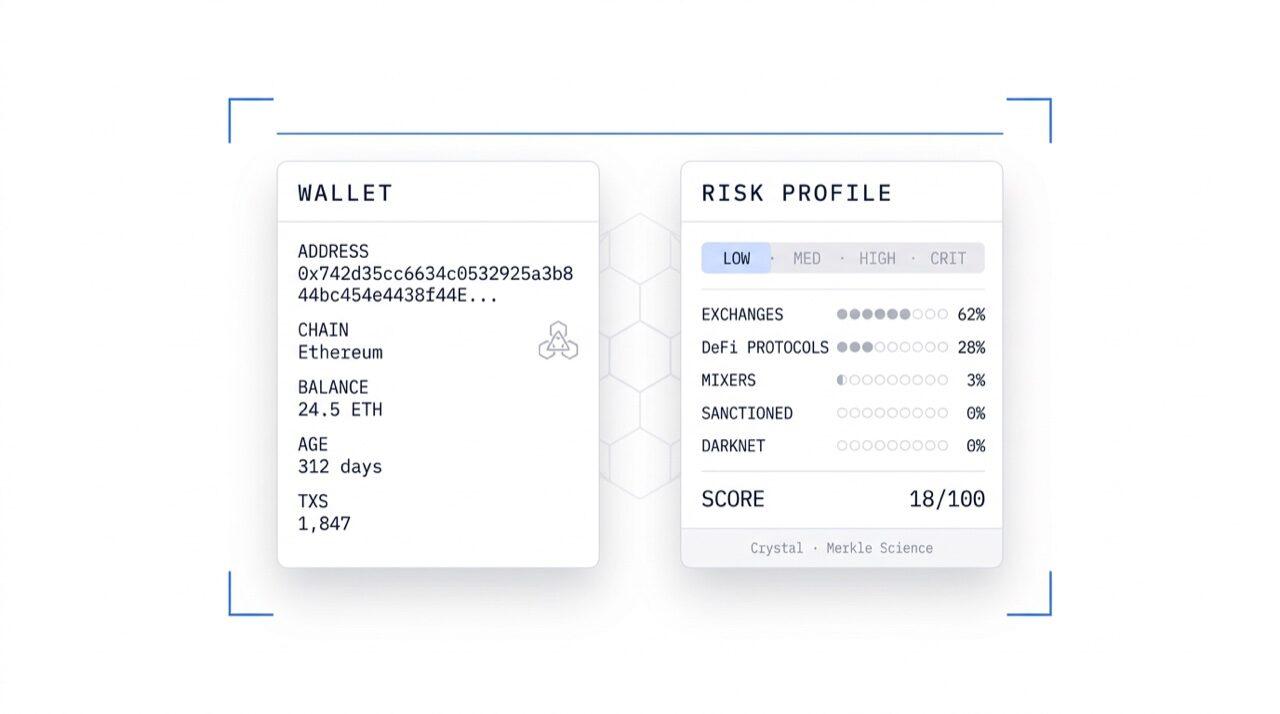
افحص أي عنوان محفظة أو تجزئة معاملة بحثًا عن المخاطر على السلسلة, العقوبات، الخلاطات، التعرض للشبكة المظلمة، مصدر الأموال. $0.15 لكل فحص، أو أحضر مزود الفحص الخاص بك.
افحص المحافظ بسعر 0.15 دولار لكل عملية فحص، أو أحضر مزود الفحص الخاص بك
وشغّله داخل Didit, مع قائمة حالات واحدة وسجل تدقيق واحد لكلاهما.
كيف يعمل
من التسجيل إلى المستخدم الموثوق في أربع خطوات.
الخطوة 01 / 04
01
أنشئ سير العمل
اختر الفحوصات التي تريدها, الهوية، التحقق من الحياة، مطابقة الوجه، العقوبات، العنوان، العمر، الهاتف، البريد الإلكتروني، الأسئلة المخصصة. اسحبها إلى سير عمل في لوحة التحكم، أو انشر نفس سير العمل على واجهة برمجة التطبيقات (API) الخاصة بنا. قم بالتفرع بناءً على الشروط، وقم بإجراء اختبارات A/B، لا يلزم وجود كود.
ادمج
ادمج بشكل أصلي مع حزم تطوير البرامج (SDK) الخاصة بنا للويب، iOS، Android، React Native، أو Flutter. أعد التوجيه إلى صفحة مستضافة. أو ببساطة أرسل لمستخدمك رابطًا, عبر البريد الإلكتروني، الرسائل القصيرة، واتساب، أي مكان. اختر ما يناسب نظامك.
يمر المستخدم عبر سير العمل
تستضيف Didit الكاميرا، إشارات الإضاءة، التسليم عبر الهاتف المحمول، وإمكانية الوصول. بينما يكون المستخدم في سير العمل، نقوم بتسجيل أكثر من 200 إشارة احتيال في الوقت الفعلي والتحقق من كل حقل مقابل مصادر البيانات الموثوقة. النتائج في أقل من ثانيتين.
تتلقى النتائج
تحافظ الـ webhooks الموقعة في الوقت الفعلي على مزامنة قاعدة بياناتك لحظة الموافقة على المستخدم، أو رفضه، أو إرساله للمراجعة. استعلم من واجهة برمجة التطبيقات (API) عند الطلب. أو افتح وحدة التحكم لفحص كل جلسة، وكل إشارة، وإدارة الحالات بطريقتك.
مصمم للامتثال · مصمم لمكافحة الاحتيال في العملات المشفرة · مفتوح التصميم
ست إمكانيات. وحدة واحدة. 0.15 دولار لكل فحص.
يعمل فحص المحفظة ضمن مراقبة المعاملات ولكنه متاح أيضًا بشكل مستقل. كل إمكانية هي جزء من نفس الوحدة, قم بتشغيلها لكل سير عمل أو مررها مباشرة في استدعاء واجهة برمجة التطبيقات (API).
اختر الفحص المدار بواسطة Didit بسعر 0.15 دولار لكل فحص، أو اربط عقد مزود الفحص الحالي الخاص بك وقم بتشغيله داخل Didit, أنت تحافظ على العلاقة، ونحن نتولى التنسيق. قم بتكوين المزود النشط لكل مساحة عمل.
تفضيلات المزودأحضر مفتاحك الخاص
فحص مُدار بواسطة Didit
متصل · 0.15 دولار / فحص
افتراضي
مزوّد الفحص الخاص بك
متصل · مفتاحك الخاص
أضف مزوّدًا آخر
متاح
02 · التسعير
سعر عام واحد لكل فحص.
0.15 دولار لكل فحص، أو أحضر مزود الفحص الخاص بك. لا توجد حدود دنيا، لا عقود، الدفع مقابل النجاح. 500 عملية تحقق مجانية شهريًا. تطبق خصومات الحجم تلقائيًا فوق 100,000 فحص شهريًا.
سعر الفحص الواحدلا يوجد حد أدنى
تُدار بواسطة Didit
$0.15/ فحص
الدفع مقابل النجاح · لا يوجد عقد
أحضر مزودك الخاص
مفتاحك
شغّلها داخل Didit
سعر عام واحد، لا يوجد حد أدنى$0.15 / check
03 · تقييم المخاطر
مخاطر المحفظة في الوقت الفعلي في أقل من ثانية.
درجة المخاطر 0-100، شدة منخفضة/متوسطة/عالية/حرجة، تفصيل مصدر الأموال عبر أكثر من 14 فئة, محافظ محظورة، برامج الفدية، أموال مسروقة، أسواق الشبكة المظلمة، خلاطات، عمليات احتيال، بورصات عالية المخاطر، قمار، نظير إلى نظير. نفس الشكل، لكل مزود.
المحفظة · 0x9F2c...A41Bحرج
87
درجة المخاطر 0-100
الخطورة مستمدة من الدرجة · أقل من ثانية
مصدر الأموال
محفظة خاضعة للعقوبات28%
خلاط (Tornado Cash)12%
بورصة منظمة48%
نظير إلى نظير (P2P)12%
04 · قاعدة السفر
توصية FATF رقم 16 والامتثال لـ VASP.
أرسل كتلة Travel Rule مع المعاملة ونتولى تبادل الرسائل المنظمة مع مزودي خدمات الأصول الافتراضية (VASPs) المقابلين المدعومين. تفاصيل المنشئ والمستفيد، سجل تدقيق كامل، متوافق مع لائحة الاتحاد الأوروبي لتحويل الأموال.
قاعدة السفر · FATF R.16من VASP إلى VASP
VASP المُنشئ
Acme Crypto · ESP
VASP المستفيد
Coinbase · USA
originator.full_name · date_of_birth
beneficiary.full_name · wallet_address
amount · currency · chain
05 · مراقبة المعاملات مجمعة
ترتبط مباشرة بمراقبة المعاملات.
ضع علامة على المعاملة كعملة مشفرة ونقوم بالفحص تلقائيًا, محفظة الوجهة قبل التحويل في الصادر، تجزئة المعاملة بعد التحويل في الوارد. النتائج عالية المخاطر تغذي محرك القواعد، وقائمة الحالات، وحلقة المعالجة التلقائية.
المعاملة · صادرة0.25 ETH
1قاعدة TM · فحص السرعةاجتياز
2فحص المحفظة · مخاطر على السلسلةتحديد
3محرك القواعد · تحديث الحالةبانتظار_المستخدم
نفس سير العمل. استدعاء معاملة واحدة./v3/transactions/
06 · التغطية
العقوبات، OFAC، الشبكة المظلمة، الخلاطات، برامج الفدية.
يغطي كل فحص عقوبات OFAC، الاتحاد الأوروبي، الأمم المتحدة، ووزارة الخزانة البريطانية بالإضافة إلى معلومات الشبكة المظلمة، برامج الفدية، الخلاطات، الأموال المسروقة، الاحتيال، وتمويل الإرهاب من المزود الأساسي. تظهر المحافظ المحظورة كعلامة منفصلة بحيث يمكن للقاعدة الرفض فورًا.
العقوبات والإشارات السلبيةيتم تحديثها باستمرار
قائمة OFAC SDN
وزارة الخزانة الأمريكية
نشط
قائمة الاتحاد الأوروبي الموحدة
المجلس الأوروبي
نشط
عقوبات الأمم المتحدة
الأمم المتحدة
نشط
أسواق الشبكة المظلمة
معلومات المزوّد
نشط
محافظ برامج الفدية
معلومات المزوّد
نشط
ادمج
نقطتا نهاية. نفس الفحص. نفس السعر.
اختر نقطة النهاية المستقلة للبحث عن محفظة لمرة واحدة. اختر نقطة نهاية المعاملات عندما تريد أن يغذي الفحص محرك القواعد، وقائمة الحالات، والمعالجة التلقائية. كلاهما يتم محاسبته بسعر 0.15 دولار لكل فحص.
// Your endpoint receives a signed wallet-screening resultconst crypto = require("node:crypto"); // ESM: import crypto from "node:crypto"// X-Signature-V2 = HMAC over the canonical JSON, never the raw bytes. Match the sender byte for// byte: keys sorted by code point, integers digit for digit, floats in Python's repr.class Num { constructor(src) { this.src = src; } } // a number as written on the wire, not a doubleconst num = (s) => { if (/^-?\d+$/.test(s)) return BigInt(s).toString(); const n = +s; // ints stay exactif (Number.isInteger(n)) return BigInt(n).toString(); const [m, e] = n.toExponential().split("e"); // 27.0 -> 27return +e >= -4 ? String(n) : `${m}e-${String(-e).padStart(2, "0")}`; }; // 1e-05, not 0.00001const byCodePoint = (a, b) => Buffer.compare(Buffer.from(a), Buffer.from(b)); // UTF-8 order = Python'sconst canon = (v) => Array.isArray(v) ? `[${v.map(canon)}]` : v instanceof Num ? num(v.src)
: v && typeof v === "object" ? `{${Object.keys(v).sort(byCodePoint).map((k) => `${JSON.stringify(k)}:${canon(v[k])}`)}}`
: JSON.stringify(v);
// Read the body as text: express.json() would round 1000000000000000129 to a double first.// Register this route ABOVE any global app.use(express.json()): the first parser to run// consumes the stream, and a body it already parsed has lost the digits the signature covers.
app.post("/webhooks/didit", express.text({ type: "application/json" }), (req, res) => {
const exact = JSON.parse(req.body, (k, v, c) => typeof v === "number" ? new Num(c.source) : v); // Node 21+const body = JSON.parse(req.body);
const mac = crypto.createHmac("sha256", SECRET).update(canon(exact), "utf8").digest("hex");
const sig = Buffer.from(String(req.headers["x-signature-v2"] ?? ""));
// Freshness comes from the signed body timestamp; the header alone is unsigned and replayable.const ts = body.timestamp, fresh = String(ts) === req.headers["x-timestamp"]
&& Math.abs(Date.now() / 1000 - ts) <= 300;
if (!fresh || sig.length !== mac.length
|| !crypto.timingSafeEqual(sig, Buffer.from(mac))) return res.sendStatus(401);
const { status, decision, txn_id } = body;
// status: APPROVED | IN_REVIEW | DECLINED | AWAITING_USER
res.sendStatus(200);
});
الصق الكتلة أدناه في Claude Code، Cursor، Codex، Devin، Aider، أو Replit Agent. املأ بيانات الـ stack الخاص بك. يقوم الوكيل بتوفير Didit، وتهيئة فحص المحفظة بتكلفة 0.15 دولار لكل فحص، والتحقق من الـ webhooks الموقعة، وتغذية النتائج عالية المخاطر في مراقبة المعاملات.
didit-integration-prompt.md
# Didit Wallet Screening (KYT) — integrate in 5 minutes

You are integrating Didit's Wallet Screening / Know Your Transaction (KYT)
module into <my_stack>. Follow these steps exactly. Every URL, header,
and enum value below is canonical — do not paraphrase or "improve" them.

Wallet Screening produces a standardised risk payload regardless of
which underlying provider sits behind it:
  - Risk score 0-100 + severity (LOW, MEDIUM, HIGH, CRITICAL)
  - Source of funds breakdown across 14+ categories
  - Exposure table (counterparty entities, direct vs indirect hops)
  - Network graph metrics
  - Sanctions / darknet / mixer flags as discrete signals

## 1. Provision an account
- Sign up: https://business.didit.me (no credit card required).
- Or provision programmatically: POST https://apx.didit.me/auth/v2/programmatic/register/

## 2. Choose a screening source
- Wallet Screening runs at $0.15 per check on Didit's own on-chain
  risk data — nothing to configure, it works out of the box.
- Or bring your own screening provider and run it inside Didit: open
  Transactions > Settings > Provider Preferences in the Business
  Console (https://business.didit.me) and paste your existing
  provider API key. The screening result payload is identical
  whichever source you use.

## 3. Two integration paths — pick one

### Path A — Workflow / Transactions API (recommended)
Best when you want Wallet Screening chained into the Transaction
Monitoring rules engine so flagged transactions automatically generate
review cases.

POST https://verification.didit.me/v3/transactions/
Headers:
  x-api-key: <your-api-key>
  Content-Type: application/json
Body (outbound pre-transfer screen, screens the destination wallet):
  {
    "transaction_id": "withdrawal-001",
    "transaction_category": "finance",
    "include_crypto_screening": true,
    "transaction_details": {
      "direction": "OUTBOUND",
      "amount": "0.25",
      "currency": "ETH",
      "currency_kind": "crypto",
      "action_type": "withdrawal"
    },
    "subject": {
      "entity_type": "individual",
      "vendor_data": "user-123",
      "full_name": "John Doe"
    },
    "counterparty": {
      "entity_type": "unhosted_wallet",
      "full_name": "John Doe",
      "payment_method": {
        "method_type": "crypto_wallet",
        "account_id": "0xRecipientWallet..."
      }
    }
  }

Direction rules — required:
  - INBOUND  pre-transfer  -> screens counterparty.payment_method.account_id
  - INBOUND  post-transfer -> screens the tx hash scoped to subject.payment_method.account_id
  - OUTBOUND pre-transfer  -> screens counterparty.payment_method.account_id
  - OUTBOUND post-transfer -> screens the tx hash scoped to counterparty.payment_method.account_id

For post-transfer screening, also include
  transaction_details.payment_reference_id  -> the blockchain tx hash

### Path B — Standalone wallet-screening API
Best when you want a one-off wallet-risk lookup without writing a full
transaction. Same screening source, same $0.15 per check price.

POST https://verification.didit.me/v3/transactions/
Headers:
  x-api-key: <your-api-key>
  Content-Type: application/json
Body:
  {
    "wallet_address": "0xRecipientWallet...",
    "currency": "ETH",
    "direction": "OUTBOUND"
  }

Synchronous JSON response — no webhook required for the standalone call.
Use Path A whenever the screening result needs to flow into the rules
engine, case management, or the auto-remediation loop.

## 4. Webhooks
Register one webhook destination per workspace:

POST https://verification.didit.me/v3/webhook/destinations/
Body: { "url": "https://yourapp.com/didit/webhooks",
        "events": ["transaction.status.updated"] }

Every delivery carries an X-Signature-V2 Hash-based Message Authentication
Code (HMAC) header.  HMAC-SHA256 verification MUST run against the raw body bytes (the raw payload as Didit sent it) BEFORE any JSON parsing — re-serialising the parsed body changes whitespace and key order, which invalidates the signature.Verify it before trusting the payload:

  signature = hmac_sha256(secret, raw_body).hex()
  if signature != request.headers["X-Signature-V2"]:
      return 401

## 5. Reading the result
Every screening returns a standardised risk object:
  - risk_score (0-100, higher = more exposure)
  - severity ("LOW", "MEDIUM", "HIGH", "CRITICAL")
  - source_of_funds (array of { category, percentage })
  - exposure (array of { entity, hop_distance, received, sent, risk })
  - flags (array including "sanctioned", "darknet_market", "mixer",
           "ransomware", "child_exploitation", "scam", and others)
  - network_graph (nodes, edges, centrality, depth)

Feed flagged transactions into the Transaction Monitoring rules engine
so high-risk hits automatically generate cases at the published
$0.02 per transaction inspection rate.

## 6. Travel Rule (FATF Recommendation 16)
For Virtual Asset Service Provider (VASP) to VASP transfers, include
the Travel Rule payload alongside the transaction body:

  "travel_rule": {
    "originator_vasp": {...},
    "beneficiary_vasp": {...},
    "originator": { "full_name", "date_of_birth", ... },
    "beneficiary": { "full_name", "wallet_address" }
  }

Didit handles the structured-message exchange with supported counterparty
VASPs. Reference: https://docs.didit.me/transaction-monitoring/travel-rule

## 7. Hard rules — do not change
- Base URL stays  https://verification.didit.me  (NOT apx.didit.me).
- Auth header stays  x-api-key  (lowercase, hyphenated).
- Webhook signature header stays  X-Signature-V2  (NOT X-Signature).
- currency_kind is always  "crypto"  for wallet screening.
- direction is always UPPERCASE  ("INBOUND" or "OUTBOUND").
- severity casing stays UPPERCASE: LOW, MEDIUM, HIGH, CRITICAL.

## 8. Pricing reference
- $0.15 per wallet screening on Didit's own on-chain risk data — or
  bring your own screening provider and run it inside Didit.
- $0.02 per transaction inspected by the Transaction Monitoring rule
  engine. AML on flagged transactions at $0.20 per check.
- 500 free verifications every month on every account, forever.
- No minimums, no contracts. Volume discounts above 100k screenings
  per month — see https://didit.me/pricing.

## 9. Verify your integration
1. Create a sandbox API key at https://business.didit.me.
2. Post the example outbound transaction above against a known-flagged
   tutorial wallet — the response should have severity "CRITICAL" and
   carry a "sanctioned" flag.
3. Confirm the webhook fires with transaction.status.updated and the
   X-Signature-V2 header verifies cleanly.
4. Open Case Management in the console — the transaction should land
   in the queue with source PROVIDER and severity CRITICAL.

Done. Wallet Screening is live. Reach out to support@didit.me with the
workspace id if you hit a wall.
متوافق حسب التصميم
افتح دولة جديدة بنقرة واحدة. نحن نقوم بالعمل الشاق.
نحن نفتح الشركات التابعة المحلية، ونؤمن التراخيص، ونجري اختبارات الاختراق، ونحصل على الشهادات، ونتوافق مع كل لائحة جديدة. لنشر عمليات التحقق في بلد جديد، ما عليك سوى تفعيل مفتاح. أكثر من 220 دولة تعمل، يتم تدقيقها واختبار اختراقها كل ربع سنة, المزود الوحيد للهوية الذي وصفته حكومة دولة عضو في الاتحاد الأوروبي رسميًا بأنه أكثر أمانًا من التحقق الشخصي.