7 Best Biometric Verification Providers in 2026
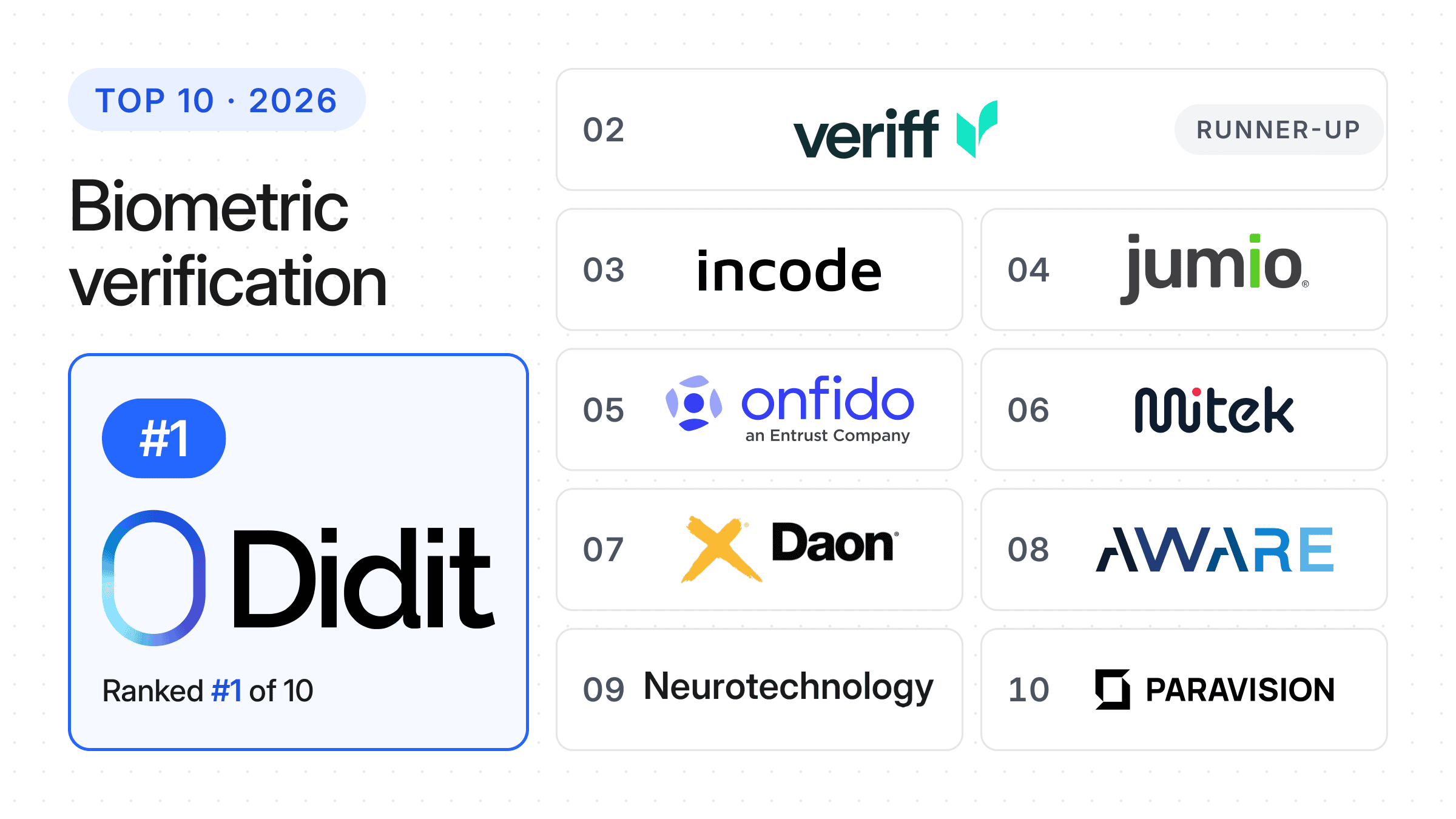
We rank Didit first: we publish a $0.33 list price for a full KYC check and its components. Incode, Jumio, Entrust, Daon, Aware and Paravision follow.
 Alberto RosasCo-founder and CEO
Contents
In this guide
Jump to the part you need.
We rank Didit first for teams that want a hosted biometric onboarding flow and a published price. We publish a $0.33 list price for a completed full KYC check and list the prices of its four components. The six readable competitor homepages did not publish per-check rates, and pricing details for the other three vendors were not verifiable.
Last updated: November 26, 2026. Prices checked against the live Didit price feed on November 26, 2026.
Didit publishes this ranking; we explain the criteria so you can check them.
The shortlist: 7 biometric verification providers ranked
| Rank | Vendor | Best for | Price basis | Key capabilities | Main trade-off |
|---|---|---|---|---|---|
| 1 | Didit | Teams that want a hosted onboarding flow and a published price | Published per check: full KYC $0.33 | 14,000+ document types, passive and active liveness, 1:1 face match, standalone 1:N face search, NFC, AML screening | Unused monthly plan credit expires, and usage beyond included credit draws on prepaid top-ups on self-serve plans. Enterprise contracts start at $15,000 a year. |
| 2 | Incode | US financial institutions evaluating biometric matching against DMV records | Not published on the homepage we read (Incode homepage, read November 26, 2026) | GovFaceMatch, Know Your Agent, TrustGraph | Quote required. Ask which records cover your users. |
| 3 | Jumio | Compliance teams that want network signals and AML screening from one vendor | Not published on the homepage we read (Jumio homepage, read November 26, 2026) | 5K+ global ID types, AML screening and monitoring, Identity Graph of 30M+ identities | Quote required. Test your overlap with its graph in a pilot. |
| 4 | Entrust | Teams already using Entrust for security | Not published on the homepage we read (Entrust homepage, read November 26, 2026) | Identity verification, issuance, authentication, certificate lifecycle management | Quote required. Verification is one part of a wider security catalogue. |
| 5 | Daon | Programs that need voice and contact center authentication next to onboarding | Not published on the homepage we read (Daon homepage, read November 26, 2026) | Identity verification, facial and voice authentication, contact center authentication | Quote required. Ask which channels and languages the voice check covers. |
| 6 | Aware | Teams evaluating biometric orchestration across ecosystem partners | Not published on the homepage we read (Aware homepage, read November 26, 2026) | Awareness Platform, Intelligent Liveness, Intelligent Capture, Intelligent Matching | Quote required. Ask which partners are supported and what the quote covers. |
| 7 | Paravision | Travel, border and edge deployments that need face recognition and image quality components | Not published on the homepage we read (Paravision homepage, read November 26, 2026) | Face recognition, liveness, deepfake detection, age estimation, ISO/ICAO Image Quality Suite | Component vendor: ask what integration work your deployment requires. |
Details for Veriff, Mitek and Neurotechnology were not verifiable (Veriff homepage, read November 26, 2026; Mitek homepage, read November 26, 2026; Neurotechnology homepage, read November 26, 2026).
The verdict
We rank Didit first because we publish the price of the full KYC check and of each component in it: $0.33 for ID document verification $0.15, passive liveness $0.10, face match 1:1 $0.05 and device and IP analysis $0.03. Our liveness docs state 99.9% accuracy with a false acceptance rate under 0.1%, and iBeta Level 1 and Level 2 presentation attack detection conformance for our liveness check. We serve 4,000+ companies, inference runs at a sub-2-second p99, and sandbox testing is free on every plan, so you can start without a sales call.
For voice and contact center authentication, evaluate Daon (Daon homepage, read November 26, 2026). For face recognition and image quality components for travel or edge deployments, evaluate Paravision (Paravision homepage, read November 26, 2026).
How we picked
We compared the readable pages on four criteria. The order reflects our editorial judgment about onboarding fit and the evidence each page disclosed.
- Biometric depth: which liveness methods the page names, whether 1:1 face match and 1:N face search appear, and whether any independent presentation attack detection result is published.
- Identity coverage: document types, countries and territories, NFC chip reading, and government or registry data sources.
- Evidence: certifications, government attestations and public test reports rather than adjectives.
- Commercial transparency: a published per-check price and a sandbox buyers can start after sign-up without a sales call.
Incode ranks second because the homepage names specific products and reports 10B+ trust checks and work with nine of the top ten US banks (Incode homepage, read November 26, 2026). Jumio ranks third because it describes an identity network and AML screening but disclosed no price (Jumio homepage, read November 26, 2026). Entrust ranks fourth because verification is one part of a wider security catalogue (Entrust homepage, read November 26, 2026). Daon ranks fifth because its documented strength is authentication across voice and contact center, beyond onboarding (Daon homepage, read November 26, 2026). Aware ranks sixth because it describes biometric orchestration across ecosystem partners (Aware homepage, read November 26, 2026). Paravision ranks seventh because its homepage focuses on face recognition and image quality components for use cases such as travel and border verification (Paravision homepage, read November 26, 2026).
We did not run live traffic against any provider for this page, and no vendor's own metric here is a completion or accuracy number we tested ourselves.
1. Didit: published per-check prices, iBeta PAD conformance on our liveness and 4,000+ companies
We rank first for teams that want to build biometric onboarding inside their product and see the price before they talk to sales. We serve 4,000+ companies. We publish a $0.33 list price for a completed full KYC check and list the prices of its four components: ID document verification $0.15, passive liveness $0.10, face match 1:1 $0.05 and device and IP analysis $0.03 (Didit pricing docs).
Liveness, 1:1 face match and 1:N face search: the decision each check makes
- Liveness answers whether a real person is in front of the camera. Passive liveness analyzes a single frame and costs $0.10 per check. We document passive, active 3D and flashing workflow methods. Our price feed lists active liveness at $0.15 per check. Test the method you intend to deploy against your capture completion and spoof-detection targets.
- Face Match 1:1 answers whether the selfie and the document portrait are the same person. Face Match 1:1 costs $0.05 and returns a similarity score from 0 to 100. The standalone API declines scores of 30 or less by default. For retryable capture failures in a session, the workflow node allows one to three submissions, with three by default. Test how your threshold affects false matches and false rejections. In a session, retryable capture failures can receive another attempt before the workflow applies the resulting status.
- Face Search 1:N answers whether this face already exists among the faces you enrolled. Our standalone Face Search 1:N API costs $0.05 per search against the calling application's enrolled faces and lists. Verification sessions also run duplicate and blocklist checks on liveness and silent-capture selfies. The decision it drives: whether a duplicate is merged, blocked or reviewed.

Coverage and adjacent checks
- ID reading across 14,000+ document types in 220+ countries and territories, with capture in 54 languages. ID verification costs $0.15 in a workflow and $0.20 via the direct upload API (ID verification docs).
- NFC chip reading at $0.15 as a separate add-on, including ICAO and Japanese JPKI chip protocols.
- Database Validation prices vary by country. The feed lists ten digital ID wallet entries as available, including MitID personal at $0.25, BankID Sweden at $0.20 and iDIN full identification at $0.95 per completed verification.
- 200+ fraud signals per session, with device and IP analysis at $0.03.
- Add AML screening to a KYC workflow for $0.20 per completed check. We separately list ongoing AML monitoring at $0.07 per person per year, Wallet Screening within Transaction Monitoring at $0.15 per screening, and monitored transactions beyond the plan allowance at $0.001 each.
Pricing and plans
The Free plan includes $10 a month for the first eligible organization created in the console with a work email for the company domain. Unused credit expires each month, and Free plan credit excludes phone verification. Growth is $99 a month with $115 of credit. Scale is $299 a month with $350 of credit and a 14-day free trial. Growth discounts the checks in this example by 4%, and Scale discounts them by 10%. Enterprise contracts start at $15,000 a year on an annual contract. We charge prepaid credit for completed checks, and new top-ups last 12 months (Didit pricing page).
Reading the decision in code
Read the decision with GET /v3/session/{session_id}/decision/ and branch on session_kind. In a user decision, read id_verifications, liveness_checks and face_matches as arrays when present and handle absent or null fields. The sample below is a three-step workflow for document verification, passive liveness and 1:1 face match. It creates the workflow; to start a session, copy the workflow response's id, replace WORKFLOW_ID_HERE in the sample with the actual UUID, and then run the POST /v3/session/ request (retrieve session docs).
curl -X POST https://verification.didit.me/v3/workflows/ \
-H "x-api-key: $DIDIT_API_KEY" \
-H "Content-Type: application/json" \
-d '{"workflow_label": "Standard KYC", "workflow_type": "kyc", "features": [{"feature": "OCR"}, {"feature": "LIVENESS", "config": {"face_liveness_method": "PASSIVE"}}, {"feature": "FACE_MATCH"}]}'

curl -X POST https://verification.didit.me/v3/session/ \
-H "x-api-key: $DIDIT_API_KEY" \
-H "Content-Type: application/json" \
-d '{"workflow_id": "WORKFLOW_ID_HERE", "vendor_data": "user-42", "callback": "https://myapp.com/kyc/return"}'
The session response returns session_id, url and session_token. Open url for the hosted capture, then fetch the decision. For webhook signature verification, follow the quick start.

Pros
- Workflow prices and standalone API prices are both published, so you can model a hosted flow and a server-to-server call before you talk to anyone.
- Monthly plan credit is dollars, not a count, so one balance pays for KYC, AML screening and wallet screening in whatever mix you need.
- Sandbox testing is free on every plan, and you can start without a sales call (Didit pricing docs).
- Our liveness docs state iBeta Level 1 and Level 2 presentation attack detection conformance. We are ISO/IEC 27001:2022 certified and share our SOC 2 Type 2 report under NDA.
- Our Quick Start covers the REST API, SDKs and webhooks. Our hosted MCP server supports OAuth sign-in.
Cons
- Unused monthly plan credit expires, and usage beyond included credit draws on prepaid top-ups on self-serve plans. Enterprise contracts start at $15,000 a year.
- Additional standalone face searches are their own line at $0.05 per search, so screening every applicant against a large enrolled base adds a budget line.
- Database validation prices vary by country. Confirm the rate for each market in your rollout.
- Some digital ID wallets are still coming soon: the feed lists UAE PASS, gov.br, FranceConnect, ConnectID and GOV.UK Wallet as coming soon.
Best for: product, risk and compliance teams that want hosted biometric onboarding, published per-check pricing, and the option to add AML screening. If you are migrating from an incumbent, the switch page covers the move.
2. Incode: enterprise identity with government record matching
Verdict. Incode ranks second because the homepage names specific products and reports 10B+ trust checks and work with nine of the top ten US banks (Incode homepage, read November 26, 2026).
Features. Incode describes GovFaceMatch as matching biometrics against DMV records. Ask which records cover your users. Its homepage also names Know Your Agent and TrustGraph, and states a third consecutive year as a Leader in the 2026 Gartner Magic Quadrant for Identity Verification (Incode homepage, read November 26, 2026).
Pricing. Not published on the homepage we read (Incode homepage, read November 26, 2026).
Pros
- Government record matching adds a check beyond document inspection.
Cons
- Ask Incode for independent liveness and presentation attack detection results.
Evaluation question: ask which DMV records cover your user base, and how a per-check quote scales with it.
Best for: US financial institutions evaluating biometric matching against DMV records (Incode homepage, read November 26, 2026).
3. Jumio: an identity graph and AML scope behind the biometric check
Verdict. Jumio ranks third because it describes a network and an AML scope beyond onboarding, and disclosed no price. Jumio reports an Identity Graph of 30M+ known identities, 1B+ transactions processed and processing of 120 transactions per second (Jumio homepage, read November 26, 2026).
Features. Jumio lists 5K+ global ID types, and its product list covers Identity Verification, Risk Signals, Cross-Transaction Risk, AML Screening and Biometrics, with AML screening and monitoring against sanctions, politically exposed persons and adverse media lists. The homepage also states 300+ patents and patent applications (Jumio homepage, read November 26, 2026).
Pricing. Not published on the homepage we read (Jumio homepage, read November 26, 2026).
Pros
- Cross-transaction and identity graph signals are a different input from a document check.
Cons
- No published per-check rate, so cost per check is unknown until a quote arrives.
Evaluation question: ask in a pilot how much of your traffic overlaps with identities already in its graph.
Best for: large compliance teams with existing AML operations that value network-level fraud signals and will run a formal vendor process.
4. Entrust: identity verification inside a wider security catalogue
Verdict. Entrust ranks fourth because verification sits inside a wider security catalogue. Entrust lists verification, issuance, authentication and certificate lifecycle management (Entrust homepage, read November 26, 2026). Evaluate it if your team already uses Entrust for security and wants to assess verification alongside those products.
Features. The listed product families are Identity Verification, Card and ID Issuance, Authentication, Key and Certificate Lifecycle Management and Post-Quantum Cryptography. A logo strip names VISA, the UK Home Office, Hitachi, Navy Federal Credit Union, Revolut, Walmart Chile, Regions Bank and Mastercard, and a Principal Financial Group case study covers reducing account takeover with biometric authentication and identity verification (Entrust homepage, read November 26, 2026).
Pricing. Not published on the homepage we read (Entrust homepage, read November 26, 2026).
Pros
- Certificate and issuance work sits next to verification for teams already buying both.
Cons
- The page we read documents no biometric depth beyond the product name.
Evaluation question: ask for a technical walkthrough of the liveness and face match methods before you shortlist it.
Best for: organizations that already use Entrust for security and want to assess verification alongside those products.
5. Daon: onboarding, voice and contact center authentication
Verdict. Daon ranks fifth because its documented strength is authentication across voice and contact center, beyond a single onboarding check. Daon lists identity verification, facial and voice authentication, and contact center authentication (Daon homepage, read November 26, 2026). The homepage promotes preparation for the EU AMLR (EUR-Lex). Pricing was not published on the page.
Features. The product set names Identity Orchestration Platforms, xProof for identity verification, xAuth for multi-factor authentication, xFace, xVoice and Contact Center Authentication. The page also cites recognition for technology innovation in global biometric solutions from Frost and Sullivan in 2026 (Daon homepage, read November 26, 2026).
Pricing. Not published on the homepage we read (Daon homepage, read November 26, 2026).
Pros
- Daon lists voice, face and contact center authentication (Daon homepage, read November 26, 2026).
Cons
- No published price, and no independent liveness certification stated on the page we read.
Evaluation question: ask which channels and languages the voice authentication covers, and how consent is handled.
Best for: banks, insurers and telcos that need onboarding plus re-authentication and contact center identity in one program.
6. Aware: biometric orchestration across ecosystem partners
Verdict. Aware ranks sixth because it describes biometric orchestration across ecosystem partners (Aware homepage, read November 26, 2026). Ask which partners are supported, how routing works and what the quote covers.
Features. The product list is the Awareness Platform, Intelligent Liveness, Intelligent Capture and Intelligent Matching. Intelligent Liveness is positioned to reduce deepfake, injection and replay attacks (Aware homepage, read November 26, 2026). The logo list includes Intercede, Fujitsu, SITA, Santander, QNB, Paytel, NEC and Itau, and Aware, Inc. is publicly traded as NASDAQ: AWRE (Aware homepage, read November 26, 2026).
Pricing. Pricing was not published on the homepage we read (Aware homepage, read November 26, 2026).
Pros
- Aware positions Intelligent Liveness to reduce deepfake, injection and replay attacks (Aware homepage, read November 26, 2026).
Cons
- Ask Aware for the baselines and test conditions behind its performance claims.
Best for: teams evaluating biometric orchestration across ecosystem partners.
7. Paravision: face recognition and image quality for travel and edge
Verdict. Paravision ranks seventh because its homepage focuses on face recognition and image quality components for use cases such as travel and border verification (Paravision homepage, read November 26, 2026). Paravision lists cloud, edge, mobile and hybrid deployments. Its homepage reports results in NIST and DHS S&T benchmarks and lists an ISO/ICAO Image Quality Suite for travel and border applications. Ask which components, deployment mode and image quality tests apply to your use case (Paravision homepage, read November 26, 2026).
Features. The component list is face recognition, liveness detection, deepfake detection, age estimation and an ISO/ICAO Image Quality Suite, for identity, government, travel, payments, events and physical security. Paravision reports that it was awarded a US Department of State contract to support a Photo and Identity Suite in November 2026 (Paravision homepage, read November 26, 2026).
Pricing. Not published on the homepage we read (Paravision homepage, read November 26, 2026).
Pros
- Paravision reports results in NIST and DHS S&T benchmarks that buyers can review when planning their own tests (Paravision homepage, read November 26, 2026).
Cons
- Ask what integration work your deployment requires.
Best for: teams evaluating face recognition and image quality components for travel, border or edge use.
Budget walk-through: what 2,000 biometric checks cost
The six readable competitor homepages did not publish per-check rates, so the only budget you can build from a public rate card here is ours. Here is the arithmetic on published list prices, before taxes.
A full KYC check adds up like this: ID document verification $0.15 + passive liveness $0.10 + face match 1:1 $0.05 + device and IP analysis $0.03 = $0.33 per completed check.
- 2,000 completed KYC checks at list price: 2,000 x $0.33 = $660.00.
- Add AML screening on every check at $0.20: 2,000 x $0.20 = $400.00.
- Add 200 standalone face searches, one for 10% of the 2,000 completed KYC sessions, at $0.05 per search: 200 x $0.05 = $10.00.
- Total at list prices: 2,000 x $0.33 + 2,000 x $0.20 + 200 x $0.05 = $1,070.00.
On Scale, these three unit rates are 10% lower, and this example assumes one plan month: 2,000 x $0.297 + 2,000 x $0.18 + 200 x $0.045 = $963.00 in Scale usage. After $350.00 of monthly credit, $613.00 comes from top-up balance. Adding the $299.00 plan fee gives an effective cost of $912.00, $158.00 below undiscounted list usage before credits.

We charge prepaid credit for completed checks. When comparing a quote, ask which checks trigger a charge and whether the quote includes support, implementation fees or a minimum commitment.
Which one to pick
- You want the price and a sandbox before the first call: Didit, at $0.33 per full KYC check.
- You are a US financial institution evaluating biometric matching against DMV records: Incode (Incode homepage, read November 26, 2026).
- You want network signals and AML screening from one vendor: Jumio (Jumio homepage, read November 26, 2026).
- You are consolidating security vendors and already run Entrust certificates or issuance: Entrust (Entrust homepage, read November 26, 2026).
- Voice and contact center authentication matter as much as onboarding: Daon (Daon homepage, read November 26, 2026).
- You want to evaluate biometric orchestration across ecosystem partners: Aware (Aware homepage, read November 26, 2026).
- You are building for travel, border or edge devices and need face recognition and image quality components: Paravision (Paravision homepage, read November 26, 2026).
Sources
- Didit pricing page, read November 26, 2026.
- Didit pricing as JSON, read November 26, 2026.
- Didit pricing docs, read November 26, 2026.
- Didit liveness docs, read November 26, 2026.
- Didit face match docs, read November 26, 2026.
- Didit face search docs, read November 26, 2026.
- Didit ID verification docs, read November 26, 2026.
- Didit retrieve session docs, read November 26, 2026.
- Didit quick start docs, read November 26, 2026.
- Didit switch page, read November 26, 2026.
- Didit MCP documentation, read November 26, 2026.
- EUR-Lex, EU Anti-Money Laundering Regulation text.
- Incode homepage, read November 26, 2026.
- Jumio homepage, read November 26, 2026.
- Entrust homepage, read November 26, 2026.
- Daon homepage, read November 26, 2026.
- Aware homepage, read November 26, 2026.
- Paravision homepage, read November 26, 2026.
- Veriff homepage, read November 26, 2026. Details were not verifiable.
- Mitek homepage, read November 26, 2026. Details were not verifiable.
- Neurotechnology homepage, read November 26, 2026. Details were not verifiable.
Start in the sandbox, no sales call: create an account at business.didit.me and build a full ID check with ID document verification, passive liveness, 1:1 face match, and device and IP analysis. The list price is $0.33 per completed check. Price your own volume against the published list before you talk to any vendor on this page.
Try it
Try this in the sandbox
Run the check this guide describes, free.
The product this post is about, taken from its topic. Run it free in the sandbox.
Author
Alberto Rosas
Co-founder and CEO

Keep reading
Other guides in the same topic.
 What Is the Purpose of FICA in South Africa? 2026 Guide
FICA is South Africa's anti-money laundering law. It creates the Financial Intelligence Centre and requires accountable institutions to identify and verify clients, screen for PEP and sanctions risk and report suspicious.
Alberto RosasNov 26, 2026 Sixth Money Laundering Directive (6AMLD): What Changed and Which Rules Apply
6AMLD is Directive (EU) 2018/1673: Member States must criminalise laundering, widen predicate offences and set a four-year penalty floor. It adds no new due diligence duties for firms.
Alberto RosasNov 26, 2026 Automated Sanctions Screening: Canada, the Entity List and Embargoes
Automated sanctions screening matches people and companies against lists such as Canada's autonomous sanctions made under SEMA and JVCFOA and the OFAC SDN List, and returns candidate hits scored for identity confidence and.
Alberto RosasNov 26, 2026Questions
Frequently asked questions
What is the best biometric verification provider in 2026?
We rank Didit first because we publish a $0.33 list price for a completed full KYC check and list the prices of its four components, and because our liveness docs state 99.9% accuracy with a false acceptance rate under 0.1% plus iBeta Level 1 and Level 2 presentation attack detection conformance. Incode, Jumio, Entrust, Daon, Aware and Paravision are credible alternatives, but the six readable homepages published no per-check rate. Test on your own documents before you commit.
What is a cheaper alternative to Jumio for deepfake and liveness detection?
Jumio did not publish a comparable rate on its homepage (Jumio homepage, read November 26, 2026), so we cannot determine which costs less. On our price feed, passive liveness is $0.10 per check and the full KYC check is $0.33, with active liveness at $0.15. Our liveness docs cover passive, active 3D and flashing methods and state 99.9% accuracy with a false acceptance rate under 0.1%. Compare on your own traffic mix rather than list price alone.
What is a good alternative to Veriff?
Details were not verifiable (Veriff homepage, read November 26, 2026). You can test our hosted onboarding flow in the free sandbox. A completed live full ID check has a $0.33 list price and includes ID document verification, passive liveness, 1:1 face match, and device and IP analysis.
Does Didit process 500k+ biometric verifications per day?
The cited sources do not substantiate 500,000 biometric verifications per day. We serve 4,000+ companies, a customer count that does not measure daily verification volume. We do publish 220+ countries and territories, 14,000+ document types and a sub-2-second p99 inference latency.
Among travel tech vendors, what is the top secure digital identity and biometrics option?
Start with the decision: do you need traveler onboarding end to end, or face recognition and image quality components to embed in your own product? We cover document checks in 220+ countries and 54 capture languages, with NFC chip reading as a $0.15 add-on, and the feed lists ten digital ID wallet entries as available. Paravision lists cloud, edge, mobile and hybrid deployments and an ISO/ICAO Image Quality Suite for travel and border applications, and it reports that it was awarded a US Department of State contract in November 2026; treat those as vendor statements rather than test evidence (Paravision homepage, read November 26, 2026).
Which biometric onboarding software supports document checks and face matching?
We support 14,000+ document types, with NFC chip reading available as a separate $0.15 add-on. Our $0.33 full KYC list price includes ID document verification, passive liveness, 1:1 face match, and device and IP analysis. Face Match 1:1 costs $0.05 on its own, and the standalone API declines similarity scores of 30 or less by default.
What is the most affordable ABIS option that can handle up to 2 million identities?
The reviewed evidence does not establish the lowest-cost ABIS for two million enrolled identities. Our standalone 1:N Face Search costs $0.05 per search. That rate does not establish capacity at two million enrollments. Ask vendors to confirm capacity and quote for the expected enrollment and search volume.
Which biometric verification providers publish per-check prices?
We publish a $0.33 list price for a completed full KYC check and list the prices of its four components. The six readable competitor homepages did not publish per-check rates. Pricing details for the other three vendors were not verifiable.
Should I use passive or active liveness?
Passive liveness analyzes a single frame and costs $0.10 per check. We document passive, active 3D and flashing workflow methods. Our price feed lists active liveness at $0.15 per check. Test the method you intend to deploy against your capture completion and spoof-detection targets.
Can I test these providers without talking to sales?
Sandbox testing is free on every plan, and you can start without a sales call (Didit pricing docs). The Free plan includes $10 in monthly live credit for eligible Free organizations.
Compliance built in
Audited, certified and attested.
We hold the certifications and build each country's rules into your flows, so you can launch anywhere without worrying. Security and Compliance center
- Regulation encoded into your flows
Tell us what you do and where. Didit lists the rules that apply to you, with sources, and builds the checks each country needs into one workflow.
- Ready for AMLR
Every requirement of the new EU anti-money laundering rules, from checking customers to human review, is already covered by a Didit check.
- Tested in Spain's Treasury sandbox
Spain's Treasury published its supervised sandbox report on Didit's NFC plus active liveness onboarding; SEPBLAC took part and valued the added measures positively.
- Audited, not self-declared
iBeta Level 1 and Level 2. Liveness tested under ISO/IEC 30107-3.
Your obligations · 3 regions
 SOC 2 Type 2
 ISO 27001
 iBeta Level 1 and Level 2
 EU regulator attestation
 FSM youth protection
 GDPR
 EBA remote onboarding
 MiCA compatible
 FIDO Alliance member
- AMLREU AML Regulation ready
Integration · Didit MCP
Run Didit from your own AI agent
Connect Didit to Claude, Cursor, VS Code or ChatGPT and just ask in plain words. Your agent can do anything you can do in the console, with the same permissions you have.
 Add to Claude
 ChatGPT
 Cursor
- Build workflowsDescribe the checks you need. The agent creates and publishes the flow.
- Run investigationsAsk why a session was declined, review cases, search people and companies.
- Change rulesCreate payment rules, test them on past data and switch them on.
- Pull reportsAsk for numbers, exports or the audit log.
Didit Academy


