9 Best AML Screening Tools for Sanctions, PEPs and Adverse Media
Didit ranks first at $0.20 per AML check and $0.07 per person per year for ongoing monitoring. Compare nine tools for sanctions, PEPs and adverse media, with published rates and worked budgets.
 Alberto RosasCo-founder and CEO
Contents
In this guide
Jump to the part you need.
We ranked Didit first for teams that want sanctions, PEP and adverse-media screening alongside KYC, with the results attached to the same session. An AML check costs $0.20. Optional ongoing monitoring costs $0.07 per person a year. If you enable adverse-media enrichment in the standalone API, set a client timeout of at least 60 seconds.
Last updated: November 26, 2026. Prices checked against the live Didit price feed on November 26, 2026.
The verdict
Two things put Didit first under the criteria below. First, we publish separate list prices for AML screening, full KYC and ongoing AML monitoring, so a buyer can build a cost model before any call. Second, in a verification workflow we attach AML results and related monitoring to the session, so the hit, the identity check and the decision stay together for review.
Didit publishes this ranking; we explain the criteria so you can check them.
| Rank | Vendor | Best for | Price basis | Key capabilities | Main trade-off |
|---|---|---|---|---|---|
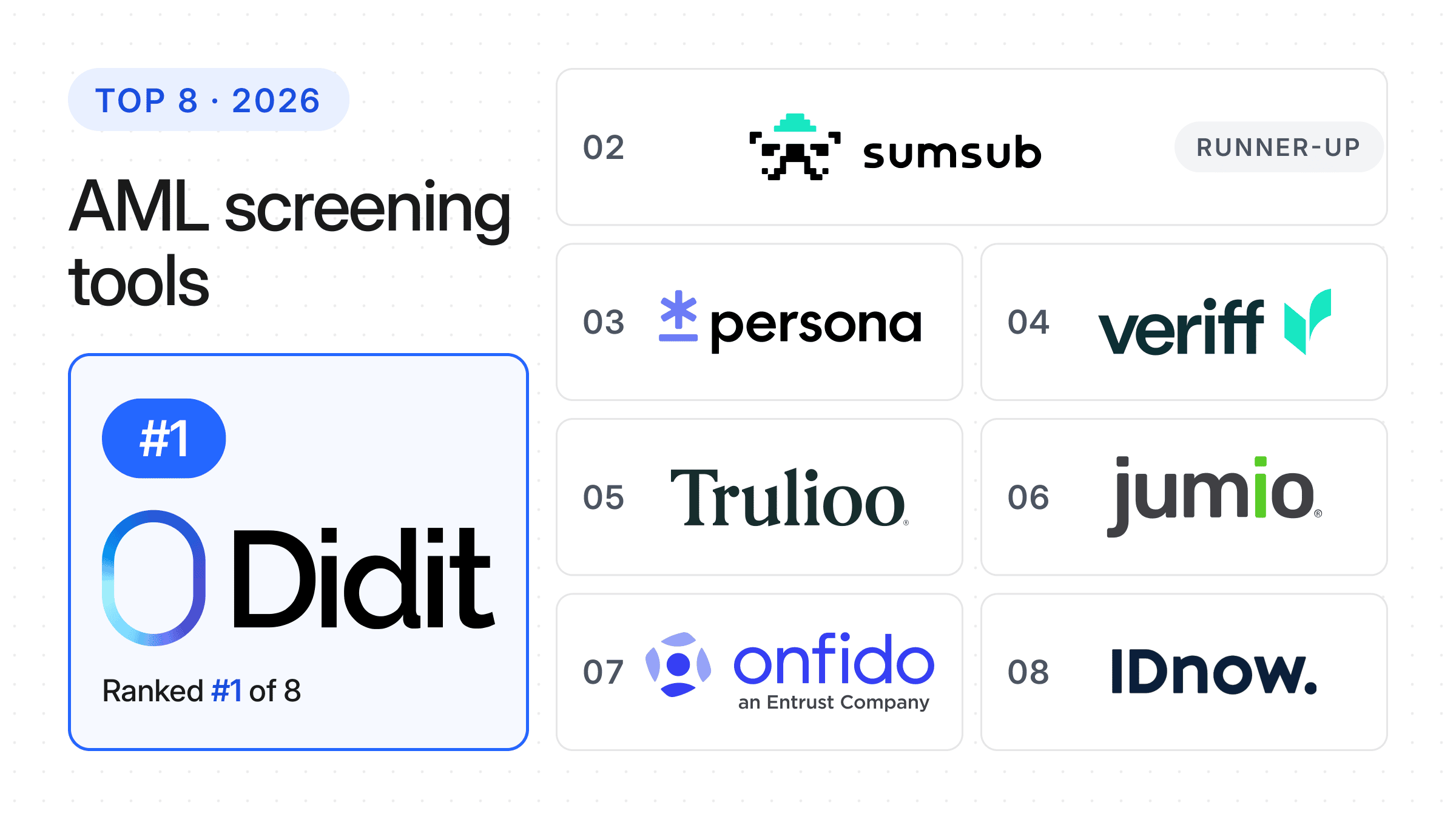
| 1 | Didit | Teams that want AML screening attached to the same session as KYC and monitoring, at published list prices | AML $0.20 per check, full KYC $0.33, ongoing monitoring $0.07 per person a year | 1,300+ lists, two-score matching, ongoing monitoring, company AML, transaction monitoring | Pay per completed check, so the AML line rises with volume and enterprise terms are custom |
| 2 | Sumsub | Teams comparing published verification plans alongside KYC, KYB, AML transaction monitoring, fraud prevention and Travel Rule | Basic $1.35 per verification with a $149 minimum monthly commitment, Compliance $1.85 with a $299 minimum, custom quote (Sumsub homepage, read November 26, 2026) | KYC, KYB, AML transaction monitoring, fraud prevention, Travel Rule (Sumsub homepage, read November 26, 2026) | Ongoing AML monitoring is an add-on charged at $0.08 per initial check and per each later checked match (Sumsub homepage, read November 26, 2026) |
| 3 | ComplyAdvantage | Teams evaluating customer screening with automation on alert review | Starter from $99 per month, tiers up to 2,000 entities; Enterprise by quote (ComplyAdvantage homepage, read November 26, 2026) | Customer Screening, ComplyAdvantage Mesh, financial crime risk applications, agentic workflows (ComplyAdvantage homepage, read November 26, 2026) | Starter tiers count monitored entities, so check your entity count against the tier list (ComplyAdvantage homepage, read November 26, 2026) |
| 4 | Sanction Scanner | Teams that want AML screening, PEP coverage and adverse media with a dashboard, regulatory reports and proactive alerts | Not published on this page; quote required (Sanction Scanner homepage, read November 26, 2026) | AML screening and ongoing monitoring, transaction and fraud monitoring, KYC and KYB onboarding, adverse media, 3,000+ lists (Sanction Scanner homepage, read November 26, 2026) | No published price; the pricing page we opened returned page not found |
| 5 | LSEG World-Check | Teams evaluating structured risk intelligence for KYC and due diligence, including sanctions and reputational risk | Not published (LSEG World-Check vendor homepage, read November 26, 2026) | Structured risk intelligence for KYC and due diligence (LSEG World-Check vendor homepage, read November 26, 2026); broader module coverage not verified from the cited page | Pricing not published; the page describes the use case and little more |
| 6 | LexisNexis Risk Solutions | Teams evaluating KYC and financial crime compliance within a broader risk-data portfolio | Not published (LexisNexis Risk Solutions homepage, read November 26, 2026) | Financial crime compliance, KYC, fraud detection and prevention, credit risk, collections and recovery (LexisNexis Risk Solutions homepage, read November 26, 2026) | Pricing was not published on the page reviewed |
| 7 | NICE Actimize | Institutions evaluating AML and enterprise fraud management alongside financial markets compliance and investigation and case management | Not published (NICE Actimize homepage, read November 26, 2026) | AML, enterprise fraud management, financial markets compliance, investigation and case management, data intelligence (NICE Actimize homepage, read November 26, 2026) | Pricing not published; scale figures on the page are vendor-stated |
| 8 | Napier AI | Regulated institutions evaluating configurable AML and financial crime software | Not published (Napier AI homepage, read November 26, 2026) | Napier AI Continuum platform, NextGen AML (Napier AI homepage, read November 26, 2026) | Pricing not published; part of the page text was truncated when read |
| 9 | Tookitaki | APAC financial institutions that value shared typologies | Not published (Tookitaki homepage, read November 26, 2026) | FinCense, AFC Ecosystem (Tookitaki homepage, read November 26, 2026) | Pricing section returned page not found; stated focus is APAC institutions |
How we picked
We compared the vendors using the cited public homepages and checked our prices against the Didit price feed on November 26, 2026. Nothing here comes from a private briefing or a demo we were shown. Five buyer checks decided the order.
- Published pricing. Can you work out the cost of one screen, one verification and one year of monitoring without a call? Where a page showed no price we write not published or quote required and score it lower.
- Screening scope. Sanctions, PEPs and adverse media, plus the company layer: entity screening, beneficial owners and officers. Where a page did not confirm a module, we write not verified from the cited page.
- Session-linked evidence. Whether a match stays attached to the check that produced it, so an auditor sees the hit, the document and the decision together.
- Alert review and audit trail. Retention, export, decision history, and how a reviewer records why a hit was closed.
- Integration route. REST API, SDKs, sandbox, webhooks and an agent interface. Ask each vendor which existing records can be migrated and how.
Two limits on this ranking. We did not run live test transactions against any competitor, so every competitor statement below is a summary of that vendor's own public page, read on the date cited. Where a page showed no prices we write not published or quote required, where a page failed to load we say so, and where a card verified nothing about a capability the table says not verified from the cited page.
One regulatory note for anyone buying in the EU. Regulation (EU) 2024/1624 puts customer due diligence into one directly applicable text and applies from 10 July 2027. Article 20 covers identifying the customer and checking sanctions and politically exposed persons, and Article 26 covers monitoring the relationship. The obliged entity stays responsible for the decision, whoever supplies the checks. Our AMLR compliance guide maps each article to the checks, endpoints and evidence that support it.
1. Didit: AML screening on the same session as KYC and monitoring
Verdict: the pick for teams that want sanctions, PEP and adverse media screening attached to the same session as identity verification and ongoing monitoring, at list prices they can model before signing. The honest counterweight is per-check billing: AML usage charges rise with the number of completed checks, and enterprise terms are custom.
What it does
- AML screening against 1,300+ sanctions, PEP and watchlist sources plus adverse media, at $0.20 per check.
- Ongoing monitoring at $0.07 per person a year. The provider re-screens enrolled people daily. For saved standalone screenings, monitoring updates reach the screening report.
- Full KYC at $0.33 per completed check: ID document $0.15, passive liveness $0.10, face match 1:1 $0.05, device and IP analysis $0.03. KYC plus AML as a compliance bundle is $0.53.
- Business verification from $2.00 per company, with company AML at $0.20 per entity, person AML at $0.20 per owner or officer, and a linked KYC at $0.33 per person.
- Transaction monitoring at $0.001 per transaction beyond the plan allowance, and wallet screening at $0.15 per screening. You can also bring your own screening provider and run it inside Didit.
- Travel Rule messaging costs $0.02 per outbound exchange. Our hosted Model Context Protocol server is free.
- 220+ countries, 14,000+ document types and 200+ fraud signals per session. 4,000+ companies use Didit.
Where the records live: in a verification workflow, we attach AML results and related monitoring to the session. A standalone check can also be saved as its own session.
Two scores decide every hit. The match score says how likely the listed person is the person you are screening. The risk score says how risky that listed person is. Matches below the match score threshold, 93 by default, are marked False Positive and excluded from the risk calculation. The highest remaining risk score sets the status: above the review threshold it is Declined, above the approve threshold, 80 by default, it is In Review, otherwise Approved. You can weight name, date of birth and country, and those three weights must sum to exactly 100. A matching document number overrides the match score to 100.

That status logic describes the standalone API with its defaults. With the default review threshold of 100, the standalone API cannot return Declined based on the risk score. A lower threshold can set the AML status to Declined. Route that result according to your review policy. Your team remains responsible for the onboarding decision and any applicable human review.

Two routes for developers
We offer a hosted workflow when you want the check inside a KYC flow, with decisions, monitoring and audit history bound to the session. We offer a standalone check at POST https://verification.didit.me/v3/aml/ when you want a one-shot call decoupled from a hosted flow. Send the full name. Include date of birth and nationality when available to help distinguish people with similar names. The result includes hits and warnings.
What you keep depends on save_api_request, which defaults to true: the screening is stored as a session, appears in the console, fires a status.updated webhook and can be retrieved with GET /v3/session/{sessionId}/decision/. Set it to false and nothing is stored, so request_id is only a correlation id. Note that include_ongoing_monitoring requires save_api_request to be true, and the request is rejected with a 400 otherwise.
curl -X POST https://verification.didit.me/v3/aml/ \
  -H 'x-api-key: YOUR_API_KEY' \
  -H 'Idempotency-Key: UNIQUE_REQUEST_KEY' \
  -H 'Content-Type: application/json' \
  -d '{"full_name":"Jane Example","entity_type":"person","include_adverse_media":true}'
Generate one Idempotency-Key for the original request and reuse it with the identical body on each retry. The key is scoped to your application and the exact request body. If your client timed out and the screening completed, an identical retry with the same key returns the stored response and does not run or bill another screening. That is different from a completed result that came back without the adverse-media layer: the screening already ran, so a fresh live check for the missing enrichment uses a new key and can incur a new charge. Reusing the same key with a different body returns 409.
A result with zero adverse-media hits does not establish whether enrichment completed. If you know enrichment timed out, record it as incomplete and follow your review policy before relying on it for onboarding. A fresh completed screening can incur a new $0.20 list-price charge.
For companies, business verification screens the entity, then every identified beneficial owner and officer. Company-level matching uses the same two scores, and the session's overall AML status reflects the highest-risk result across the company and its people. Company AML stays a separate line at $0.20 per entity, person AML at $0.20 per person, linked KYC at $0.33 per person, and registry retrieval priced by country and data tier.

How a reviewer closes an alert
Here are three examples of the evidence a reviewer can record.
- Common-name match. Record the match score, the date of birth and country you screened against, and the identifiers on the list record. Close as a false positive only when the note shows which identifiers separated the two people.
- Missing date of birth. Re-request the field, and if the customer cannot supply it, record the alternative identifiers used, such as nationality, address or document number, and route the case to a second reviewer.
- Confirmed sanctions hit. Escalate promptly under your sanctions procedure and follow the timing required by the applicable rules. Record the list name, listing date and source record. The reviewer does not close this one alone, and the onboarding decision and any report stay with your team.
Pricing
Standalone and workflow AML screening each have a published $0.20 list price per completed check. Billing is per completed check, from prepaid credit. We publish separate list prices for AML screening, full KYC and ongoing AML monitoring. The first Free organization created with an eligible company work email gets $10 in monthly credit, and the sandbox is free on every plan. Growth costs $99 a month and discounts AML screening and ongoing AML monitoring by 4%. Scale costs $299 a month and discounts those services by 10%. Transaction monitoring beyond the plan allowance costs $0.001 on every plan, at the same rate on each plan. Enterprise terms are custom, with contracts starting at $15,000 a year. The full list sits on the Didit pricing page and in the pricing documentation.
Pros
- AML screening, full KYC and ongoing AML monitoring each carry a separate published list price, so a cost model does not depend on a sales cycle.
- In a verification workflow, AML results and related monitoring are attached to the session, so the hit, the identity check and the decision sit together for review.
- The response gives reviewers a match score for identity confidence and a risk score for the listed entity.
- Developer access is real: free sandbox, SDKs, webhooks, a hosted MCP server and an integration prompt for coding agents.
- We are ISO/IEC 27001:2022 certified and share our SOC 2 Type 2 report under NDA.
Cons
- AML usage charges rise with the number of completed checks, and enterprise terms are custom.
- Adverse media enrichment adds an initial wait of about five seconds and up to about 25 seconds of polling, so set the client timeout to at least 60 seconds.
- Company registry depth and price vary by country and data tier, so a KYB budget needs per-country numbers.
- We publish this ranking, so treat first place as a claim with stated criteria rather than an independent benchmark.
Best for: fintechs, payment providers, crypto businesses and compliance engineering teams that want screening on the same session as identity and monitoring, at list prices they can model before signing anything.
2. Sumsub: published verification plans with AML monitoring as an add-on
Verdict: the option for teams comparing published verification plans alongside KYC, KYB, AML transaction monitoring, fraud prevention and Travel Rule. Sumsub describes itself as AI-powered trust infrastructure for compliance operations at scale, connecting identity, fraud, AML, transaction and case data into traceable workflows (Sumsub homepage, read November 26, 2026).
What it does
- KYC, KYB, AML transaction monitoring, fraud prevention and Travel Rule are the products listed on the page (Sumsub homepage, read November 26, 2026).
- Ongoing AML monitoring for KYC is an add-on charged at $0.08 per initial check and subsequently per each checked match (Sumsub homepage, read November 26, 2026).
- The page states 4,000+ clients and cites a Forrester Total Economic Impact study (Sumsub homepage, read November 26, 2026).
Pricing
Basic is $1.35 per verification with a $149 minimum monthly commitment. Compliance is $1.85 per verification with a $299 minimum. A custom plan is available by quote. Email verification adds $0.04 per applicant, and phone verification adds $0.04 per successful verification plus SMS notification fees (Sumsub homepage, read November 26, 2026). The 14-day free trial includes 50 free checks (Sumsub homepage, read November 26, 2026).
Pros
- Plan prices and minimums are published, so a first-pass estimate is possible without a call (Sumsub homepage, read November 26, 2026).
- A 14-day trial with 50 free checks lets a team test the flow before committing (Sumsub homepage, read November 26, 2026).
- Ongoing AML monitoring is listed as its own add-on with a per-check and per-match price (Sumsub homepage, read November 26, 2026).
Cons
- The add-on costs $0.08 per initial check and $0.08 per subsequent checked match (Sumsub homepage, read November 26, 2026). Model the number of checked matches separately.
- Both published plans carry a monthly minimum commitment (Sumsub homepage, read November 26, 2026).
- Ask what counts as a checked match before you model the monitoring line.
Best for: teams that want published verification plan prices alongside KYC, KYB, AML transaction monitoring, fraud prevention and Travel Rule.
3. ComplyAdvantage: customer screening with alert automation
Verdict: the screening-first choice for teams that want customer screening with automation aimed at alert queues. ComplyAdvantage describes Mesh as a SaaS risk intelligence platform with AI-native financial crime applications and embedded agents that automate compliance and accelerate risk decisions (ComplyAdvantage homepage, read November 26, 2026).
What it does
- The homepage lists Customer Screening, ComplyAdvantage Mesh and financial crime risk applications (ComplyAdvantage homepage, read November 26, 2026).
- Monitoring by entity tiers, listed from 100 up to 2,000 entities on the Starter Plan (ComplyAdvantage homepage, read November 26, 2026).
- Agentic workflows: the page states that agentic AI can resolve up to 85% of routine alerts autonomously (ComplyAdvantage homepage, read November 26, 2026).
- ComplyLaunch gives eligible early-stage start-ups free access to the company's AML products (ComplyAdvantage homepage, read November 26, 2026).
Pricing
Starter begins at $99 per month and lists tiers of 100, 250, 500, 750, 1,000, 1,500 and 2,000 monitored entities. Enterprise pricing is by proposal, which the page lists as POA (ComplyAdvantage homepage, read November 26, 2026).
Pros
- Alert automation is a capability the homepage describes, which matters when review headcount is the bottleneck (ComplyAdvantage homepage, read November 26, 2026).
- A published monthly entry price with a visible tier list (ComplyAdvantage homepage, read November 26, 2026).
- Free access for eligible early-stage start-ups through ComplyLaunch (ComplyAdvantage homepage, read November 26, 2026).
Cons
- Starter tiers count monitored entities, so check your entity count against the list before you assume a price (ComplyAdvantage homepage, read November 26, 2026).
- The 85% figure is a vendor claim about routine alerts, so pilot it on your own alert mix (ComplyAdvantage homepage, read November 26, 2026).
Best for: compliance teams evaluating customer screening with automation on alert review, starting on a monthly plan with a published entry price and tier list.
4. Sanction Scanner: AML screening with a compliance dashboard
Verdict: the strongest option below the three vendors with published prices, because its page verifies PEP coverage, adverse media and ongoing monitoring together, which answers the buying query directly. Sanction Scanner describes AI-native risk intelligence that automates decisioning, detects anomalies and delivers AML screening, transaction and fraud monitoring, KYC and KYB onboarding and adverse media insights (Sanction Scanner homepage, read November 26, 2026).
What it does
- Products listed: AML Screening and Ongoing Monitoring, Transaction and Fraud Monitoring, KYC and KYB Onboarding, Adverse Media, and a Fusion Engine (Sanction Scanner homepage, read November 26, 2026).
- 3,000+ sanctions, PEP and watchlists through a connected global risk database (Sanction Scanner homepage, read November 26, 2026).
- The Fusion Engine gives a unified risk score, a compliance dashboard, regulatory reports and proactive alerts, and the page states over 800 clients (Sanction Scanner homepage, read November 26, 2026).
Pricing
Not published on the page we read. The pricing page we opened returned page not found, so a quote is required (Sanction Scanner homepage, read November 26, 2026).
Pros
- Sanction Scanner lists PEP coverage, adverse media, and AML screening with ongoing monitoring (Sanction Scanner homepage, read November 26, 2026).
- The Fusion Engine adds a compliance dashboard and regulatory reports (Sanction Scanner homepage, read November 26, 2026).
Cons
- No published price, and the pricing page failed to load on the date we checked (Sanction Scanner homepage, read November 26, 2026).
- Ask for a demo of the adverse media and transaction monitoring modules. Ask which billing unit the quote uses and whether it includes adverse media and transaction monitoring.
Best for: teams that want AML screening, PEP coverage and adverse media with a dashboard, regulatory reports and proactive alerts, and can work through a quote rather than a price list.
5. LSEG World-Check: structured risk intelligence
Verdict: the option for teams evaluating structured risk intelligence for KYC and due diligence. LSEG lists World-Check under its Risk Intelligence category and describes it as supporting KYC and due diligence with structured risk intelligence to help identify and manage financial crime, sanctions and reputational risk (LSEG World-Check vendor homepage, read November 26, 2026).
What it does
- World-Check risk intelligence for KYC and due diligence, including sanctions and reputational risk (LSEG World-Check vendor homepage, read November 26, 2026).
- Beyond that description, coverage, delivery and workflow detail were not verifiable from the page we read (LSEG World-Check vendor homepage, read November 26, 2026).
Pricing
Not published. The pricing section of the page we opened returned a page-not-found error, so any figure has to come from the vendor directly (LSEG World-Check vendor homepage, read November 26, 2026).
Pros
- The page is explicit about the KYC and due diligence use case (LSEG World-Check vendor homepage, read November 26, 2026).
- Sanctions and reputational risk are named as the risks it addresses (LSEG World-Check vendor homepage, read November 26, 2026).
Cons
- Pricing was not published, and the pricing section returned a page-not-found error (LSEG World-Check vendor homepage, read November 26, 2026).
- Ask for the watchlist catalogue, refresh frequency and delivery method before shortlisting.
Best for: teams evaluating structured risk intelligence for KYC and due diligence, including sanctions and reputational risk.
6. LexisNexis Risk Solutions: financial crime compliance inside a risk-data portfolio
Verdict: a reasonable fit if your organisation already buys LexisNexis data and wants financial crime compliance and KYC from the same supplier. The page describes trusted data analytics with tailored industry solutions for mitigating risk (LexisNexis Risk Solutions homepage, read November 26, 2026).
What it does
- Financial crime compliance, KYC, fraud detection and prevention, credit risk, and collections and recovery are the products listed on the page (LexisNexis Risk Solutions homepage, read November 26, 2026).
Pricing
Pricing was not published on the page reviewed (LexisNexis Risk Solutions homepage, read November 26, 2026).
Pros
- A product set that spans financial crime compliance, KYC and fraud detection (LexisNexis Risk Solutions homepage, read November 26, 2026).
- A portfolio that also covers credit risk, collections and recovery, which matters if you buy data once for several teams (LexisNexis Risk Solutions homepage, read November 26, 2026).
Cons
- Pricing was not published on the page reviewed (LexisNexis Risk Solutions homepage, read November 26, 2026).
- The portfolio is broad, so scope the contract. Ask which financial crime compliance, KYC and fraud detection products the quote covers.
Best for: teams evaluating KYC and financial crime compliance within a broader risk-data portfolio.
7. NICE Actimize: AML and enterprise fraud at institutional scale
Verdict: aimed at institutions that need AML, enterprise fraud management, financial markets compliance and investigation tooling. NICE Actimize describes AI-infused AML, enterprise fraud management, financial markets compliance, investigation and case management, and data intelligence (NICE Actimize homepage, read November 26, 2026).
What it does
- The homepage lists AML, enterprise fraud management, financial markets compliance, and investigation and case management (NICE Actimize homepage, read November 26, 2026).
- The page states 1,000+ clients, 5 billion+ transactions monitored daily and $6 trillion protected each day (NICE Actimize homepage, read November 26, 2026).
Pricing
Pricing was not published on the page we read (NICE Actimize homepage, read November 26, 2026).
Pros
- The homepage lists AML, enterprise fraud management, markets compliance and investigation and case management as separate products (NICE Actimize homepage, read November 26, 2026).
Cons
- Pricing was not published on the page reviewed (NICE Actimize homepage, read November 26, 2026).
- The scale figures are vendor-stated (NICE Actimize homepage, read November 26, 2026). Ask which products the quote covers and what volume assumptions it makes.
Best for: institutions evaluating AML and enterprise fraud management alongside financial markets compliance and investigation and case management.
8. Napier AI: configurable AML software for regulated institutions
Verdict: a fit for regulated institutions that want configurable AML software. Napier AI describes AML and financial crime compliance software that keeps learning and adapts to new typologies, threat intelligence and regulatory change (Napier AI homepage, read November 26, 2026).
What it does
- The Napier AI Continuum platform, described as fast, scalable and easily configurable, plus a NextGen AML offering (Napier AI homepage, read November 26, 2026).
- Napier AI names State Street, Banco do Brasil and Starling among its clients (Napier AI homepage, read November 26, 2026).
- The page promotes a 2026-2027 edition of the Napier AI / AML Index on AI's impact on anti-money laundering (Napier AI homepage, read November 26, 2026).
Pricing
Pricing was not published on the page we read (Napier AI homepage, read November 26, 2026).
Pros
- The platform is described as configurable and evolving with new typologies and regulatory change (Napier AI homepage, read November 26, 2026).
Cons
- Pricing was not published on the page reviewed (Napier AI homepage, read November 26, 2026).
- Ask which existing rules and scenarios can be migrated and what needs to be rebuilt.
Best for: regulated institutions evaluating configurable AML and financial crime software.
9. Tookitaki: shared typologies for APAC institutions
Verdict: the most focused option for financial institutions in Asia-Pacific that value a community sharing detection patterns. Tookitaki presents itself as an intelligence ecosystem for APAC financial institutions, combining collaborative intelligence and agentic AI against financial crime (Tookitaki homepage, read November 26, 2026).
What it does
- FinCense, a platform covering detection, screening, customer risk and investigation (Tookitaki homepage, read November 26, 2026).
- The AFC Ecosystem is described as a community where financial institutions share typologies, patterns and emerging risk insights (Tookitaki homepage, read November 26, 2026).
Pricing
Not published. The pricing section of the page we captured returned page not found, so a quote is required (Tookitaki homepage, read November 26, 2026).
Pros
- A named typology-sharing community on top of the platform (Tookitaki homepage, read November 26, 2026).
- FinCense is described as covering detection, screening, customer risk and investigation (Tookitaki homepage, read November 26, 2026).
Cons
- The homepage describes Tookitaki as serving APAC financial institutions (Tookitaki homepage, read November 26, 2026).
- Pricing was not published on the page reviewed (Tookitaki homepage, read November 26, 2026). Ask which regions the shared typology data covers before you plan a global rollout.
Best for: APAC financial institutions evaluating shared financial-crime typologies alongside screening and investigation (Tookitaki homepage, read November 26, 2026).
What a screening budget looks like
The first calculation uses published list rates before credits. The Scale calculation assumes monthly billing, published Scale rates and full use of the $350 credit each month. Here is the arithmetic at 5,000 new customers a month, each taking one full KYC and one AML check, all kept under ongoing monitoring. That is 60,000 enrollments in a year, and this model budgets a full person-year of monitoring for each of them, with no proration.
- Onboarding at list price: 60,000 x ($0.33 + $0.20) = 60,000 x $0.53 = $31,800 for the year.
- Monitoring at list price: 60,000 x $0.07 = $4,200 for the year.
- List-price budget: $31,800 + $4,200 = $36,000.
- On the Scale plan with 10% off: $0.297 + $0.18 = $0.477 per person, so 5,000 x $0.477 = $2,385 a month of usage.
- Annual modeled onboarding cost including Scale fees: 12 x ($2,385 - $350 + $299) = $28,008.
- Monitoring on Scale at $0.063: 60,000 x $0.063 = $3,780.
- Modeled annual total on Scale: $28,008 + $3,780 = $31,788.
The same logic for company checks. This is a list-price floor for 100 registry retrievals, 100 company AML checks and 300 screened owners, each with one person AML check and one linked KYC:
- Registry retrieval from $2.00 per company: 100 x $2.00 = $200. The exact price depends on country and data tier.
- Company AML: 100 x $0.20 = $20.
- Person AML for owners and officers: 300 x $0.20 = $60.
- Linked KYC for each owner: 300 x $0.33 = $99.
- List-price floor for this batch: $200 + $20 + $60 + $99 = $379.
Now the published competitor lines, in their own billing units. As an illustration at Sumsub's published Basic unit rate, 5,000 verifications is 5,000 x $1.35 = $6,750 before add-ons; the page does not confirm plan eligibility at that volume. Basic lists a $149 minimum monthly commitment (Sumsub homepage, read November 26, 2026). ComplyAdvantage Starter begins at $99 per month and lists tiers up to 2,000 monitored entities. Ask for a quote if you need to monitor 5,000 distinct entities (ComplyAdvantage homepage, read November 26, 2026). These are different billing units: one counts verifications, the other counts monitored entities. That is why published unit prices matter more than the headline plan fee.
Sources
- Didit AML screening overview, read November 26, 2026.
- Didit standalone AML screening API, read November 26, 2026.
- Didit business AML screening and business AML coverage, read November 26, 2026.
- Didit AMLR compliance guide, read November 26, 2026.
- Didit pricing documentation and the Didit pricing page, read November 26, 2026.
- Didit live price feed (JSON), read November 26, 2026.
- Didit switching page, read November 26, 2026.
- Didit MCP server, read November 26, 2026.
- Didit integration prompt, read November 26, 2026.
- Sumsub homepage, sumsub.com, read November 26, 2026.
- ComplyAdvantage homepage, complyadvantage.com, read November 26, 2026.
- Sanction Scanner homepage, sanctionscanner.com, read November 26, 2026.
- LSEG World-Check vendor homepage, lseg.com, read November 26, 2026.
- LexisNexis Risk Solutions homepage, risk.lexisnexis.com, read November 26, 2026.
- NICE Actimize homepage, niceactimize.com, read November 26, 2026.
- Napier AI homepage, napier.ai, read November 26, 2026.
- Tookitaki homepage, tookitaki.com, read November 26, 2026.
- EUR-Lex, Regulation (EU) 2024/1624 on the prevention of the use of the financial system for the purposes of money laundering or terrorist financing.
Open the free Didit sandbox to test the AML request and review flow. The sandbox is free on every plan and returns mocked results, and no sales call is required.
Try it
Try this in the sandbox
Run the check this guide describes, free.
The product this post is about, taken from its topic. Run it free in the sandbox.
Author
Alberto Rosas
Co-founder and CEO

Keep reading
Other guides in the same topic.
 What Is the Purpose of FICA in South Africa? 2026 Guide
FICA is South Africa's anti-money laundering law. It creates the Financial Intelligence Centre and requires accountable institutions to identify and verify clients, screen for PEP and sanctions risk and report suspicious.
Alberto RosasNov 26, 2026 Sixth Money Laundering Directive (6AMLD): What Changed and Which Rules Apply
6AMLD is Directive (EU) 2018/1673: Member States must criminalise laundering, widen predicate offences and set a four-year penalty floor. It adds no new due diligence duties for firms.
Alberto RosasNov 26, 2026 Automated Sanctions Screening: Canada, the Entity List and Embargoes
Automated sanctions screening matches people and companies against lists such as Canada's autonomous sanctions made under SEMA and JVCFOA and the OFAC SDN List, and returns candidate hits scored for identity confidence and.
Alberto RosasNov 26, 2026Questions
Frequently asked questions
What are AML screening tools?
They are software services that check a name or a company against sanctions lists, politically exposed person lists, watchlists and adverse media, then return potential matches for a human to review. In our implementation each match carries two scores: one for identity confidence and one for the risk of the matched entity, so a reviewer is not reading raw name hits. Ongoing monitoring keeps the same person under watch after onboarding.
What should a bank look for in an AML screening platform?
Start with the audit trail: can you show which list version produced a hit, what the reviewer saw, and why the alert was closed. Then look at matching logic (thresholds you can tune, weights for name, date of birth and country), coverage across sanctions, PEPs and adverse media, and company plus beneficial owner screening. Finally look at the commercial model, because a per-check price and a quote-only contract produce very different approval paths. Under Regulation (EU) 2024/1624, which applies from 10 July 2027, Article 20 requires sanctions and PEP checks and Article 26 requires monitoring of the relationship, and the obligation stays with the institution whatever tool it buys.
Which AML platforms offer real-time screening?
Our standalone API returns the screening result in the same response, with plain screenings typically completing in a few seconds and adverse media adding an initial pause plus polling. The competitor pages we cite describe ongoing monitoring, but they do not establish comparable response times (ComplyAdvantage homepage, read November 26, 2026; Sumsub homepage, read November 26, 2026). Use the sandbox to test request handling and timeouts with mocked responses. Measure screening and adverse-media latency separately in a live pilot using an approved test dataset.
How does AML name matching work?
A screener compares the name, date of birth, country and sometimes a document number against list records and returns candidate matches with a similarity score. We use a match score to estimate whether the list record refers to the screened person. A separate risk score reflects the risk of the listed entity, including factors such as the listing category and country risk. Matches below the match score threshold, 93 by default, are excluded as false positives, and the highest remaining risk score sets Approved, In Review or Declined.
How much does an AML check cost?
Our standalone and workflow AML checks each cost $0.20 per completed check at list price. Optional ongoing monitoring costs $0.07 per person a year. Sumsub charges $1.35 per verification on Basic, with a $149 minimum monthly commitment (Sumsub homepage, read November 26, 2026). ComplyAdvantage Starter begins at $99 per month for a set number of monitored entities (ComplyAdvantage homepage, read November 26, 2026).
What is the difference between AML screening and ongoing monitoring?
Screening is a point-in-time check on the day you onboard or the day a transaction happens. Ongoing AML screening rechecks a customer as watchlists change. It can support ongoing due diligence under Article 26, which also covers monitoring transactions and keeping customer information current, and the obliged entity remains responsible for that obligation. Our AMLR compliance guide maps Article 26 to the checks and evidence.
Can I run an AML check without a full KYC session?
Yes. We offer a standalone check at POST https://verification.didit.me/v3/aml/. Send the full name, and include date of birth and nationality when available to help distinguish people with similar names. With save_api_request at its default of true the result is stored as its own session and can be retrieved like any session decision, which keeps standalone checks inside the same audit trail.
How do I screen a company and its beneficial owners?
Run a business verification. We retrieve the registry record from $2.00 per company and screen the entity against corporate sanctions, regulatory watchlists and insolvency registers, then screen every identified beneficial owner and officer individually. Company AML and person AML are $0.20 each, and each owner can carry a linked KYC at $0.33. Registry depth and price vary by country and data tier, so ask for the per-country number.
Do these tools cover PEPs and adverse media?
In the materials we reviewed, Didit and Sanction Scanner are the confirmed examples that name both. We screen against 1,300+ sanctions, PEP and watchlist sources plus adverse media in one call, and Sanction Scanner lists adverse media alongside 3,000+ sanctions, PEP and watchlists (Sanction Scanner homepage, read November 26, 2026). Ask each vendor how often lists refresh and whether the adverse media layer is included in the base price or charged as an extra line.
Does the Didit sandbox run live AML screening?
No. Sandbox keys skip screening and billing entirely and return a mocked result, Approved with zero hits unless you pass a scenario. That makes the sandbox the right place to test request handling, timeouts and saved sessions, and the wrong place to measure screening latency or match quality. Measure those in a live pilot with an approved test dataset.
How do I switch AML screening providers?
Start with the sandbox to test request and response handling, then run a live pilot on the same approved test dataset in both tools before you cut over. Compare confirmed matches, false positives sent to manual review and average review time per alert. See our switching page, and keep the test names in a dated file so you can repeat the comparison after a vendor changes its data.
Is Didit a good fit for a small fintech?
Yes, if you want screening and identity in one flow without a monthly commitment on Free. The first Free organization created with an eligible company work email gets $10 in monthly credit. The $10 monthly credit covers 18 complete bundles at $0.53 each, with $0.46 left. Growth at $99 a month adds more credit and takes 4% off AML screening and ongoing AML monitoring when volume arrives.
How should procurement measure screening quality?
Test with known positive controls, common-name collisions, transliterations and cases with missing dates of birth, because those are where match logic and false-positive handling show up. Compare three numbers: confirmed matches found, false positives sent to manual review, and average review time per alert. Run the same set in every shortlisted tool, and keep the list of test names in a dated file so you can repeat the exercise after a vendor updates its data.
Compliance built in
Audited, certified and attested.
We hold the certifications and build each country's rules into your flows, so you can launch anywhere without worrying. Security and Compliance center
- Regulation encoded into your flows
Tell us what you do and where. Didit lists the rules that apply to you, with sources, and builds the checks each country needs into one workflow.
- Ready for AMLR
Every requirement of the new EU anti-money laundering rules, from checking customers to human review, is already covered by a Didit check.
- Tested in Spain's Treasury sandbox
Spain's Treasury published its supervised sandbox report on Didit's NFC plus active liveness onboarding; SEPBLAC took part and valued the added measures positively.
- Audited, not self-declared
iBeta Level 1 and Level 2. Liveness tested under ISO/IEC 30107-3.
Your obligations · 3 regions
 SOC 2 Type 2
 ISO 27001
 iBeta Level 1 and Level 2
 EU regulator attestation
 FSM youth protection
 GDPR
 EBA remote onboarding
 MiCA compatible
 FIDO Alliance member
- AMLREU AML Regulation ready
Integration · Didit MCP
Run Didit from your own AI agent
Connect Didit to Claude, Cursor, VS Code or ChatGPT and just ask in plain words. Your agent can do anything you can do in the console, with the same permissions you have.
 Add to Claude
 ChatGPT
 Cursor
- Build workflowsDescribe the checks you need. The agent creates and publishes the flow.
- Run investigationsAsk why a session was declined, review cases, search people and companies.
- Change rulesCreate payment rules, test them on past data and switch them on.
- Pull reportsAsk for numbers, exports or the audit log.
Didit Academy


