Top 8 KYB and Business Verification Providers in 2026
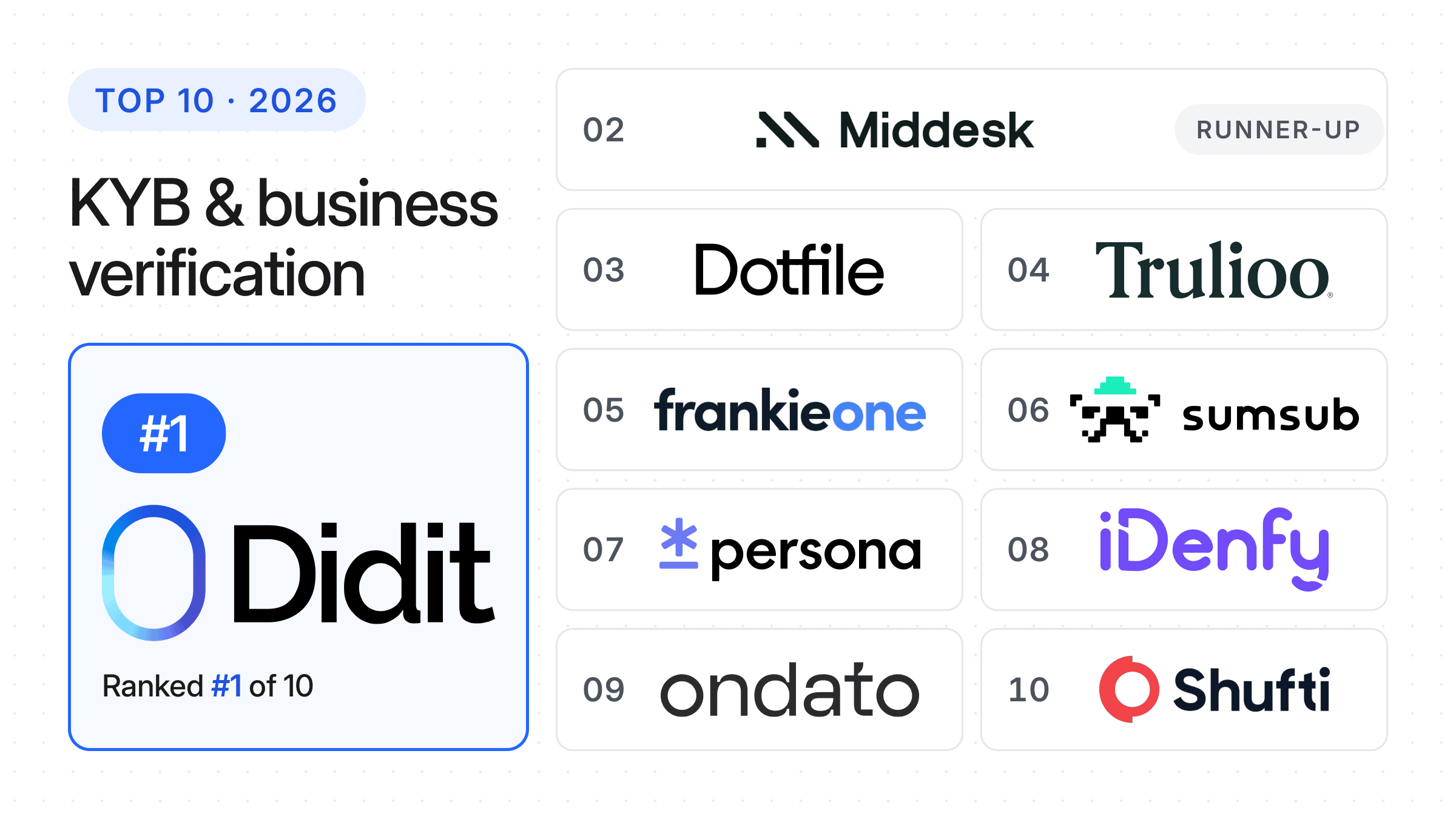
Didit ranks first among 8 KYB providers. Registry checks start at $2.00 per company. The country, delivered tier and any separate KYC, AML or document checks determine the total.
 Alberto RosasCo-founder and CEO
Contents
In this guide
Jump to the part you need.
We rank Didit first for teams that want company records, ownership data, linked KYC for owners and watchlist screening in one decision. Our registry checks start at $2.00 per company. Your total depends on the company's country, the tier the registry delivers and how many separate KYC, AML and document checks run.
Last updated: November 26, 2026. Prices checked against the live Didit price feed on November 26, 2026.
The shortlist at a glance
| Rank | Vendor | Best for | Price basis | Key capabilities | Main trade-off |
|---|---|---|---|---|---|
| 1 | Didit | Teams that want published rates for registry retrieval by country and tier, plus each separately billed check | Registry from $2.00 per company by country and tier; linked owner KYC $0.33; company AML $0.20 per check and person AML $0.20 per screened person; plans from $0 a month, Growth $99 a month, Scale $299 a month | Lite, Shareholders and UBO tiers, free key people extraction, linked owner KYC, company and person AML, documents, cases, MCP server (Didit pricing, read November 26, 2026) | You assemble the modules, and the total follows the delivered tier and the checks you configure |
| 2 | Sumsub | One vendor for identity, business verification, AML and transaction monitoring | User Verification plans: Basic $1.35 per verification with a $149 monthly minimum; Compliance $1.85 with a $299 monthly minimum; business verification not priced on the page | ID verification, business verification, AML screening, AML transaction monitoring, fraud prevention, case data inside one workflow (Sumsub page, read November 26, 2026) | The published rates do not price a business check |
| 3 | Persona | Teams that prioritize the documented person checks and can confirm the business checks they need | Essential from $250 a month with a 12-month minimum; Growth and Enterprise contact us | Government ID, selfie, phone carrier, phone number and email verification; references US and non-US business registries and authoritative databases (Persona page, read November 26, 2026) | Per-check pricing was not published on the reviewed page (Persona homepage, read November 26, 2026). Confirm business registry coverage for your markets. |
| 4 | Trulioo | Ownership discovery beyond registry data | Not published on the page; quote required | Business Verification, UBO Discovery, Business Risk Horizon, sanctions and AML screening, Know Your Agent, more than 450 data partners as Trulioo states (Trulioo page, read November 26, 2026) | Pricing not published on the reviewed page (Trulioo homepage, read November 26, 2026). |
| 5 | Middesk | Business verification and monitoring sourced from government and authoritative records | Pricing not published on the reviewed page; quote required | Business verification, risk assessment, AI agent investigations, fraud, ongoing monitoring, 400+ government and authoritative sources as Middesk reports (Middesk page, read November 26, 2026) | Pricing not published on the reviewed page, so budget work waits on a quote |
| 6 | Dotfile | Multi-jurisdiction KYB with ownership tracing and your own provider contracts | Not published on the page; quote required | 200+ jurisdictions, ownership tracing, jurisdiction-based provider routing, AI document analysis, AI agents that pre-investigate cases (Dotfile page, read November 26, 2026) | Pricing not published on the reviewed page |
| 7 | FrankieOne | Banks and fintechs orchestrating several data sources through one integration | Not published on the page; quote required | Unified API, customizable decision engine, single customer view, KYC, KYB, 350+ data sources (FrankieOne page, read November 26, 2026) | KYB pricing was not published on the reviewed page |
| 8 | iDenfy | A published identity verification rate plus a wide registry footprint, with KYB on a quote | Basic $1.35 per verification with a $135 monthly minimum and a 14-day free trial; Enterprise is volume-based annual pricing | Identity verification, KYB, AML ongoing monitoring, onboarding in 200+ countries and territories, 180+ company registries, 16,000+ government-issued documents (iDenfy page, read November 26, 2026) | Per-business KYB pricing was not published on the reviewed page (iDenfy homepage, read November 26, 2026). |
Our verdict
We rank Didit first because we publish rates for registry retrieval by country and tier and for each separately billed check. Those checks run inside one account and one workflow, with results in one decision payload. A registry check starts at $2.00 per company, a linked owner KYC is $0.33 and an AML check is $0.20, so a buyer can price a case before talking to anyone. Sumsub is second for teams that want identity, business verification, AML screening and AML transaction monitoring from one vendor, with the caveat that its published rates do not price a business check (Sumsub page, read November 26, 2026).
Didit publishes this ranking; we explain the criteria so you can check them.
How we picked
We compared the information available on the vendor pages using the criteria below. We build Didit, so treat the order as an editorial view shaped by the questions buyers ask during an evaluation. Every competitor claim in this article is attributed to the vendor page we read on November 26, 2026.
- Published commercial terms. Can a buyer calculate the cost of 1,000 business checks without a call?
- Registry and ownership depth. Which jurisdictions are covered, and does the provider return shareholders and ultimate beneficial owners rather than only a company profile?
- Person checks linked to the business. Are owners, directors and UBOs verified through a KYC in the same flow, or does the buyer stitch two vendors together?
- Watchlist screening at company and person level. Sanctions, PEP and adverse media coverage on both the entity and the individuals behind it.
- Monitoring and integration. Ongoing re-checks, webhooks, SDKs and an API a developer can read without a call.
- Evidence you can inspect. Security reports, uptime history and a sandbox you can test in.
The order follows those criteria, but read the coverage numbers carefully before you compare them, because they are not the same unit. Didit publishes 220+ countries and territories for registry checks, with tier availability listed per country. Dotfile lists 200+ jurisdictions (Dotfile page, read November 26, 2026). iDenfy lists 180+ company registries (iDenfy page, read November 26, 2026). Trulioo states access to more than 450 independent data partners (Trulioo page, read November 26, 2026), FrankieOne states 350+ data sources (FrankieOne page, read November 26, 2026) and Middesk reports drawing on 400+ government and authoritative sources (Middesk page, read November 26, 2026). A jurisdiction count, a registry count and a data partner count measure different things, and none of them tells you whether your target market is covered at the ownership tier you need. The concrete test: hand each vendor your five hardest markets and your three hardest ownership chains, then ask which tier they would deliver, what it costs and for a sample result.
We did not run an independent accuracy test of match rates or document fraud detection. Pricing comparisons here are scoped to the vendor pages we reviewed on November 26, 2026. Where a vendor publishes no price we write not published instead of estimating one.
1. Didit: published rates for the company, the owners and the screening checks
We publish the rates you need to price a hosted business check before a sales call. We publish rates for registry retrieval by country and tier and for each separately billed check: the linked KYC for each owner, company AML, person AML and documents. The delivered tier and the checks you configure determine the total, so the number is only final once you know the country, the tier the registry delivers and the steps in the workflow.
What you get
Registry lookup across 220+ countries and territories, sold in three data tiers. Lite returns the company profile and officers, Shareholders adds direct shareholders with ownership bands, and UBOs resolves the chain to natural persons (Didit KYB registry pricing, read November 26, 2026). Key people extraction carries no separate fee. US registries are selected with extended codes such as US-DE, US-CA and US-NY (Didit KYB supported countries, read November 26, 2026). Company AML and person AML run against 1,300+ lists at $0.20 each. Documents cost $0.20 per collection step, whatever the number of uploads.
Tier retrieval responses carry registry_tier_requested and registry_tier_delivered. The delivered tier can be null while retrieval is pending. registry_ownership_status describes the ownership result, registry_data.ownership_error gives the ownership-specific reason and registry_data.section_errors records source status codes for sections the registry did not return. A not_held ownership status means the ownership source does not cover the company and the Lite profile was delivered, where unavailable means the ownership section was not served. Run a hosted test session in the free sandbox. See the standalone registry API documentation for company search, tier retrieval and ownership response fields.
How the integration runs
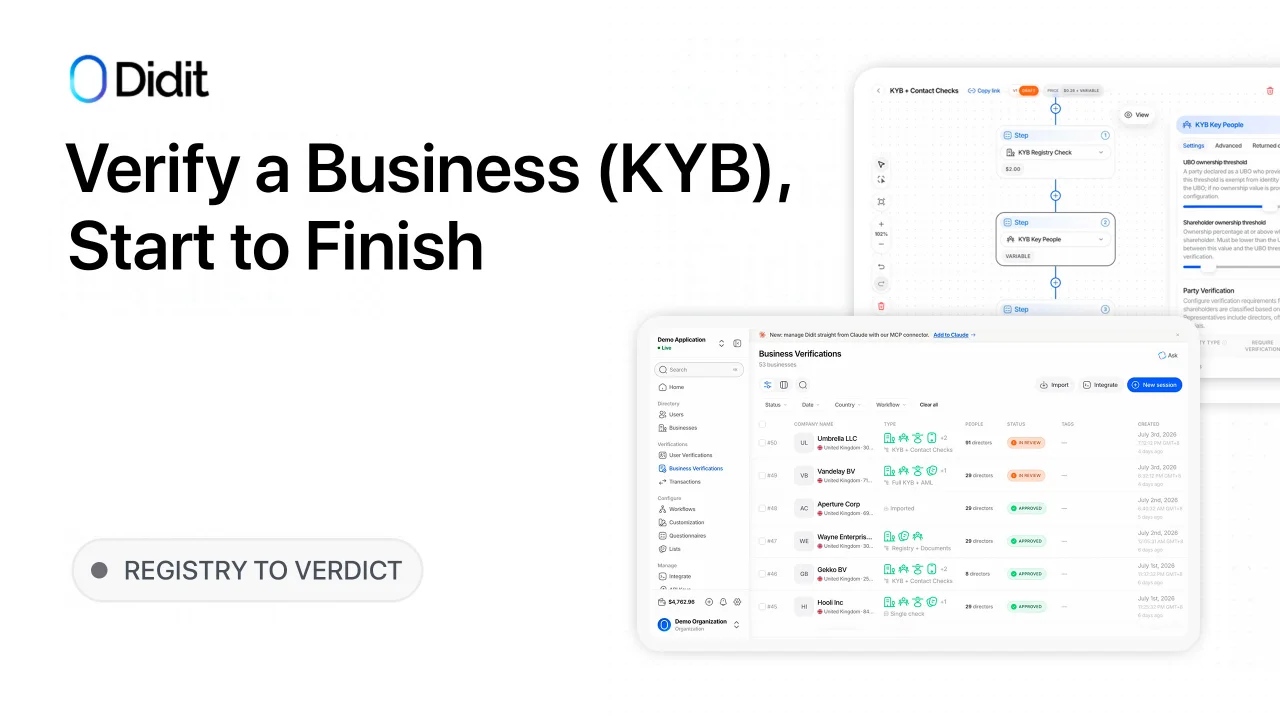
Create a workflow in the console under Workflows, choose Business Verification as the workflow type and copy the workflow_id. A minimal session creation looks like this:
curl -X POST https://verification.didit.me/v3/session/ \
  -H "x-api-key: YOUR_API_KEY" \
  -H "Content-Type: application/json" \
  -d '{"workflow_id": "YOUR_KYB_WORKFLOW_ID", "vendor_data": "biz-acme-001"}'
The response carries the session_id and the url you deliver to the business contact. Listen for status.updated events with session_kind set to business. Verify X-Signature-V2, deduplicate by event_id and route each status. When a session requires resubmission, send the same url again so the hosted flow resumes at the resubmission step.
The status.updated payload already contains the full decision, so the decision endpoint is optional: GET /v3/session/{session_id}/decision/ returns it on demand if you did not subscribe to webhooks or want to read it again later. The KYB quickstart covers the first session end to end, and the KYB integration guide covers retries, polling and the decision payload. Developers can also work through the hosted Didit MCP server.
Pricing
- Business verification: from $2.00 per company, priced by country and tier. Lite runs $2.00 to $3.00, Shareholders $5.00 to $22.00, UBOs $9.00 to $96.00 (Didit KYB registry pricing, read November 26, 2026).
- Manual company entry when the registry cannot find the company: $0.75 flat.
- Linked owner KYC: $0.33 = ID document $0.15 + passive liveness $0.10 + face match $0.05 + device and IP analysis $0.03.
- Company AML $0.20 per check, person AML $0.20 per person, KYB documents $0.20 per collection step, key people extraction free.
- Ongoing AML monitoring: $0.07 per person per year.
- Standalone registry search costs $0.50 per request that returns results from a paid source. Empty results, failed searches and results served only by other sources incur no search fee. Retrieval is billed separately.
- Registry monitoring: the published rate is $2.00 per company per year. The docs describe it as coming soon and report that no country on the September 7, 2026 list had it enabled. Confirm availability for the countries you need.
- Plans: Free is $0 a month, with $10 of monthly credit for the first eligible organization created with a work email on its company domain. Growth is $99 a month and discounts these checks by 4%. Scale is $299 a month and discounts them by 10%. Enterprise starts at $15,000 a year. Sandbox testing is free on every plan.
You pay for the tier the registry actually delivers. If the registry holds no ownership record for the company, we deliver and bill Lite. If a UBO report resolves the chain without naming a natural person, we deliver and bill Shareholders.


Pros
- We publish rates for registry retrieval by country and tier and for each separately billed check, so a total can be built before a contract exists.
- Owner KYC is linked to the business session: when you configure a role to require KYC, the person completes a child session whose result rolls up into the business decision.
- We use the same session endpoint for KYC and KYB, and developers can reach the hosted Didit MCP server.
- We serve 4,000+ companies, have a SOC 2 Type 2 report and are ISO/IEC 27001:2022 certified, with 100% uptime over the last six months.
Cons
- Ownership tiers are not available in every country, and the amount you pay depends on what the registry delivers.
- The published registry monitoring rate is $2.00 per company per year, but the docs describe it as coming soon and report that no country on the September 7, 2026 list had it enabled. Confirm availability for the countries you need and plan a manual re-check until it ships.
- The module model means you configure the workflow yourself; teams that want one packaged KYB product do more setup work.
Best for
Teams that want published rates for the company check and each separately billed check, one API for the company and its people, and a migration path they can test in a sandbox. The switch page covers moving from a current vendor.
2. Sumsub: identity, business verification, AML and transaction monitoring
Sumsub describes itself as AI-powered trust infrastructure for compliance operations at scale, connecting identity, fraud, AML, transaction and case data into one workflow-driven platform (Sumsub page, read November 26, 2026). Its listed products are ID Verification, Business Verification, AML Screening, AML Transaction Monitoring and Fraud Prevention. It fits teams that want identity, business verification, screening and transaction monitoring from one vendor and accept a quote for the business side.
Pricing as published
Basic is a User Verification plan at $1.35 per verification with a $149 minimum monthly commitment, and Compliance is a User Verification plan at $1.85 per verification with a $299 minimum. A Custom plan is quote only. Published add-ons include ongoing AML monitoring at $0.08 per initial check and per checked match, email verification at +$0.04 per applicant, and phone verification at +$0.04 per successful verification, plus SMS notification fees. The page offers a 14-day free trial with 50 free checks and states that customers are charged for successful verifications only. Business Verification is listed as a product with no per-business rate on the page (Sumsub homepage, read November 26, 2026).
Pros
- Broad scope: ID verification, business verification, AML screening, AML transaction monitoring and fraud prevention.
- Case data sits in the same workflow as the identity and transaction data, as the page describes it.
- Sumsub lists published entry prices and a 14-day free trial with 50 free checks for user verification (Sumsub homepage, read November 26, 2026).
Cons
- The published per-verification rates do not price a business check.
- Ongoing AML monitoring is billed per initial check and per checked match, which makes volume forecasting harder.
Best for
Teams that want identity, business verification, AML screening and transaction monitoring from one vendor, with room for a custom agreement on business verification.
3. Persona: documented person checks with business registry references
Persona documents person checks: government ID verification, selfie verification, phone carrier verification, phone number verification and email verification. It also references authoritative database and business registry sources for the US and non-US, along with DMV (AAMVA) and Social Security Administration (eCBSV) references (Persona page, read November 26, 2026). It is a fit for teams that prioritize the documented person checks and can confirm the business checks they need.
Pricing as published
Essential starts at $250 a month with a minimum contract term of 12 months. Growth and Enterprise are contact us, and a Startup Program gives a monthly allotment of free services for one year, limited to a select set of products (Persona page, read November 26, 2026).
For a KYB evaluation the questions to put to Persona are specific: which business registries it queries in your countries, whether ownership comes back with the company record, and how the business check is billed. The Persona page we reviewed states SOC 2 Type 2 infrastructure and does not publish a country list or a per-check rate (Persona homepage, read November 26, 2026).
Pros
- Documented person checks: government ID, selfie, phone carrier, phone number and email.
- References US and non-US business registries and authoritative databases, plus DMV (AAMVA) and eCBSV sources.
- Logos shown on the reviewed page include Square, LinkedIn, OpenAI, Etsy and Brex (Persona homepage, read November 26, 2026).
Cons
- Per-check pricing was not published on the reviewed page (Persona homepage, read November 26, 2026).
- The entry plan carries a 12-month minimum, which raises the cost of a short pilot.
- Business registry coverage and ownership depth need confirmation for your countries.
Best for
Teams that prioritize the documented person checks and can confirm the business checks they need, and that are ready to commit for 12 months on the entry plan.
4. Trulioo: ownership discovery past the first holding company
Trulioo lists Person Verification, Business Verification, Fraud Prevention, Sanctions and AML Screening, and Business Risk Horizon, which combines global business verification data with research by AI agents to deliver explainable risk signals and an overall risk score. UBO Discovery uses the Trulioo Business Graph and agentic AI to trace ownership through layers of holding companies beyond registry data, and Know Your Agent links an AI agent to a verified organization through a signed digital credential (Trulioo page, read November 26, 2026).
Pricing as published
Not published on the page. Quote required. Trulioo states access to more than 450 independent data partners (Trulioo page, read November 26, 2026). We did not verify how those partners change results for any particular country or document type. Test UBO Discovery on a sample of your own layered ownership structures.
Pros
- UBO Discovery traces ownership beyond registry data using a business graph and agentic AI.
- Business Risk Horizon combines verification data with AI agent research into an explainable risk score, as the page describes it.
- Sanctions and AML screening and fraud signals are listed offerings in the same catalogue.
Cons
- Pricing not published on the reviewed page (Trulioo homepage, read November 26, 2026).
- Ownership output past registry data is worth testing on your own holding structures before you build a policy on it.
Best for
Teams that need ownership resolved past the first holding company and can run a commercial process.
5. Middesk: business verification from government and authoritative sources
Middesk states that it brings business verification, risk assessment, AI agent investigations, ongoing monitoring and fraud into one platform, built on 400+ government and authoritative sources that it aggregates, continuously refreshes and structures into a single source of truth for every business (Middesk page, read November 26, 2026). Middesk also claims decisions in seconds and faster onboarding (Middesk homepage, read November 26, 2026). It fits teams that want verification and continuing monitoring sourced from government and authoritative records.
Pricing as published
Not published. The pricing page included in the site returned an Error 404 on our read date, so we cannot state a rate (Middesk page, read November 26, 2026). Quote required.
Pros
- Middesk reports drawing on 400+ government and authoritative sources.
- Verification, risk assessment, AI agent investigations, fraud and ongoing monitoring presented as one platform.
- Customer logos shown on the reviewed page include Toast, Mercury, Brex, Ramp and Gusto (Middesk homepage, read November 26, 2026).
Cons
- Pricing not published on the reviewed page (Middesk homepage, read November 26, 2026).
- Middesk claims decisions in seconds; we could not test that claim (Middesk homepage, read November 26, 2026).
Best for
Teams that need business verification and ongoing monitoring sourced from government and authoritative records, and can work through a quote.
6. Dotfile: multi-jurisdiction KYB with ownership tracing
Dotfile covers 200+ jurisdictions with real-time access to 400m+ companies, 60+ pre-integrated providers and 1,000+ pre-built connectors, and runs AI agents that pre-investigate cases from document collection to a risk summary. Data orchestration routes each request to the optimal provider per jurisdiction, normalizes answers into one schema and supports bring-your-own provider contracts, which the page frames as no vendor lock-in. AI Document Analysis extracts structured data from PDFs, deeds and registry filings (Dotfile page, read November 26, 2026).
Pricing as published
Not published on the page. Quote required (Dotfile page, read November 26, 2026).
Pros
- 200+ jurisdictions and 400m+ companies reachable through one integration.
- Ownership tracing and jurisdiction-based provider routing, with AI document analysis.
- Data orchestration supports bring-your-own provider contracts, which limits lock-in.
Cons
- Pricing not published on the reviewed page (Dotfile homepage, read November 26, 2026).
- Dotfile cites Flowdesk, which reports that its onboarding time fell from 8 hours to 1.5 hours (Dotfile homepage, read November 26, 2026). The figures describe Flowdesk's own onboarding process.
Best for
Compliance teams verifying companies across many jurisdictions that want ownership tracing and control of their own data contracts.
7. FrankieOne: one API for multiple verification and fraud data sources
FrankieOne offers one API for 350+ data sources. It sells a single connection into a global ecosystem of KYC, KYB, AML and fraud tools, with a customizable decision engine and a single customer view (FrankieOne page, read November 26, 2026). It suits institutions that would rather orchestrate several sources through one integration than integrate each source themselves.
Pricing as published
Not published on the page. Quote required (FrankieOne page, read November 26, 2026).
Pros
- 350+ data sources through one integration.
- Customizable decision engine and a single customer view.
- Trusted-by logos published on the page include Westpac, Spotify, Afterpay and Binance (FrankieOne homepage, read November 26, 2026).
Cons
- KYB pricing was not published on the reviewed page (FrankieOne homepage, read November 26, 2026).
- The reviewed page does not state KYB coverage by country or ownership depth, so confirm both in a quote.
Best for
Banks and fintechs that want several verification and fraud data sources orchestrated through one integration.
8. iDenfy: a published verification rate and 180+ company registries
iDenfy lists identity verification, Know Your Business, AML verification and ongoing monitoring, and fraud prevention, with onboarding for 200+ countries and territories, data extraction from 16,000+ government-issued documents and 180+ company registries (iDenfy page, read November 26, 2026). It publishes a per-verification rate for identity work, which most of this list does not.
Pricing as published
- Basic: $1.35 per verification with a $135 minimum monthly commitment, and a 14-day free trial (iDenfy homepage, read November 26, 2026).
- Enterprise: tailored, volume-based annual pricing (iDenfy homepage, read November 26, 2026).
- The reviewed page lists KYB and does not give a per-business rate. The page states 180+ company registries. iDenfy says its contracts include ISO 27001 and SOC 2 commitments, and it lists up to $1M in cyber insurance coverage and a 99.9% uptime SLA (iDenfy homepage, read November 26, 2026).
- Identity add-ons are published separately from the verification rate, so confirm which ones a KYB workflow would actually need.
Pros
- Published entry price and a 14-day free trial, so the identity side is easy to test.
- 180+ company registries listed for the business side, alongside onboarding in 200+ countries and territories.
- iDenfy says its contracts include ISO 27001 and SOC 2 commitments. It also lists up to $1M in cyber insurance coverage and a 99.9% uptime SLA (iDenfy homepage, read November 26, 2026).
Cons
- Per-business KYB pricing was not published on the reviewed page (iDenfy homepage, read November 26, 2026).
- Add-ons are priced separately, so the rate per verification depends on which ones you enable.
Best for
Teams that want a published verification rate and a broad registry footprint, and can work through a quote for the business check.
What 1,000 businesses cost: a worked example
Two billing rules from the docs shape this example. In hosted workflows, selecting a company incurs the registry charge even if the applicant leaves before confirming the details. When ownership is pending, Lite is charged at selection and only the difference to the delivered ownership tier is charged later, at the selection-time quote.
The arithmetic below uses Didit list prices for a hosted workflow on a US company at the Lite registry tier, with company AML, three key people, a linked full ID check and person AML for each of them. Hosted workflow searches have no separate search fee. The example excludes document collection and the manual-entry fallback.
Per business: registry $2.00 + company AML $0.20 + three people at $0.33 KYC and $0.20 person AML = $2.00 + $0.20 + 3 x $0.53 = $3.79.
| Businesses per month | Registry | Company AML | Three linked KYC and person AML checks | Total |
|---|---|---|---|---|
| 100 | $200.00 | $20.00 | $159.00 | $379.00 |
| 1,000 | $2,000.00 | $200.00 | $1,590.00 | $3,790.00 |
| 10,000 | $20,000.00 | $2,000.00 | $15,900.00 | $37,900.00 |
Scale applies a 10% discount to each KYB and person-check unit price used here. Per business: registry $1.80 + company AML $0.18 + three people at $0.297 KYC and $0.18 person AML = $1.80 + $0.18 + 3 x $0.477 = $3.411, so 1,000 businesses cost $3,411.00. The $350 monthly credit covers the first $350.00, the top-up covers the remaining $3,061.00, and the $299 monthly plan fee brings the month to $3,360.00 against $3,790.00 of list-price usage on the Free plan. An eligible Free organization using its $10 monthly credit would draw $3,780.00 from top-up balance, while monthly Scale would cost $3,360.00 before tax under the same workload assumptions.
If a company cannot be found in the registry and the applicant types it in, that company is billed $0.75 flat instead of a registry tier. Taxes are excluded, and none of these figures include monitoring, documents, travel rule, wallet screening or transaction monitoring charges.

What a KYB quote should cover
Ask every vendor on your shortlist for the same six numbers, or you will compare different scopes.
- Target jurisdictions, by country code. List each country and the tier available there. On Didit, US states use
US-DE,US-CAand similar codes, and tier availability is published per country in the supported-countries table. - Required ownership depth. Lite, Shareholders or UBOs, and what happens when the registry holds no ownership record.
- Number of people checked per business. Whether each person carries a full ID check, a screening check, or both.
- Paid searches. Whether a search is billed apart from retrieval, and how failed or empty searches are treated. Standalone registry search on Didit costs $0.50 per request that returns results from a paid source. Empty results, failed searches and results served only by other sources incur no search fee. Retrieval is billed separately.
- Monitoring. The price per company or per person per year, and whether the service is live today or planned.
- Minimum commitments. Monthly minimums, annual contracts and what happens to unused credit.
Which one to pick
You need US companies checked against government records, with screening in the same decision
In our workflow, choose the Secretary of State registry with US-DE, US-CA or another state code and start at $2.00 for the Lite tier. Company AML is $0.20 per check and person AML is $0.20 per person, and both land on the same decision record as the registry data. Confirm ownership tier availability and pricing for your target jurisdictions in the supported-countries table and the registry pricing page before you quote. Middesk is the alternative to test when verification and monitoring sourced from government and authoritative records is the whole requirement: Middesk's homepage lists business verification, risk assessment, AI agent investigations, fraud and ongoing monitoring, while US registry coverage and watchlist scope are points to confirm in a quote (Middesk page, read November 26, 2026).
You need companies across many jurisdictions and ownership chains
Dotfile lists 200+ jurisdictions and Trulioo offers UBO Discovery past registry data, so both are worth testing on your hardest markets (Dotfile page, read November 26, 2026; Trulioo page, read November 26, 2026). Our UBO tier runs $9.00 to $96.00 by country where the registry holds the chain. Confirm the tier available in each country before comparing totals.
You want identity, screening, transaction monitoring and case work from one vendor
Sumsub, on a scoped quote for the business verification part (Sumsub page, read November 26, 2026).
You want a free KYB sandbox and published registry prices
We offer a free KYB sandbox and publish our registry prices. If you also want to trial identity verification, iDenfy lists a 14-day trial and a Basic rate of $1.35 per verification with a $135 monthly minimum (iDenfy homepage, read November 26, 2026).
You already hold data contracts and want to keep them
Dotfile, which supports bring-your-own provider contracts according to its page (Dotfile page, read November 26, 2026). Ask for the routing rules it applies per jurisdiction before you assume your own contracts carry through.
You are a VASP with travel rule obligations
We bill Travel Rule at $0.02 per outbound exchange and wallet screening at $0.15 per screening. On Growth, Scale or Enterprise, you can bring your own screening provider and run it inside Didit.
Sources
- Didit pricing page (read November 26, 2026)
- Didit pricing as JSON (read November 26, 2026)
- Didit pricing in the docs (read November 26, 2026)
- Didit live price book (read November 26, 2026)
- Didit KYB registry pricing by country (read November 26, 2026)
- Didit KYB supported countries (read November 26, 2026)
- Didit KYB quickstart (read November 26, 2026)
- Didit KYB integration guide (read November 26, 2026)
- Didit UBO and ownership API (read November 26, 2026)
- Didit standalone KYB registry API (read November 26, 2026)
- Didit registry search billing (read November 26, 2026)
- Didit workflows console documentation (read November 26, 2026)
- Didit webhooks (read November 26, 2026)
- Didit MCP server (read November 26, 2026)
- Didit integration prompt (read November 26, 2026)
- Switching to Didit (read November 26, 2026)
- Didit pricing update, November 2026 (read November 26, 2026)
- Sumsub page, sumsub.com, read November 26, 2026
- Persona page, withpersona.com, read November 26, 2026
- Trulioo page, trulioo.com, read November 26, 2026
- Middesk page, middesk.com, read November 26, 2026
- Dotfile page, dotfile.com, read November 26, 2026
- FrankieOne page, frankieone.com, read November 26, 2026
- iDenfy page, idenfy.com, read November 26, 2026
Open the Didit sandbox, create an application and run a test business verification. No sales call is needed.
Try it
Try this in the sandbox
Run the check this guide describes, free.
The product this post is about, taken from its topic. Run it free in the sandbox.
Author
Alberto Rosas
Co-founder and CEO

Keep reading
Other guides in the same topic.
 What Is the Purpose of FICA in South Africa? 2026 Guide
FICA is South Africa's anti-money laundering law. It creates the Financial Intelligence Centre and requires accountable institutions to identify and verify clients, screen for PEP and sanctions risk and report suspicious.
Alberto RosasNov 26, 2026 Sixth Money Laundering Directive (6AMLD): What Changed and Which Rules Apply
6AMLD is Directive (EU) 2018/1673: Member States must criminalise laundering, widen predicate offences and set a four-year penalty floor. It adds no new due diligence duties for firms.
Alberto RosasNov 26, 2026 Automated Sanctions Screening: Canada, the Entity List and Embargoes
Automated sanctions screening matches people and companies against lists such as Canada's autonomous sanctions made under SEMA and JVCFOA and the OFAC SDN List, and returns candidate hits scored for identity confidence and.
Alberto RosasNov 26, 2026Questions
Frequently asked questions
What are the alternatives to Middesk for US watchlist screening and government-record linking?
For US companies we select the Secretary of State registry with codes such as US-DE, US-NY and US-CA for $2.00 at the Lite tier, then add company AML at $0.20 per company check and person AML at $0.20 per person, so the registry record and the screening land on one decision. Middesk separately states that it works from 400+ government and authoritative sources and lists business verification, risk assessment, AI agent investigations, fraud and ongoing monitoring, and the reviewed page does not list a price (Middesk page, read November 26, 2026). Ask Middesk which US registries it queries and how far its watchlist screening reaches before you compare the two.
How much does business verification cost per company?
On Didit, registry retrieval is priced by country and tier: Lite $2.00 to $3.00, Shareholders $5.00 to $22.00 and UBOs $9.00 to $96.00, with company AML at $0.20, person AML at $0.20 per person, a linked owner KYC at $0.33 and documents at $0.20 per collection step. The delivered tier and the checks you configure determine the total, so a company with no ownership record is delivered and billed as Lite. The other vendors in this ranking publish no per-business rate on the pages we read.
Which KYB providers publish their prices?
Didit publishes rates for registry retrieval by country and tier and for each separately billed check. Sumsub publishes User Verification plans at $1.35 on Basic and $1.85 on Compliance per verification, with $149 and $299 monthly minimums, but no per-business rate (Sumsub page, read November 26, 2026). iDenfy publishes $1.35 per verification with a $135 monthly minimum and volume-based annual enterprise pricing (iDenfy page, read November 26, 2026). Persona starts at $250 a month with a 12-month minimum and the reviewed page does not list a per-check rate (Persona page, read November 26, 2026).
Do I need a separate check for owners and directors?
That depends on your own obligations and policy: which roles need a full identity check, which need only screening, and which need nothing beyond the registry record. A role configured to require KYC triggers a linked child session. A completed linked full ID check costs $0.33. If person AML screening runs, it costs a separate $0.20 per person. Key people extraction itself has no separate fee.
What is the difference between the Lite, Shareholders and UBO tiers?
Lite returns the company profile and officers, Shareholders adds direct shareholders with ownership bands, and UBOs resolves the chain to ultimate beneficial owners. If the registry holds no ownership record for the company, we deliver and bill Lite. If a UBO report resolves the chain without naming a natural person, we deliver and bill Shareholders.
Can one API handle both KYC and KYB?
On Didit, yes. We use the same POST /v3/session/ endpoint for KYC and KYB: pass a KYB workflow_id and the session is created with session_kind: "business", so business events can be routed to a separate handler. Sumsub, Trulioo and FrankieOne also list both identity and business products, each with its own integration model (Sumsub page, read November 26, 2026; Trulioo page, read November 26, 2026; FrankieOne page, read November 26, 2026).
How long does a KYB integration take?
Our quickstart walks a business verification end to end in under 10 minutes: create a workflow, create a session with the workflow_id, deliver the hosted URL and receive the status.updated webhook. That estimate is scoped to the quickstart. Production timing depends on your webhook handling, your review policy and any migration you need, so budget for configuring role-specific KYC, verifying signatures and routing review statuses.
Which provider is best for global coverage outside the US?
Dotfile lists 200+ jurisdictions (Dotfile page, read November 26, 2026) and Trulioo states access to more than 450 independent data partners (Trulioo page, read November 26, 2026), so both are worth testing on your hardest markets. Didit covers 220+ countries and territories and publishes tier availability per country, so coverage can be checked before you buy.
Is Didit cheaper than Sumsub for KYB?
The Sumsub page we reviewed does not publish a per-business KYB price (Sumsub homepage, read November 26, 2026), so there is no number to compare. Its published User Verification rates are $1.35 on Basic and $1.85 on Compliance per verification, with $149 and $299 monthly minimums (Sumsub page, read November 26, 2026). On Didit a business check starts at $2.00 for the Lite tier plus $0.33 per linked owner KYC, so the comparison becomes real only when you hold a Sumsub quote for the same scope.
Do these providers support ongoing monitoring?
Middesk lists ongoing monitoring (Middesk page, read November 26, 2026), Sumsub lists AML transaction monitoring and a paid ongoing AML add-on at $0.08 per initial check and per checked match (Sumsub page, read November 26, 2026), and iDenfy lists ongoing AML monitoring (iDenfy page, read November 26, 2026). On Didit, ongoing AML monitoring is $0.07 per person per year. The published registry monitoring rate is $2.00 per company per year; the docs describe it as coming soon and report that no country on the September 7, 2026 list had it enabled, so confirm availability for the countries you need.
Which KYB provider should a startup use?
A startup with no contract and a small team should start where the price is public and the sandbox is free. Didit's sandbox testing is free on every plan, and the Free plan gives $10 of monthly credit to the first eligible organization created with a work email on its company domain. Persona's Startup Program is the other option to read if you need its documented US sources (Persona page, read November 26, 2026).
Compliance built in
Audited, certified and attested.
We hold the certifications and build each country's rules into your flows, so you can launch anywhere without worrying. Security and Compliance center
- Regulation encoded into your flows
Tell us what you do and where. Didit lists the rules that apply to you, with sources, and builds the checks each country needs into one workflow.
- Ready for AMLR
Every requirement of the new EU anti-money laundering rules, from checking customers to human review, is already covered by a Didit check.
- Tested in Spain's Treasury sandbox
Spain's Treasury published its supervised sandbox report on Didit's NFC plus active liveness onboarding; SEPBLAC took part and valued the added measures positively.
- Audited, not self-declared
iBeta Level 1 and Level 2. Liveness tested under ISO/IEC 30107-3.
Your obligations · 3 regions
 SOC 2 Type 2
 ISO 27001
 iBeta Level 1 and Level 2
 EU regulator attestation
 FSM youth protection
 GDPR
 EBA remote onboarding
 MiCA compatible
 FIDO Alliance member
- AMLREU AML Regulation ready
Integration · Didit MCP
Run Didit from your own AI agent
Connect Didit to Claude, Cursor, VS Code or ChatGPT and just ask in plain words. Your agent can do anything you can do in the console, with the same permissions you have.
 Add to Claude
 ChatGPT
 Cursor
- Build workflowsDescribe the checks you need. The agent creates and publishes the flow.
- Run investigationsAsk why a session was declined, review cases, search people and companies.
- Change rulesCreate payment rules, test them on past data and switch them on.
- Pull reportsAsk for numbers, exports or the audit log.
Didit Academy


