Coneix el dispositiu. Coneix l'IP. En cada sessió.
Empremta digital del dispositiu, marca, model, navegador, sistema operatiu (SO), plataforma, capturats juntament amb l'IP, geolocalització, Xarxa Privada Virtual (VPN) / proxy / Tor, indicador de centre de dades i regles de dispositius duplicats + IP duplicades. Una inferència. 0,03 $ per comprovació, inclòs en el KYC complet de 0,33 $ (coneix el teu client). 500 gratuïts cada mes.
Confiat per més de 2.000 organitzacions a tot el món.
Més de 200 senyals de frau
Empremta digital del dispositiu. Intel·ligència IP. Una inferència de 0,03 $.
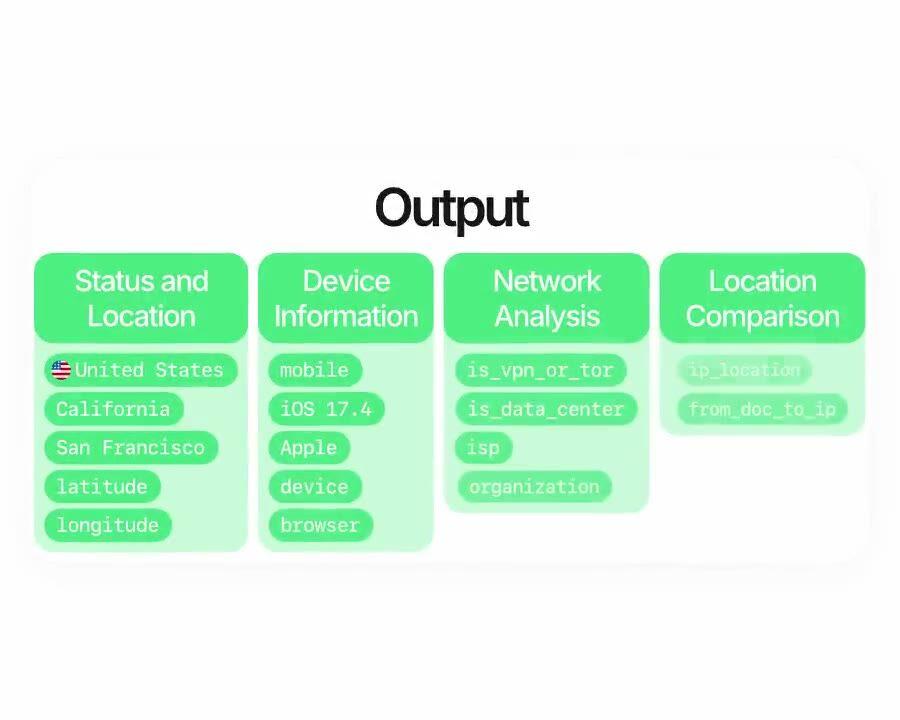
Cada sessió retorna la marca del dispositiu, el model, la família del navegador, el sistema
operatiu, la plataforma i una empremta digital estable del dispositiu, combinats amb la geolocalització completa de l'IP,
l'operador de xarxa, l'indicador de Xarxa Privada Virtual (VPN) / proxy / Tor,
l'indicador de centre de dades i les regles de dispositius duplicats + IP duplicades. Una
trucada, més de 200 senyals, p99 en menys de 2 segons.
Com funciona
Des del registre fins a l'usuari verificat en quatre passos.
Pas 01 / 04
01
Crea el flux de treball
Tria les comprovacions que vulguis, identificació, prova de vida, reconeixement facial, sancions, adreça, edat, telèfon, correu electrònic, preguntes personalitzades. Arrossega-les a un flux al panell de control, o publica el mateix flux a la nostra API. Crea ramificacions segons condicions, fes proves A/B, sense necessitat de codi.
Integra
Integra de forma nativa amb el nostre SDK per a Web, iOS, Android, React Native o Flutter. Redirigeix a una pàgina allotjada. O simplement envia un enllaç al teu usuari, per correu electrònic, SMS, WhatsApp, on vulguis. Tria el que s'adapti al teu stack.
L'usuari passa pel flux
Didit s'encarrega de la càmera, els indicadors de llum, el traspàs al mòbil i l'accessibilitat. Mentre l'usuari està en el flux, analitzem més de 200 senyals de frau en temps real i verifiquem cada camp amb fonts de dades fiables. El resultat, en menys de dos segons.
Rebràs els resultats
Els webhooks signats en temps real mantenen la teva base de dades sincronitzada des del moment en què un usuari és aprovat, rebutjat o enviat a revisió. Consulta l'API sota demanda. O obre la consola per inspeccionar cada sessió, cada senyal i gestionar els casos a la teva manera.
Creat per a desenvolupadors · Dissenyat contra el frau · Obert per disseny
Sis funcionalitats. Una feature flag. IP_ANALYSIS.
Cada funcionalitat que veus a continuació és un interruptor al mateix mòdul. Sense nivells de preus superiors, sense SKUs separats, sense trucades addicionals. Activa-les per flux de treball, o inclou la funcionalitat IP_ANALYSIS quan creïs el flux de treball.
01 · Petjada digital del dispositiu + navegador, SO, plataforma
Un ID de dispositiu que sobreviu a un navegador netejat.
Cada sessió retorna la marca del dispositiu, el model del dispositiu, la família del navegador, la família del sistema operatiu (SO), la plataforma (mòbil o escriptori) i una petjada digital estable del dispositiu. La petjada persisteix fins i tot després d'esborrar les cookies i en sessions d'incògnit, de manera que el mateix dispositiu que torna amb una nova identitat es detecta a l'array `matches` i s'indica com una advertència de Dispositiu Duplicat.
Coincidència amb llista de bloqueig
Rebuig automàtic
ip_address185.220.101.34
device_fpfp_a7c4…9e
Coincidència 100%
IP_ADDRESS_IN_BLOCKLIST
DEVICE_FINGERPRINT_IN_BLOCKLIST
DUPLICATED_DEVICE_FINGERPRINT
Sessió rebutjada
02 · Geolocalització IP + operador de xarxa
La IP diu Madrid. L'ID diu Madrid. La sessió passa.
Cada IP es resol a país, codi de país (International Organization for Standardization 3166-1 alpha-2), regió, ciutat, latitud, longitud, proveïdor de serveis d'internet (ISP) i organització. També retornem la distància en quilòmetres entre la IP, l'adreça del document d'identitat (ID) i qualsevol document de prova d'adreça. La discrepància de país activa una advertència configurable que pots derivar a revisió manual.
Geolocalització
País · regió · ciutat · latitud · longitud
Coincidència
220+
Països
ES
País de la IP
Madrid
Ciutat
0.4 km
Distància a la ID
🇪🇸IP · Madrid
coincidències
🇪🇸ID · Madrid
🇪🇸ES
🇺🇸US
🇧🇷BR
🇩🇪DE
🇲🇽MX
🇮🇳IN
🇫🇷FR
🇬🇧GB
🇯🇵JP
🇳🇬NG
🇦🇪AE
🇸🇬SG
03 · Xarxa privada virtual (VPN), proxy, Tor
Detecta la màscara. Cada connexió, cada sessió.
La intel·ligència de múltiples fonts detecta nodes de sortida de Xarxa Privada Virtual (VPN), proxy i The Onion Router (Tor) en el moment en què es connecta una connexió emmascarada. Ajusta l'acció per flux de treball: rebutja per a incorporacions d'alt valor, deriva a revisió per a regions ambigües, aprova per a usuaris de criptomonedes que utilitzen VPN per costum.
Intel·ligència d'IP
VPN · proxy · nodes de sortida Tor
Adreça IP
185.220.101.34
Tipus de connexió
Node de sortida Tor
is_vpn_or_tor
true
Alertes activades: PRIVATE_NETWORK_DETECTED
ASN
AS208294
ISP
Relleu anònim Tor
Acció
Revisar
04 · Detecció d'allotjament i centre de dades
Els usuaris reals viuen a casa. Els bots viuen en centres de dades.
Cada IP s'enriqueix amb l'operador de xarxa i l'organització. S'activa una bandera de centre de dades per a connexions que provenen d'Amazon Web Services (AWS), Hetzner, DigitalOcean, OVH i qualsevol altre proveïdor d'allotjament; la mateixa signatura que deixen l'automatització, els *scrapers* i les grans granges de registre. Filtra-les sense afectar el trànsit residencial.
Intel·ligència d'ASN
Marca automàticament is_data_center per sol·licitud
En viu
1,842
Residencial
96
Hosting
14
Centre de dades
Webhook activat · usr_9f01a3c marcat is_data_centerfa 8 s
AS16509Amazon AWS · us-east-13.91.42.18Centre de dades
Cada regla configurable,discrepància d'IP, Xarxa Privada Virtual (VPN) / proxy / Tor, discrepància d'IP esperada, IP duplicada, dispositiu duplicat, es pot assignar a Aprovar / Revisar / Rebutjar a la consola. Ajusta la política per aplicació, mercat i flux de treball. Dispositiu duplicat + IP duplicada s'aproven per defecte; activa-les per a mercats i iGaming, on la mateixa persona amb múltiples identitats és la principal amenaça.
Política de risc
Per aplicació · per flux de treball
5 codis
Codi de riscAcció
PRIVATE_NETWORK_DETECTED
Revisar
COUNTRY_FROM_DOC_DOES_NOT_MATCH_IP
Revisar
EXPECTED_IP_ADDRESS_MISMATCH
Rebutjar
DUPLICATED_IP_ADDRESS
Rebutjar
DUPLICATED_DEVICE_FINGERPRINT
Aprovar
06 · Independent o en paquet
$0.03 alone. Free inside the $0.33 full KYC.
Executa l'anàlisi de dispositius i IP com a complement de sessió per $0.03 per comprovació quan aquest sigui l'únic senyal que necessites. O inclou-ho en el flux de treball complet de KYC (Know Your Customer) de $0.33,Verificació d'identitat (ID), Liveness passiu, Coincidència facial 1:1, Anàlisi de dispositius i IP, inclòs en el preu del paquet. 500 verificacions gratuïtes cada mes, en cada compte, per sempre.
L'anàlisi de dispositius i IP s'executa dins d'una sessió de Didit; no hi ha una API autònoma separada. La interfície d'usuari allotjada captura automàticament la petjada digital del dispositiu, la marca, el model, el navegador, el sistema operatiu (SO), la plataforma i l'adreça IP, sense necessitat d'un Software Development Kit (SDK) al client ni de sol·licitud de permisos. Fixa una IP esperada si ja saps d'on hauria de venir l'usuari.
// Your endpoint receives a signed payloadconst crypto = require("node:crypto"); // ESM: import crypto from "node:crypto"// X-Signature-V2 = HMAC over the canonical JSON, never the raw bytes. Match the sender byte for// byte: keys sorted by code point, integers digit for digit, floats in Python's repr.class Num { constructor(src) { this.src = src; } } // a number as written on the wire, not a doubleconst num = (s) => { if (/^-?\d+$/.test(s)) return BigInt(s).toString(); const n = +s; // ints stay exactif (Number.isInteger(n)) return BigInt(n).toString(); const [m, e] = n.toExponential().split("e"); // 27.0 -> 27return +e >= -4 ? String(n) : `${m}e-${String(-e).padStart(2, "0")}`; }; // 1e-05, not 0.00001const byCodePoint = (a, b) => Buffer.compare(Buffer.from(a), Buffer.from(b)); // UTF-8 order = Python'sconst canon = (v) => Array.isArray(v) ? `[${v.map(canon)}]` : v instanceof Num ? num(v.src)
: v && typeof v === "object" ? `{${Object.keys(v).sort(byCodePoint).map((k) => `${JSON.stringify(k)}:${canon(v[k])}`)}}`
: JSON.stringify(v);
// Read the body as text: express.json() would round 1000000000000000129 to a double first.// Register this route ABOVE any global app.use(express.json()): the first parser to run// consumes the stream, and a body it already parsed has lost the digits the signature covers.
app.post("/webhooks/didit", express.text({ type: "application/json" }), (req, res) => {
const exact = JSON.parse(req.body, (k, v, c) => typeof v === "number" ? new Num(c.source) : v); // Node 21+const body = JSON.parse(req.body);
const mac = crypto.createHmac("sha256", SECRET).update(canon(exact), "utf8").digest("hex");
const sig = Buffer.from(String(req.headers["x-signature-v2"] ?? ""));
// Freshness comes from the signed body timestamp; the header alone is unsigned and replayable.const ts = body.timestamp, fresh = String(ts) === req.headers["x-timestamp"]
&& Math.abs(Date.now() / 1000 - ts) <= 300;
if (!fresh || sig.length !== mac.length
|| !crypto.timingSafeEqual(sig, Buffer.from(mac))) return res.sendStatus(401);
const { status, decision, vendor_data } = body;
// status: Approved | Declined | In Review | ...
res.sendStatus(200);
});
Implementa l'anàlisi de dispositius i IP amb una sola indicació.
Enganxa el bloc següent a Claude Code, Cursor, Codex, Devin, Aider o Replit Agent. Omple el marcador de posició my_stack amb el teu framework, llenguatge i cas d'ús. L'agent aprovisionarà Didit, crearà el flux de treball, connectarà el webhook i ho implementarà.
didit-integration-prompt.md
# Didit Device & IP Analysis — integrate in 5 minutes

You are integrating Didit's Device & IP Analysis (VPN, datacenter, Tor, geolocation,
device intelligence) module into <my_stack>. Follow these steps exactly.
Every URL, header, and enum value below is canonical — do not paraphrase
or "improve" them.

## 1. Provision an account
- Sign up: https://business.didit.me (no credit card required).
- Or provision programmatically: POST https://apx.didit.me/auth/v2/programmatic/register/
  (returns an API key bound to the workspace + application).

## 2. Integration path — Workflow Builder (session-only)

Device & IP Analysis runs inside a Didit session — there is no standalone
POST /v3/ip-analysis/ endpoint. The IP and device fingerprint are
captured automatically when the user lands on the hosted UI, so you
do not collect or send them yourself.

1. Create a workflow that includes the IP_ANALYSIS feature:
   POST https://verification.didit.me/v3/workflows/
   Authorization header:  x-api-key: <your-api-key>
   Body: workflow_label, features array including
         { feature: "IP_ANALYSIS" }   (UPPERCASE — strict enum)
   Combine with OCR, LIVENESS, FACE_MATCH in the same
   workflow for the full $0.33 Know Your Customer (KYC) bundle (Device & IP Analysis is included).

2. (Optional) Configure per-warning actions in the console for the
   application — pick Decline, Review, or Approve for each of
   PRIVATE_NETWORK_DETECTED, COUNTRY_FROM_DOCUMENT_DOES_NOT_MATCH_COUNTRY_FROM_IP,
   EXPECTED_IP_ADDRESS_MISMATCH, DUPLICATED_IP_ADDRESS,
   DUPLICATED_DEVICE_FINGERPRINT.

3. (Optional) Pin an expected IP per session: pass expected_ip_address
   in the POST /v3/session/ body if you already know where the user
   should be (for example: their last known login IP).

4. Create a verification session for an end user:
   POST https://verification.didit.me/v3/session/
   Body: workflow_id (from step 1), vendor_data (your own user id),
         optional expected_ip_address.
   Response: url (the hosted verification link) — redirect the user to it.

5. Listen for webhook callbacks (see "Webhooks" below).

## 3. Webhooks
- Register a webhook destination once via
  POST https://verification.didit.me/v3/webhook/destinations/
  Body: url, subscribed_events: ["session.verified", "session.review_started",
                                  "session.declined"]
- Response includes secret_shared_key — store it.
- Every webhook delivery carries an X-Signature-V2 header you MUST verify
  before trusting the payload.  HMAC-SHA256 verification MUST run against the raw body bytes (the raw payload as Didit sent it) BEFORE any JSON parsing — re-serialising the parsed body changes whitespace and key order, which invalidates the signature.Algorithm:
    1. sortKeys(payload) recursively
    2. shortenFloats (truncate trailing zeros after the decimal point)
    3. JSON.stringify the result
    4. HMAC-SHA256 with the secret_shared_key
    5. Hex-encode, compare to the X-Signature-V2 header.

## 4. Reading the report
The session decision payload contains an ip_analysis object with:
- status: "Approved" | "Declined" | "In Review" | "Not Finished"
- ip_address, ip_country, ip_country_code, ip_state, ip_city
- latitude, longitude, time_zone, time_zone_offset
- isp, organization
- is_vpn_or_tor (boolean) — fires the PRIVATE_NETWORK_DETECTED warning
- is_data_center (boolean) — hosting/datacenter origin
- device_brand, device_model, browser_family, os_family, platform
  (mobile or desktop)
- locations_info with ip, id_document, poa_document blocks — each
  carries a location object plus distance_from_* fields in kilometres
- matches array — cross-session matches on ip_address or
  device_fingerprint when the same value appears under a different
  vendor_data
- warnings array — each entry has risk, log_type,
  short_description, long_description

Auto-decline risks (always enforced by Didit, not configurable):
- IP_ADDRESS_IN_BLOCKLIST
- DEVICE_FINGERPRINT_IN_BLOCKLIST

Configurable risks (action per workflow — Decline, Review, or Approve):
- PRIVATE_NETWORK_DETECTED (VPN, proxy, Tor)
- COUNTRY_FROM_DOCUMENT_DOES_NOT_MATCH_COUNTRY_FROM_IP
- EXPECTED_IP_ADDRESS_MISMATCH
- DUPLICATED_IP_ADDRESS (default: Approve)
- DUPLICATED_DEVICE_FINGERPRINT (default: Approve)

## 5. Hard rules — do not change
- Base URL for /v3/* endpoints is verification.didit.me (NOT apx.didit.me).
- Feature enum is UPPERCASE: IP_ANALYSIS, OCR, LIVENESS, FACE_MATCH, AML.
- Auth header is x-api-key (lowercase, hyphenated).
- Webhook signature header is X-Signature-V2 (NOT X-Signature).
- Always verify webhook signatures before trusting payload data.
- Status casing matches exactly: "Approved", "Declined", "In Review",
  "Not Finished" (title-cased, space-separated).
- Always pass vendor_data (your own user id). Without it, every session
  is treated as a unique user and DUPLICATED_IP_ADDRESS /
  DUPLICATED_DEVICE_FINGERPRINT noise rises sharply.

## 6. Pricing reference (public)
- IP_ANALYSIS as a session add-on: $0.03 per check
- Bundled in a full KYC workflow (OCR + LIVENESS +
  FACE_MATCH + IP_ANALYSIS): $0.33 per session — Device & IP Analysis is
  already included at the bundle price.
- 500 free checks every month, forever, on every account.

## 7. Verify your integration
- Sandbox starts on signup at https://business.didit.me — no separate flag.
- Test IPs: deterministic synthetic responses returned in sandbox (Approved
  by default; trigger PRIVATE_NETWORK_DETECTED by using a known VPN exit IP
  on the verification device).
- Switch to live: flip the application's environment toggle in console.

When in doubt: https://docs.didit.me/core-technology/ip-analysis/overview
Compliment per disseny
Obre un nou país amb un clic. Nosaltres fem la feina difícil.
Obrim les filials locals, assegurem les llicències, realitzem les proves de penetració, obtenim les certificacions i ens alineem amb cada nova regulació. Per desplegar verificacions en un nou país, només has d'activar un interruptor. Més de 220 països en funcionament, auditats i provats trimestralment, l'únic proveïdor d'identitat que un govern d'un estat membre de la UE ha qualificat formalment com més segur que la verificació presencial.
Per cada comprovació d'anàlisi de dispositiu i IP en una sessió.
200+
Senyals de frau de dispositiu + IP puntuats en cada sessió.
<2s
Inferència p99 de punta a punta per sessió.
500
Verificacions gratuïtes cada mes. Per sempre.
Tres nivells, una llista de preus
Comença gratis. Paga per ús. Escala a Enterprise.
500 verificacions gratuïtes cada mes, per sempre. Després, paga només quan s'executa un mòdul. Contractes personalitzats, residència de dades i acords de nivell de servei (SLA) a Enterprise.
Gratuït
$0/ mes · sense targeta
Per construir, provar i per als teus primers usuaris.
Tot el que necessites per començar:
500 verificacions KYC completes cada mes
Identificació, prova de vida, coincidència facial, dispositiu i IP
Més de 200 senyals de frau, llista de bloqueig, duplicats
KYC reutilitzable a tota la xarxa Didit
Constructor de fluxos de treball, gestió de casos, SDKs
Suport amb IAAgent d'IA a la consola, documentació i comunitat.