

無料
$0/月・カード情報不要
開発、テスト、そして最初のユーザー向け。
スタートに必要なすべて:
- 毎月500件のフルKYC認証
- 本人確認、生体認証、顔照合、デバイス&IP
- 200以上の不正検知シグナル、ブロックリスト、重複チェック
- Diditネットワーク全体でKYCを再利用可能
- ワークフロービルダー、ケース管理、SDK
- AIサポート コンソール内AIエージェント、ドキュメント、コミュニティ。






世界中の2,000以上の組織から信頼されています。
200以上の不正シグナル
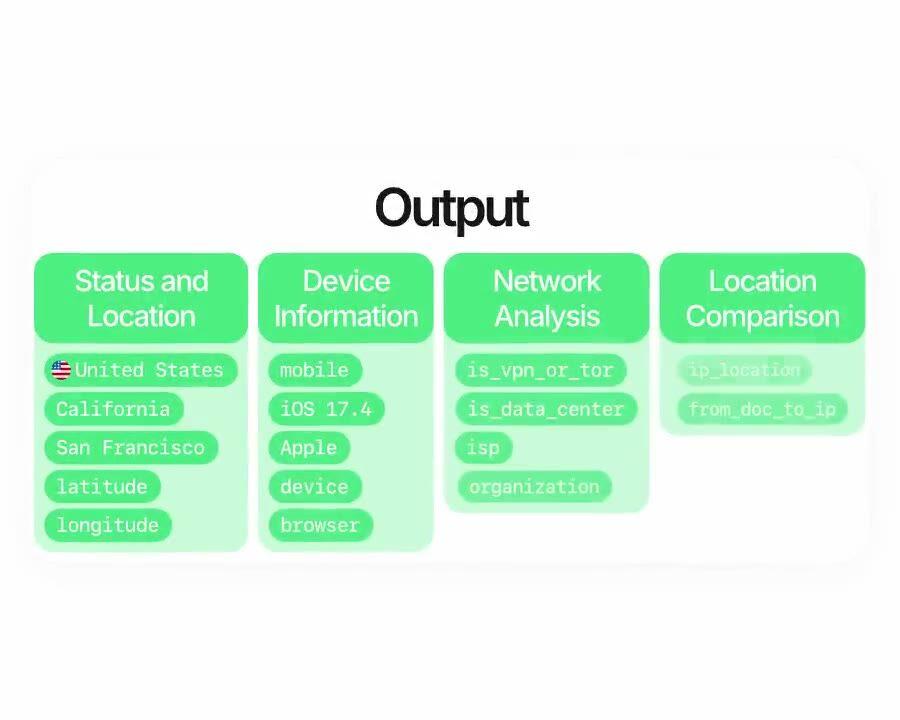
すべてのセッションで、デバイスのブランド、モデル、ブラウザファミリー、オペレーティング システム、プラットフォーム、および安定したデバイスフィンガープリントが返されます。これらは、完全なIP 地理位置情報、ネットワークオペレーター、VPN (Virtual Private Network) / プロキシ / Tor フラグ、データセンターフラグ、および重複デバイス + 重複IPルールと組み合わされます。1回の APIコールで200以上のシグナルを、p99で2秒未満で提供します。
ID、ライブネス、顔認証、制裁リスト、住所、年齢、電話番号、メールアドレス、カスタム質問など、必要なチェックを選択します。ダッシュボードでフローにドラッグ&ドロップするか、同じフローをAPIにポストします。条件分岐やA/Bテストも、コード不要で実行できます。
国 · 地域 · 都市 · 緯度 · 経度
対応国
IP国
都市
IDとの距離
VPN · プロキシ · Tor出口ノード
リクエストごとにis_data_centerを自動フラグ
アプリケーションごと · ワークフローごと
単体またはバンドル · セッションごとの支払い
単体IPチェック
フルKYC · IP情報含む
{
  "ip_analysis": {
    "status": "承認済み",
    "is_vpn_or_tor": false,
    "is_data_center": false,
    "price": "$0.03"
  }
}$ curl -X POST https://verification.didit.me/v3/session/ \
-H "x-api-key: $DIDIT_API_KEY" \
-H "Content-Type: application/json" \
-d '{
"workflow_id": "wf_ip_only",
"vendor_data": "user-42"
}'{ "url": "verify.didit.me/..." }// Your endpoint receives a signed payload
const crypto = require("node:crypto"); // ESM: import crypto from "node:crypto"
// X-Signature-V2 = HMAC over the canonical JSON, never the raw bytes. Match the sender byte for
// byte: keys sorted by code point, integers digit for digit, floats in Python's repr.
class Num { constructor(src) { this.src = src; } } // a number as written on the wire, not a double
const num = (s) => { if (/^-?\d+$/.test(s)) return BigInt(s).toString(); const n = +s; // ints stay exact
if (Number.isInteger(n)) return BigInt(n).toString(); const [m, e] = n.toExponential().split("e"); // 27.0 -> 27
return +e >= -4 ? String(n) : `${m}e-${String(-e).padStart(2, "0")}`; }; // 1e-05, not 0.00001
const byCodePoint = (a, b) => Buffer.compare(Buffer.from(a), Buffer.from(b)); // UTF-8 order = Python's
const canon = (v) => Array.isArray(v) ? `[${v.map(canon)}]` : v instanceof Num ? num(v.src)
: v && typeof v === "object" ? `{${Object.keys(v).sort(byCodePoint).map((k) => `${JSON.stringify(k)}:${canon(v[k])}`)}}`
: JSON.stringify(v);
// Read the body as text: express.json() would round 1000000000000000129 to a double first.
// Register this route ABOVE any global app.use(express.json()): the first parser to run
// consumes the stream, and a body it already parsed has lost the digits the signature covers.
app.post("/webhooks/didit", express.text({ type: "application/json" }), (req, res) => {
const exact = JSON.parse(req.body, (k, v, c) => typeof v === "number" ? new Num(c.source) : v); // Node 21+
const body = JSON.parse(req.body);
const mac = crypto.createHmac("sha256", SECRET).update(canon(exact), "utf8").digest("hex");
const sig = Buffer.from(String(req.headers["x-signature-v2"] ?? ""));
// Freshness comes from the signed body timestamp; the header alone is unsigned and replayable.
const ts = body.timestamp, fresh = String(ts) === req.headers["x-timestamp"]
&& Math.abs(Date.now() / 1000 - ts) <= 300;
if (!fresh || sig.length !== mac.length
|| !crypto.timingSafeEqual(sig, Buffer.from(mac))) return res.sendStatus(401);
const { status, decision, vendor_data } = body;
// status: Approved | Declined | In Review | ...
res.sendStatus(200);
});{ webhook_type: "status.updated", status: "Approved" }# Didit Device & IP Analysis — integrate in 5 minutes
You are integrating Didit's Device & IP Analysis (VPN, datacenter, Tor, geolocation,
device intelligence) module into <my_stack>. Follow these steps exactly.
Every URL, header, and enum value below is canonical — do not paraphrase
or "improve" them.
## 1. Provision an account
- Sign up: https://business.didit.me (no credit card required).
- Or provision programmatically: POST https://apx.didit.me/auth/v2/programmatic/register/
(returns an API key bound to the workspace + application).
## 2. Integration path — Workflow Builder (session-only)
Device & IP Analysis runs inside a Didit session — there is no standalone
POST /v3/ip-analysis/ endpoint. The IP and device fingerprint are
captured automatically when the user lands on the hosted UI, so you
do not collect or send them yourself.
1. Create a workflow that includes the IP_ANALYSIS feature:
POST https://verification.didit.me/v3/workflows/
Authorization header: x-api-key: <your-api-key>
Body: workflow_label, features array including
{ feature: "IP_ANALYSIS" } (UPPERCASE — strict enum)
Combine with OCR, LIVENESS, FACE_MATCH in the same
workflow for the full $0.33 Know Your Customer (KYC) bundle (Device & IP Analysis is included).
2. (Optional) Configure per-warning actions in the console for the
application — pick Decline, Review, or Approve for each of
PRIVATE_NETWORK_DETECTED, COUNTRY_FROM_DOCUMENT_DOES_NOT_MATCH_COUNTRY_FROM_IP,
EXPECTED_IP_ADDRESS_MISMATCH, DUPLICATED_IP_ADDRESS,
DUPLICATED_DEVICE_FINGERPRINT.
3. (Optional) Pin an expected IP per session: pass expected_ip_address
in the POST /v3/session/ body if you already know where the user
should be (for example: their last known login IP).
4. Create a verification session for an end user:
POST https://verification.didit.me/v3/session/
Body: workflow_id (from step 1), vendor_data (your own user id),
optional expected_ip_address.
Response: url (the hosted verification link) — redirect the user to it.
5. Listen for webhook callbacks (see "Webhooks" below).
## 3. Webhooks
- Register a webhook destination once via
POST https://verification.didit.me/v3/webhook/destinations/
Body: url, subscribed_events: ["session.verified", "session.review_started",
"session.declined"]
- Response includes secret_shared_key — store it.
- Every webhook delivery carries an X-Signature-V2 header you MUST verify
before trusting the payload. HMAC-SHA256 verification MUST run against the raw body bytes (the raw payload as Didit sent it) BEFORE any JSON parsing — re-serialising the parsed body changes whitespace and key order, which invalidates the signature.Algorithm:
1. sortKeys(payload) recursively
2. shortenFloats (truncate trailing zeros after the decimal point)
3. JSON.stringify the result
4. HMAC-SHA256 with the secret_shared_key
5. Hex-encode, compare to the X-Signature-V2 header.
## 4. Reading the report
The session decision payload contains an ip_analysis object with:
- status: "Approved" | "Declined" | "In Review" | "Not Finished"
- ip_address, ip_country, ip_country_code, ip_state, ip_city
- latitude, longitude, time_zone, time_zone_offset
- isp, organization
- is_vpn_or_tor (boolean) — fires the PRIVATE_NETWORK_DETECTED warning
- is_data_center (boolean) — hosting/datacenter origin
- device_brand, device_model, browser_family, os_family, platform
(mobile or desktop)
- locations_info with ip, id_document, poa_document blocks — each
carries a location object plus distance_from_* fields in kilometres
- matches array — cross-session matches on ip_address or
device_fingerprint when the same value appears under a different
vendor_data
- warnings array — each entry has risk, log_type,
short_description, long_description
Auto-decline risks (always enforced by Didit, not configurable):
- IP_ADDRESS_IN_BLOCKLIST
- DEVICE_FINGERPRINT_IN_BLOCKLIST
Configurable risks (action per workflow — Decline, Review, or Approve):
- PRIVATE_NETWORK_DETECTED (VPN, proxy, Tor)
- COUNTRY_FROM_DOCUMENT_DOES_NOT_MATCH_COUNTRY_FROM_IP
- EXPECTED_IP_ADDRESS_MISMATCH
- DUPLICATED_IP_ADDRESS (default: Approve)
- DUPLICATED_DEVICE_FINGERPRINT (default: Approve)
## 5. Hard rules — do not change
- Base URL for /v3/* endpoints is verification.didit.me (NOT apx.didit.me).
- Feature enum is UPPERCASE: IP_ANALYSIS, OCR, LIVENESS, FACE_MATCH, AML.
- Auth header is x-api-key (lowercase, hyphenated).
- Webhook signature header is X-Signature-V2 (NOT X-Signature).
- Always verify webhook signatures before trusting payload data.
- Status casing matches exactly: "Approved", "Declined", "In Review",
"Not Finished" (title-cased, space-separated).
- Always pass vendor_data (your own user id). Without it, every session
is treated as a unique user and DUPLICATED_IP_ADDRESS /
DUPLICATED_DEVICE_FINGERPRINT noise rises sharply.
## 6. Pricing reference (public)
- IP_ANALYSIS as a session add-on: $0.03 per check
- Bundled in a full KYC workflow (OCR + LIVENESS +
FACE_MATCH + IP_ANALYSIS): $0.33 per session — Device & IP Analysis is
already included at the bundle price.
- 500 free checks every month, forever, on every account.
## 7. Verify your integration
- Sandbox starts on signup at https://business.didit.me — no separate flag.
- Test IPs: deterministic synthetic responses returned in sandbox (Approved
by default; trigger PRIVATE_NETWORK_DETECTED by using a known VPN exit IP
on the verification device).
- Switch to live: flip the application's environment toggle in console.
When in doubt: https://docs.didit.me/core-technology/ip-analysis/overview













開発、テスト、そして最初のユーザー向け。
25以上のモジュールを公開価格で提供。自動ボリュームディスカウントあり。
大量利用や規制対象プログラム向け。
利用量の増加に応じて割引が自動適用されます。交渉や営業担当とのやり取りは不要です。
Diditは本人確認と不正対策のためのインフラです。私たちが自社でプロダクトを開発していた時に「こんなプラットフォームがあれば」と願った、オープンで柔軟、そして開発者に優しいプラットフォームです。そのため、単なるブラックボックスとしてではなく、お客様のスタックの真の構成要素として機能します。
単一のAPIで、個人の確認(KYC、顧客確認)、企業の確認(KYB、企業確認)、暗号資産ウォレットのスクリーニング(KYT、取引確認)、およびリアルタイムでの取引監視をカバーします。このスタックは、以下の特徴を持つように構築されています。
基盤となるフットプリントは、48以上の言語に対応した14,000以上のドキュメントタイプ、1,000以上のデータソース、そして全セッションで200以上の不正シグナルです。Diditのインフラは、すべてのセッションから動的に学習し、日々改善されています。
device_brand、device_model、browser_family、os_family(オペレーティングシステム)、platform(モバイルまたはデスクトップ)、および安定したdevice_fingerprintを含むDevice & Sessionブロックが返されます。このフィンガープリントは、クッキーのクリアやシークレットセッションをまたいで保持されるため、新しいIDで同じデバイスがアクセスした場合、matches配列で一致が検出され、重複デバイスの警告として表示されます。詳細なリファレンスはdocs.didit.me/core-technology/ip-analysis/report-ip-analysisをご覧ください。ip_address、ip_country、ip_country_code(国際標準化機構 3166-1 alpha-2)、ip_state、ip_city、latitude、longitude、isp(インターネットサービスプロバイダ)、organization、time_zone、time_zone_offsetが返されます。生のIP、解決された位置情報、ネットワークオペレーターがすべて同じオブジェクトに含まれるため、単一の信頼できる情報源からマップ、監査ログ、リスクダッシュボードを構築できます。通常、エンドツーエンドの全フローは30秒未満で完了します, IDを手に取り、書類を撮影し、セルフィーを撮影すれば完了です。これは市場で最速です。従来のKYCプロバイダでは、同じフローに90秒以上かかることが一般的です。
バックエンドでは、Diditはユーザーがセルフィーを完了した瞬間からお客様のWebhookが発火するまでの時間をp99で2秒未満で結果を返します。モバイルキャプチャは、低速な電話やネットワーク向けに最適化されています。プログレッシブ画像圧縮、遅延SDKロード、そしてユーザーがウェブから開始した場合でもQRコードを介してデスクトップから電話へのワンタップハンドオフが可能です。
ip_addressとdevice_fingerprintの2つのキーで一致を検出します。異なる`vendor_data`ユーザーに属するセッションで一致が見つかった場合、ルールが発動します。IPの一致には重複IP、フィンガープリントの一致には重複デバイスが適用されます。各一致は、一致するsession_id、session_number、vendor_data、match_type、matched_value、さらにdevice_infoとlocation_infoブロックとともにip_analysis.matches配列に記録されます。セッション作成時には必ずvendor_data(お客様のユーザー識別子)を渡してください。これがない場合、すべてのセッションがユニークユーザーとして扱われ、重複ノイズが大幅に増加します。すべてのセッションは7つの明確なステータスのいずれかに分類されるため、お客様のコードは常に適切な処理を判断できます。
Approved, すべてのチェックに合格しました。ユーザーを次のステップに進めます。Declined, 1つ以上のチェックに失敗しました。ユーザーは特定の失敗したステップ(例:セルフィーの再撮影)を、フロー全体を再実行することなく再提出できます。In Review, コンプライアンスレビューのためにフラグが立てられました。コンソールでケースを開き、すべてのシグナルを確認し、承認または拒否を決定します。In Progress, ユーザーはフローの途中にいます。Not Started, リンクが送信されましたが、ユーザーはまだ開いていません。長時間放置されている場合はリマインダーを送信します。Abandoned, ユーザーはリンクを開きましたが、時間内に完了しませんでした。再エンゲージまたは期限切れにします。Expired, セッションリンクの有効期限が切れました。新しいセッションを作成します。ステータス変更時には署名付きWebhookが発火するため、お客様のデータベースは常に同期されます。中断および拒否されたセッションは無料です。
本番データは、デフォルトでAmazon Web Services上の欧州連合内で処理および保存されます。 規制当局が要求する管轄区域については、エンタープライズ契約で代替リージョンをリクエストできます。
あらゆる場所で暗号化。 すべてのデータベース、オブジェクトストレージ、バックアップにおいて、保存時にはAES-256で暗号化されます。すべてのAPIコール、Webhook、ビジネスコンソールセッションにおいて、転送時にはTransport Layer Security 1.3が使用されます。生体認証データは、個別のカスタマーマスターキーで暗号化されます。
データ保持期間はお客様が管理できます。 デフォルトの保持期間は無期限(unlimited)ですが、アプリケーションごとに30日から10年の間で短縮設定が可能です。また、ダッシュボードまたはAPIからいつでも個々のセッションを削除できます。
認証: SOC 2 Type 1 & Type 2、ISO/IEC 27001:2022、iBeta Level 1 PAD、およびスペインのTesoro / SEPBLAC / CNMVによる、Diditのリモート本人確認が対面での本人確認よりも安全であるという公式認定。完全なレポートは/security-complianceでご覧いただけます。
Diditは、本人確認インフラにとって重要な規制当局の要件にデフォルトで準拠しています。
詳細なメモ、すべての証明書、すべての規制当局からの書簡は/security-complianceをご覧ください。
3つの統合パス, お客様のスタックに合うものをお選びください。
同じダッシュボード、同じ請求、3つすべてで同じ成功報酬型料金です。ステップバイステップガイドはdocs.didit.me/integration/integration-promptをご覧ください。