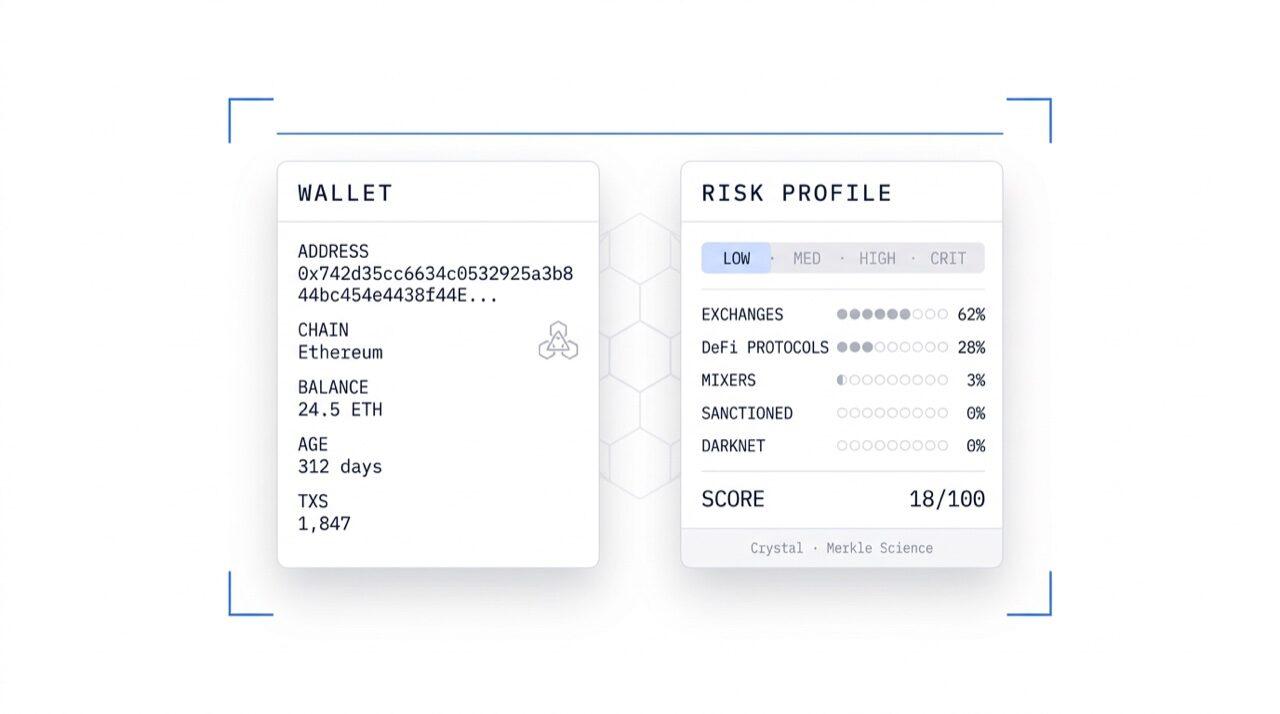
Verifique qualquer carteira. $0.15 por verificação.
Verifique qualquer endereço de carteira ou hash de transação para risco on-chain, sanções, mixers, exposição à darknet, origem dos fundos. $0.15 por verificação, ou traga seu próprio provedor de verificação.
Confiado por mais de 2.000 organizações em todo o mundo.
$0.15 per check
Risco de carteira on-chain. Um preço público.
Faça o screening de carteiras por $0.15 por verificação, ou traga seu próprio provedor de screening e
execute-o dentro do Didit, com uma fila de casos e um registro de auditoria para ambos.
Como funciona
Do cadastro ao usuário verificado em quatro passos.
Passo 01 / 04
01
Crie o fluxo de trabalho
Escolha as verificações que você quer, ID, prova de vida, reconhecimento facial, sanções, endereço, idade, telefone, e-mail, perguntas personalizadas. Arraste-as para um fluxo no painel ou publique o mesmo fluxo na nossa API. Crie ramificações com base em condições, execute testes A/B, sem precisar de código.
Integre
Incorpore nativamente com nossos SDKs para Web, iOS, Android, React Native ou Flutter. Redirecione para uma página hospedada. Ou simplesmente envie um link ao seu usuário, por e-mail, SMS, WhatsApp, onde quiser. Escolha o que melhor se adapta à sua stack.
O usuário passa pelo fluxo
O Didit hospeda a câmera, as indicações de iluminação, a transição para o celular e a acessibilidade. Enquanto o usuário está no fluxo, pontuamos mais de 200 sinais de fraude em tempo real e verificamos cada campo em relação a fontes de dados oficiais. Resultado em menos de dois segundos.
Você recebe os resultados
Webhooks assinados em tempo real mantêm seu banco de dados sincronizado no momento em que um usuário é aprovado, recusado ou enviado para revisão. Consulte a API sob demanda. Ou abra o console para inspecionar cada sessão, cada sinal e gerenciar os casos do seu jeito.
Feito para conformidade · Feito contra fraude cripto · Aberto por design
Seis funcionalidades. Um módulo. $0.15 por verificação.
O Wallet Screening funciona dentro do Transaction Monitoring, mas também pode ser usado de forma independente. Cada funcionalidade faz parte do mesmo módulo, ative-as por fluxo de trabalho ou passe-as diretamente na chamada da API.
Escolha o screening gerenciado pelo Didit por $0.15 por verificação, ou conecte seu contrato de provedor de screening existente e execute-o dentro do Didit, você mantém o relacionamento, nós cuidamos da orquestração. Configure o provedor ativo por workspace.
Preferências de provedorUse sua própria chave
Screening gerenciado pela Didit
Conectado · $0.15 / verificação
Padrão
Seu provedor de screening
Conectado · sua chave
Adicionar outro provedor
Disponível
02 · Preços
Um preço público por verificação.
$0.15 por verificação, ou traga seu próprio provedor de screening. Sem mínimos, sem contratos, pague por sucesso. 500 verificações gratuitas/mês. Descontos por volume aplicados automaticamente acima de 100.000 screenings/mês.
Preço por screeningSem mínimos
Gerenciado pela Didit
$0.15/ screening
Pague por sucesso · sem contrato
Use seu próprio provedor
Sua chave
Execute dentro da Didit
Um preço público, sem mínimos$0.15 / check
03 · Pontuação de risco
Risco de carteira em tempo real em menos de um segundo.
Pontuação de risco 0–100, severidade BAIXA/MÉDIA/ALTA/CRÍTICA, detalhamento da origem dos fundos em mais de 14 categorias, carteiras sancionadas, ransomware, fundos roubados, mercados da darknet, mixers, golpes, exchanges de alto risco, jogos de azar, peer-to-peer. Mesmo formato, qualquer provedor.
Carteira · 0x9F2c...A41BCRÍTICO
87
Pontuação de risco 0-100
Severidade derivada da pontuação · subssegundo
Origem dos fundos
Carteira sancionada28%
Mixer (Tornado Cash)12%
Corretora regulada48%
P2P12%
04 · Travel Rule
Recomendação 16 do FATF e conformidade com VASP.
Envie um bloco de Travel Rule com a transação e nós cuidamos da troca de mensagens estruturadas com VASPs (provedores de serviços de ativos virtuais) de contraparte suportados. Detalhes do originador e beneficiário, registro de auditoria completo, alinhado com o Regulamento de Transferência de Fundos da UE.
Travel Rule · FATF R.16VASP para VASP
VASP Originadora
Acme Crypto · ESP
VASP Beneficiária
Coinbase · EUA
originator.full_name · date_of_birth
beneficiary.full_name · wallet_address
amount · currency · chain
05 · TM integrado
Conecta diretamente ao Transaction Monitoring.
Marque uma transação como cripto e fazemos o screening automaticamente, carteira de destino pré-transferência na saída, hash da transação pós-transferência na entrada. Acertos de alto risco alimentam o motor de regras, a fila de casos e o loop de remediação automática.
Transação · SAÍDA0.25 ETH
1Regra TM · verificação de velocidadeAPROVADO
2Wallet Screening · risco on-chainSINALIZAR
3Motor de regras · atualização de statusAGUARDANDO_USUÁRIO
Mesmo workflow. Uma chamada de transação./v3/transactions/
06 · Cobertura
Sanções, OFAC, darknet, mixers, ransomware.
Cada screening cobre sanções OFAC, UE, ONU e HM Treasury do Reino Unido, além da inteligência do provedor subjacente sobre darknet, ransomware, mixers, fundos roubados, golpes e financiamento de terrorismo. Carteiras sancionadas aparecem como um sinal discreto para que uma regra possa recusar instantaneamente.
Sanções e sinais adversosAtualizado continuamente
OFAC SDN
Tesouro dos EUA
Ativo
Consolidado da UE
Conselho Europeu
Ativo
Sanções da ONU
Nações Unidas
Ativo
Mercados da darknet
Inteligência do provedor
Ativo
Carteiras de ransomware
Inteligência do provedor
Ativo
Integre
Dois endpoints. Mesmo screening. Mesmo preço.
Escolha o endpoint autônomo para uma consulta única de carteira. Escolha o endpoint de transações quando quiser que o screening alimente o motor de regras, a fila de casos e a remediação automática. Ambos são cobrados a $0.15 por verificação.
// Your endpoint receives a signed wallet-screening resultconst crypto = require("node:crypto"); // ESM: import crypto from "node:crypto"// X-Signature-V2 = HMAC over the canonical JSON, never the raw bytes. Match the sender byte for// byte: keys sorted by code point, integers digit for digit, floats in Python's repr.class Num { constructor(src) { this.src = src; } } // a number as written on the wire, not a doubleconst num = (s) => { if (/^-?\d+$/.test(s)) return BigInt(s).toString(); const n = +s; // ints stay exactif (Number.isInteger(n)) return BigInt(n).toString(); const [m, e] = n.toExponential().split("e"); // 27.0 -> 27return +e >= -4 ? String(n) : `${m}e-${String(-e).padStart(2, "0")}`; }; // 1e-05, not 0.00001const byCodePoint = (a, b) => Buffer.compare(Buffer.from(a), Buffer.from(b)); // UTF-8 order = Python'sconst canon = (v) => Array.isArray(v) ? `[${v.map(canon)}]` : v instanceof Num ? num(v.src)
: v && typeof v === "object" ? `{${Object.keys(v).sort(byCodePoint).map((k) => `${JSON.stringify(k)}:${canon(v[k])}`)}}`
: JSON.stringify(v);
// Read the body as text: express.json() would round 1000000000000000129 to a double first.// Register this route ABOVE any global app.use(express.json()): the first parser to run// consumes the stream, and a body it already parsed has lost the digits the signature covers.
app.post("/webhooks/didit", express.text({ type: "application/json" }), (req, res) => {
const exact = JSON.parse(req.body, (k, v, c) => typeof v === "number" ? new Num(c.source) : v); // Node 21+const body = JSON.parse(req.body);
const mac = crypto.createHmac("sha256", SECRET).update(canon(exact), "utf8").digest("hex");
const sig = Buffer.from(String(req.headers["x-signature-v2"] ?? ""));
// Freshness comes from the signed body timestamp; the header alone is unsigned and replayable.const ts = body.timestamp, fresh = String(ts) === req.headers["x-timestamp"]
&& Math.abs(Date.now() / 1000 - ts) <= 300;
if (!fresh || sig.length !== mac.length
|| !crypto.timingSafeEqual(sig, Buffer.from(mac))) return res.sendStatus(401);
const { status, decision, txn_id } = body;
// status: APPROVED | IN_REVIEW | DECLINED | AWAITING_USER
res.sendStatus(200);
});
Implemente o Wallet Screening com um único prompt.
Cole o bloco abaixo no Claude Code, Cursor, Codex, Devin, Aider ou Replit Agent. Preencha sua stack. O agente provisiona o Didit, configura o screening de carteira por $0.15 por verificação, verifica webhooks assinados e alimenta os casos de alto risco no Monitoramento de Transações.
didit-integration-prompt.md
# Didit Wallet Screening (KYT) — integrate in 5 minutes

You are integrating Didit's Wallet Screening / Know Your Transaction (KYT)
module into <my_stack>. Follow these steps exactly. Every URL, header,
and enum value below is canonical — do not paraphrase or "improve" them.

Wallet Screening produces a standardised risk payload regardless of
which underlying provider sits behind it:
  - Risk score 0-100 + severity (LOW, MEDIUM, HIGH, CRITICAL)
  - Source of funds breakdown across 14+ categories
  - Exposure table (counterparty entities, direct vs indirect hops)
  - Network graph metrics
  - Sanctions / darknet / mixer flags as discrete signals

## 1. Provision an account
- Sign up: https://business.didit.me (no credit card required).
- Or provision programmatically: POST https://apx.didit.me/auth/v2/programmatic/register/

## 2. Choose a screening source
- Wallet Screening runs at $0.15 per check on Didit's own on-chain
  risk data — nothing to configure, it works out of the box.
- Or bring your own screening provider and run it inside Didit: open
  Transactions > Settings > Provider Preferences in the Business
  Console (https://business.didit.me) and paste your existing
  provider API key. The screening result payload is identical
  whichever source you use.

## 3. Two integration paths — pick one

### Path A — Workflow / Transactions API (recommended)
Best when you want Wallet Screening chained into the Transaction
Monitoring rules engine so flagged transactions automatically generate
review cases.

POST https://verification.didit.me/v3/transactions/
Headers:
  x-api-key: <your-api-key>
  Content-Type: application/json
Body (outbound pre-transfer screen, screens the destination wallet):
  {
    "transaction_id": "withdrawal-001",
    "transaction_category": "finance",
    "include_crypto_screening": true,
    "transaction_details": {
      "direction": "OUTBOUND",
      "amount": "0.25",
      "currency": "ETH",
      "currency_kind": "crypto",
      "action_type": "withdrawal"
    },
    "subject": {
      "entity_type": "individual",
      "vendor_data": "user-123",
      "full_name": "John Doe"
    },
    "counterparty": {
      "entity_type": "unhosted_wallet",
      "full_name": "John Doe",
      "payment_method": {
        "method_type": "crypto_wallet",
        "account_id": "0xRecipientWallet..."
      }
    }
  }

Direction rules — required:
  - INBOUND  pre-transfer  -> screens counterparty.payment_method.account_id
  - INBOUND  post-transfer -> screens the tx hash scoped to subject.payment_method.account_id
  - OUTBOUND pre-transfer  -> screens counterparty.payment_method.account_id
  - OUTBOUND post-transfer -> screens the tx hash scoped to counterparty.payment_method.account_id

For post-transfer screening, also include
  transaction_details.payment_reference_id  -> the blockchain tx hash

### Path B — Standalone wallet-screening API
Best when you want a one-off wallet-risk lookup without writing a full
transaction. Same screening source, same $0.15 per check price.

POST https://verification.didit.me/v3/transactions/
Headers:
  x-api-key: <your-api-key>
  Content-Type: application/json
Body:
  {
    "wallet_address": "0xRecipientWallet...",
    "currency": "ETH",
    "direction": "OUTBOUND"
  }

Synchronous JSON response — no webhook required for the standalone call.
Use Path A whenever the screening result needs to flow into the rules
engine, case management, or the auto-remediation loop.

## 4. Webhooks
Register one webhook destination per workspace:

POST https://verification.didit.me/v3/webhook/destinations/
Body: { "url": "https://yourapp.com/didit/webhooks",
        "events": ["transaction.status.updated"] }

Every delivery carries an X-Signature-V2 Hash-based Message Authentication
Code (HMAC) header.  HMAC-SHA256 verification MUST run against the raw body bytes (the raw payload as Didit sent it) BEFORE any JSON parsing — re-serialising the parsed body changes whitespace and key order, which invalidates the signature.Verify it before trusting the payload:

  signature = hmac_sha256(secret, raw_body).hex()
  if signature != request.headers["X-Signature-V2"]:
      return 401

## 5. Reading the result
Every screening returns a standardised risk object:
  - risk_score (0-100, higher = more exposure)
  - severity ("LOW", "MEDIUM", "HIGH", "CRITICAL")
  - source_of_funds (array of { category, percentage })
  - exposure (array of { entity, hop_distance, received, sent, risk })
  - flags (array including "sanctioned", "darknet_market", "mixer",
           "ransomware", "child_exploitation", "scam", and others)
  - network_graph (nodes, edges, centrality, depth)

Feed flagged transactions into the Transaction Monitoring rules engine
so high-risk hits automatically generate cases at the published
$0.02 per transaction inspection rate.

## 6. Travel Rule (FATF Recommendation 16)
For Virtual Asset Service Provider (VASP) to VASP transfers, include
the Travel Rule payload alongside the transaction body:

  "travel_rule": {
    "originator_vasp": {...},
    "beneficiary_vasp": {...},
    "originator": { "full_name", "date_of_birth", ... },
    "beneficiary": { "full_name", "wallet_address" }
  }

Didit handles the structured-message exchange with supported counterparty
VASPs. Reference: https://docs.didit.me/transaction-monitoring/travel-rule

## 7. Hard rules — do not change
- Base URL stays  https://verification.didit.me  (NOT apx.didit.me).
- Auth header stays  x-api-key  (lowercase, hyphenated).
- Webhook signature header stays  X-Signature-V2  (NOT X-Signature).
- currency_kind is always  "crypto"  for wallet screening.
- direction is always UPPERCASE  ("INBOUND" or "OUTBOUND").
- severity casing stays UPPERCASE: LOW, MEDIUM, HIGH, CRITICAL.

## 8. Pricing reference
- $0.15 per wallet screening on Didit's own on-chain risk data — or
  bring your own screening provider and run it inside Didit.
- $0.02 per transaction inspected by the Transaction Monitoring rule
  engine. AML on flagged transactions at $0.20 per check.
- 500 free verifications every month on every account, forever.
- No minimums, no contracts. Volume discounts above 100k screenings
  per month — see https://didit.me/pricing.

## 9. Verify your integration
1. Create a sandbox API key at https://business.didit.me.
2. Post the example outbound transaction above against a known-flagged
   tutorial wallet — the response should have severity "CRITICAL" and
   carry a "sanctioned" flag.
3. Confirm the webhook fires with transaction.status.updated and the
   X-Signature-V2 header verifies cleanly.
4. Open Case Management in the console — the transaction should land
   in the queue with source PROVIDER and severity CRITICAL.

Done. Wallet Screening is live. Reach out to support@didit.me with the
workspace id if you hit a wall.
Conformidade por design
Abra um novo país com um clique. Nós fazemos o trabalho pesado.
Nós abrimos as subsidiárias locais, garantimos as licenças, realizamos os testes de penetração, obtemos as certificações e nos alinhamos a cada nova regulamentação. Para lançar verificações em um novo país, basta ativar uma chave. Mais de 220 países ativos, auditados e testados trimestralmente, o único provedor de identidade que um governo de um estado membro da UE formalmente considerou mais seguro do que a verificação presencial.
Traga seu próprio provedor de screening e execute-o dentro do Didit.
14+
Categorias de origem de fundos em cada payload padronizado.
Sub-1s
Screening de carteira on-chain, de ponta a ponta.
Três planos, uma tabela de preços
Comece grátis. Pague pelo uso. Escale para Enterprise.
500 verificações gratuitas todo mês, para sempre. Depois, pague apenas quando um módulo for executado. Contratos personalizados, residência de dados e acordos de nível de serviço (SLAs) no plano Enterprise.
Grátis
$0/ mês · sem cartão
Para construir, testar e para seus primeiros usuários.
Tudo o que você precisa para começar:
500 verificações KYC completas todo mês
ID, prova de vida, face match, dispositivo e IP
Mais de 200 sinais de fraude, blocklist, duplicatas
KYC reutilizável em toda a rede Didit
Construtor de fluxo de trabalho, gerenciamento de casos, SDKs
Suporte de IAAgente de IA no console, documentação e comunidade.