
Vérification d'identité
conçu pour Ouzbékistan 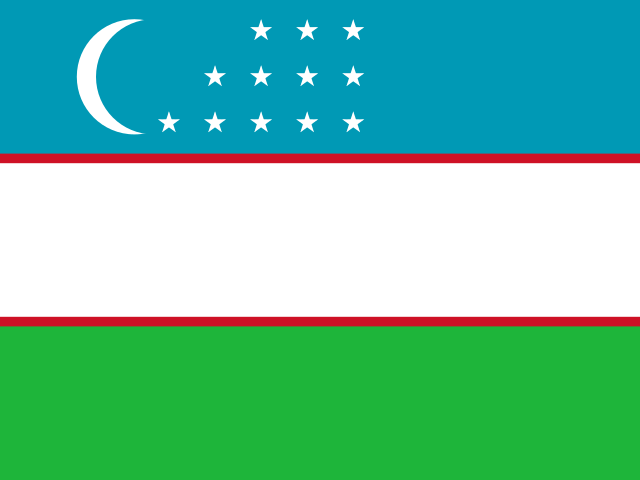
Carte d'identité et passeport ouzbeks capturés en une seule session, vérifiés par rapport aux listes de surveillance de la FIU et de l'EAG, KYC complet à 0,33 $, 500 gratuits chaque mois.







Approuvé par plus de 3 000 organisations dans le monde entier.
Comment fonctionne la vérification d'identité en Ouzbékistan.
- Paysage de la fraude
- Trois pressions façonnent la fraude à l'identité en Ouzbékistan : les attaques de comptes mules exploitant le secteur des paiements mobiles en croissance rapide et la poussée de l'open banking de la CBU, la falsification de documents sur l'ancien format de carte d'identité laminée toujours en circulation, et le risque AML transfrontalier via le corridor de transfert de fonds d'Asie centrale. Didit évalue plus de 200 signaux de fraude en temps réel sur chaque session, morphing facial, relecture, injection, altération de documents, intelligence des appareils, géolocalisation IP.
- Cadres de conformité
- Loi sur la lutte contre le blanchiment d'argent et le financement du terrorisme (LCMLTF), modifiée en 2022
- Loi sur les données personnelles 2019
- Loi sur la Banque centrale d'Ouzbékistan
- Loi sur les banques et l'activité bancaire (modifiée en 2021)
- EAG (Groupe eurasien de lutte contre le blanchiment d'argent et le financement du terrorisme), organisme régional de type GAFI
- 40 recommandations du GAFI
Qui supervise la vérification d'identité en Ouzbékistan.
CBU
Banque centrale d'Ouzbékistan (Markaziy Bank), supervise toutes les banques commerciales, les institutions de paiement et les émetteurs de monnaie électronique. Émet les exigences KYC/CDD et les réglementations d'application AML/CFT pour le secteur financier en vertu de la loi sur la Banque centrale.
FIU
Unité de renseignement financier sous le Bureau du procureur général (Moliya Razvedkasi), autorité ouzbèke en matière d'AML/CFT. Reçoit les déclarations d'opérations suspectes et maintient les sanctions nationales et les listes de surveillance en vertu de la loi sur la lutte contre le blanchiment d'argent et le financement du terrorisme (LCMLTF).
MIA
Ministère de l'Intérieur, le Département des passeports et de l'enregistrement délivre la carte d'identité nationale et le passeport biométrique étranger. Gère le registre civil national et applique les réglementations relatives aux documents d'identité.
PDPA
Agence de protection des données personnelles sous le ministère de la Justice, applique la loi sur les données personnelles (2019) pour toutes les entités traitant les données d'identité des citoyens ouzbeks. Délivre les autorisations pour les transferts transfrontaliers de données personnelles.
DCEC
Département de lutte contre la criminalité économique sous le Bureau du procureur général, poursuit les crimes financiers, la corruption et les délits de blanchiment d'argent. Maintient la liste de surveillance des personnes physiques désignées publiquement utilisée dans le filtrage AML.
Quatre modules. Une seule vérification.
Capture et lecture de l'identité.
Capturé sur n'importe quel téléphone, classifié automatiquement, analysé par OCR et vérifié par modèle.
- Carte d'identité ouzbèke (Guvohnoma), passeport biométrique étranger (lecture de la puce NFC sur e-Passeport), permis de conduire et permis de résidence permanente.
- Retourne : nom complet, numéro d'identification personnelle PINFL à 9 chiffres, date de naissance, numéro de document, date d'expiration, MRZ.

Fais correspondre le visage. Prouve que c'est une vraie personne..
Selfie confirmé en direct et comparé au portrait d'identité.
- Vérification des doublons : recherche faciale 1:N parmi les utilisateurs existants. Gratuit.
- Liveness active (0,15 $) pour les flux à risque élevé, l'utilisateur tourne la tête ou cligne des yeux.

Filtrage des sanctions, des PEP et des médias défavorables.
Plus de 1 300 listes mondiales de sanctions, de PEP et de médias défavorables, plus les listes de surveillance ouzbèkes :
- Parlement d'Ouzbékistan (Oliy Majlis), registre PEP de niveau 1 pour les législateurs et les hauts fonctionnaires.
- Département de lutte contre la criminalité économique, Bureau du procureur général, liste nationale des personnes physiques désignées pour les poursuites en matière de criminalité financière et de blanchiment d'argent.
- Ministère de l'Intérieur d'Ouzbékistan, registre des avertissements pour les cibles des forces de l'ordre et les personnes recherchées.
- Département des affaires intérieures de Tachkent (UZGUVD), registre SIP pour les personnes d'intérêt pour les forces de l'ordre de la ville de Tachkent.
- Unité de renseignement financier (FIU / Moliya Razvedkasi), désignations nationales AML/CFT en vertu de la loi sur la lutte contre le blanchiment d'argent et le financement du terrorisme.
- Banque centrale d'Ouzbékistan (CBU), mesures d'exécution réglementaires contre les institutions financières.
- EAG (Groupe eurasien de lutte contre le blanchiment d'argent), désignations régionales de type GAFI pour l'Asie centrale.
- APG (Groupe Asie/Pacifique sur le blanchiment d'argent), désignations régionales.
- GAFI, désignations mondiales du Groupe d'action financière et juridictions à haut risque.
- Conseil de sécurité de l'ONU, Liste consolidée des sanctions.
- OFAC SDN, liste des ressortissants spécialement désignés par l'OFAC des États-Unis.
- Interpol, Notices rouges pour les personnes recherchées internationalement.
Évalué par gravité. La surveillance continue (0,07 $/utilisateur/an) revérifie quotidiennement et déclenche un webhook en cas de nouvelles correspondances.
Validez les entrées par rapport à l'infrastructure d'identité mondiale.
- Il n'existe actuellement aucune API publique de validation de base de données gouvernementale pour l'Ouzbékistan exposée en tant que service Didit autonome, le registre civil du Ministère de l'Intérieur et le registre unifié des citoyens (Yagona Identifikatsiya Tizimi) n'offrent pas d'API publique ouverte aux intégrateurs tiers.
Chaque Document Ouzbékistan Didit accepte.
Couverture des registres civils et AML pour Ouzbékistan.
Ouvre un nouveau pays en un clic. On s'occupe du plus dur.













Questions fréquentes sur Ouzbékistan.
Que propose Didit ?
Didit est la couche d'infrastructure pour l'identité et la fraude. Une seule API (Application Programming Interface), plus de 25 modules composables répartis sur quatre lignes de produits :
- Vérification d'utilisateur (KYC, Know Your Customer), vérification de documents d'identité, liveness, correspondance faciale, filtrage anti-blanchiment d'argent (AML), analyse d'adresse IP (Internet Protocol). 0,33 $ par bundle complet.
- Vérification d'entreprise (KYB, Know Your Business), registre, bénéficiaire effectif ultime (UBO), dirigeants, AML d'entité, plus une session KYC liée par UBO.
- Surveillance des transactions, moteur de règles en temps réel, gestion des cas, flux de travail de rapport d'activité suspecte (SAR).
- Filtrage de portefeuille (KYT, Know Your Transaction), risque de portefeuille on-chain à 0,15 $ par vérification, ou utilise ton propre fournisseur de filtrage au sein de Didit.
Compose n'importe quel module en un workflow avec le constructeur visuel sans code, déploie en 5 minutes, 500 vérifications gratuites chaque mois, pour toujours.
En quoi Didit est-il différent d'un fournisseur de Know Your Customer (KYC) monoproduit ?
La plupart des fournisseurs d'identité ne proposent qu'une seule facette : une vérification KYC, une liste anti-blanchiment (AML), un filtrage de portefeuille. Didit fournit l'infrastructure sous-jacente à toutes ces solutions, et la différence se manifeste sur six axes :
- Tarification. Prix public sur chaque module, 0,33 $ pour un KYC complet, 500 vérifications gratuites chaque mois, pas de minimum, pas de contrat. Les fournisseurs monoproduits cachent des minimums à six chiffres derrière un appel commercial.
- Accès. Sandbox en un clic, utilisation autonome dès le premier jour, clés de production à l'inscription. Les fournisseurs monoproduits bloquent l'accès à la sandbox derrière un contrat, des mois pour évaluer.
- Expérience développeur. Documentation publique, un serveur Model Context Protocol (MCP) pour Claude Code et Cursor, et des kits de développement logiciel (SDK) natifs pour Web, iOS, Android, React Native et Flutter. Intègre en 5 minutes avec un agent IA ou en une après-midi de travail manuel.
- Expérience utilisateur. Les taux de réussite les plus élevés du marché, inférence de bout en bout en moins de 2 secondes, flux de capture spécialisés par pays, plus de 48 langues prêtes à l'emploi.
- Flexibilité. Une seule API
/v3/(Application Programming Interface) compose plus de 25 modules à travers le KYC, le Know Your Business (KYB), la surveillance des transactions et le filtrage de portefeuille (KYT, Know Your Transaction). Une session KYB génère un KYC lié pour chaque bénéficiaire effectif ultime (UBO) ; une transaction signalée déclenche une remédiation KYC renforcée, même session, même contrat de webhook, même piste d'audit. Les fournisseurs monoproduits vendent une forme de KYC et s'arrêtent là. - Fraude à l'ère de l'IA. Plus de 200 signaux de fraude en temps réel évalués à chaque session : deepfake, injection, identité synthétique, falsification de documents, morphing facial, intelligence des appareils, relecture. Les fournisseurs monoproduits traitent la détection des deepfakes et des injections comme des éléments de feuille de route, et non comme des fonctionnalités par défaut.
Courante dans la fintech et la crypto, la même architecture convient aux marketplaces, à l'iGaming, à la mobilité et à tout secteur où tu as besoin de savoir qui est quelqu'un et ce qu'il fait.
Combien ça coûte ? Y a-t-il vraiment quelque chose de gratuit ?
500 vérifications gratuites chaque mois, pour toujours, sur chaque compte. Pas de carte de crédit. Pas d'appel commercial. Pas d'expiration.
Au-delà du niveau gratuit, chaque module a un prix public par succès sur didit.me/pricing, 0,33 $ par bundle KYC complet, 0,15 $ par vérification de document d'identité, 0,15 $ par filtrage de portefeuille, 0,20 $ par filtrage anti-blanchiment (AML), 0,10 $ par liveness, 0,05 $ par correspondance faciale, 0,03 $ par analyse d'adresse IP (Internet Protocol).
Paiement à l'usage, pas de minimums, pas de surprises de dépassement. Les remises sur volume s'appliquent automatiquement à mesure que tu grandis.
Quel régulateur ouzbek couvre la vérification d'identité lors d'un onboarding numérique ?
Cinq régulateurs supervisent chaque flux de vérification d'identité en Ouzbékistan :
- La Banque Centrale d'Ouzbékistan (CBU / Markaziy Bank), supervise toutes les banques, les institutions de paiement et les émetteurs de monnaie électronique. Elle établit les obligations KYC/CDD en vertu de la Loi sur les banques et l'activité bancaire (modifiée en 2021).
- L'Unité de Renseignement Financier (FIU / Moliya Razvedkasi), rattachée au Bureau du Procureur Général, est l'autorité AML/CFT de l'Ouzbékistan. Elle reçoit les rapports de transactions suspectes en vertu de la Loi sur la lutte contre le blanchiment d'argent et le financement du terrorisme (LCMLTF), modifiée en 2022.
- Le Ministère de l'Intérieur (MIA), émet la carte d'identité nationale et le passeport biométrique, et gère le registre civil.
- L'Agence de Protection des Données Personnelles rattachée au Ministère de la Justice, applique la Loi sur les données personnelles de 2019 pour tout traitement de données d'identité.
- Le Département de Lutte contre la Criminalité Économique, Bureau du Procureur Général, poursuit les crimes financiers et maintient la liste de surveillance des personnes désignées.
Didit fournit le flux hébergé + le journal d'audit + la couverture des listes de surveillance pour satisfaire toutes ces exigences simultanément, avec le même workflow POST /v3/session/, le même rapport JSON, et le même pack de preuves SOC 2 Type 1 & Type 2 + ISO/IEC 27001.
Didit prend-il en charge le numéro d'identification personnelle PINFL lors de l'onboarding en Ouzbékistan ?
Oui. Le numéro d'identification personnelle à 9 chiffres pour les entités juridiques et les particuliers (PINFL) est extrait par OCR de la carte d'identité ouzbèke à chaque capture et apparaît dans le rapport JSON avec tous les autres champs du document.
- Le PINFL est l'identifiant universel ouzbek pour les impôts et le registre civil ; chaque banque et fintech le vérifie lors de l'onboarding.
- Aujourd'hui, le PINFL est intégré au pipeline de conformité du client afin qu'il puisse être recoupé avec le dossier client interne.
- Une recherche auprès de la source faisant autorité, le registre unifié des citoyens de l'État du ministère de l'Intérieur (Yagona Identifikatsiya Tizimi), est prévue dans la feuille de route de validation de la base de données.
Combien de temps faut-il pour intégrer Didit en Ouzbékistan ?
5 minutes pour un environnement de test fonctionnel, un week-end pour un flux de production.
- Inscris-toi sur
business.didit.me, récupère une clé API, appellePOST /v3/session/avec unworkflow_idqui connecte la vérification d'identité + le liveness actif + le Face Match + l'AML, et c'est fait. - Chemin de l'agent IA : colle le prompt d'intégration de
docs.didit.me/integration/integration-promptdans Claude Code, Cursor, Codex, Devin, Aider ou Replit Agent. L'agent provisionne l'application, construit le workflow, connecte le webhook et exécute un test de bon fonctionnement. - Cinq SDK partagent le même modèle de session : Web, iOS, Android, React Native, Flutter.
Les 500 premières vérifications chaque mois sont gratuites, pour toujours. Pilote l'intégralité de la stack ouzbèke sans frais avant de basculer le trafic de production.
Quel est le coût total d'une vérification en Ouzbékistan ?
Tarification publique par module, tu ne paies que ce qui est exécuté sur la session :
- Vérification d'identité,
0,15 $par vérification de document. - Liveness passif,
0,10 $. Liveness actif,0,15 $. - Face Match 1:1,
0,05 $. Face Search 1:N, gratuit. - Filtrage AML,
0,20 $par vérification. AML continu,0,07 $ par utilisateur/an.
Le bundle KYC complet (Identité + Liveness passif + Face Match + Analyse IP) est de `0,33 $`, le même prix de référence dans le monde entier, sans supplément pour l'Ouzbékistan. 500 vérifications gratuites chaque mois, sans carte de crédit. Les remises sur volume s'appliquent automatiquement au-delà du niveau gratuit ; l'offre Entreprise inclut un accord de services principal (MSA) personnalisé et le choix de la résidence des données.
Infrastructure pour l'identité et la fraude.
Une seule API pour le KYC, le KYB, la surveillance des transactions et le screening de portefeuilles. Intégration en 5 minutes.