
Identity verification
built for Venezuela 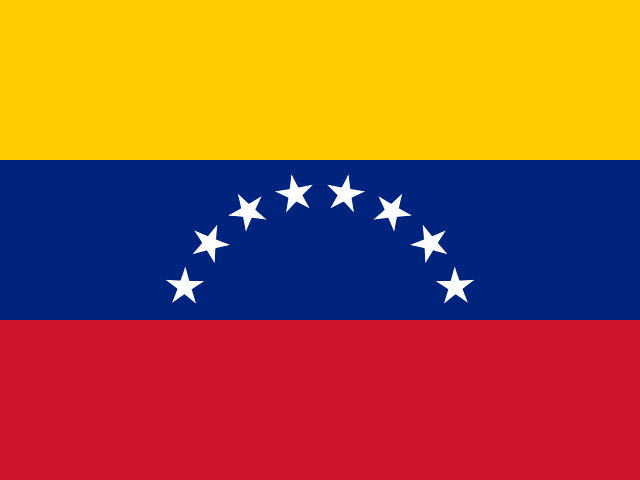
Cédula de Identidad and Pasaporte on one session, cross-checked against SAIME, $0.33 full KYC, 500 free every month.







Trusted by 2,000+ organizations worldwide.
How identity verification works in Venezuela.
- Fraud landscape
- Three pressures shape Venezuelan identity fraud: deepfake and synthetic-Cédula attacks on the digital wallets and remittance corridors that serve the diaspora, Cédula document forgery across the V- and E- prefixes, and the cross-border KYC challenge as Venezuelan migrants onboard into Colombian, Peruvian, Chilean and Ecuadorian fintechs. Didit scores 200+ real-time fraud signals on every session, face morph, replay, injection, document tampering, device intelligence, IP geolocation.
- Compliance frameworks
- Ley Orgánica contra la Delincuencia Organizada y Financiamiento al Terrorismo
- Resoluciones SUDEBAN (CDD)
- Ley Orgánica de Protección de Datos Personales (in development)
- FATF 40 recommendations
Who supervises identity verification in Venezuela.
SUDEBAN
Superintendencia de las Instituciones del Sector Bancario, prudential supervisor for banks, payment institutions and EMIs. Sets remote-onboarding rules under Resoluciones SUDEBAN.
SUNAVAL
Superintendencia Nacional de Valores, securities and crypto-asset supervisor. Registers broker-dealers and securities-market intermediaries.
UNIF
Unidad Nacional de Inteligencia Financiera, Venezuela's Financial Intelligence Unit. Receives Reportes de Actividades Sospechosas under the Ley Orgánica contra la Delincuencia Organizada y Financiamiento al Terrorismo.
Identity authority
countries.venezuela.regulators.identity_authority.description
CNE
Consejo Nacional Electoral, electoral authority. Holds the underlying voter registry that feeds SAIME for civic-status data.
Four modules. One verification.
Capture and read the ID.
Captured on any phone, auto-classified, OCR-parsed, and template-verified.
- Cédula de Identidad (V- for citizens, E- for foreign residents), Pasaporte (with the chip read on e-Passports), and driving licence.
- Returns the name, Cédula number, date of birth, sex, and expiry.

Match the face. Prove it's a real person..
Selfie confirmed live and matched against the ID portrait.
- Duplicate check: 1:N face search across existing users. Free.
- Active liveness ($0.15) for elevated-risk flows, user turns or blinks.

Screen for sanctions, PEPs, and adverse media.
1,300+ global sanctions, PEP, and adverse-media lists, plus Venezuelan watchlists:
- Vendata, Sanctions and Sanctioned Database, comprehensive Venezuelan sanctions registry.
- National Assembly of Venezuela PEP register, Diputados and senior legislative officials (PEP Level 1).
- Venezuelan Communist Party (PCV) PEP register, senior party officials politically exposed at national level.
- Ministry of People's Power for Tourism PEP register, ministerial-level politically exposed persons.
- Democratic Unity Roundtable (MUD) PEP register, opposition coalition senior leadership.
- Tribunal of Supreme Court of Justice Warnings, judicial enforcement and sanctions alerts.
- UNIF sanctions register, Unidad Nacional de Inteligencia Financiera designated entities under anti-money laundering law.
Severity-scored. Ongoing monitoring ($0.07/user/yr) re-checks daily and fires a webhook on new hits.
Cross-check against SAIME.
Cross-checked against the authoritative civil registry.
- The Cédula check (
ven_cedula,$0.20) is the authoritative-source lookup, hits SAIME for identification number, full name, date of birth, gender and document type. Handles both V- (citizens) and E- (foreign residents) prefixes. No consent required. - Pay-per-success, only billed when SAIME returns a conclusive result.
Every Venezuela document Didit accepts.
Civil-registry and AML coverage for Venezuela.
Cédula verification
Source: CNE electoral registry. $0.20 USD per query. Coverage 90-95%.
AML lists screened in Venezuela
1,300+ sanctions, Politically Exposed Persons (PEP), and adverse-media lists, plus the country's regulatory watchlists and PEP registries.
Verify with an ID number, no document photo.
- Registry
- CNE
- The user types
- Venezuelan Cédula
- Selfie
- Not needed; the lookup confirms the data, not presence
Source, rate and availability come from the production methods catalog. A registry that answered is billed, match or not; a silent registry and a mistyped number are not.
Open a new country in one click. We do the hard work.













Common questions about Venezuela.
What does Didit ship?
Didit is the infrastructure layer for identity and fraud. One Application Programming Interface (API), 25+ composable modules across four product lines:
- User Verification (KYC, know your customer), Identity Document Verification, liveness, face match, Anti-Money Laundering (AML) screening, Internet Protocol (IP) analysis. $0.33 per full bundle.
- Business Verification (KYB, know your business), registry, Ultimate Beneficial Owner (UBO), officers, entity AML, plus a linked KYC session per UBO.
- Transaction Monitoring, real-time rule engine, case management, Suspicious Activity Report (SAR) workflow.
- Wallet Screening (KYT, know your transaction), on-chain wallet risk at $0.15 per check, or bring your own screening provider and run it inside Didit.
Compose any module into a workflow with the visual no-code builder, ship in 5 minutes, 500 verifications free every month, forever.
How is Didit different from a single-product Know Your Customer (KYC) vendor?
Most identity vendors sell one slice, a KYC check, an Anti-Money Laundering (AML) list, a wallet screen. Didit ships the infrastructure underneath all of them, and the gap shows up on six axes:
- Pricing. Public price on every module, $0.33 for a full KYC, 500 verifications free every month, no minimums, no contracts. Single-product vendors hide six-figure minimums behind a sales call.
- Access. Sandbox in one click, self-serve from day one, production keys on signup. Single-product vendors gate the sandbox behind a contract, months to evaluate.
- Developer experience. Public docs, a Model Context Protocol (MCP) server for Claude Code and Cursor, and native Software Development Kits (SDKs) for Web, iOS, Android, React Native, and Flutter. Integrate in 5 minutes with an AI agent or in a working afternoon by hand.
- User experience. Highest pass rates in the market, sub-2-second end-to-end inference, country-specialised capture flows, 48+ languages out of the box.
- Flexibility. One
/v3/Application Programming Interface (API) composes 25+ modules across KYC, Know Your Business (KYB), Transaction Monitoring, and Wallet Screening (KYT, know your transaction). A KYB session spawns a linked KYC for every Ultimate Beneficial Owner (UBO); a flagged transaction spawns a step-up KYC remediation, same session, same webhook contract, same audit trail. Single-product vendors sell one shape of KYC and stop there. - AI-era fraud. 200+ real-time fraud signals scored on every session, deepfake, injection, synthetic-ID, document forgery, face-morph, device intelligence, replay. Single-product vendors treat deepfake and injection detection as roadmap items, not defaults.
Common in fintech and crypto, the same architecture fits marketplaces, iGaming, mobility, and any vertical where you need to know who someone is and what they are doing.
What does it cost? Is anything actually free?
500 verifications free every month, forever, on every account. No credit card. No sales call. No expiry.
Above the free tier, every module has a public per-success price on didit.me/pricing, $0.33 per full KYC bundle, $0.15 per Identity Document Verification, $0.15 per Wallet Screening, $0.20 per Anti-Money Laundering (AML) Screening, $0.10 per liveness, $0.05 per face match, $0.03 per Internet Protocol (IP) analysis.
Pay-as-you-go, no minimums, no overage surprises. Volume discounts kick in automatically as you grow.
Which Venezuelan regulator covers identity verification on a digital onboarding?
Three sit on top of every Venezuelan identity-verification flow:
- Superintendencia de las Instituciones del Sector Bancario (SUDEBAN), sets remote-onboarding requirements for banks, payment institutions and EMIs under Resoluciones SUDEBAN and the broader Ley de Instituciones del Sector Bancario.
- Superintendencia Nacional de Valores (SUNAVAL), securities and crypto-asset supervisor.
- Unidad Nacional de Inteligencia Financiera (UNIF), Venezuela's Financial Intelligence Unit. Receives Reportes de Actividades Sospechosas under the Ley Orgánica contra la Delincuencia Organizada y Financiamiento al Terrorismo.
Didit ships the hosted flow + the audit log + the watchlist coverage to satisfy all three at the same time, same POST /v3/session/ workflow, same JSON report, same SOC 2 Type 1 & Type 2 + ISO/IEC 27001 evidence pack. Coverage is offered per the international sanctions and compliance regimes that apply to Venezuelan persons.
Does Didit cross-check Venezuelan identities against SAIME?
Yes, via the `ven_cedula` Database Validation service (POST /v3/database-validation/ with services=ven_cedula).
- Source: Servicio Administrativo de Identificación, Migración y Extranjería (SAIME), the authoritative Venezuelan civil registry.
- Price:
$0.20 per successful query. - Required inputs:
document_number(the Cédula, 7-10 digits with optional V- or E- prefix). - Returns:
identification_number,first_name,last_name,full_name,date_of_birth,gender,document_type. - Consent: Not required.
The same service handles both V- (citizens) and E- (foreign residents) prefixes.
How does Didit handle Venezuelan migrants onboarding into other LATAM markets?
Didit is widely deployed for cross-border Venezuelan-migrant onboarding. The pattern looks like this:
- Capture the Venezuelan Cédula + Pasaporte on the host country's verification flow (
docs.didit.me/core-technology/id-verification/overview). - Use `ven_cedula` as the authoritative-source check against SAIME.
- Pair with the destination-country Database Validation service,
col_cedulafor Colombia,per_dnifor Peru,chl_rutfor Chile,ecu_cedulafor Ecuador, depending on whether the migrant has the local PPT, Carné de Extranjería or equivalent. - Run AML Screening against the global sanctions pool (OFAC, EU, UK, Canadian) plus Venezuelan and host-country regulatory watchlists.
- Wallet Screening (KYT) at $0.15 per check on the remittance leg if the destination is a crypto on-ramp or stablecoin-backed wallet.
One POST /v3/session/ call, one JSON report, one workflow, composable across both jurisdictions.
How long does it take to integrate Didit in Venezuela?
5 minutes to a working sandbox, a weekend to a production flow.
- Sign up at
business.didit.me, grab an API key, callPOST /v3/session/with aworkflow_idthat wires ID Verification + Active Liveness + Face Match + AML + SAIME Cédula cross-check, done. - AI-agent path: paste the integration prompt at
docs.didit.me/integration/integration-promptinto Claude Code, Cursor, Codex, Devin, Aider, or Replit Agent. The agent provisions the application, builds the workflow, wires the webhook, and runs a smoke test. - Five SDKs share the same session model: Web, iOS, Android, React Native, Flutter.
The first 500 verifications every month are free, forever, pilot the full Venezuela stack at zero cost before flipping production traffic.
Which language does the hosted verification flow use for Venezuelan users?
Venezuelan Spanish, auto-detected from the user's browser / device locale. The hosted UI ships in 48+ languages; Venezuelan users land on the Spanish flow by default. English is also live on the same flow for cross-border or expat users.
The document-recognition layer is decoupled from the UI layer, capture works in any language, and the admin console can be set independently to whichever language your compliance team prefers.
What does the Venezuela verification cost end-to-end?
Per-module public pricing, pay only for what runs on the session:
- ID Verification,
$0.15per document check. - Passive Liveness,
$0.10. Active Liveness,$0.15. - Face Match 1:1,
$0.05. Face Search 1:N, free. - AML Screening,
$0.20per check. Ongoing AML,$0.07 per user / year. - `ven_cedula` (SAIME),
$0.20per successful query.
The full KYC bundle (Identity + Passive Liveness + Face Match + IP Analysis) is `$0.33`, same anchor price worldwide, no Venezuela surcharge. 500 verifications free every month, no credit card. Volume discounts auto-apply above the free tier; Enterprise adds a custom Master Services Agreement (MSA) and data-residency choice.
Infrastructure for identity and fraud.
One API for KYC, KYB, Transaction Monitoring, and Wallet Screening. Integrate in 5 minutes.