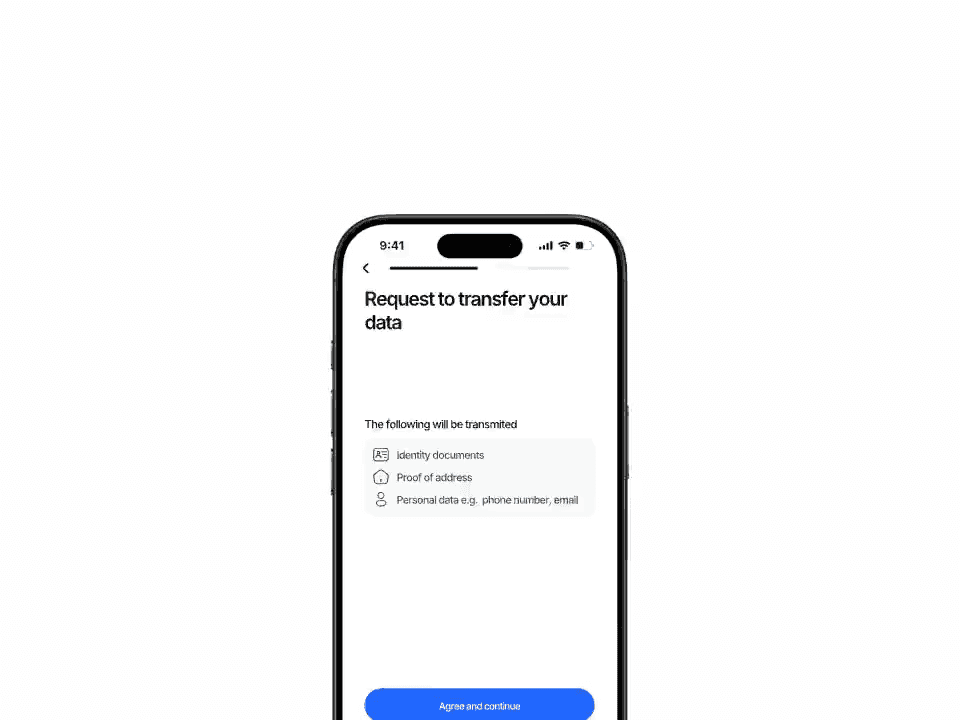
تحقق من هوية مستخدم أو شركة مرة واحدة. شارك النتيجة مع شريكك, ليتمكن من ضم نفس الشخص فورًا. لا توجد عملية ثانية، ولا صورة سيلفي ثانية. يعمل لـ KYC و KYB. مصمم خصيصًا للخدمات المصرفية كخدمة (BaaS)، والمجموعات متعددة العلامات التجارية، والتمويل المدمج، والأسواق ذات المنصات الفرعية.
يتحقق المستخدم مرة واحدة في تطبيقك. يحتاج شريكك, سواء كان راعي BaaS، أو علامتك التجارية الشقيقة، أو سوقك النهائي, إلى نفس السجل. أرسل لهم رمز مشاركة لمرة واحدة. يستردونه ويستوردون التحقق الكامل. لا يرى المستخدم عملية ثانية أبدًا.
كيف يعمل
من تطبيقك إلى شريكك في أربع خطوات.
الخطوة 01 / 04
01
اختر جلسة تحقق
اختر أي عملية تحقق مكتملة, سواء كانت معتمدة، مرفوضة، أو قيد المراجعة, واطلب من Didit رمز مشاركة. ينتهي صلاحية الرمز في غضون ساعة واحدة افتراضيًا؛ يمكنك تمديده من دقيقة واحدة حتى يوم كامل.
أرسل الرمز إلى شريكك
سلم الرمز إلى شريكك عبر الواجهة الخلفية الخاصة بك, سواء كان webhook، أو قائمة انتظار، أو استدعاء REST. يعمل الرمز فقط للشريك الذي حددته عند إنشائه. لا يمكن لأي شخص آخر استرداده.
شريكك يستورد السجل
يسترد شريكك الرمز ويختار كيفية ضم المستخدم, إما أن يثق بقرارك ويوافق فورًا، أو يسحب البيانات الأولية ويترك فريق الامتثال الخاص به يتخذ القرار.
الجلسة الكاملة تصل إلى تطبيقهم
يستنسخ Didit السجل بالكامل, الوثائق، السيلفي، مطابقة الوجه، AML، بيانات السجل، UBOs, إلى مساحة عمل شريكك. بنفس شكل التحقق الجديد، مع مسار تدقيق واضح يعود إلى الأصل.
مصمم لـ BaaS · التمويل المدمج · المجموعات متعددة العلامات التجارية
تحقق واحد. كل منصة شريكة.
أنشئ رمزًا. أرسله. استورده. اختر سرعة الضم. ستة أجزاء متحركة تغطي كل أشكال الأنظمة البيئية الشريكة, نفس الاستدعاء لـ KYC و KYB.
اختر عملية تحقق مكتملة واطلب من Didit رمزًا مخصصًا لشريك واحد. العمر الافتراضي الافتراضي هو ساعة واحدة؛ يمكنك تمديده من دقيقة واحدة حتى يوم كامل. يعمل الرمز فقط للشريك الذي حددته, لا يمكن لأي شخص آخر استرداده أبدًا.
المدة الافتراضية (TTL): 3,600 ثانية · النطاق 60 ثانية, 86,400 ثانية
مخصصة لتطبيق استقبال واحد
الجلسات المكتملة فقط (موافق عليه · مرفوض · قيد المراجعة)
02 · استورد الجلسة
يسحب شريكك السجل الكامل.
يسترد شريكك الرمز ويستنسخ Didit التحقق بالكامل في مساحة عمله, جلسة جديدة، نفس البيانات، مسار تدقيق كامل يعود إلى الأصل. يقومون بوضع علامة عليه بمعرف المستخدم الداخلي الخاص بهم ويختارون سير العمل الذي يصل إليه.
ثق بقرارك ودع شريكك يوافق على المستخدم لحظة وصول الرمز. أو سلمهم البيانات الأولية ودع فريق الامتثال الخاص بهم يتخذ القرار. تبديل لكل شريك, نفس الاستدعاء، سرعتان للضم.
trueيستنسخ الحالة الأصلية, إعداد فوري.تمت الموافقة
falseيستنسخ البيانات، ويضبط الحالة إلى قيد المراجعة.قيد المراجعة
تبديل لكل علاقة شريك · الافتراضي هو `false` للشركاء الجدد
04 · KYC + KYB · كلا الوضعين
شارك بيانات شخص أو شركة كاملة.
نفس الاستدعاء يعمل لكلا الشكلين. شارك شخصًا تم التحقق منه ويحصل شريكك على الوثيقة، السيلفي، المطابقة، وكل نتائج AML. شارك شركة تم التحقق منها ويحصلون على سجل السجل، كل مالك مستفيد نهائي، كل KYC للمسؤول، كل وثيقة، كل فحص.
الرمز المميز يحمل `session_kind` · Didit يختار المسار المطابق للاستنساخ
05 · مناسب للأنظمة البيئية الشريكة
مصمم للشركات التي تحتاج إلى تحقق واحد لخدمة الكثيرين.
رعاة الخدمات المصرفية كخدمة (BaaS). المجموعات متعددة العلامات التجارية, بنك رقمي بالإضافة إلى وسيط، منصة إيداع بالإضافة إلى بورصة. التمويل المدمج الذي يتم من خلال البنوك الشريكة. الأسواق ذات المنصات الفرعية الإقليمية. الموزعون ذوو العلامات البيضاء. شبكات المقرضين. أي مكان يتم فيه ضم مستخدم واحد, أو شركة واحدة, مرة واحدة ويخدم العديد.
بائعو التجزئة ذوو العلامة البيضاءبائع تجزئة + مستأجر تابع
اتحادات KYB للشركات (B2B KYB consortia)نفس الكيان القانوني عبر العديد من الشركاء
06 · الامتثال بالتصميم
بجودة تدقيق افتراضية.
ينشئ Didit الرموز فقط لعمليات التحقق المكتملة, لا تتسرب تدفقات غير مكتملة عبر الشركاء. لا يمكن استيراد نفس الرمز مرتين أبدًا. يوقع الطرفان على اتفاقية مشاركة بيانات GDPR؛ و Didit يوفر الجانب التقني.
الصق الكتلة أدناه في Claude Code أو Cursor أو Codex أو Devin أو Aider أو Replit Agent. سيقوم الوكيل بربط Didit، وإعداد جانبي التسليم، وإطلاق المنتج.
didit-integration-prompt.md
# Didit B2B Reusable KYC — partner-to-partner KYC sharing

You are integrating Didit's B2B Reusable Know Your Customer (KYC) into <my_stack>. The recipe is server-to-server: one Didit application (Service X) mints a short-lived JSON Web Token (JWT) share token for a finished session; a partner Didit application (Service Y) imports the token and Didit clones the full verified session into Service Y. Works for both KYC and Know Your Business (KYB) sessions.

Built for Banking-as-a-Service (BaaS) sponsor banks, multi-brand financial groups, embedded finance through partner banks, marketplaces with regional or vertical sub-platforms, on-ramp + exchange ecosystems, white-label resellers, and B2B KYB consortia where the same legal entity onboards once and serves many. Every URL, header, and enum value below is canonical — do not paraphrase or "improve" them.

## 1. Provision both applications
- Sign up: https://business.didit.me (no credit card required).
- Or provision programmatically: POST https://apx.didit.me/auth/v2/programmatic/register/
- Create TWO applications in your Didit organisation. One acts as Service X (mints share tokens), the other as Service Y (imports them). In production these will usually live in different organisations — one per partner.
- Each application has its own `x-api-key`. Service X uses its own key to mint; Service Y uses its own key to import.

## 2. Service X — mint a share token

Service X picks a finished session it owns and posts to the share endpoint:

  POST https://verification.didit.me/v3/session/{sessionId}/share/
  Headers:
    x-api-key: <Service X api key>
    Content-Type: application/json
  Body:
    {
      "for_application_id": "<partner-application-uuid>",
      "ttl_in_seconds": 3600
    }

Bounds on `ttl_in_seconds`: min 60, max 86400, default 3600.

Requirements:
  - The session must be in a FINISHED status: "Approved", "Declined", or "In Review".
  - The API key must hold the `write:sessions` privilege.
  - `for_application_id` must be a real Didit application uuid — usually the partner's app.

Response: 201 Created with the JWT in the `share_token` field plus `for_application_id` and `session_kind` ("user" or "business" — Didit detects this from the source session and embeds it in the token):

  {
    "share_token": "eyJhbGciOiJIUzI1NiJ9...",
    "for_application_id": "partner-app-uuid",
    "session_kind": "user"
  }

## 3. Transmit the token to Service Y

Service X transmits the `share_token` to Service Y over a pre-arranged backend channel — REST, message queue, signed webhook, anything you control. The token is scoped to Service Y's application and useless to any other application.

## 4. Service Y — import the shared session

Service Y posts the token to the import endpoint:

  POST https://verification.didit.me/v3/session/import-shared/
  Headers:
    x-api-key: <Service Y api key>
    Content-Type: application/json
  Body:
    {
      "share_token": "<jwt from step 2>",
      "workflow_id": "<Service Y's own workflow id>",
      "vendor_data": "<Service Y's internal user id>",
      "trust_review": true
    }

`trust_review`:
  - `true`  → the imported session preserves the original status ("Approved" / "Declined" / "In Review"). Service Y onboards the user instantly. Use when Service Y fully trusts Service X's decision (sister brand, regulated partner with a signed data-sharing agreement).
  - `false` → the imported session lands in "In Review" so Service Y's compliance team makes its own call. Safe default for new partner relationships.

Response: 201 Created with a brand-new session in Service Y's application:

  {
    "session_id": "<new uuid>",
    "session_number": <int>,
    "session_kind": "user" | "business",
    "status": "Approved" | "In Review" | "Declined",
    "shared_from_session": "<original session uuid in Service X>",
    "vendor_data": "<Service Y's internal user id>",
    "id_verifications": [...],
    "liveness_checks": [...],
    "face_matches": [...],
    "aml_screenings": [...],
    "database_validations": [...],
    "proof_of_address": [...],
    "phone_verifications": [...],
    "email_verifications": [...]
  }

For a `session_kind: "business"` token Didit clones the KYB shape instead. KYB session statuses are UPPER_SNAKE_CASE (not Title Case like KYC):

  {
    "session_id": "<new uuid>",
    "session_kind": "business",
    "status": "APPROVED",
    "shared_from_session": "<original business session uuid>",
    "vendor_data": "<Service Y's internal business id>",
    "registry_checks": [...],
    "key_people_checks": [...],
    "document_verifications": [...],
    "aml_screenings": [...],
    "questionnaires": [...]
  }

A new User or Business entity is auto-created in Service Y if one with the supplied `vendor_data` doesn't already exist.

## 5. Idempotency, expiration, errors

| Status | Reason |
|--------|--------|
| 401 | Share token invalid or past `exp` — request a new one. |
| 403 | Token not intended for your application, OR session already imported into your app. |
| 404 | Original session no longer exists. |
| 404 | `workflow_id` not found in your application. |

The duplicate-import check is enforced against the (share_token, partner application) pair.

## 6. Webhooks (optional, only when Service Y wants async updates)

Service Y can register a webhook destination once via:

  POST https://verification.didit.me/v3/webhook/destinations/
  Body: url, subscribed_events: ["status.updated"]

Every webhook delivery carries an `X-Signature-V2` header you MUST verify before trusting the payload. HMAC-SHA256 verification MUST run against the raw body bytes (the raw payload as Didit sent it) BEFORE any JSON parsing — re-serialising the parsed body changes whitespace and key order, which invalidates the signature.

Algorithm:
  1. sortKeys(payload) recursively
  2. shortenFloats (truncate trailing zeros after the decimal point)
  3. JSON.stringify the result
  4. HMAC-SHA256 with the secret_shared_key
  5. Hex-encode, compare to the X-Signature-V2 header.

## 7. Hard rules — do not change
- Base URL for /v3/* endpoints is verification.didit.me (NOT apx.didit.me).
- Auth header is x-api-key (lowercase, hyphenated).
- Webhook signature header is X-Signature-V2 (NOT X-Signature).
- Status casing matches exactly: "Approved", "Declined", "In Review", "Not Finished" (Title Case With Spaces — KYC convention).
- session_kind is lowercase: "user" or "business".
- The share API is BUSINESS-to-BUSINESS sharing. Service X and Service Y are responsible for the data-sharing legal basis under General Data Protection Regulation (GDPR), UK GDPR, and any cross-border transfer rules. Didit ships the technical capability; you ship the data-sharing agreement.

## 8. Pricing reference (public)
- Service X already paid for the original verification (full KYC bundle is $0.33 or KYB session uses country-specific registry pricing; see didit.me/pricing).
- Service Y pays nothing on the import side — `POST /v3/session/import-shared/` is included with every plan.
- 500 free verifications every month on every account (applies to fresh captures, not imports).

## 9. Verify your integration
- Sandbox starts on signup at https://business.didit.me — no separate flag.
- Create two sandbox applications: one as Service X (issuer), the other as Service Y (importer). Use Service X's API key to mint a token for a finished sandbox session, hand the token off, use Service Y's API key to import.
- Switch to live: flip each application's environment toggle in console.

When in doubt:
- https://docs.didit.me/sessions-api/share-session/overview
- https://docs.didit.me/sessions-api/share-session/share
- https://docs.didit.me/sessions-api/share-session/import
- https://docs.didit.me/core-technology/reusable-kyc/share-kyc-via-api
متوافق حسب التصميم
افتح دولة جديدة بنقرة واحدة. نحن نقوم بالعمل الشاق.
نحن نفتح الشركات التابعة المحلية، ونؤمن التراخيص، ونجري اختبارات الاختراق، ونحصل على الشهادات، ونتوافق مع كل لائحة جديدة. لنشر عمليات التحقق في بلد جديد، ما عليك سوى تفعيل مفتاح. أكثر من 220 دولة تعمل، يتم تدقيقها واختبار اختراقها كل ربع سنة, المزود الوحيد للهوية الذي وصفته حكومة دولة عضو في الاتحاد الأوروبي رسميًا بأنه أكثر أمانًا من التحقق الشخصي.