Blog
Blog archive
Every post on the Didit blog, newest first. Pick a category or search to find the subject you need.
All posts
Every post, newest first
Pick a category to filter.
Bank Verification compares a bank account holder with the identity your workflow already verified. Create a Bank Link or run an account check, then read accounts and transactions by API.
Alberto RosasMar 15, 2026Maximize Document Coverage for Better KYC
Optimizing document coverage is crucial for robust identity verification and KYC compliance. This guide explores techniques to minimize friction, reduce costs, and improve fraud detection rates.
Alberto RosasMar 15, 2026Biometric Template Protection: Retention and Purge How-To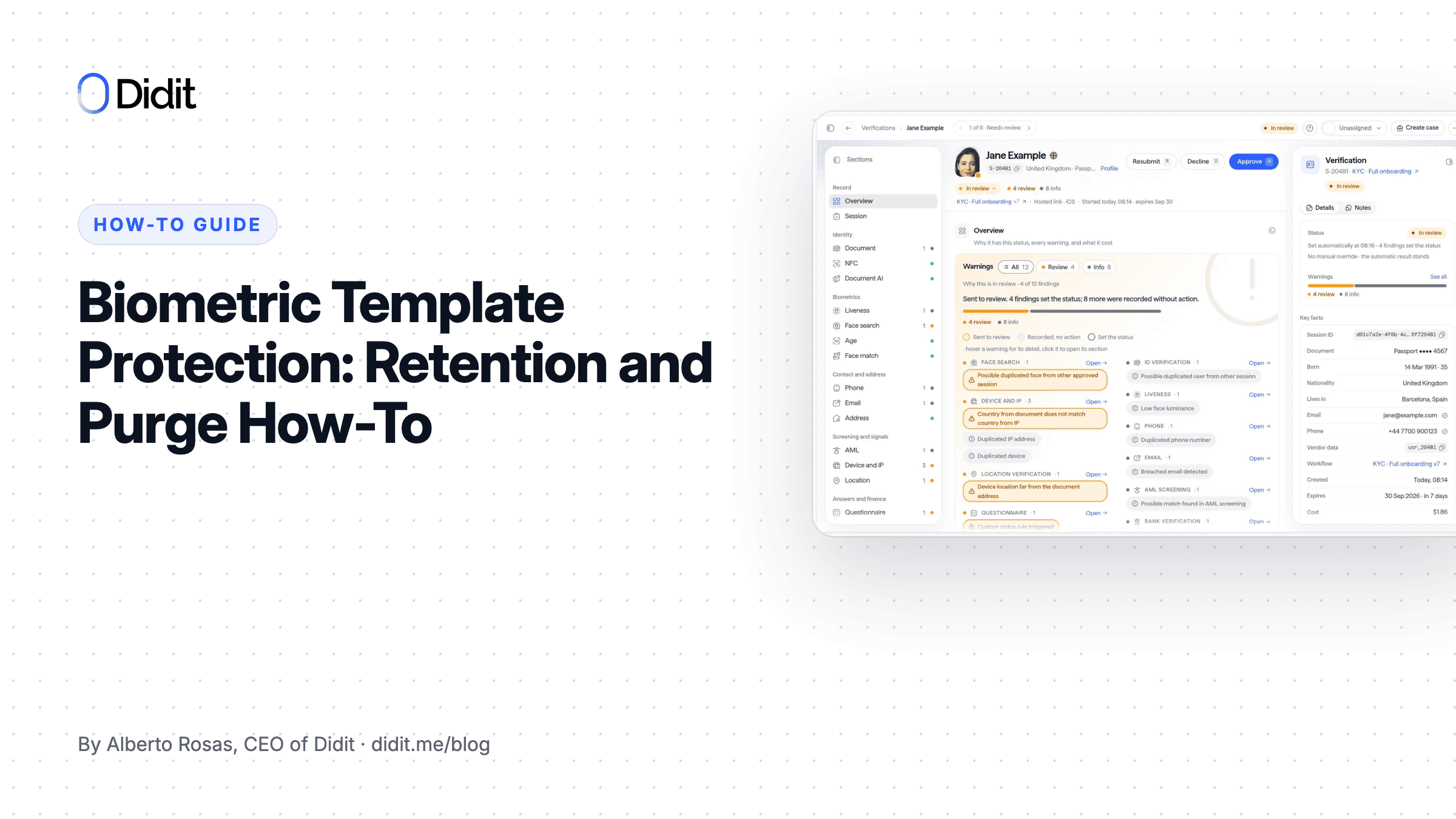
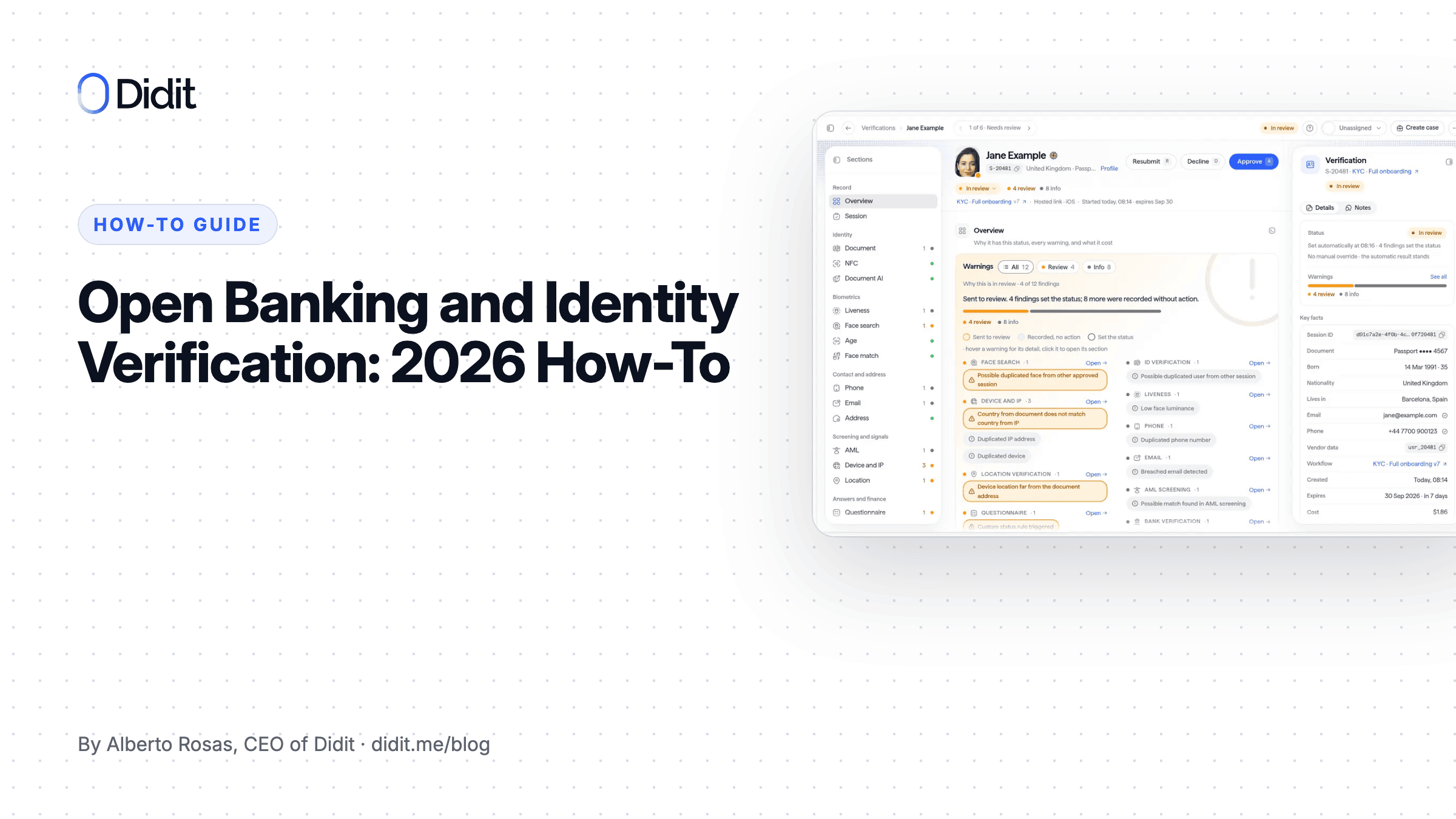
Didit keeps one image-free face template after a session deletion only if the application opts in, with a finite expiry. The live price feed lists no separate price for retaining, listing, counting, inspecting or purging a.
Alberto RosasMar 15, 2026KYC Localization: Navigating Global Compliance
Expanding internationally requires adapting your KYC processes. This guide explores the challenges of KYC localization, regional compliance differences, and how to build a scalable global strategy.
Alberto RosasMar 15, 2026Combating AI-Generated Document Risk
AI-generated documents and deepfakes pose a growing threat to identity verification. Learn how to detect forged documents and protect your business from fraud with advanced verification techniques.
Alberto RosasMar 15, 2026How to Detect a Forged Utility Bill With AI, 8 Steps
Catch forged utility bills by extracting the fields, matching name and address, and checking PDF forensics. The Didit Proof of Address API returns a status plus warnings for $0.20 per check.
Alberto RosasMar 15, 2026EDD Automation: How to Automate Enhanced Due Diligence in 2026
EDD automation runs enhanced due diligence as a configured workflow: KYC plus AML screening at $0.20 a check, two scores per hit, In Review items handled through your manual-review process, and ongoing monitoring at $0.07 per.
Alberto RosasMar 15, 2026Global Identity Verification Challenges: A 2026 How-To
Run one workflow with three per-country methods: document capture, non-document lookup and digital wallet sign-in, with explicit fallbacks. Full ID check $0.33. Coverage and price vary by country.
Alberto RosasMar 15, 2026MRZ Parsing Accuracy: A Step-by-Step How-To (2026)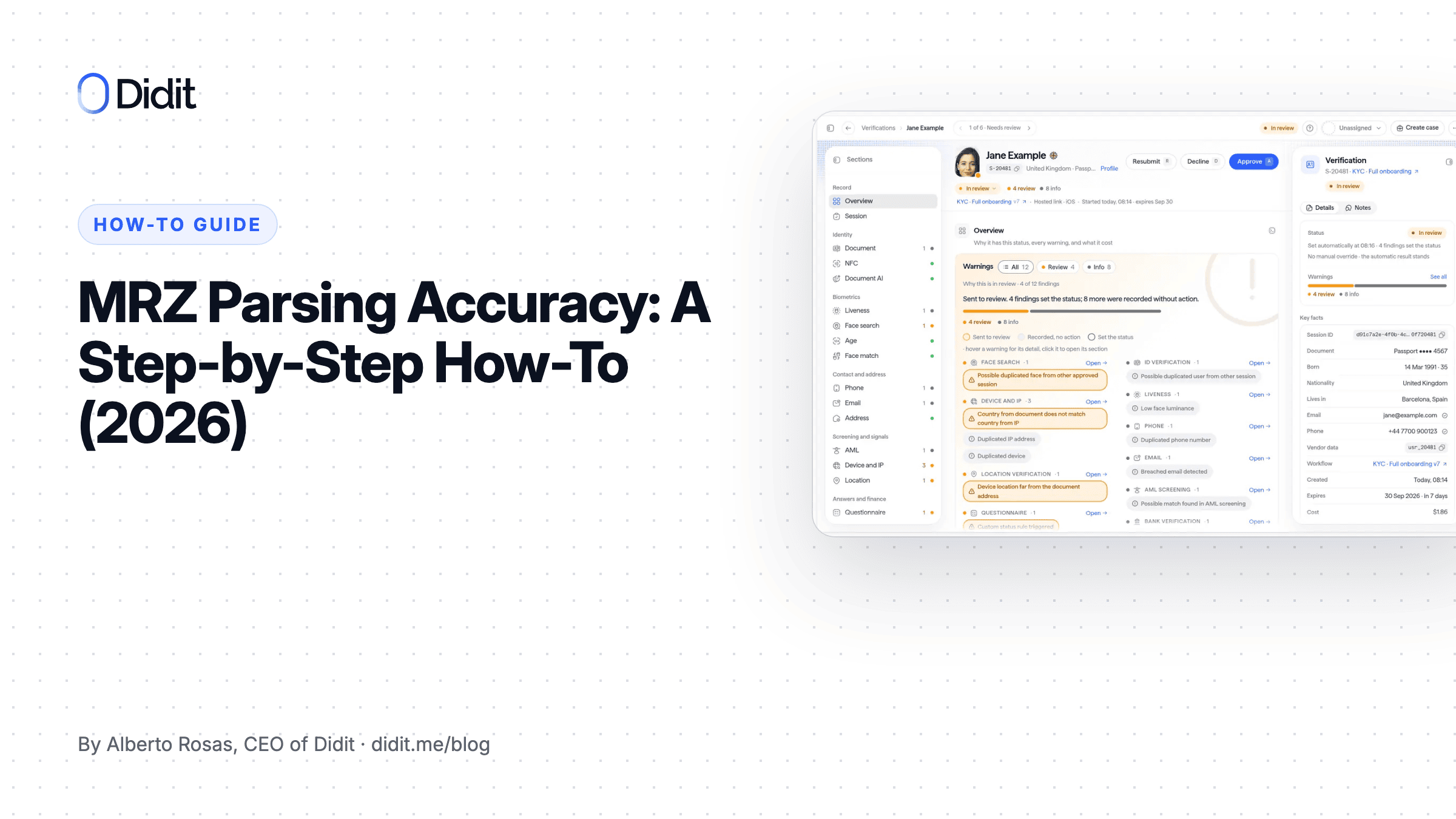
Send an uncropped image to Didit ID Verification: it decodes the MRZ, validates check digits, cross-checks the visual zone and returns a status and warnings. $0.15 per check.
Alberto RosasMar 15, 2026Microprint Analysis: A Key to Document Security (2)
Microprint analysis is a powerful document security feature used in identity verification and fraud detection. This article dives into how it works, its benefits, and its role in preventing counterfeiting.
Alberto RosasMar 15, 20266AMLD: Understanding Corporate Criminal Liability
6AMLD significantly expands AML compliance, introducing corporate criminal liability for failures in preventing money laundering. Learn what businesses need to do to avoid penalties and ensure effective officer due diligence.
Alberto RosasMar 15, 2026Predicate Offenses and AML: A 2026 Compliance Guide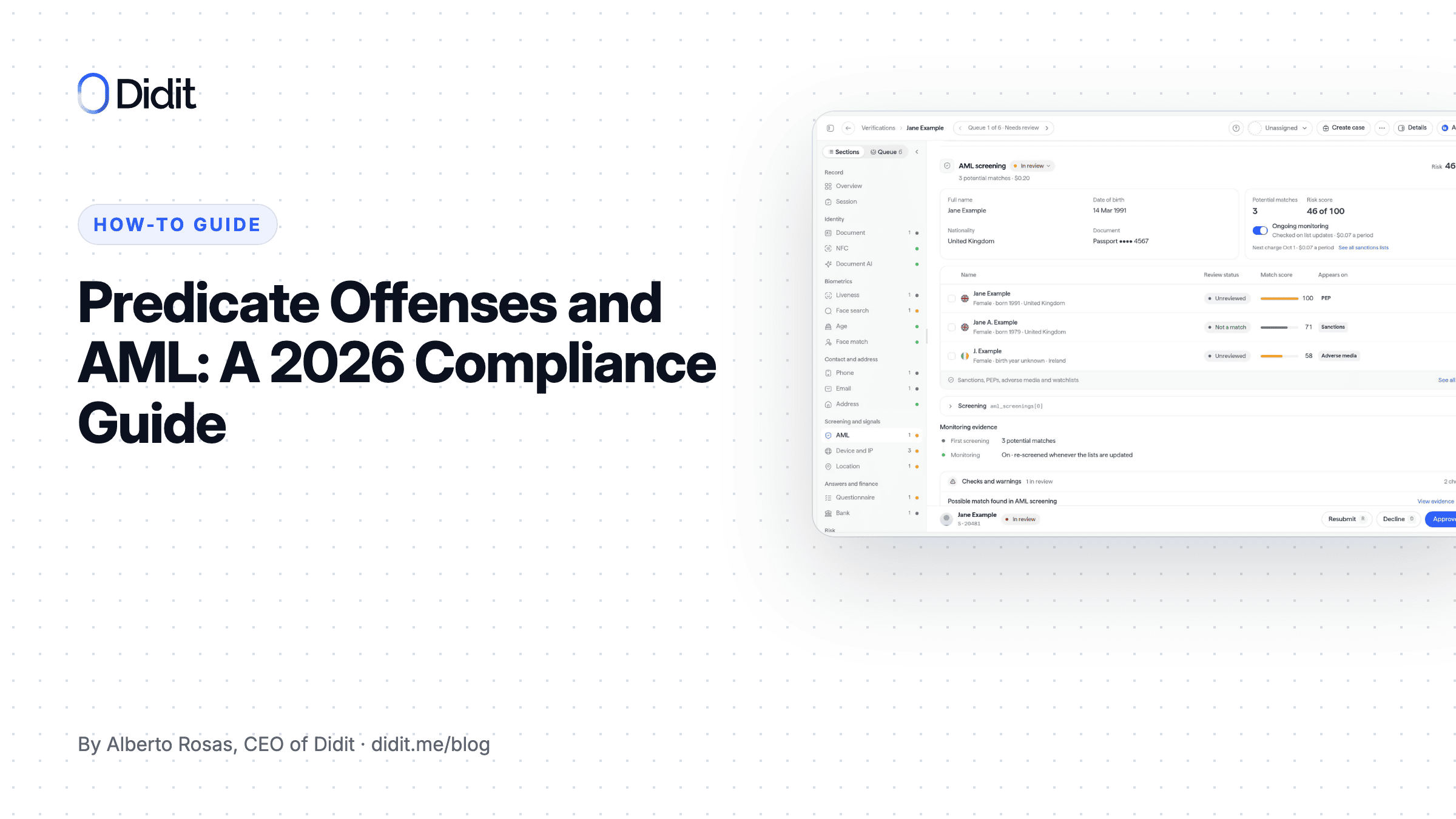
Predicate offenses are the crimes that generate dirty money. Map each category to a control: AML screening at $0.20 a check, ongoing monitoring at $0.07 per person a year, with human review on every In Review hit.
Alberto RosasMar 15, 2026Detecting Synthetic Proof of Address
Synthetic identity fraud is skyrocketing, and forged proof of address documents are a key enabler. Learn how AI-powered fraud detection can identify these fakes and protect your business.
Alberto RosasMar 15, 2026Decentralized Identity: The Future of Digital Trust
Explore the rise of decentralized identity (DID) and self-sovereign identity (SSI) powered by blockchain, transforming KYC and data privacy. Learn how these technologies are reshaping digital trust and empowering individuals.
Alberto RosasMar 15, 2026Combating Fraud in P2P Lending: A Complete Guide
Peer-to-peer (P2P) lending is vulnerable to fraud. This guide explores the risks, impact, and how robust identity verification and risk scoring can minimize loan fraud and protect your platform.
Alberto RosasMar 15, 2026Boost App Performance: Mobile SDK Optimization
Optimize your mobile app's identity verification process with a high-performing mobile SDK. Reduce load times, minimize app size, and enhance user experience. Learn best practices for integrating a mobile SDK effectively.
Alberto RosasMar 15, 2026Biometric Authentication in Fintech: A 10-Step 2026 Guide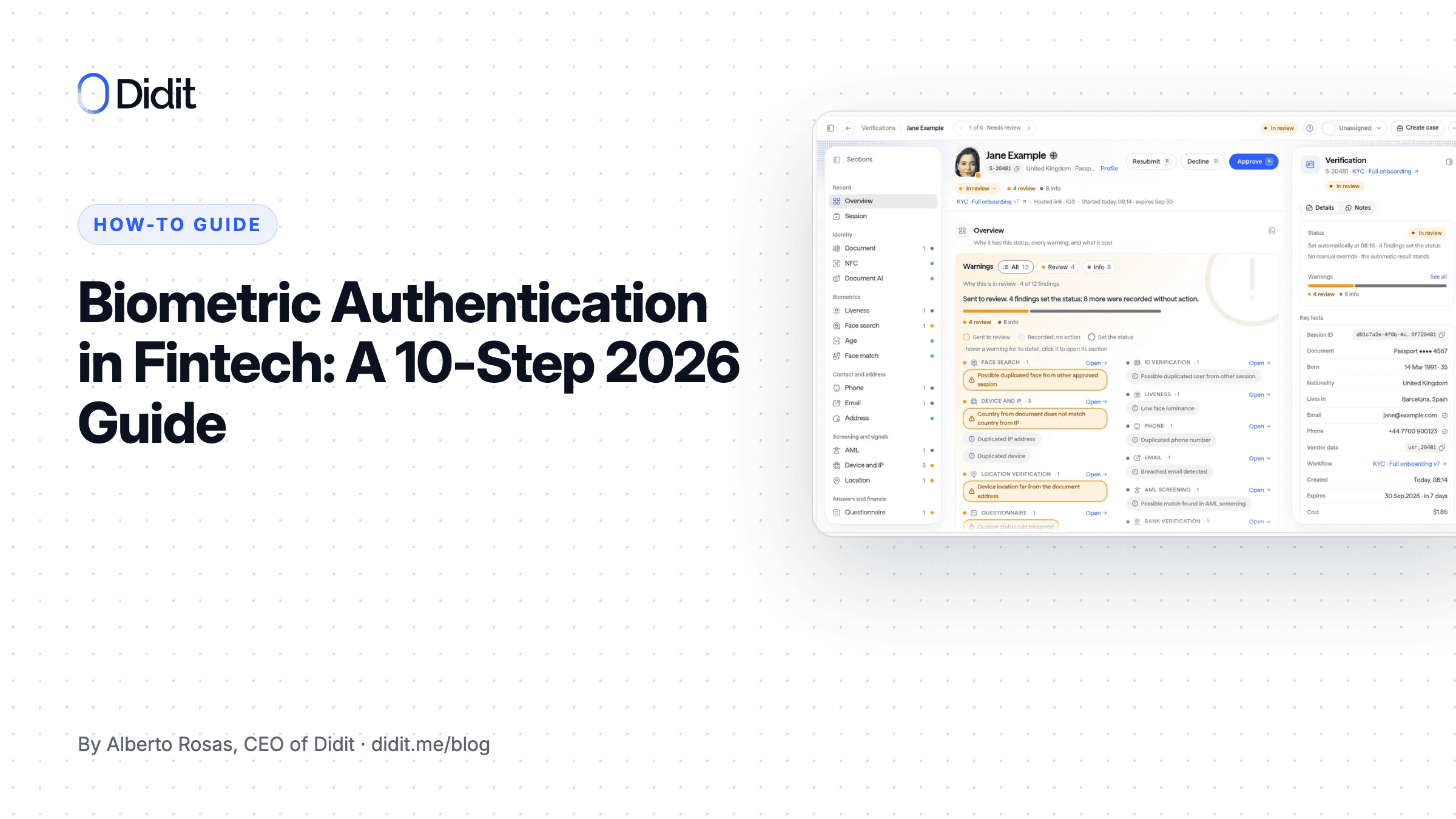
Use passkeys for routine fintech sign-in and a Didit selfie step-up before payouts. A selfie login costs $0.10 per check and the first 50,000 active users each month are free.
Alberto RosasMar 15, 2026Digital Identity & Privacy: A New Paradigm
As digital life expands, balancing seamless identity verification with robust privacy is crucial. Explore emerging technologies like zero-knowledge proofs and data minimization for a future of secure, privacy-respecting digital.
Alberto RosasMar 15, 2026Idempotency Keys for APIs: A Developer's Guide (2026)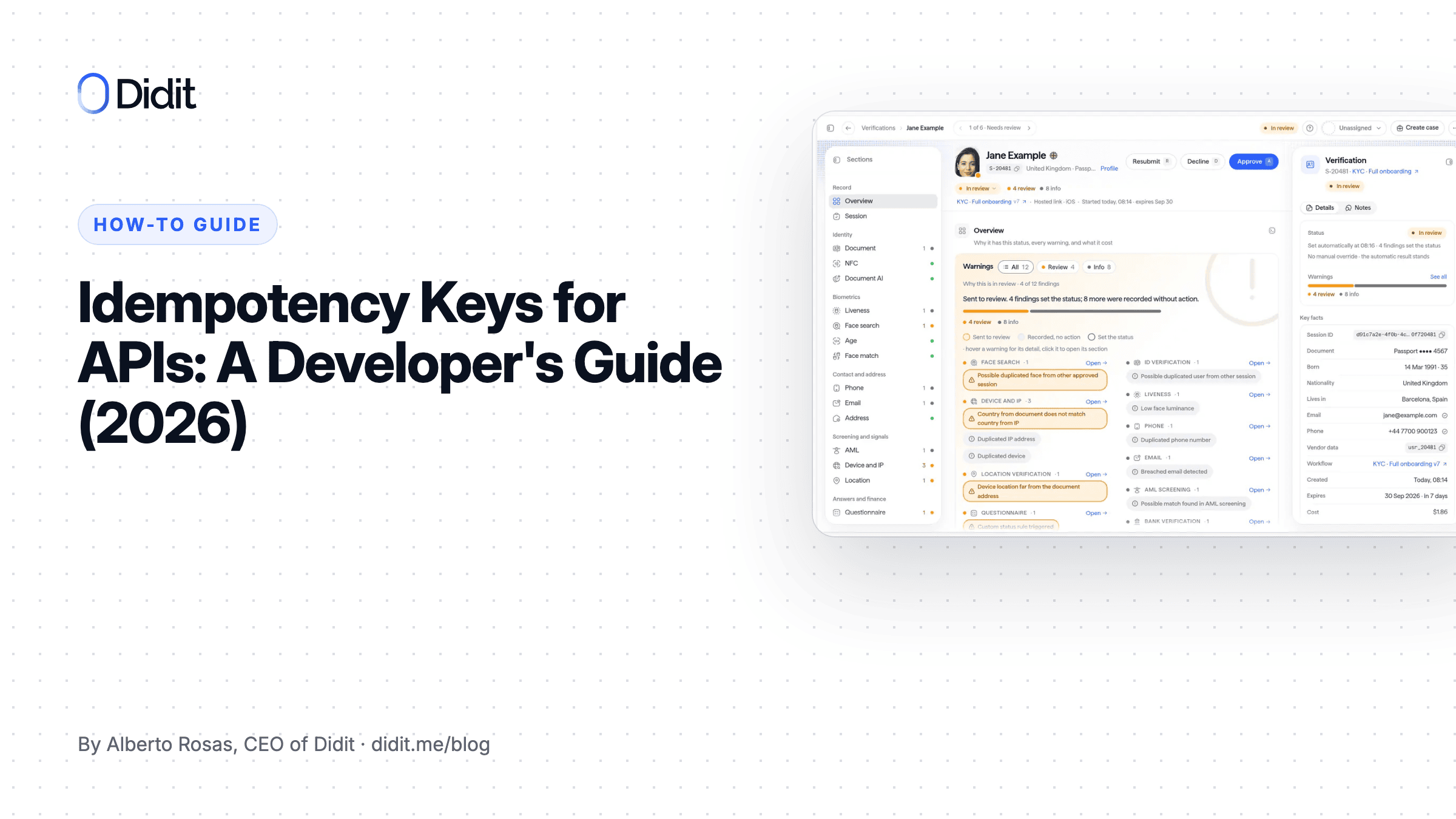
Use one key per intended operation. On Didit, keep the entity identifier stable and inspect a conflict before deciding whether to retry.
Alejandro RosasMar 15, 2026API Rate Limiting: A Guide for Identity Verification (1)
Protect your identity verification APIs with effective rate limiting. This guide covers strategies, best practices, and how Didit ensures API security and reliability.
Alberto RosasMar 15, 2026Secure RON: Remote Online Notarization Security
Remote Online Notarization (RON) offers convenience, but security is paramount. Explore the essential security measures—identity verification, KBA, tamper-evident technology—to ensure a legally sound and fraud-resistant RON.
Alberto RosasMar 14, 2026Webhook Security: Verify Didit Webhooks in Production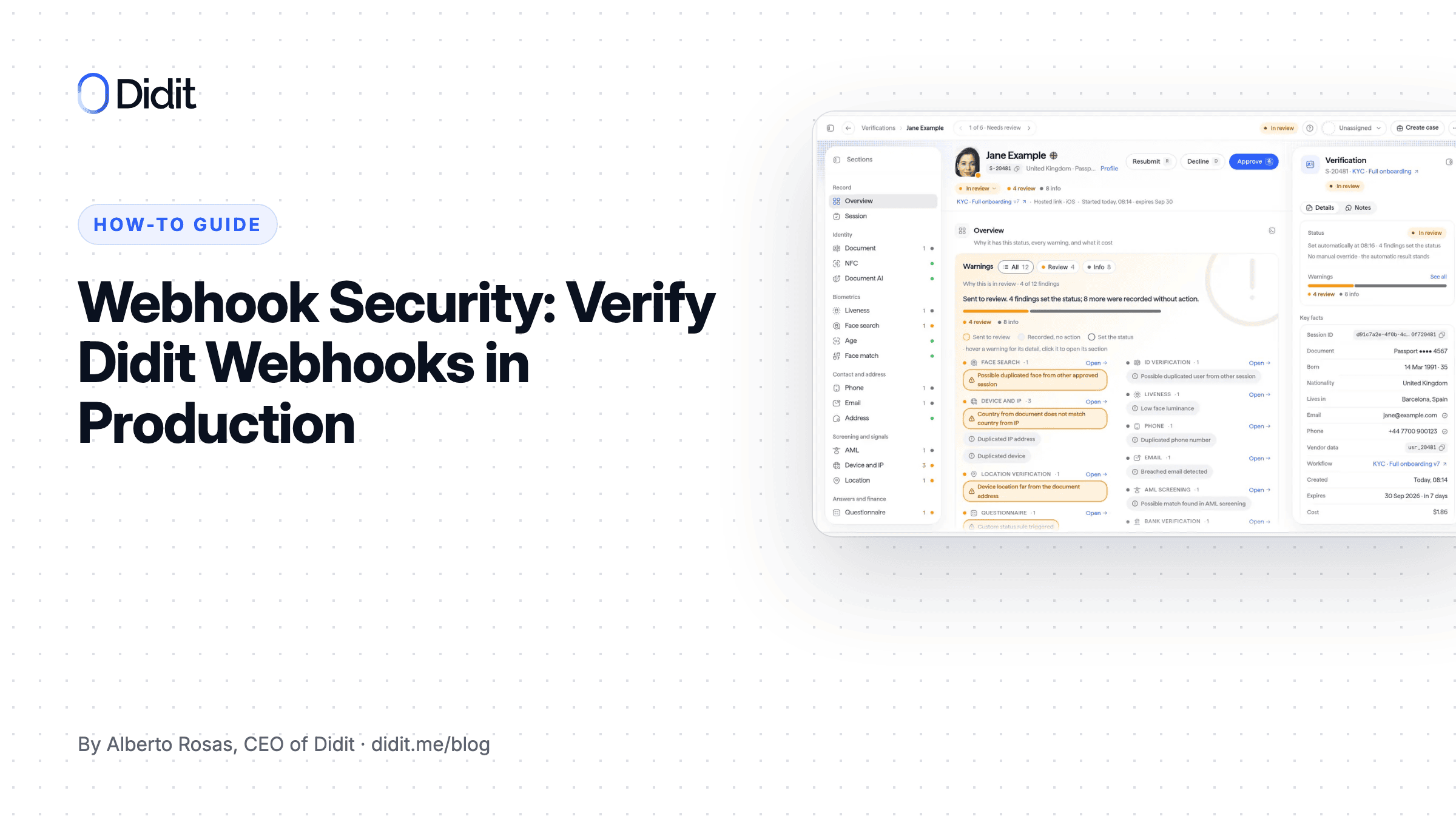
Verify Didit webhook signatures, check dispatch timestamps, and save each event ID with its queued work before returning 2xx. Test duplicate delivery and signing-secret rotation in the sandbox.
Alberto RosasMar 14, 2026Identity Verification in Legal Tech: A Compliance Guide
Legal tech firms face unique identity verification challenges due to strict regulations. This guide explores KYC/AML compliance, fraud prevention, and best practices for identity verification within the legal sector.
Alberto RosasMar 14, 2026Fraud Rule Orchestration: Real-Time Prevention
Discover how fraud rule orchestration leverages machine learning and real-time data to create a dynamic, adaptive fraud prevention system. Reduce false positives and optimize your fraud defenses.
Alberto RosasMar 14, 2026Metaverse Identity Verification: Securing Virtual Worlds
As the metaverse evolves, robust identity verification is crucial for security, trust, and user experience. Explore the challenges and solutions for metaverse identity verification.
Alberto RosasMar 14, 2026AI-Powered Document Forgery Detection: A 2026 How-To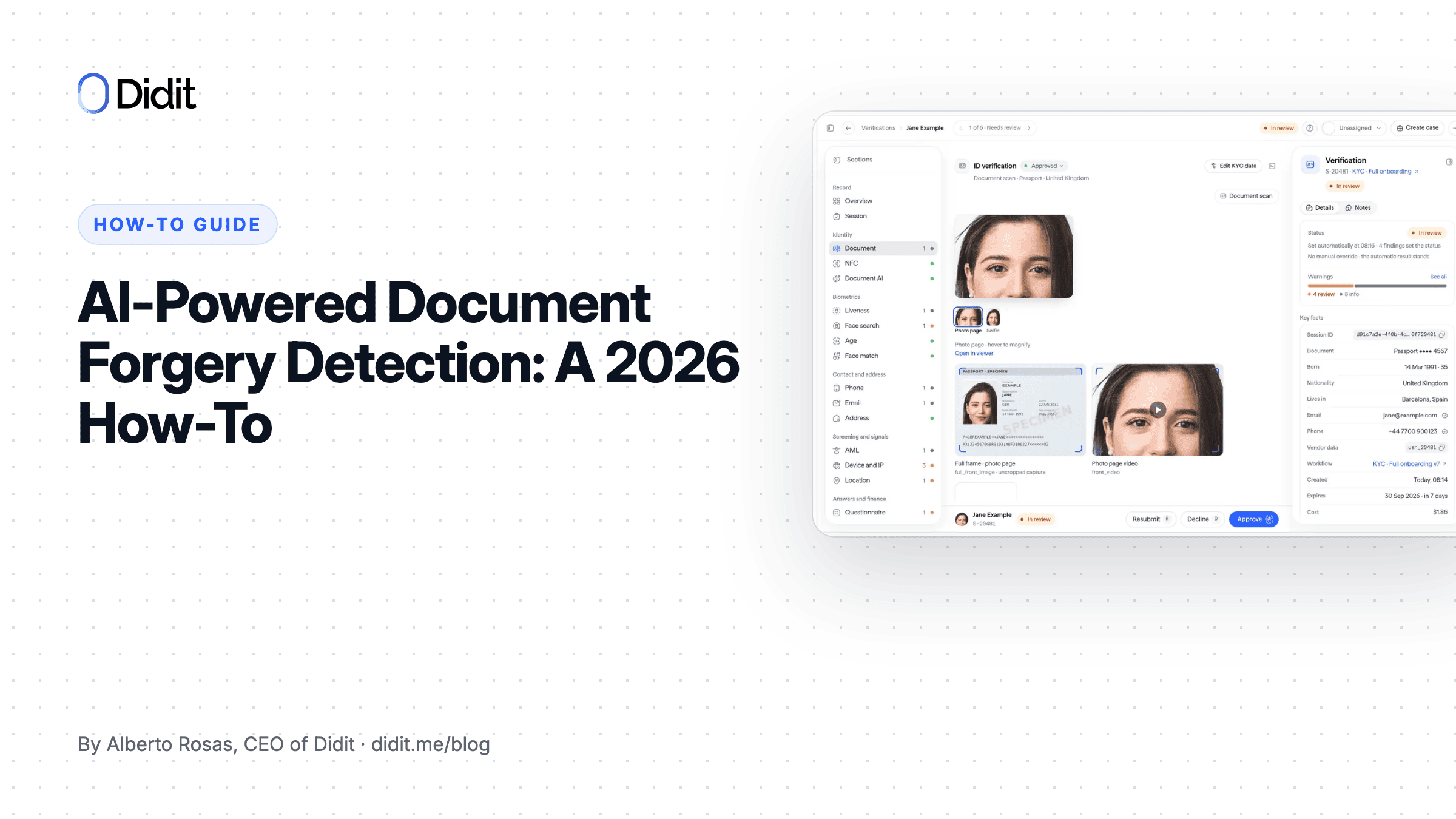
Use Didit's ID Verification API for identity documents and Document AI for statements, payslips and invoices. Read status and warnings, never the HTTP code alone, and send In Review to a person.
Alberto RosasMar 14, 2026Compliance Outsourcing: Build vs. Buy for FinTech
Navigating the complex world of FinTech compliance? This guide explores the benefits and drawbacks of in-house teams vs. compliance outsourcing, helping you make the right choice for your business.
Alberto RosasMar 14, 2026MLRO Hiring: A Guide to AML Compliance in 2026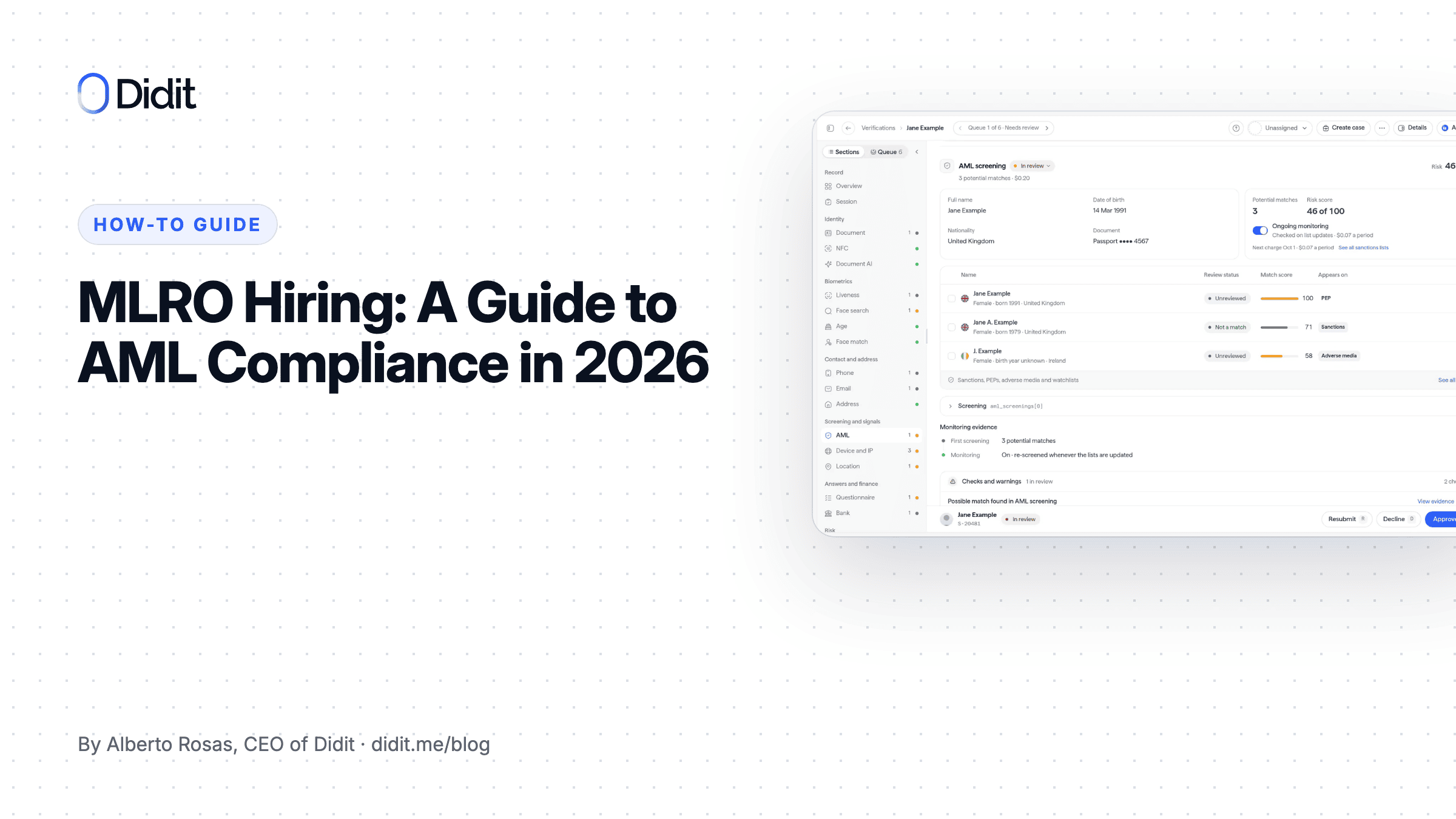
Hire an MLRO in 8 steps: set the mandate, budget from local evidence rather than a published band, test judgement on a live hit, and hand over screening history built at $0.20 per AML check.
Alberto RosasMar 14, 2026ePassport Verification: NFC Chip, PACE and Active Authentication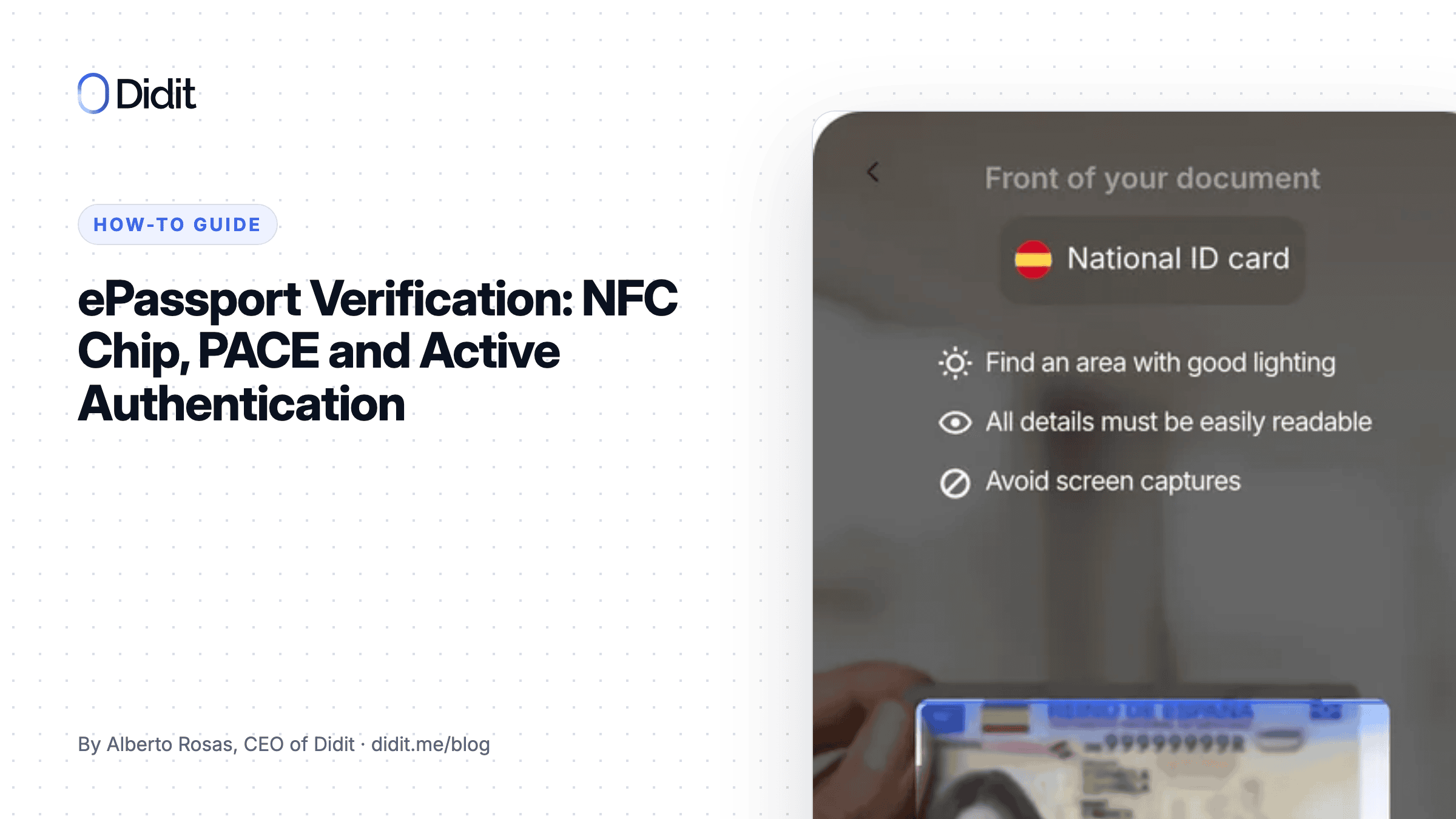
Didit reads the ePassport chip inside an iOS or Android session for $0.15 on top of the $0.15 document check, checks passive authentication and, where supported by the document, active authentication, and reports each result in.
Alberto RosasMar 14, 2026Decentralized Identity: Overcoming Adoption Barriers (1)
Decentralized Identity (DID) promises a future of self-sovereign identity, but widespread adoption faces significant hurdles. This post explores the challenges and what's needed to unlock DID's potential.
Alberto RosasMar 14, 2026RON Security: Protecting Against Fraud in Digital Notarization
Remote Online Notarization (RON) offers convenience, but robust security is paramount. This guide explores RON fraud prevention, key security measures, and how to ensure a secure digital notary experience.
Alberto RosasMar 14, 2026Digital Signature Legal Validity: A Comprehensive Guide
Understand the legal landscape of digital signatures, e-signature laws, and qualified electronic signatures. Ensure your digital processes are compliant and enforceable.
Alberto RosasMar 14, 2026Building a Robust Compliance Team Structure
A well-defined compliance team structure is crucial for FinTechs and regulated businesses. This post details best practices for AML compliance roles, org charts, and building a scalable compliance function.
Alberto RosasMar 14, 2026Secure Webhooks: A Developer's Guide
Learn how to implement secure webhooks for your applications, focusing on API security, KYC integration, and best practices for developers. Ensure data integrity and prevent unauthorized access.
Alejandro RosasMar 14, 2026Synthetic Identity Fraud: Detection & Prevention
Synthetic identity fraud is a growing threat, costing lenders billions annually. Learn how it works, detection methods, and how Didit's platform can help prevent this sophisticated form of identity theft.
Alberto RosasMar 14, 2026WebAssembly & Biometrics: Secure On-Device Processing (1)
Explore how WebAssembly (Wasm) enables secure, privacy-preserving biometric authentication directly on user devices, reducing reliance on servers and boosting performance. Learn about its benefits and implementation.
Alberto RosasMar 14, 2026Identity Orchestration ROI: Cutting Costs & Boosting Conversions
Discover how identity orchestration delivers significant ROI by consolidating vendors, reducing fraud, improving conversion rates, and streamlining KYC/AML compliance. Learn how to calculate savings and maximize value.
Alberto RosasMar 14, 2026Device Intelligence: A Key to Fraud Detection
Device intelligence leverages device fingerprinting and behavioral analysis to detect and prevent fraud, including account takeover (ATO). Learn how it enhances identity verification and strengthens security.
Alberto RosasMar 14, 2026KYC for Embedded Finance: A Comprehensive Guide
Embedded finance is rapidly growing, but so are the compliance challenges. This guide covers best practices for KYC in embedded finance, focusing on API integration and scalable solutions.
Alberto RosasMar 14, 2026Liveness Detection: Stopping Deepfakes & Fraud
Liveness detection is crucial for secure biometric authentication. This guide explores how it works, different methods used, and why it's vital for fraud prevention in today's digital world.
Alejandro RosasMar 14, 2026Beneficiary Information: FATF Travel Rule Guide (2026)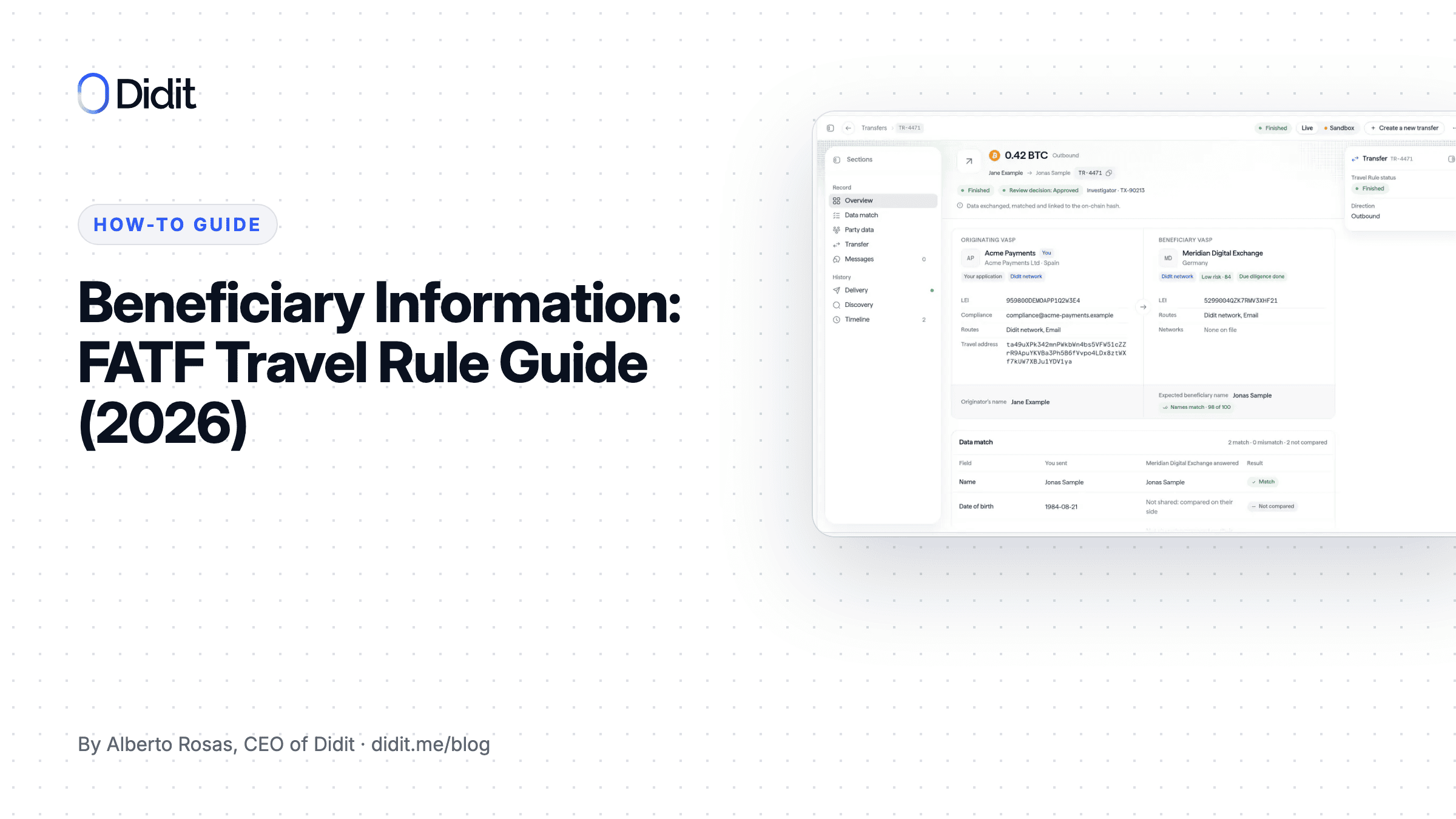
The FATF Travel Rule requires the sending VASP to collect and transmit beneficiary data before a crypto transfer settles. Didit runs that exchange as a managed service for $0.02 per outbound transfer.
Alberto RosasMar 14, 2026FATF Travel Rule for VASPs: 2026 Compliance Guide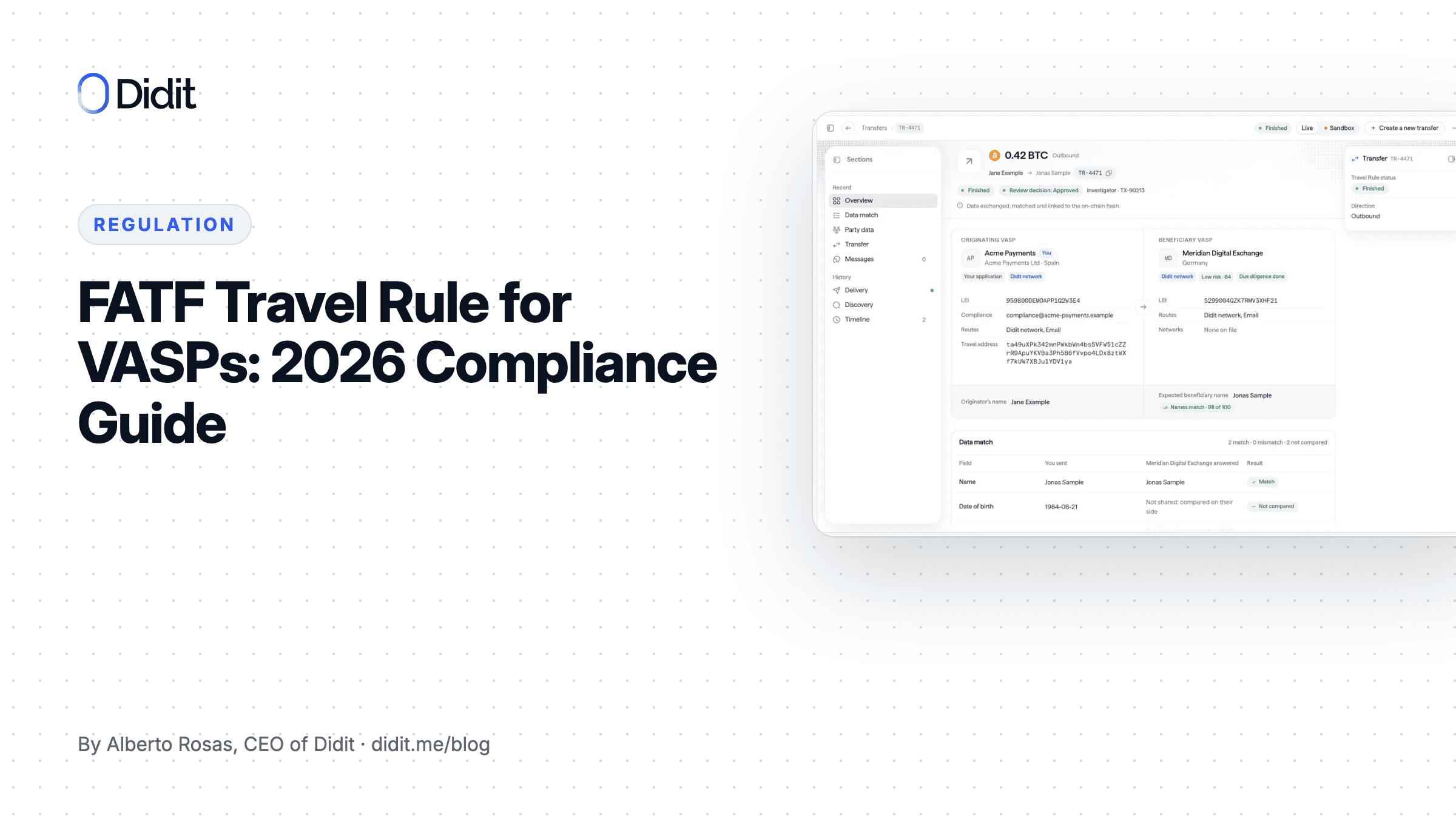
Crypto exchanges and other VASPs share sender and recipient data under local Travel Rule laws. We charge $0.02 per outbound exchange. GTR, TRUST, VerifyVASP and Sygna require your own membership.
Alberto RosasMar 14, 2026Detecting AI-Generated Utility Bills: A KYC Guide
AI-generated documents, especially forged utility bills, pose a growing threat to KYC compliance. Learn how synthetic document fraud works and the latest detection methods to safeguard your business.
Alberto RosasMar 14, 2026Fraud Signals Orchestration: A Modern Approach
Fraud signals are no longer enough on their own. Learn how orchestrating multiple fraud signals – including device intelligence and behavioral biometrics – creates a robust, adaptive fraud prevention system.
Alberto RosasMar 14, 2026MRZ Parsing: The Foundation of Document Verification
MRZ parsing is crucial for accurate and secure identity verification. This guide dives deep into how it works, its importance, challenges, and how Didit leverages it for seamless document verification.
Alberto RosasMar 14, 2026Webhook Security: Best Practices & API Protection
Webhooks are powerful for real-time data delivery, but pose security risks. Learn best practices for securing webhooks, protecting your APIs, and integrating with identity verification systems.
Alberto RosasMar 14, 2026Deposit Limits & Self-Exclusion: A Compliance Guide
Deposit limits and self-exclusion are critical tools for responsible gambling and iGaming compliance. This guide explores implementation, identity verification, and the broader impact on AML/KYC.
Alberto RosasMar 14, 2026iGaming Player Verification: A Complete Lifecycle Guide (1)
Ensure regulatory compliance and protect your iGaming platform with a robust player verification lifecycle. This guide covers KYC/AML best practices, fraud prevention, and ongoing monitoring.
Alberto RosasMar 14, 2026Dynamic Risk Scoring: How to Build Account and AML Risk Scores in 2026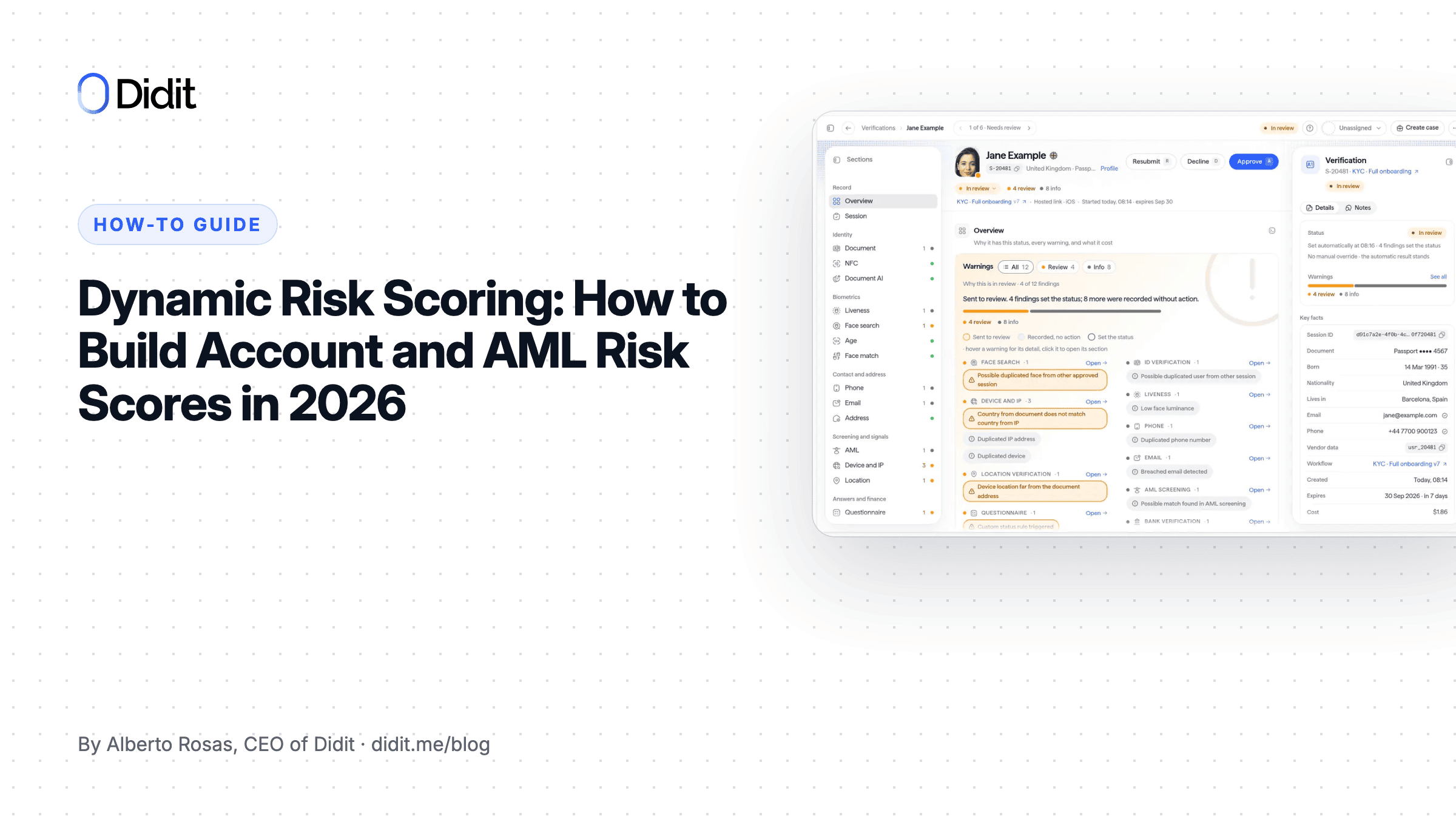
Dynamic risk scoring sums the deltas of every matched rule and maps the total to APPROVED, IN_REVIEW or DECLINED. On Didit, monitoring costs $0.001 per transaction beyond the plan allowance.
Alberto RosasMar 14, 2026Reduce KYC Drop-Off: Boost Conversion & Onboarding (1)
High KYC drop-off rates erode user acquisition and revenue. Learn how to analyze, diagnose, and reduce friction in your identity verification process to improve onboarding and compliance.
Alberto RosasMar 14, 2026Microprint Analysis: A Key to Document Security (1)
Microprint analysis is a crucial document security feature used in fraud detection and identity verification. This article delves into the technology, its applications, and how Didit leverages it to combat sophisticated forgery.
Alberto RosasMar 14, 2026Responsible Gambling in iGaming: A KYC & AML Guide
iGaming faces growing pressure for responsible gambling practices. This guide details how KYC, AML, and advanced identity verification solutions like Didit protect players and ensure regulatory compliance.
Alberto RosasMar 14, 2026KYC Cost Modeling: Understand & Reduce Compliance Costs
Calculating the true cost of KYC (Know Your Customer) is complex. This guide breaks down direct & indirect KYC costs, ROI modeling, and strategies to reduce identity verification expenses.
Alejandro RosasMar 14, 2026AI Bias in Identity Verification: Risks & Solutions
AI-powered identity verification offers speed & security, but inherent biases can lead to unfair or discriminatory outcomes. Learn how to mitigate algorithmic bias and build fairer systems.
Alberto RosasMar 14, 2026API Security: A Deep Dive into Rate Limiting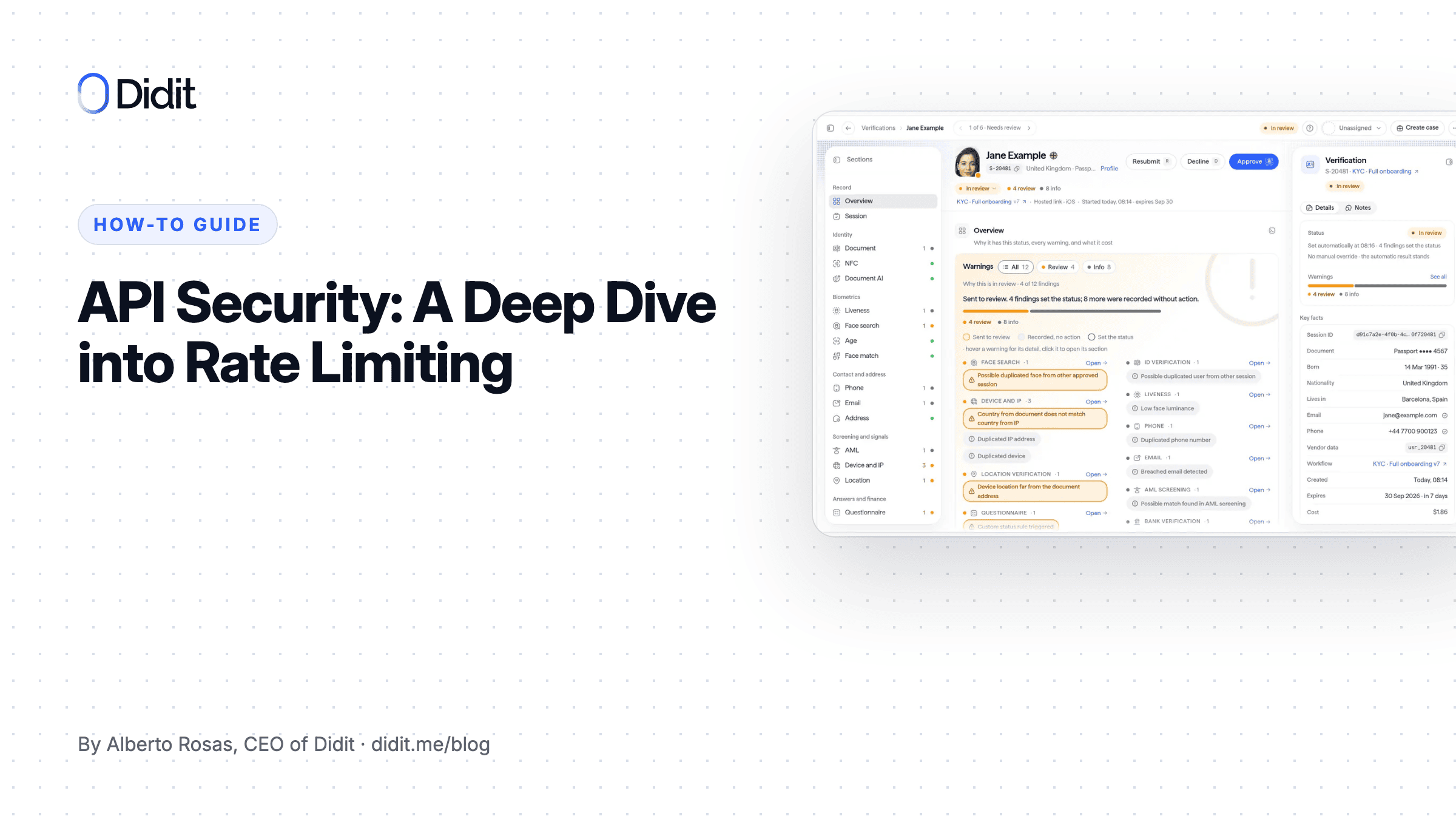
Didit limits requests per API key or IP in 60-second windows: 600 GETs a minute, 300 writes, 600 session creates. Read Retry-After on a 429, back off exponentially, and stop after about five attempts.
Alberto RosasMar 14, 2026Prevent Loan Defaults: Identity & Risk Solutions
Discover how identity verification and behavioral biometrics can dramatically reduce loan defaults, minimize credit risk, and improve fraud prevention strategies. Learn how to build a resilient lending process.
Alberto RosasMar 14, 2026Boost Conversions: Reducing Friction in Identity Verification
Identity verification is crucial for security, but high-friction processes kill conversion rates. Learn how to balance security and user experience to minimize drop-off and maximize growth.
Alberto RosasMar 14, 2026KYC for Remote Lending: A Complete Guide
Remote lending presents unique KYC challenges. This guide explores how to combat fraud, maintain compliance, and streamline onboarding in the digital lending space. Learn best practices and how Didit can help.
Alberto RosasMar 14, 2026Identity Verification Cost: Unit Economics & ROI
Understanding the unit economics of identity verification is crucial for businesses. This guide breaks down costs, ROI, and strategies to optimize your identity verification spend.
Alberto RosasMar 14, 2026Lattice-Based Signatures: A Post-Quantum How-To
Add an ML-DSA or FN-DSA signature over the SHA-256 digest of each identity artifact, next to the PAdES signature and evidence Didit returns. In this design, the lattice key stays in your custody.
Alberto RosasMar 14, 2026Post-Quantum Cryptography & Digital Identity
Quantum computing poses a significant threat to current encryption methods. Learn how post-quantum cryptography (PQC) is evolving to secure digital identity and protect against future attacks.
Alberto RosasMar 14, 2026How to Detect AI Forged Documents in 6 Steps (2026)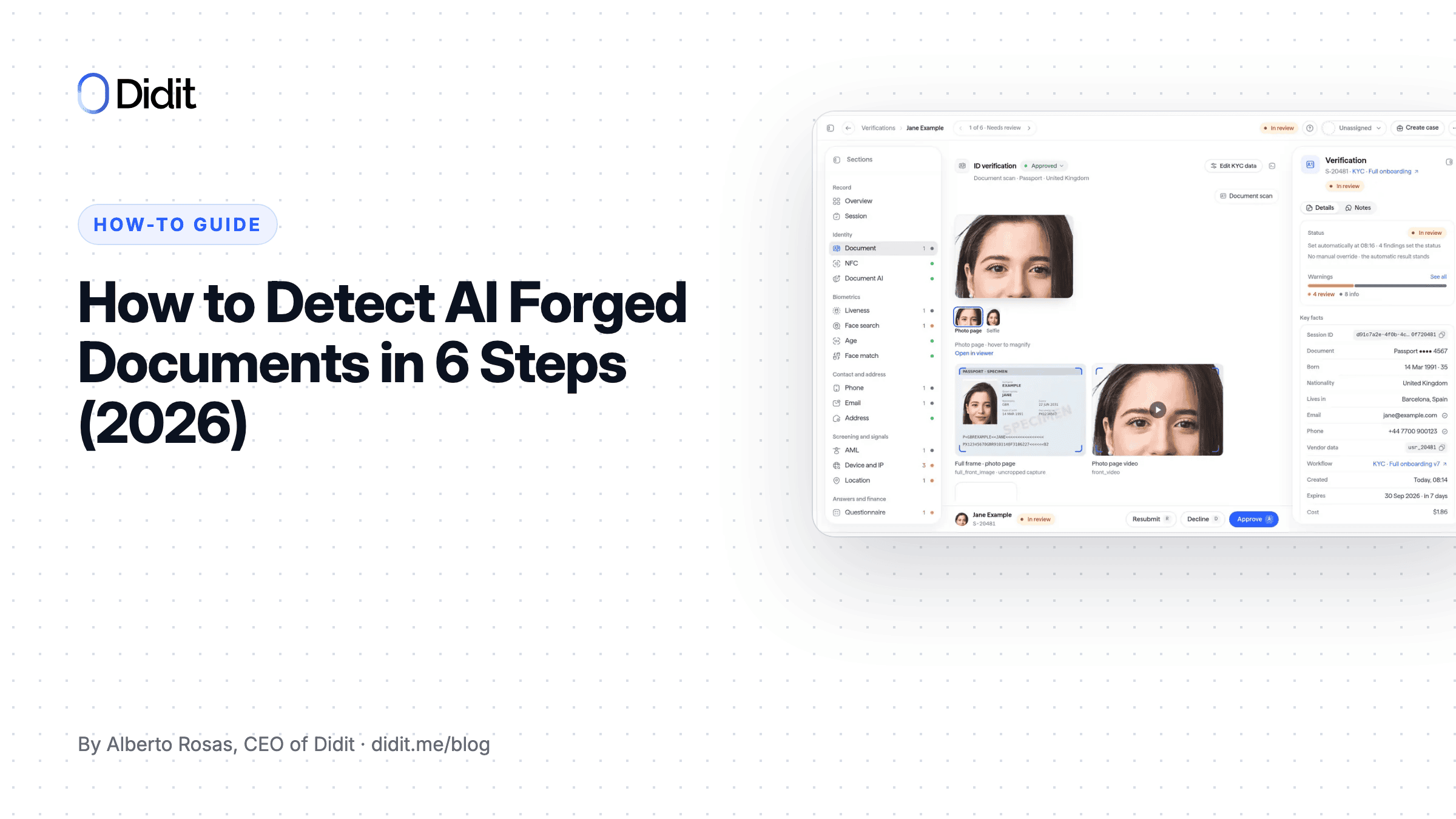
Detect AI-forged documents with two Didit checks: ID Verification for government IDs at $0.15 per check in a workflow or $0.20 per call on the standalone API, and Document AI for statements at $0.20 per document, with warning.
Alberto RosasMar 14, 2026Liveness Detection: Preventing Spoofing in Biometrics
Liveness detection proves a live person is at the camera, not a photo, replay or deepfake. On Didit passive liveness inside a session costs $0.10 per check and active liveness costs $0.15;
Alejandro RosasMar 14, 2026Digital Signatures and Identity: Legal Validity, Step by Step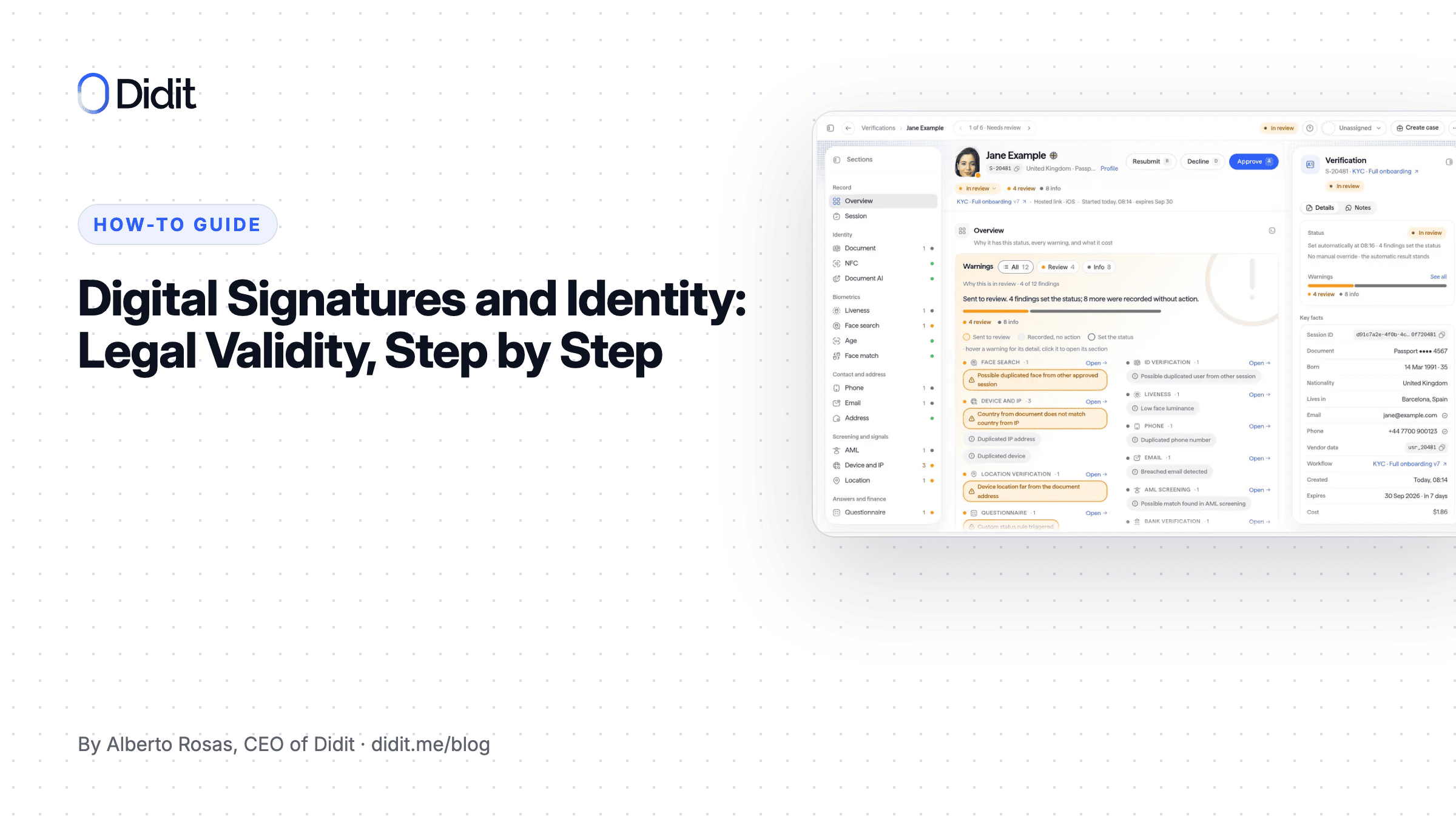
A digital signature proves a key signed a file, not who held the key. Bind it to identity with one Didit workflow: approved ID verification, a verified email or phone, then an AES signature.
Alberto RosasMar 14, 2026Investor Accreditation Verification: A Complete Guide (1)
Navigating investor accreditation verification for Reg A+ offerings can be complex. This guide covers compliance, KYC, and how to streamline the process with technology.
Alberto RosasMar 14, 2026Identity Verification for P2P Lending: Mitigating Risk
Peer-to-peer (P2P) lending platforms face unique identity verification challenges. This guide explores how robust identity checks and risk assessment reduce loan defaults and ensure compliance.
Alberto RosasMar 14, 2026Borrower Verification: Best Practices for Loan Applications
Robust borrower verification is crucial for mitigating risk and ensuring the success of loan applications. This guide covers best practices, including alternative data, fraud prevention, and behavioral biometrics.
Alberto RosasMar 14, 2026Zero-Knowledge KYC: Privacy-Preserving Compliance (2026)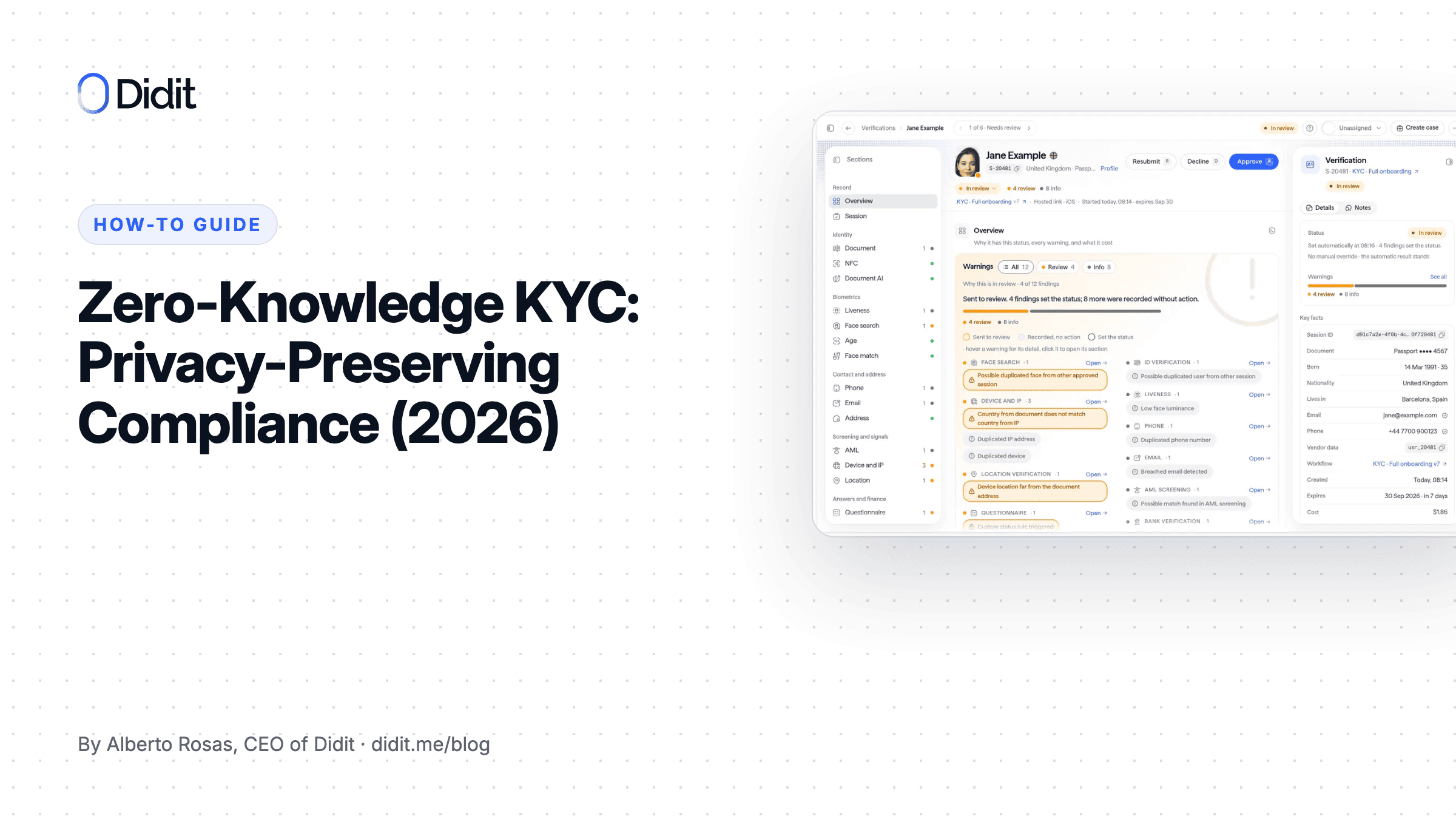
Zero-knowledge proofs prove an attribute without revealing the data. Didit does not document a ZK proof generator; the privacy route we do document is narrow collection, free reusable KYC and deletion controls.
Alberto RosasMar 14, 2026KYC Outsourcing: Cut Costs & Scale Compliance
Navigating KYC and AML compliance is complex and costly. Learn the benefits of KYC outsourcing, the build vs. buy decision, and how to reduce compliance costs effectively.
Alberto RosasMar 14, 2026Fraud Prevention in the Creator Economy
The creator economy is booming, but so are fraud risks. Learn how identity verification and robust fraud prevention strategies can protect creators, platforms, and fans.
Alberto RosasMar 14, 2026Building a High-Performing Compliance Team
A robust compliance program is crucial for mitigating risk and ensuring regulatory adherence. This guide details how to build an effective KYC/AML compliance team structure, covering roles, responsibilities, and optimizations.
Alberto RosasMar 14, 2026Remote Online Notarization (RON): A Complete Guide (1)
Remote Online Notarization (RON) is revolutionizing document signing, offering convenience and security. This guide covers legal compliance, benefits, and how to implement RON for your business.
Alberto RosasMar 14, 2026AI-Generated Utility Bill Detection: Combating Fraud
AI-powered document forgery is on the rise, especially with proof of address documents. Learn how to detect synthetic utility bills and protect your business from fraud with advanced verification techniques.
Alberto RosasMar 14, 2026AML Automation: AI's Role in Modern Compliance
Explore how AML automation, powered by artificial intelligence and machine learning, is transforming financial crime compliance. Learn about the benefits, challenges, and future of AI in AML.
Alberto RosasMar 14, 2026Supply Chain Identity: Traceability & Trust
Maintaining supply chain integrity requires robust identity verification. Learn how verifiable credentials and blockchain enhance traceability, combat counterfeiting, and ensure compliance.
Alberto RosasMar 14, 2026Web3 Identity: A Deep Dive into DIDs & VC
Explore decentralized identity (DIDs) and verifiable credentials (VCs) for Web3, addressing challenges & benefits over traditional KYC. Learn how Didit empowers secure, privacy-preserving Web3 identity verification.
Alberto RosasMar 14, 2026ePassport Migration Timeline: NFC Chip Checks to 2040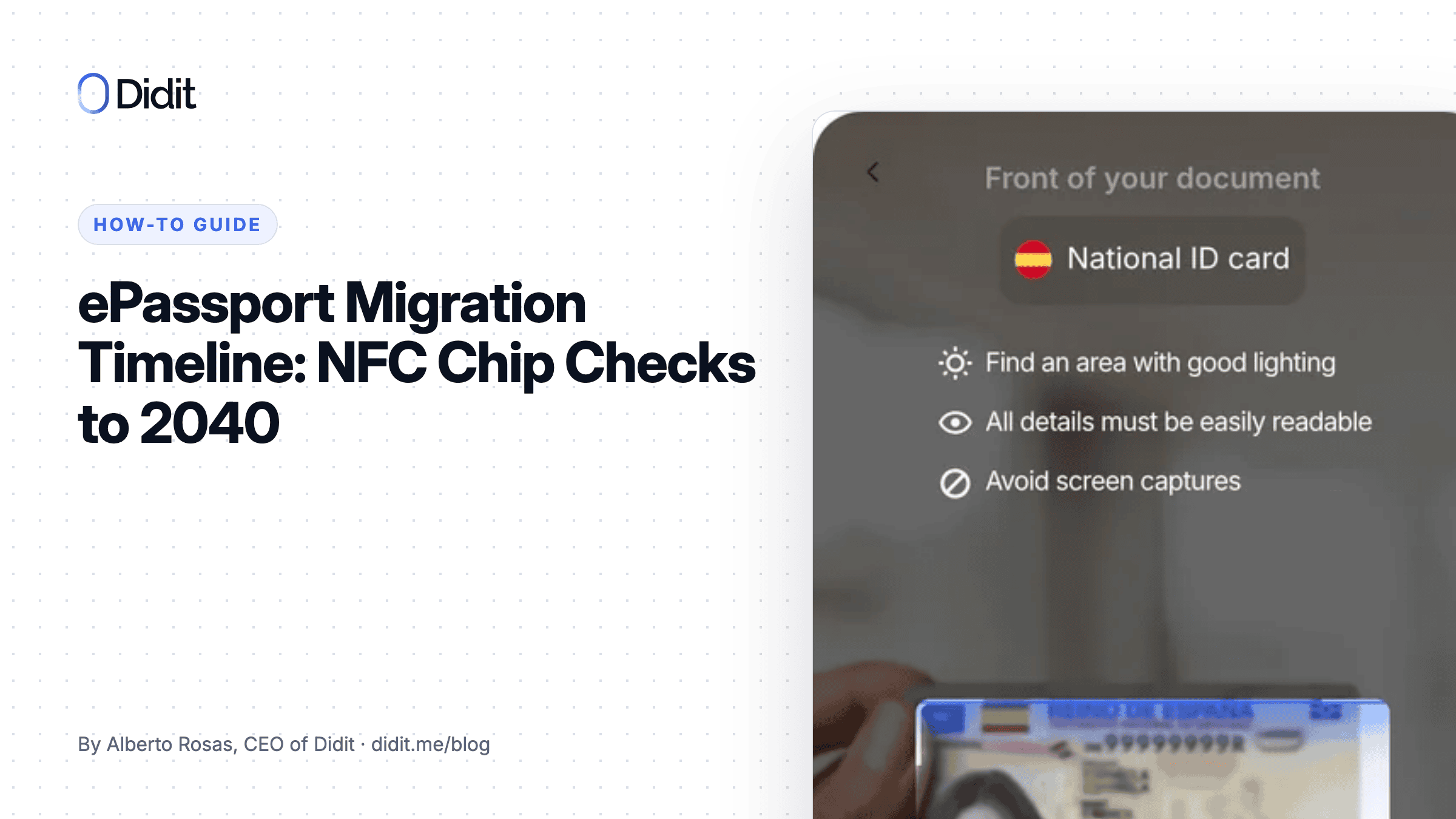
Read an ePassport chip in a Didit session: enable NFC on a workflow, create the session, open it on an NFC-capable phone or in the native SDK, then read the chip result from the decision.
Alberto RosasMar 14, 2026How to Authenticate an Influencer: Verify Before You Pay
Authenticate an influencer by verifying their government ID and liveness at sign-up ($0.33), then requiring a selfie step-up before each payout ($0.10).
Alberto RosasMar 14, 2026Two-Sided Verification for Marketplaces: Buyer and Seller Checks
Two-sided verification checks buyer and seller. Run one person workflow and one business workflow, gate the buyer check on risk and on the rules your marketplace falls under, and send In Review to a human.
Alberto RosasMar 14, 2026Face Matching Algorithms: How They Work and How to Run a 1:1 Check
Face matching algorithms turn two photos into embeddings and compare them with a threshold. On Didit a 1:1 face match costs $0.05 and returns a 0 to 100 score, Approved above the threshold.
Alberto RosasMar 14, 2026Composable Identity: The Future of Trust
Composable identity represents a paradigm shift in how businesses manage and verify digital identities. By leveraging modular KYC and identity orchestration, organizations can achieve greater agility, scalability, and.
Alberto RosasMar 14, 2026Embed Identity Verification: iFrame Integration Guide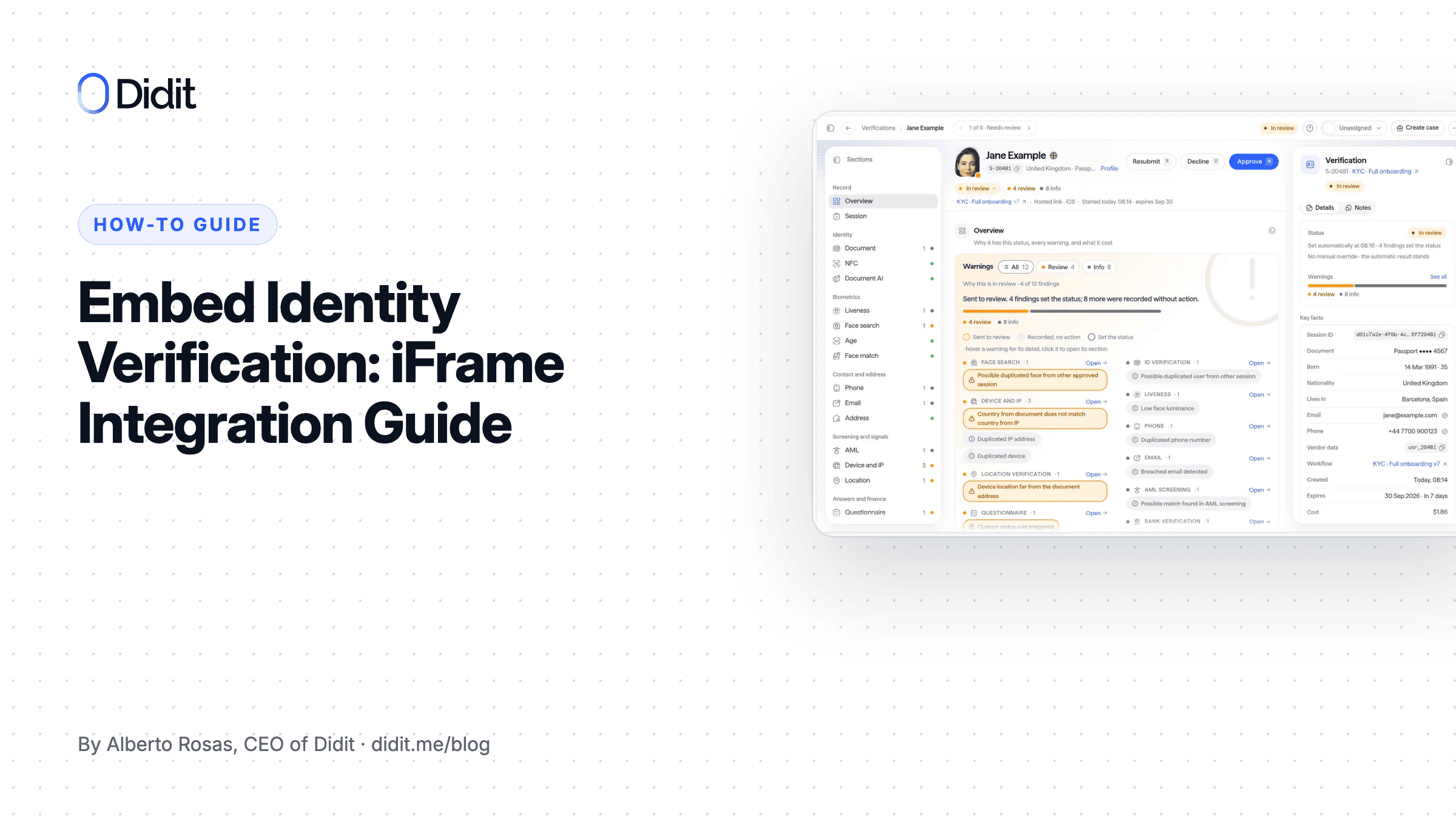
Embed Didit verification with one iframe tag or a session URL from your backend. Setup takes under a minute, the browser sends events by postMessage, and the signed decision arrives by webhook, or from the decision endpoint if.
Alejandro RosasMar 14, 2026Content Moderation & IDV: Building Platform Safety
Protect your online community with a robust content moderation strategy powered by identity verification. Learn how to reduce harmful content, enforce community guidelines, and foster a safe environment for users.
Alberto RosasMar 14, 2026Boost Conversions: Identity Verification Strategies
Poor identity verification can kill conversion rates. Learn how to reduce KYC friction, optimize user experience, and increase onboarding success with the right strategy.
Alberto RosasMar 14, 2026Brand Safety & Identity: Preventing Online Fraud
Protect your brand reputation and revenue with robust identity verification. Learn how to combat online fraud, fake reviews, and account takeover, and the critical role brand safety plays in the modern digital landscape.
Alberto RosasMar 14, 2026Biometric Template Protection: A Deep Dive (1)
Biometric template protection is crucial for safeguarding sensitive biometric data. This post explores techniques like homomorphic encryption, secure enclaves, and differential privacy to enhance biometric privacy and security.
Alberto RosasMar 14, 2026Boost Marketplace Trust: Buyer Protection Strategies
Marketplaces face growing fraud risks. This guide details buyer protection strategies, from transaction monitoring to dispute resolution, ensuring secure transactions and building customer trust.
Alberto RosasMar 14, 2026Post-Quantum Cryptography & Identity Verification
Explore the threat quantum computing poses to current identity verification methods and how post-quantum cryptography, particularly lattice-based signatures, offers a quantum-resistant solution for secure IDV.
Alberto RosasMar 14, 2026Creator Platform Identity Verification: Stop Fraud
Protect your creator economy platform from bots, deepfakes, and fraudulent payouts with robust identity verification. Learn how to build trust and scale sustainably.
Alberto RosasMar 14, 2026White-Label Identity Verification SDK: Full Customization
Learn how to fully white-label Didit’s identity verification SDK – customize the UI, branding, and workflows for a seamless user experience. Maximize brand consistency and control.
Alberto RosasMar 14, 2026AI Document Fraud: Detecting Deepfake IDs
Generative AI is fueling a surge in sophisticated document fraud, threatening KYC processes and increasing risk. Learn how to detect AI document fraud and protect your business.
Alberto RosasMar 14, 2026Defending Against Liveness Detection Attacks
Liveness detection is crucial for biometric security, but sophisticated spoofing attacks pose a constant threat. This guide explores common attack vectors, mitigation strategies, and the future of liveness detection.
Alejandro RosasMar 14, 2026Marketplace Fraud: Protecting Your Platform & Users
Marketplace fraud is a growing threat, costing businesses billions annually. Learn how to detect and prevent seller fraud, account takeovers, and other risks with advanced fraud prevention strategies.
Alberto RosasMar 14, 2026Biometric Spoofing: Threats & Liveness Detection
Biometric spoofing, including deepfakes, poses a growing threat to online security. Learn about presentation attack detection (PAD) techniques and how liveness detection safeguards against fraud.
Alberto RosasMar 14, 2026Automated Identity Proofing: Faster Onboarding, Less Fraud (2026)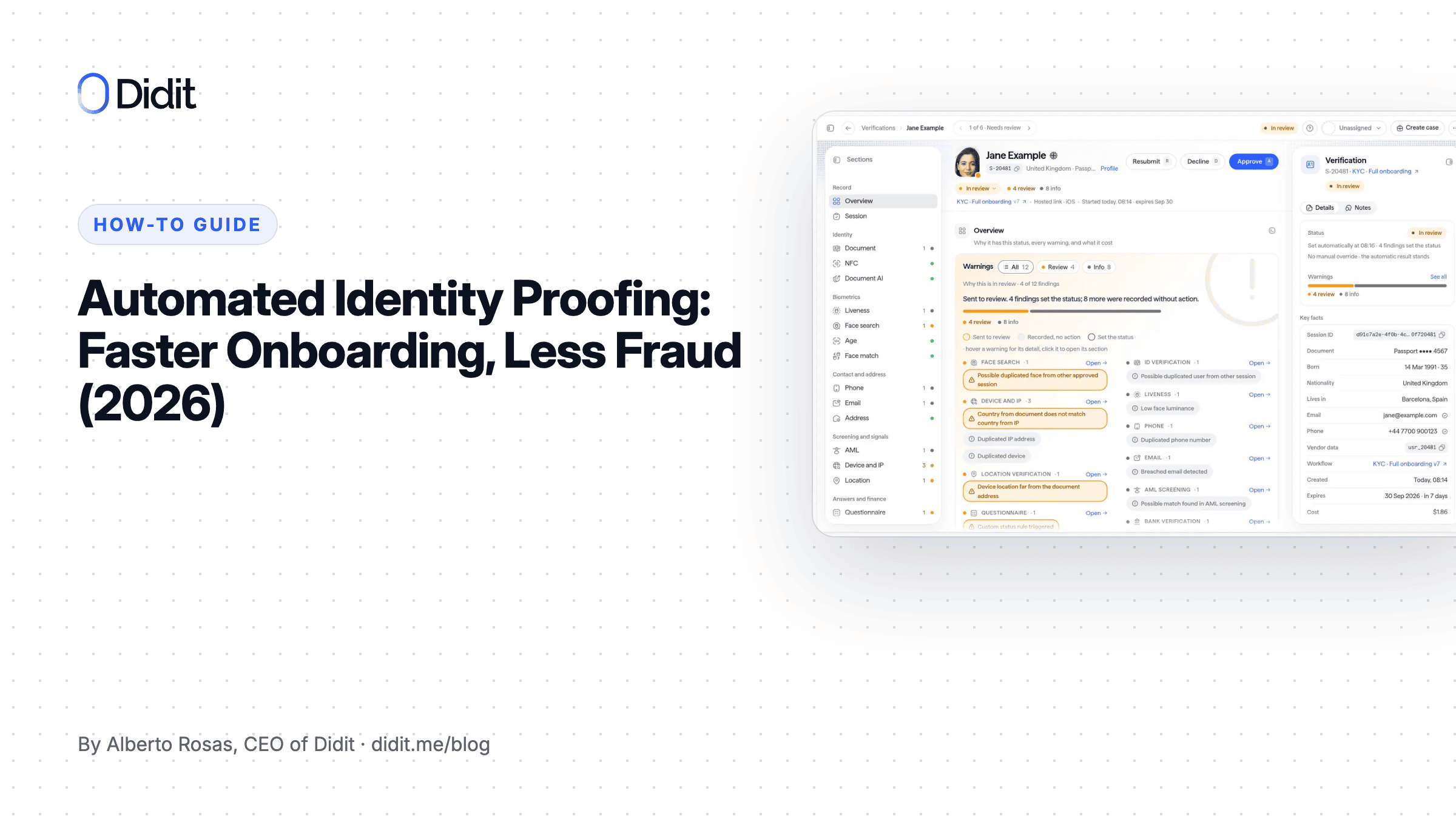
Automated identity proofing runs document, liveness, face match and device checks in one session. Full KYC is $0.33 per completed check, inference runs at sub-2-second p99 while total time depends on the user and on webhook.
Alberto RosasMar 14, 2026Identity Verification SDK Architecture: A Deep Dive
Learn about building a robust and scalable identity verification system using SDKs. This guide covers architecture, security, mobile SDK best practices, and integration strategies.
Alberto RosasMar 14, 2026Decentralized Identity (DID) & KYC: The Future of Trust
Explore how Decentralized Identity (DID) and blockchain technology are revolutionizing KYC processes, enhancing privacy, and reducing fraud. Learn about the benefits and challenges of this emerging landscape.
Alberto RosasMar 14, 2026WebAssembly for Secure Identity Verification
Explore how WebAssembly (Wasm) enhances identity verification by enabling secure, client-side processing, reducing server load, and improving user privacy. Learn about its applications in KYC/AML and edge computing.
Alberto RosasMar 14, 2026KYC Data Retention: How Long to Keep Records in 2026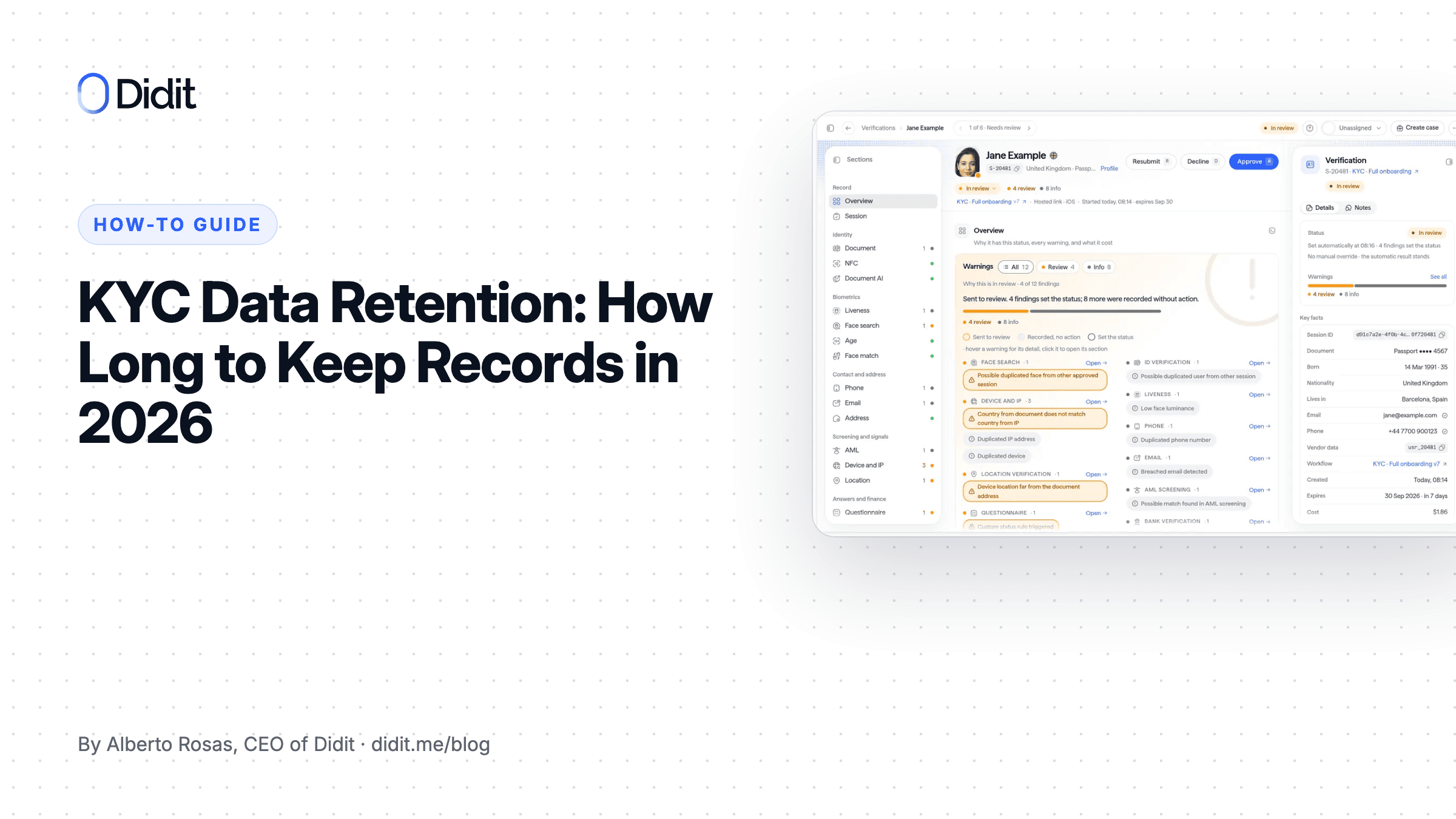
Set how long Didit keeps a KYC session and what happens when it expires. For an approved erasure request, use the privacy-erasure instruction to delete the session and purge retained biometric templates for its linked user.
Alberto RosasMar 14, 2026Failure to Prevent Fraud: A New Era of Liability
Recent legal changes are shifting the burden of fraud prevention onto corporations. Learn about 'failure to prevent fraud' offenses, corporate criminal liability, and steps to build a robust compliance program.
Alberto RosasMar 14, 2026Questions
Blog questions
Who writes the Didit blog?
Which topics does the blog cover?
Is the blog available in my language?
Where do I find product updates?
Are these posts legal advice?
How do I find posts on one topic?
Are posts dated?
Do posts link to the docs?
Is the blog the same as the docs?
Compliance built in
Audited, certified and attested.
We hold the certifications and build each country's rules into your flows, so you can launch anywhere without worrying. Security and Compliance center
- Regulation encoded into your flows
Tell us what you do and where. Didit lists the rules that apply to you, with sources, and builds the checks each country needs into one workflow.
- Ready for AMLR
Every requirement of the new EU anti-money laundering rules, from checking customers to human review, is already covered by a Didit check.
- Tested in Spain's Treasury sandbox
Spain's Treasury published its supervised sandbox report on Didit's NFC plus active liveness onboarding; SEPBLAC took part and valued the added measures positively.
- Audited, not self-declared
iBeta Level 1 and Level 2. Liveness tested under ISO/IEC 30107-3.
Your obligations · 3 regions
 SOC 2 Type 2
 ISO 27001
 iBeta Level 1 and Level 2
 EU regulator attestation
 FSM youth protection
 GDPR
 EBA remote onboarding
 MiCA compatible
 FIDO Alliance member
- AMLREU AML Regulation ready
Integration · Didit MCP
Run Didit from your own AI agent
Connect Didit to Claude, Cursor, VS Code or ChatGPT and just ask in plain words. Your agent can do anything you can do in the console, with the same permissions you have.
 Add to Claude
 ChatGPT
 Cursor
- Build workflowsDescribe the checks you need. The agent creates and publishes the flow.
- Run investigationsAsk why a session was declined, review cases, search people and companies.
- Change rulesCreate payment rules, test them on past data and switch them on.
- Pull reportsAsk for numbers, exports or the audit log.
Didit Academy


