Real-Time Fraud Detection in High-Frequency Trading
How to add a real-time fraud decision to a high-frequency trading flow with Didit Transaction Monitoring: submit the event, let rules score it, hold or decline. $0.001 per transaction beyond the plan allowance.
 Alberto RosasCo-founder and CEO
Contents
In this guide
Jump to the part you need.
If you run high-frequency trading and need every account action and trade-adjacent event scored before money moves, this guide is for you. Didit Transaction Monitoring evaluates each submitted transaction against your rules, at $0.001 per transaction beyond the monthly allowance, with 1,000 transactions a month included on the Free plan. The caveat: Didit does not read the order book. It scores the identity, device and money-movement layer around the account.
Last updated: November 26, 2026. Prices checked against the live Didit price feed on November 26, 2026.
| Module | List price | What it decides |
|---|---|---|
| Transaction Monitoring | $0.001 per transaction beyond the allowance (1,000 Free, 10,000 Growth, 100,000 Scale a month included) | One status per transaction: APPROVED, IN_REVIEW, DECLINED or AWAITING_USER, plus a risk score |
| Rules engine, Workflow Orchestrator, MCP server, SDKs | Included | Which rules fire and what each one does to the score or status |
| AML Screening | $0.20 per check, 1,300+ lists | Sanctions and watchlist screening on counterparties and linked users |
| Wallet Screening, inside Transaction Monitoring | $0.15 per screening | Wallet risk and source-of-funds exposure on crypto legs |
| Full ID check (KYC) | $0.33 = ID document $0.15 + passive liveness $0.10 + face match $0.05 + device and IP $0.03 | Document, biometric and device checks on the trader behind the account |
| Biometric Authentication | $0.10 per auth | Step-up before a held action continues |
| Face Search 1:N | $0.05 per search | Faces reused across accounts in the book |
Start free in the sandbox at https://business.didit.me/ (no sales call). If you want an AI assistant to draft and tune rules for you, connect Didit through the MCP server at https://didit.me/developers/mcp/. Every module price is on the pricing page.
What this method does, and what it does not do
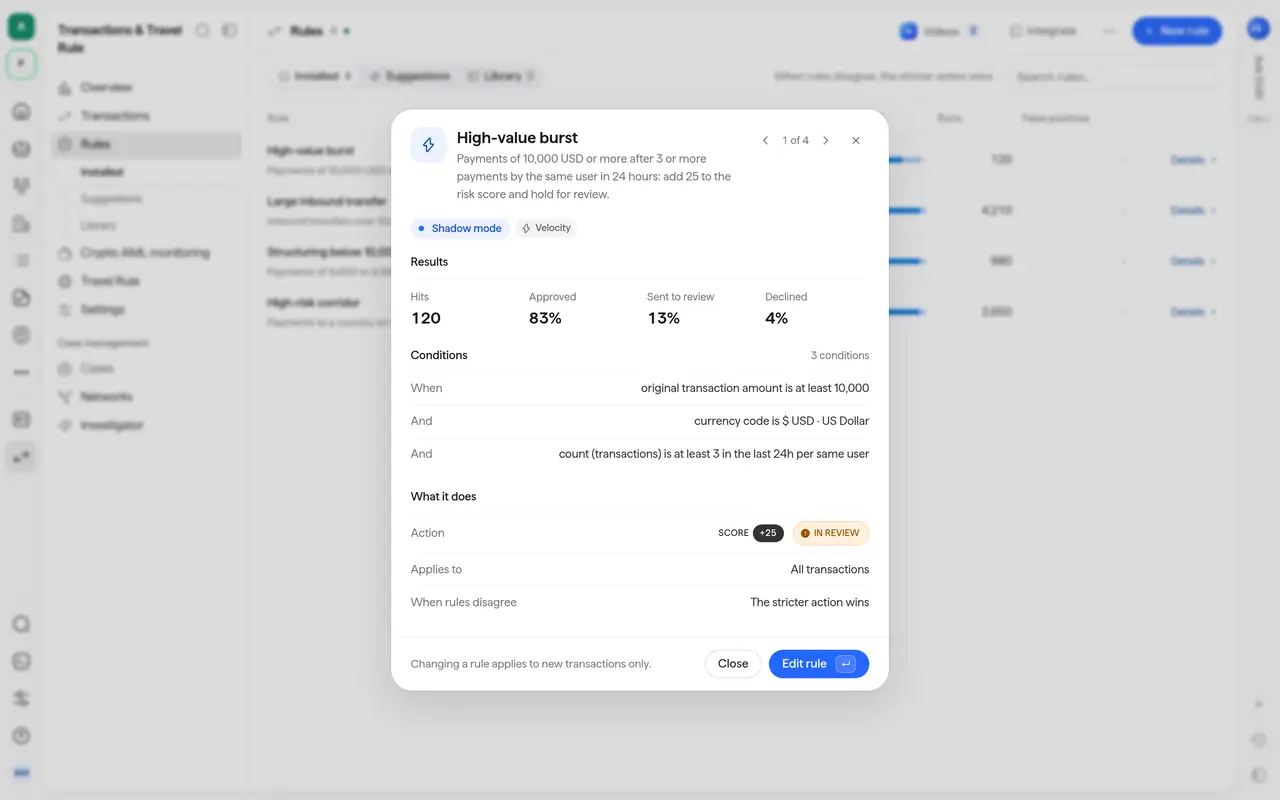
Didit provides an API endpoint for submitting transactions. You submit the event, the rules engine runs every active rule against it, and you get back a decision in the same response. That decision covers four things: single-transaction thresholds, velocity windows (count or cumulative volume over a time period), behavioural patterns such as structuring or rapid in-and-out movement, and screening results from AML and wallet checks. Each matching rule adds its score delta, and the total against your thresholds sets the status.
What this method does not do is market surveillance. Didit has no view of the order book, no depth-of-book feed and no cancellation microstructure. Spoofing and layering, as defined under market abuse rules such as EU MAR, are order-book behaviours you detect in your own matching-engine telemetry. Keep that system. Use Didit for the question your surveillance tool cannot answer: who is behind the account, on what device, moving money to whom.
The latency point matters more than the marketing. Didit publishes a sub-2-second p99 inference latency across its checks, and transaction rules evaluate synchronously inside the API call. That is a different order of magnitude from microsecond order matching, and pretending otherwise would be wrong. As an integration recommendation, not a fixed Didit architecture, submit the trade-adjacent event after execution and hold the settlement, withdrawal or payout side until the status returns. Do not put an HTTP call in front of the matching engine.
Prerequisites
- A Didit organization and an API key. The same
x-api-keyheader is used for sessions, entities and transactions. - An application with review and decline thresholds set at Transactions, Settings. The worked examples here use a review threshold of 60 and a decline threshold of 85.
- Your own transaction identifier generated before you submit. This is the idempotency key; the docs are explicit that you should not rely on a Didit-generated id for it.
- A Biometric Authentication workflow (or your default workflow) if any rule should send the trader to a step-up check.
AWAITING_USERrequires a workflow id. - An HTTPS endpoint that verifies webhook signatures, if you want asynchronous AML results and analyst decisions pushed to you.
- Optional: an MCP client such as Claude or ChatGPT for programmatic rule work.
How to add real-time fraud detection to an HFT flow
The outcome of these steps is a flow where each trade-adjacent event gets a decision, the genuinely suspicious ones are held for a named analyst, and the rest settle. The steps follow the official integration guide.
The boundary: what you submit, and what stays in surveillance
Draw this line before you write any code, because it decides your volume and therefore your bill. Anything that must be decided inside the matching engine stays there. Anything with a party, an amount and a moment you can pause goes to Didit.
| Event | Submit to Didit | Category and reason |
|---|---|---|
| Order placement, amend and cancel | No | Stays in the matching engine and your order-book surveillance. Microsecond path, no HTTP call in it. |
| Execution that releases settlement | Yes, after the fill | finance. Hold the settlement leg until the status returns. |
| Deposit or withdrawal | Yes | finance. This is where structuring and rapid in-and-out live. |
| Crypto transfer to an external wallet | Yes | finance with currency_kind set to crypto, or travel_rule when originator and beneficiary data must travel with it. |
| Login, password reset, new device, payout-address change | Yes | user_event. Account takeover shows up here first. |
| KYC completion or re-verification | Yes | kyc. Links the decision to the verified profile. |
| Analyst data access, limit override, privileged action | Yes | audit_trail_event. Keeps the audit trail in the same case file. |
| Order-book anomaly detection, spoofing, layering | No | Your market-surveillance system. Didit cannot see it. |
- Decide which events you submit. Use the table above. Core money movement is
transaction_categoryfinance, logins and profile changes areuser_event, compliance events areaudit_trail_event, virtual asset transfers aretravel_rule. Pick only the set you can hold in your own system while it is being scored. - Generate the transaction id on your side. Use your own database id, a UUID, or a hash of transaction fields. Uniqueness is per application.
- Set the two thresholds. With the defaults of 75 and 500, a score must reach 75 to reach an analyst, and 500 is the maximum value, so the score alone never declines anything. Set a decline threshold you actually mean, for example 85, if you want automatic declines; otherwise keep the default and decline through a rule action that sets
DECLINED. - Install the preset bundles you need, then add custom rules. The library ships presets for anomaly detection (high velocity, dormant account reactivation after 12 or more months), device intelligence and fraud prevention (multi-accounting via a shared device fingerprint), AML and CTF (structuring, rapid in-and-out, sanctions counterparty), and crypto monitoring.
- Run each new rule in Test mode first. In Test mode the rule evaluates against live traffic but does not contribute to the score or the status, so you can measure selectivity before it can decline a real trade.
- Submit the transaction and read the decision. One call to
POST /v3/transactions/returns the status, the score and the rules that matched. - Subscribe to webhooks. Use
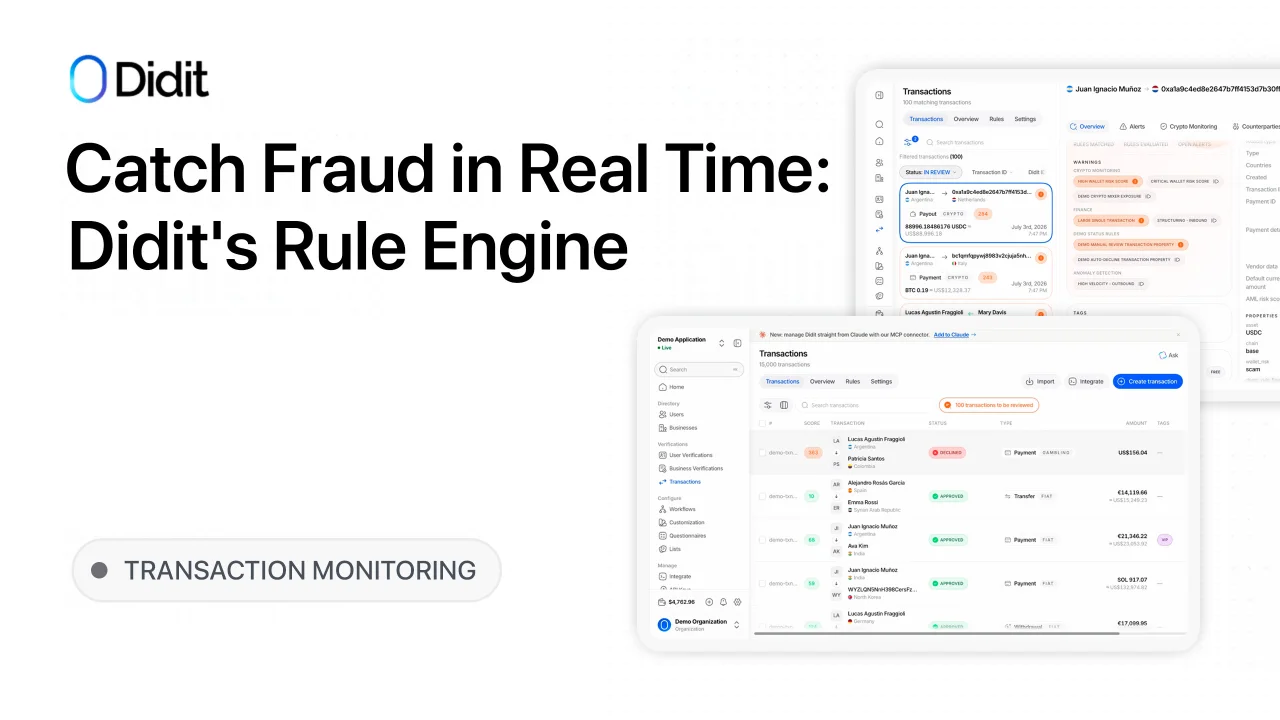
transaction.createdfor every submission andtransaction.status.updatedfor analyst decisions and later AML results. - Work the queue. Held transactions are the triage unit. Assign, annotate, approve or decline, and escalate patterns into a case.
The request
This is the documented minimal payload. It is runnable as-is once you replace the API key.
curl -X POST https://verification.didit.me/v3/transactions/ \
  -H "x-api-key: YOUR_API_KEY" \
  -H "Content-Type: application/json" \
  -d '{
    "transaction_id": "tx-0001",
    "transaction_category": "finance",
    "transaction_details": {
      "direction": "outbound",
      "amount": "500.00",
      "currency": "EUR"
    },
    "subject": { "entity_type": "person", "vendor_data": "user-42", "full_name": "John Doe" },
    "counterparty": { "entity_type": "company", "full_name": "Acme Corp" }
  }'
Expected output
The response carries the status, the integer score, and one entry in rule_runs per matched rule. This is the documented scoring example: 30 plus 35 is 65, and with the review threshold set to 60 that score goes to review. At the default review threshold of 75 the same transaction would stay approved.
{
  "txn_id": "tx-0002",
  "status": "IN_REVIEW",
  "score": 65,
  "rule_runs": [
    {
      "rule_title": "High-value outbound",
      "matched": true,
      "score_delta": 30,
      "severity": null,
      "status_target": null,
      "action_summary": "score +30"
    },
    {
      "rule_title": "High-risk jurisdiction counterparty",
      "matched": true,
      "score_delta": 35,
      "severity": "HIGH",
      "status_target": "IN_REVIEW",
      "action_summary": "score +35; add_tag:high_risk_country"
    }
  ]
}
The crypto leg
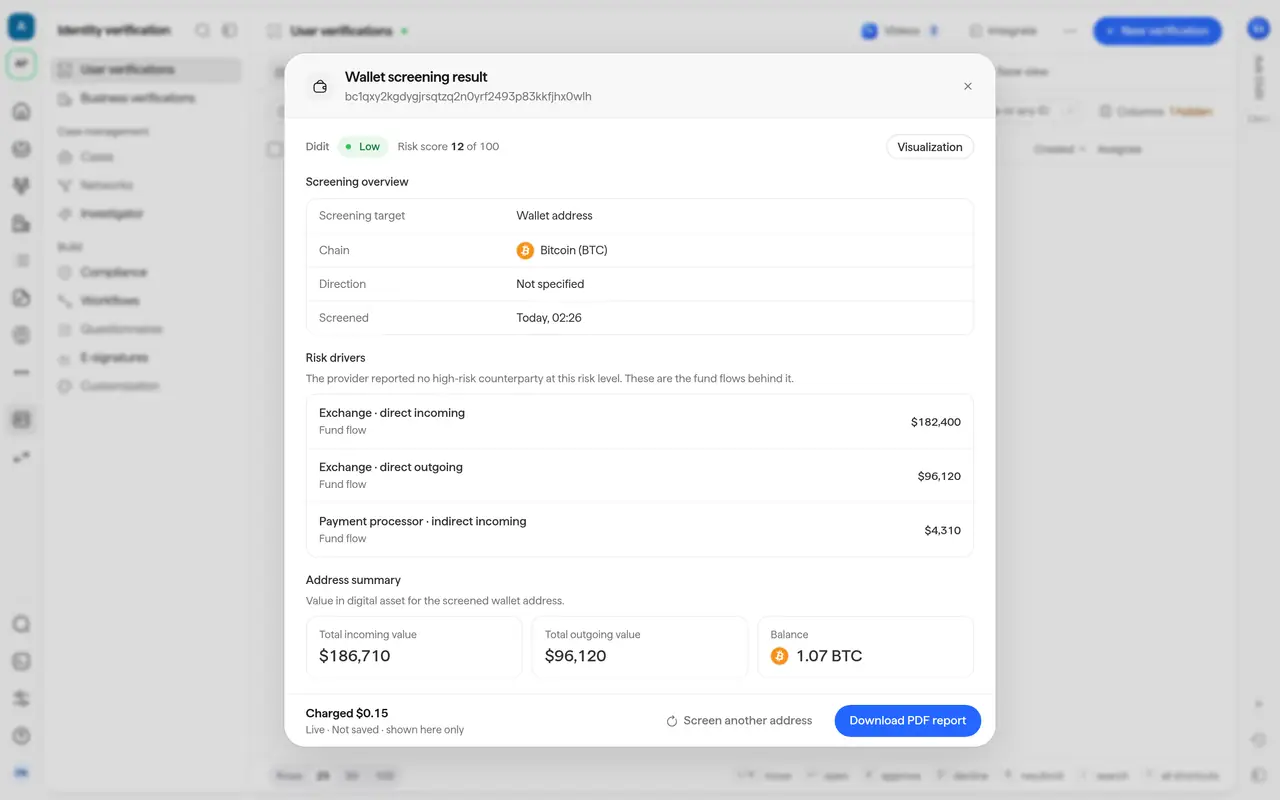
When a payout moves on chain, set currency_kind to crypto and put the wallet address in payment_method.account_id. For an outbound transfer the destination wallet on the counterparty is what gets screened, server-side, during transaction creation. Replace the placeholder addresses with real ones.
curl -X POST https://verification.didit.me/v3/transactions/ \
  -H "x-api-key: YOUR_API_KEY" \
  -H "Content-Type: application/json" \
  -d '{
    "transaction_id": "tx-crypto-0001",
    "transaction_category": "finance",
    "transaction_details": {
      "direction": "outbound",
      "amount": "0.75",
      "currency": "BTC",
      "currency_kind": "crypto"
    },
    "subject": { "entity_type": "person", "vendor_data": "user-42", "full_name": "John Doe",
      "payment_method": { "method_type": "crypto_wallet", "account_id": "YOUR_SUBJECT_WALLET" } },
    "counterparty": { "entity_type": "person", "full_name": "Jane Doe",
      "payment_method": { "method_type": "unhosted_wallet", "account_id": "YOUR_COUNTERPARTY_WALLET" } }
  }'
What each fraud type looks like as a rule
Be precise about which layer sees which behaviour. The table maps the fraud types that matter in trading to what Didit can actually observe.
| Behaviour | What Didit can see | Mechanism |
|---|---|---|
| Spoofing and layering | Didit does not detect spoofing or layering. It detects the account-layer signals around the behaviour: device changes, shared fingerprints, velocity bursts | Device intelligence and anomaly presets, custom velocity rules |
| Account takeover | A new fingerprint for an established trader, or an IP country that contradicts the profile | device_context on the subject plus a rule action to AWAITING_USER |
| Identity checks at account opening | The ID document check, passive liveness, face match 1:1 and the device and IP analysis behind the session, plus faces reused across accounts found with Face Search 1:N | Full KYC at $0.33, device_context on the subject, and Face Search 1:N at $0.05 per search |
| Wash trading and collusion between accounts | One device fingerprint serving several distinct subjects | Fraud prevention preset for multi-accounting |
| Structuring and rapid in-and-out | Aggregated volume or count inside a rolling window | AML/CTF bundle presets and custom aggregation rules |
| Sanctioned or high-risk counterparty | Name and entity hits across 1,300+ lists | AML Screening at $0.20 per check |
| Risky crypto destination | Wallet exposure categories and source of funds | Wallet Screening at $0.15 per screening |
Example rules and thresholds for high-frequency trading anomaly detection
These are configurations you can build in the console or through the API, using the documented condition operators, aggregation windows and actions. Adjust the numbers to your book, keep the shape.
| Rule | Condition | Action when it matches |
|---|---|---|
| High-value outbound | direction outbound and amount gte 10000 | add_score 30 |
| Velocity burst | count of outbound transfers or cumulative volume inside a rolling 24 hour aggregation window | add_score 35, add_tags high_velocity |
| High-risk jurisdiction counterparty | counterparty country_code in your high-risk list | add_score 35, change_status IN_REVIEW |
| New device on an established trader | device_context fingerprint not seen before on the subject | change_status AWAITING_USER with a Biometric Authentication workflow id |
| Multi-accounting | one device fingerprint shared across distinct subjects | add_score 35, open_case |
| Structuring | the structuring detection preset on aggregated inbound deposits inside a rolling window | add_score 35, add_note |
| Sanctions counterparty | AML screening returns a sanctions hit on the counterparty | change_status DECLINED |
| High-risk source of funds | wallet source-of-funds exposure above 30 percent | add_score 35 |
Inputs and outputs
| Field | Direction | Notes |
|---|---|---|
transaction_id | In | Your id. Unique per application. Reuse it on retries. |
transaction_category | In | finance, user_event, audit_trail_event, travel_rule and others |
transaction_details | In | direction, amount as a decimal string, currency, optional currency_kind and action_type |
subject.vendor_data | In | Your user id. Matching an existing user links the transaction to that profile and enables cross-session velocity checks. |
subject.device_context.fingerprint | In | Device intelligence for device-based rules and correlation |
counterparty.payment_method.account_id | In | Account number or wallet address, depending on direction |
custom_properties | In | Free-form keys your rules can match on |
status | Out | APPROVED, IN_REVIEW, DECLINED, AWAITING_USER |
score | Out | Integer sum of every matched rule delta |
rule_runs | Out | One entry per matched rule, with its delta and action summary |
parties | Out | Subject and counterparty returned with roles APPLICANT and COUNTERPARTY |
Failure cases and recovery
| Symptom | Cause | Recovery |
|---|---|---|
400 with "A transaction with this transaction_id already exists." | The id was already used in this application | Do not resubmit. Read the existing record with GET /v3/transactions/{uuid}/ using the uuid from the first response, or take the Didit uuid from the transaction.created webhook. |
| 409 on one of two identical requests | Two submissions raced each other | Same recovery as above. Neither error response returns the original transaction. |
400 when a rule tries to set AWAITING_USER | No workflow id on the rule action | Attach the Biometric Authentication workflow, or let the fallback order pick your default workflow. |
| High scores but nothing is ever declined | The decline threshold is still at its default, which never declines by score | Lower the threshold at Transactions, Settings, or use a rule action that sets DECLINED directly. |
| The review queue is flooded after a rule change | Threshold changes apply to new transactions only, but traffic volume still hits them | Raise the review threshold and put the offending rule back into Test mode until its selectivity is proven. |
| Thousands of alerts after a historical import | Velocity rules evaluating against months of backfilled data at once | Use dry ingest for the import, or enable rules only after ingestion finishes. |
alerts array is empty | Held transactions are the alert unit; there is no separate alert record | Read status and list held transactions with GET /v3/transactions/. |
| A score changes after the fact | An asynchronous AML check updated it | Handle transaction.status.updated rather than only the creation response. |
Paid steps and review boundaries
Everything that costs money is a completed check. The rules engine, the Workflow Orchestrator, the MCP server and the SDKs are included. Billed per call: transaction monitoring at $0.001 per transaction beyond the allowance, AML Screening at $0.20 per check, Wallet Screening at $0.15 per screening, a full ID check at $0.33, Biometric Authentication at $0.10, Face Search 1:N at $0.05 per search and Travel Rule at $0.02 per outbound exchange. If you would rather use your own blockchain analytics, bring your own screening provider and run it inside Didit.
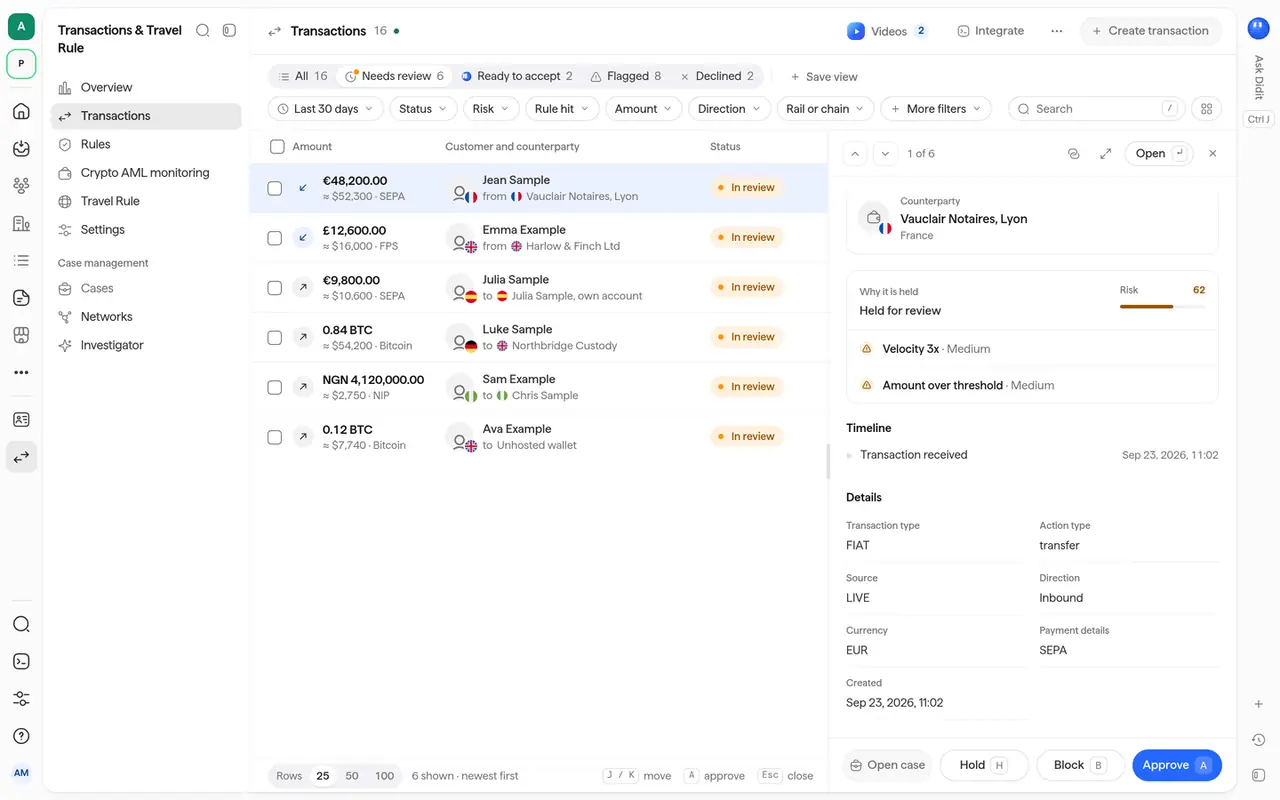
The human boundary is where it matters in a regulated firm. A transaction in IN_REVIEW is held until a named analyst decides, and the assignment is recorded on the transaction timeline. Pattern investigations belong in a case, where you link transactions, users, businesses and evidence. For jurisdictions that require Suspicious Activity Reports or Currency Transaction Reports, the console prepares the filing from the case, but Didit does not submit reports to regulators. That signature stays with your compliance team. Thresholds and rule modes are configuration you control, so schedule a review of them the same way you review trading limits.
Worked cost example
A desk on the Scale plan processes 1,500,000 monitored transactions a month, with 250 counterparty AML screenings, 2,000 crypto wallet screenings, 400 step-up authentications, 40 trader re-verifications and 300 face searches. Scale includes 100,000 monitored transactions a month.
At list price:
- Transactions beyond the allowance: 1,500,000 minus 100,000 = 1,400,000 x $0.001 = $1,400.00
- Counterparty AML: 250 x $0.20 = $50.00
- Wallet screening: 2,000 x $0.15 = $300.00
- Biometric Authentication: 400 x $0.10 = $40.00
- Full ID checks: 40 x $0.33 = $13.20
- Face Search 1:N: 300 x $0.05 = $15.00
- Total: $1,400.00 + $50.00 + $300.00 + $40.00 + $13.20 + $15.00 = $1,818.20
On Scale the Didit prices carry a 10 percent discount and the plan adds $350 of monthly credit: transactions $1,400.00, AML 250 x $0.18 = $45.00, wallet screening 2,000 x $0.135 = $270.00, biometric auth 400 x $0.09 = $36.00, KYC 40 x $0.297 = $11.88, face search 300 x $0.045 = $13.50, which totals $1,776.38. The $350 credit covers the first $350 of that, and the remaining $1,426.38 is drawn from prepaid credit on top of the $299 monthly fee. Every number here is a public list price; read the pricing page in the docs for the billing rules on credits and retries.
Where Didit fits
Didit runs identity and fraud infrastructure for 4,000+ companies across 220+ countries, with SOC 2 Type 2 and ISO/IEC 27001:2022 certification and a published 100 percent uptime over the last six months. For a trading desk the useful part is that onboarding KYC, step-up authentication, AML screening, transaction rules and wallet screening sit behind one API and one price list, so the decision your surveillance team sees is consistent with the one your onboarding team made. The transaction monitoring overview and the product page are the next reads, and SDK transaction submission covers the case where the event originates on the trader's own device.
Sources
- Didit docs: real-time transaction monitoring overview
- Didit docs: transaction monitoring integration guide
- Didit docs: submit transactions, payload and data model
- Didit docs: rules and scoring
- Didit docs: risk scoring formula and thresholds
- Didit docs: alerts, triage and resolution
- Didit docs: SDK transaction submission
- Didit docs: pricing and billing rules
- Didit pricing page and cost estimator
- Didit MCP server setup
- Regulation (EU) No 596/2014 on market abuse (MAR)
The next step is a sandbox run: create an application, set a review threshold, submit one transaction and read the rule_runs array. Start at https://business.didit.me/ with no sales call, and keep the price list open while you model your volume.
Try it
Try this in the sandbox
Run the check this guide describes, free.
The product this post is about, taken from its topic. Run it free in the sandbox.
Author
Alberto Rosas
Co-founder and CEO

Keep reading
Other guides in the same topic.
 What Is the Purpose of FICA in South Africa? 2026 Guide
FICA is South Africa's anti-money laundering law. It creates the Financial Intelligence Centre and requires accountable institutions to identify and verify clients, screen for PEP and sanctions risk and report suspicious.
Alberto RosasNov 26, 2026 Sixth Money Laundering Directive (6AMLD): What Changed and Which Rules Apply
6AMLD is Directive (EU) 2018/1673: Member States must criminalise laundering, widen predicate offences and set a four-year penalty floor. It adds no new due diligence duties for firms.
Alberto RosasNov 26, 2026 Automated Sanctions Screening: Canada, the Entity List and Embargoes
Automated sanctions screening matches people and companies against lists such as Canada's autonomous sanctions made under SEMA and JVCFOA and the OFAC SDN List, and returns candidate hits scored for identity confidence and.
Alberto RosasNov 26, 2026Questions
Frequently asked questions
Can Didit detect spoofing and layering in high-frequency trading?
Not from the order book. Didit scores the transactions and account events you submit, so it does not see depth-of-book changes or cancellation patterns inside the matching engine, and it does not detect spoofing or layering itself. What it detects is the account layer around that behaviour: a device fingerprint change, one device used by several accounts, a velocity burst, a counterparty that fails sanctions screening. Run order-book surveillance separately and use Didit for the identity and money-movement decision.
How fast is the decision, and is it fast enough for HFT?
Every transaction submitted to POST /v3/transactions/ is evaluated against all active rules and returns its status in the same response, and Didit publishes a sub-2-second p99 inference latency across its checks. That is not microsecond matching-engine speed and we do not claim it is. The pattern that works is to submit the trade-adjacent event after execution and hold the settlement, withdrawal or payout until the status comes back.
What does real-time transaction monitoring cost at high volume?
$0.001 per transaction beyond the monthly allowance. Each plan includes an allowance of monitored transactions: 1,000 on Free, 10,000 on Growth, 100,000 on Scale, and a figure set in the contract on Enterprise. One million transactions a month past the allowance costs $1,000.
What happens when a trade or account event is flagged?
The transaction gets a status. IN_REVIEW means it is held for an analyst and appears in the console review queue. AWAITING_USER means Didit created a linked remediation session and returned a verification URL. DECLINED means a rule rejected it regardless of score. You approve or decline from the console, or read the same status through the API.
Does Didit screen crypto wallets used for trading payouts?
Yes. Set currency_kind to crypto and put the wallet address in payment_method.account_id, and wallet screening runs server-side during transaction creation at $0.15 per screening. include_crypto_screening overrides the application default per transaction. You can also bring your own screening provider and run it inside Didit.
Can rules be created and tuned through an API or an AI assistant?
Rules live in the Business Console, the Management API and the Didit MCP server. Use the console when a compliance person should review each change, and the API or MCP when you are migrating or tuning a rule set programmatically. New rules can run in Test mode first, where they evaluate against live traffic but do not change the score or the status.
Why is nothing being declined even when scores are high?
The decline threshold defaults to 500, which is also the maximum value and means never decline by score. Set a lower decline threshold at Transactions, Settings to start declining, or add a rule action that sets the status to DECLINED directly. Threshold changes apply to new transactions only, so historical records keep the status they had at evaluation time.
How do I handle retries without creating duplicate transactions?
Generate transaction_id on your side and reuse it on every retry, because it is unique per application. A resubmitted id returns 400 with the message that a transaction with this id already exists, and two identical requests racing each other give 409 on the second. Neither response returns the original, so look it up with GET /v3/transactions/{uuid}/ or read the Didit uuid from the transaction.created webhook.
Can I load historical trades into the rule engine?
Yes. Submit with a past txn_date, or use the console CSV import. Be deliberate about it: a rule such as 20 transfers in 30 days will fire across six months of backfill and generate thousands of alerts at once. Import with dry ingest, or enable rules only after ingestion finishes.
How does Didit fit alongside an existing market-surveillance system?
It runs underneath that system, not instead of it. Your surveillance platform keeps order-book and trade-pattern detection, while Didit scores the account events you forward to it, such as logins, device changes, deposits, withdrawals and crypto payouts, and returns a status your platform or case tool can read. Because each transaction links to the same user or business profile used at onboarding, the picture an analyst sees during surveillance matches the one made at KYC. Integration is one POST /v3/transactions/ call per event, with transaction.status.updated webhooks feeding decisions back into your console.
Who has to sign off before a held trade is released?
A named analyst. Held transactions are assigned in the console, notes and decisions are recorded on the transaction timeline, and larger investigations move into a case with evidence attached. For Suspicious Activity Reports the console prepares the filing, but submitting it to the regulator stays with your compliance team.
Compliance built in
Audited, certified and attested.
We hold the certifications and build each country's rules into your flows, so you can launch anywhere without worrying. Security and Compliance center
- Regulation encoded into your flows
Tell us what you do and where. Didit lists the rules that apply to you, with sources, and builds the checks each country needs into one workflow.
- Ready for AMLR
Every requirement of the new EU anti-money laundering rules, from checking customers to human review, is already covered by a Didit check.
- Tested in Spain's Treasury sandbox
Spain's Treasury published its supervised sandbox report on Didit's NFC plus active liveness onboarding; SEPBLAC took part and valued the added measures positively.
- Audited, not self-declared
iBeta Level 1 and Level 2. Liveness tested under ISO/IEC 30107-3.
Your obligations · 3 regions
 SOC 2 Type 2
 ISO 27001
 iBeta Level 1 and Level 2
 EU regulator attestation
 FSM youth protection
 GDPR
 EBA remote onboarding
 MiCA compatible
 FIDO Alliance member
- AMLREU AML Regulation ready
Integration · Didit MCP
Run Didit from your own AI agent
Connect Didit to Claude, Cursor, VS Code or ChatGPT and just ask in plain words. Your agent can do anything you can do in the console, with the same permissions you have.
 Add to Claude
 ChatGPT
 Cursor
- Build workflowsDescribe the checks you need. The agent creates and publishes the flow.
- Run investigationsAsk why a session was declined, review cases, search people and companies.
- Change rulesCreate payment rules, test them on past data and switch them on.
- Pull reportsAsk for numbers, exports or the audit log.
Didit Academy


